lock VAUXHALL ANTARA 2014 Workshop Manual
[x] Cancel search | Manufacturer: VAUXHALL, Model Year: 2014, Model line: ANTARA, Model: VAUXHALL ANTARA 2014Pages: 217, PDF Size: 5.94 MB
Page 176 of 217

174Vehicle care
To remove the jack and vehicle tools,open the tailgate.
Push both levers on the floor cover
towards the handle and pull up the
cover by the handle.
Where present, hang the hook to the
upper part of the tailgate opening.
Remove wing bolt from the jack by
rotating it anticlockwise and remove
the jack and wheel wrench bag.
Remove straps holding the bag
containing the wheel wrench.
Remove wheel wrench from the bag.
Vehicles with tyre repair kit
In vehicles with a tyre repair kit, there may not be a jack and vehicle tool kit.
The tyre repair kit is in a storage
compartment below the floor cover in the load compartment.
Page 181 of 217

Vehicle care179Wheel coversWheel covers and tyres that are
factory approved for the respective
vehicle and comply with all of the
relevant wheel and tyre combination
requirements must be used.
If the wheel covers and tyres used are
not factory approved, the tyres must
not have a rim protection ridge.
Wheel covers must not impair brake
cooling.9 Warning
Use of unsuitable tyres or wheel
covers could lead to sudden
pressure loss and thereby
accidents.
Tyre chains
Tyre chains are only permitted on the
front wheels.
They must be fitted to the tyres
symmetrically in order to achieve a
concentric fit.
Always use fine mesh chains that add no more than 15 mm to the tyre tread
and the inboard sides (including chain lock).
9 Warning
Damage may lead to tyre blowout.
Tyre chains are permitted only on
16 inch wheels. We recommend you consult your service partner.
If the use of tyre chains is required
after suffering a flat front tyre, fit the
temporary spare wheel on the rear
axle and transfer one of the rear
wheels to the front axle.General
The use of tyre chains is not permitted on the temporary spare wheel.
Tyre repair kit
Minor damage to the tyre tread or
sidewall can be repaired with the tyre
repair kit.
Do not remove foreign bodies from
the tyres.
Tyre damage exceeding 4 mm or that
is at the tyre's sidewall near the rim
cannot be repaired with the tyre repair kit.
In vehicles with a tyre repair kit, there may not be a jack and vehicle tool kit.
Vehicle tools 3 173.
Temporary spare wheel 3 185.
Page 182 of 217

180Vehicle care9Warning
Do not drive faster than 50 mph.
Do not use for a lengthy period.
Steering and handling may be
affected.
If you have a flat tyre:
Apply the electrical parking brake
3 136 and engage first gear, reverse
gear or P.
The tyre repair kit is in a storage
compartment below the floor cover in the load compartment.
To remove the tyre repair kit, open the
tailgate.
Pull the floor cover handle upwards
3 68.
Vehicle tools 3 173.
Caution
Do not allow objects to protrude
above the top of the rear floor
storage compartment, to avoid
damage to the storage area and
the load compartment floor.
1. Release the sealant filler hose 1
and the power plug 2.
2. Unscrew valve cap from defective
tyre.
Screw the sealant filler hose onto
the tyre valve.
3. Connect the power plug to the power outlet. Unplug all items
from other power outlets.
4. Switch on ignition. To avoid discharging the battery, werecommend running the engine.
5. Turn the selector switch anticlockwise to the sealant +
air position.
Page 184 of 217

182Vehicle care
not be driven. Seek the
assistance of a workshop.
12. To adjust tyre pressure, screw compressor air hose (arrowed)
directly onto tyre valve.
13. Turn the selector switch clockwise
to the air only position. Switch on
the compressor to inflate the tyre
with air only.
Notice
The driving characteristic of the
repaired tyre is severely affected,
therefore have this tyre replaced.
If unusual noise is heard or the
compressor becomes hot, turn
compressor off for at least
30 minutes.
Note the expiry date of the kit. After
this date its sealing capability is no
longer guaranteed. Pay attention to
storage information on sealant
canister.
Replace the used sealant canister.
To remove sealant canister, release sealant filler hose and air hose, slide
canister out of housing and unscrew hose from canister. Dispose of thecanister as prescribed by applicable
laws.
The accessory adapter supplied can
be used to pump up other items
e.g. footballs, air mattresses,
inflatable dinghies etc. The adapter
is located on the underside of the
tyre repair kit.
Wheel changing Some vehicles are equipped with a
tyre repair kit instead of a spare wheel 3 179.
Page 185 of 217

Vehicle care183
Make the following preparations and
observe the following information:
■ Park the vehicle on a level, firm and
non-slippery surface. The front wheels must be in the straight-ahead position.
■ Apply the electrical parking brake 3 136 and engage first gear,
reverse gear or P.
■ Remove the spare wheel 3 185.
■ Never change more than one wheel
at a time.
■ Block wheel diagonally opposite the wheel to be changed, by placing
wedge blocks or equivalent in front
and behind the wheel.
■ Use the jack only to change wheels
in case of puncture, not for
seasonal winter or summer tyre
changes.
■ Never exceed jack maximum working load (900 kg).
■ If the ground on which the vehicle is standing is soft, a solid board
(max. 1 cm thick) should be placed
under the jack.■ Do not raise the vehicle more than is necessary to change a wheel.
■ No people or animals may be in the
vehicle when it is jacked-up.
■ Never crawl under a jacked-up vehicle.
■ Do not start the engine when it is raised on the jack.
■ Clean wheel nuts and thread before
mounting the wheel.9 Warning
Do not grease wheel bolt, wheel
nut and wheel nut cone.
1. Pull off the wheel cover.
2. Install the wheel wrench ensuring that it locates securely and loosen
each wheel nut by one turn by
turning anticlockwise.
3. The location of front and rear jacking points is indicated by
notches on the bottom edge of the
vehicle, under the doors.
Page 186 of 217

184Vehicle care
4. Before positioning the jack, set itto the necessary height by
rotating the eye by hand.
Position jack at the jacking point
located nearest to the wheel concerned so that the jack claw
spans the vertical base. Ensure
the jack is positioned correctly.
The jack base must be on the
ground directly below the jacking
point in a manner that prevents it
from slipping.5. Attach wheel wrench to eye of threaded rod and rotate wrench
clockwise to raise vehicle.
If this is not the case, carefully
lower the vehicle immediately and
reposition the jack. Raise the
vehicle until the wheel is just clear of the ground.
6. Unscrew wheel nuts completely and wipe clean with a cloth.
Do not grease the threads. Put
wheel nuts somewhere where the threads will not be soiled.
7. Change the wheel. Notes on spare wheel 3 185.
8. Screw on the wheel nuts and
tighten slightly by hand by turning
clockwise until wheel is held
against the hub.
9. Rotate wrench anticlockwise and lower vehicle to the ground.
10. Install the wheel wrench ensuring that it locates securely and tighten
each wheel nut in a crosswise
sequence. Tightening torque is
140 Nm.
11. Stow the replaced wheel 3 185
and the vehicle tools 3 173.
12. Check the tyre pressure of the installed tyre as soon as possible.
Page 188 of 217

186Vehicle care
The temporary spare wheel is locatedin the load compartment below the
floor cover and is secured with a
screw-in retainer.
Push both levers on the floor cover
towards the handle and pull up the
cover by the handle. Hang the hook
to the upper part of the tailgate
opening.
Vehicle tools 3 173.
Remove the retainer by rotating it
anticlockwise and remove temporary
spare wheel from the spare wheel
well.
Only mount one temporary spare
wheel. Do not drive faster than
50 mph. Take curves slowly. Do not
use for a long period of time.
When the temporary spare wheel is
fitted, do not take the vehicle through an automatic vehicle wash with guide
rails. The temporary spare wheel may get caught on the rails, causing
damage to the tyre, wheel and other
vehicle parts.
The use of tyre chains is not permitted on the temporary spare wheel.
Tyre chains 3 179.
Directional tyres
Fit directional tyres such that they roll in the direction of travel. The rolling
direction is indicated by a symbol
(e.g. an arrow) on the sidewall.
The following applies to tyres fitted
opposing the rolling direction:
■ Driveability may be affected. Have the defective tyre renewed as soon
as possible and have the wheel
balanced and fitted to the vehicle.■ Do not drive faster than 50 mph.
■ Drive particularly carefully on wet and snow-covered road surfaces.9 Warning
Storing a jack, a wheel or other
equipment in the load
compartment could cause injury if they are not fixed in place
properly. During a sudden stop or
a collision, loose equipment could
cause personal injury or damage
to the vehicle.
Always store the jack and vehicle
tools in their respective storage
compartments and secure them properly.
Always place the damaged wheel
in the load compartment, secured
in the spare wheel well with the
screw-in retainer.
Page 190 of 217
188Vehicle care
3. Connect the black lead to thenegative terminal 3 of the booster
battery.
4. Connect the other end of the black
lead to a vehicle grounding point,
such as the engine block 4 or an
engine mounting bolt. Connect as far away from the discharged
battery as possible, however at
least 60 cm.
Route the leads so that they cannot
catch on rotating parts in the engine
compartment.
To start the engine: 1. Start the engine of the vehicle providing the jump start.
2. After 5 minutes, start the other engine. Start attempts should be
made for no longer than
15 seconds at an interval of
1 minute.
3. Allow both engines to idle for approx. 3 minutes with the leads
connected.4. Switch on electrical consumers (e.g. headlights, heated rear
window) of the vehicle receiving
the jump start.
5. Operate discharged vehicle for approx. 20 minutes to allow for
adequate battery recharging.
6. Reverse above sequence exactly when removing leads.Towing
Towing the vehicle
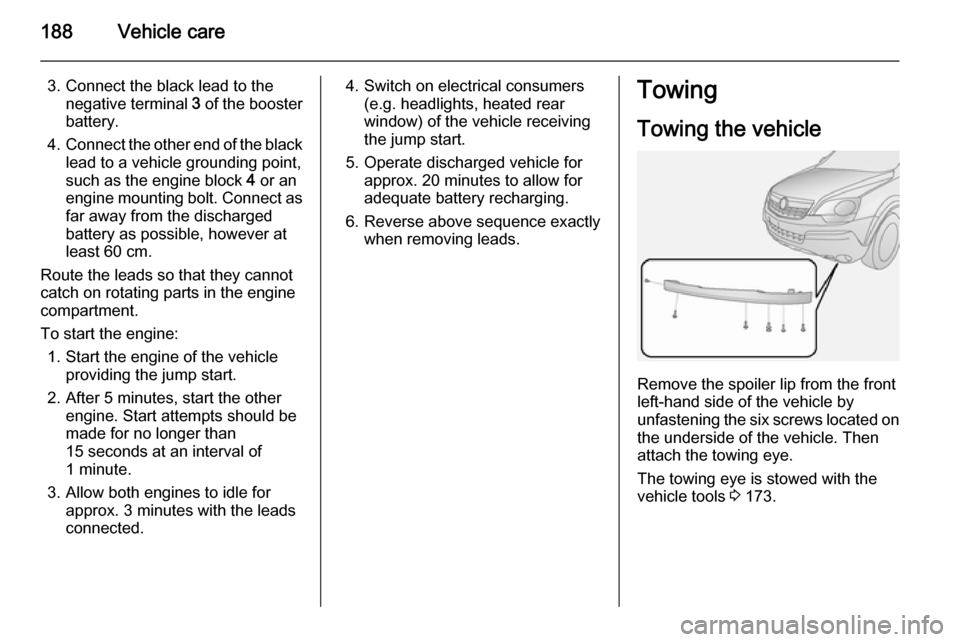
Remove the spoiler lip from the front
left-hand side of the vehicle by
unfastening the six screws located on the underside of the vehicle. Then
attach the towing eye.
The towing eye is stowed with the
vehicle tools 3 173.
Page 191 of 217
Vehicle care189
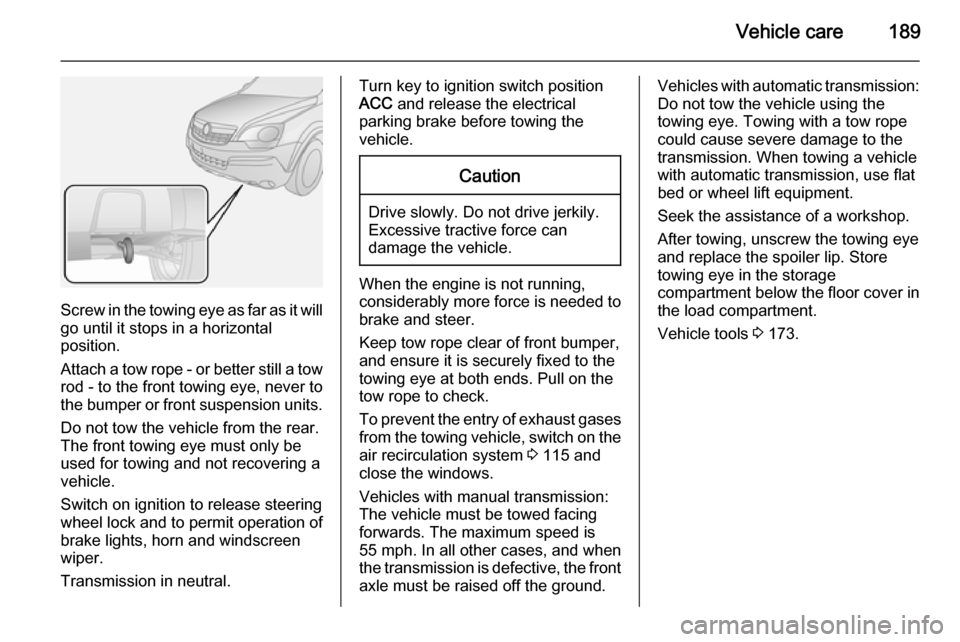
Screw in the towing eye as far as it will
go until it stops in a horizontal
position.
Attach a tow rope - or better still a tow
rod - to the front towing eye, never to
the bumper or front suspension units.
Do not tow the vehicle from the rear.
The front towing eye must only be
used for towing and not recovering a
vehicle.
Switch on ignition to release steering
wheel lock and to permit operation of
brake lights, horn and windscreen
wiper.
Transmission in neutral.
Turn key to ignition switch position
ACC and release the electrical
parking brake before towing the
vehicle.Caution
Drive slowly. Do not drive jerkily.
Excessive tractive force can
damage the vehicle.
When the engine is not running,
considerably more force is needed to
brake and steer.
Keep tow rope clear of front bumper, and ensure it is securely fixed to the
towing eye at both ends. Pull on the tow rope to check.
To prevent the entry of exhaust gases from the towing vehicle, switch on the
air recirculation system 3 115 and
close the windows.
Vehicles with manual transmission:
The vehicle must be towed facing
forwards. The maximum speed is
55 mph. In all other cases, and when
the transmission is defective, the front axle must be raised off the ground.
Vehicles with automatic transmission:
Do not tow the vehicle using the
towing eye. Towing with a tow rope
could cause severe damage to the
transmission. When towing a vehicle
with automatic transmission, use flat
bed or wheel lift equipment.
Seek the assistance of a workshop.
After towing, unscrew the towing eye
and replace the spoiler lip. Store
towing eye in the storage
compartment below the floor cover in the load compartment.
Vehicle tools 3 173.
Page 192 of 217
190Vehicle careTowing another vehicle
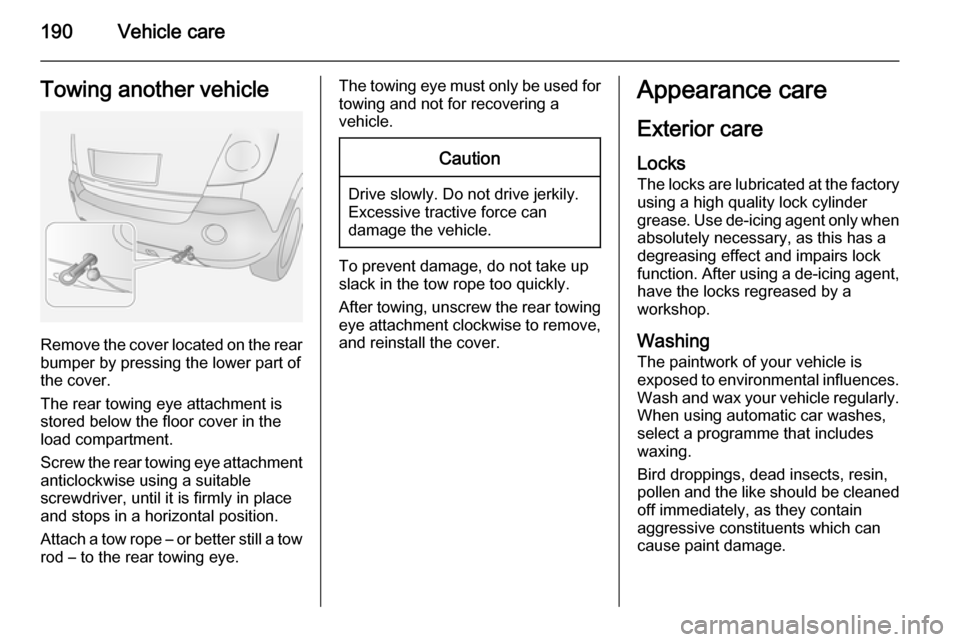
Remove the cover located on the rearbumper by pressing the lower part of
the cover.
The rear towing eye attachment is
stored below the floor cover in the
load compartment.
Screw the rear towing eye attachment
anticlockwise using a suitable
screwdriver, until it is firmly in place
and stops in a horizontal position.
Attach a tow rope – or better still a tow
rod – to the rear towing eye.
The towing eye must only be used for
towing and not for recovering a
vehicle.Caution
Drive slowly. Do not drive jerkily.
Excessive tractive force can
damage the vehicle.
To prevent damage, do not take up slack in the tow rope too quickly.
After towing, unscrew the rear towing
eye attachment clockwise to remove,
and reinstall the cover.
Appearance care
Exterior care Locks
The locks are lubricated at the factory using a high quality lock cylinder
grease. Use de-icing agent only when absolutely necessary, as this has adegreasing effect and impairs lockfunction. After using a de-icing agent,
have the locks regreased by a
workshop.
Washing The paintwork of your vehicle is
exposed to environmental influences.
Wash and wax your vehicle regularly.
When using automatic car washes,
select a programme that includes waxing.
Bird droppings, dead insects, resin,
pollen and the like should be cleaned
off immediately, as they contain
aggressive constituents which can
cause paint damage.