vents VAUXHALL ASTRA K 2017 User Guide
[x] Cancel search | Manufacturer: VAUXHALL, Model Year: 2017, Model line: ASTRA K, Model: VAUXHALL ASTRA K 2017Pages: 293, PDF Size: 8.27 MB
Page 155 of 293

Driving and operating1539Warning
Do not let this special safety
feature tempt you into taking risks
when driving.
Adapt speed to the road
conditions.
Control indicator b 3 88.
Deactivation
TC can be switched off when spinning of drive wheels is required:
press b briefly to deactivate TC, k
illuminates. Deactivation is displayed
as status message in the Driver
Information Centre.
TC is reactivated by pressing b
again.
TC is also reactivated the next time
the ignition is switched on.
Electronic Stability Control
Electronic Stability Control (ESC)
improves driving stability when
necessary, regardless of the type of
road surface or tyre grip. It also
prevents the drive wheels from
spinning. ESC operates in
combination with the Traction Control system (TC) 3 152.
As soon as the vehicle starts to
swerve (understeer/oversteer),
engine output is reduced and the
wheels are braked individually. This
considerably improves the driving
stability of the vehicle on slippery road
surfaces.
ESC is operational after each engine
start as soon as the control indicator
b extinguishes.When ESC operates b flashes.9 Warning
Do not let this special safety
feature tempt you into taking risks
when driving.
Adapt speed to the road
conditions.
Control indicator b 3 88.
Deactivation
Page 161 of 293
Driving and operating159Pressing L for activating speed
limiter or switching off the ignition also
switches off cruise control and
deletes the stored speed.
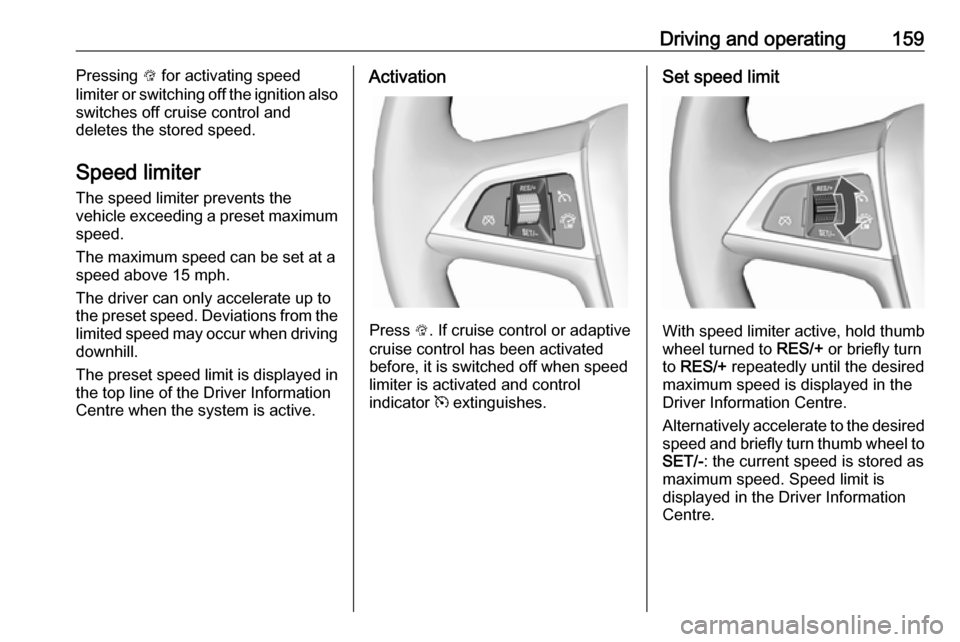
Speed limiter
The speed limiter prevents the
vehicle exceeding a preset maximum speed.
The maximum speed can be set at a
speed above 15 mph.
The driver can only accelerate up to
the preset speed. Deviations from the
limited speed may occur when driving
downhill.
The preset speed limit is displayed in
the top line of the Driver Information
Centre when the system is active.Activation
Press L. If cruise control or adaptive
cruise control has been activated
before, it is switched off when speed
limiter is activated and control
indicator m extinguishes.
Set speed limit
With speed limiter active, hold thumb
wheel turned to RES/+ or briefly turn
to RES/+ repeatedly until the desired
maximum speed is displayed in the
Driver Information Centre.
Alternatively accelerate to the desired speed and briefly turn thumb wheel to SET/- : the current speed is stored as
maximum speed. Speed limit is
displayed in the Driver Information
Centre.
Page 239 of 293

Vehicle care237Drain excess tyre pressure with
the button over the pressure
indicator.
Do not run the compressor longer than ten minutes.
14. Detach the tyre repair kit. Push catch on bracket to remove
sealant bottle from bracket. Screw
the tyre inflation hose to the free
connection of the sealant bottle.
This prevents sealant from
escaping. Stow tyre repair kit in
load compartment.
15. Remove any excess sealant using a cloth.
16. Take the label indicating maximum permitted speed from
the sealant bottle and affix in the
driver's field of view.
17. Continue driving immediately so that sealant is evenly distributedin the tyre. After driving approx.
6 miles (but no more than ten
minutes), stop and check tyre
pressure. Screw compressor air
hose directly onto tyre valve and
compressor when doing this.
If tyre pressure is more than
1.3 bar , set it to the correct value.
Repeat the procedure until there
is no more loss of pressure.
If the tyre pressure has fallen
below 1.3 bar, the vehicle must
not be used. Seek the assistance
of a workshop.
18. Stow away tyre repair kit in load compartment.
Notice
The driving characteristics of the
repaired tyre are severely affected, therefore have this tyre replaced.
If unusual noise is heard or the
compressor becomes hot, turn
compressor off for at least
30 minutes.
The built-in safety valve opens at a
pressure of 102 psi.
Note the expiry date of the kit. After
this date its sealing capability is no
longer guaranteed. Pay attention to
storage information on sealant
bottle.
Replace the used sealant bottle. Dispose of the bottle as prescribed
by applicable laws.
The compressor and sealant can be
used from approx. -30 °C.
The adapters supplied can be used
to pump up other items e.g.
footballs, air mattresses, inflatable
dinghies etc. They are located on the underside of the compressor. To
remove, screw on compressor air hose and withdraw adapter.
Wheel changing
Some vehicles are equipped with a
tyre repair kit instead of a spare wheel
3 234.
Page 242 of 293

240Vehicle care
Set the jack to the necessary
height. Position it directly below
the jacking point in a manner that
prevents it from slipping.
Attach jack handle and with the
jack correctly aligned rotate
handle until wheel is clear of the ground.
5. Unscrew the wheel nuts.
6. Change the wheel. Spare wheel 3 241.
7. Screw on the wheel nuts.
8. Lower the vehicle and remove jack.
9. Install the wheel wrench ensuring that it locates securely and tighten
each nut in a crosswise
sequence. Tightening torque is
140 Nm.
10. Align the valve hole in the wheel cover with the tyre valve before
installing.
Install wheel nut caps.
Install centre cap on alloy wheels.
11. Install vehicle jacking point cover on versions with sill panelling.
12. Stow the replaced wheel 3 241,
the vehicle tools 3 226 and the
adapter for the locking wheel nuts 3 59.
13. Check the tyre pressure of the installed tyre and the wheel nut
torque as soon as possible.Have the defective tyre renewed or repaired as soon as possible.
Jacking position for lifting platform
Rear arm position of the lifting
platform centrically under the recess
of the sill.
Page 252 of 293

250Vehicle careIce residues, pollution and continuouswiping on dry windows will damage or
even destroy the wiper blades.
Sunroof Never clean with solvents or abrasive
agents, fuels, aggressive media
(e.g. paint cleaner, acetone-
containing solutions etc.), acidic or
highly alkaline media or abrasive
pads. Do not apply wax or polishing
agents to the sunroof.
Glass panel Never clean with solvents or abrasive
agents, fuels, aggressive media
(e.g. paint cleaner, acetone-
containing solutions etc.), acidic or
highly alkaline media or abrasive
pads. Do not apply wax or polishing
agents to the glass panel.
Wheels and tyres Do not use high-pressure jet
cleaners.
Clean rims with a pH-neutral wheel
cleaner.Rims are painted and can be treated
with the same agents as the body.
Paintwork damage
Rectify minor paintwork damage with a touch-up pen before rust forms.
Have more extensive damage or rust areas repaired by a workshop.
Underbody Some areas of the vehicle underbody
have a PVC undercoating while other
critical areas have a durable
protective wax coating.
After the underbody is washed, check
the underbody and have it waxed if
necessary.
Bitumen/rubber materials could
damage the PVC coating. Have
underbody work carried out by a
workshop.
Before and after winter, wash the
underbody and have the protective
wax coating checked.Liquid gas system9 Danger
Liquid gas is heavier than air and
can collect in sink points.
Take care when performing work
at the underbody in a pit.
For painting work and when using a
drying booth at a temperature above
60 °C, the liquid gas tank must be
removed.
Do not make any modifications to the
liquid gas system.
Towing equipment
Do not clean the coupling ball bar with a steam-jet or high-pressure jet
cleaner.
Air shutter Clean the shutter system in the front
bumper to maintain correct
functionality.
Page 253 of 293

Vehicle care251Interior care
Interior and upholstery
Only clean the vehicle interior,
including the instrument panel fascia
and panelling, with a dry cloth or
interior cleaner.
Clean the leather upholstery with
clear water and a soft cloth. In case of heavy soiling, use leather care.
The instrument cluster and the
displays should only be cleaned using
a soft damp cloth. If necessary use a
weak soap solution.
Clean fabric upholstery with a
vacuum cleaner and brush. Remove
stains with an upholstery cleaner.
Clothing fabrics may not be
colourfast. This could cause visible
discolourations, especially on light-
coloured upholstery. Removable
stains and discolourations should be
cleaned as soon as possible.
Clean seat belts with lukewarm water or interior cleaner.Caution
Close Velcro fasteners as open
Velcro fasteners on clothing could damage seat upholstery.
The same applies to clothing with
sharp-edged objects, like zips or
belts or studded jeans.
Plastic and rubber parts
Plastic and rubber parts can be
cleaned with the same cleaner as
used to clean the body. Use interior cleaner if necessary. Do not use any
other agent. Avoid solvents and petrol in particular. Do not use high-
pressure jet cleaners.
Page 285 of 293

Customer information283original source. Such altered
versions also must not be
misrepresented as being Info-ZIP
releases--including, but not
limited to, labeling of the altered
versions with the names “Info-
ZIP” (or any variation thereof,
including, but not limited to,
different capitalizations), “Pocket
UnZip,” “WiZ” or “MacZip” without the explicit permission of Info-ZIP.
Such altered versions are further
prohibited from misrepresentative use of the Zip-Bugs or Info-ZIP e-mail addresses or of the Info-ZIP
URL(s).
4. Info-ZIP retains the right to use the names “Info-ZIP,” “Zip,”
“UnZip,” “UnZipSFX,” “WiZ,” “Pocket UnZip,” “Pocket Zip,” and
“MacZip” for its own source and
binary releases.
Registered trademarksApple Inc.
Apple CarPlay™ is a trademark of
Apple Inc.
App Store ®
is a registered trademark
of Apple Inc.iPhone ®
and iPod ®
are registered
trademarks of Apple Inc.Aupeo! GmbH
AUPEO ®
is a registered trademark of
the Aupeo! GmbH.Bluetooth SIG, Inc.
Bluetooth ®
is a registered trademark
of Bluetooth SIG, Inc.EnGIS Technologies, Inc.
BringGo ®
is a registered trademark of
EnGIS Technologies, Inc.Google Inc.
Android™, Android Auto™ and
Google Play™ Store are trademarks
of Google Inc.Verband der Automobilindustrie e.V.
AdBlue ®
is a registered trademark of
the VDA.Vehicle data recording
and privacy
Event data recorders
Data storage modules in the
vehicle
A large number of electronic
components of your vehicle contain
data storage modules temporarily or
permanently storing technical data
about the condition of the vehicle,
events and errors. In general, this
technical information documents the
condition of parts, modules, systems
or the environment:
● operating conditions of system components (e.g. filling levels)
● status messages of the vehicle and its single components (e.g.
number of wheel revolutions / rotational speed, deceleration,
lateral acceleration)
● dysfunctions and defects in important system components
Page 288 of 293

286IndexAAccessories and vehicle modifications .......................... 199
Active Emergency Braking .........171
Active head restraints ..................38
Adaptive cruise control .........90, 160
Adaptive forward lighting ....90,
118, 210
Adjustable air vents ...................135
Airbag and belt tensioners ...........85
Airbag deactivation ................51, 85
Airbag system .............................. 49
Air conditioning regular operation ................................ 136
Air conditioning system .............. 128
Air intake .................................... 135
Air vents...................................... 135
Antilock brake system ................ 149
Antilock brake system (ABS) .......87
Anti-theft alarm system ................27
Anti-theft locking system .............. 27
Appearance care ........................248
Armrest .................................. 45, 46
Armrest storage ........................... 61
Ashtrays ....................................... 78
Automatic anti-dazzle ..................31
Automatic light control ...............115
Automatic locking ........................24
Automatic transmission .............145Autostop..................................... 140
Auxiliary heater ........................... 134
B Battery discharge protection ......126
Battery voltage ........................... 100
Belts.............................................. 46 Bonnet ....................................... 200
Brake and clutch fluid .................253
Brake and clutch system .............86
Brake assist ............................... 152
Brake fluid .................................. 204
Brakes ............................... 149, 204
Breakdown.................................. 246
Bulb replacement ....................... 207
C Capacities .................................. 268
Car Pass ...................................... 21
Catalytic converter .....................144
Central locking system ................23
Centre console lighting ..............125
Centre console storage ...............62
Changing tyre and wheel size ...233
Charging system .......................... 86
Child locks ................................... 25
Child restraint installation locations ................................... 55
Child restraints.............................. 53
Child restraint systems ................53
Cigarette lighter ........................... 78
Page 289 of 293

287Climate control ............................. 15
Climate control systems .............127
Clock............................................. 76
Code ............................................. 97
Collision damage repair ..............281
Control indicators.......................... 82
Control of the vehicle .................138
Controls ........................................ 72
Convex shape .............................. 30
Coolant and antifreeze ...............253
Cruise control ...................... 90, 157
Cupholders .................................. 59
Curtain airbag system .................. 51
Curve lighting.............................. 118
D Danger, Warnings and Cautions ...4
Daytime running lights ...............118
Declaration of conformity ............278
Diesel fuel system bleeding .......206
Diesel particle filter ...............88, 143
Door open .................................... 91
Doors ............................................ 25
Driver assistance systems ..........157
Driver Information Centre .............91
Driving characteristics and towing tips .............................. 193
Driving hints ................................ 138E
Electric adjustment ......................30
Electrical system......................... 221
Electric parking brake ...........86, 150
Electric parking brake fault ...........87
Electronic climate control system 130
Electronic driving programmes ..147
Electronic Stability Control.......... 153
Electronic Stability Control and Traction Control system ............88
Electronic Stability Control off ...... 88
End-of-life vehicle recovery .......200
Engine compartment fuse box ...222
Engine coolant ........................... 202
Engine coolant temperature gauge ....................................... 80
Engine data ............................... 260
Engine exhaust .......................... 143
Engine identification ...................256
Engine oil ................... 201, 253, 257
Engine oil pressure ......................89
Entry lighting .............................. 125
ERA GLONASS .......................... 111
Event data recorders ..................283
Exit lighting ................................ 125
Exterior care .............................. 248
Exterior light ................................. 90
Exterior lighting ....................13, 114
Exterior mirrors ............................. 30F
Fault ........................................... 147
First aid ......................................... 68
First aid kit ................................... 68
Fixed air vents ........................... 135
Fog light ....................................... 90
Fog lights ................................... 211
Folding mirrors ............................. 30
Following distance indication ......170
Forward collision alert................. 167
Front airbag system .....................49
Front fog lights ........................... 122
Front seats.................................... 39
Front storage ................................ 60
Front turn signal lights ...............213
Fuel............................................. 186
Fuel consumption - CO 2-
Emissions ............................... 192
Fuel for diesel engines ..............186
Fuel for liquid gas operation .......187
Fuel for petrol engines ...............186
Fuel gauge ................................... 80
Fuel selector ................................ 80
Fuses ......................................... 221
G Gauges ......................................... 79
General information ...................193
Glass panel .................................. 36