tyre pressure VAUXHALL COMBO 2015 User Guide
[x] Cancel search | Manufacturer: VAUXHALL, Model Year: 2015, Model line: COMBO, Model: VAUXHALL COMBO 2015Pages: 183, PDF Size: 4.28 MB
Page 148 of 183

146Vehicle care
If w illuminates at lower temperatures
and extinguishes after some driving,
this could be an indicator for getting low pressure. Check tyre pressure.
If the tyre pressure must be reduced
or increased, switch off ignition.
Only mount wheels with pressure
sensors, otherwise the tyre pressure
will not be displayed and w flashes for
several seconds then illuminates
continuously.
A spare wheel or temporary spare
wheel is not equipped with pressure
sensors. TPMS is not operational for
these wheels. For the further three
wheels, TPMS remains operational.
Spare wheel 3 152, Wheel changing
3 150.
Control indicator w and (depending
on version) a corresponding message
appears at each ignition cycle until
the tyres are inflated to the correct
tyre pressure.
Driver Information Centre 3 80.Temperature dependency
Tyre pressure depends on the
temperature of the tyre. During
driving, tyre temperature and
pressure increase. Therefore it is important to check tyre pressure with
cold tyres.
General information The use of commercially available
liquid tyre repair kits can impair the
function of the system. Factory-
approved tyre repair kits can be used.
Tyre repair kit 3 148.
External high-power radio equipment
could disrupt the TPMS.
Each time the tyres are replaced,
TPMS sensors must be dismounted
and serviced by a workshop.
Relearn function After changing wheels, TPMS needs
to recalculate. The relearn process
takes up to 20 minutes of driving with
a minimum speed of 15 mph.
If problems occur during the relearn
process, control indicator w flashes
for several seconds then illuminatescontinuously and (depending on
version) a warning message is
displayed in the Driver Information
Centre.
Tread depth
Check tread depth at regular
intervals.
Tyres should be replaced for safety
reasons at a tread depth of 2-3 mm
(4 mm for winter tyres).
For safety reasons, it is
recommended that the tread depth of the tyres on one axle should not vary
by more than 2 mm.
Page 149 of 183

Vehicle care147
The legally permissible minimum
tread depth (1.6 mm) has been
reached when the tread has worn
down as far as one of the tread wear
indicators (TWI). Their position is
indicated by markings on the
sidewall.
If there is more wear at the front than
the rear, swap round front wheels and rear wheels periodically. Ensure that
the direction of rotation of the wheels
is the same as before.
Tyres age, even if they are not used.
We recommend tyre replacement
every 6 years.
Changing tyre and wheel
size If tyres of a different size than those
fitted at the factory are used, it may be necessary to reprogramme the
speedometer as well as the nominal
tyre pressure and make other vehicle
modifications.
After converting to a different tyre
size, have the label with tyre
pressures replaced.9 Warning
Use of unsuitable tyres or wheels
may lead to accidents and will
invalidate the vehicle type
approval.
Wheel covers
Wheel covers and tyres that are
factory approved for the respective
vehicle and comply with all of the
relevant wheel and tyre combination requirements must be used.
If the wheel covers and tyres used are
not factory approved, the tyres must
not have a rim protection ridge.
Wheel covers must not impair brake
cooling.
9 Warning
Use of unsuitable tyres or wheel
covers could lead to sudden
pressure loss and thereby
accidents.
Tyre chains
Tyre chains are only permitted on the
front wheels.
Always use fine mesh chains that add no more than 10 mm to the tyre tread
and the inboard sides (including chain lock).
Do not exceed 30 mph when tyre
chains are fitted.
9 Warning
Damage may lead to tyre blowout.
Page 151 of 183
Vehicle care149
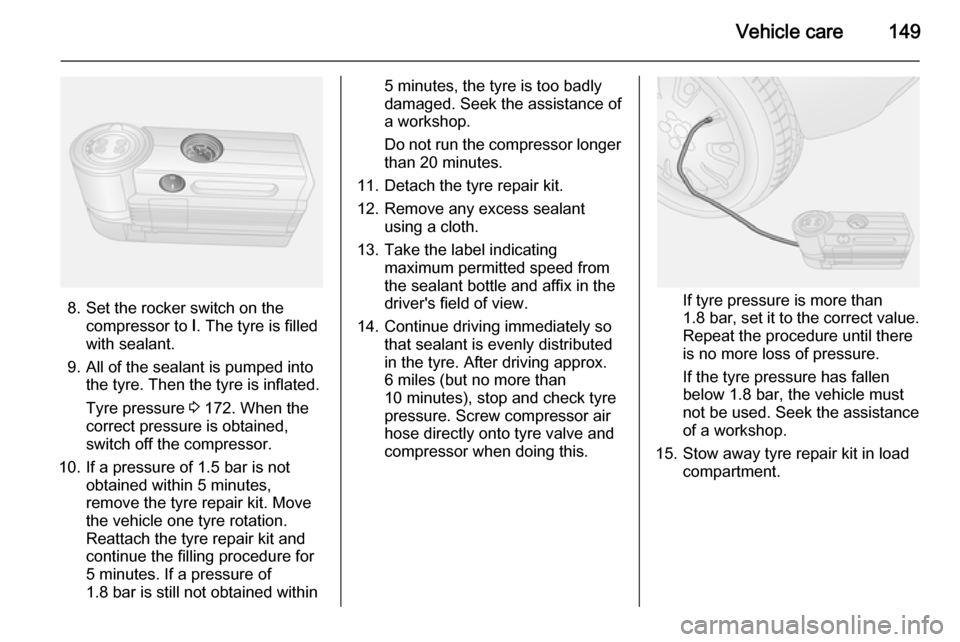
8. Set the rocker switch on thecompressor to I. The tyre is filled
with sealant.
9. All of the sealant is pumped into the tyre. Then the tyre is inflated.
Tyre pressure 3 172. When the
correct pressure is obtained,
switch off the compressor.
10. If a pressure of 1.5 bar is not obtained within 5 minutes,
remove the tyre repair kit. Move
the vehicle one tyre rotation.
Reattach the tyre repair kit and
continue the filling procedure for 5 minutes. If a pressure of
1.8 bar is still not obtained within
5 minutes, the tyre is too badly
damaged. Seek the assistance of
a workshop.
Do not run the compressor longer
than 20 minutes.
11. Detach the tyre repair kit.
12. Remove any excess sealant using a cloth.
13. Take the label indicating maximum permitted speed from
the sealant bottle and affix in the
driver's field of view.
14. Continue driving immediately so that sealant is evenly distributed
in the tyre. After driving approx.
6 miles (but no more than 10 minutes), stop and check tyre
pressure. Screw compressor air
hose directly onto tyre valve and
compressor when doing this.
If tyre pressure is more than 1.8 bar , set it to the correct value.
Repeat the procedure until there
is no more loss of pressure.
If the tyre pressure has fallen
below 1.8 bar, the vehicle must
not be used. Seek the assistance
of a workshop.
15. Stow away tyre repair kit in load compartment.
Page 154 of 183

152Vehicle care
With the jack correctly aligned,
rotate until wheel is clear of the
ground.
5. Unscrew the wheel nuts. 6. Change the wheel. Spare wheel 3 152.
7. Screw on the wheel nuts.
8. Lower vehicle.
9. Install the wheel wrench ensuring that it locates securely and tighten
each nut in a crosswise
sequence. Tightening torque is
85 Nm (steel wheel) or 120 Nm
(alloy wheel).
10. Align the valve hole in the wheel cover with the tyre valve before
installing.
Install wheel nut caps.
11. Stow the replaced wheel 3 152
and the vehicle tools 3 143.
12. Check the tyre pressure of the installed tyre and the wheel nut
torque as soon as possible.
Have the defective tyre renewed or
repaired as soon as possible.Spare wheel
Some vehicles are equipped with a tyre repair kit 3 148 instead of a spare
wheel.
The spare wheel can be classified as a temporary spare wheel depending
on the size compared to the other
mounted wheels and country
regulations.Caution
The use of a spare wheel that is smaller than the other wheels or in combination with winter tyres
could affect driveability. Have the defective tyre replaced as soon as
possible.Depending on model variant, the
spare wheel is stored beneath the
floor or in the load compartment.
1. Attach the extension bar 2 to the
wheel wrench 1. Vehicle tools
3 143.
Page 161 of 183

Vehicle care159
Windows and windscreen wiperblades
Use a soft lint-free cloth or chamois
leather together with window cleaner
and insect remover.
When cleaning the rear window from
inside, always wipe in parallel to the
heating element to prevent damage.
For mechanical removal of ice, use a
sharp-edged ice scraper. Press the
scraper firmly against the glass so
that no dirt can get under it and
scratch the glass.
Clean smearing wiper blades with a
soft cloth and window cleaner.
Glass panel
Never clean with solvents or abrasive
agents, fuels, aggressive media (e.g.
paint cleaner, acetone-containing
solutions etc.), acidic or highly
alkaline media or abrasive pads. Do
not apply wax or polishing agents to
the glass panel.
Wheels and tyres Do not use high-pressure jet
cleaners.Clean rims with a pH-neutral wheel
cleaner.
Rims are painted and can be treated
with the same agents as the body.
Paintwork damage Rectify minor paintwork damage with
a touch-up pen before rust forms.
Have more extensive damage or rust
areas repaired by a workshop.
Underbody
Some areas of the vehicle underbody
have a PVC undercoating while other critical areas have a durable
protective wax coating.
After the underbody is washed, check
the underbody and have it waxed if
necessary.
Bitumen/rubber materials could
damage the PVC coating. Have
underbody work carried out by a
workshop.
Before and after winter, wash the
underbody and have the protective
wax coating checked.Natural gas system
Do not direct the steam jet or high-
pressure jet towards natural gas
system components. It is particularly
important to protect the natural gas
tank and the pressure valves on the
vehicle underbody and the bulkhead
in the engine compartment.
These components must not be
treated using chemical cleaners or
preservatives.
Have components of the natural gas
system cleaned by a workshop
authorised to carry out maintenance
of natural gas vehicles.
Towing equipment Do not clean the coupling ball bar with
a steam-jet or high-pressure jet
cleaner.
Interior care Interior and upholsteryOnly clean the vehicle interior,
including the instrument panel fascia
and panelling, with a dry cloth or
interior cleaner.
Page 174 of 183
![VAUXHALL COMBO 2015 User Guide 172Technical dataTyre pressuresAdjust tyre pressure to the value specified for full load when driving at speeds of 100 mph.ComfortWith full loadEngineTyresfrontrearfrontrear[kPa/bar] ([psi])[kPa/bar]](/img/38/19397/w960_19397-173.png "VAUXHALL COMBO 2015 User Guide 172Technical dataTyre pressuresAdjust tyre pressure to the value specified for full load when driving at speeds of 100 mph.ComfortWith full loadEngineTyresfrontrearfrontrear[kPa/bar] ([psi])[kPa/bar]")
172Technical dataTyre pressuresAdjust tyre pressure to the value specified for full load when driving at speeds of 100 mph.ComfortWith full loadEngineTyresfrontrearfrontrear[kPa/bar] ([psi])[kPa/bar] ([psi])[kPa/bar] ([psi])[kPa/bar] ([psi])All185/65 R15 88T250/2.5 (36)250/2.5 (36)290/2.9 (42)290/2.9 (42)185/65 R15 92T250/2.5 (36)260/2.6 (38)290/2.9 (42)300/3.0 (44)195/65 R15 95T240/2.4 (35)240/2.4 (35)
300/3.0 (44) 9)260/2.6 (38)270/2.7 (39)
320/3.2 (46) 9)
260/2.6 (38) 10)195/60 R16 C 99/97T270/2.7 (39)270/2.7 (39)270/2.7 (39)330/3.3 (48)
360/3.6 (52) 9)11)
280/2.8 (41) 12)9)
Combi.
10) Combo Tour.
11) L2 Van, all variants with CNG, and Combo Tour with 7 seats.
12) Combo Tour with 5 seats.
Page 176 of 183

174Customer information
■ Vehicle reactions in particulardriving situations (e.g. inflation of
an airbag, activation of the stability
regulation system)
■ Environmental conditions (e.g. temperature)
This data is exclusively technical and
helps identifying and correcting errors
as well as optimizing vehicle
functions.
Motion profiles indicating travelled
routes cannot be created with this
data.
If services are used (e.g. repair
works, service processes, warranty
cases, quality assurance),
employees of the service network
(manufacturer included) are able to
read out this technical information
from the event and error data storage
modules applying special diagnostic
devices. If required, you will receive
further information at these
workshops. After an error has been
corrected, the data is deleted from the error storage module or it is
constantly overwritten.When using the vehicle, situations
may occur in which technical data
related to other information (accident
report, damages on the vehicle,
witness statements etc.) may be
associated with a specific person -
possibly, with the assistance of an
expert.
Additional functions contractually
agreed upon with the client (e.g.
vehicle location in emergency cases)
allow the transmission of particular
vehicle data from the vehicle.Radio Frequency
Identification (RFID) RFID technology is used in some
vehicles for functions such as tyre
pressure monitoring and ignition
system security. It is also used in
connection with conveniences such
as radio remote controls for door
locking/unlocking and starting, and in-
vehicle transmitters for garage door
openers. RFID technology in
Vauxhall vehicles does not use or
record personal information or link with any other Vauxhall system
containing personal information.
Page 182 of 183

180
Tyre pressure ............................ 144
Tyre pressure monitoring system ............................... 77, 145
Tyre pressures ........................... 172
Tyre repair kit ............................. 148
U Ultrasonic parking assist ...... 76, 118
Underseat storage .......................54
Unit of measurement ....................80
Upholstery .................................. 159
Upshift .......................................... 76
Using this manual ..........................3
V Vehicle battery ........................... 131
Vehicle checks............................ 127
Vehicle data ................................ 165
Vehicle data recording and privacy ..................................... 173
Vehicle dimensions .................... 170
Vehicle Identification Number ....164
Vehicle jack ................................ 143
Vehicle security ............................ 26
Vehicle shutdown .................86, 104
Vehicle specific data ......................3
Vehicle storage ........................... 126
Vehicle tools ............................... 143
Vehicle unlocking ........................... 6
Vehicle weight ........................... 169Ventilation..................................... 96
Volume ......................................... 80
W
Warning chime.............................. 80
Warning chimes ........................... 86
Warning lights ............................... 67
Washer and wiper systems .........14
Washer fluid ............................... 130
Wheel changing .........................150
Wheel covers ............................. 147
Wheels and tyres .......................144
Windows ....................................... 29
Windscreen................................... 29
Windscreen wiper/washer ...........63
Winter tyres ............................... 144
Wiper blade replacement ..........132