tyre pressure VAUXHALL COMBO 2015 Owner's Manual
[x] Cancel search | Manufacturer: VAUXHALL, Model Year: 2015, Model line: COMBO, Model: VAUXHALL COMBO 2015Pages: 183, PDF Size: 4.28 MB
Page 18 of 183
16In briefTransmission
Manual transmission
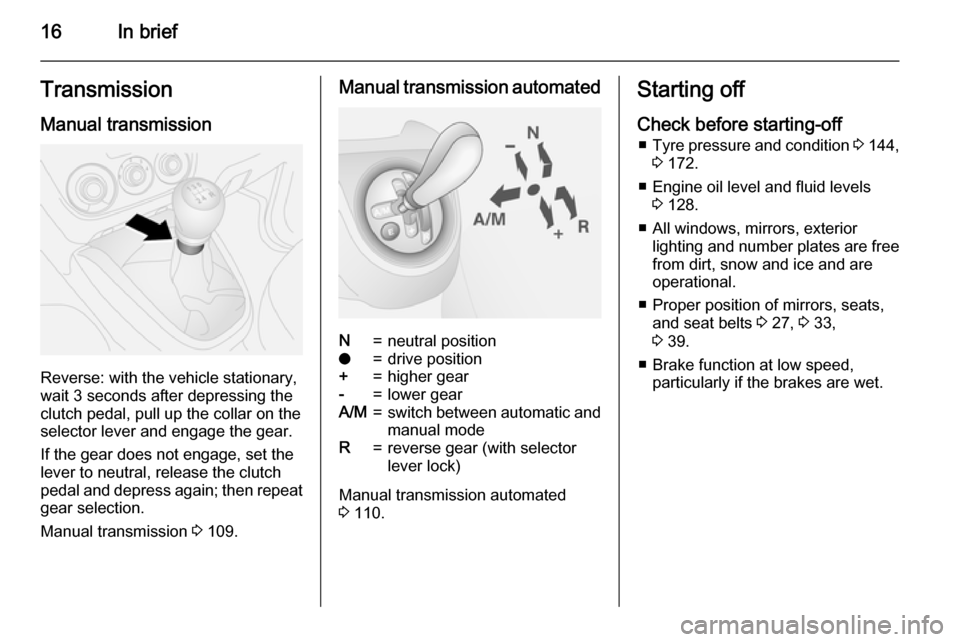
Reverse: with the vehicle stationary,
wait 3 seconds after depressing the
clutch pedal, pull up the collar on the
selector lever and engage the gear.
If the gear does not engage, set the
lever to neutral, release the clutch
pedal and depress again; then repeat
gear selection.
Manual transmission 3 109.
Manual transmission automatedN=neutral positiono=drive position+=higher gear-=lower gearA/M=switch between automatic and
manual modeR=reverse gear (with selector
lever lock)
Manual transmission automated
3 110.
Starting off
Check before starting-off ■ Tyre pressure and condition 3 144,
3 172.
■ Engine oil level and fluid levels 3 128.
■ All windows, mirrors, exterior lighting and number plates are free
from dirt, snow and ice and are
operational.
■ Proper position of mirrors, seats, and seat belts 3 27, 3 33,
3 39.
■ Brake function at low speed, particularly if the brakes are wet.
Page 63 of 183

Storage61
luggage (7 kg) and all fluids (tank90 % full).
Optional equipment and
accessories increase the kerb
weight.
■ Driving with a roof load increases the sensitivity of the vehicle to
cross-winds and has a detrimental
effect on vehicle handling due to
the vehicle's higher centre of
gravity. Distribute the load evenly
and secure it properly with retaining
straps. Adjust the tyre pressure and vehicle speed according to the load
conditions. Check and retighten the straps frequently.
Do not drive faster than 75 mph.
The permissible roof load (which
includes the weight of the roof rack)
is 100 kg. The roof load is the
combined weight of the roof rack
and the load.
Page 79 of 183

Instruments and controls77
FlashesThe system is actively engaged.
Engine output may be reduced and
the vehicle may be braked
automatically to a small degree.
Illuminates
A fault in the system is present.
Continued driving is possible. Driving
stability, however, may deteriorate
depending on road surface
conditions.
Have the cause of the fault remedied
by a workshop.
Electronic Stability Program (ESP)
3 116, Traction control system/Anti-
Slip Regulator (ASR) 3 115.
Engine coolant
temperature
$ illuminates red.
Illuminates for a few seconds after the ignition is switched on.
If control indicator $ illuminates, the
coolant temperature is too high.
Depending on version, a warningmessage may also be displayed in
the Driver Information Centre 3 80.
Seek the assistance of a workshop.Caution
If engine coolant temperature is
too high, stop vehicle, switch off
the ignition. Danger to engine.
Check coolant level.
If the control indicator remains on, seek the assistance of your
workshop.
Engine coolant temperature gauge
3 70.
Preheating ! illuminates yellow.
Preheating is activated. Only
activates when outside temperature
is low.
Diesel particle filter
% illuminates yellow.
The diesel particle filter requires
cleaning.
Continue driving until %
extinguishes. If possible, do not allow engine speed to drop below
2000 rpm.
Illuminates The diesel particle filter is full. Start
cleaning process as soon as
possible.
Diesel particle filter 3 108, Stop-start
system 3 105.
Tyre pressure monitoring
system
w illuminates or flashes.
Illuminates
Tyre pressure loss. Stop immediately and check tyre pressure.
Control indicator w illuminates
together with a warning chime and, in
vehicles with Multifunction version of
the Driver Information Centre, a
Page 80 of 183
78Instruments and controls
corresponding message also
appears when a puncture or severely
under-inflated tyre is detected.
Flashes
Fault in system. After a delay the
control indicator illuminates
continuously. Consult a workshop.
Control indicator w illuminates and
(depending on version) a
corresponding message appears in
the Driver Information Centre when a tyre without a pressure sensor ismounted (e.g. spare wheel).
Tyre pressure monitoring system
3 145.
Engine oil pressure
I illuminates red.
Illuminates when the ignition is
switched on and extinguishes shortly
after the engine starts.Illuminates when the engine is
runningCaution
Engine lubrication may be
interrupted. This may result in
damage to the engine and/or
locking of the drive wheels.
1. Depress clutch.
2. Select neutral gear (or move selector lever to N).
3. Move out of the flow of traffic as quickly as possible without
impeding other vehicles.
4. Switch off ignition.
9 Warning
When the engine is off,
considerably more force is needed
to brake and steer. During an
Autostop the brake servo unit will still be operational.
Do not remove key until vehicle isstationary, otherwise the steeringwheel lock could engage
unexpectedly.
Check oil level before seeking the
assistance of a workshop 3 128.
Change engine oil Diesel engines with dieselparticle filter
I flashes red.
Illuminates when the ignition is
switched on and extinguishes shortly
after the engine starts.
The engine oil life monitor lets you know when to change the oil. Control
indicator I will flash to indicate that
engine oil life has been diminished
and the oil needs changing.
Depending on version, a warning
message may also be displayed in
the Driver Information Centre 3 80.
Based on driving conditions, the
interval at which an oil change will be indicated can vary considerably.
Page 88 of 183

86Instruments and controlsVehicle messagesWarning chimes
Only one warning chime will sound at
a time.
The warning chime regarding
unfastened seat belts has priority
over any other warning chime.
When starting the engine or
whilst driving ■ If seat belt is not fastened.
■ If a certain speed is exceeded with the parking brake applied.
■ If the parking assist detects an object.
■ If a fault is detected in the parking assist.
■ If a door or the tailgate is not fully closed when starting-off.
■ If the vehicle speed briefly exceeds
a set limit.
■ If the stop-start system cannot restart the engine automatically.■ Vehicles with manual transmissionautomated; neutral is not selected
or the foot brake has not been depressed.
■ If a transmission fault is detected in
vehicles with manual transmission
automated.
■ If a warning message, e.g. low tyre
pressure, appears in the Driver
Information Centre.
When the vehicle is parked
and/or the driver's door is
opened ■ When the key is in the ignition switch.
■ Vehicles with manual transmission automated; neutral is not selected,
the parking brake is not applied, or
the foot brake and/or the
accelerator pedal has not been depressed.Fuel system messages
Fuel cut-off system
In the event of a collision of a certain
severity, the fuel system is cut-off and
the engine is switched off
automatically, for safety reasons.
Depending on version, a
corresponding warning message may
also appear in the Driver Information Centre 3 80.
To reset the fuel cut-off system and
enable the vehicle to be driven, refer
to " Vehicle shutdown " 3 104.
Page 126 of 183

124Driving and operating
The figures are provided only for the
purpose of comparison between different vehicle variants and mustnot be taken as a guarantee for the
actual fuel consumption of a
particular vehicle.
Additional equipment may result in
slightly higher results than the stated
fuel consumption and CO 2 figures.
Furthermore, fuel consumption is dependent on personal driving style
as well as road and traffic conditions.
Natural gas
The fuel consumption information
was obtained using reference fuel
G20 (methane proportion
99 - 100 mol%) under prescribed
driving conditions. When using
natural gas with a lower proportion of
methane, the fuel consumption can
differ from the specified values.Trailer hitch
General information
Only use towing equipment that has
been approved for your vehicle.
Vehicles with natural gas engine may
require special towing equipment.
Entrust retrofitting of towing
equipment to a workshop. It may be
necessary to make changes that
affect the cooling system, heat
shields or other equipment.
Fitting of towing equipment could
cover the opening of the towing eye.
If this is the case use the coupling ball
bar for towing. Always keep the
coupling ball bar in the vehicle.
Driving characteristics and
towing tips Before attaching a trailer, lubricate
the coupling ball. However, do not do
so if a stabiliser, which acts on the coupling ball, is being used to reduce
snaking movements.For trailers with low driving stability
and caravan trailers with a permitted
gross vehicle weight of more than
1300 kg the use of a stabiliser is
strongly recommended when driving
above 50 mph.
If the trailer starts snaking, drive more slowly, do not attempt to correct the
steering and brake sharply if
necessary.
When driving downhill, drive in the
same gear as if driving uphill and
drive at a similar speed.
Adjust tyre pressure to the value
specified for full load 3 172.
Trailer towing Trailer loads The permissible trailer loads are
vehicle and engine-dependent
maximum values which must not be
exceeded. The actual trailer load is
the difference between the actual
gross weight of the trailer and the
actual coupling socket load with the
trailer coupled.
Page 128 of 183

126Vehicle careVehicle careGeneral Information...................126
Vehicle checks ........................... 127
Bulb replacement .......................133
Electrical system ........................139
Vehicle tools .............................. 143
Wheels and tyres .......................144
Jump starting ............................. 155
Towing ....................................... 156
Appearance care .......................158General Information
Accessories and vehicle
modifications
We recommend the use of genuine parts and accessories and factory
approved parts specific for your
vehicle type. We cannot assess or
guarantee reliability of other products
- even if they have a regulatory or
otherwise granted approval.
Do not make any modifications to the electrical system, e.g. changes of
electronic control units (chip tuning).Caution
When transporting the vehicle on
a train or on a recovery vehicle, the
mud flaps might be damaged.
Vehicle storage
Storage for a long period of time
If the vehicle is to be stored for several months:
■ Wash and wax the vehicle.
■ Have the wax in the engine compartment and underbody
checked.
■ Clean and preserve the rubber seals.
■ Fill up fuel tank completely.
■ Change the engine oil.
■ Drain the washer fluid reservoir.
■ Check the coolant antifreeze and corrosion protection.
■ Adjust tyre pressure to the value specified for full load.
■ Park the vehicle in a dry, well ventilated place. Engage first orreverse gear to prevent the vehicle
from rolling.
■ Do not apply the parking brake.
Page 129 of 183

Vehicle care127
■ Open the bonnet, close all doorsand lock the vehicle.
■ Disconnect the clamp from the negative terminal of the vehicle
battery. Beware that all systems are
not functional, e.g. anti-theft locking
system.
Putting back into operation When the vehicle is to be put back into
operation:
■ Connect the clamp to the negative terminal of the vehicle battery.
Activate the electronics of the
power windows.
■ Check tyre pressure.
■ Fill up the washer fluid reservoir. ■ Check the engine oil level.
■ Check the coolant level.
■ Fit the number plates if necessary.End-of-life vehicle
recovery Information on end-of-life vehicle
recovery centres and the recycling of
end-of-life vehicles is available on our
website. Only entrust this work to an
authorised recycling centre.
Natural gas vehicles must be recycled by a service centre authorised for
natural gas vehicles.Vehicle checks
Performing work9 Warning
Only perform engine compartment
checks when the ignition is off.
The cooling fan may start
operating even if the ignition is off.
Page 146 of 183

144Vehicle careWheels and tyres
Tyre condition, wheel condition
Drive over edges slowly and at right
angles if possible. Driving over sharp
edges can cause tyre and wheel
damage. Do not trap tyres on the kerb when parking.
Regularly check the wheels for
damage. Seek the assistance of a
workshop in the event of damage or
unusual wear.
Winter tyres Winter tyres improve driving safety at
temperatures below 7 °C and should
therefore be fitted on all wheels.
Tyres of size 185/65 R15,
195/65 R15 and 195/60 R16 C are
permitted as winter tyres.
In accordance with country-specific
regulations, affix the speed sticker in
the driver's field of view.Tyre designations
E.g. 215/60 R 16 95 H215=Tyre width, mm60=Cross-section ratio (tyre height
to tyre width), %R=Belt type: RadialRF=Type: RunFlatC=Cargo or commercial use16=Wheel diameter, inches95=Load index e.g. 95 is
equivalent to 690 kgH=Speed code letter
Speed code letter:
Q=up to 100 mphS=up to 112 mphT=up to 118 mphH=up to 130 mphV=up to 150 mphW=up to 168 mph
Directional tyres
Fit directional tyres such that they roll in the direction of travel. The rolling
direction is indicated by a symbol
(e.g. an arrow) on the sidewall.
Tyre pressure
Check the pressure of cold tyres atleast every 14 days and before any
long journey. Do not forget the spare
wheel.
Unscrew the valve cap.
Tyre pressure 3 172.
The tyre pressure data refers to cold
tyres. It applies to summer and winter tyres.
Always inflate the spare tyre to the
pressure specified for full load.
Incorrect tyre pressures will impair
safety, vehicle handling, comfort and
fuel economy and will increase tyre
wear.
Tyre pressures differ depending on
various options. For the correct tyre
pressure value, follow the procedure
below:
1. Identify the engine identifier code.
Engine data 3 166.
2. Identify the respective tyre.
The tyre pressure tables show all
possible tyre combinations 3 172.
Page 147 of 183

Vehicle care145
For the tyres approved for your
vehicle, refer to the EEC Certificate of Conformity provided with your vehicle
or other national registration
documents.
The driver is responsible for correct
adjustment of tyre pressures.9 Warning
If the pressure is too low, this can
result in considerable tyre warm-
up and internal damage, leading to tread separation and even to tyre
blow-out at high speeds.
Tyre pressure monitoring
system
The Tyre Pressure Monitoring
System (TPMS) uses radio and
sensor technology to check tyre
pressure levels.
Caution
Tyre pressure monitoring system
warns only about low tyre pressure condition and does not replace
regular tyre maintenance by the
driver.
The TPMS sensors monitor the air pressure in the tyres and transmit tyre
pressure readings to a receiver
located in the vehicle.
All wheels must be equipped with
pressure sensors and the tyres must
have the prescribed pressure.
Tyre pressure chart 3 172.
Notice
In countries where the tyre pressure monitoring system is legally
required, the use of wheels without
pressure sensors will invalidate the
vehicle type approval.
Low tyre pressure condition
A detected low tyre pressure
condition is indicated by illumination
of control indicator w 3 77 together
with a warning chime. In vehicles with Multifunction version of the Driver
Information Centre, a corresponding message is also displayed.
If w illuminates, stop as soon as
possible and inflate the tyres as
recommended 3 172.
After inflating, driving may be
required to update the tyre pressure
values in the system. During this time
w may illuminate.