parking brake VAUXHALL COMBO 2015 Owner's Manual
[x] Cancel search | Manufacturer: VAUXHALL, Model Year: 2015, Model line: COMBO, Model: VAUXHALL COMBO 2015Pages: 183, PDF Size: 4.28 MB
Page 20 of 183

18In briefParking9Warning
■ Do not park the vehicle on an
easily ignitable surface. The
high temperature of the exhaust system could ignite the surface.
■ Always apply parking brake without pressing release button.Apply as firmly as possible on a
downhill slope or uphill slope.
Depress foot brake at the same
time to reduce operating force.
■ Switch off the engine. Turn the ignition key to position STOP
and remove it. Turn the steering
wheel until the steering wheel
lock is felt to engage.
■ If the vehicle is on a level surface or uphill slope, engage
first gear before switching off the ignition. On an uphill slope, turn
the front wheels away from the
kerb.
If the vehicle is on a downhill
slope, engage reverse gear
before switching off the ignition. Turn the front wheels towards
the kerb.
■ Close the windows.
■ Lock the vehicle with button e on
the radio remote control.
■ The engine cooling fans may run after the engine has been switched
off 3 127.
■ After running at high engine speeds
or with high engine loads, operate the engine briefly at a low load or
run in neutral for
approx. 30 seconds before
switching off, in order to protect the turbocharger.
Keys, locks 3 19, Laying the vehicle
up for a long period of time 3 126.
Page 62 of 183

60Storage
To fasten a roof rack, insert the
mounting bolts in the holes indicated
in the illustration.Loading information
■ Heavy objects in the load compartment should be evenly
distributed and placed as far
forward as possible. If objects can
be stacked, the heavier objects
should be placed at the bottom.
■ Secure objects with lashing straps attached to lashing eyes 3 59.
■ Secure loose objects in load compartment to prevent them from
sliding.
■ When transporting objects in the load compartment, the backrests of
the rear seats must not be tilted
forwards or folded down.
■ Do not allow the load to protrude above the upper edge of the
backrests.
■ Do not place any objects on the extendable load compartment
cover 3 56 or the instrument panel,
and do not cover the sensor on top
of the instrument panel 3 98.■ The load must not obstruct the
operation of the pedals, parking
brake and gear selector, or hinder the freedom of movement of thedriver. Do not place any unsecured
objects in the interior.
■ Do not drive with an open load compartment.9 Warning
Always make sure that the load in
the vehicle is securely stowed.
Otherwise objects can be thrown
around inside the vehicle and
cause personal injury or damage
to the load or vehicle.
■ The payload is the difference between the permitted gross
vehicle weight (see identification
plate 3 164) and the EC kerb
weight.
To calculate the payload, enter the
data for your vehicle in the Weights
table at the front of this manual.
The EC kerb weight includes
weights for the driver (68 kg),
Page 77 of 183

Instruments and controls75
Illuminates when the engine is
running Stop, switch off engine. Battery is not
charging. Engine cooling may be
interrupted. The brake servo unit may
cease to be effective. Seek the
assistance of a workshop.
Malfunction indicator light Z illuminates or flashes yellow.
Illuminates when the ignition is
switched on and extinguishes shortly
after the engine starts.
Illuminates when the engine is running Fault in the emission control system.
The permitted emission limits may be
exceeded. Seek the assistance of a
workshop immediately.Flashes when the engine is
running
Fault that could lead to catalytic
converter damage. Ease up on the
accelerator until the flashing stops.
Seek the assistance of a workshop
immediately.
Brake system R illuminates red.
Illuminates when the parking brake is
released if the brake fluid level is too
low 3 131.9 Warning
Stop. Do not continue your
journey. Consult a workshop.
Illuminates if the brake vacuum servo
fails; the brake pedal becomes stiff
when pressed. The brake system
remains operational however,
assistance will be reduced. The
steering may also require
considerably more effort when
turning.
Illuminates after the ignition is
switched on if the parking brake is
applied 3 114.
Brake pad wear F illuminates yellow.
The front brake pads are worn, seek
the assistance of a workshop
immediately.
Antilock brake system
(ABS)
u illuminates yellow.
Illuminates for a few seconds after the ignition is switched on. The system is
ready for operation when the control
indicator extinguishes.
If the control indicator does not
extinguish after a few seconds, or if it illuminates while driving, there is a
fault in the ABS. The brake system
remains operational but without ABS
regulation.
Antilock brake system 3 113.
Page 88 of 183

86Instruments and controlsVehicle messagesWarning chimes
Only one warning chime will sound at
a time.
The warning chime regarding
unfastened seat belts has priority
over any other warning chime.
When starting the engine or
whilst driving ■ If seat belt is not fastened.
■ If a certain speed is exceeded with the parking brake applied.
■ If the parking assist detects an object.
■ If a fault is detected in the parking assist.
■ If a door or the tailgate is not fully closed when starting-off.
■ If the vehicle speed briefly exceeds
a set limit.
■ If the stop-start system cannot restart the engine automatically.■ Vehicles with manual transmissionautomated; neutral is not selected
or the foot brake has not been depressed.
■ If a transmission fault is detected in
vehicles with manual transmission
automated.
■ If a warning message, e.g. low tyre
pressure, appears in the Driver
Information Centre.
When the vehicle is parked
and/or the driver's door is
opened ■ When the key is in the ignition switch.
■ Vehicles with manual transmission automated; neutral is not selected,
the parking brake is not applied, or
the foot brake and/or the
accelerator pedal has not been depressed.Fuel system messages
Fuel cut-off system
In the event of a collision of a certain
severity, the fuel system is cut-off and
the engine is switched off
automatically, for safety reasons.
Depending on version, a
corresponding warning message may
also appear in the Driver Information Centre 3 80.
To reset the fuel cut-off system and
enable the vehicle to be driven, refer
to " Vehicle shutdown " 3 104.
Page 109 of 183

Driving and operating107
■ the driver's seat belt is unfastenedand the driver's door is opened
■ three minutes have elapsed since the engine was switched off
In this event, control indicator ^
flashes in the Driver Information
Centre in conjunction with a warning
chime. Depending on version, a
corresponding message may also
appear in the Driver Information
Centre 3 80.
Fault If control indicator Æ illuminates in the
instrument cluster, there is a fault in
the stop-start system 3 79.
Depending on version, 9 will
illuminate as an alternative if control
indicator Æ is not present. A warning
message may also be displayed in
the Driver Information Centre 3 80.
Generic warning 9 3 73.
Seek the assistance of a workshop.Parking9 Warning
■ Do not park the vehicle on an
easily ignitable surface. The
high temperature of the exhaust system could ignite the surface.
■ Always apply parking brake without pressing release button.Apply as firmly as possible on a
downhill slope or uphill slope.
Depress foot brake at the same
time to reduce operating force.
■ Switch off the engine. Turn the ignition key to position STOP
and remove it. Turn the steering
wheel until the steering wheel
lock is felt to engage.
■ If the vehicle is on a level surface or uphill slope, engage
first gear before switching off the ignition. On an uphill slope, turn
the front wheels away from the
kerb.
If the vehicle is on a downhill
slope, engage reverse gear
before switching off the ignition. Turn the front wheels towards
the kerb.
Lock the vehicle 3 21 and activate the
anti-theft locking system 3 26 .
Notice
In the event of an accident with
airbag deployment, the engine is
turned off automatically if the vehicle
comes to a standstill within a certain time.
Page 113 of 183

Driving and operating111
R=Reverse gear.
Engage only when vehicle is
stationary. The transmission
display shows "R" when
reverse gear is engaged.+=Shift to a higher gear.-=Shift to a lower gear.
Starting-off
When the engine is started, depress
the foot brake and move the selector
lever towards + to engage first gear.
Shift to a higher or lower gear by
moving selector lever to + or -.
Gears can be skipped by moving the selector lever repeatedly at short
intervals.
The driver will be alerted to an
incorrect gear selection by an audible warning chime in conjunction with a
message in the Driver Information
Centre 3 80. The system will
downshift, selecting the most
appropriate gear automatically.
If R is selected, reverse gear is
engaged. The vehicle starts to move
when the foot brake is released. To
start off quickly, release the foot brake
and accelerate immediately after
engaging a gear.
Move the selector lever towards A/M
to engage automatic mode; the
transmission shifts to other gears
automatically, dependent on driving
conditions.
To engage manual mode, move the
selector lever towards A/M. The
current gear will appear in the
transmission display.
Stopping the vehicle
In automatic or manual mode,
first gear is engaged and the clutch is
released when the vehicle is stopped. In R, reverse gear remains engaged.
When stopping on gradients, engage parking brake or depress the foot
brake. To prevent overheating of the
clutch, an intermittent audible
warning chime may sound as a signal
to depress the foot brake or apply the
parking brake.
Switch off engine if stopping for a
lengthy period, e.g. in traffic jams.When the vehicle is parked and the
driver's door is opened, a warning
chime will sound if neutral is not
selected or the foot brake has not
been depressed.
Engine braking Automatic mode
When driving downhill, the manual
transmission automated does not
shift into higher gears until a fairly
high engine speed has been reached.
It shifts down in good time when
braking.
Manual mode
To utilise the engine braking effect, select a lower gear in good time when driving downhill.
Page 114 of 183

112Driving and operating
Rocking the vehicleRocking the vehicle is only
permissible if the vehicle is stuck in
sand, mud, snow or a hole. Move the selector lever between R and A/M (or
between + and -) in a repeat pattern,
while applying light pressure to the
accelerator pedal. Do not race the
engine and avoid sudden
acceleration.
Parking
Apply the parking brake. The most recently engaged gear (see
transmission display) remains
engaged. With N, no gear is engaged.
When the ignition is switched off, the transmission no longer responds to
movement of the selector lever.
If the ignition is not switched off, or the
parking brake has not been applied, a warning chime will sound upon
opening the driver's door.
Manual mode If engine speed is too low, the
transmission automatically shifts to a
lower gear.In manual mode, no automatic
shifting to a higher gear takes place at high engine revolutions. If engine
speed is too high, the transmission
only switches to a higher gear via
kickdown 3 112.
When gearshifting is recommended
to improve fuel economy, control
indicator [ or Ò illuminates in the
Driver Information Centre 3 76.
Electronic driving
programmes
Eco mode EWhen automatic mode is engaged,
the Eco mode can be selected to
reduce fuel consumption.
Eco mode selects the most suitable gear depending on the speed of the
vehicle, the engine speed and the
intensity with which the accelerator is pressed.
Activation
Press the E button on the selector
lever housing. Control indicator E is
shown in the transmission display to
indicate activation.
Deactivation
Eco mode is switched off by:
■ pressing the E button again,
■ switching to manual mode.
In order to protect the transmission at
extremely high clutch temperatures,
an intermittent audible warning chime may sound. In such cases, depress
the foot brake, select N and apply the
parking brake to allow the clutch to
cool down.
Page 116 of 183

114Driving and operating
ABS starts to regulate brake pressureas soon as a wheel shows a tendency to lock. The vehicle remains
steerable, even during hard braking.
ABS control is made apparent
through a pulse in the brake pedal
and the noise of the regulation
process.
For optimum braking, keep the brake
pedal fully depressed throughout the
braking process, despite the fact that
the pedal is pulsating. Do not reduce
the pressure on the pedal.
After starting off the system performs
a self-test which may be audible.
Control indicator u 3 75.
Fault9 Warning
If there is a fault in the ABS, the
wheels may be liable to lock due
to braking that is heavier than
normal. The advantages of ABS are no longer available. During
hard braking, the vehicle can nolonger be steered and may
swerve.
Have the cause of the fault remedied
by a workshop.
Parking brake Manual parking brake
Always apply parking brake firmly
without operating the release button,
and apply as firmly as possible on a
downhill or uphill slope.
To release the parking brake, pull the lever up slightly, press the release
button and fully lower the lever.
To reduce the operating forces of the
parking brake, depress the foot brake
at the same time.
A warning chime will sound if a certain speed is exceeded with the parking
brake applied.
Notice
The volume of the warning chime can also be adjusted via the Driver
Information Centre 3 80.
Control indicator R 3 75.
Brake assist
If the brake pedal is depressed
quickly and forcefully, maximum
brake force is automatically applied
(full braking).
Maintain steady pressure on the
brake pedal for as long as full braking is required. Maximum brake force is
automatically reduced when the
brake pedal is released.
Page 120 of 183
118Driving and operating
Reduce speedWith cruise control active, push lever
downwards ( -) or briefly push lever
downwards ( -) repeatedly; speed
decreases continuously or in small
increments.
Deactivation
Automatic deactivation:
■ vehicle speed below approx. 20 mph,
■ the brake pedal is depressed,
■ the clutch pedal is depressed,
■ the traction control system/Anti-Slip
Regulator (ASR) or Electronic
Stability Program (ESP) is
operating.
Resume stored speed Press button = at a speed above
20 mph. The stored speed will be
obtained.Switching off
Turn end of lever to the OFF position;
control indicator m extinguishes. The
stored speed is deleted. Switching off the ignition also deletes the stored
speed.
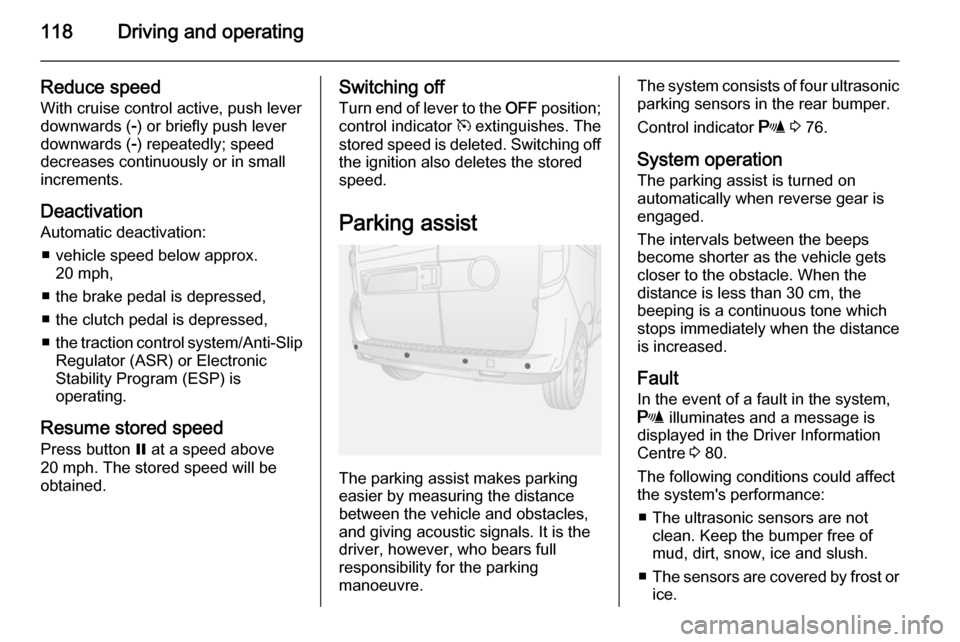
Parking assist
The parking assist makes parking
easier by measuring the distance
between the vehicle and obstacles,
and giving acoustic signals. It is the
driver, however, who bears full
responsibility for the parking
manoeuvre.
The system consists of four ultrasonic parking sensors in the rear bumper.
Control indicator r 3 76.
System operation
The parking assist is turned on
automatically when reverse gear is
engaged.
The intervals between the beeps
become shorter as the vehicle gets
closer to the obstacle. When the
distance is less than 30 cm, the beeping is a continuous tone which
stops immediately when the distance
is increased.
Fault
In the event of a fault in the system,
r illuminates and a message is
displayed in the Driver Information
Centre 3 80.
The following conditions could affect
the system's performance:
■ The ultrasonic sensors are not clean. Keep the bumper free ofmud, dirt, snow, ice and slush.
■ The sensors are covered by frost or
ice.
Page 128 of 183

126Vehicle careVehicle careGeneral Information...................126
Vehicle checks ........................... 127
Bulb replacement .......................133
Electrical system ........................139
Vehicle tools .............................. 143
Wheels and tyres .......................144
Jump starting ............................. 155
Towing ....................................... 156
Appearance care .......................158General Information
Accessories and vehicle
modifications
We recommend the use of genuine parts and accessories and factory
approved parts specific for your
vehicle type. We cannot assess or
guarantee reliability of other products
- even if they have a regulatory or
otherwise granted approval.
Do not make any modifications to the electrical system, e.g. changes of
electronic control units (chip tuning).Caution
When transporting the vehicle on
a train or on a recovery vehicle, the
mud flaps might be damaged.
Vehicle storage
Storage for a long period of time
If the vehicle is to be stored for several months:
■ Wash and wax the vehicle.
■ Have the wax in the engine compartment and underbody
checked.
■ Clean and preserve the rubber seals.
■ Fill up fuel tank completely.
■ Change the engine oil.
■ Drain the washer fluid reservoir.
■ Check the coolant antifreeze and corrosion protection.
■ Adjust tyre pressure to the value specified for full load.
■ Park the vehicle in a dry, well ventilated place. Engage first orreverse gear to prevent the vehicle
from rolling.
■ Do not apply the parking brake.