lock VAUXHALL COMBO 2016 Owner's Guide
[x] Cancel search | Manufacturer: VAUXHALL, Model Year: 2016, Model line: COMBO, Model: VAUXHALL COMBO 2016Pages: 189, PDF Size: 4.47 MB
Page 89 of 189
Instruments and controls87After accessing this menu option,
activate or deactivate the function
(set to On or Off) and confirm.
Press SETq when activated ( On) to
access the current set speed. Adjust
as required and confirm.
Warning chimes 3 90.
HOUR (Setting the clock)
Adjust the hours setting (flashing
value) and confirm. Adjust minutes
setting (flashing value) and confirm.
Clock 3 67.
UNIT (Unit of measurement)
Set the unit of measurement to km or
miles .
bUZZ (Warning chime volume)
Adjust the volume of warning chimes
and confirm. 8 volume levels are
available.
A chime is also sounded every time
SET q, R or S is pressed.
Warning chimes 3 90.BAG P (Passenger front and side
airbags activation/deactivation)
Activate the front passenger airbags
if an adult is occupying the front
passenger seat. Deactivate airbags
when a child restraint system is
installed on this seat.9 Danger
Risk of fatal injury for a child using
a child restraint system on a seat
with activated front passenger
airbag.
Risk of fatal injury for an adult
person on a seat with deactivated
front passenger airbag.
After accessing this menu option,
activate or deactivate the airbags
( BAG P On or BAG P Off ) and
confirm; a confirmation message
appears in the display. Select YES (to
confirm changes) or No (to cancel
changes).
Airbag deactivation 3 49.
DRL (Daytime running lights)
Activate the daytime running lights to
increase visibility of the vehicle during
daylight (set to On). Deactivate when
not required (set to Off).
Daytime running lights 3 95.
Settings menu options -
Multifunction version
The settings menu contains the
following options:
● Lighting
● Speed beep
● Trip B data
● Set time
● Set date
● Radio info
● Autoclose
● Unit of measurement
● Language
● Warning volume
● Button volume
● Seat belt buzzer
● Service
● Passenger airbag
Page 90 of 189

88Instruments and controls●Daytime running lights
● Exit menu
LIGHTING (Brightness of interior
lighting)
When driving at night with the low
beam on, adjust the brightness of the
vehicle's interior lighting (e.g.
instrument panel, climate control
display).
It is also possible to adjust the
brightness by pressing R or S
without accessing the settings menu.
SPEED BEEP (Speed limit warning
chime)
Activate or deactivate the speed limit
warning chime or change the speed
limit. Speeds between 20 and
125 mph can be stored.
When activated, the driver is alerted
with a warning chime when the set
speed limit is exceeded.
After accessing this menu option,
activate or deactivate the function
(set to On or Off) and confirm.
Press SETq when activated ( On) to
access the current set speed. Adjust
as required and confirm.Warning chimes 3 90.
TRIP B DATA
Activate or deactivate the second trip
computer (set to On or Off).
Trip B records average consumption, distance travelled, average speed
and travel time (driving time). The
measurement can be restarted at any
time. Trip computer 3 91.
SET TIME (Setting the clock and clock mode)
After accessing this menu option, it is possible to either set the time or
change the clock mode between 12
hour and 24 hour clock.
Select Time and confirm. Adjust the
hours setting (flashing value) and
confirm. Adjust minutes setting
(flashing value) and confirm.
Select Mode and confirm. Select
12h or 24h and confirm.
Clock 3 67.SET DATE
Adjust the year setting (flashing
value) and confirm. Adjust month
setting (flashing value) and confirm.
Adjust the day setting (flashing value)
and confirm.
RADIO INFO (Display audio and
radio information)
Activate radio info (set to On) to
display audio and radio information (e.g. station frequency, RDS
messages, track number). Deactivate
when not required (set to Off).
AUTOCLOSE (Automatic central
locking when driving)
Activate the autoclose feature (set to
On ) to automatically lock the doors
when vehicle speed exceeds
12 mph. Deactivate when not
required (set to Off).
UNIT OF MEASUREMENT (for
Distance, Fuel consumption and
Temperature)
After accessing this menu option, it is
possible to set the unit of
measurement for distance, fuel
consumption and temperature.
Page 106 of 189

104Climate controlclockwise:warmanticlockwise:cold
Heating will not be fully effective until
the engine has reached normal
operating temperature.
When the minimum temperature is
set below 16 ℃, the electronic climate
control system runs at maximum
cooling. LO appears in the display.
If the maximum temperature is set
above 32 ℃, the electronic climate
control system runs at maximum
heating. HI appears in the display.
Fan speed
The selected fan speed is indicated
with bars in the display.
Press ] or < to increase or decrease
the fan speed.
maximum fan
speed:all bars displayedminimum fan
speed:one bar displayed
Press n to deactivate fan.
To return to automatic fan speed: Press AUTO.
Demisting and defrosting the
windows
Press Ê.
Temperature and air distribution are
set automatically and the fan runs at a high speed.
When the vehicle reaches normal
operating temperature the function
remains active for approx. 3 minutes.
To return to automatic mode: press n or AUTO .
Air distribution Press R, S or 6.
LED in buttons illuminate.
Arrows shown in the display indicate
the distribution settings.
Cooling
Press n to switch on cooling.
Activation is indicated by the LED in
the button. Cooling is only functional
when the engine is running and
climate control fan is switched on.
Press n again to switch off cooling.The air conditioning system cools and
dehumidifies (dries) when outside
temperature is above a specific level. Therefore condensation may form
and drip from under the vehicle.
If no cooling or drying is required
press n again to switch the cooling
system off, thus saving fuel.
Manual air recirculation mode Operated by pressing 4.recirculation on:LED in button
illuminated; D
appears in the
displayrecirculation off:LED in button
extinguishes; E
appears in the
display9 Warning
The exchange of fresh air is
reduced in air recirculation mode.
In operation without cooling the air humidity increases, so the
windows may mist up. The quality
Page 109 of 189

Driving and operating107Driving and
operatingDriving hints ............................... 107
Control of the vehicle ...............107
Steering ................................... 107
Starting and operating ...............108
New vehicle running-in ............108
Ignition switch positions ...........108
Starting the engine ..................109
Vehicle shutdown ....................109
Overrun cut-off ........................ 110
Stop-start system ....................110
Parking .................................... 112
Engine exhaust .......................... 113
Diesel particle filter ..................113
Catalytic converter ...................114
Manual transmission ..................114
Manual transmission automa‐ ted .............................................. 115
Transmission display ...............115
Starting the engine ..................115
Selector lever .......................... 116
Manual mode ........................... 117
Electronic driving programmes 118
Fault ........................................ 118Brakes........................................ 119
Antilock brake system .............119
Parking brake .......................... 119
Brake assist ............................. 120
Hill start assist ......................... 120
Ride control systems .................121
Traction Control system ..........121
Electronic Stability Control ......121
Driver assistance systems .........122
Cruise control .......................... 122
Parking assist .......................... 124
Fuel ............................................ 125
Fuel for petrol engines .............125
Fuel for diesel engines ............126
Fuel for natural gas operation . 126
Refuelling ................................ 127
Fuel consumption - CO 2-
Emissions .............................. 129
Trailer hitch ................................ 130
General information .................130
Driving characteristics and towing tips .............................. 130
Trailer towing ........................... 130Driving hints
Control of the vehicle
Never coast with engine not
running (except during Autostop)
Many systems will not function in this
situation (e.g. brake servo unit, power
steering). Driving in this manner is a
danger to yourself and others. All
systems function during an Autostop,
but there will be a controlled reduction in power steering assist and vehicle
speed is reduced.
Stop-start system 3 110.
Pedals
To ensure the pedal travel is
uninhibited, there must be no mats in the area of the pedals.
Steering
If power steering assist is lost
because the engine stops or due to a system malfunction, the vehicle can
be steered but may require increased
effort.
Page 110 of 189
108Driving and operatingCaution
Never leave the steering wheel on
full lock when the vehicle is
stationary, as this may damage
the power steering pump.
Starting and operating
New vehicle running-in Do not brake unnecessarily hard for
the first few journeys.
During the first drive, smoke may
occur because of wax and oil
evaporating off the exhaust system.
Park the vehicle in the open for a
while after the first drive and avoid
inhaling the fumes.
During the running-in period fuel and
engine oil consumption may be
higher and the cleaning process of the diesel particle filter may take
place more often. Autostop may be
inhibited to allow for charging the
battery.
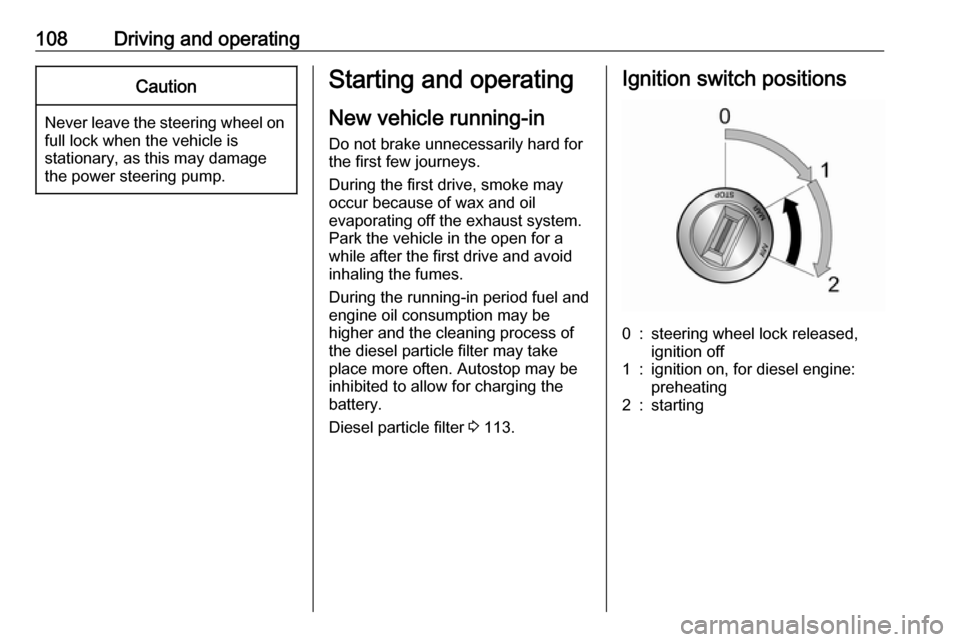
Diesel particle filter 3 113.Ignition switch positions0:steering wheel lock released,
ignition off1:ignition on, for diesel engine:
preheating2:starting
Page 111 of 189
Driving and operating109Starting the engine
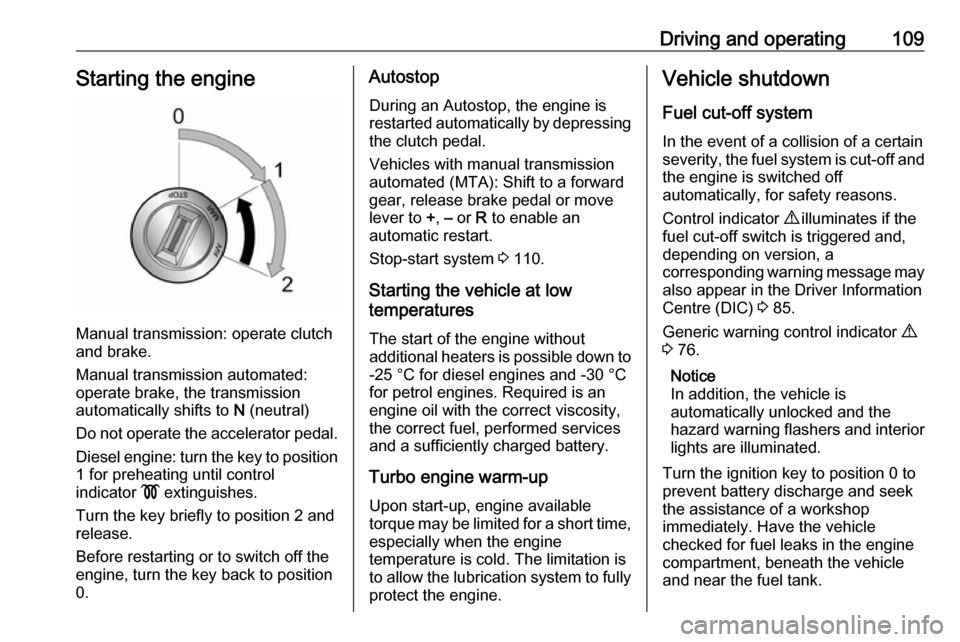
Manual transmission: operate clutch
and brake.
Manual transmission automated: operate brake, the transmission
automatically shifts to N (neutral)
Do not operate the accelerator pedal. Diesel engine: turn the key to position1 for preheating until control
indicator ! extinguishes.
Turn the key briefly to position 2 and release.
Before restarting or to switch off the engine, turn the key back to position
0.
Autostop
During an Autostop, the engine is
restarted automatically by depressing
the clutch pedal.
Vehicles with manual transmission
automated (MTA): Shift to a forward
gear, release brake pedal or move
lever to +, – or R to enable an
automatic restart.
Stop-start system 3 110.
Starting the vehicle at low
temperatures
The start of the engine without
additional heaters is possible down to -25 °С for diesel engines and -30 °C
for petrol engines. Required is an engine oil with the correct viscosity,
the correct fuel, performed services
and a sufficiently charged battery.
Turbo engine warm-up
Upon start-up, engine available
torque may be limited for a short time, especially when the engine
temperature is cold. The limitation is
to allow the lubrication system to fully protect the engine.Vehicle shutdown
Fuel cut-off system In the event of a collision of a certain
severity, the fuel system is cut-off and
the engine is switched off
automatically, for safety reasons.
Control indicator 9 illuminates if the
fuel cut-off switch is triggered and, depending on version, a
corresponding warning message may
also appear in the Driver Information
Centre (DIC) 3 85.
Generic warning control indicator 9
3 76.
Notice
In addition, the vehicle is
automatically unlocked and the
hazard warning flashers and interior lights are illuminated.
Turn the ignition key to position 0 to
prevent battery discharge and seek
the assistance of a workshop
immediately. Have the vehicle
checked for fuel leaks in the engine
compartment, beneath the vehicle
and near the fuel tank.
Page 114 of 189

112Driving and operatingRestarting the engine
Manual transmission
The selector lever must be in neutral
to enable an automatic restart.
Depress the clutch pedal to restart the
engine.
Manual transmission automated
If the lever is in position N, select
another gear, otherwise release the
brake pedal or move the lever to +, –
or R to enable an automatic restart.
If an electrical accessory, e.g. a
portable CD player, is connected to
the power outlet, a brief power drop
during the restart may be noticeable.
Restarting the engine with the key When one of the following conditions
occurs during an Autostop, the
engine will need to be restarted
manually using the key.
● the driver's seat belt is unfastened and the driver's door
is opened
● three minutes have elapsed since the engine was switched offIn this event, control indicator ^
flashes in the DIC in conjunction with
a warning chime. Depending on
version, a corresponding message
may also appear in the DIC 3 85.
Fault
If control indicator Æ illuminates in the
instrument cluster, there is a fault in
the stop-start system 3 84.
Depending on version, 9 will
illuminate as an alternative if control
indicator Æ is not present. A warning
message may also be displayed in
the DIC 3 85.
Generic warning 9 3 76.
Seek the assistance of a workshop.
Parking9 Warning
● Do not park the vehicle on an
easily ignitable surface. The
high temperature of the
exhaust system could ignite the
surface.
● Always apply parking brake without pressing release
button. Apply as firmly as
possible on a downhill slope or
uphill slope. Depress brake
pedal at the same time to
reduce operating force.
● Switch off the engine. Turn the ignition key to position 0 and
remove it. Turn the steering
wheel until the steering wheel
lock is felt to engage.
● If the vehicle is on a level surface or uphill slope, engage
first gear before switching off
the ignition. On an uphill slope,
turn the front wheels away from
the kerb.
If the vehicle is on a downhill
slope, engage reverse gear
before switching off the ignition. Turn the front wheels towardsthe kerb.
Lock the vehicle 3 21 and activate the
anti-theft locking system 3 26 .
Page 121 of 189

Driving and operating119Brakes
The brake system comprises two
independent brake circuits.
If a brake circuit fails, the vehicle can
still be braked using the other brake
circuit. However, braking effect is
achieved only when the brake pedal
is depressed firmly. Considerably
more force is needed for this. The
braking distance is extended. Seek the assistance of a workshop before
continuing your journey.
When the engine is not running, the
support of the brake servo unit
disappears once the brake pedal has
been depressed once or twice.
Braking effect is not reduced, but
braking requires significantly greater
force. It is especially important to bear this in mind when being towed.
Control indicator R 3 79.
Antilock brake system
Antilock brake system (ABS)
prevents the wheels from locking.ABS starts to regulate brake pressure as soon as a wheel shows a tendency to lock. The vehicle remains
steerable, even during hard braking.
ABS control is made apparent
through a pulse in the brake pedal
and the noise of the regulation
process.
For optimum braking, keep the brake
pedal fully depressed throughout the
braking process, despite the fact that
the pedal is pulsating. Do not reduce
the pressure on the pedal.
After starting off the system performs
a self-test which may be audible.
Control indicator u 3 79.
Fault9 Warning
If there is a fault in the ABS, the
wheels may be liable to lock due
to braking that is heavier than
normal. The advantages of ABS
are no longer available. During
hard braking, the vehicle can nolonger be steered and may
swerve.
Have the cause of the fault remedied
by a workshop.
Parking brake
Manual parking brake
Page 129 of 189

Driving and operating127A slight loss of power and torque can
be expected in petrol operation. You
must therefore adapt your driving
style (e.g. during overtaking
manoeuvres) and vehicle loads (e.g.
towing loads) accordingly.
Every six months run the petrol tank
down until control indicator §
illuminates and then refuel. This is
necessary to maintain fuel quality as
well as system function necessary for
petrol operation.
Fill the tank completely at regular
intervals to prevent corrosion in the
tank.
Refuelling
Fuel filler flap is located at left rear side of vehicle.9 Danger
Before refuelling, switch off engine
and any external heaters with
combustion chambers. Switch off
any mobile phones.
Follow the operating and safety
instructions of the filling station
when refuelling.9 Danger
Fuel is flammable and explosive.
No smoking. No naked flames or
sparks.
If you can smell fuel in your
vehicle, have the cause of this
remedied immediately by a
workshop.
Caution
In case of misfuelling, do not
switch on ignition.
Release the fuel filler flap by pulling
the flap by hand.
Insert key into fuel filler cap and turn
anticlockwise to unlock.
To remove fuel filler cap, rotate
anticlockwise.
Caution
To avoid damage, do not attempt
to operate the sliding side door
when the fuel filler flap is open.
Notice
Depending on model, the sliding
side door may be fitted with a safety system that prevents the door from
being opened fully when the fuel
filler flap is open.
Sliding side door 3 23.
The fuel filler cap can be retained in
the bracket on the fuel filler flap.
Page 130 of 189
128Driving and operatingTo refuel, fully insert the pump nozzle
and switch it on.
After the automatic cut-off, the fuel
tank can be topped up with a
maximum of two doses of fuel.Caution
Wipe off any overflowing fuel
immediately.
To close, replace fuel filler cap and
turn clockwise.
Insert key into fuel filler cap and turn
clockwise to lock, then remove key.
Close the fuel filler flap.
Natural gas refuelling
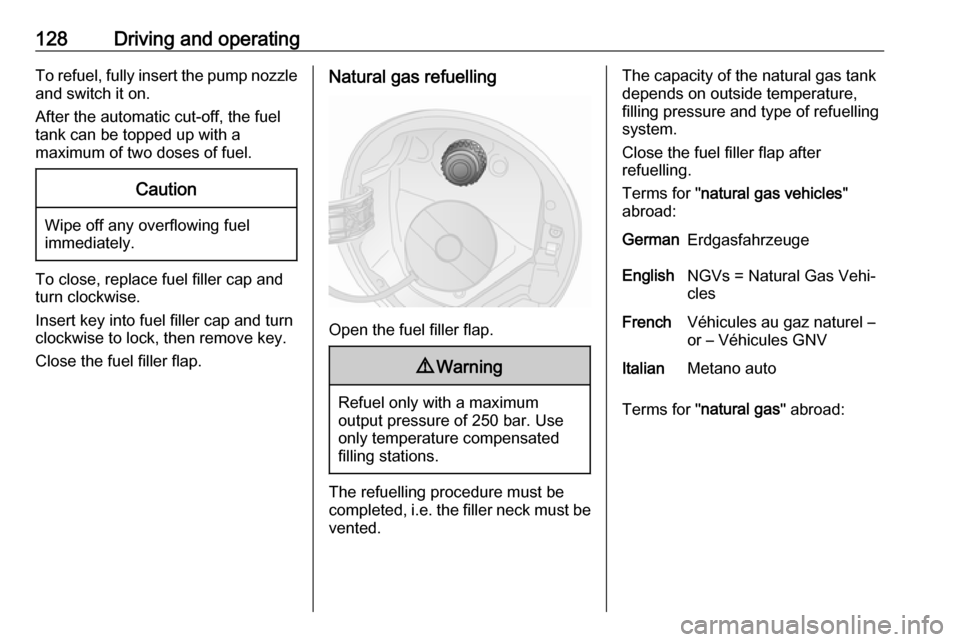
Open the fuel filler flap.
9 Warning
Refuel only with a maximum
output pressure of 250 bar. Use
only temperature compensated
filling stations.
The refuelling procedure must be
completed, i.e. the filler neck must be
vented.
The capacity of the natural gas tank depends on outside temperature,
filling pressure and type of refuelling
system.
Close the fuel filler flap after
refuelling.
Terms for " natural gas vehicles "
abroad:GermanErdgasfahrzeugeEnglishNGVs = Natural Gas Vehi‐
clesFrenchVéhicules au gaz naturel –
or – Véhicules GNVItalianMetano auto
Terms for " natural gas " abroad: