belt VAUXHALL CORSA 2014.5 User Guide
[x] Cancel search | Manufacturer: VAUXHALL, Model Year: 2014.5, Model line: CORSA, Model: VAUXHALL CORSA 2014.5Pages: 231, PDF Size: 6.8 MB
Page 48 of 231

46Seats, restraints
The risk of injury to the head in the
event of a side impact is considerably reduced.
9 Warning
Keep the area in which the airbag
inflates clear of obstructions.
The hooks on the handles in the
roof frame are only suitable for
hanging up light articles of
clothing, without coat hangers. Do
not keep any items in these
clothes.
Airbag deactivation
Front airbag and side airbag systems for the front passenger seat must be
deactivated if a child restraint system
is to be fitted on this seat. The curtain
airbag system, the belt tensioners
and all driver airbag systems will
remain active.
There is a warning label on the side
of the instrument panel, visible when
the front passenger door is open.
Control indicator W and LEDs in the
button not on:
Airbag systems for the front
passenger are active. No child
restraint systems can be installed.
Control indicator W and LEDs in
button on:
Front passenger airbags are
deactivated and will not inflate in the
event of a collision. A child restraint system according to the chart Child
restraint installation locations can be
installed 3 49.
Page 50 of 231

48Seats, restraintsChild restraintsChild restraint systems
We recommend the Vauxhall child
restraint system which is tailored
specifically to the vehicle.
When a child restraint system is being used, pay attention to the following
usage and installation instructions
and also those supplied with the child
restraint system.
Always comply with local or national
regulations. In some countries, the
use of child restraint systems is
forbidden on certain seats.9 Warning
When using a child restraint
system on the front passenger
seat, the airbag systems for the
front passenger seat must be
deactivated; if not, the triggering of the airbags poses a risk of fatal
injury to the child.
This is especially the case if rear-
facing child restraint systems are
used on the front passenger seat.
Airbag deactivation 3 46.
Airbag label 3 41.
Selecting the right system The rear seats are the most
convenient location to fasten a child
restraint system.
Children should travel facing
rearwards in the vehicle as long as
possible. This makes sure that the child's backbone, which is still very
weak, is under less strain in the event
of an accident.
Suitable are restraint systems that
comply with valid UN ECE
regulations. Check local laws and
regulations for mandatory use of child restraint systems.
Ensure that the child restraint system to be installed is compatible with the
vehicle type.
Ensure that the mounting location of
the child restraint system within the
vehicle is correct, see following
tables.
Allow children to enter and exit the
vehicle only on the side facing away
from the traffic.
When the child restraint system is not
in use, secure the seat with a seat belt or remove it from the vehicle.
Notice
Do not stick anything on the child
restraint systems and do not cover
them with any other materials.
A child restraint system which has
been subjected to stress in an
accident must be replaced.
Page 51 of 231

Seats, restraints49Child restraint installation locationsPermissible options for fitting a child restraint system
Weight and age class
On front passenger seat
On rear outboard seatsOn rear centre seat
activated airbagdeactivated airbagGroup 0: up to 10 kg
or approx. 10 monthsXU 1UXGroup 0+: up to 13 kg
or approx. 2 yearsXU 1UXGroup I: 9 to 18 kg
or approx. 8 months to 4 yearsXU 1UXGroup II: 15 to 25 kg
or approx. 3 to 7 yearsXXUXGroup III: 22 to 36 kg
or approx. 6 to 12 yearsXXUX1=If the child restraint system is being secured using a three-point seat belt, move seat height adjustment to uppermost position and ensure that vehicle seat belt runs forwards from the upper anchorage point. Adjust seat backrest
inclination as far as necessary to a vertical position to ensure that the belt is tight on the buckle side.U=Universal suitability in conjunction with three-point seat belt.X=No child restraint system permitted in this weight class.
Page 53 of 231

Seats, restraints51
IL=Suitable for particular ISOFIX restraint systems of the 'specific-vehicle', 'restricted' or 'semi-universal' categories.The ISOFIX restraint system must be approved for the specific vehicle type (Not available on the front passenger
seat in the Corsa VXR).IUF=Suitable for ISOFIX forward-facing child restraint systems of universal category approved for use in this mass group
(Not available on the front passenger seat in the Corsa VXR).X=No ISOFIX child restraint system approved in this weight class.
ISOFIX size class and seat device
A – ISO/F3=Forward-facing child restraint system for children of maximum size in the weight class 9 to 18 kg.B – ISO/F2=Forward-facing child restraint system for smaller children in the weight class 9 to 18 kg.B1 – ISO/F2X=Forward-facing child restraint system for smaller children in the weight class 9 to 18 kg.C – ISO/R3=Rear-facing child restraint system for children of maximum size in the weight class up to 18 kg.D – ISO/R2=Rear-facing child restraint system for smaller children in the weight class up to 18 kg.E – ISO/R1=Rear-facing child restraint system for young children in the weight class up to 13 kg.U=Universal suitability in conjunction with three-point seat belt.X=No child restraint system permitted in this weight class.
Page 65 of 231
Storage63Load compartment
Load compartment extension
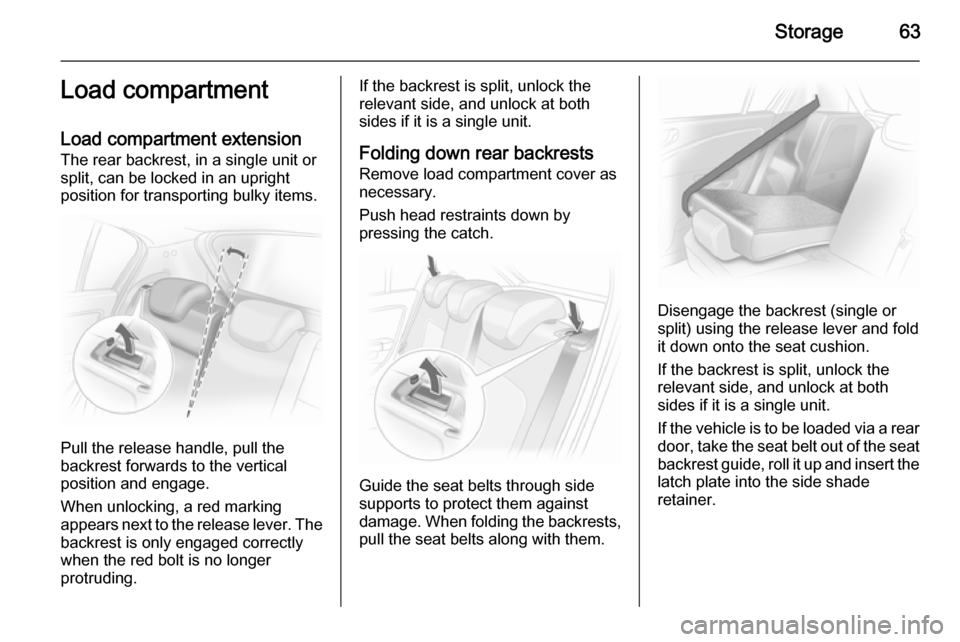
The rear backrest, in a single unit or
split, can be locked in an upright
position for transporting bulky items.
Pull the release handle, pull the
backrest forwards to the vertical
position and engage.
When unlocking, a red marking
appears next to the release lever. The
backrest is only engaged correctly
when the red bolt is no longer
protruding.
If the backrest is split, unlock the
relevant side, and unlock at both
sides if it is a single unit.
Folding down rear backrests
Remove load compartment cover as
necessary.
Push head restraints down by
pressing the catch.
Guide the seat belts through side
supports to protect them against
damage. When folding the backrests,
pull the seat belts along with them.
Disengage the backrest (single or
split) using the release lever and fold
it down onto the seat cushion.
If the backrest is split, unlock the
relevant side, and unlock at both
sides if it is a single unit.
If the vehicle is to be loaded via a rear door, take the seat belt out of the seat
backrest guide, roll it up and insert the
latch plate into the side shade
retainer.
Page 66 of 231

64Storage
Move rear seat backrests upright and
allow locking mechanisms to engage
audibly at both sides. Once the
backrests are locked the red mark
must no longer protrude.
The rear seat backrests can be
locked in two positions.
Do not trap the seat belt when moving the backrest to the upright position.
Install the load compartment cover.
9 Warning
Only drive the vehicle when the
backrests are securely locked into position. Otherwise there is a risk
of personal injury or damage to the
load or vehicle in the event of hard braking or a collision.
The seat belt of the centre seat could
be blocked when the backrest is
folded up too quickly. To unlock the
retractor, push in the seat belt or pull
it out by approx. 20 mm and then let
go.
Load compartment cover
Do not place any objects on the cover.
5-door passenger vehicle
Lift the cover backwards, until it
unlatches, then remove.
Fit in reverse order.
Page 82 of 231

80Instruments and controlsTurn signal
O illuminates or flashes green.
Illuminates The control indicator illuminates
briefly when the parking lights are
switched on 3 102.
Flashes
The control indicator flashes if a turn
signal or the hazard warning flashers
are activated.
Rapid flashing: failure of a turn signal light or associated fuse, failure of turn
signal light on trailer.
Bulb replacement 3 153, Fuses
3 166, Turn signals 3 101.
Seat belt reminder
X illuminates or flashes red.
Illuminates
After the ignition is switched on until
the seat belt is fastened.Flashes
After starting off until the seat belt is
fastened.
Fastening the seat belt 3 39.
Airbag and belt tensioners
v illuminates red.
When the ignition is switched on, the
control indicator illuminates for
approx. 4 seconds. If it does not
illuminate, does not go out after
4 seconds or illuminates whilst
driving, there is a fault in the belt
tensioner or the airbags. In this case
the LEDs in the button W will also
flash. The airbags and belt tensioners
may fail to trigger in the event of an
accident.
Deployment of the belt tensioners or
airbags is indicated by continuous
illumination of v.9 Warning
Have the cause of the fault
remedied immediately by a
workshop.
Airbag system, belt tensioners 3 41,
3 38.
Airbag deactivation W illuminates together with the LEDs
in the button W: airbag deactivated
3 46.
W flashes: the system can be
activated or deactivated within
15 seconds of switching on the
ignition 3 46.
Charging system
p illuminates or flashes red.
Illuminates when the ignition is
switched on and extinguishes shortly
after the engine starts.
Page 92 of 231

90Instruments and controlsVehicle messagesMessages are given via the
instrument panel display or as
warning and signal buzzers. Check
control messages appear on the
Info-Display. Some appear in an
abbreviated form. Confirm warning
messages with the multifunction
control 3 86.
Warning chimes When starting the engine or
whilst driving ■ If seat belt is not fastened.
■ If a door or the tailgate is not fully closed when starting-off.
■ If a certain speed is exceeded with the parking brake applied.
■ If the speed programmed at the factory is exceeded.
■ If the vehicle has manual transmission automated and the
driver's door is opened when theengine is running, a gear is
engaged and the foot brake is not
depressed.
■ Warning signal sounds three times if the rear carrier system is
extended and reverse gear is
selected.
When the vehicle is parked and
the driver's door is opened ■ When the key is in the ignition switch.
■ With exterior lights on.
■ For manual transmission automated, if the parking brake is
not applied and no gear is engaged when the engine is switched off.
During an Autostop ■ If the driver's door is opened.
Battery voltage Low battery voltage in the radio
remote control. On vehicles without
check control, the message InSP3
appears in the instrument panel
display. Replace the battery 3 20.Brake light switch
Brake light does not come on during
braking. Have the cause of the fault
remedied immediately by a
workshop.
Drain diesel fuel filter
If there is water in the diesel fuel filter, the message InSP4 appears in the
instrument panel. In some models
InSP4 illuminates together with A in
the instrument. Consult a workshop.
Lighting
Important exterior lighting lamps,
including cables and fuses, are
monitored. In trailer mode, trailer
lighting is also monitored. Trailers
with LED lighting must have an
adapter that enables lamp monitoring as with conventional bulbs.
Page 115 of 231
Climate control113
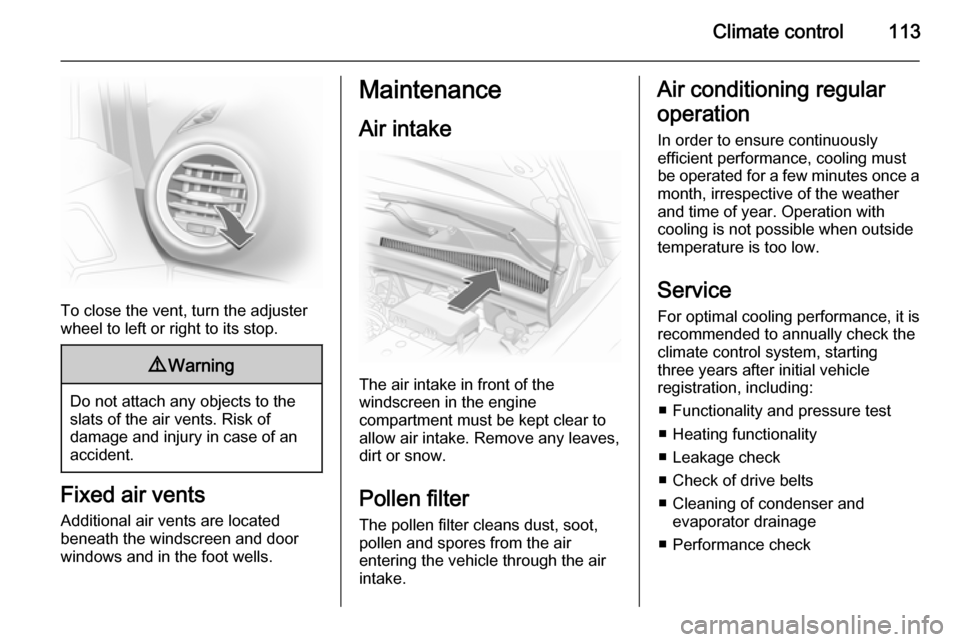
To close the vent, turn the adjuster
wheel to left or right to its stop.
9 Warning
Do not attach any objects to the
slats of the air vents. Risk of
damage and injury in case of an
accident.
Fixed air vents
Additional air vents are located
beneath the windscreen and door windows and in the foot wells.
Maintenance
Air intake
The air intake in front of the
windscreen in the engine
compartment must be kept clear to
allow air intake. Remove any leaves,
dirt or snow.
Pollen filter
The pollen filter cleans dust, soot,
pollen and spores from the air
entering the vehicle through the air
intake.
Air conditioning regular
operation In order to ensure continuously
efficient performance, cooling must
be operated for a few minutes once a
month, irrespective of the weather
and time of year. Operation with
cooling is not possible when outside
temperature is too low.
Service For optimal cooling performance, it isrecommended to annually check the
climate control system, starting
three years after initial vehicle
registration, including:
■ Functionality and pressure test■ Heating functionality
■ Leakage check
■ Check of drive belts
■ Cleaning of condenser and evaporator drainage
■ Performance check
Page 119 of 231
Driving and operating117
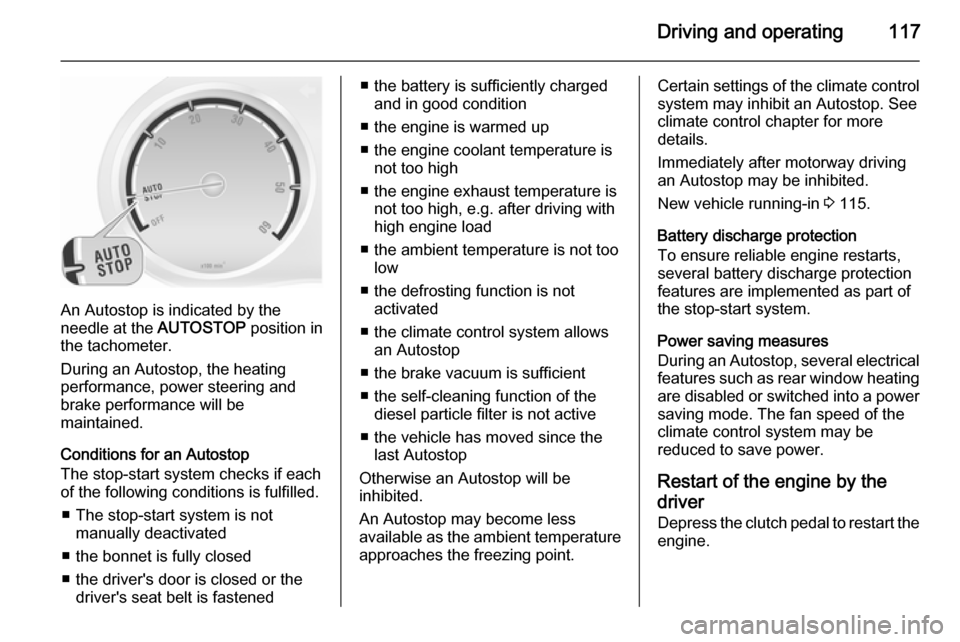
An Autostop is indicated by the
needle at the AUTOSTOP position in
the tachometer.
During an Autostop, the heating
performance, power steering and
brake performance will be
maintained.
Conditions for an Autostop
The stop-start system checks if each
of the following conditions is fulfilled.
■ The stop-start system is not manually deactivated
■ the bonnet is fully closed
■ the driver's door is closed or the driver's seat belt is fastened
■ the battery is sufficiently chargedand in good condition
■ the engine is warmed up
■ the engine coolant temperature is not too high
■ the engine exhaust temperature is not too high, e.g. after driving with
high engine load
■ the ambient temperature is not too low
■ the defrosting function is not activated
■ the climate control system allows an Autostop
■ the brake vacuum is sufficient
■ the self-cleaning function of the diesel particle filter is not active
■ the vehicle has moved since the last Autostop
Otherwise an Autostop will be
inhibited.
An Autostop may become less
available as the ambient temperature
approaches the freezing point.Certain settings of the climate control
system may inhibit an Autostop. See
climate control chapter for more
details.
Immediately after motorway driving
an Autostop may be inhibited.
New vehicle running-in 3 115.
Battery discharge protection
To ensure reliable engine restarts,
several battery discharge protection
features are implemented as part of
the stop-start system.
Power saving measures
During an Autostop, several electrical
features such as rear window heating
are disabled or switched into a power saving mode. The fan speed of the
climate control system may be
reduced to save power.
Restart of the engine by the
driver
Depress the clutch pedal to restart the
engine.