wheel VAUXHALL INSIGNIA 2017 Manual Online
[x] Cancel search | Manufacturer: VAUXHALL, Model Year: 2017, Model line: INSIGNIA, Model: VAUXHALL INSIGNIA 2017Pages: 327, PDF Size: 9.34 MB
Page 265 of 327
Vehicle care263
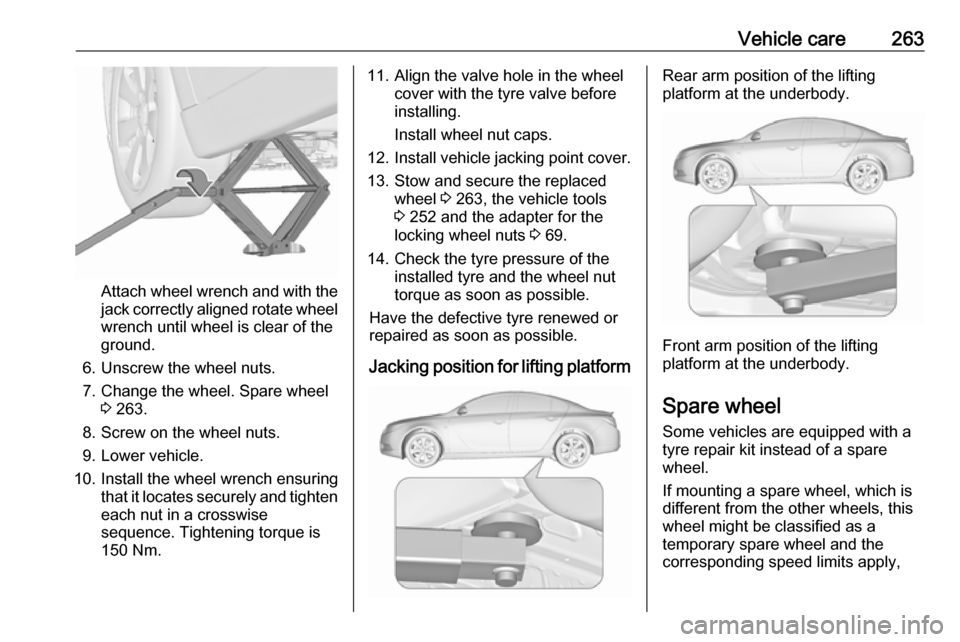
Attach wheel wrench and with the
jack correctly aligned rotate wheel wrench until wheel is clear of the
ground.
6. Unscrew the wheel nuts. 7. Change the wheel. Spare wheel 3 263.
8. Screw on the wheel nuts.
9. Lower vehicle.
10. Install the wheel wrench ensuring that it locates securely and tighten
each nut in a crosswise
sequence. Tightening torque is
150 Nm.
11. Align the valve hole in the wheel cover with the tyre valve before
installing.
Install wheel nut caps.
12. Install vehicle jacking point cover.
13. Stow and secure the replaced wheel 3 263, the vehicle tools
3 252 and the adapter for the
locking wheel nuts 3 69.
14. Check the tyre pressure of the installed tyre and the wheel nut
torque as soon as possible.
Have the defective tyre renewed or
repaired as soon as possible.
Jacking position for lifting platformRear arm position of the lifting
platform at the underbody.
Front arm position of the lifting
platform at the underbody.
Spare wheel Some vehicles are equipped with a
tyre repair kit instead of a spare
wheel.
If mounting a spare wheel, which is
different from the other wheels, this
wheel might be classified as a
temporary spare wheel and the
corresponding speed limits apply,
Page 266 of 327
264Vehicle careeven though no label indicates this.
Seek the assistance of a workshop to
check the applicable speed limit.
The spare wheel has a steel rim.Caution
The use of a spare wheel that is smaller than the other wheels or in
combination with winter tyres
could affect driveability. Have the defective tyre replaced as soon as
possible.
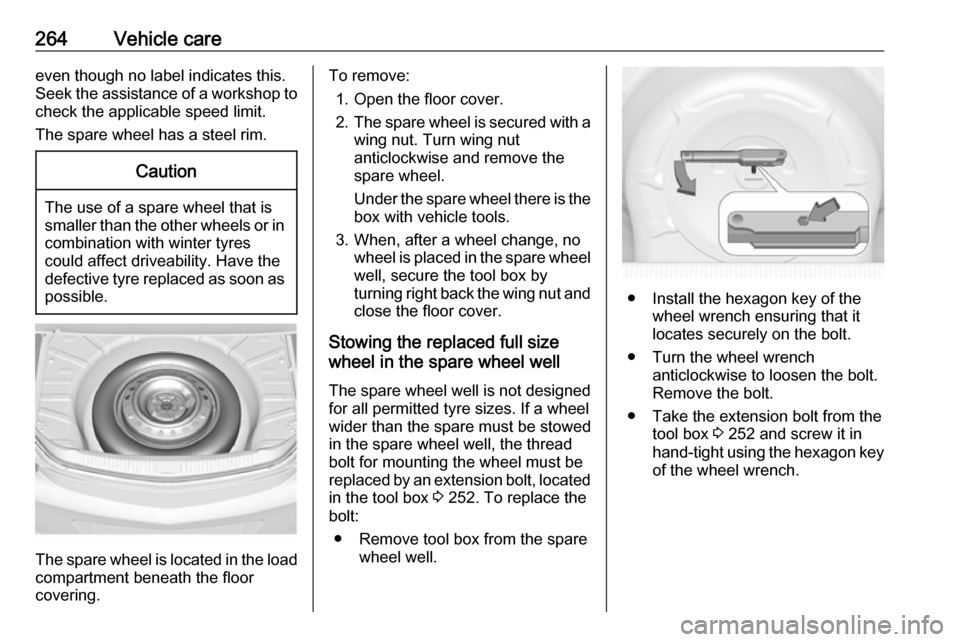
The spare wheel is located in the load
compartment beneath the floor
covering.
To remove:
1. Open the floor cover.
2. The spare wheel is secured with a
wing nut. Turn wing nut
anticlockwise and remove the
spare wheel.
Under the spare wheel there is the box with vehicle tools.
3. When, after a wheel change, no wheel is placed in the spare wheel
well, secure the tool box by
turning right back the wing nut and close the floor cover.
Stowing the replaced full size
wheel in the spare wheel well
The spare wheel well is not designed for all permitted tyre sizes. If a wheel
wider than the spare must be stowed
in the spare wheel well, the thread
bolt for mounting the wheel must be
replaced by an extension bolt, located
in the tool box 3 252. To replace the
bolt:
● Remove tool box from the spare wheel well.
● Install the hexagon key of thewheel wrench ensuring that it
locates securely on the bolt.
● Turn the wheel wrench anticlockwise to loosen the bolt.
Remove the bolt.
● Take the extension bolt from the tool box 3 252 and screw it in
hand-tight using the hexagon key of the wheel wrench.
Page 267 of 327
Vehicle care265
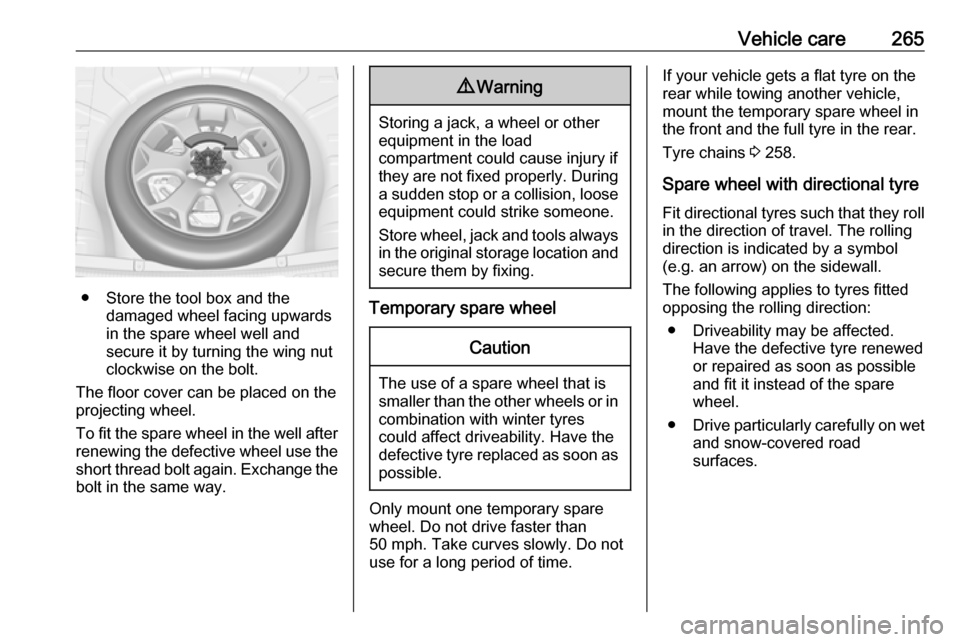
● Store the tool box and thedamaged wheel facing upwards
in the spare wheel well and
secure it by turning the wing nut
clockwise on the bolt.
The floor cover can be placed on the
projecting wheel.
To fit the spare wheel in the well after
renewing the defective wheel use the
short thread bolt again. Exchange the bolt in the same way.
9 Warning
Storing a jack, a wheel or other
equipment in the load
compartment could cause injury if they are not fixed properly. During a sudden stop or a collision, looseequipment could strike someone.
Store wheel, jack and tools always
in the original storage location and secure them by fixing.
Temporary spare wheel
Caution
The use of a spare wheel that issmaller than the other wheels or in combination with winter tyres
could affect driveability. Have the defective tyre replaced as soon as
possible.
Only mount one temporary spare
wheel. Do not drive faster than
50 mph. Take curves slowly. Do not
use for a long period of time.
If your vehicle gets a flat tyre on the
rear while towing another vehicle,
mount the temporary spare wheel in
the front and the full tyre in the rear.
Tyre chains 3 258.
Spare wheel with directional tyre
Fit directional tyres such that they roll in the direction of travel. The rolling
direction is indicated by a symbol
(e.g. an arrow) on the sidewall.
The following applies to tyres fitted
opposing the rolling direction:
● Driveability may be affected. Have the defective tyre renewed
or repaired as soon as possible
and fit it instead of the spare
wheel.
● Drive particularly carefully on wet
and snow-covered road
surfaces.
Page 270 of 327
268Vehicle care
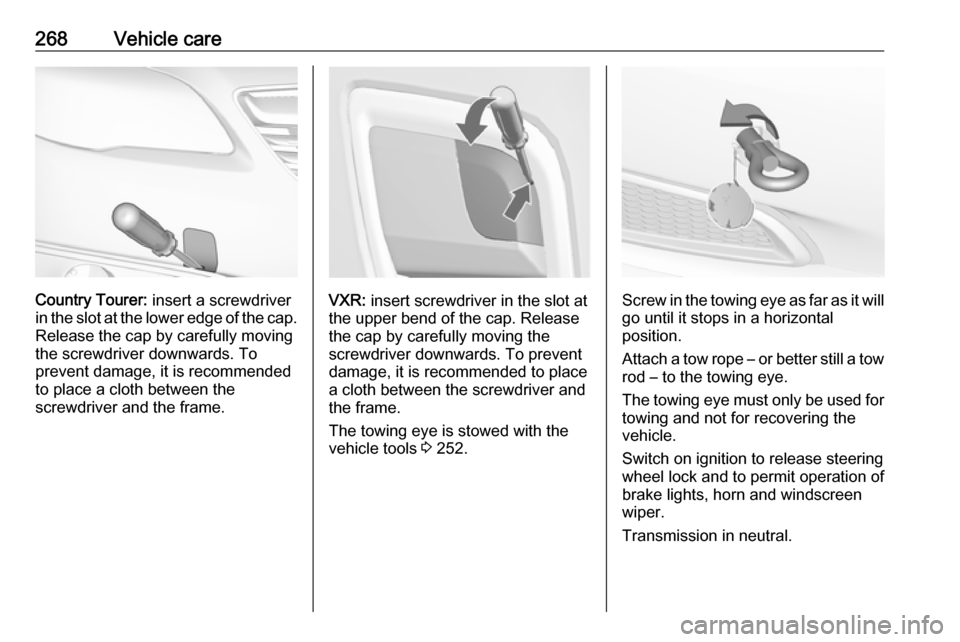
Country Tourer: insert a screwdriver
in the slot at the lower edge of the cap. Release the cap by carefully moving
the screwdriver downwards. To
prevent damage, it is recommended
to place a cloth between the
screwdriver and the frame.VXR: insert screwdriver in the slot at
the upper bend of the cap. Release
the cap by carefully moving the
screwdriver downwards. To prevent
damage, it is recommended to place
a cloth between the screwdriver and
the frame.
The towing eye is stowed with the vehicle tools 3 252.Screw in the towing eye as far as it will
go until it stops in a horizontal
position.
Attach a tow rope – or better still a tow
rod – to the towing eye.
The towing eye must only be used for
towing and not for recovering the
vehicle.
Switch on ignition to release steering wheel lock and to permit operation of
brake lights, horn and windscreen
wiper.
Transmission in neutral.
Page 271 of 327
Vehicle care269Caution
Drive slowly. Do not drive jerkily.
Excessive tractive force can
damage the vehicle.
When the engine is not running,
considerably more force is needed to
brake and steer.
To prevent the entry of exhaust gases from the towing vehicle, switch on the
air recirculation and close the
windows.
Vehicles with manual transmission
and All-wheel drive: If the vehicle is
towed with all four wheels on the
ground then there are no technical
limitations for speed and distance. If
only one axle has been raised, the
maximum speed is 30 mph. There is
no distance limitation.
Vehicles with automatic transmission
and Front-wheel drive: The vehicle
must be towed facing forwards, not
faster than 50 mph nor further than
60 miles . In all other cases and when
the transmission is defective, the front
axle must be raised off the ground.
Vehicles with automatic transmission
and All-wheel drive: The vehicle must
be towed facing forwards. If the
vehicle is towed with all four wheels
on the ground, the maximum speed is 30 mph and for a maximum of
30 miles. If the front axle has been
raised, the maximum speed is
30 mph. There is no distance
limitation.
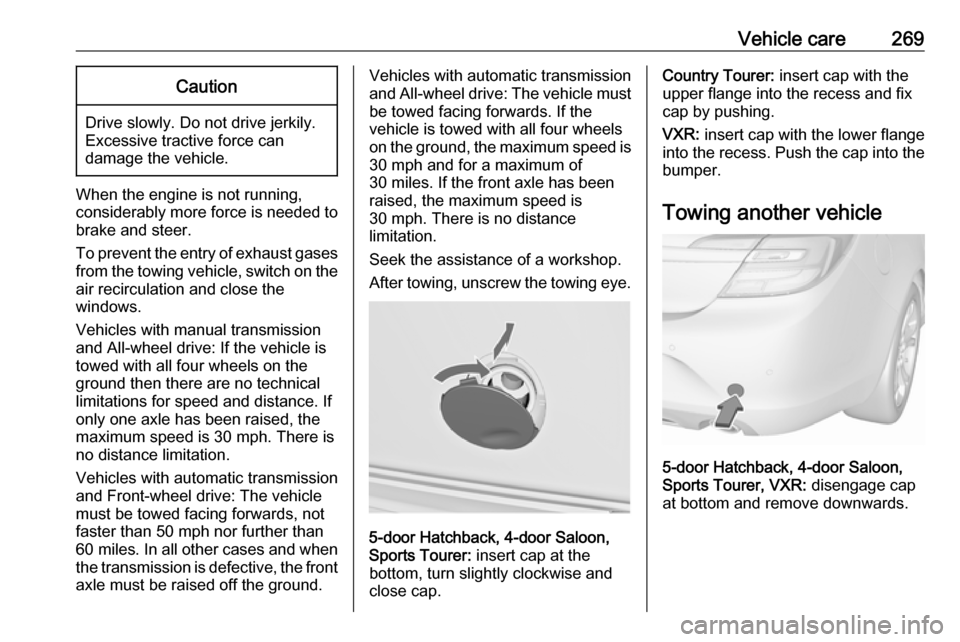
Seek the assistance of a workshop. After towing, unscrew the towing eye.
5-door Hatchback, 4-door Saloon,
Sports Tourer: insert cap at the
bottom, turn slightly clockwise and
close cap.
Country Tourer: insert cap with the
upper flange into the recess and fix
cap by pushing.
VXR: insert cap with the lower flange
into the recess. Push the cap into the bumper.
Towing another vehicle
5-door Hatchback, 4-door Saloon,
Sports Tourer, VXR: disengage cap
at bottom and remove downwards.
Page 273 of 327

Vehicle care271Appearance care
Exterior care LocksThe locks are lubricated at the factoryusing a high quality lock cylinder
grease. Use a de-icing agent only
when absolutely necessary, as this
has a degreasing effect and impairs
lock function. After using a de-icing
agent, have the locks regreased by a
workshop.
Washing
The paintwork of your vehicle is
exposed to environmental influences. Wash and wax your vehicle regularly.
When using automatic vehicle
washes, select a programme that
includes waxing.
Bird droppings, dead insects, resin,
pollen and the like should be cleaned
off immediately, as they contain
aggressive constituents which can
cause paint damage.If using a vehicle wash, comply with
the vehicle wash manufacturer's instructions. The windscreen wiperand rear window wiper must be
switched off. Remove antenna and
external accessories such as roof
racks etc.
If you wash your vehicle by hand,
make sure that the insides of the
wheel housings are also thoroughly
rinsed out.
Wax painted parts of the vehicle
regularly.
Clean edges and folds on opened
doors and the bonnet as well as the
areas they cover.
Clean bright metal mouldings with a
cleaning solution approved for
aluminium to avoid damages.Caution
Always use a cleaning agent with
a pH value of four to nine.
Do not use cleaning agents on hot surfaces.
Do not clean the engine compartmentwith a steam-jet or high-pressure jet
cleaner.
Thoroughly rinse and leather-off the vehicle. Rinse leather frequently. Use
separate leathers for painted and
glass surfaces: remnants of wax on
the windows will impair vision.
Have the door hinges of all doors
greased by a workshop.
Exterior lights
Headlight and other light covers are
made of plastic. Do not use any
abrasive or caustic agents, do not use an ice scraper, and do not clean them
dry.
Polishing and waxing
Wax the vehicle regularly (at the
latest when water no longer beads).
Otherwise, the paintwork will dry out.
Polishing is necessary only if the paint
has become dull or if solid deposits
have become attached to it.
Paintwork polish with silicone forms a
protective film, making waxing
unnecessary.
Page 274 of 327

272Vehicle carePlastic body parts must not be treatedwith wax or polishing agents.
Windows and windscreen wiper
blades
Use a soft lint-free cloth or chamois
leather together with window cleaner and insect remover.
When cleaning the rear window from
inside, always wipe in parallel to the
heating element to prevent damage.
For mechanical removal of ice, use a
sharp-edged ice scraper. Press the
scraper firmly against the glass so
that no dirt can get under it and
scratch the glass.
Clean smearing wiper blades with a
soft cloth and window cleaner.
Remove dirt residues from smearing
wiper blades by using a soft cloth and window cleaner. Also make sure to
remove any residues such as wax,
insect residues and similar from the
window.
Ice residues, pollution and continuous
wiping on dry windows will damage or
even destroy the wiper blades.Sunroof
Never clean with solvents or abrasive
agents, fuels, aggressive media
(e.g. paint cleaner, acetone-
containing solutions etc.), acidic or
highly alkaline media or abrasive
pads. Do not apply wax or polishing
agents to the sunroof.
Wheels and tyres
Do not use high-pressure jet
cleaners.
Clean rims with a pH-neutral wheel
cleaner.
Rims are painted and can be treated
with the same agents as the body.
Paintwork damageRectify minor paintwork damage with
a touch-up pen before rust forms.
Have more extensive damage or rust
areas repaired by a workshop.
Underbody Some areas of the vehicle underbody
have a PVC undercoating while other
critical areas have a durable
protective wax coating.After the underbody is washed, check the underbody and have it waxed if
necessary.
Bitumen/rubber materials could
damage the PVC coating. Have
underbody work carried out by a
workshop.
Before and after winter, wash the
underbody and have the protective
wax coating checked.
Liquid gas system9 Danger
Liquid gas is heavier than air and
can collect in sink points.
Take care when performing work
at the underbody in a pit.
For painting work and when using a
drying booth at a temperature above
60 °C, the liquid gas tank must be
removed.
Do not make any modifications to the
liquid gas system.
Page 287 of 327
![VAUXHALL INSIGNIA 2017 Manual Online Technical data285Performance
5-door Hatchback/4-door SaloonEngineB14NET
B14NET
LPG
B16SHLB18XERB20NHT
B20NHT
AWD 3)
B28NER
Maximum speed [mph]Manual transmission1271211371271551551554)
/168Automatic t](/img/38/19486/w960_19486-286.png "VAUXHALL INSIGNIA 2017 Manual Online Technical data285Performance
5-door Hatchback/4-door SaloonEngineB14NET
B14NET
LPG
B16SHLB18XERB20NHT
B20NHT
AWD 3)
B28NER
Maximum speed [mph]Manual transmission1271211371271551551554)
/168Automatic t")
Technical data285Performance
5-door Hatchback/4-door SaloonEngineB14NET
B14NET
LPG
B16SHLB18XERB20NHT
B20NHT
AWD 3)
B28NER
Maximum speed [mph]Manual transmission1271211371271551551554)
/168Automatic transmission––130–152152155 4)
/1653) All wheel drive.
4) Limited speed.
EngineB16DTJB16DTHB20DTHB20DTHAWD 3)Maximum speed [mph]Manual transmission121/124 5)127/1305)140134Automatic transmission–1241371303)
All wheel drive.
5) CO2 reduced.
Page 288 of 327
![VAUXHALL INSIGNIA 2017 Manual Online 286Technical dataSports TourerEngineB14NETB14NET LPGB16SHLB18XERB20NHTB20NHTB28NERAWD3)Maximum speed [mph]Manual transmission1241181341241521491554)
/168Automatic transmission––127–149146155 4)](/img/38/19486/w960_19486-287.png "VAUXHALL INSIGNIA 2017 Manual Online 286Technical dataSports TourerEngineB14NETB14NET LPGB16SHLB18XERB20NHTB20NHTB28NERAWD3)Maximum speed [mph]Manual transmission1241181341241521491554)
/168Automatic transmission––127–149146155 4)")
286Technical dataSports TourerEngineB14NETB14NET LPGB16SHLB18XERB20NHTB20NHTB28NERAWD3)Maximum speed [mph]Manual transmission1241181341241521491554)
/168Automatic transmission––127–149146155 4)
/1683) All wheel drive.
4) Limited speed.
EngineB16DTJB16DTHB20DTHB20DTHAWD 3)Maximum speed[mph]Manual transmission118/121 6)124/1276)137130Automatic transmission–1211331273)
All wheel drive.
6) CO2 reduced.
Page 289 of 327
![VAUXHALL INSIGNIA 2017 Manual Online Technical data287Country TourerEngineB16SHLB20NHTB20DTHB20DTHAWD3)AWD3)Maximum speed [mph]Manual transmission134146137134Automatic transmission1271431331243)
All wheel drive.](/img/38/19486/w960_19486-288.png "VAUXHALL INSIGNIA 2017 Manual Online Technical data287Country TourerEngineB16SHLB20NHTB20DTHB20DTHAWD3)AWD3)Maximum speed [mph]Manual transmission134146137134Automatic transmission1271431331243)
All wheel drive.")
Technical data287Country TourerEngineB16SHLB20NHTB20DTHB20DTHAWD3)AWD3)Maximum speed [mph]Manual transmission134146137134Automatic transmission1271431331243)
All wheel drive.