open VAUXHALL INSIGNIA 2019 Owner's Guide
[x] Cancel search | Manufacturer: VAUXHALL, Model Year: 2019, Model line: INSIGNIA, Model: VAUXHALL INSIGNIA 2019Pages: 345, PDF Size: 9.61 MB
Page 72 of 345
70Seats, restraintsPedestrian protection
system
Active bonnet Pedestrian protection system can
help to reduce the injury of
pedestrians in case of a front
collision.
When the sensors in the front bumper
detect a certain impact within the
speed range of 15 mph to 31 mph, the
rear part of the bonnet will be lifted to
reduce pedestrians head injuries.
In addition the front bumper is
designed to reduce leg injuries of
pedestrians.
The active bonnet can be triggered
only once and remains in the raised
position. A message is displayed in
the Driver Information Centre.
Seek the assistance of a workshop as
soon as possible, thereby adapting
the driving style, to have the
actuators, hinges and bonnet
replaced.9 Warning
Do not drive with the bonnet
raised.
9 Warning
After any frontal accident the front
bumper may appear to be intact,
however, the sensors may be
damaged. Consult a workshop to
verify proper functionality of the
sensors.
The system may not trigger under the following conditions:
● The impact is out of sensor range.
● The sensors are damaged or blocked by accessory parts.
● The bonnet is blocked by snow or
ice.
● The vehicle speed is not within the range.
● The object is too small.
Manually bonnet lowering9 Warning
After the system has triggered, the
hinges of the bonnet are hot. Do
not touch.
To manually lower the triggered
bonnet for driving to the next
workshop:
1. Pull the bonnet release lever.
2. Push the safety catch to left vehicle side.
3. Open the bonnet approx. 20 cm and lower it slowly without
engaging.
4. Push down bonnet with both hands at rear corners in small
steps alternating between right
and left side.
9 Warning
Be sure to keep away from the
edge of the bonnet to prevent
injuries.
Page 74 of 345
72StorageStorageStorage compartments9Warning
Do not store heavy or sharp
objects in the storage
compartments. Otherwise, the
storage compartment lid could
open and vehicle occupants could be injured by objects being thrown
around in the event of hard
braking, a sudden change in
direction or an accident.
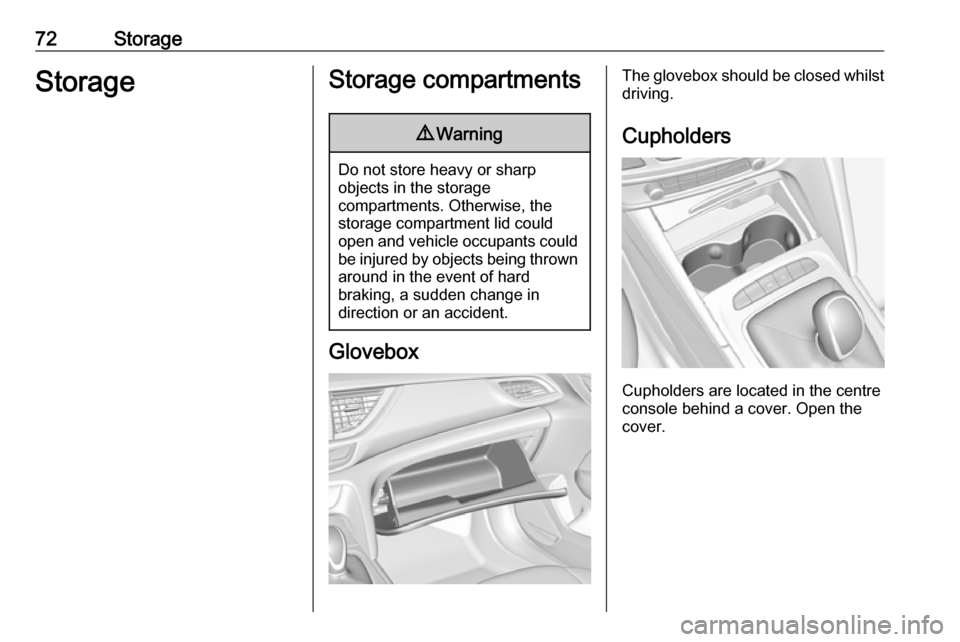
Glovebox
The glovebox should be closed whilst driving.
Cupholders
Cupholders are located in the centre
console behind a cover. Open the
cover.
Page 75 of 345
Storage73
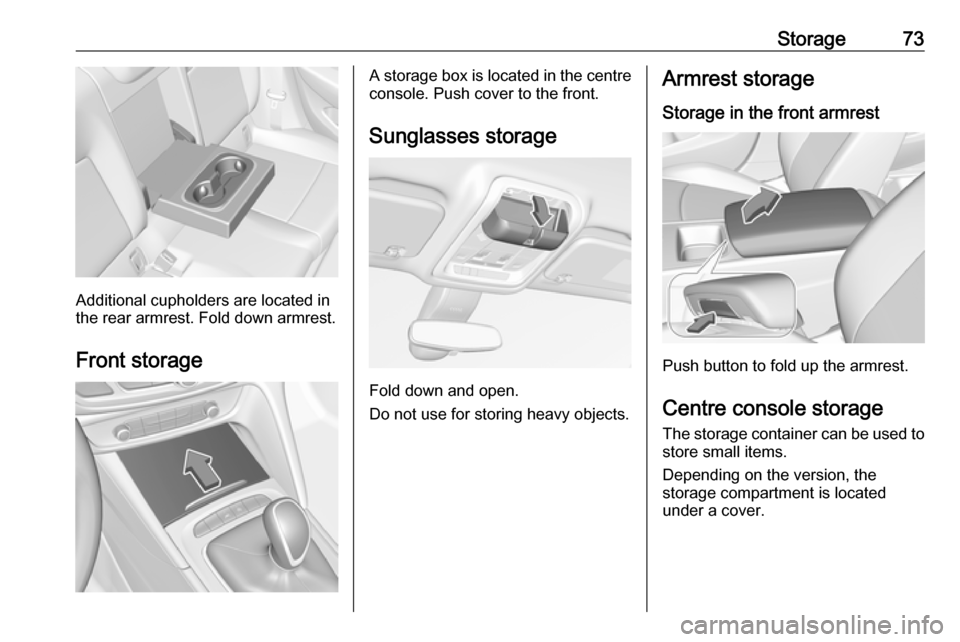
Additional cupholders are located in
the rear armrest. Fold down armrest.
Front storage
A storage box is located in the centre
console. Push cover to the front.
Sunglasses storage
Fold down and open.
Do not use for storing heavy objects.
Armrest storage
Storage in the front armrest
Push button to fold up the armrest.
Centre console storage The storage container can be used to
store small items.
Depending on the version, the
storage compartment is located
under a cover.
Page 76 of 345
74Storage
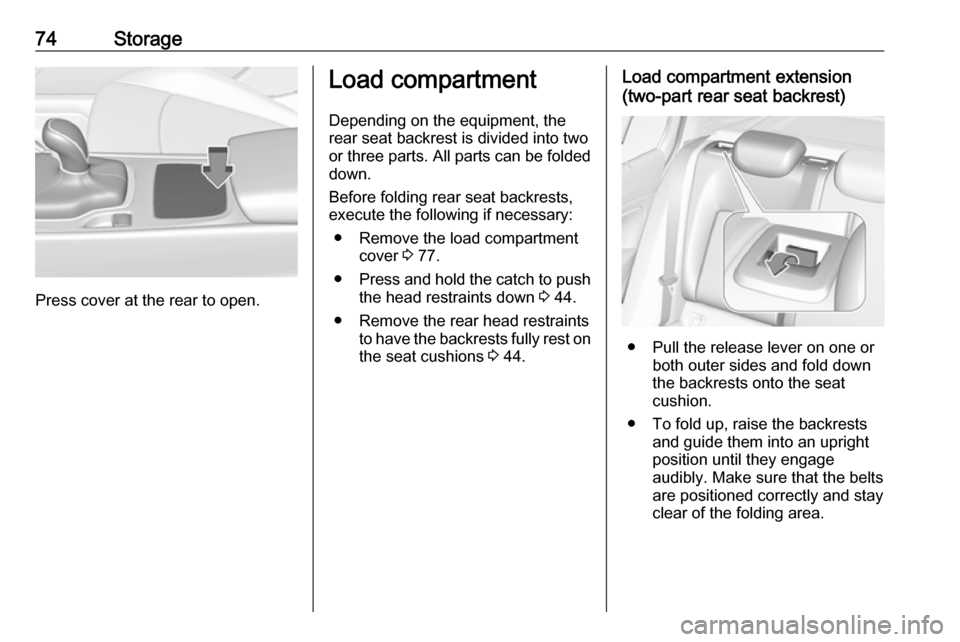
Press cover at the rear to open.
Load compartment
Depending on the equipment, the
rear seat backrest is divided into two or three parts. All parts can be folded
down.
Before folding rear seat backrests,
execute the following if necessary:
● Remove the load compartment cover 3 77.
● Press and hold the catch to push
the head restraints down 3 44.
● Remove the rear head restraints to have the backrests fully rest on
the seat cushions 3 44.Load compartment extension
(two-part rear seat backrest)
● Pull the release lever on one or both outer sides and fold down
the backrests onto the seat
cushion.
● To fold up, raise the backrests and guide them into an upright
position until they engage
audibly. Make sure that the belts
are positioned correctly and stay
clear of the folding area.
Page 80 of 345
78StorageLift cover at the rear and at the front.
Remove the cover.
Fitting cover
Engage cover in side guides and fold
downwards. Attach the retaining
straps to the tailgate.
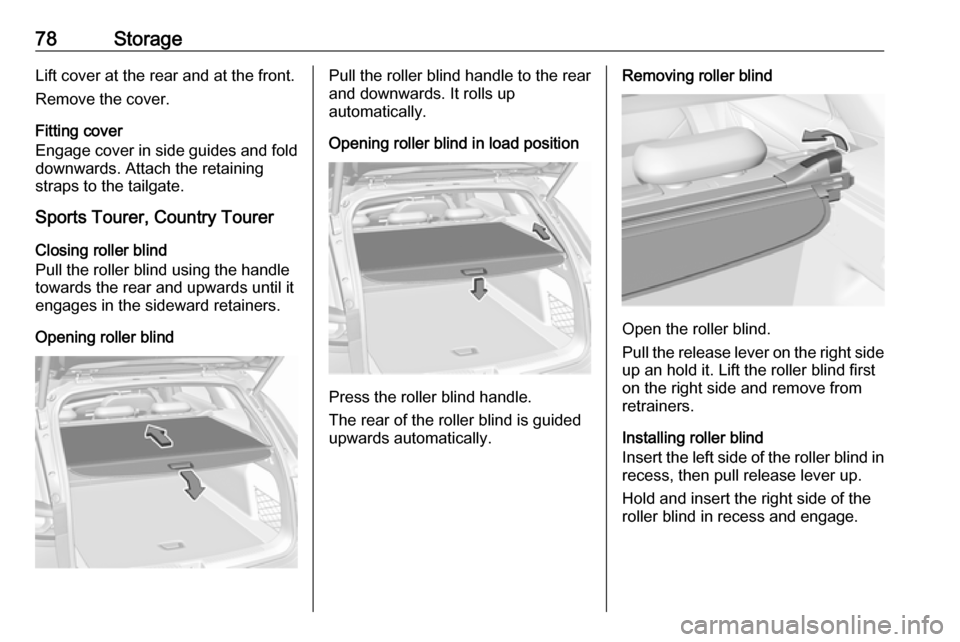
Sports Tourer, Country Tourer
Closing roller blind
Pull the roller blind using the handle
towards the rear and upwards until it
engages in the sideward retainers.
Opening roller blindPull the roller blind handle to the rear
and downwards. It rolls up
automatically.
Opening roller blind in load position
Press the roller blind handle.
The rear of the roller blind is guided
upwards automatically.
Removing roller blind
Open the roller blind.
Pull the release lever on the right side
up an hold it. Lift the roller blind first
on the right side and remove from retrainers.
Installing roller blind
Insert the left side of the roller blind in
recess, then pull release lever up.
Hold and insert the right side of the roller blind in recess and engage.
Page 83 of 345
Storage81
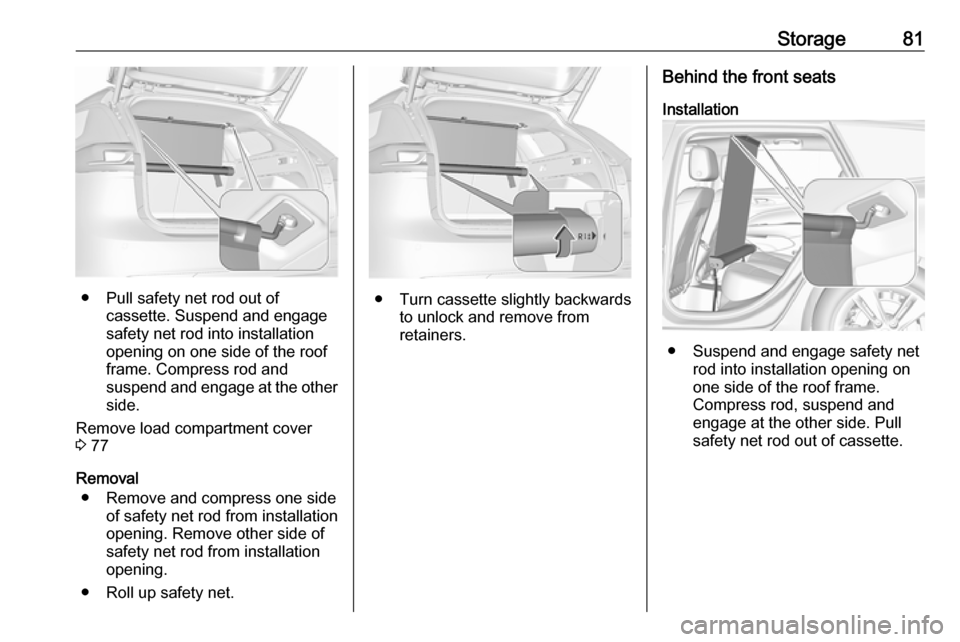
● Pull safety net rod out ofcassette. Suspend and engage
safety net rod into installation
opening on one side of the roof
frame. Compress rod and
suspend and engage at the other
side.
Remove load compartment cover
3 77
Removal ● Remove and compress one side of safety net rod from installationopening. Remove other side of
safety net rod from installation
opening.
● Roll up safety net.● Turn cassette slightly backwards to unlock and remove from
retainers.
Behind the front seats
Installation
● Suspend and engage safety net rod into installation opening on
one side of the roof frame.
Compress rod, suspend and
engage at the other side. Pull
safety net rod out of cassette.
Page 84 of 345
82Storage
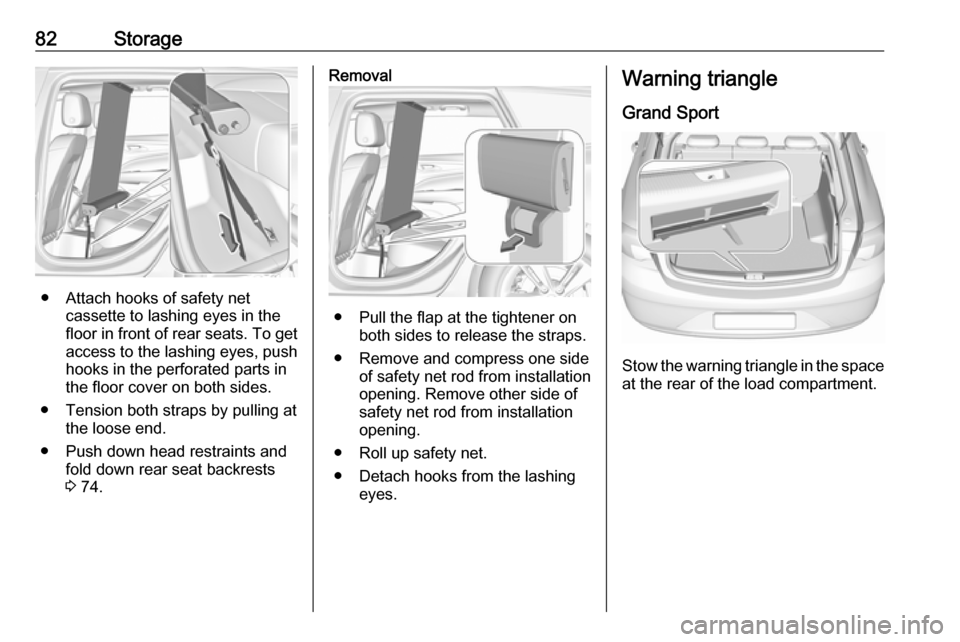
● Attach hooks of safety netcassette to lashing eyes in the
floor in front of rear seats. To get
access to the lashing eyes, push
hooks in the perforated parts in
the floor cover on both sides.
● Tension both straps by pulling at the loose end.
● Push down head restraints and fold down rear seat backrests
3 74.
Removal
● Pull the flap at the tightener on
both sides to release the straps.
● Remove and compress one side of safety net rod from installation
opening. Remove other side of
safety net rod from installation
opening.
● Roll up safety net.
● Detach hooks from the lashing eyes.
Warning triangle
Grand Sport
Stow the warning triangle in the space
at the rear of the load compartment.
Page 86 of 345
84StorageRoof rack systemRoof rackFor safety reasons and to avoid
damage to the roof, the vehicle
approved roof rack system is
recommended. For further
information, contact your workshop.
Mounting roof rack
Grand Sport
Open all doors.
Mounting points are located in each
door frame of the vehicle body.
Fasten the roof rack according to the installation instructions delivered with the roof rack.
Remove the roof rack when not in use.
Sports Tourer, Country Tourer
Mounting points are located in each
roof railing.
Fasten the roof rack on the first two
mounting points according to the
installation instructions delivered with the roof rack.
Remove the roof rack when not in
use.
Loading information
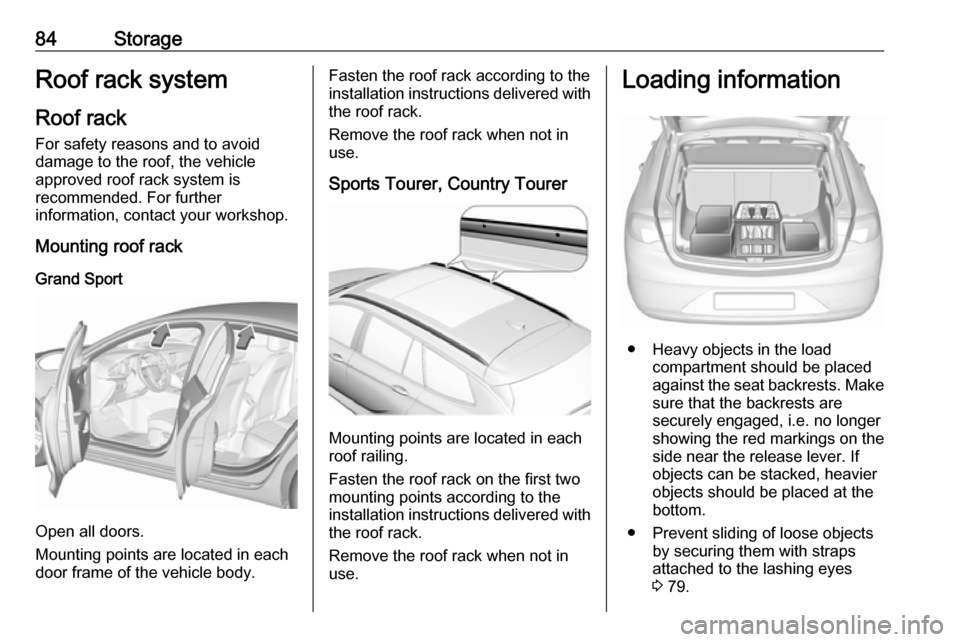
● Heavy objects in the load compartment should be placed
against the seat backrests. Make
sure that the backrests are
securely engaged, i.e. no longer
showing the red markings on the side near the release lever. If
objects can be stacked, heavier
objects should be placed at the
bottom.
● Prevent sliding of loose objects by securing them with straps
attached to the lashing eyes
3 79.
Page 87 of 345

Storage85● Do not allow the load to protrudeabove the upper edge of the
backrests.
● Do not place any objects on the load compartment cover or the
instrument panel, and do not
cover the sensor on top of the instrument panel.
● The load must not obstruct the operation of the pedals, parking
brake and gear selector, or
hinder the freedom of movement
of the driver. Do not place any
unsecured objects in the interior.
● Do not drive with an open load compartment.9Warning
Always ensure that the load in the
vehicle is securely stowed.
Otherwise objects can be thrown
around inside the vehicle and
cause personal injury or damage
to the load or vehicle.
● The payload is the difference between the permitted grossvehicle weight (see identification
plate 3 302) and the EC kerb
weight.
To calculate the payload, enter the data for your vehicle in the
weights table at the front of this
manual.
The EC kerb weight includes
weights for the driver (68 kg),
luggage (7 kg) and all fluids (fuel
tank 90% full).
Optional equipment and
accessories increase the kerb
weight.
● Driving with a roof load increases
the sensitivity of the vehicle to
cross-winds and has a
detrimental effect on vehicle
handling due to the vehicle's
higher centre of gravity.
Distribute the load evenly and secure it properly with retaining
straps. Adjust the tyre pressure
and vehicle speed according to
the load conditions. Check and
retighten the straps frequently.
Do not drive faster than 75 mph.
The permissible roof load is
100 kg. The roof load is thecombined weight of the roof rack
and the load.
Page 88 of 345

86Instruments and controlsInstruments and
controlsControls ....................................... 87
Steering wheel adjustment ........87
Steering wheel controls .............87
Heated steering wheel ...............87
Horn ........................................... 88
Windscreen wiper and washer ..88
Rear window wiper and washer ...................................... 90
Outside temperature ..................91
Clock ......................................... 91
Power outlets ............................. 92
Navigation map card port ..........93
Inductive charging .....................93
Ashtrays .................................... 94
Warning lights, gauges and indi‐ cators ........................................... 95
Instrument cluster ......................95
Speedometer ........................... 100
Odometer ................................ 101
Trip odometer .......................... 101
Tachometer ............................. 102
Fuel gauge .............................. 102
Engine coolant temperature gauge ..................................... 103Service display........................ 103
Control indicators ....................104
Turn lights ................................ 104
Seat belt reminder ...................104
Airbag and belt tensioners .......105
Airbag deactivation ..................105
Charging system .....................106
Malfunction indicator light ........106
Brake and clutch system .........106
Electric parking brake ..............106
Electric parking brake fault ......106
Antilock brake system (ABS) ...107
Gear shifting ............................ 107
Following distance ...................107
Lane keep assist .....................107
Electronic Stability Control off . 107
Electronic Stability Control and Traction Control system .........107
Traction Control system off .....108
Engine coolant temperature ....108
Preheating ............................... 108
AdBlue ..................................... 108
Tyre pressure monitoring system .................................... 108
Engine oil pressure ..................108
Low fuel ................................... 109
Immobiliser .............................. 109
Exterior light ............................ 109
High beam ............................... 109
High beam assist .....................109LED headlights ........................ 109
Front fog lights ......................... 109
Rear fog light ........................... 110
Cruise control .......................... 110
Adaptive cruise control ............110
Vehicle detected ahead ...........110
Pedestrian detection ................110
Speed limiter ........................... 110
Traffic sign assistant ................110
Door open ................................ 110
Displays ..................................... 111
Driver Information Centre ........111
Info Display .............................. 117
Head-up display ......................119
Vehicle messages ......................122
Warning chimes .......................122
Battery voltage ........................ 123
Vehicle personalisation ..............123
Telematics service .....................126
OnStar ..................................... 126