transmission VAUXHALL MERIVA 2015 User Guide
[x] Cancel search | Manufacturer: VAUXHALL, Model Year: 2015, Model line: MERIVA, Model: VAUXHALL MERIVA 2015Pages: 245, PDF Size: 7.76 MB
Page 145 of 245
![VAUXHALL MERIVA 2015 User Guide Driving and operating143Manual mode
Move selector lever out of position D
towards the left and then forwards or backwards.
<=Shift to a higher gear.]=Shift to a lower gear.
If a higher gear is selecte](/img/38/19514/w960_19514-144.png "VAUXHALL MERIVA 2015 User Guide Driving and operating143Manual mode
Move selector lever out of position D
towards the left and then forwards or backwards.
<=Shift to a higher gear.]=Shift to a lower gear.
If a higher gear is selecte")
Driving and operating143Manual mode
Move selector lever out of position D
towards the left and then forwards or backwards.
<=Shift to a higher gear.]=Shift to a lower gear.
If a higher gear is selected when
vehicle speed is too low, or a lower
gear when vehicle speed is too high,
the shift is not executed. This can
cause a message in the Driver
Information Centre.
In manual mode no automatic shifting to a higher gear takes place at high
engine revolutions.
Electronic driving
programmes ■ Following a cold start, the operating
temperature programme increasesengine speed to quickly bring the
catalytic converter to the required
temperature.
■ The automatic neutral shift function
automatically shifts to idling when
the vehicle is stopped with a
forward gear engaged and the
brake pedal is pressed.
■ Special programmes automatically adapt the shifting points when
driving up inclines or down hills.
Kickdown If the accelerator pedal is pressed
down completely in automatic mode, the transmission shifts to a lower gear depending on engine speed.Fault
In the event of a fault, g illuminates.
Additionally a code number or a
vehicle message is displayed in the
Driver Information Centre. Vehicle
messages 3 104.
The transmission no longer shifts
automatically. Continued travel is possible with manual shifting.
Only the highest gear is available.
Depending on the fault, second gear
may also be available in manual
mode. Shift only when vehicle is at a
standstill.
Have the cause of the fault remedied
by a workshop.
Interruption of power
supply In the event of an interruption of
power supply, the selector lever
cannot be moved out of the P
position. The ignition key cannot be
removed from the ignition switch.
Page 146 of 245
144Driving and operating
If the vehicle battery is discharged,
start the vehicle using jump leads
3 209.
If the vehicle battery is not the cause
of the fault, release the selector lever.
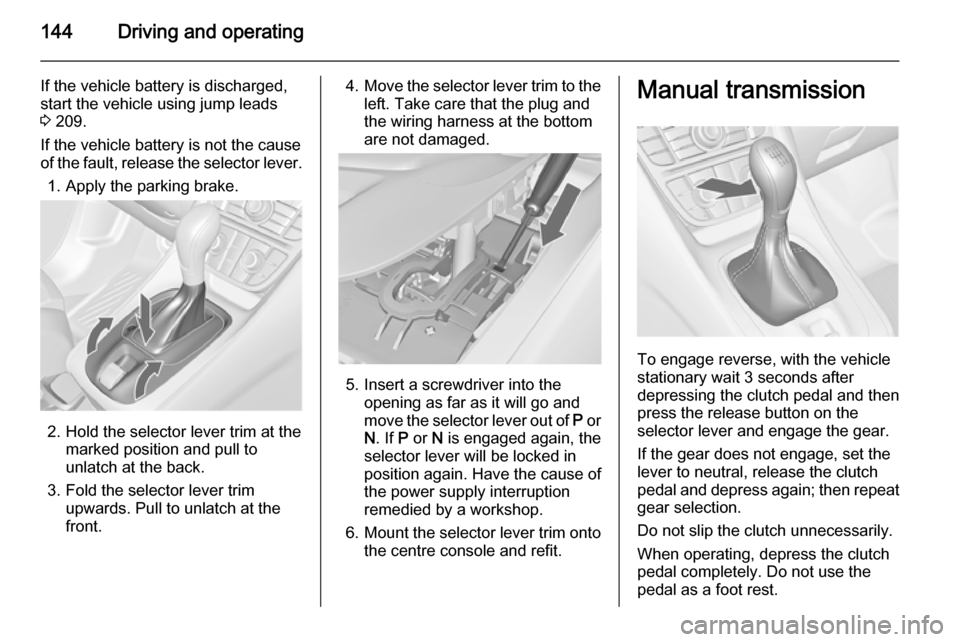
1. Apply the parking brake.
2. Hold the selector lever trim at the marked position and pull tounlatch at the back.
3. Fold the selector lever trim upwards. Pull to unlatch at the
front.
4. Move the selector lever trim to the
left. Take care that the plug and
the wiring harness at the bottom are not damaged.
5. Insert a screwdriver into the opening as far as it will go and
move the selector lever out of P or
N . If P or N is engaged again, the
selector lever will be locked in
position again. Have the cause of
the power supply interruption
remedied by a workshop.
6. Mount the selector lever trim onto
the centre console and refit.
Manual transmission
To engage reverse, with the vehicle
stationary wait 3 seconds after
depressing the clutch pedal and then
press the release button on the
selector lever and engage the gear.
If the gear does not engage, set the
lever to neutral, release the clutch
pedal and depress again; then repeat
gear selection.
Do not slip the clutch unnecessarily.
When operating, depress the clutch
pedal completely. Do not use the
pedal as a foot rest.
Page 148 of 245
146Driving and operating
Fault9Warning
If there is a fault in the ABS, the
wheels may be liable to lock due
to braking that is heavier than
normal. The advantages of ABS are no longer available. During
hard braking, the vehicle can no longer be steered and may
swerve.
Have the cause of the fault remedied
by a workshop.
Parking brake
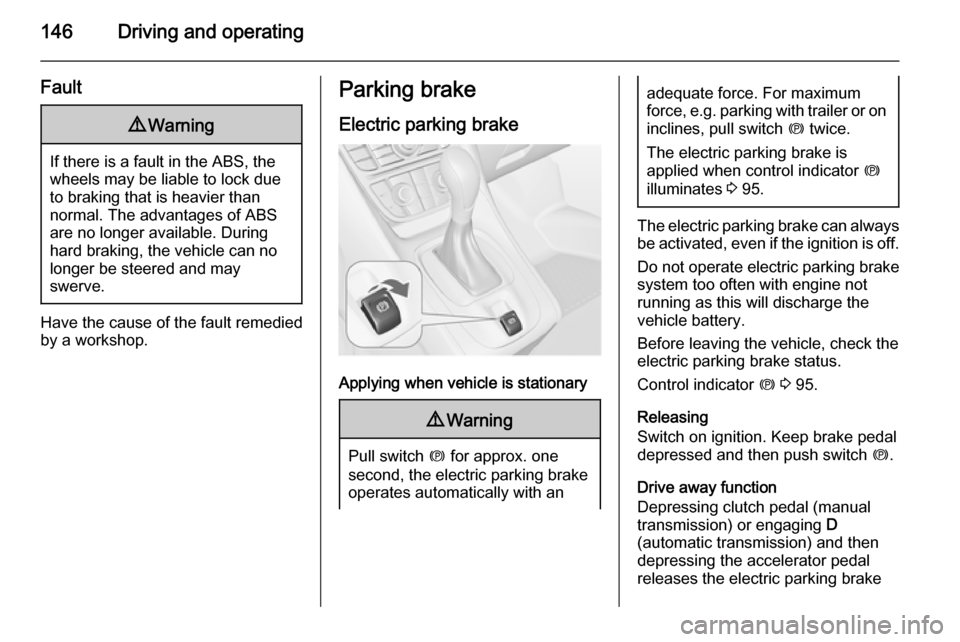
Electric parking brake
Applying when vehicle is stationary
9 Warning
Pull switch m for approx. one
second, the electric parking brake
operates automatically with an
adequate force. For maximum
force, e.g. parking with trailer or on
inclines, pull switch m twice.
The electric parking brake is
applied when control indicator m
illuminates 3 95.
The electric parking brake can always
be activated, even if the ignition is off.
Do not operate electric parking brake
system too often with engine not
running as this will discharge the
vehicle battery.
Before leaving the vehicle, check the electric parking brake status.
Control indicator m 3 95.
Releasing
Switch on ignition. Keep brake pedal
depressed and then push switch m.
Drive away function
Depressing clutch pedal (manual
transmission) or engaging D
(automatic transmission) and then
depressing the accelerator pedal
releases the electric parking brake
Page 152 of 245
150Driving and operating
For safety reasons the cruise control
cannot be activated until the foot
brake has been operated once.
Activating in first gear is not possible.
Do not use the cruise control if it is not advisable to maintain a constant
speed.
With automatic transmission, only
activate cruise control in automatic
mode.
Control indicator m 3 98.
Switching on
Press rocker switch m at the upper
end, control indicator m illuminates
white.
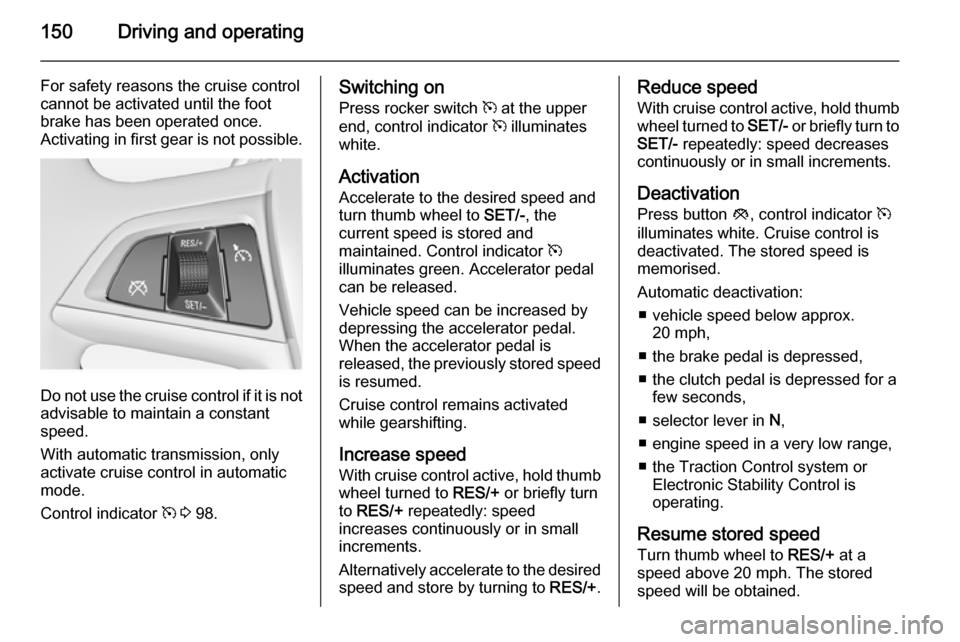
Activation Accelerate to the desired speed and
turn thumb wheel to SET/-, the
current speed is stored and
maintained. Control indicator m
illuminates green. Accelerator pedal
can be released.
Vehicle speed can be increased by depressing the accelerator pedal.
When the accelerator pedal is
released, the previously stored speed
is resumed.
Cruise control remains activated
while gearshifting.
Increase speed With cruise control active, hold thumb
wheel turned to RES/+ or briefly turn
to RES/+ repeatedly: speed
increases continuously or in small
increments.
Alternatively accelerate to the desired speed and store by turning to RES/+.Reduce speed
With cruise control active, hold thumb
wheel turned to SET/- or briefly turn to
SET/- repeatedly: speed decreases
continuously or in small increments.
Deactivation
Press button y, control indicator m
illuminates white. Cruise control is deactivated. The stored speed is
memorised.
Automatic deactivation:
■ vehicle speed below approx. 20 mph,
■ the brake pedal is depressed,
■ the clutch pedal is depressed for a few seconds,
■ selector lever in N,
■ engine speed in a very low range,
■ the Traction Control system or Electronic Stability Control is
operating.
Resume stored speed Turn thumb wheel to RES/+ at a
speed above 20 mph. The stored
speed will be obtained.
Page 189 of 245
Vehicle care187
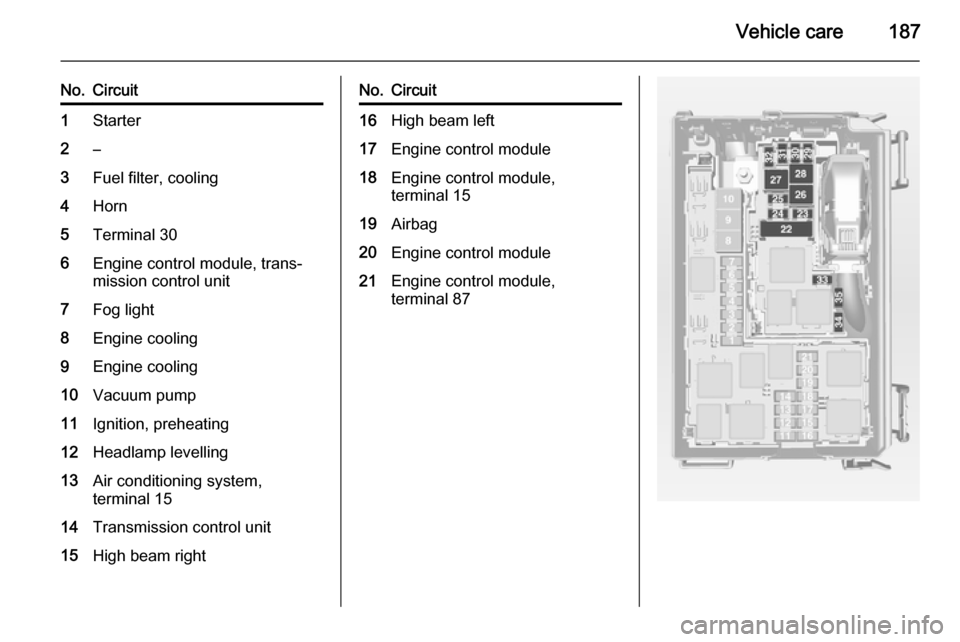
No.Circuit1Starter2–3Fuel filter, cooling4Horn5Terminal 306Engine control module, trans‐
mission control unit7Fog light8Engine cooling9Engine cooling10Vacuum pump11Ignition, preheating12Headlamp levelling13Air conditioning system,
terminal 1514Transmission control unit15High beam rightNo.Circuit16High beam left17Engine control module18Engine control module,
terminal 1519Airbag20Engine control module21Engine control module,
terminal 87
Page 197 of 245
Vehicle care195
Each time the tyres are replaced tyre
pressure monitoring system sensors
must be dismounted and serviced.
For the screwed sensor: replace
valve core and sealing ring. For
clipped sensor: replace complete
valve stem.
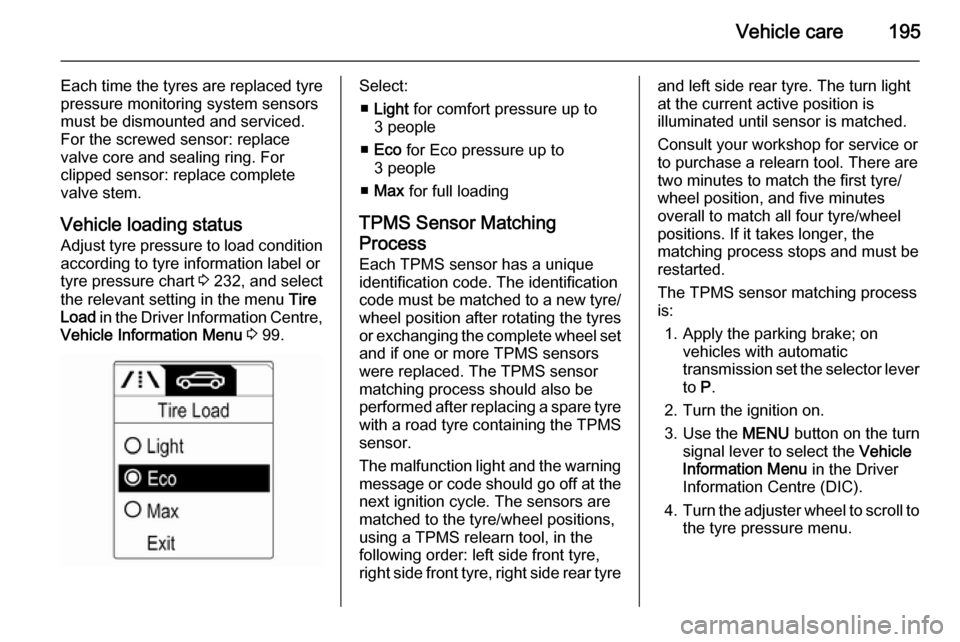
Vehicle loading status Adjust tyre pressure to load condition according to tyre information label or
tyre pressure chart 3 232, and select
the relevant setting in the menu Tire
Load in the Driver Information Centre,
Vehicle Information Menu 3 99.Select:
■ Light for comfort pressure up to
3 people
■ Eco for Eco pressure up to
3 people
■ Max for full loading
TPMS Sensor Matching
Process
Each TPMS sensor has a unique
identification code. The identification
code must be matched to a new tyre/
wheel position after rotating the tyres
or exchanging the complete wheel set and if one or more TPMS sensors
were replaced. The TPMS sensor matching process should also be
performed after replacing a spare tyre
with a road tyre containing the TPMS
sensor.
The malfunction light and the warning
message or code should go off at the
next ignition cycle. The sensors are
matched to the tyre/wheel positions,
using a TPMS relearn tool, in the
following order: left side front tyre,
right side front tyre, right side rear tyreand left side rear tyre. The turn light
at the current active position is
illuminated until sensor is matched.
Consult your workshop for service or
to purchase a relearn tool. There are
two minutes to match the first tyre/
wheel position, and five minutes
overall to match all four tyre/wheel
positions. If it takes longer, the
matching process stops and must be
restarted.
The TPMS sensor matching process is:
1. Apply the parking brake; on vehicles with automatic
transmission set the selector lever
to P.
2. Turn the ignition on.
3. Use the MENU button on the turn
signal lever to select the Vehicle
Information Menu in the Driver
Information Centre (DIC).
4. Turn the adjuster wheel to scroll to
the tyre pressure menu.
Page 212 of 245

210Vehicle care
■ The vehicles must not come intocontact with each other during thejump starting process.
■ Apply the parking brake, transmission in neutral, automatic
transmission in P.
■ Open the positive terminal protection caps of both batteries.
Lead connection order:
1. Connect the red lead to the positive terminal of the booster
battery.
2. Connect the other end of the red lead to the positive terminal of the
discharged battery.
3. Connect the black lead to the negative terminal of the booster
battery.
4. Connect the other end of the black
lead to a vehicle grounding point,
such as the engine block or an
engine mounting bolt. Connect as far away from the discharged
battery as possible, however at
least 60 cm.
Route the leads so that they cannot
catch on rotating parts in the engine
compartment.
To start the engine: 1. Start the engine of the vehicle providing the jump.
2. After 5 minutes, start the other engine. Start attempts should be
made for no longer than
15 seconds at an interval of
1 minute.
3. Allow both engines to idle for approx. 3 minutes with the leads
connected.4. Switch on electrical consumers (e.g. headlights, heated rear
window) of the vehicle receiving
the jump start.
5. Reverse above sequence exactly when removing leads.
Page 213 of 245
Vehicle care211Towing
Towing the vehicle
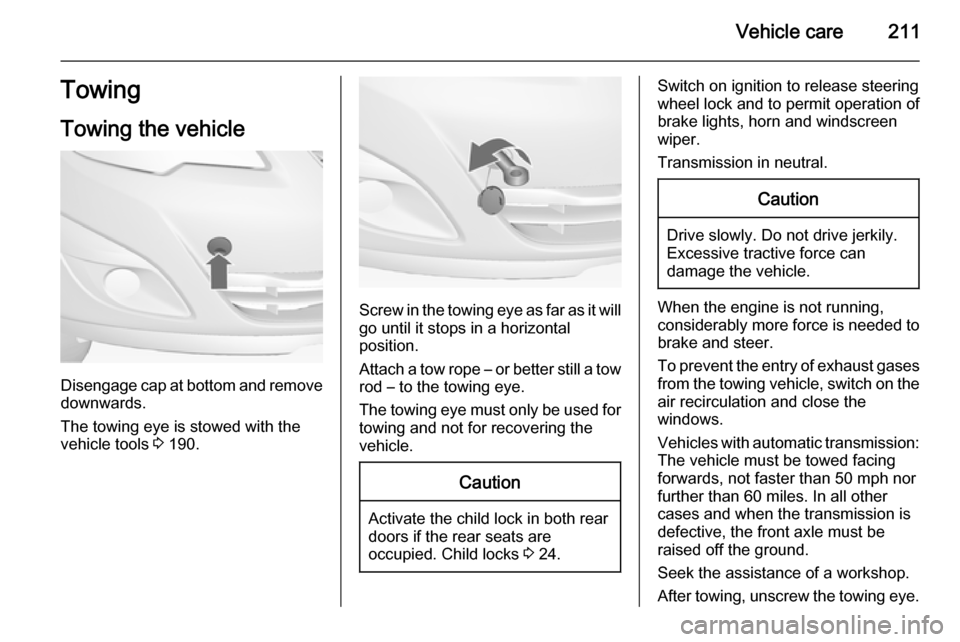
Disengage cap at bottom and remove downwards.
The towing eye is stowed with the
vehicle tools 3 190.
Screw in the towing eye as far as it will
go until it stops in a horizontal
position.
Attach a tow rope – or better still a tow
rod – to the towing eye.
The towing eye must only be used for towing and not for recovering the
vehicle.
Caution
Activate the child lock in both rear
doors if the rear seats are
occupied. Child locks 3 24.
Switch on ignition to release steering
wheel lock and to permit operation of
brake lights, horn and windscreen
wiper.
Transmission in neutral.Caution
Drive slowly. Do not drive jerkily.
Excessive tractive force can
damage the vehicle.
When the engine is not running,
considerably more force is needed to
brake and steer.
To prevent the entry of exhaust gases from the towing vehicle, switch on the
air recirculation and close the
windows.
Vehicles with automatic transmission: The vehicle must be towed facing
forwards, not faster than 50 mph nor further than 60 miles. In all other
cases and when the transmission is
defective, the front axle must be
raised off the ground.
Seek the assistance of a workshop. After towing, unscrew the towing eye.
Page 226 of 245
![VAUXHALL MERIVA 2015 User Guide 224Technical dataEngine dataSales designation1.41.41.4 LPG1.4Engine identifier codeB14XERB14NELB14NELB14NETNumber of cylinders4444Piston displacement [cm3
]1398136413641364Engine power [kW]748888103at](/img/38/19514/w960_19514-225.png "VAUXHALL MERIVA 2015 User Guide 224Technical dataEngine dataSales designation1.41.41.4 LPG1.4Engine identifier codeB14XERB14NELB14NELB14NETNumber of cylinders4444Piston displacement [cm3
]1398136413641364Engine power [kW]748888103at")
224Technical dataEngine dataSales designation1.41.41.4 LPG1.4Engine identifier codeB14XERB14NELB14NELB14NETNumber of cylinders4444Piston displacement [cm3
]1398136413641364Engine power [kW]748888103at rpm60004200-60004800-60004900-6000Torque [Nm]130175/200 2)175200/220 3)at rpm40001750-48001750-48001850-4900Fuel typePetrolPetrolPetrol/LPGPetrolOctane rating RONrecommended95959595possible98989898possible91919191Oil consumption [l/1000 km]0.60.60.60.62)
With six-speed transmission.
3) With overboost function.
Page 229 of 245
![VAUXHALL MERIVA 2015 User Guide Technical data227PerformanceEngineB14XERB14NELB14NEL LPGB14NETMaximum speed4)
[mph]Manual transmission110117117122Automatic transmission–115–1204) The maximum speed indicated is achievable at ker](/img/38/19514/w960_19514-228.png "VAUXHALL MERIVA 2015 User Guide Technical data227PerformanceEngineB14XERB14NELB14NEL LPGB14NETMaximum speed4)
[mph]Manual transmission110117117122Automatic transmission–115–1204) The maximum speed indicated is achievable at ker")
Technical data227PerformanceEngineB14XERB14NELB14NEL LPGB14NETMaximum speed4)
[mph]Manual transmission110117117122Automatic transmission–115–1204) The maximum speed indicated is achievable at kerb weight (without driver) plus 200 kg payload. Optional equipment could reduce the specified maximum
speed of the vehicle.EngineB16DTCB16DTLB16DTNB16DTHB16DTEMaximum speed 4)
[mph]Manual transmission108115113122115Automatic transmission–––––4) The maximum speed indicated is achievable at kerb weight (without driver) plus 200 kg payload. Optional equipment could reduce the specified maximum
speed of the vehicle.