AUX VAUXHALL MOKKA 2016 User Guide
[x] Cancel search | Manufacturer: VAUXHALL, Model Year: 2016, Model line: MOKKA, Model: VAUXHALL MOKKA 2016Pages: 231, PDF Size: 6.55 MB
Page 159 of 231
Driving and operating157The multivalve on the liquid gas tank
automatically limits the fill quantity. If
a larger quantity is added, we
recommend not exposing the vehicle
to the sun until the excess amount
has been used up.
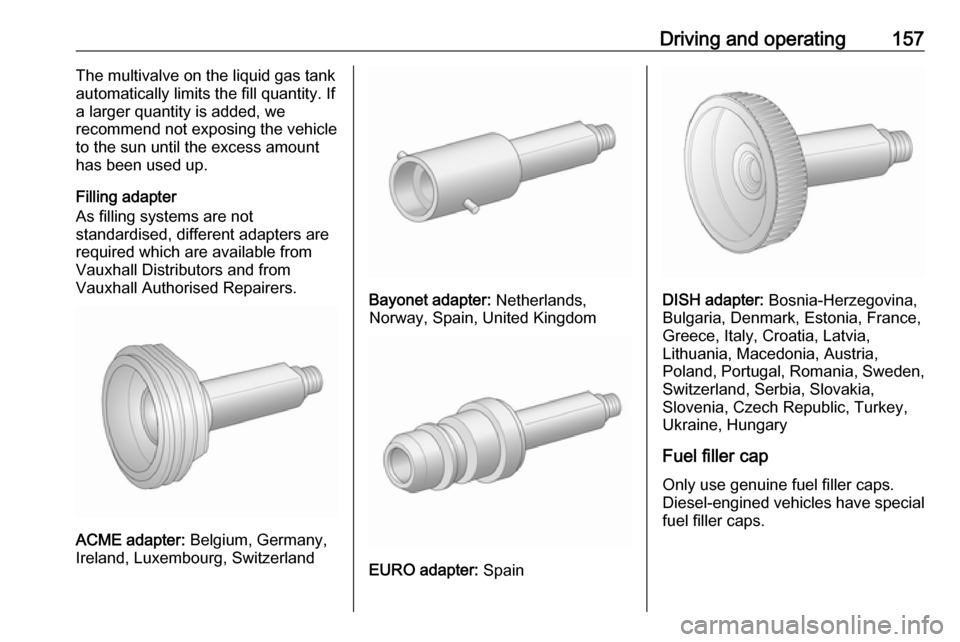
Filling adapter
As filling systems are not
standardised, different adapters are
required which are available from
Vauxhall Distributors and from
Vauxhall Authorised Repairers.
ACME adapter: Belgium, Germany,
Ireland, Luxembourg, Switzerland
Bayonet adapter: Netherlands,
Norway, Spain, United Kingdom
EURO adapter: Spain
DISH adapter: Bosnia-Herzegovina,
Bulgaria, Denmark, Estonia, France,
Greece, Italy, Croatia, Latvia,
Lithuania, Macedonia, Austria,
Poland, Portugal, Romania, Sweden,
Switzerland, Serbia, Slovakia,
Slovenia, Czech Republic, Turkey,
Ukraine, Hungary
Fuel filler cap
Only use genuine fuel filler caps.
Diesel-engined vehicles have special
fuel filler caps.
Page 160 of 231

158Driving and operatingFuel consumption - CO2-
Emissions
The values for fuel consumption
(combined) of the model Vauxhall
Mokka is within a range of 37 to
69 mpg.
The values for CO 2 emission
(combined) is within a range of 158 to 109 g/km.
For the values specific to your
vehicle, refer to the EEC Certificate of
Conformity provided with your vehicle or other national registration
documents.
General information
The official fuel consumption and
specific CO 2 emission figures quoted
relate to the EU base model with
standard equipment.
Fuel consumption data and CO 2
emission data are determined
according to regulation
R (EC) No. 715/2007 (in the latest
applicable version), taking intoconsideration the vehicle weight in running order, as specified by the
regulation.
The figures are provided only for the
purpose of comparison between
different vehicle variants and must
not be taken as a guarantee for the
actual fuel consumption of a
particular vehicle. Additional
equipment may result in slightly
higher results than the stated
consumption and CO 2 figures.
Furthermore, fuel consumption is
dependent on personal driving style
as well as road and traffic conditions.Trailer hitch
General information
Only use towing equipment that has
been approved for your vehicle.
Entrust retrofitting of towing
equipment to a workshop. It may be
necessary to make changes that
affect the cooling system, heat
shields or other equipment.
The bulb outage detection function for
trailer brake light cannot detect a
partial bulb outage, e.g. in case of four times five watt bulbs, the function only
detects lamp outage when only a
single five Watt lamp remains or none remain.
Fitting of towing equipment could
cover the opening of the towing eye. If this is the case, use the coupling ball
bar for towing. Always keep the
coupling ball bar in the vehicle when
not in use.
Page 172 of 231

170Vehicle careReplacing the vehicle batteryNotice
Any deviation from the instructions
given in this section may lead to
temporary deactivation of the stop-
start system.
When the vehicle battery is being
replaced, please ensure that there
are no open ventilation holes in the
vicinity of the positive terminal. If a
ventilation hole is open in this area, it
must be closed off with a dummy cap, and the ventilation in the vicinity of the
negative terminal must be opened.
Only use vehicle batteries that allow
the fuse box to be mounted above the
vehicle battery.
In vehicles with an AGM (Absorptive Glass Mat) battery, make sure to
have the battery replaced with
another AGM battery.
An AGM battery can be identified by
the label on the battery. We
recommend the use of an original
Vauxhall vehicle battery.
Notice
Using an AGM vehicle battery
different from the original Vauxhall
vehicle battery may result in a lower performance.
We recommend that you have the
vehicle battery replaced by a
workshop.
Stop-start system 3 127.
Charging the vehicle battery9 Warning
On vehicles with stop-start
system, ensure that the charging potential does not exceed
14.6 volts when using a battery
charger. Otherwise the vehicle
battery might be damaged.
Jump starting 3 198.
Warning label
Page 184 of 231
182Vehicle careNo.Circuit18Rain sensor19Body control module/Regulated
voltage control20Steering wheel21AC accessory power outlet/
Automatic transmission22Cigarette lighter/DC accessory
power outlet23Spare24Spare25Spare26Spare27Instrument panel cluster/Auxil‐
iary heater/Clutch switch28Adaptive forward lighting/
Voltage converter/Headlamp
switch29Spare30SpareNo.Circuit31Instrument panel cluster32Infotainment system/Chime33Display/Infotainment system34Onstar UHP/DAB
S/B Fuses
No.Circuit01Spare02Spare03Power windows front04Power windows rear05Logistic mode06Spare07Spare08SpareLoad compartment fuse box
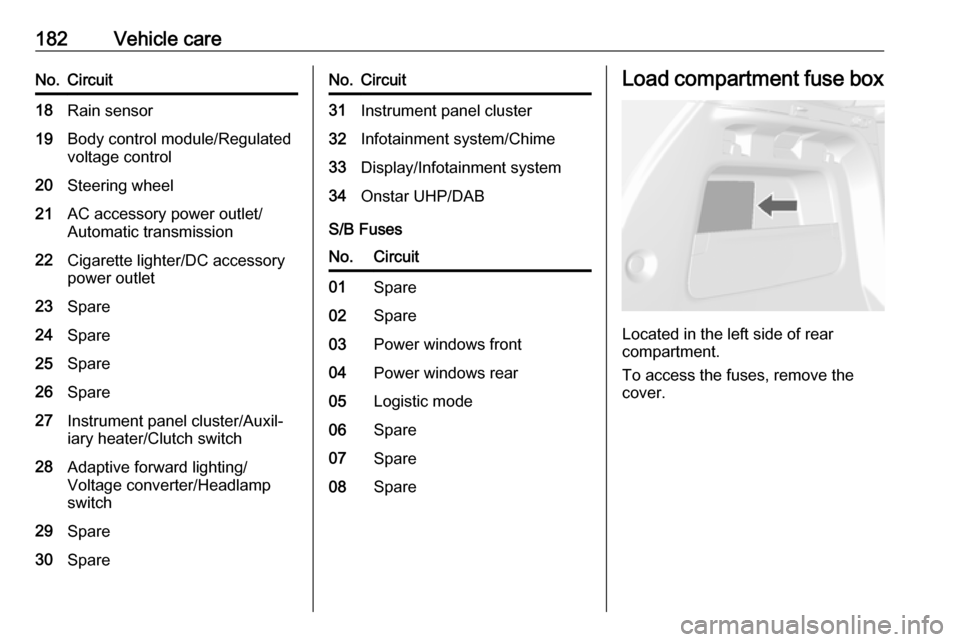
Located in the left side of rear
compartment.
To access the fuses, remove the cover.
Page 225 of 231

Customer information223Vehicle data recording
and privacy
Event data recorders Data storage modules in the
vehicle
A large number of electronic
components of your vehicle contain
data storage modules temporarily or
permanently storing technical data
about the condition of the vehicle,
events and errors. In general, this
technical information documents the
condition of parts, modules, systems
or the environment:
● Operating conditions of system components (e.g. filling levels)
● Status messages of the vehicle and its single components (e.g.
number of wheel revolutions / rotational speed, deceleration,
lateral acceleration)
● Dysfunctions and defects in important system components● Vehicle reactions in particular driving situations (e.g. inflation of
an airbag, activation of the
stability regulation system)
● Environmental conditions (e.g. temperature)
These data are exclusively technical
and help identifying and correcting
errors as well as optimizing vehicle
functions.
Motion profiles indicating travelled
routes cannot be created with these
data.
If services are used (e.g. repair
works, service processes, warranty cases, quality assurance),
employees of the service network
(manufacturer included) are able to
read out this technical information
from the event and error data storage
modules applying special diagnostic
devices. If required, you will receive
further information at these
workshops. After an error has been
corrected, the data are deleted from
the error storage module or they are
constantly overwritten.When using the vehicle, situations
may occur in which these technical
data related to other information
(accident report, damages on the
vehicle, witness statements etc.) may
be associated with a specific person - possibly, with the assistance of an
expert.
Additional functions contractually
agreed upon with the client (e.g.
vehicle location in emergency cases)
allow the transmission of particular vehicle data from the vehicle.
Radio Frequency
Identification (RFID)
RFID technology is used in some
vehicles for functions such as tyre
pressure monitoring and ignition
system security. It is also used in
connection with conveniences such
as radio remote controls for door
locking/unlocking and starting, and in-
vehicle transmitters for garage door
openers. RFID technology in
Vauxhall vehicles does not use or
record personal information or link
with any other Vauxhall system
containing personal information.
Page 226 of 231

224IndexAAccessories and vehicle modifications .......................... 164
Adaptive forward lighting .....87, 110
Adjustable air vents ...................122
Airbag and belt tensioners ...........83
Airbag deactivation ................47, 83
Airbag label................................... 42 Airbag system .............................. 42
Air conditioning regular operation ................................ 123
Air conditioning system .............. 118
Air intake .................................... 122
Air vents...................................... 122
All-wheel drive ........................... 135
Antilock brake system ................ 136
Antilock brake system (ABS) .......84
Anti-theft alarm system ................25
Anti-theft locking system .............. 25
Appearance care ........................202
Automatic anti-dazzle ..................29
Automatic light control ...............108
Automatic locking ........................23
Automatic transmission .............131
Auxiliary heater ........................... 121
B Battery discharge protection ......116
Battery voltage ............................. 95 Bicycle rack .................................. 56Bonnet ....................................... 165
Bonnet open ................................. 88
Brake and clutch fluid .................206
Brake and clutch system .............84
Brake assist ............................... 137
Brake fluid .................................. 169
Brakes ............................... 136, 169
Breakdown.................................. 200
Bulb replacement ....................... 172
C
Capacities .................................. 217
Catalytic converter .....................131
Central locking system ................21
Centre console storage ...............56
Centre high-mounted brake light 177
Changing tyre and wheel size ...190
Charging system .......................... 84
Child locks ................................... 24
Child restraint installation locations ................................... 49
Child restraints.............................. 48
Child restraint systems ................48
Climate control ............................. 15
Climate control systems .............117
Clock ............................................ 75
Code ............................................. 94
Collision damage repair ..............221
Control indicators.......................... 80
Control of the vehicle .................125