belt VAUXHALL MOKKA 2016 Owner's Guide
[x] Cancel search | Manufacturer: VAUXHALL, Model Year: 2016, Model line: MOKKA, Model: VAUXHALL MOKKA 2016Pages: 231, PDF Size: 6.55 MB
Page 125 of 231

Climate control123Air conditioning regular
operation
In order to ensure continuously
efficient performance, cooling must
be operated for a few minutes once a month, irrespective of the weather
and time of year. Operation with
cooling is not possible when the
outside temperature is too low.
Service For optimal cooling performance, it is
recommended to annually check the
climate control system, starting
three years after initial vehicle
registration, including:
● functionality and pressure test
● heating functionality
● leakage check
● check of drive belts
● cleaning of condenser and evaporator drainage
● performance check
Page 130 of 231

128Driving and operating
An Autostop is indicated by the
needle at the AUTOSTOP position in
the tachometer.
During an Autostop, the heating
performance, power steering and
brake performance will be
maintained.
Conditions for an Autostop
The stop-start system checks if each
of the following conditions is fulfilled:
● The stop-start system is not manually deactivated .
● The bonnet is fully closed.
● The driver's door is closed or the driver's seat belt is fastened.
● The battery is sufficientlycharged and in good condition.
● The engine is warmed up.
● The engine coolant temperature is not too high.
● The engine exhaust temperature is not too high, e.g. after driving
with high engine load.
● The ambient temperature is not too low.
● The climate control system allows an Autostop.
● The brake vacuum is sufficient.
● The self-cleaning function of the diesel particle filter is not active.
● The vehicle has moved since the
last Autostop.
Otherwise an Autostop will be
inhibited.
Ambient temperature near to the
freezing point can inhibit an Autostop.
Certain settings of the climate control
system may inhibit an Autostop. See
'Climate control' chapter for more
details.
Immediately after motorway driving
an Autostop may be inhibited.New vehicle running-in 3 125.
Battery discharge protection To ensure reliable engine restarts,
several battery discharge protection
features are implemented as part of
the stop-start system.
Power saving measures
During an Autostop, several electrical
features such as auxiliary electric
heater or rear window heating are
disabled or switched into a power
saving mode. The fan speed of the
climate control system is reduced to
save power.
Restart of the engine by the driver Depress the clutch pedal to restart the
engine.
The engine start is indicated by the
needle at the idle speed position in
the tachometer.
If the selector lever is shifted out of
neutral before depressing the clutch
first, control indicator - illuminates
or is shown as a message in the Driver Information Centre.
Control indicator - 3 84.
Page 131 of 231

Driving and operating129Restart of the engine by the stop-start system
The selector lever must be in neutral
to enable an automatic restart.
If one of the following conditions
occurs during an Autostop, the
engine will be restarted automatically by the stop-start system:
● The stop-start system is manually deactivated.
● The bonnet is opened.
● The driver's seat belt is unfastened and the driver's door
is opened.
● The engine temperature is too low.
● The battery is discharged.
● The brake vacuum is not sufficient.
● The vehicle starts to move.
● The climate control system requests an engine start.
● The air conditioning is manually switched on.If the bonnet is not fully closed, a
warning message is displayed in the
Driver Information Centre.
If an electrical accessory, e.g. a
portable CD player, is connected to
the power outlet, a brief power drop
during engine restart might be
noticeable.
Parking9 Warning
● Do not park the vehicle on an
easily ignitable surface. The
high temperature of the
exhaust system could ignite the
surface.
● Always apply the parking brake. Activate the parking
brake without pressing the
release button. Apply as firmly
as possible on a downhill slope
or uphill slope. Depress brake
pedal at the same time to
reduce operating force.
● Switch off the engine.
● If the vehicle is on a level surface or uphill slope, engage
first gear or set the selector
lever to position P before
removing the ignition key. On
an uphill slope, turn the front
wheels away from the kerb.
If the vehicle is on a downhill
slope, engage reverse gear or
set the selector lever to position P before removing the ignition
key. Turn the front wheels
towards the kerb.
● Close the windows and the sunroof.
● Remove the ignition key from the ignition switch. For vehicles
with automatic transmission,
the key can only be removed
when the selector lever is in
position P.
Turn the steering wheel until
the steering wheel lock is felt to engage.
● Lock the vehicle.
● Activate the anti-theft alarm system.
Page 187 of 231
Vehicle care185Tyre designations
E.g. 215/60 R 16 95 H215:tyre width, mm60:cross-section ratio (tyre height
to tyre width), percentageR:belt type: RadialRF:type: RunFlat16:wheel diameter, inches95:load index e.g. 95 is equivalent to 690 kgH:speed code letter
Speed code letter:
Q:up to 100 mphS:up to 112 mphT:up to 118 mphH:up to 130 mphV:up to 150 mphW:up to 168 mph
Choose a tyre appropiate for the
maximum speed of your verhicle.
The maximum speed is achievable at
kerb weight with driver (75 kg) plus
125 kg payload. Optional equipment
could reduce the maximum speed of
the vehicle.
Performance 3 214.
Directional tyres
Fit directional tyres such that they roll
in the direction of travel. The rolling
direction is indicated by a symbol
(e.g. an arrow) on the sidewall.
Tyre pressure
Check the pressure of cold tyres at
least every 14 days and before any
long journey. Do not forget the spare
wheel. This also applies to vehicles
with tyre pressure monitoring system.
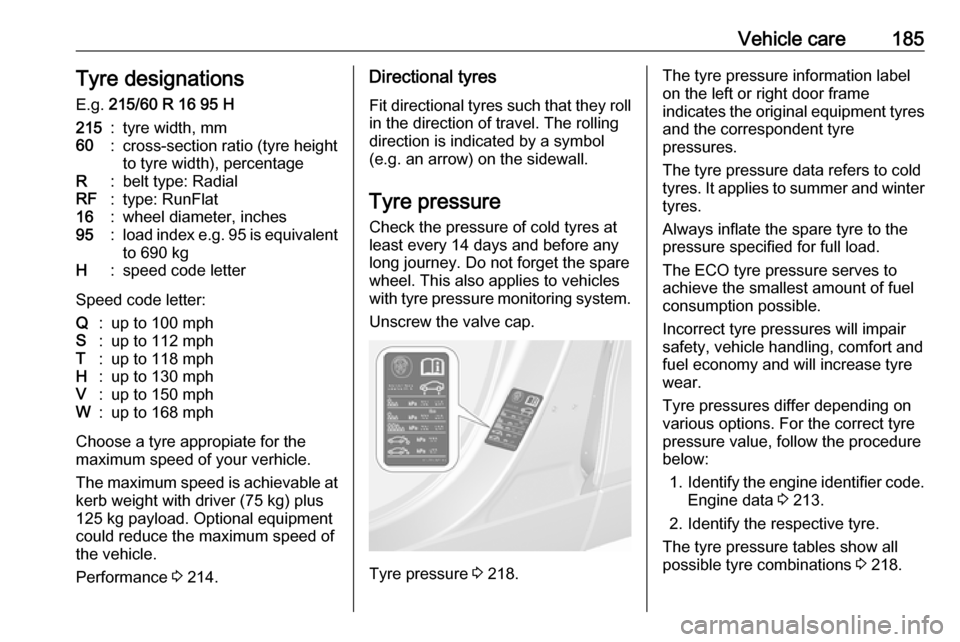
Unscrew the valve cap.
Tyre pressure 3 218.
The tyre pressure information label
on the left or right door frame
indicates the original equipment tyres
and the correspondent tyre
pressures.
The tyre pressure data refers to cold
tyres. It applies to summer and winter tyres.
Always inflate the spare tyre to the
pressure specified for full load.
The ECO tyre pressure serves to
achieve the smallest amount of fuel
consumption possible.
Incorrect tyre pressures will impair
safety, vehicle handling, comfort and
fuel economy and will increase tyre
wear.
Tyre pressures differ depending on
various options. For the correct tyre
pressure value, follow the procedure
below:
1. Identify the engine identifier code.
Engine data 3 213.
2. Identify the respective tyre.
The tyre pressure tables show all possible tyre combinations 3 218.
Page 193 of 231
Vehicle care191Special snow chains are only
permitted when they are designed
with a rotating chain belt on the tyre tread, no chain links on the wheel
inboard sides and the chains add no
more than 12 mm to the tyre tread.
For further information regarding
correct snow chain usage for this tyre
size, contact a specialized vehicle
parts dealer or snow chain
manufacturer.
Only use tyre chains on production
tyre that meet the vehicle
specifications.
The use of tyre chains is not permitted
on the temporary spare wheel.
Tyre repair kit
Minor damage to the tyre tread can be repaired with the tyre repair kit.
Do not remove foreign bodies from
the tyres.
Tyre damage exceeding 4 mm or that
is at tyre's sidewall cannot be repaired with the tyre repair kit.9 Warning
Do not drive faster than 50 mph.
Do not use for a lengthy period.
Steering and handling may be
affected.
If you have a flat tyre:
Apply the parking brake and engage
first gear, reverse gear or P.
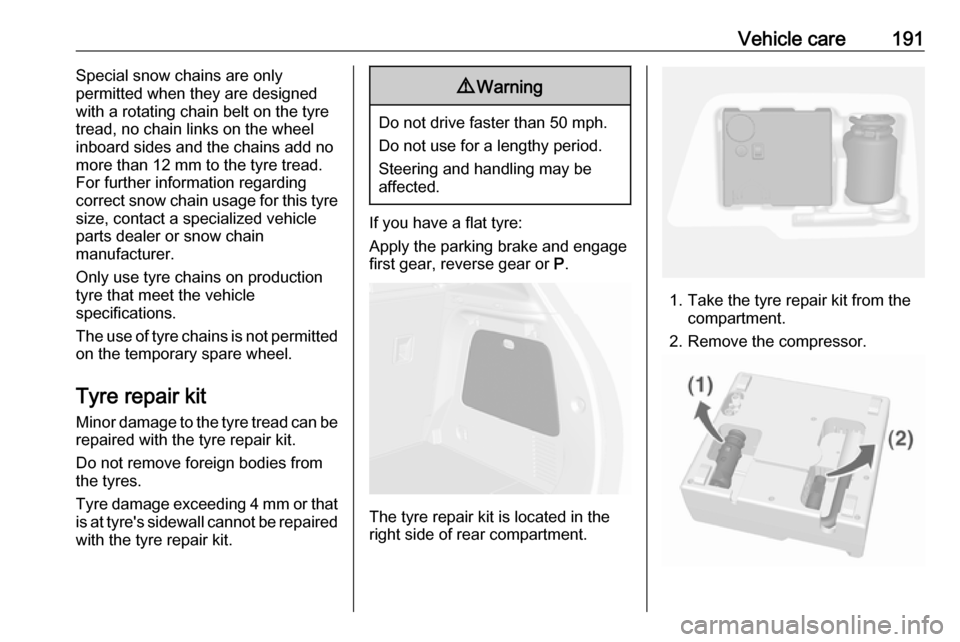
The tyre repair kit is located in the
right side of rear compartment.
1. Take the tyre repair kit from the compartment.
2. Remove the compressor.
Page 206 of 231
204Vehicle careBefore and after winter, wash the
underbody and have the protective
wax coating checked.
Liquid gas system9 Danger
Liquid gas is heavier than air and
can collect in sink points.
Take care when performing work
at the underbody in a pit.
For painting work and when using a
drying booth at a temperature above
60 °C, the liquid gas system must be
completely evacuated.
Do not make any modifications to the
liquid gas system.
Towing equipment
Do not clean the coupling ball bar with a steam-jet or high-pressure jet
cleaner.
Rear carrier system Clean the rear carrier system with a
steam-jet or high-pressure jet cleaner
at least once a year.
Operate the rear carrier system
periodically if not in regular use, in
particular during winter.
Interior care
Interior and upholstery Only clean the vehicle interior,
including the instrument panel fascia
and panelling, with a dry cloth or
interior cleaner.
Clean the leather upholstery with
clear water and a soft cloth. In case of
heavy soiling, use leather care.
The instrument cluster and the
displays should only be cleaned using
a soft damp cloth. If necessary use a
weak soap solution.
Clean fabric upholstery with a
vacuum cleaner and brush. Remove
stains with an upholstery cleaner.
Clothing fabrics may not be
colourfast. This could cause visible
discolourations, especially on light- coloured upholstery. Removable
stains and discolourations should be
cleaned as soon as possible.Clean seat belts with lukewarm water or interior cleaner.Caution
Close Velcro fasteners as open
Velcro fasteners on clothing could damage seat upholstery.
The same applies to clothing with
sharp-edged objects, e.g. zips, belts or studded jeans.
Plastic and rubber parts
Plastic and rubber parts can be
cleaned with the same cleaner as
used to clean the body. Use interior
cleaner if necessary. Do not use any
other agent. Avoid solvents and petrol in particular. Do not use high-
pressure jet cleaners.
Page 226 of 231

224IndexAAccessories and vehicle modifications .......................... 164
Adaptive forward lighting .....87, 110
Adjustable air vents ...................122
Airbag and belt tensioners ...........83
Airbag deactivation ................47, 83
Airbag label................................... 42 Airbag system .............................. 42
Air conditioning regular operation ................................ 123
Air conditioning system .............. 118
Air intake .................................... 122
Air vents...................................... 122
All-wheel drive ........................... 135
Antilock brake system ................ 136
Antilock brake system (ABS) .......84
Anti-theft alarm system ................25
Anti-theft locking system .............. 25
Appearance care ........................202
Automatic anti-dazzle ..................29
Automatic light control ...............108
Automatic locking ........................23
Automatic transmission .............131
Auxiliary heater ........................... 121
B Battery discharge protection ......116
Battery voltage ............................. 95 Bicycle rack .................................. 56Bonnet ....................................... 165
Bonnet open ................................. 88
Brake and clutch fluid .................206
Brake and clutch system .............84
Brake assist ............................... 137
Brake fluid .................................. 169
Brakes ............................... 136, 169
Breakdown.................................. 200
Bulb replacement ....................... 172
C
Capacities .................................. 217
Catalytic converter .....................131
Central locking system ................21
Centre console storage ...............56
Centre high-mounted brake light 177
Changing tyre and wheel size ...190
Charging system .......................... 84
Child locks ................................... 24
Child restraint installation locations ................................... 49
Child restraints.............................. 48
Child restraint systems ................48
Climate control ............................. 15
Climate control systems .............117
Clock ............................................ 75
Code ............................................. 94
Collision damage repair ..............221
Control indicators.......................... 80
Control of the vehicle .................125
Page 229 of 231

227Rear fog light ....................... 88, 113
Rear view camera ...................... 146
Rear window wiper/washer .......... 74 Recommended fluids and lubricants ........................ 206, 210
Refuelling ................................... 154 Reversing lights .........................113
Ride control systems ..................137
Roof .............................................. 32
Roof load ...................................... 69
Roof rack ..................................... 68
S Seat adjustment ....................... 6, 36
Seat belt ........................................ 8
Seat belt reminder .......................83
Seat belts ..................................... 39
Seat heating ................................. 38
Seat position ................................ 35
Selector lever ............................. 132
Service ....................................... 123
Service display ............................ 79
Service information ....................205
Service vehicle soon .................... 84
Side airbag system ......................45
Side turn signal lights ................177
Software acknowledgement .......221
Spare wheel ............................... 196
Speed limiter............................... 141
Speedometer ............................... 77Starting and operating ................125
Starting off ................................... 16
Starting the engine ....................126
Steering ...................................... 125
Steering wheel adjustment ......9, 71
Steering wheel controls ...............71
Stop-start system........................ 127
Storage compartments .................54
Sunglasses storage .....................55
Sunroof ........................................ 32
Sunvisor lights ........................... 115
Sun visors .................................... 31
Symbols ......................................... 4
T
Tachometer ................................. 78
Tail lights ................................... 176
Three-point seat belt .................... 40
Tools .......................................... 184
Top-tether fastening eyes ............53
Tow bar....................................... 158
Towing ................................ 158, 200
Towing another vehicle .............201
Towing equipment .....................160
Towing the vehicle .....................200
Traction Control system ............. 137
Traction Control system off........... 86
Traffic sign assistant ...................148
Trailer towing ............................. 159
Transmission ............................... 16Transmission display .................131
Tread depth ............................... 189
Trip computer .............................. 96
Trip odometer .............................. 77
Turn and lane-change signals ...113
Turn signal ................................... 83
Tyre chains ................................ 190
Tyre designations ......................185
Tyre pressure ............................ 185
Tyre pressure monitoring system ............................... 86, 186
Tyre pressures ........................... 218
Tyre repair kit ............................. 191
U Ultrasonic parking assist ...... 85, 144
Underseat storage .......................56
Upholstery .................................. 204
Upshift .......................................... 85
Using this manual ..........................3
V Vehicle battery ........................... 169
Vehicle checks............................ 165
Vehicle data ................................ 210
Vehicle data recording and privacy ..................................... 223
Vehicle detected ahead ................88
Vehicle dimensions .................... 215
Vehicle Identification Number ....208
Vehicle jack ................................ 184