lock VAUXHALL MOVANO_B 2014 Service Manual
[x] Cancel search | Manufacturer: VAUXHALL, Model Year: 2014, Model line: MOVANO_B, Model: VAUXHALL MOVANO_B 2014Pages: 201, PDF Size: 4.74 MB
Page 152 of 201
150Vehicle care
SymbolCircuitZInfotainment system, seat
heating, vehicle display
screen, audio connections,
alarm?Power outletÌCigarette lightereInstrument panelUCentral lockingOTurn signals, rear fog lights, body control moduleDIAGDiagnostic connectoruABS, Electronic stability
programdInterior lights, brake lightsZBody control moduleSTOPBrake lightIBody control module, power windows, air conditioningmLeft heated rear windowSymbolCircuitnRight heated rear windowRWindscreen washerMElectronic immobiliserUHeated seatsFBLCornering lightlHands-free connection&TachographPTOPower take-offjHornÍPreheating, diesel fuel filterxClimate control fanADPAdditional adaptations,Power windows, body
control moduleVehicle tools
Tools
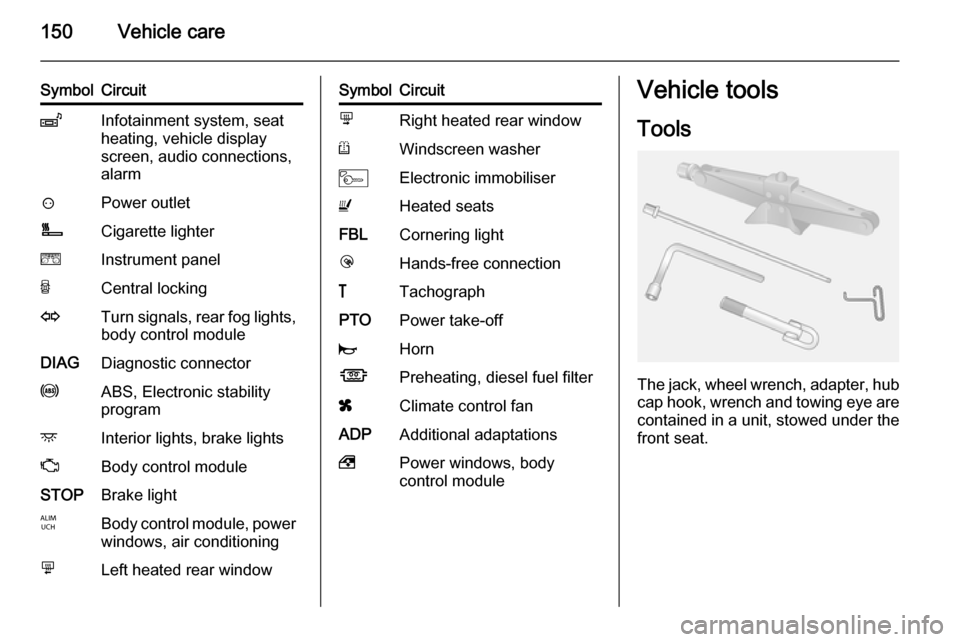
The jack, wheel wrench, adapter, hubcap hook, wrench and towing eye are
contained in a unit, stowed under the front seat.
Page 156 of 201
154Vehicle care
Always use fine mesh chains that addno more than 15 mm to the tyre tread
and the inboard sides (including chain
lock).9 Warning
Damage may lead to tyre blowout.
Wheel covers on steel wheels may
come into contact with parts of the
chains. In such cases, remove the
wheel covers.
Tyre chains may only be used at
speeds up to 30 mph and, when
travelling on roads that are free of
snow, they may only be used for brief
periods since they are subject to rapid wear on a hard road and may snap.
The use of tyre chains is not permitted on the temporary spare wheel.
Tyre repair kit
Minor damage to the tyre tread can be
repaired with the tyre repair kit.
Do not remove foreign bodies from
the tyres.
Tyre damage exceeding 4 mm or that
is at the tyre's sidewall near the rim
cannot be repaired with the tyre repair kit.9 Warning
Do not drive faster than 50 mph.
Do not use for a lengthy period.
Steering and handling may be
affected.
If the vehicle has a flat tyre:
Apply the parking brake and engage
first gear or reverse gear.
The tyre repair kit is located under the
front seat. Slide seat forwards fully
and fold backrest down to access kit.
1. Take the tyre repair kit out from under the front seat.
2. Remove the compressor.
3. Remove the power supply lead and air hose from the stowage
compartments on the underside
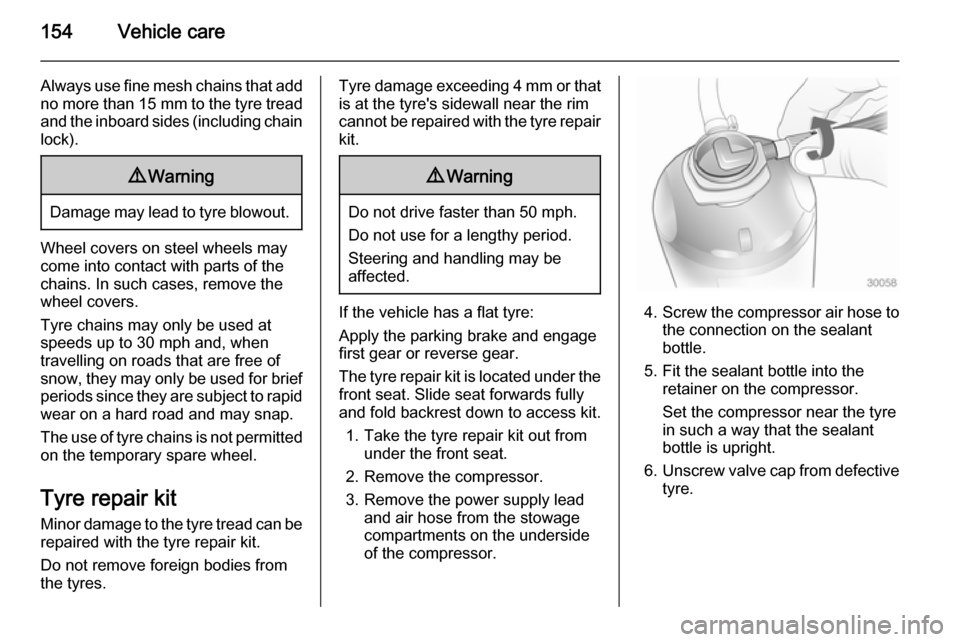
of the compressor.4. Screw the compressor air hose to
the connection on the sealant
bottle.
5. Fit the sealant bottle into the retainer on the compressor.
Set the compressor near the tyre
in such a way that the sealant
bottle is upright.
6. Unscrew valve cap from defective
tyre.
Page 157 of 201
Vehicle care155
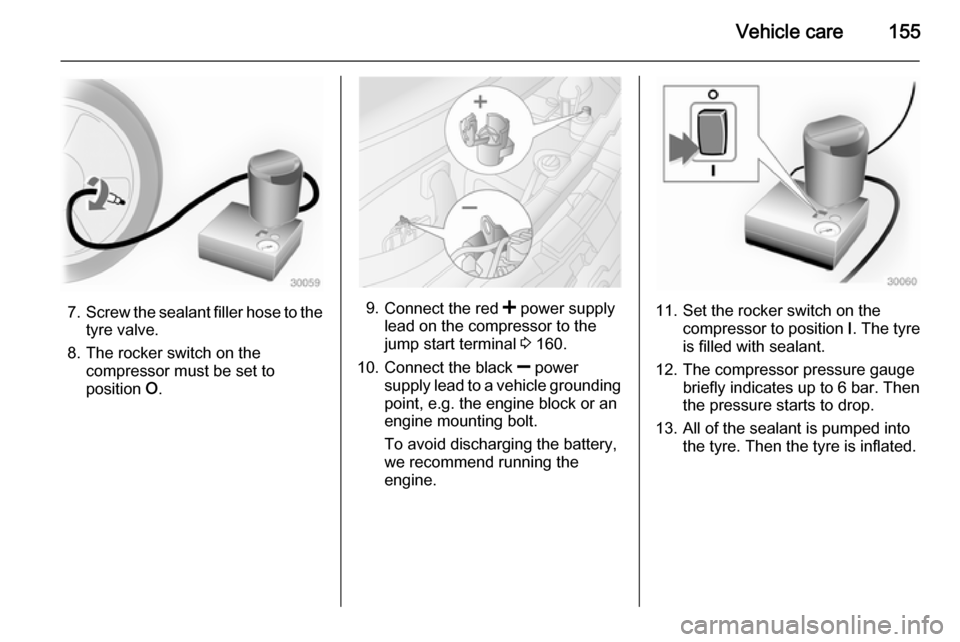
7.Screw the sealant filler hose to the
tyre valve.
8. The rocker switch on the compressor must be set to
position O.9.
Connect the red < power supply
lead on the compressor to the
jump start terminal 3 160.
10. Connect the black ] power
supply lead to a vehicle grounding
point, e.g. the engine block or an
engine mounting bolt.
To avoid discharging the battery,
we recommend running the
engine.11. Set the rocker switch on the compressor to position I. The tyre
is filled with sealant.
12. The compressor pressure gauge briefly indicates up to 6 bar. Then
the pressure starts to drop.
13. All of the sealant is pumped into the tyre. Then the tyre is inflated.
Page 164 of 201
162Vehicle care
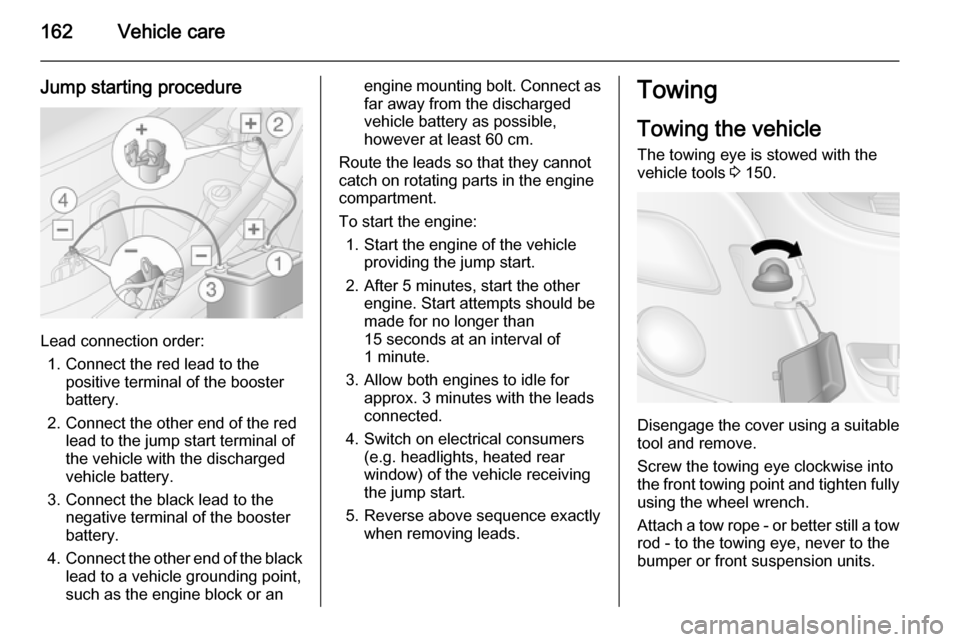
Jump starting procedure
Lead connection order:1. Connect the red lead to the positive terminal of the booster
battery.
2. Connect the other end of the red lead to the jump start terminal of
the vehicle with the discharged
vehicle battery.
3. Connect the black lead to the negative terminal of the booster
battery.
4. Connect the other end of the black
lead to a vehicle grounding point,
such as the engine block or an
engine mounting bolt. Connect as far away from the discharged
vehicle battery as possible,
however at least 60 cm.
Route the leads so that they cannot
catch on rotating parts in the engine
compartment.
To start the engine: 1. Start the engine of the vehicle providing the jump start.
2. After 5 minutes, start the other engine. Start attempts should be
made for no longer than
15 seconds at an interval of
1 minute.
3. Allow both engines to idle for approx. 3 minutes with the leads
connected.
4. Switch on electrical consumers (e.g. headlights, heated rear
window) of the vehicle receiving
the jump start.
5. Reverse above sequence exactly when removing leads.Towing
Towing the vehicle The towing eye is stowed with thevehicle tools 3 150.
Disengage the cover using a suitable
tool and remove.
Screw the towing eye clockwise into
the front towing point and tighten fully using the wheel wrench.
Attach a tow rope - or better still a tow
rod - to the towing eye, never to the
bumper or front suspension units.
Page 165 of 201
Vehicle care163Caution
Do not tow the vehicle from the
rear. The front towing eye must
only be used for towing and not
recovering a vehicle.
Switch on ignition to release steering
wheel lock and to permit operation of
brake lights, horn and windscreen
wipers.
Switch off the air suspension system
3 110.
Transmission in neutral.
If neutral cannot be selected on
vehicles with MTA transmission, the vehicle must only be towed with the
drive wheels raised off the ground.
Caution
Drive slowly. Do not drive jerkily.
Excessive tractive force can
damage the vehicle.
When the engine is not running,
considerably more force is needed to
brake and steer.
To prevent the entry of exhaust fumes
from the towing vehicle, switch on the air recirculation system and close the
windows.
Seek the assistance of a workshop.
After towing, unscrew the towing eye
and refit the cover.
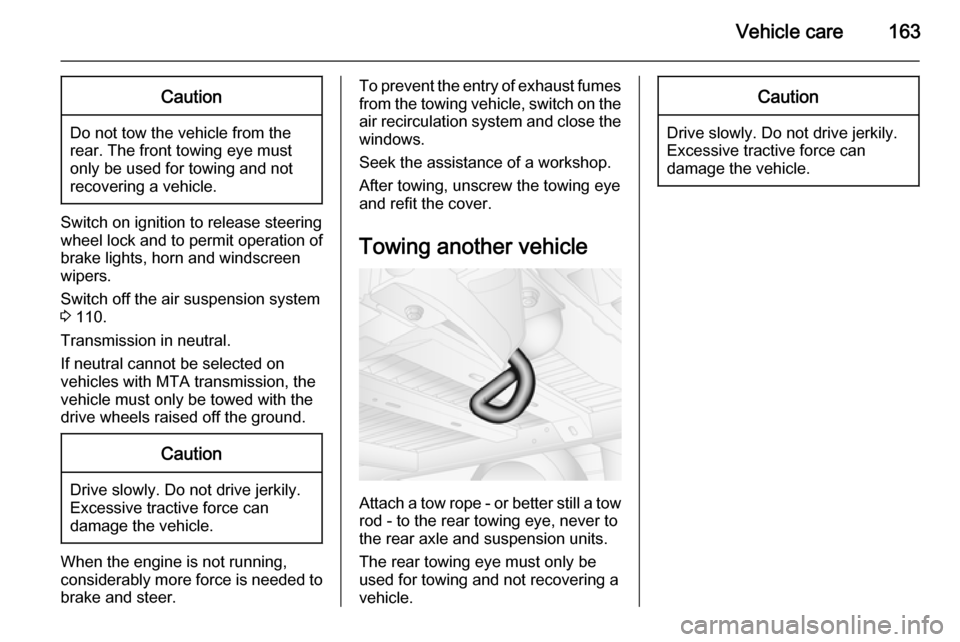
Towing another vehicle
Attach a tow rope - or better still a tow
rod - to the rear towing eye, never to
the rear axle and suspension units.
The rear towing eye must only be
used for towing and not recovering a
vehicle.
Caution
Drive slowly. Do not drive jerkily.
Excessive tractive force can
damage the vehicle.
Page 166 of 201

164Vehicle careAppearance care
Exterior care Locks
The locks are lubricated at the factory using a high quality lock cylinder
grease. Use de-icing agent only when absolutely necessary, as this has adegreasing effect and impairs lockfunction. After using a de-icing agent,
have the locks regreased by a
workshop.
Washing The paintwork of your vehicle is
exposed to environmental influences.
Wash and wax your vehicle regularly.
When using automatic vehicle
washes, select a programme that
includes waxing.
Bird droppings, dead insects, resin,
pollen and the like should be cleaned
off immediately, as they contain
aggressive constituents which can
cause paint damage.If using a vehicle wash, comply with
the vehicle wash manufacturer's
instructions. The windscreen wipers
must be switched off. Remove
antenna and external accessories
such as roof racks etc..
If you wash your vehicle by hand, make sure that the insides of the
wheel housings are also thoroughly
rinsed out.
Clean edges and folds on opened
doors and the bonnet as well as the
areas they cover.Caution
Always use a cleaning agent with
a pH value of 4 to 9.
Do not use cleaning agents on hot surfaces.
Have the door hinges of all doors
greased by a workshop.
Do not clean the engine compartment with a steam-jet or high-pressure jet
cleaner.
Thoroughly rinse and leather-off the vehicle. Rinse leather frequently. Use
separate leathers for painted and
glass surfaces: remnants of wax on
the windows will impair vision.
Exterior lights
Headlight and other light covers are
made of plastic. Do not use any
abrasive or caustic agents, do not use an ice scraper, and do not clean them
dry.
Polishing and waxing Wax the vehicle regularly (at the
latest when water no longer beads).
Otherwise, the paintwork will dry out.
Polishing is necessary only if the paint
has become dull or if solid deposits
have become attached to it.
Paintwork polish with silicone forms a
protective film, making waxing
unnecessary.
Plastic body parts must not be treated with wax or polishing agents.
Page 173 of 201
Technical data171Identification plate
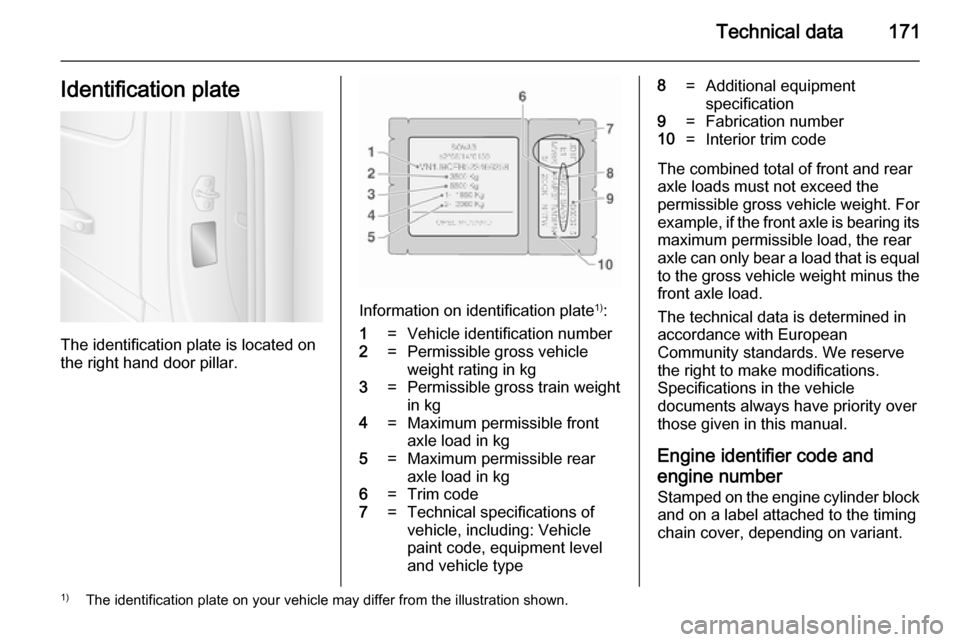
The identification plate is located on
the right hand door pillar.
Information on identification plate 1)
:
1=Vehicle identification number2=Permissible gross vehicle
weight rating in kg3=Permissible gross train weight
in kg4=Maximum permissible front
axle load in kg5=Maximum permissible rear
axle load in kg6=Trim code7=Technical specifications of
vehicle, including: Vehicle
paint code, equipment level
and vehicle type8=Additional equipment
specification9=Fabrication number10=Interior trim code
The combined total of front and rear
axle loads must not exceed the
permissible gross vehicle weight. For
example, if the front axle is bearing its
maximum permissible load, the rear
axle can only bear a load that is equal
to the gross vehicle weight minus the front axle load.
The technical data is determined in
accordance with European
Community standards. We reserve
the right to make modifications.
Specifications in the vehicle
documents always have priority over
those given in this manual.
Engine identifier code and engine number Stamped on the engine cylinder block
and on a label attached to the timing
chain cover, depending on variant.
1) The identification plate on your vehicle may differ from the illustration shown.
Page 194 of 201

192Customer information
■ Vehicle reactions in particulardriving situations (e.g. inflation of
an airbag, activation of the stability
regulation system)
■ Environmental conditions (e.g. temperature)
These data are exclusively technical
and help identifying and correcting
errors as well as optimizing vehicle
functions.
Motion profiles indicating travelled
routes cannot be created with these
data.
If services are used (e.g. repair
works, service processes, warranty
cases, quality assurance),
employees of the service network
(manufacturer included) are able to
read out this technical information
from the event and error data storage
modules applying special diagnostic
devices. If required, you will receive
further information at these
workshops. After an error has been
corrected, the data are deleted from
the error storage module or they are
constantly overwritten.When using the vehicle, situations
may occur in which these technical
data related to other information
(accident report, damages on the
vehicle, witness statements etc.) may be associated with a specific person -
possibly, with the assistance of an
expert.
Additional functions contractually
agreed upon with the client (e.g.
vehicle location in emergency cases)
allow the transmission of particular vehicle data from the vehicle.
Radio Frequency
Identification (RFID) RFID technology is used in somevehicles for functions such as ignition system security. It is also used inconnection with conveniences such
as radio remote controls for door
locking/unlocking and starting, and in-
vehicle transmitters for garage door
openers. RFID technology in
Vauxhall vehicles does not use or
record personal information or link
with any other Vauxhall system
containing personal information.
Page 196 of 201

194IndexAAccessories and vehicle modifications .......................... 132
Adaptive forward lighting .....89, 142
Adjustable air vents ...................103
Airbag and belt tensioners ...........78
Airbag deactivation ................50, 78
Airbag label................................... 45 Airbag system .............................. 45
Air conditioning regular operation ................................ 105
Air conditioning system ................ 95
Air intake .................................... 104
Air suspension ........................... 110
Air vents...................................... 103
Antifreeze ................................... 135
Antilock brake system ................ 118
Antilock brake system (ABS) .......80
Anti-theft alarm system ................27
Anti-theft locking system .............. 27
Appearance care ........................164
Armrest ........................................ 40
Ashtrays ....................................... 72 Automatic light control .................87
Automatic locking ........................23
Auxiliary heater ........................... 100B
Battery, jump starting.................. 160
Belts.............................................. 43 Bonnet ....................................... 133
Brake assist ............................... 119
Brake fluid .......................... 136, 168
Brake pad wear ............................ 80
Brakes ............................... 118, 136
Brake system ............................... 79
Breakdown.................................. 162
Bulb replacement ....................... 140
C
Capacities .................................. 188
Cargo management system ........63
Car Pass ...................................... 18
Catalytic converter .....................112
Central locking system ................19
Centre high-mounted brake light 145
Changing tyre and wheel size ...153
Charging system .......................... 78
Child locks ................................... 23
Child restraint installation locations ................................... 53
Child restraints.............................. 51
Child restraint systems ................51
Cigarette lighter ........................... 72
Cleaning the vehicle ...................164
Climate control ............................. 14
Page 197 of 201

195
Climate control systems...............94
Clock ............................................ 71
Control indicators.......................... 76
Control of the vehicle .................106
Controls ........................................ 68
Convex shape .............................. 30
Coolant ....................................... 135
Coolant and antifreeze ...............168
Coolant heater ............................ 100
Cornering light ......................89, 142
Coupling ball bar ........................130
Cruise control ...................... 82, 121
Cupholders .................................. 61
D Danger, Warnings and Cautions ...3
Dashboard .................................... 10
Daytime running lights .................88
Declaration of conformity ............191
Diesel fuel filter .......................... 138
Diesel fuel system bleeding .......139
Diesel particle filter ...............81, 112
Door open .................................... 82
Doors ............................................ 24
Drain fuel filter ............................. 81
Driver assistance systems ..........121
Driver Information Centre .............83
Driving characteristics and towing tips .............................. 129
Driving hints ................................ 106E
Electric adjustment ......................30
Electrical system......................... 148
Electronic climate control system 96
Electronic driving programmes ..116
Electronic Stability Program 80, 120
Emergency exit ............................. 34
End-of-life vehicle recovery .......133
Engine compartment fuse box ...149
Engine coolant ........................... 135
Engine coolant temperature ........80
Engine coolant temperature gauge ....................................... 74
Engine data ............................... 174
Engine exhaust .......................... 112
Engine identification ...........171, 172
Engine oil ................... 134, 168, 173
Engine oil level monitor ................74
Engine oil pressure ......................81
Event data recorders ..................191
Exhaust gases ............................ 112
Exit lighting .................................. 92
Exterior care .............................. 164
Exterior light ................................. 82
Exterior lighting ......................12, 87
Exterior mirrors ............................. 30F
Fault ........................................... 117
Fire extinguisher ..........................65
First aid ......................................... 65
First aid kit ................................... 65
Fixed air vents ........................... 104
Fog light ....................................... 82
Fog lights .............................. 89, 143
Folding mirrors ............................. 30
Front airbag system .....................49
Front fog lights ............................. 89
Front seats.................................... 36
Front storage ............................... 61
Front turn signal lights ...............143
Fuel consumption - CO 2-
Emissions ............................... 128
Fuel for diesel engines ..............127
Fuel gauge ................................... 74
Fuse box ..................................... 149
Fuses ......................................... 148
G Gauges ......................................... 73
General information ...................129
Glass panel .................................. 34 Glovebox ..................................... 61
Glovebox cooler ......................... 104