height VAUXHALL MOVANO_B 2015 Owner's Manual
[x] Cancel search | Manufacturer: VAUXHALL, Model Year: 2015, Model line: MOVANO_B, Model: VAUXHALL MOVANO_B 2015Pages: 209, PDF Size: 4.92 MB
Page 9 of 209
In brief7Seat adjustmentSeat positioning
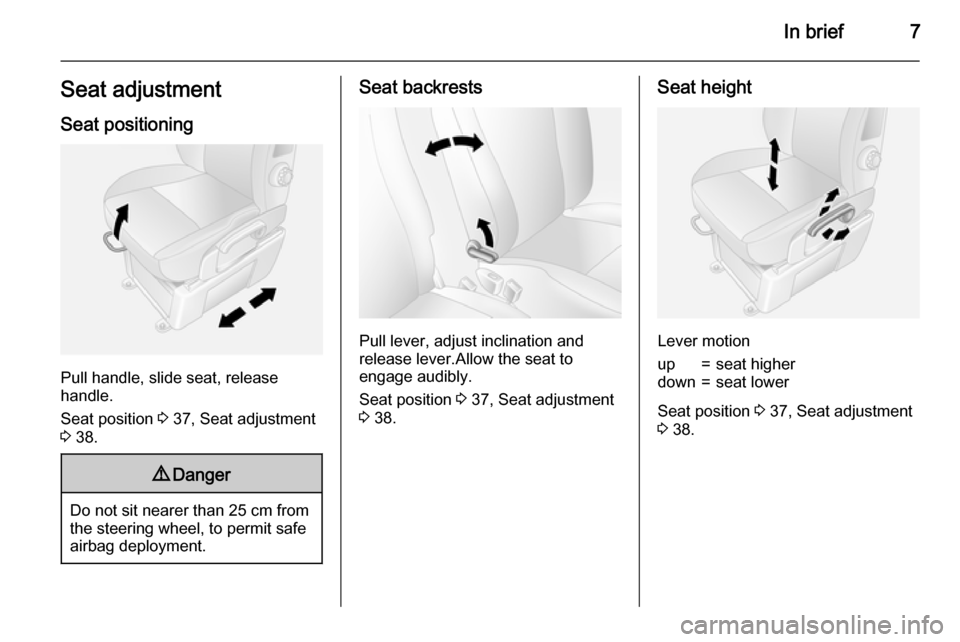
Pull handle, slide seat, release
handle.
Seat position 3 37, Seat adjustment
3 38.
9 Danger
Do not sit nearer than 25 cm from
the steering wheel, to permit safe
airbag deployment.
Seat backrests
Pull lever, adjust inclination and
release lever.Allow the seat to
engage audibly.
Seat position 3 37, Seat adjustment
3 38.
Seat height
Lever motion
up=seat higherdown=seat lower
Seat position 3 37, Seat adjustment
3 38.
Page 10 of 209
8In briefHead restraint adjustment
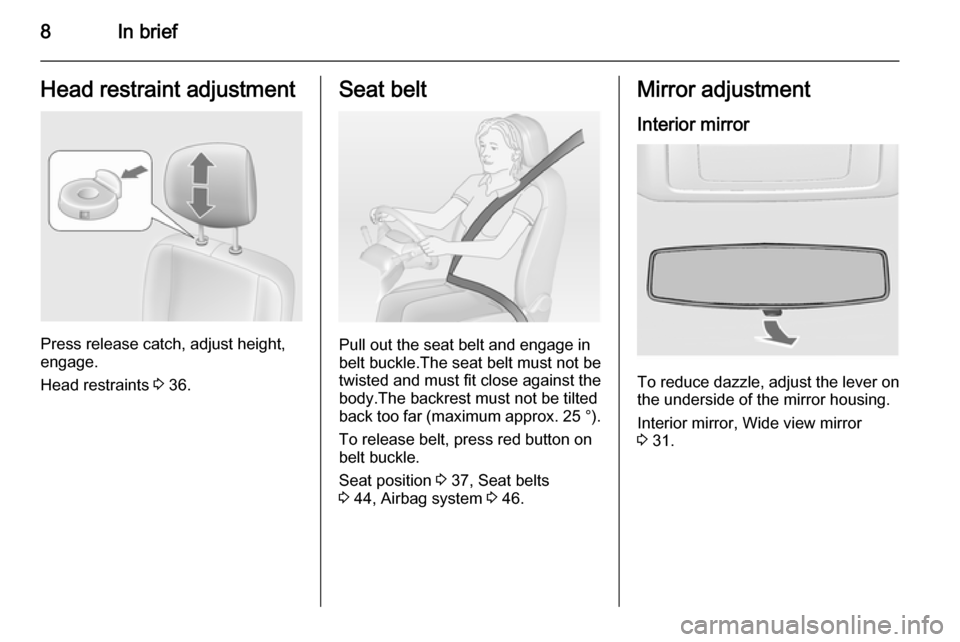
Press release catch, adjust height,
engage.
Head restraints 3 36.
Seat belt
Pull out the seat belt and engage in
belt buckle.The seat belt must not be twisted and must fit close against the
body.The backrest must not be tilted
back too far (maximum approx. 25 °).
To release belt, press red button on
belt buckle.
Seat position 3 37, Seat belts
3 44, Airbag system 3 46.
Mirror adjustment
Interior mirror
To reduce dazzle, adjust the lever on the underside of the mirror housing.
Interior mirror, Wide view mirror
3 31.
Page 38 of 209
36Seats, restraintsSeats, restraintsHead restraints............................ 36
Front seats ................................... 37
Rear seats ................................... 42
Seat belts ..................................... 44
Airbag system .............................. 46
Child restraints ............................. 52Head restraints
Position9 Warning
Only drive with the head restraint
set to the proper position.
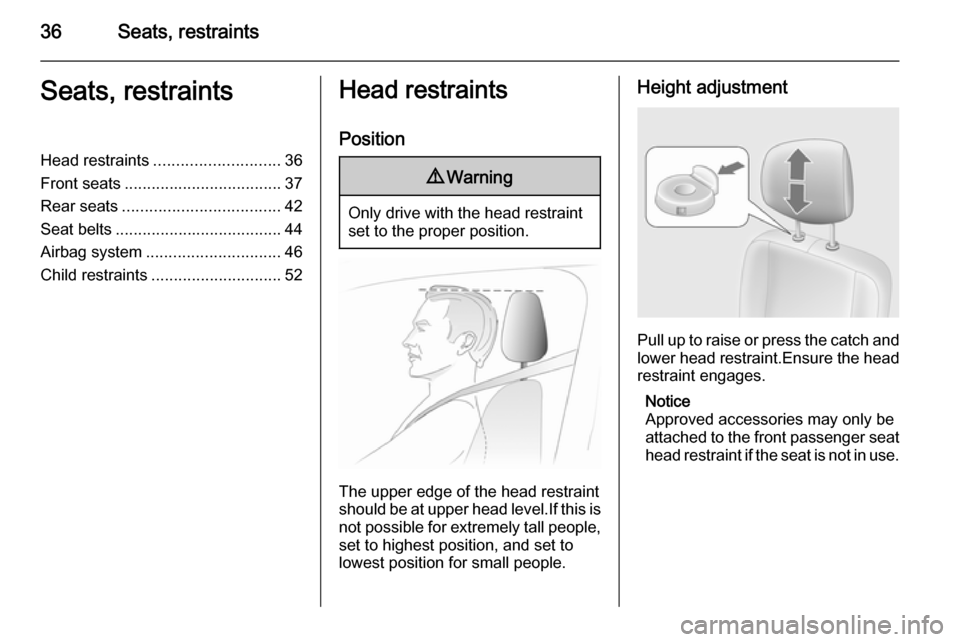
The upper edge of the head restraint
should be at upper head level.If this is not possible for extremely tall people,
set to highest position, and set to
lowest position for small people.
Height adjustment
Pull up to raise or press the catch and
lower head restraint.Ensure the head
restraint engages.
Notice
Approved accessories may only be
attached to the front passenger seat head restraint if the seat is not in use.
Page 39 of 209
Seats, restraints37
Removal
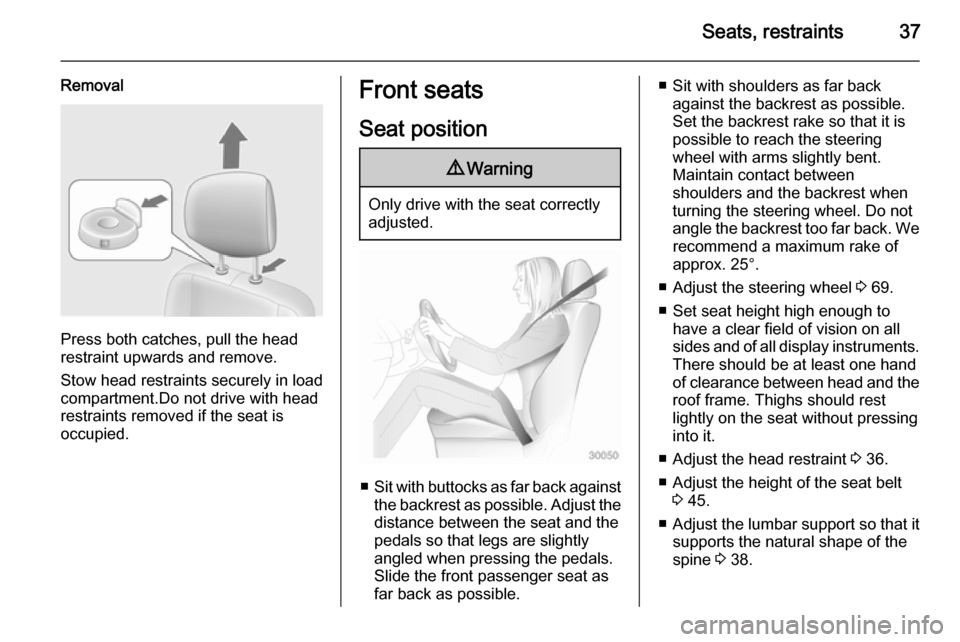
Press both catches, pull the head
restraint upwards and remove.
Stow head restraints securely in load
compartment.Do not drive with head
restraints removed if the seat is
occupied.
Front seats
Seat position9 Warning
Only drive with the seat correctly
adjusted.
■ Sit with buttocks as far back against
the backrest as possible. Adjust the distance between the seat and the
pedals so that legs are slightly
angled when pressing the pedals.
Slide the front passenger seat as
far back as possible.
■ Sit with shoulders as far back against the backrest as possible.
Set the backrest rake so that it is possible to reach the steering
wheel with arms slightly bent.
Maintain contact between
shoulders and the backrest when
turning the steering wheel. Do not
angle the backrest too far back. We recommend a maximum rake of
approx. 25°.
■ Adjust the steering wheel 3 69.
■ Set seat height high enough to have a clear field of vision on allsides and of all display instruments.
There should be at least one hand
of clearance between head and the
roof frame. Thighs should rest
lightly on the seat without pressing
into it.
■ Adjust the head restraint 3 36.
■ Adjust the height of the seat belt 3 45.
■ Adjust the lumbar support so that it
supports the natural shape of the
spine 3 38.
Page 41 of 209
Seats, restraints39
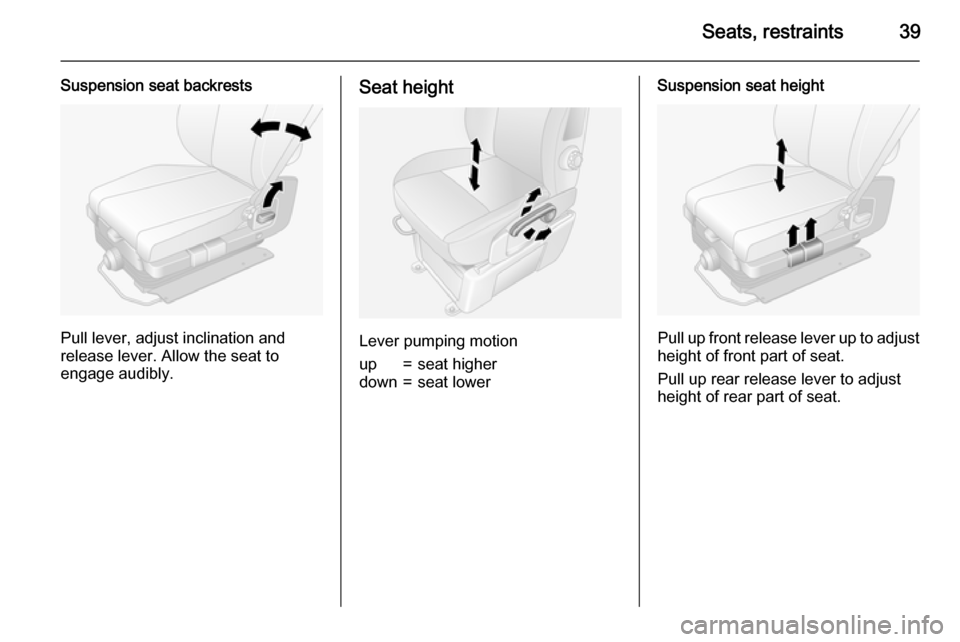
Suspension seat backrests
Pull lever, adjust inclination and
release lever. Allow the seat to
engage audibly.
Seat height
Lever pumping motion
up=seat higherdown=seat lowerSuspension seat height
Pull up front release lever up to adjust height of front part of seat.
Pull up rear release lever to adjust height of rear part of seat.
Page 47 of 209
Seats, restraints45Three-point seat belt
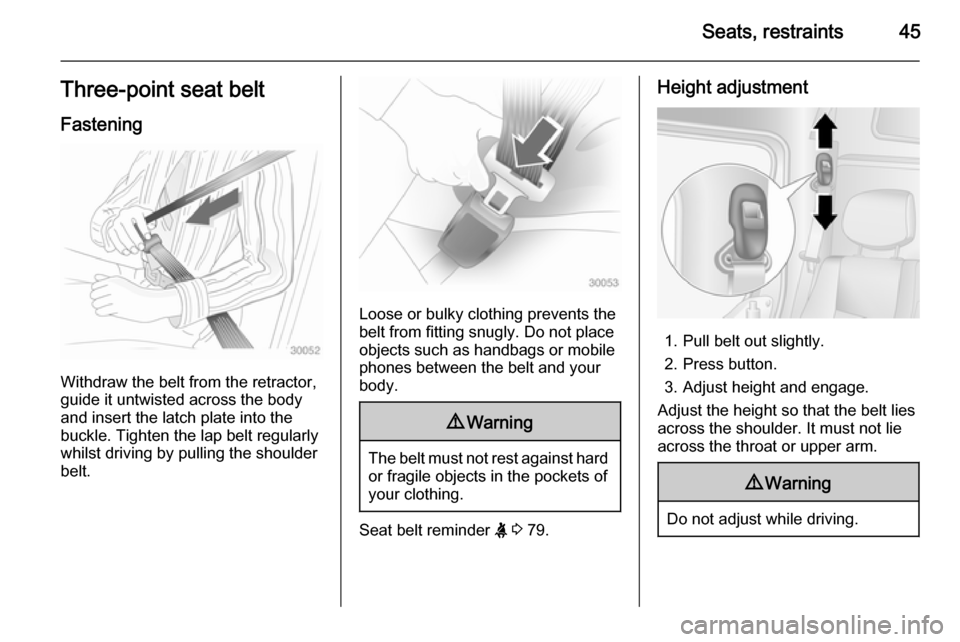
Fastening
Withdraw the belt from the retractor,
guide it untwisted across the body
and insert the latch plate into the
buckle. Tighten the lap belt regularly
whilst driving by pulling the shoulder
belt.
Loose or bulky clothing prevents the
belt from fitting snugly. Do not place
objects such as handbags or mobile
phones between the belt and your body.
9 Warning
The belt must not rest against hard
or fragile objects in the pockets of
your clothing.
Seat belt reminder X 3 79.
Height adjustment
1. Pull belt out slightly.
2. Press button.
3. Adjust height and engage.
Adjust the height so that the belt lies across the shoulder. It must not lie
across the throat or upper arm.
9 Warning
Do not adjust while driving.
Page 58 of 209

56Seats, restraints
Combi - rear seatsWeight and age class2nd row seats3rd row seatsDriver side
outer seat
Centre seat
Passenger side
outer seatGroup 0: up to 10 kg
or approx. 10 months
Group 0+: up to 13 kg
or approx. 2 years
U 3)
,
or approx. 8 months to 4 yearsU 4)
,
Group III: 22 to 36 kg
or approx. 6 to 12 years
U 4)UF 4)UF 4)X
3)
Move the front seat as far forward as possible to install a rear facing child seat, then move back the seat in front in accordance with the child seat instructions.
4) Forward facing child seat; position the seatback of the child seat in contact with the seatback of the vehicle seat. Adjust the height of the headrest or
remove it if necessary; do not push the seat in front of the child more than halfway back on its runners and do not recline the seatback more than 25°.
Page 116 of 209
114Driving and operating■ Always apply parking brakewithout pressing release button.Apply as firmly as possible on a
downhill slope or uphill slope.
Depress foot brake at the same
time to reduce operating force.
■ Switch off the engine.
■ If the vehicle is on a level surface or uphill slope, engage
first gear. On an uphill slope,
turn the front wheels away from the kerb.
If the vehicle is on a downhill
slope, engage reverse gear.
Turn the front wheels towards
the kerb.
Lock the vehicle 3 19 and activate the
anti-theft locking system 3 27 and
anti-theft alarm system 3 27.
Air suspension Operates automatically when the
vehicle is driven. The air suspension
system constantly adjusts the ride
height according to the vehicle load.
For further information on the air
suspension system, refer to the
operating instructions supplied.
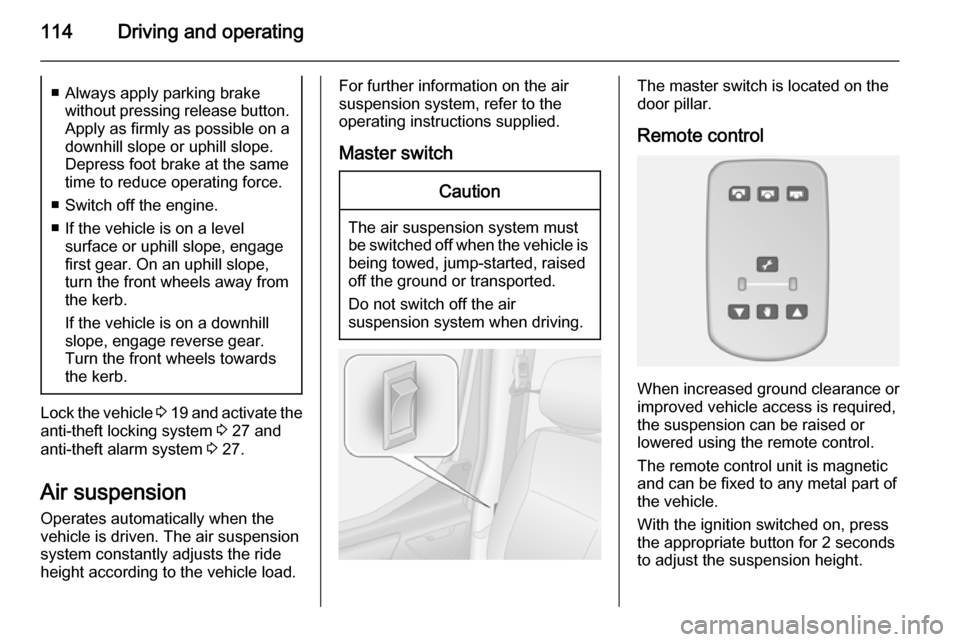
Master switchCaution
The air suspension system must
be switched off when the vehicle is
being towed, jump‐started, raised
off the ground or transported.
Do not switch off the air
suspension system when driving.
The master switch is located on the
door pillar.
Remote control
When increased ground clearance or improved vehicle access is required,the suspension can be raised or
lowered using the remote control.
The remote control unit is magnetic
and can be fixed to any metal part of
the vehicle.
With the ignition switched on, press
the appropriate button for 2 seconds
to adjust the suspension height.
Page 117 of 209

Driving and operating115
Indicator light will flash intermittently
while height adjustment is in progress
and illuminates when complete.
Handle with care, protect from
moisture and high temperatures and
avoid unnecessary operation.
Pre-programmed settings Adjusts the suspension height to oneof three pre-programmed positions.
The buttons are only functional when
the engine is running.l=lowered positionk=normal positionj=raised position
Manual settings
Manual adjustment can only be
performed when the vehicle is
stationary.
Select by pressing button h for 2
seconds, then button R to raise, or
button S to lower.
To exit, press any of the pre-
programmed buttons.
When the vehicle is moving, manual
adjustment will exit automatically. If
the ignition is switched off, the vehicle will return to normal ride height when
the ignition is switched back on.
Service mode Press button i for 5 seconds to put
the vehicle into service mode. The
indicator light will illuminate. When
service mode has been activated, the
air suspension master switch must be turned off.
To exit service mode, press button
i again for 5 seconds.
Fault If a fault is detected, i button will
flash intermittently. If the service
mode has been activated and there is a fault h, S and R buttons will flash
simultaneously.
Have the cause of the fault remedied by a workshop.Engine exhaust9 Danger
Engine exhaust gases contain
poisonous carbon monoxide,
which is colourless and odourless and could be fatal if inhaled.
If exhaust gases enter the interior
of the vehicle, open the windows.
Have the cause of the fault
rectified by a workshop.
Avoid driving with an open load
compartment, otherwise exhaust
gases could enter the vehicle.
Diesel particle filter
The diesel particle filter system filters
harmful soot particles out of the
exhaust gases. The system includes
a self-cleaning function that runs
automatically during driving without
any notification. The filter is cleaned
by periodically burning off the soot
particles at high temperature. This
Page 158 of 209

156Vehicle careWheels and tyres
Tyre condition, wheel condition
Drive over edges slowly and at right
angles if possible. Driving over sharp
edges can cause tyre and wheel
damage. Do not trap tyres on the kerb when parking.
Regularly check the wheels for
damage. Seek the assistance of a
workshop in the event of damage or
unusual wear.
Tyres Factory-fitted tyres are matched to
the chassis and offer optimum driving
comfort and safety.
Winter tyres Winter tyres improve driving safety attemperatures below 7 °C and shouldtherefore be fitted on all wheels.
In accordance with country-specific
regulations, affix the maximum speed
sticker in the driver's field of view.Tyre designations
E.g. 215/65 R 16 C 109 R215=Tyre width, mm65=Cross-section ratio (tyre height
to tyre width), %R=Belt type:RadialRF=Type:RunFlat16=Wheel diameter, inchesC=Cargo or commercial use88=Load index e.g. 109 is
equivalent to approx. 1030 kgR=Speed code letter
Speed code letter:
Q=up to 100 mphS=up to 112 mphT=up to 118 mphH=up to 130 mphV=up to 150 mphW=up to 168 mph
Tyre pressure
Check the pressure of cold tyres at
least every 14 days and before any
long journey. Do not forget the spare
wheel. This also applies to vehicles
with tyre pressure monitoring system.
Tyre pressures 3 198. Always inflate
tyres to the pressures shown on the
label on the driver's door frame.
The tyre pressure data refers to cold
tyres. It applies to summer and winter tyres.
Always inflate the spare tyre to the
pressure specified for full load.
Incorrect tyre pressures will impair
safety, vehicle handling, comfort and
fuel economy and will increase tyre
wear.
Tyre pressures differ depending on
various options. For the correct tyre
pressure value, follow the procedure
below:
1. Identify the engine identifier code.
Engine data 3 182.
2. Identify the respective tyre.
The tyre pressure tables show all possible tyre combinations 3 198.
For the tyres approved for your
vehicle, refer to the EEC Certificate of
Conformity provided with your vehicle or other national registration
documents.