check engine VAUXHALL MOVANO_B 2016.5 User Guide
[x] Cancel search | Manufacturer: VAUXHALL, Model Year: 2016.5, Model line: MOVANO_B, Model: VAUXHALL MOVANO_B 2016.5Pages: 239, PDF Size: 5.64 MB
Page 131 of 239
Driving and operating129The current fluid level remaining is
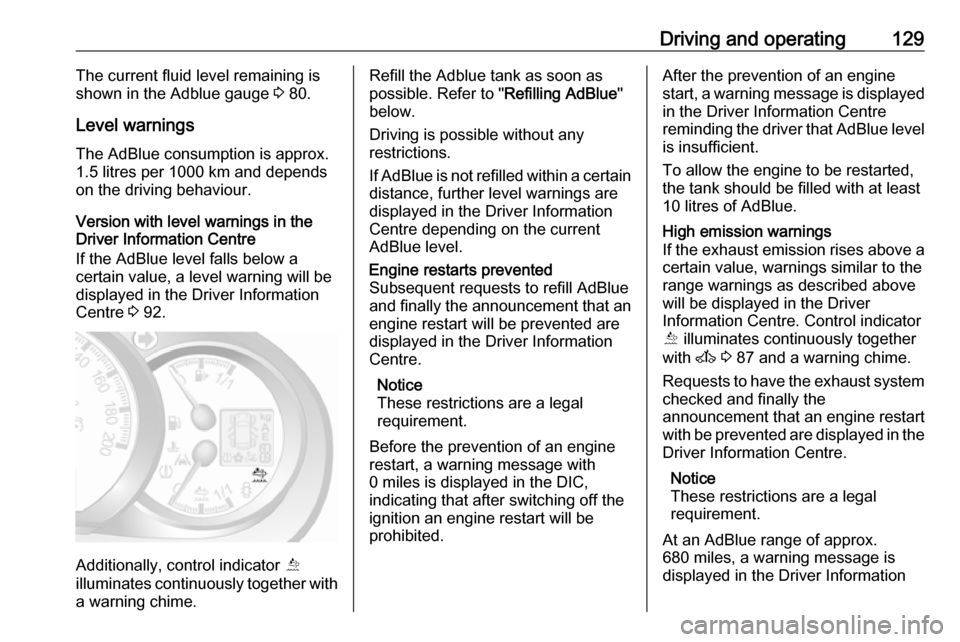
shown in the Adblue gauge 3 80.
Level warnings The AdBlue consumption is approx.
1.5 litres per 1000 km and depends
on the driving behaviour.
Version with level warnings in the
Driver Information Centre
If the AdBlue level falls below a
certain value, a level warning will be
displayed in the Driver Information
Centre 3 92.
Additionally, control indicator Õ
illuminates continuously together with a warning chime.
Refill the Adblue tank as soon as
possible. Refer to " Refilling AdBlue"
below.
Driving is possible without any
restrictions.
If AdBlue is not refilled within a certain
distance, further level warnings are
displayed in the Driver Information
Centre depending on the current
AdBlue level.Engine restarts prevented
Subsequent requests to refill AdBlue
and finally the announcement that an engine restart will be prevented are
displayed in the Driver Information
Centre.
Notice
These restrictions are a legal
requirement.
Before the prevention of an engine
restart, a warning message with
0 miles is displayed in the DIC,
indicating that after switching off the
ignition an engine restart will be
prohibited.After the prevention of an engine
start, a warning message is displayed in the Driver Information Centre
reminding the driver that AdBlue level
is insufficient.
To allow the engine to be restarted,
the tank should be filled with at least
10 litres of AdBlue.High emission warnings
If the exhaust emission rises above a
certain value, warnings similar to the
range warnings as described above
will be displayed in the Driver
Information Centre. Control indicator
Õ illuminates continuously together
with A 3 87 and a warning chime.
Requests to have the exhaust system checked and finally the
announcement that an engine restart
with be prevented are displayed in the
Driver Information Centre.
Notice
These restrictions are a legal
requirement.
At an AdBlue range of approx.
680 miles, a warning message is
displayed in the Driver Information
Page 134 of 239
132Driving and operating5. When refilling is complete, mountthe protective cap and turn
clockwise until it engages.
6. Close filler flap and right-hand door.
AdBlue canister Notice
Only use the designated AdBlue canisters for refilling, to prevent a
topping-up of too much AdBlue.
Additionally, the fumes in the tank
are captured in the canister and do
not emerge.
Notice
Since AdBlue has a limited
durability, check the date of expiry
before refilling.
1. Switch off engine and remove key
from ignition switch.
2. Pull filler flap to open.
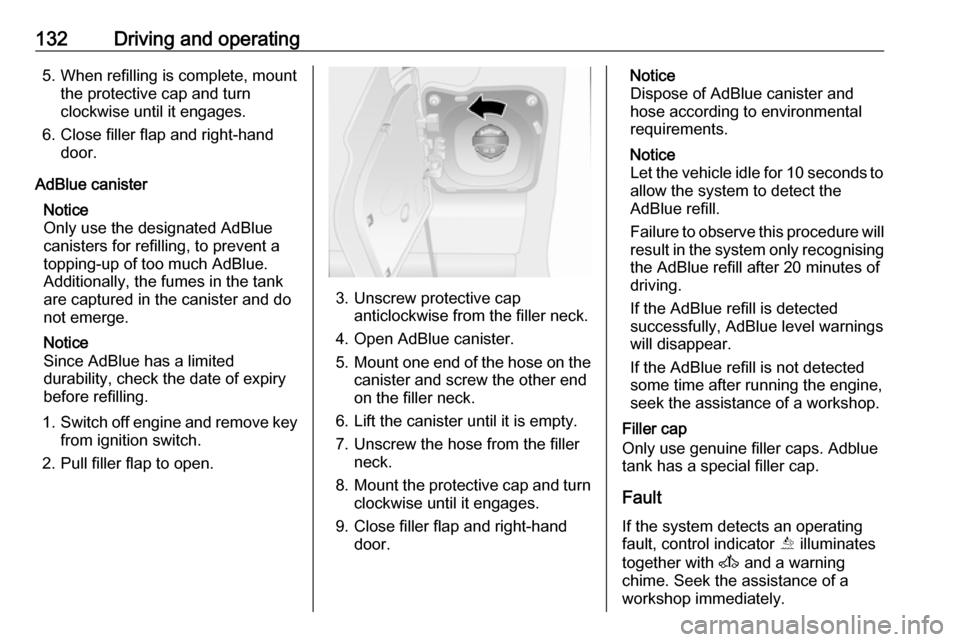
3. Unscrew protective cap anticlockwise from the filler neck.
4. Open AdBlue canister.
5. Mount one end of the hose on the
canister and screw the other end
on the filler neck.
6. Lift the canister until it is empty.
7. Unscrew the hose from the filler neck.
8. Mount the protective cap and turn
clockwise until it engages.
9. Close filler flap and right-hand door.
Notice
Dispose of AdBlue canister and
hose according to environmental
requirements.
Notice
Let the vehicle idle for 10 seconds to
allow the system to detect the
AdBlue refill.
Failure to observe this procedure will result in the system only recognising
the AdBlue refill after 20 minutes of
driving.
If the AdBlue refill is detected
successfully, AdBlue level warnings
will disappear.
If the AdBlue refill is not detected
some time after running the engine,
seek the assistance of a workshop.
Filler cap
Only use genuine filler caps. Adblue
tank has a special filler cap.
Fault
If the system detects an operating
fault, control indicator Õ illuminates
together with A and a warning
chime. Seek the assistance of a
workshop immediately.
Page 159 of 239

Vehicle care157Vehicle careGeneral Information...................158
Accessories and vehicle modifications .......................... 158
Vehicle storage ........................158
End-of-life vehicle recovery .....159
Vehicle checks ........................... 159
Performing work ......................159
Bonnet ..................................... 159
Engine oil ................................. 160
Engine coolant ......................... 161
Power steering fluid .................162
Washer fluid ............................ 163
Brakes ..................................... 163
Brake fluid ............................... 163
Vehicle battery ......................... 163
Diesel fuel filter ........................165
Diesel fuel system bleeding .....166
Wiper blade replacement ........166
Bulb replacement .......................167
Headlights ............................... 167
Adaptive forward lighting .........169
Fog lights ................................. 169
Front turn signal lights .............170
Tail lights ................................. 170
Side turn signal lights ..............171Centre high-mounted brake
light ......................................... 172
Number plate light ...................173
Interior lights ............................ 173
Instrument panel illumination ...174
Electrical system ........................174
Fuses ....................................... 174
Engine compartment fuse box . 176
Instrument panel fuse box .......176
Load compartment fuse box ....177
Vehicle tools .............................. 179
Tools ........................................ 179
Wheels and tyres .......................180
Tyres ....................................... 180
Winter tyres ............................. 180
Tyre designations ....................180
Tyre pressure .......................... 181
Tyre pressure monitoring system .................................... 182
Tread depth ............................. 184
Changing tyre and wheel size . 184 Wheel covers ........................... 184
Tyre chains .............................. 185
Tyre repair kit .......................... 185
Wheel changing .......................188
Spare wheel ............................ 190
Jump starting ............................. 193Towing....................................... 195
Towing the vehicle ...................195
Towing another vehicle ...........196
Appearance care .......................197
Exterior care ............................ 197
Interior care ............................. 198
Page 160 of 239

158Vehicle careGeneral Information
Accessories and vehicle modifications
We recommend the use of genuine
parts and accessories and factory
approved parts specific for your
vehicle type. We cannot assess or guarantee reliability of other products
- even if they have a regulatory or
otherwise granted approval.
Do not make any modifications to the electrical system, e.g. changes of
electronic control units (chip tuning).Caution
When transporting the vehicle on
a train or on a recovery vehicle, the
mud flaps might be damaged.
Vehicle storage
Storage for a long period of time
If the vehicle is to be stored for several months:
● Wash and wax the vehicle.
● Have the wax in the engine compartment and underbody
checked.
● Clean and preserve rubber seals.
● Change engine oil.
● Drain washer fluid reservoir. ● Check coolant antifreeze and corrosion protection.
● Adjust tyre pressure to the value specified for full load.
● Park vehicle in a dry, well ventilated place. Engage first or
reverse gear. Prevent the vehicle
from rolling.
● Do not apply parking brake.● Open bonnet, close all doors and
lock the vehicle.
● Disconnect the clamp from the negative terminal of the vehicle
battery. Beware that all systems
are not functional, e.g. anti-theft
alarm system.
Putting back into operation When the vehicle is to be put back into
operation:
● Connect the clamp to the negative terminal of the vehicle
battery. Activate the electronics
of the power windows.
● Check tyre pressure.
● Fill up the washer fluid reservoir. ● Check the engine oil level.
● Check the coolant level.
● Fit the number plate, if necessary.
Page 161 of 239
Vehicle care159End-of-life vehicle recovery
Information on end-of-life vehicle
recovery centres and the recycling of
end-of-life vehicles is available on our website, where legally required. Only
entrust this work to an authorised
recycling centre.Vehicle checks
Performing work9 Warning
Only perform engine compartment
checks when the ignition is off.
The cooling fan may start
operating even if the ignition is off.
9 Danger
The ignition system generates
extremely high voltages. Do not
touch.
The caps for topping up the engine oil, the coolant, the washer fluid and the
oil dipstick handle are yellow for ease
of identification.
Bonnet
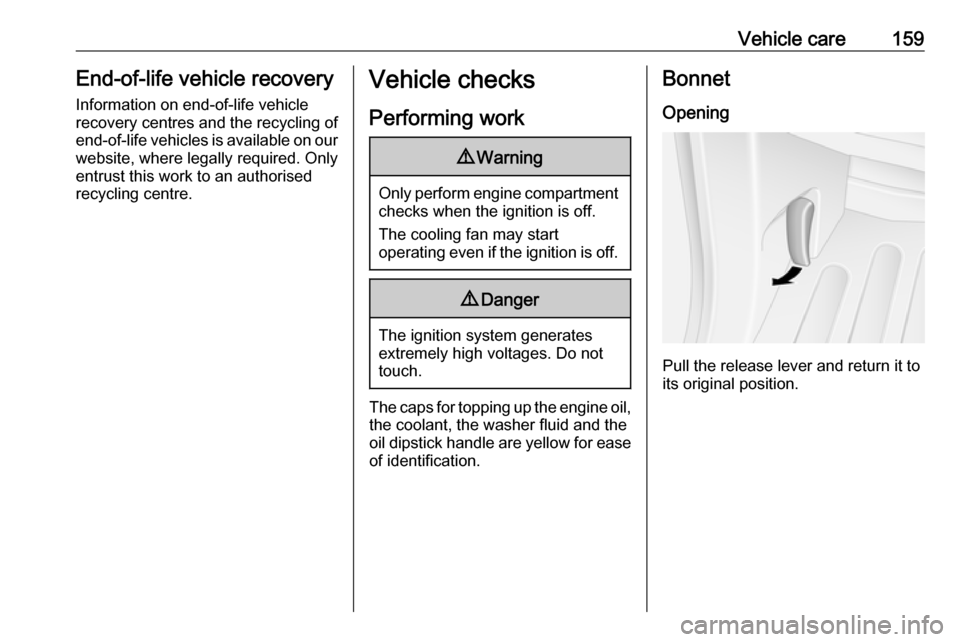
Opening
Pull the release lever and return it to
its original position.
Page 162 of 239
160Vehicle care
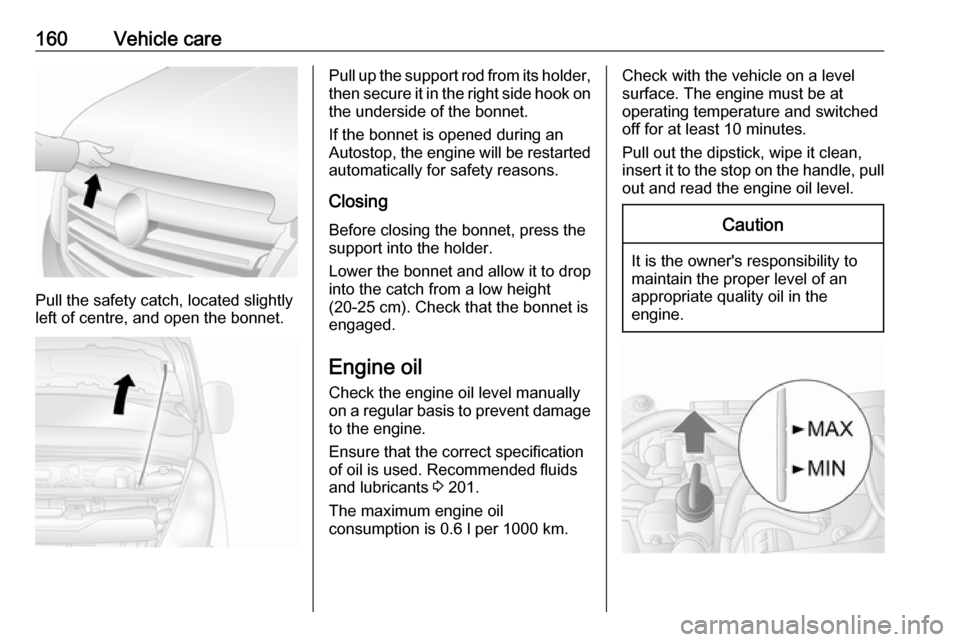
Pull the safety catch, located slightly
left of centre, and open the bonnet.
Pull up the support rod from its holder,
then secure it in the right side hook on the underside of the bonnet.
If the bonnet is opened during an Autostop, the engine will be restarted
automatically for safety reasons.
Closing Before closing the bonnet, press the
support into the holder.
Lower the bonnet and allow it to drop into the catch from a low height
(20-25 cm). Check that the bonnet is
engaged.
Engine oil Check the engine oil level manuallyon a regular basis to prevent damage
to the engine.
Ensure that the correct specification
of oil is used. Recommended fluids
and lubricants 3 201.
The maximum engine oil
consumption is 0.6 l per 1000 km.Check with the vehicle on a level
surface. The engine must be at
operating temperature and switched
off for at least 10 minutes.
Pull out the dipstick, wipe it clean,
insert it to the stop on the handle, pull
out and read the engine oil level.Caution
It is the owner's responsibility to
maintain the proper level of an
appropriate quality oil in the
engine.
Page 164 of 239
162Vehicle care9Warning
Allow the engine to cool before
opening the cap. Carefully open
the cap, relieving the pressure
slowly.
Top up with antifreeze. If no
antifreeze is available, use clean tap
water or distilled water. Install the cap
tightly. Have the antifreeze
concentration checked and have the
cause of the coolant loss remedied by a workshop.
If a substantial amount of coolant is
required, it will be necessary to bleed
any trapped air from the cooling
system. Seek the assistance of a
workshop.
Power steering fluid
Caution
Extremely small amounts of
contamination can cause steering
system damage and cause it to not work properly. Do not allow
contaminates to contact the fluid
side of the reservoir cap or from
entering the reservoir.
The fluid level normally does not need
to be checked. If an unusual noise is
heard during steering or if the power
steering reacts conspicuously, seek
the assistance of a workshop.
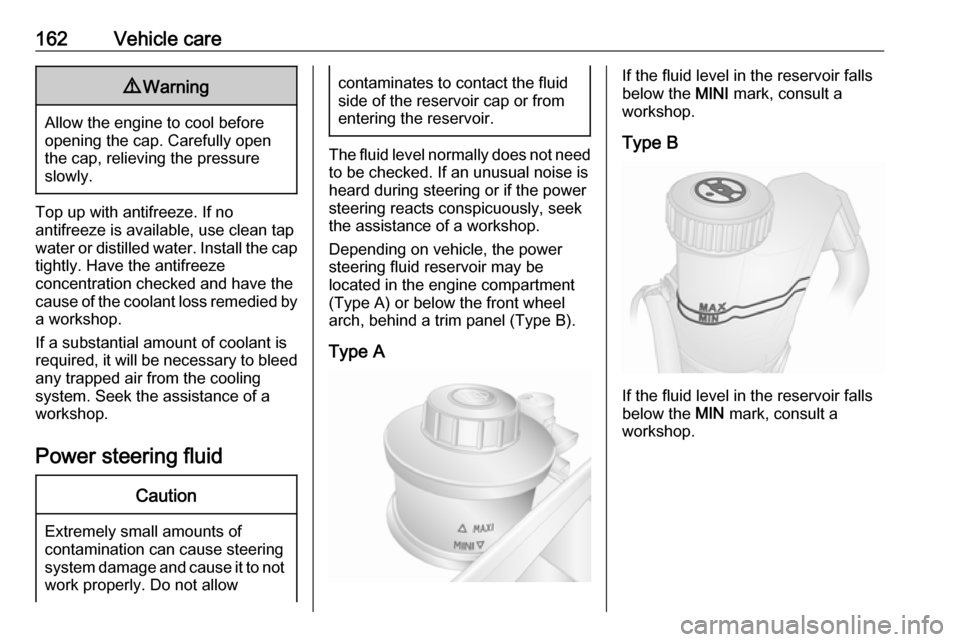
Depending on vehicle, the power
steering fluid reservoir may be
located in the engine compartment
(Type A) or below the front wheel
arch, behind a trim panel (Type B).
Type A
If the fluid level in the reservoir falls
below the MINI mark, consult a
workshop.
Type B
If the fluid level in the reservoir falls
below the MIN mark, consult a
workshop.
Page 168 of 239
166Vehicle carePlace a container underneath the
filter housing. Loosen the knurled
screws on the filter cover and on the
lower part of the filter by approx. one
turn, to drain off the water.
The filter is drained as soon as diesel fuel emerges from the knurled screw
at the bottom. Retighten the two
screws.
Check diesel fuel filter at shorter
intervals if the vehicle is subjected to
extreme operating conditions.
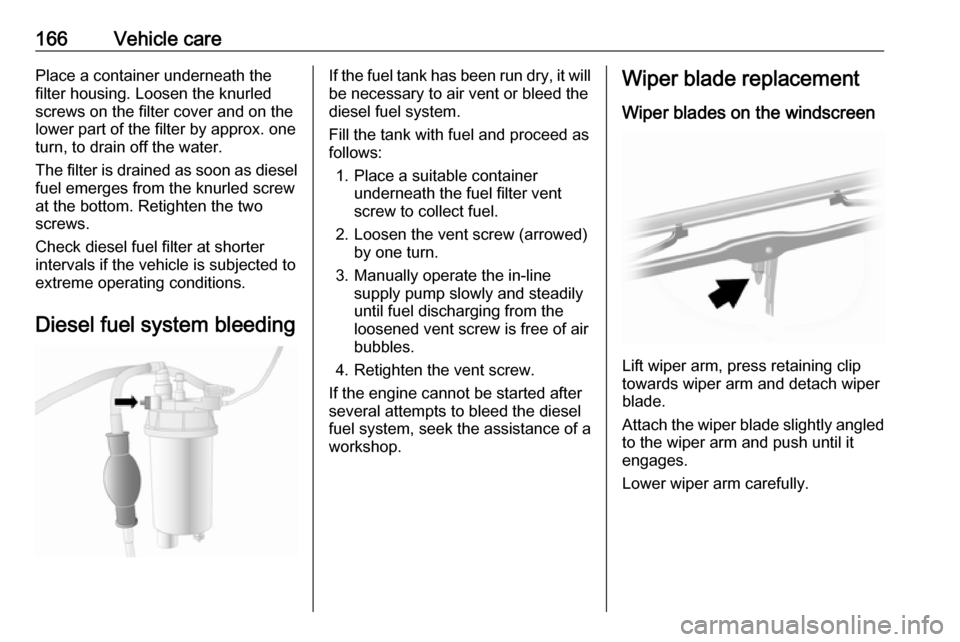
Diesel fuel system bleedingIf the fuel tank has been run dry, it will be necessary to air vent or bleed the
diesel fuel system.
Fill the tank with fuel and proceed as
follows:
1. Place a suitable container underneath the fuel filter vent
screw to collect fuel.
2. Loosen the vent screw (arrowed) by one turn.
3. Manually operate the in-line supply pump slowly and steadily
until fuel discharging from the
loosened vent screw is free of air
bubbles.
4. Retighten the vent screw.
If the engine cannot be started after
several attempts to bleed the diesel
fuel system, seek the assistance of a
workshop.Wiper blade replacement
Wiper blades on the windscreen
Lift wiper arm, press retaining clip
towards wiper arm and detach wiper
blade.
Attach the wiper blade slightly angled
to the wiper arm and push until it
engages.
Lower wiper arm carefully.
Page 183 of 239

Vehicle care181Choose a tyre appropriate for the
maximum speed of your vehicle.
The maximum speed is achievable at
kerb weight with driver (75 kg) plus
125 kg payload. Optional equipment
could reduce the maximum speed of
the vehicle.
Directional tyres Fit directional tyres such that they rollin the direction of travel. The rolling
direction is indicated by a symbol
(e.g. an arrow) on the sidewall.
Tyre pressure
Check the pressure of cold tyres at
least every 14 days and before any
long journey. Do not forget the spare
wheel. This also applies to vehicles
with tyre pressure monitoring system.
The tyre pressure information label
on the driver's door frame indicates
the original equipment tyres and the
correspondent tyre pressures.
Always inflate tyres to the pressures
shown on the label.
Tyre pressures 3 225.The tyre pressure data refers to cold
tyres. It applies to summer and winter tyres.
Always inflate the spare tyre to the
pressure specified for full load.
Incorrect tyre pressures will impair
safety, vehicle handling, comfort and
fuel economy and will increase tyre
wear.
Tyre pressures differ depending on
various options. For the correct tyre
pressure value, follow the procedure
below:
1. Identify the engine identifier code.
Engine data 3 206.
2. Identify the respective tyre.
The tyre pressure tables show all
possible tyre combinations 3 225.
For the tyres approved for your
vehicle, refer to the EEC Certificate of Conformity provided with your vehicle
or other national registration
documents.
The driver is responsible for correct
adjustment of tyre pressure.9 Warning
If the pressure is too low, this can
result in considerable tyre warm-
up and internal damage, leading to tread separation and even to tyre
blow-out at high speeds.
9 Warning
For specific tyres the
recommended tyre pressure as
shown in the tyre pressure table may exceed the maximum tyre
pressure as indicated on the tyre.
Never exceed the maximum tyre
pressure as indicated on the tyre.
Temperature dependency
Tyre pressure depends on the
temperature of the tyre. During
driving, tyre temperature and
pressure increase.
Tyre pressure values provided on the
tyre information label and tyre
pressure chart are valid for cold tyres, which means at 20 °C. The pressure
increases by nearly 1.5 psi for a
Page 236 of 239

234Speed limiter......................... 79, 145
Speedometer ............................... 79
Starting and operating ................120
Starting off ................................... 16
Starting the engine .......16, 121, 134
Steering ...................................... 119
Steering column controls ..............75
Steering wheel adjustment ......9, 75
Steering wheel controls ...............75
Stop engine .................................. 88
Stop-start system............ 16, 90, 122
Storage ......................................... 66
Storage compartments .................66
Sun visors .................................... 37
Suspension height ......................125
Suspension seat ........................... 41
Symbols ......................................... 4
T
Tachograph ............................ 91, 96
Tachometer ................................. 80
Tail lights ................................... 170
Technical data ............................ 206
Three-point seat belt .................... 49 Tools .......................................... 179
Top-tether fastening eyes ............65
Tow bar....................................... 153
Towing ........................................ 153
Towing another vehicle .............196
Towing a trailer ........................... 154Towing equipment .....................154
Towing eye ................................. 195
Towing the vehicle .....................195
Traction Control system ............. 140
Trailer coupling ........................... 153
Trailer stability assist .................155
Trailer towing ............................. 154
Transmission ............................... 16
Transmission display ...........82, 134
Tread depth ............................... 184
Trip computer .............................. 94
Trip odometer .............................. 80
Turbo engine warm-up ...............121
Turn and lane-change signals ...100
Turn signal ................................... 86
Tyre chains ................................ 185
Tyre changing ............................. 188
Tyre designations ......................180
Tyre pressure ............................ 181
Tyre pressure monitoring system ............................... 89, 182
Tyre pressures ........................... 225
Tyre repair kit ............................. 185
Tyres .......................................... 180
Tyres and wheel size, changing. 184
U Ultrasonic parking assist............. 146
Underseat storage .......................68
Upholstery .................................. 198Upshift.......................................... 88
Using this manual ..........................3
V Vehicle battery ........................... 163
Vehicle checks............................ 159
Vehicle data ................................ 205
Vehicle data recording and privacy ..................................... 227
Vehicle dimensions .................... 215
Vehicle Identification Number ....203
Vehicle jack ................................ 179
Vehicle messages .......................92
Vehicle security ............................ 31
Vehicle specific data ......................3
Vehicle storage ........................... 158
Vehicle tools ............................... 179
Vehicle unlocking ........................... 6
Vehicle weight ........................... 208
Ventilation ................................... 105
W
Warning chimes ........................... 93
Warning lights ............................... 79
Warning triangle .......................... 71
Washer and wiper systems .........14
Washer fluid ............................... 163
Washing the vehicle ...................197
Wheel changing .........................188
Wheel covers ............................. 184
Wheels and tyres .......................180