roof VAUXHALL MOVANO_B 2016 User Guide
[x] Cancel search | Manufacturer: VAUXHALL, Model Year: 2016, Model line: MOVANO_B, Model: VAUXHALL MOVANO_B 2016Pages: 233
Page 73 of 233

Storage71Loading information● Heavy objects in the load compartment should be evenly
distributed and placed as far
forward as possible. If objects
can be stacked, the heavier
objects should be placed at the
bottom.
● Secure objects with lashing straps attached to lashing eyes
3 67.
● Secure loose objects in load compartment to prevent them
from sliding.
● The load must not obstruct the operation of the pedals, parking
brake and gear selector lever, or
hinder the freedom of movement of the driver. Do not place any
unsecured objects in the interior.
● Do not drive with an open load compartment. In addition, the
number plate is only
distinguishable and illuminated
correctly if the doors are closed.9 Warning
Always make sure that the load in
the vehicle is securely stowed.
Otherwise objects can be thrown
around inside the vehicle and
cause personal injury or damage
to the load or vehicle.
● The payload is the difference between the permitted gross
vehicle weight (see identification
plate 3 199) and the EC kerb
weight.
To calculate the payload, enter
the data for your vehicle in the
Weights table at the front of this
manual.
The EC kerb weight includes
weights for the driver (68 kg),
luggage (7 kg) and all fluids (tank 90% full).
Optional equipment and
accessories increase the kerb
weight.
● Driving with a roof load increases
the sensitivity of the vehicle to
cross-winds and has a
detrimental effect on vehicle
handling due to the vehicle's
higher centre of gravity.
Distribute the load evenly and secure it properly with retaining
straps. Adjust the tyre pressure
and vehicle speed according to
the load conditions. Check and
retighten the straps frequently.
Do not drive faster than 75 mph.
● The permissible roof load (which includes the weight of the roof
rack) is 200 kg for standard roof
variants. The roof load is the combined weight of the roof rack
and the load.
Page 85 of 233
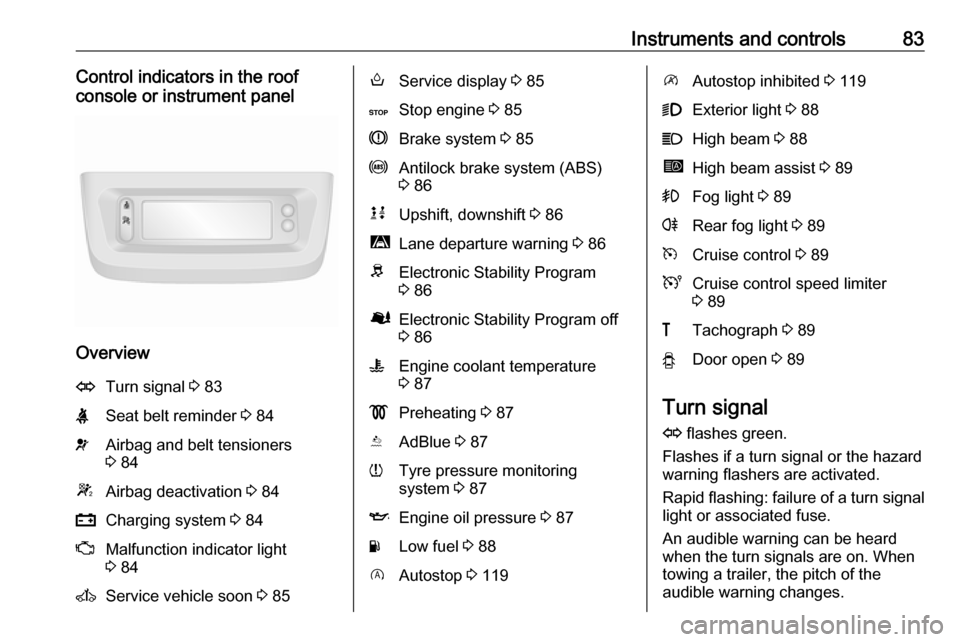
Instruments and controls83Control indicators in the roof
console or instrument panel
Overview
OTurn signal 3 83XSeat belt reminder 3 84vAirbag and belt tensioners
3 84WAirbag deactivation 3 84pCharging system 3 84ZMalfunction indicator light
3 84AService vehicle soon 3 85oService display 3 85CStop engine 3 85RBrake system 3 85uAntilock brake system (ABS)
3 86kjUpshift, downshift 3 86ìLane departure warning 3 86RElectronic Stability Program
3 86ØElectronic Stability Program off
3 86WEngine coolant temperature
3 87!Preheating 3 87YAdBlue 3 87wTyre pressure monitoring
system 3 87IEngine oil pressure 3 87YLow fuel 3 88DAutostop 3 119\Autostop inhibited 3 1199Exterior light 3 88CHigh beam 3 88íHigh beam assist 3 89>Fog light 3 89rRear fog light 3 89mCruise control 3 89UCruise control speed limiter
3 89&Tachograph 3 89yDoor open 3 89
Turn signal
O flashes green.
Flashes if a turn signal or the hazard
warning flashers are activated.
Rapid flashing: failure of a turn signal
light or associated fuse.
An audible warning can be heard
when the turn signals are on. When
towing a trailer, the pitch of the
audible warning changes.
Page 115 of 233
Climate control113Air vents
Adjustable air vents At least one air vent must be open
while cooling is on in order to prevent
the evaporator from icing up due to
lack of air movement.
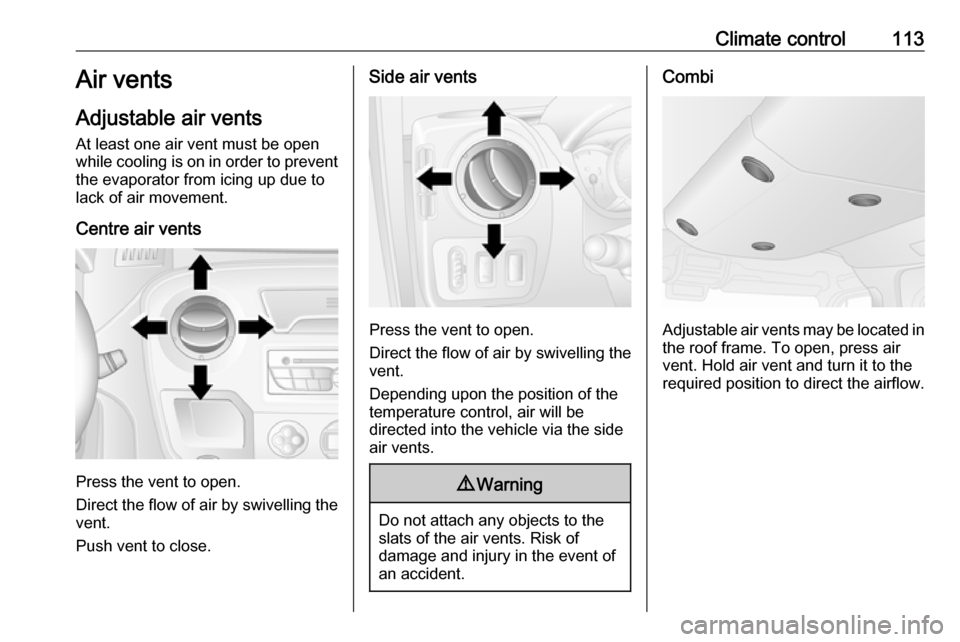
Centre air vents
Press the vent to open.
Direct the flow of air by swivelling the vent.
Push vent to close.
Side air vents
Press the vent to open.
Direct the flow of air by swivelling the vent.
Depending upon the position of the
temperature control, air will be
directed into the vehicle via the side
air vents.
9 Warning
Do not attach any objects to the
slats of the air vents. Risk of
damage and injury in the event of
an accident.
Combi
Adjustable air vents may be located in the roof frame. To open, press air
vent. Hold air vent and turn it to the
required position to direct the airflow.
Page 116 of 233
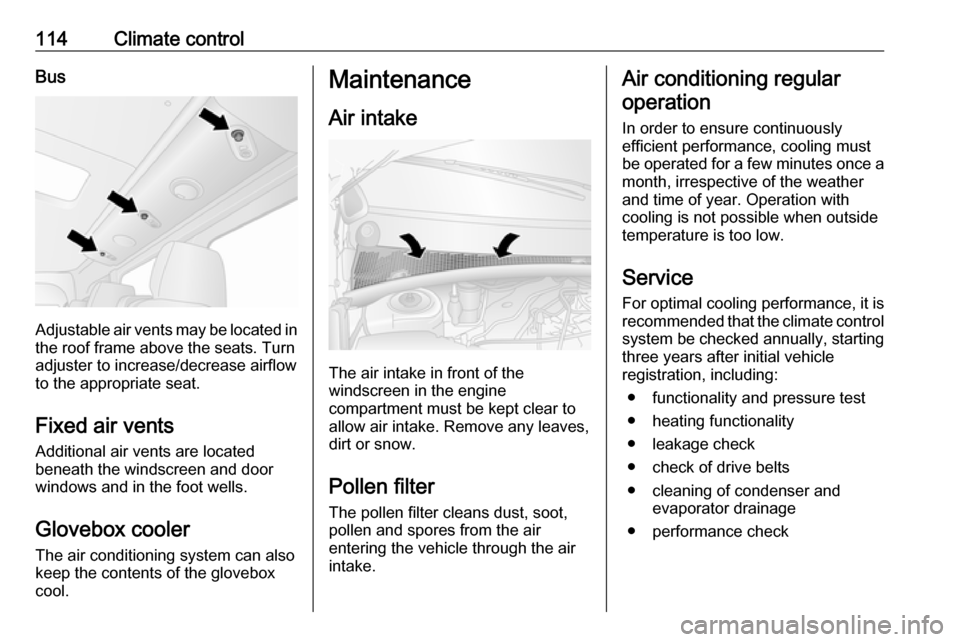
114Climate controlBus
Adjustable air vents may be located inthe roof frame above the seats. Turn
adjuster to increase/decrease airflow
to the appropriate seat.
Fixed air vents Additional air vents are located
beneath the windscreen and door
windows and in the foot wells.
Glovebox cooler
The air conditioning system can also
keep the contents of the glovebox
cool.
Maintenance
Air intake
The air intake in front of the
windscreen in the engine
compartment must be kept clear to
allow air intake. Remove any leaves,
dirt or snow.
Pollen filter The pollen filter cleans dust, soot,
pollen and spores from the air
entering the vehicle through the air
intake.
Air conditioning regular
operation
In order to ensure continuously
efficient performance, cooling must
be operated for a few minutes once a
month, irrespective of the weather
and time of year. Operation with
cooling is not possible when outside
temperature is too low.
ServiceFor optimal cooling performance, it is
recommended that the climate control system be checked annually, starting
three years after initial vehicle
registration, including:
● functionality and pressure test
● heating functionality
● leakage check
● check of drive belts
● cleaning of condenser and evaporator drainage
● performance check
Page 149 of 233
Driving and operating147Activation
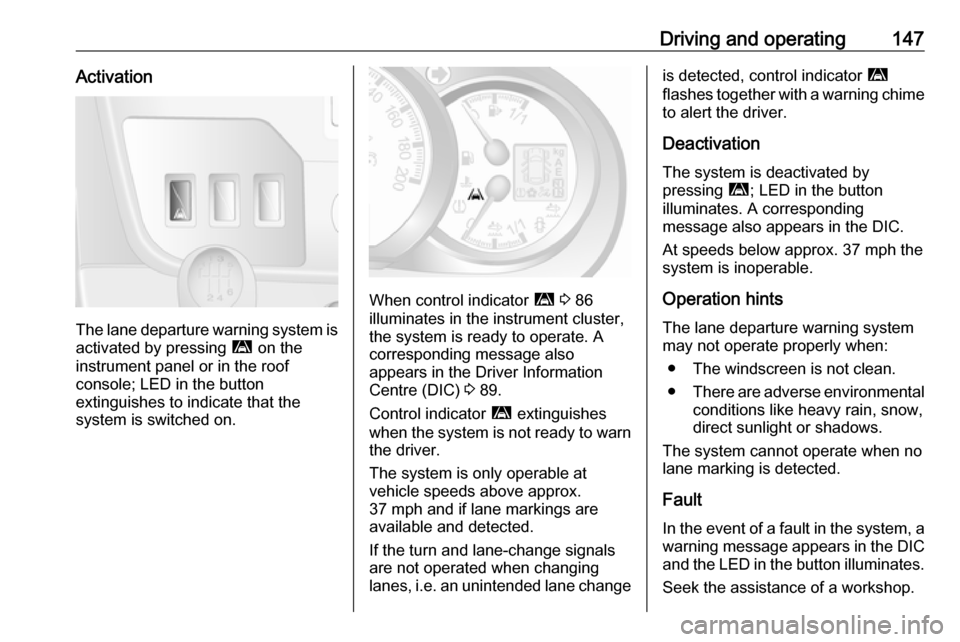
The lane departure warning system isactivated by pressing ì on the
instrument panel or in the roof
console; LED in the button
extinguishes to indicate that the
system is switched on.
When control indicator ì 3 86
illuminates in the instrument cluster,
the system is ready to operate. A
corresponding message also
appears in the Driver Information
Centre (DIC) 3 89.
Control indicator ì extinguishes
when the system is not ready to warn the driver.
The system is only operable at
vehicle speeds above approx.
37 mph and if lane markings are
available and detected.
If the turn and lane-change signals
are not operated when changing
lanes, i.e. an unintended lane change
is detected, control indicator ì
flashes together with a warning chime
to alert the driver.
Deactivation The system is deactivated by
pressing ì; LED in the button
illuminates. A corresponding
message also appears in the DIC.
At speeds below approx. 37 mph the
system is inoperable.
Operation hints The lane departure warning system
may not operate properly when:
● The windscreen is not clean.
● There are adverse environmental
conditions like heavy rain, snow,
direct sunlight or shadows.
The system cannot operate when no
lane marking is detected.
Fault
In the event of a fault in the system, a warning message appears in the DIC
and the LED in the button illuminates.
Seek the assistance of a workshop.
Page 194 of 233

192Vehicle careAppearance careExterior care
Locks The locks are lubricated at the factoryusing a high quality lock cylinder
grease. Use de-icing agent only when
absolutely necessary, as this has a
degreasing effect and impairs lock function. After using a de-icing agent, have the locks regreased by a
workshop.
Washing The paintwork of your vehicle is
exposed to environmental influences. Wash and wax your vehicle regularly.
When using automatic vehicle
washes, select a programme that
includes waxing. Restrictions for
filmed or matt painted body parts or decor tapes, see "Polishing and
waxing".
Bird droppings, dead insects, resin,
pollen and the like should be cleaned
off immediately, as they contain
aggressive constituents which can cause paint damage.If using a vehicle wash, comply with
the vehicle wash manufacturer's instructions. The windscreen wipersmust be switched off and the exterior
mirrors must be folded in. Remove
antenna and external accessories
such as roof racks etc.
If you wash your vehicle by hand,
make sure that the insides of the
wheel housings are also thoroughly
rinsed out.
Clean edges and folds on opened
doors and the bonnet as well as the
areas they cover.
Clean bright metal mouldings with a
cleaning solution approved for
aluminium to avoid damages.Caution
Always use a cleaning agent with
a pH value of 4 to 9.
Do not use cleaning agents on hot surfaces.
Have the door hinges of all doors
greased by a workshop.
Do not clean the engine compartment with a steam-jet or high-pressure jet
cleaner.
Thoroughly rinse and leather-off the vehicle. Rinse leather frequently. Use
separate leathers for painted and
glass surfaces: remnants of wax on
the windows will impair vision.
Exterior lights
Headlight and other light covers are
made of plastic. Do not use any
abrasive or caustic agents, do not use
an ice scraper, and do not clean them
dry.
Polishing and waxing
Wax the vehicle regularly (at the
latest when water no longer beads).
Otherwise, the paintwork will dry out.
Polishing is necessary only if the paint
has become dull or if solid deposits
have become attached to it.
Paintwork polish with silicone forms a protective film, making waxing
unnecessary.
Page 197 of 233

Service and maintenance195Service and
maintenanceGeneral information ...................195
Service information ..................195
Recommended fluids, lubricants and parts .................................... 196
Recommended fluids and lubricants ................................ 196General information
Service information In order to ensure economical and
safe vehicle operation and to
maintain the value of your vehicle, it
is of vital importance that all
maintenance work is carried out at the proper intervals as specified.
The detailed, up-to-date service
schedule for the vehicle is available at
the workshop.
Service display 3 80.
Engine identification 3 199.
Service intervals - except Bus Maintenance of your vehicle is
required every 25,000 miles or after 2 years, whichever occurs first,
unless otherwise indicated by the
service display.
A shorter service interval can be valid
for severe driving behaviour, e.g. for
taxis and police vehicles.Service intervals - Bus only
Maintenance of your vehicle is
required every 20,000 miles or after 1 year , whichever occurs first, unless
otherwise indicated by the service
display.
Confirmations
Confirmation of service is recorded in the Service and Warranty Booklet.The date and mileage is completed
with the stamp and signature of the
servicing workshop.
Make sure that the Service and
Warranty Booklet is completed
correctly as continuous proof of
service is essential if any warranty or
goodwill claims are to be met, and is
also a benefit when selling the
vehicle.
Service display The service interval is based on
several parameters depending on
usage.
Page 204 of 233

202Technical dataVehicle weight
Kerb weight, basic model without any optional equipment Optional equipment and accessories increase the kerb weight.
VanDrive wheelsLengthRoof heightGross vehicle weightKerb weightFront-wheel driveL1H1280018063300181135001816H2280018343300183935001844L2H23300188535001890H33300192135001931L3H235001970H335002010
Page 205 of 233

Technical data203Drive wheelsLengthRoof heightGross vehicle weightKerb weightRear-wheel driveL3H235001)21593500 2)224645002246H335001)21483500 2)227945002279L4H235001)22703500 2)232445002324H335001)23003500 2)2366450023661)
With Single rear wheels.
2) With Twin rear wheels.
Page 206 of 233

204Technical dataDoublecabDrive wheelsLengthRoof heightGross vehicle weightKerb weightFront-wheel driveL1H13300197035001975L1H23300199535002000L2H23300209435002102L3H235002177Rear-wheel driveL3H235001)232435002)24534500 2)24531)
With Single rear wheels.
2) With Twin rear wheels.
Combi
Drive wheelsLengthRoof heightGross vehicle weightKerb weightFront-wheel driveL1H133002002L2H235002149