steering VAUXHALL MOVANO_B 2017.5 Owner's Guide
[x] Cancel search | Manufacturer: VAUXHALL, Model Year: 2017.5, Model line: MOVANO_B, Model: VAUXHALL MOVANO_B 2017.5Pages: 259, PDF Size: 6.15 MB
Page 166 of 259
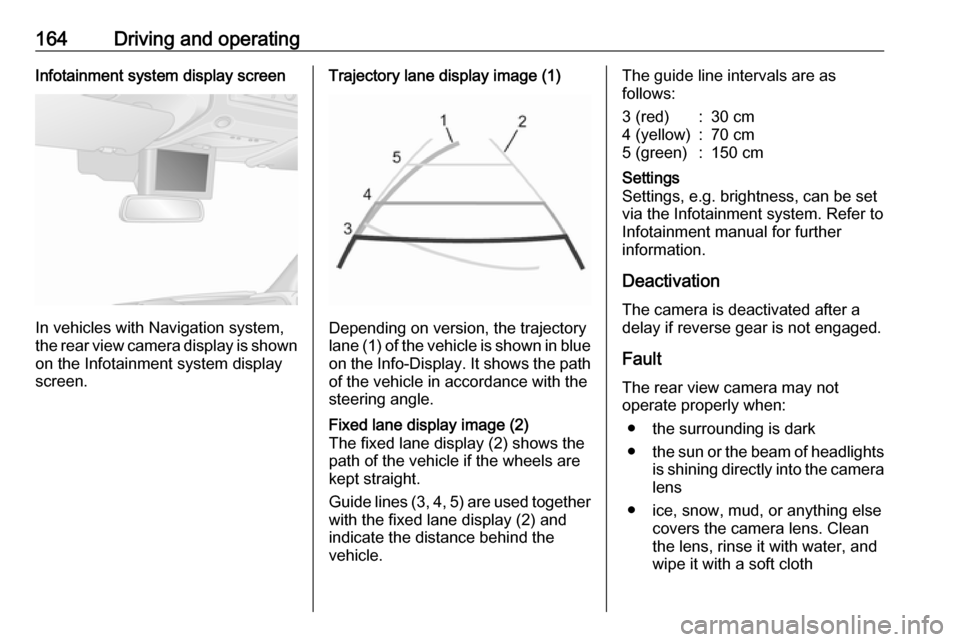
164Driving and operatingInfotainment system display screen
In vehicles with Navigation system,
the rear view camera display is shown
on the Infotainment system display
screen.
Trajectory lane display image (1)
Depending on version, the trajectory
lane (1) of the vehicle is shown in blue
on the Info-Display. It shows the path of the vehicle in accordance with the
steering angle.
Fixed lane display image (2)
The fixed lane display (2) shows the
path of the vehicle if the wheels are
kept straight.
Guide lines (3, 4, 5) are used together
with the fixed lane display (2) and indicate the distance behind the
vehicle.The guide line intervals are as
follows:3 (red):30 cm4 (yellow):70 cm5 (green):150 cmSettings
Settings, e.g. brightness, can be set
via the Infotainment system. Refer to
Infotainment manual for further
information.
Deactivation
The camera is deactivated after a
delay if reverse gear is not engaged.
Fault
The rear view camera may not
operate properly when:
● the surrounding is dark
● the sun or the beam of headlights
is shining directly into the camera lens
● ice, snow, mud, or anything else covers the camera lens. Clean
the lens, rinse it with water, and
wipe it with a soft cloth
Page 167 of 259
Driving and operating165● the rear doors/tailgate are notclosed correctly
● the vehicle had a rear-end accident
● there are extreme temperature changes
Lane departure warning The lane departure warning systemuses a front camera to observe the
lane markings between which the
vehicle is driving. The system detects
lane changes and warns the driver in
the event of an unintended lane
change via visual and acoustic
signals.
Criteria for the detection of an
unintended lane change are:
● no operation of turn and lane- change signals
● no active steering
If the driver is performing these
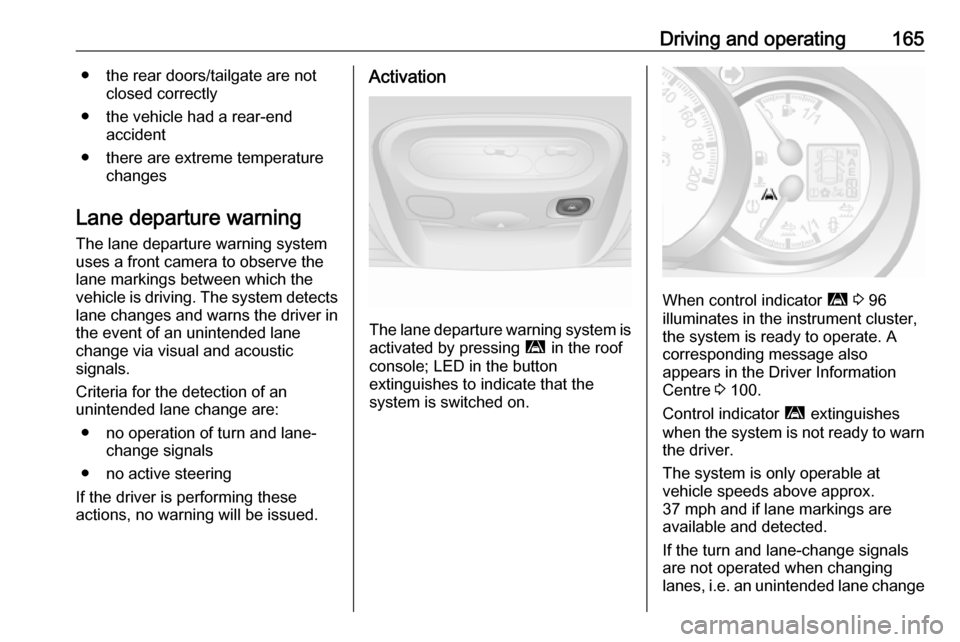
actions, no warning will be issued.Activation
The lane departure warning system is activated by pressing ì in the roof
console; LED in the button
extinguishes to indicate that the
system is switched on.
When control indicator ì 3 96
illuminates in the instrument cluster,
the system is ready to operate. A
corresponding message also
appears in the Driver Information
Centre 3 100.
Control indicator ì extinguishes
when the system is not ready to warn the driver.
The system is only operable at
vehicle speeds above approx.
37 mph and if lane markings are
available and detected.
If the turn and lane-change signals
are not operated when changing
lanes, i.e. an unintended lane change
Page 171 of 259

Driving and operating169Trailer hitch
General information
Only use towing equipment that has
been approved for your vehicle.
Entrust fitting of towing equipment at
a later date to a workshop. It may be
necessary to make changes that
affect the cooling system, heat
shields or other equipment.
Driving characteristics and towing tips
In the case of trailers with brakes,
attach the breakaway stopping cable.
Before attaching a trailer, lubricate
the coupling ball. However, do not do
so if a stabiliser, which acts on the coupling ball, is being used to reduce
snaking movements. For trailers with
low driving stability the use of a
stabiliser is recommended.
A maximum speed of 50 mph must
not be exceeded, even in countries
where higher speeds are permitted.If the trailer starts snaking, drive more slowly, do not attempt to correct the
steering and brake sharply if
necessary.
When driving downhill, drive in the
same gear as if driving uphill and
drive at a similar speed.
Adjust tyre pressure to the value
specified for full load 3 243.
Trailer towing
Trailer loads The permissible trailer loads are
vehicle-dependent and engine-
dependent maximum values which
must not be exceeded. The actual
trailer load is the difference between
the actual gross weight of the trailer
and the actual coupling socket load
with the trailer coupled.
The permissible trailer loads are
specified in the vehicle documents. In
general, they are valid for gradients
up to max. 12%.
The permitted trailer load applies up to the specified incline and up to an
altitude of 1000 metres above sealevel. Since engine power decreases as altitude increases due to the airbecoming thinner, therefore reducing
climbing ability, the permissible gross
train weight also decreases by 10%
for every 1000 metres of additional
altitude. The gross train weight does
not have to be reduced when driving on roads with slight inclines (less than 8%, e.g. motorways).
The permissible gross train weight
must not be exceeded. This weight is
specified on the identification plate
3 222.
Vertical coupling load
The vertical coupling load is the load
exerted by the trailer on the coupling
ball. It can be varied by changing the
weight distribution when loading the
trailer.
The maximum permissible vertical
coupling load is specified on the
towing equipment identification plate
and in the vehicle documents. Always aim for the maximum load, especially in the case of heavy trailers. The
vertical coupling load should never
fall below 25 kg.
Page 172 of 259
170Driving and operatingIn the case of trailer loads of
1200 kg or more, the vertical coupling load should not be less than 50 kg.
Rear axle load When the trailer is coupled and the
towing vehicle fully loaded (including all occupants), the permissible rear
axle load (see identification plate or
vehicle documents) must not be
exceeded.
Towing equipmentCaution
When operating without a trailer,
remove the coupling ball bar.
Towing equipment audible
warning
For vehicles fitted with towing
equipment, when connected to a
trailer the pitch of the audible warning
changes upon operation of the turn
signals.
The pitch of the audible warning will
change if a turn signal light on the
trailer or the towing vehicle fails.
Trailer stability assist
If the system detects snaking
movements, engine power is reduced
and the vehicle/trailer combination is
selectively braked until the snaking ceases. While the system is working,keep steering wheel as still as
possible.
Trailer stability assist (TSA) is a
function of the Electronic Stability
Program (ESP) 3 155.Auxiliary features
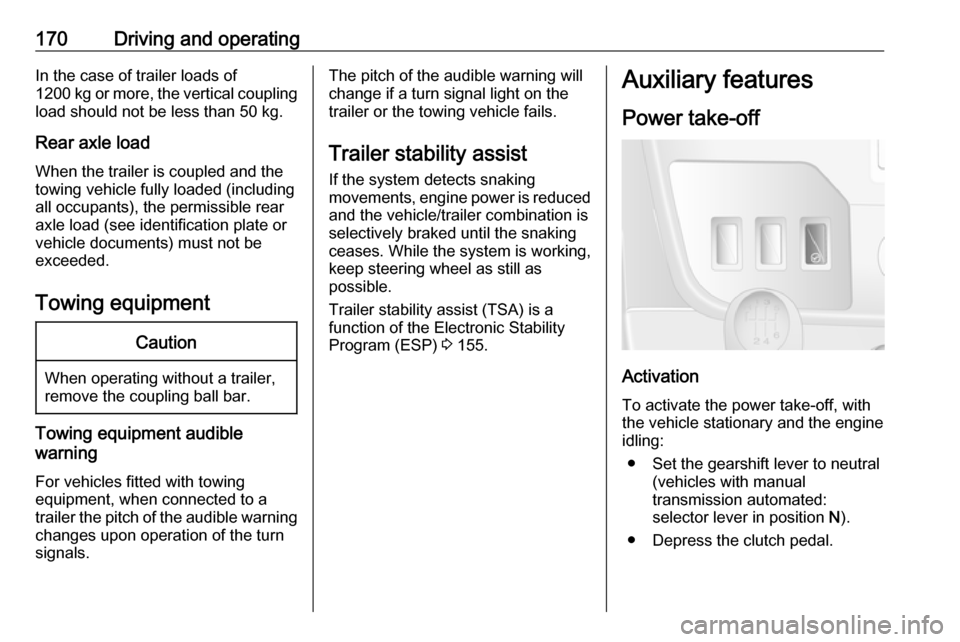
Power take-off
Activation
To activate the power take-off, with
the vehicle stationary and the engine
idling:
● Set the gearshift lever to neutral (vehicles with manual
transmission automated:
selector lever in position N).
● Depress the clutch pedal.
Page 174 of 259

172Vehicle careVehicle careGeneral Information...................173
Accessories and vehicle modifications .......................... 173
Vehicle storage ........................173
End-of-life vehicle recovery .....174
Vehicle checks ........................... 174
Performing work ......................174
Bonnet ..................................... 174
Engine oil ................................. 175
Engine coolant ......................... 176
Power steering fluid .................177
Washer fluid ............................ 178
Brakes ..................................... 178
Brake fluid ............................... 178
Vehicle battery ......................... 179
Diesel fuel filter ........................181
Diesel fuel system bleeding .....181
Wiper blade replacement ........182
Bulb replacement .......................183
Headlights ............................... 183
Adaptive forward lighting .........185
Fog lights ................................. 186
Front turn signal lights .............186
Tail lights ................................. 187
Side turn signal lights ..............188Centre high-mounted brake
light ......................................... 189
Number plate light ...................190
Interior lights ............................ 190
Instrument panel illumination ...191
Electrical system ........................192
Fuses ....................................... 192
Engine compartment fuse box . 193
Instrument panel fuse box .......193
Load compartment fuse box ....194
Vehicle tools .............................. 196
Tools ........................................ 196
Wheels and tyres .......................197
Tyres ....................................... 197
Winter tyres ............................. 198
Tyre designations ....................198
Tyre pressure .......................... 198
Tyre pressure monitoring system .................................... 199
Tread depth ............................. 201
Changing tyre and wheel size . 201 Wheel covers ........................... 202
Tyre chains .............................. 202
Tyre repair kit .......................... 202
Wheel changing .......................206
Spare wheel ............................ 208
Jump starting ............................. 211Towing....................................... 213
Towing the vehicle ...................213
Towing another vehicle ...........214
Appearance care .......................215
Exterior care ............................ 215
Interior care ............................. 216
Page 179 of 259
Vehicle care177Coolant levelCaution
Too low a coolant level can causeengine damage.
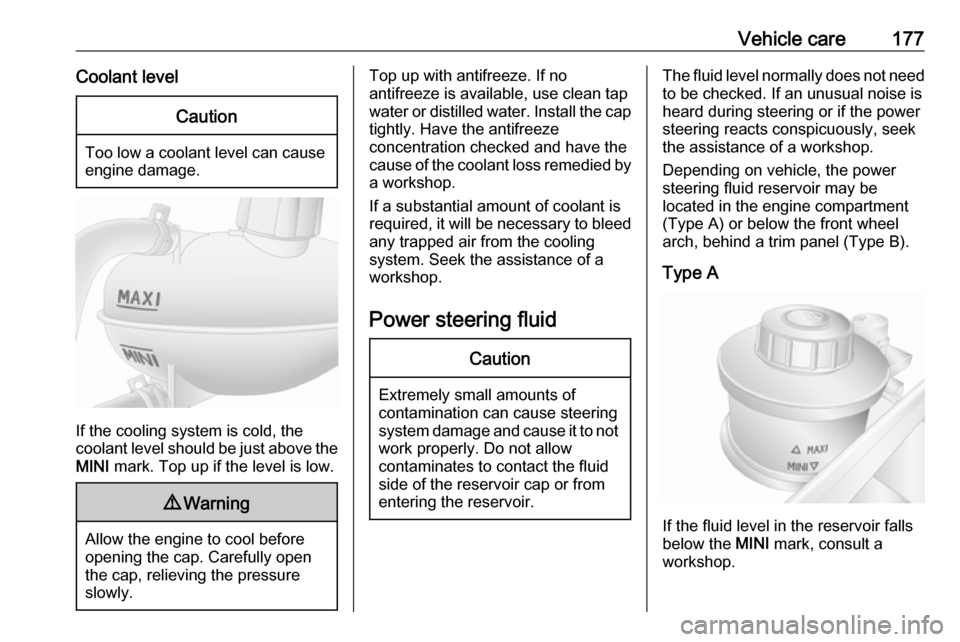
If the cooling system is cold, the
coolant level should be just above the
MINI mark. Top up if the level is low.
9Warning
Allow the engine to cool before
opening the cap. Carefully open
the cap, relieving the pressure
slowly.
Top up with antifreeze. If no
antifreeze is available, use clean tap
water or distilled water. Install the cap
tightly. Have the antifreeze
concentration checked and have the
cause of the coolant loss remedied by a workshop.
If a substantial amount of coolant is
required, it will be necessary to bleed
any trapped air from the cooling
system. Seek the assistance of a
workshop.
Power steering fluidCaution
Extremely small amounts of
contamination can cause steering
system damage and cause it to not work properly. Do not allow
contaminates to contact the fluid
side of the reservoir cap or from
entering the reservoir.
The fluid level normally does not need
to be checked. If an unusual noise is
heard during steering or if the power
steering reacts conspicuously, seek
the assistance of a workshop.
Depending on vehicle, the power
steering fluid reservoir may be
located in the engine compartment
(Type A) or below the front wheel
arch, behind a trim panel (Type B).
Type A
If the fluid level in the reservoir falls
below the MINI mark, consult a
workshop.
Page 205 of 259
Vehicle care203Do not remove foreign bodies from
the tyres.
Tyre damage exceeding four mm or
that is at the tyre's sidewall near the
rim cannot be repaired with the tyre repair kit.9 Warning
Do not drive faster than 50 mph.
Do not use for a lengthy period.
Steering and handling may be
affected.
If the vehicle has a flat tyre:
Apply the parking brake and engage
neutral (manual transmission) or N
(manual transmission automated).
The tyre repair kit is located under the
front seat. Slide seat forwards fully
and fold backrest down to access kit.
1. Take the tyre repair kit out from under the front seat.
2. Remove the compressor.
3. Remove the power supply lead(s)
and air hose from the stowage
compartments on the underside
of the compressor.
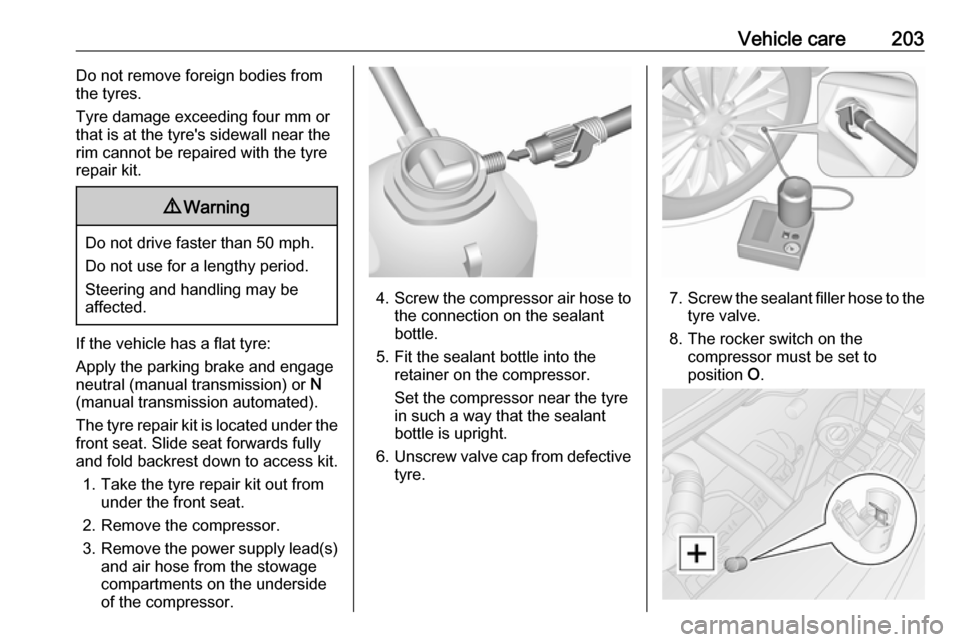
4. Screw the compressor air hose to
the connection on the sealant
bottle.
5. Fit the sealant bottle into the retainer on the compressor.
Set the compressor near the tyre
in such a way that the sealant
bottle is upright.
6. Unscrew valve cap from defective
tyre.7. Screw the sealant filler hose to the
tyre valve.
8. The rocker switch on the compressor must be set to
position O.
Page 215 of 259
Vehicle care213far away from the discharged
vehicle battery as possible,
however at least 60 cm.
Route the leads so that they cannot
catch on rotating parts in the engine
compartment.
To start the engine: 1. Start the engine of the vehicle providing the jump start.
2. After five minutes, start the other engine. Start attempts should be
made for no longer than
15 seconds at an interval of
one minute.
3. Allow both engines to idle for approx. three minutes with the
leads connected.
4. Switch on electrical consumers (e.g. headlights, heated rear
window) of the vehicle receiving
the jump start.
5. Reverse above sequence exactly when removing leads.Towing
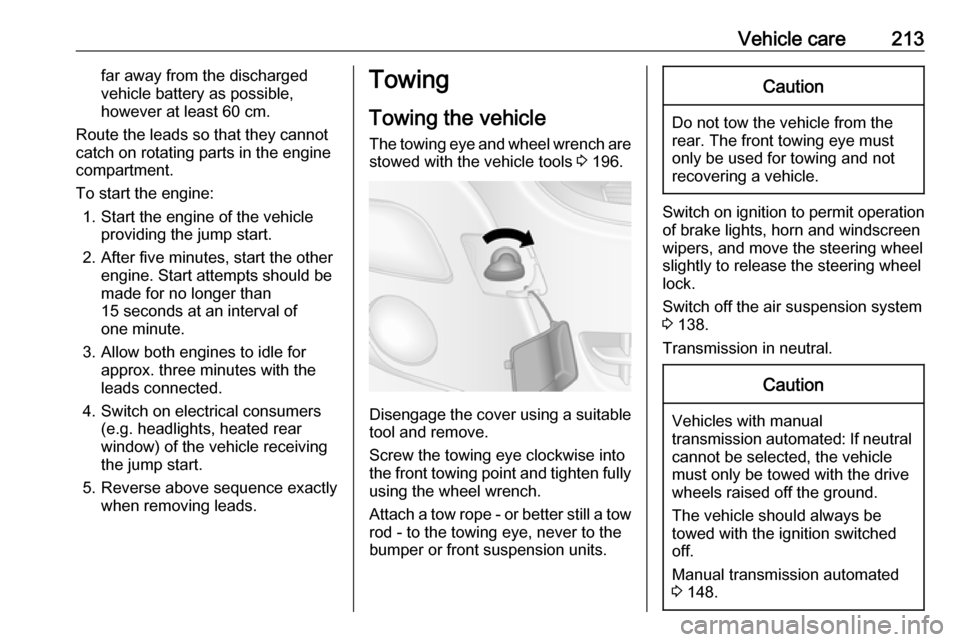
Towing the vehicle The towing eye and wheel wrench are
stowed with the vehicle tools 3 196.
Disengage the cover using a suitable
tool and remove.
Screw the towing eye clockwise into
the front towing point and tighten fully using the wheel wrench.
Attach a tow rope - or better still a tow
rod - to the towing eye, never to the
bumper or front suspension units.
Caution
Do not tow the vehicle from the
rear. The front towing eye must
only be used for towing and not
recovering a vehicle.
Switch on ignition to permit operation
of brake lights, horn and windscreen
wipers, and move the steering wheel
slightly to release the steering wheel
lock.
Switch off the air suspension system 3 138.
Transmission in neutral.
Caution
Vehicles with manual
transmission automated: If neutral cannot be selected, the vehiclemust only be towed with the drive
wheels raised off the ground.
The vehicle should always be
towed with the ignition switched
off.
Manual transmission automated
3 148.
Page 255 of 259

253Lighting features.........................113
Light switch ................................ 106
Limited-slip rear axle ..................157
Load compartment .................22, 73
Load compartment fuse box ......194
Load compartment grille ...............77
Load compartment lighting .........111
Loading information .....................79
Low fuel ....................................... 98
Luggage floor net .........................73
M
Malfunction indicator light ............95
Manual adjustment ......................34
Manual anti-dazzle ......................36
Manual door locks ........................21
Manual mode ............................. 150
Manual transmission............. 16, 148
Manual transmission automated ......................... 16, 148
Manual windows ..........................37
Messages ................................... 101
Mirror adjustment ........................... 8
Mirrors .................................... 34, 36
Misted light covers .....................110
N New vehicle running-in ..............132
Number plate light .....................190O
Object detection systems ...........161
Odometer ..................................... 88
Oil ............................................... 175
Oil, engine .......................... 219, 223
Oil level ......................................... 90
Oil pressure .................................. 98
Outside temperature ....................84
Overcab storage ..........................73
Overhead console .......................72
Overrun cut-off ........................... 134
P Parking ................................ 18, 137
Parking assist ............................ 161
Parking brake ............................ 153
Parking ticket holder .....................39
Particulate filter ........................... 140
Pedals......................................... 131
Performing work ........................174
Pollen filter ................................. 128
Power door locks ..........................25
Power outlets ............................... 85
Power side step ............................ 27
Power sliding door ........................27
Power steering fluid ....................177
Power take-off ............................ 170
Power windows ............................ 37
Preheating ........................... 97, 133
Puncture ............................. 202, 206R
Radio Frequency Identification (RFID) ..................................... 248
Radio remote control ...................20
Rain sensor .................................. 83
Reading lights ............................ 112
Rear air conditioning system .....120
Rear bench seat storage ..............72
Rear courtesy light...................... 111
Rear doors ................................... 30
Rear fog light ............................... 99
Rear fog lights ....................106, 110
Rear heating system .................. 118
Rear reading light .......................112
Rear reversing lens ......................38
Rear seats ................................... 48
Bus ............................................ 48
Installing .................................... 48
Rear seat access ......................48
Removing .................................. 48
Rear storage ................................. 73
Rear view camera ...................... 163
Rear windows .............................. 38
Recommended fluids and lubricants ........................ 219, 223
Refuelling ................................... 167 Registered trademarks ...............247
Remote control ............................. 20
Retractable parking brake ..........153
Reversing lights .........................110
Page 256 of 259

254Ride control systems..........154, 157
Ride height ................................. 138
Roof .............................................. 40
Glass panel ............................... 40
Roof load ...................................... 79
Roof rack ..................................... 79
S
Safety belts ................................... 51
Safety net .................................... 77
Seat adjustment ....................... 7, 43 Seat belt ........................................ 8
Seat belt reminder .......................94
Seat belts ..................................... 51 Seat heating ................................. 48
Seat position ................................ 42
Selective catalytic reduction .......141
Selector lever ............................. 149
Service ............................... 128, 218
Service display ......................90, 95
Service information ....................218
Service vehicle soon .................... 95
Side airbag system ......................59
Sidelights .................................... 106
Side turn signal lights ................188
Side windows................................ 38
Sliding door .................................. 27
Sliding side door ........................... 27
Spare wheel ............................... 208
Speed limiter......................... 87, 161Speedometer ............................... 87
Starting and operating ................132
Starting off ................................... 16
Starting the engine .......16, 133, 149
Steering ...................................... 131
Steering column controls ..............82
Steering wheel adjustment ......9, 82
Steering wheel controls ...............82
Stop engine .................................. 96
Stop-start system............ 16, 98, 134
Storage ......................................... 70
Storage compartments .................70
Storage net ............................. 71, 72
Sun visors .................................... 39
Suspension height ......................138
Suspension seat ........................... 43
Swivelling shelf ............................. 71
Symbols ......................................... 4
T
Tachograph .......................... 99, 104
Tachometer ................................. 88
Tail lights ................................... 187
Technical data ....................223, 224
Three-point seat belt .................... 52
Tools .......................................... 196
Top-Tether .................................... 61
Touchscreen ............................... 100
Tow bar....................................... 169 Towing ........................................ 169Towing another vehicle .............214
Towing a trailer ........................... 169
Towing equipment .....................170
Towing eye ................................. 213
Towing the vehicle .....................213
Traction Control system ............. 154
Trailer coupling ........................... 169
Trailer stability assist .................170
Trailer towing ............................. 169
Transmission ............................... 16
Transmission display ...........91, 148
Tread depth ............................... 201
Trip computer ............................ 102
Trip odometer .............................. 88
Turbo engine warm-up ...............133
Turn and lane-change signals ...109
Turn signal ................................... 94
Tyre chains ................................ 202
Tyre changing ............................. 206
Tyre designations ......................198
Tyre pressure ............................ 198
Tyre pressure monitoring system ............................... 97, 199
Tyre pressures ........................... 243
Tyre repair kit ............................. 202
Tyres .......................................... 197
Tyres and wheel size, changing. 201