seats VAUXHALL VIVARO 2014.5 Owner's Guide
[x] Cancel search | Manufacturer: VAUXHALL, Model Year: 2014.5, Model line: VIVARO, Model: VAUXHALL VIVARO 2014.5Pages: 189, PDF Size: 4.16 MB
Page 59 of 189

Seats, restraints57
Airbag label 3 50.
Selecting the right system The rear seats are the most
convenient location to fasten a child
restraint system.
Children should travel facing
rearwards in the vehicle as long as
possible. This makes sure that the child's backbone, which is still very
weak, is under less strain in the event
of an accident.
Suitable are restraint systems that
comply with valid UN ECE
regulations. Check local laws and
regulations for mandatory use of child restraint systems.
Ensure that the child restraint system to be installed is compatible with the
vehicle type.
Ensure that the mounting location of
the child restraint system within the
vehicle is correct, see following
tables.
Allow children to enter and exit the
vehicle only on the side facing away
from the traffic.When the child restraint system is not in use, secure the seat with a seat belt
or remove it from the vehicle.
Notice
Do not affix anything on the child
restraint systems and do not cover
them with any other materials.
A child restraint system which has
been subjected to stress in an
accident must be replaced.
Page 60 of 189

58Seats, restraintsChild restraint installation locationsPermissible options for fitting a child restraint system
Front seats - Van
Weight and age class
Single front passenger seat 1Double front passenger seat
activated airbag
deactivated
or without airbag
activated airbag
deactivated
or without airbagcentreouterGroup 0: up to 10 kg
or approx. 10 months
Group 0+: up to 13 kg
or approx. 2 years
XUXXU
Group I: 9 to 18 kg
or approx. 8 months to 4 yearsXUXXUGroup II: 15 to 25 kg
or approx. 3 to 7 years
Group III: 22 to 36 kg
or approx. 6 to 12 years
XUXXU
1=Forward-facing child restraints: Remove head restraint 3 40. Slide seat as far back as possible. Set seat height to
highest position. Maximum backrest rake is 25°. Seat adjustment 3 42.
Page 61 of 189

Seats, restraints59
Front seats - Combi, Bus, Crew Van
Weight and age class
Single front passenger seat1Double front passenger seat
activated airbag
deactivated
or without airbag
activated airbag
deactivated
or without airbagcentreouterGroup 0: up to 10 kg
or approx. 10 months
Group 0+: up to 13 kg
or approx. 2 years
XUXXU
Group I: 9 to 18 kg
or approx. 8 months to 4 yearsXU 2XXU2Group II: 15 to 25 kg
or approx. 3 to 7 years
Group III: 22 to 36 kg
or approx. 6 to 12 years
XXXXX
1=If adjustable, slide seat as far back as possible and set seat height to highest position. Maximum backrest rake is
25°. Seat adjustment 3 42.2=Rear-facing child restraints only for this weight and age class.
Page 62 of 189

60Seats, restraints
Rear seats - Combi, Bus, Crew VanWeight and age class2nd row seats13rd row seatsGroup 0: up to 10 kg
or approx. 10 months
Group 0+: up to 13 kg
or approx. 2 years
UU
Group I: 9 to 18 kg
or approx. 8 months to 4 yearsU 2U2Group II: 15 to 25 kg
or approx. 3 to 7 years
Group III: 22 to 36 kg
or approx. 6 to 12 years
U 2U2
1=If necessary, slide adjustable front seat forwards to install a child restraint system on these seats. There may not be
enough clearance to install particular child restraint systems on vehicles fitted with fixed front seats.2=Forward-facing child restraints: Remove head restraint 3 40 before installing child restraint. The seat in front of this
installation position must not be more than halfway back on its runners. Maximum backrest rake is 25°. Seat adjustment
3 42.U=Suitable for universal category restraint systems for use in this weight and age class, in conjunction with three-point
seat belt.X=Seat position not suitable for children in this weight and age class.
Page 63 of 189

Seats, restraints61
Permissible options for fitting an ISOFIX child restraint systemWeight classSize
classFixtureFront seats2nd row seats 13rd row
seatsCentreOutervehicles with single
passenger seatvehicles with
double passenger
seatGroup 0: up to 10 kg
or approx. 10 monthsEISO/R1XXILILXGroup 0+: up to 13 kg
or approx. 2 yearsEISO/R1XXILILXDISO/R2XXILXXCISO/R3XXILXXGroup I: 9 to 18 kg
or approx. 8 months to 4 yearsDISO/R2XXILXXCISO/R3XXILXXBISO/F2XXIL, IUF 2IL, IUF2XB1ISO/F2XXXIL, IUF2IL, IUF2XAISO/F3XXIL, IUF 2IL, IUF2XGroup II: 15 to 25 kg
or approx. 3 to 7 yearsXXIL, IUF2IL, IUF2XGroup III: 22 to 36 kg
or approx. 6 to 12 yearsXXIL, IUF2IL, IUF 2X
Page 64 of 189

62Seats, restraints
1=If necessary, slide adjustable front seat forwards to install a child restraint system on these seats. There may not be
enough clearance to install a child restraint system on vehicles fitted with fixed front seats.2=Forward-facing child restraints: Remove head restraint 3 40 before installing child restraint. The seat in front of this
installation position must not be more than halfway back on its runners. Maximum backrest rake is 25°. Seat adjustment
3 42.IUF=Suitable for ISOFIX forward-facing child restraint systems of universal category approved for use in this weight class.X=No ISOFIX child restraint system approved in this weight class.IL=Suitable for particular ISOFIX restraint systems of the 'specific-vehicle', 'restricted' or 'semi-universal' categories.
The ISOFIX restraint system must be approved for the specific vehicle type.
ISOFIX size class and seat device
A - ISO/F3=Forward-facing child restraint system for children of maximum size in the weight class 9 to 18 kg.B - ISO/F2=Forward-facing child restraint system for smaller children in the weight class 9 to 18 kg.B1 - ISO/F2X=Forward-facing child restraint system for smaller children in the weight class 9 to 18 kg.C - ISO/R3=Rear-facing child restraint system for children of maximum size in the weight class up to 18 kg.D - ISO/R2=Rear-facing child restraint system for smaller children in the weight class up to 18 kg.E - ISO/R1=Rear-facing child restraint system for young children in the weight class up to 13 kg.
Page 65 of 189
Seats, restraints63Isofix child restraint
systems
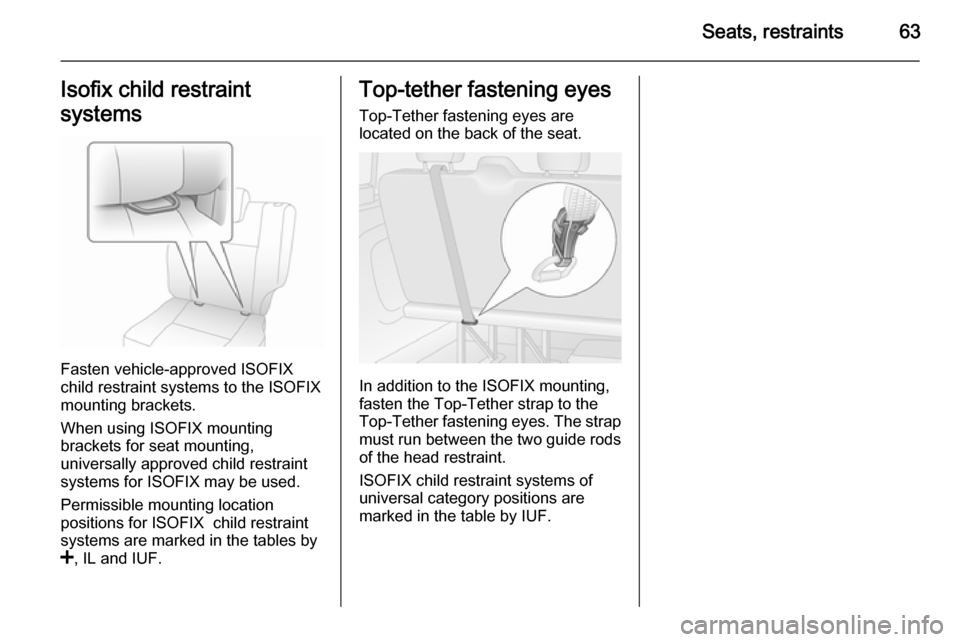
Fasten vehicle-approved ISOFIX
child restraint systems to the ISOFIX
mounting brackets.
When using ISOFIX mounting
brackets for seat mounting,
universally approved child restraint
systems for ISOFIX may be used.
Permissible mounting location
positions for ISOFIX child restraint
systems are marked in the tables by
< , IL and IUF.
Top-tether fastening eyes
Top-Tether fastening eyes are
located on the back of the seat.
In addition to the ISOFIX mounting,
fasten the Top-Tether strap to the
Top-Tether fastening eyes. The strap
must run between the two guide rods
of the head restraint.
ISOFIX child restraint systems of
universal category positions are
marked in the table by IUF.
Page 68 of 189
66Storage
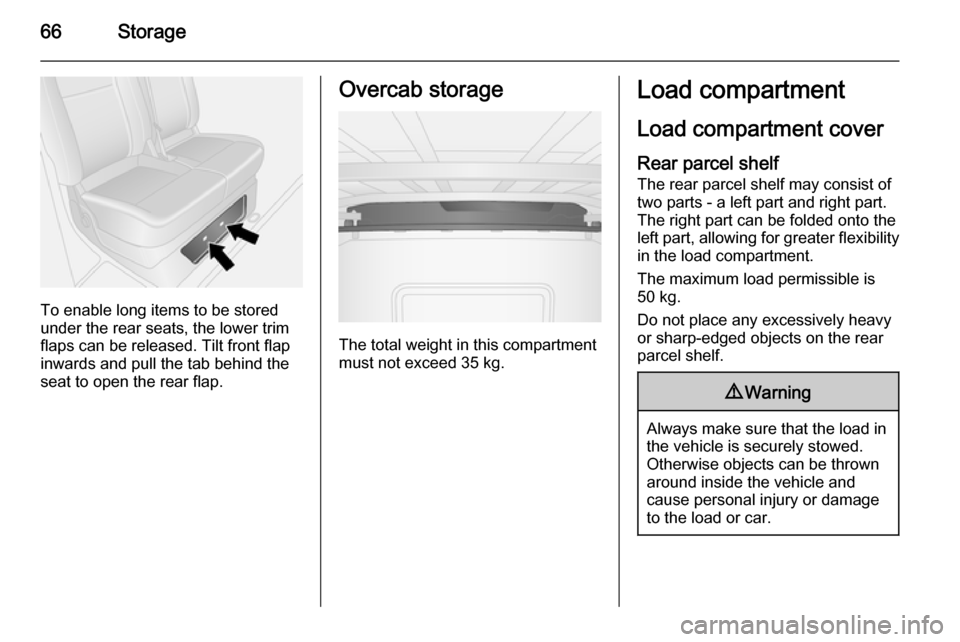
To enable long items to be stored
under the rear seats, the lower trim
flaps can be released. Tilt front flap
inwards and pull the tab behind the
seat to open the rear flap.
Overcab storage
The total weight in this compartment
must not exceed 35 kg.
Load compartment
Load compartment cover Rear parcel shelf
The rear parcel shelf may consist of
two parts - a left part and right part.
The right part can be folded onto the
left part, allowing for greater flexibility in the load compartment.
The maximum load permissible is
50 kg.
Do not place any excessively heavy
or sharp-edged objects on the rear
parcel shelf.9 Warning
Always make sure that the load in
the vehicle is securely stowed.
Otherwise objects can be thrown
around inside the vehicle and
cause personal injury or damage
to the load or car.
Page 69 of 189
Storage67
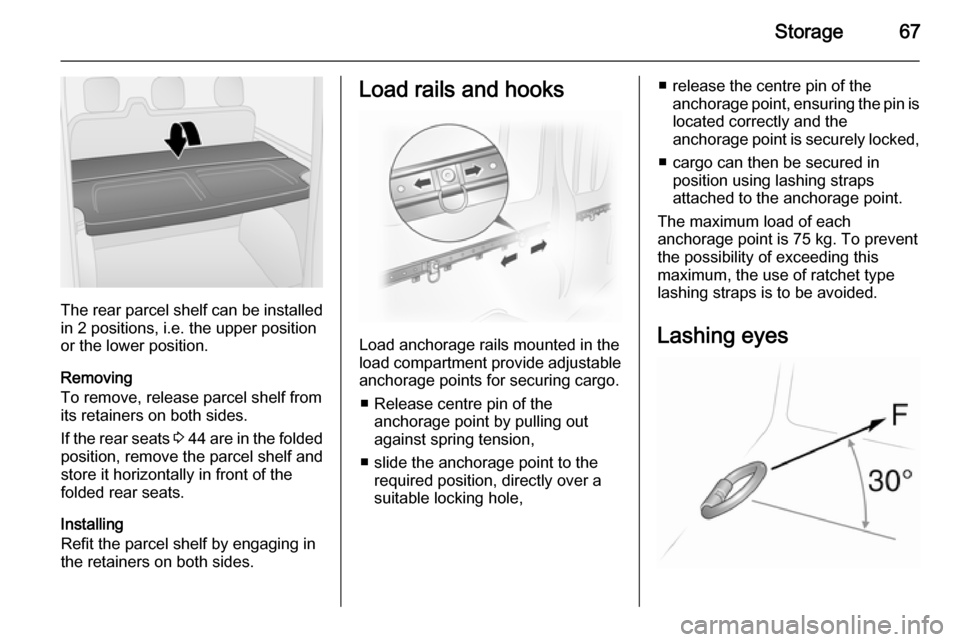
The rear parcel shelf can be installed
in 2 positions, i.e. the upper position
or the lower position.
Removing
To remove, release parcel shelf from
its retainers on both sides.
If the rear seats 3 44 are in the folded
position, remove the parcel shelf and
store it horizontally in front of the
folded rear seats.
Installing
Refit the parcel shelf by engaging in
the retainers on both sides.
Load rails and hooks
Load anchorage rails mounted in the
load compartment provide adjustable anchorage points for securing cargo.
■ Release centre pin of the anchorage point by pulling out
against spring tension,
■ slide the anchorage point to the required position, directly over a
suitable locking hole,
■ release the centre pin of the anchorage point, ensuring the pin islocated correctly and the
anchorage point is securely locked,
■ cargo can then be secured in position using lashing straps
attached to the anchorage point.
The maximum load of each
anchorage point is 75 kg. To prevent
the possibility of exceeding this
maximum, the use of ratchet type
lashing straps is to be avoided.
Lashing eyes
Page 70 of 189
68Storage
Lashing eyes are mounted in the load
compartment to enable cargo to be
secured against slippage using
lashing straps or a luggage floor net.
The maximum force applied to the
lashing eyes should not exceed
6250 N at 30°.
Safety net The safety net can be installed behind the front seats or the rear seats.
Passengers must not be transported
behind the safety net.
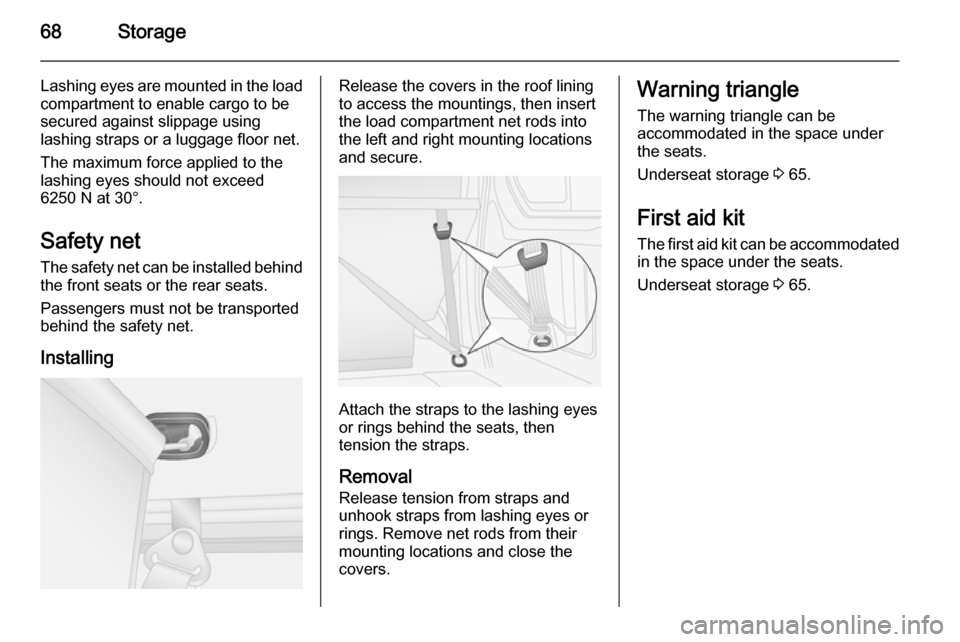
InstallingRelease the covers in the roof lining
to access the mountings, then insert
the load compartment net rods into
the left and right mounting locations and secure.
Attach the straps to the lashing eyes
or rings behind the seats, then
tension the straps.
Removal Release tension from straps and
unhook straps from lashing eyes or
rings. Remove net rods from their
mounting locations and close the
covers.
Warning triangle
The warning triangle can be
accommodated in the space under
the seats.
Underseat storage 3 65.
First aid kit
The first aid kit can be accommodated
in the space under the seats.
Underseat storage 3 65.