lock VAUXHALL VIVARO 2014.5 Workshop Manual
[x] Cancel search | Manufacturer: VAUXHALL, Model Year: 2014.5, Model line: VIVARO, Model: VAUXHALL VIVARO 2014.5Pages: 189, PDF Size: 4.16 MB
Page 155 of 189
Vehicle care153
Tyres age, even if they are not used.
We recommend tyre replacement
every 6 years.
Changing tyre and wheel
size If tyres of a different size than those
fitted at the factory are used, it may be necessary to reprogramme the
speedometer as well as the nominal
tyre pressure and make other vehicle modifications.
After converting to a different tyre
size, have the label with tyre
pressures replaced.9 Warning
Use of unsuitable tyres or wheels
may lead to accidents and will
invalidate the vehicle type
approval.
Wheel covers
Wheel covers and tyres that are
factory approved for the respective
vehicle and comply with all of the
relevant wheel and tyre combination requirements must be used.
If the wheel covers and tyres used are
not factory approved, the tyres must
not have a rim protection ridge.
Wheel covers must not impair brake
cooling.9 Warning
Use of unsuitable tyres or wheel
covers could lead to sudden
pressure loss and thereby
accidents.
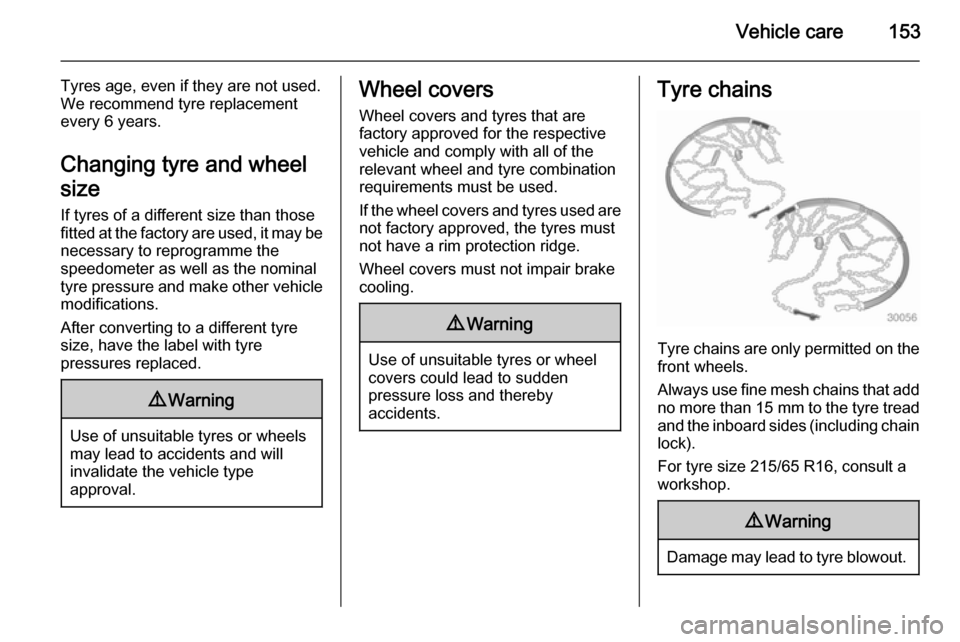
Tyre chains
Tyre chains are only permitted on the
front wheels.
Always use fine mesh chains that add no more than 15 mm to the tyre tread
and the inboard sides (including chain lock).
For tyre size 215/65 R16, consult a
workshop.
9 Warning
Damage may lead to tyre blowout.
Page 159 of 189

Vehicle care157
Replace the used sealant bottle.
Dispose of the sealant bottle as
prescribed by applicable laws.
Wheel changing
Some vehicles are equipped with a
tyre repair kit instead of a spare wheel 3 154.
Make the following preparations and
observe the following information:
■ Park the vehicle on a level, firm and
non-slippery surface. The front wheels must be in the straight-ahead position.
■ Apply the parking brake and engage first gear or reverse gear.
■ Remove the spare wheel 3 158.
■ Never change more than one wheel
at a time.
■ Use the jack only to change wheels
in case of puncture, not for a
seasonal winter or summer tyre
change.
■ If the ground on which the vehicle is standing is soft, a solid board
(max. 1 cm thick) should be placed
under the jack.■ Take heavy objects out of the vehicle before jacking up.
■ No people or animals may be in the
vehicle when it is jacked-up.
■ Never crawl under a jacked-up vehicle.
■ Do not start the engine when the vehicle is raised on the jack.
1. Remove the wheel cover (using the hook supplied). Vehicle tools
3 148.
2. Loosen each of the wheel bolts by
half a turn using the wheel
wrench. Ensure the wrench
locates securely. The wrench
should turn anticlockwise to
loosen the bolts. Invert the wrench if necessary.
3. Place lifting pad spigot of the jack
under the jacking hole located
nearest the wheel concerned.
Ensure the jack is positioned
correctly. The jack base must be
on the ground directly below the
jacking hole in a manner that
prevents it from slipping.
4. Install wrench onto the jack and raise the vehicle by turning the
wrench until the wheel is clear of
the ground.
Page 160 of 189
158Vehicle care
5. Unscrew wheel bolts completelyby turning anticlockwise and wipe
clean with a cloth.
Put wheel bolts somewhere
where the threads will not be
soiled.
6. Change the wheel. Spare wheel 3 158.
7. Screw in the wheel bolts.
8. Lower the vehicle and remove jack.
9. Tighten each of the wheel bolts in
a crosswise sequence using the
wheel wrench. Ensure the wrench
locates securely. The wrench
should turn clockwise to tighten
the bolts. Invert the wrench if
necessary.
Tightening torque is 160 Nm.
10. Replace the wheel cover, ensuring that the valve hole in thewheel cover is aligned with the
tyre valve before installing.11. Stow the replaced wheel 3 158
and the vehicle tools 3 148.
12. Have the new wheel balanced on the vehicle.
Check the tyre pressure of the
installed tyre 3 178.
Check the wheel bolt torque.
Have the defective tyre renewed or
repaired as soon as possible.
Spare wheel
Some vehicles are equipped with a tyre repair kit instead of a spare wheel 3 154.
If mounting a spare wheel which is
different from the other wheels, this
wheel might be classified as a
temporary spare wheel and the
corresponding speed limits apply,
even though no label indicates this.
Seek the assistance of a workshop to
check the applicable speed limit.Caution
The use of a spare wheel that is smaller than the other wheels or in combination with winter tyres
could affect driveability. Have the defective tyre replaced as soon as
possible.
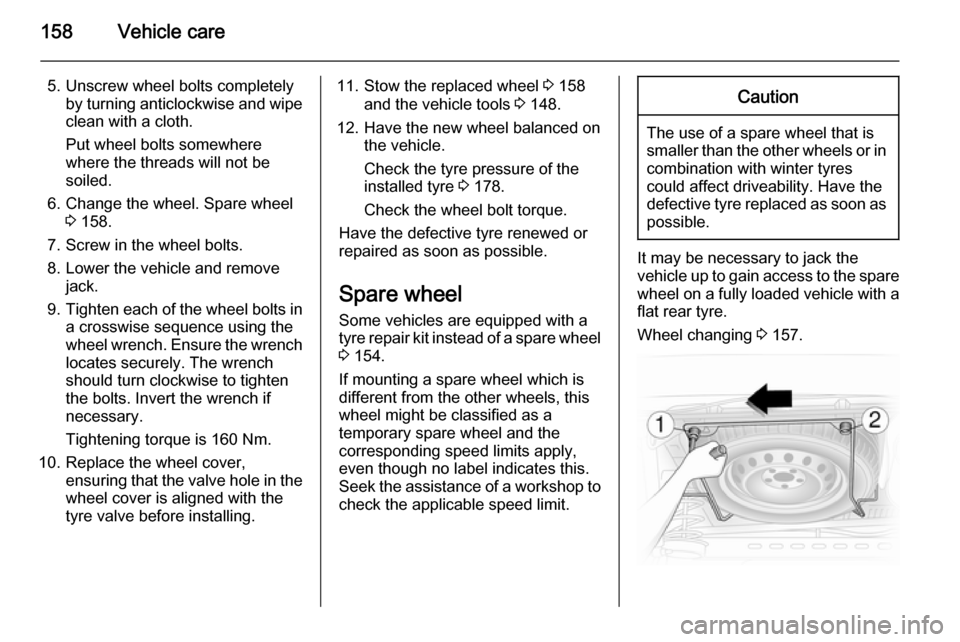
It may be necessary to jack the
vehicle up to gain access to the spare
wheel on a fully loaded vehicle with a
flat rear tyre.
Wheel changing 3 157.
Page 162 of 189
160Vehicle care
■ A discharged vehicle battery canalready freeze at a temperature of
0 °C. Defrost the frozen battery
before connecting jump leads.
■ Wear eye protection and protective
clothing when handling a battery.
■ Use a booster battery with the same voltage (12 volts). Its capacity(Ah) must not be much less than
that of the discharged battery.
■ Use jump leads with insulated terminals and a cross section of at
least 16 mm 2
(25 mm 2
for diesel
engines).
■ Do not disconnect the discharged vehicle battery from the vehicle.
■ Switch off all unnecessary electrical
consumers.
■ Do not lean over the battery during jump starting.
■ Do not allow the terminals of one lead to touch those of the other
lead.
■ The vehicles must not come into contact with each other during thejump starting process.■ Apply the parking brake, transmission in neutral.
■ Open the positive terminal protection caps of both batteries.
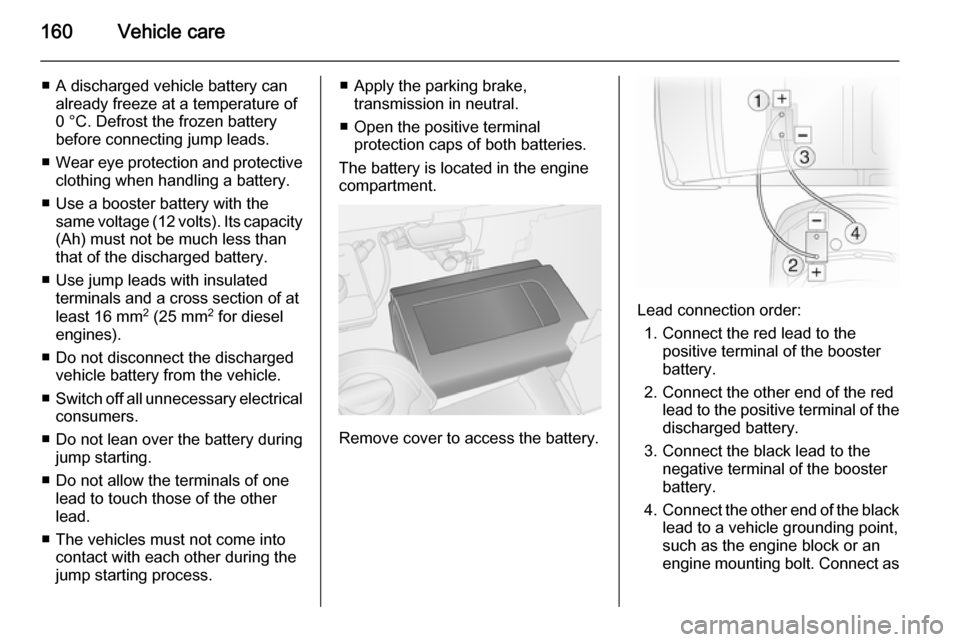
The battery is located in the engine
compartment.
Remove cover to access the battery.
Lead connection order:
1. Connect the red lead to the positive terminal of the booster
battery.
2. Connect the other end of the red lead to the positive terminal of the
discharged battery.
3. Connect the black lead to the negative terminal of the booster
battery.
4. Connect the other end of the black
lead to a vehicle grounding point,
such as the engine block or an
engine mounting bolt. Connect as
Page 163 of 189
Vehicle care161
far away from the discharged
vehicle battery as possible,
however at least 60 cm.
Route the leads so that they cannot
catch on rotating parts in the engine
compartment.
To start the engine: 1. Start the engine of the vehicle providing the jump start.
2. After 5 minutes, start the other engine. Start attempts should be
made for no longer than
15 seconds at an interval of
1 minute.
3. Allow both engines to idle for approx. 3 minutes with the leads
connected.
4. Switch on electrical consumers (e.g. headlights, heated rear
window) of the vehicle receiving
the jump start.
5. Reverse above sequence exactly when removing leads.Towing
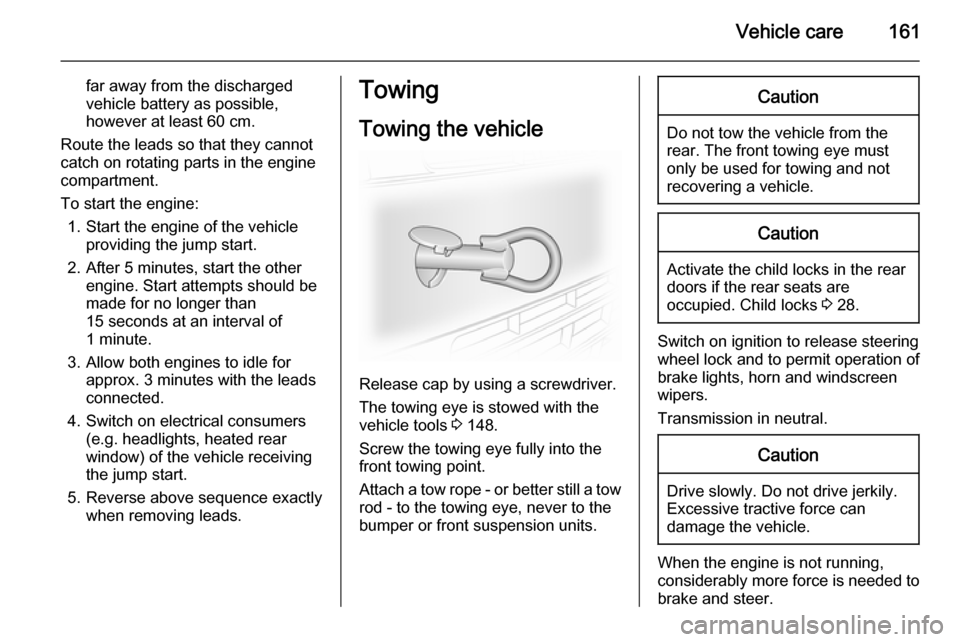
Towing the vehicle
Release cap by using a screwdriver.
The towing eye is stowed with the
vehicle tools 3 148.
Screw the towing eye fully into the
front towing point.
Attach a tow rope - or better still a tow
rod - to the towing eye, never to the
bumper or front suspension units.
Caution
Do not tow the vehicle from the
rear. The front towing eye must
only be used for towing and not
recovering a vehicle.
Caution
Activate the child locks in the rear
doors if the rear seats are
occupied. Child locks 3 28.
Switch on ignition to release steering
wheel lock and to permit operation of
brake lights, horn and windscreen
wipers.
Transmission in neutral.
Caution
Drive slowly. Do not drive jerkily.
Excessive tractive force can
damage the vehicle.
When the engine is not running,
considerably more force is needed to
brake and steer.
Page 164 of 189
162Vehicle care
To prevent the entry of exhaust fumesfrom the towing vehicle, switch on the
air recirculation system and close the windows.
Seek the assistance of a workshop.
After towing, unscrew the towing eye and replace cap.
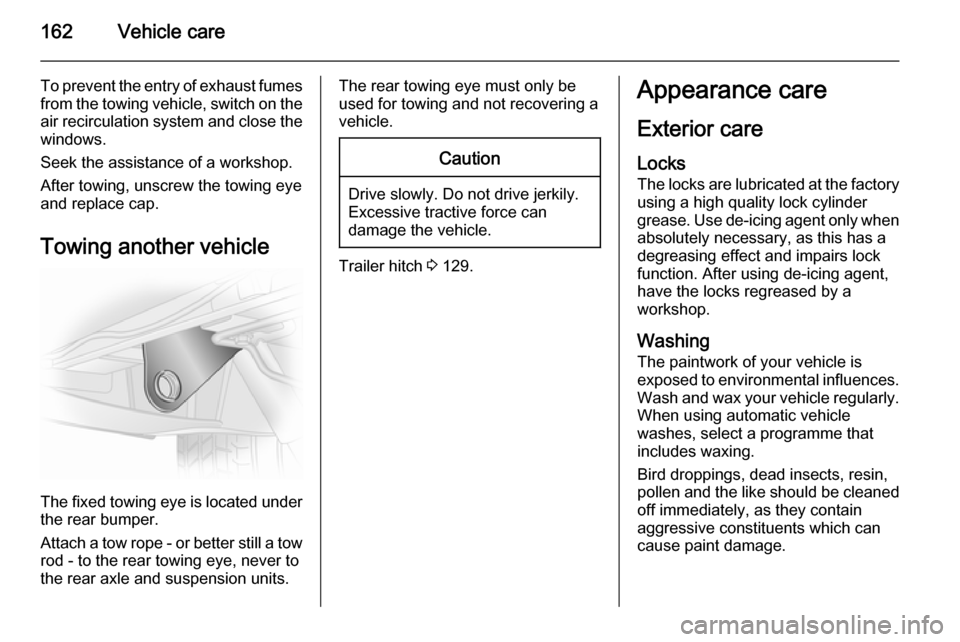
Towing another vehicle
The fixed towing eye is located under the rear bumper.
Attach a tow rope - or better still a tow
rod - to the rear towing eye, never to
the rear axle and suspension units.
The rear towing eye must only be
used for towing and not recovering a
vehicle.Caution
Drive slowly. Do not drive jerkily.
Excessive tractive force can
damage the vehicle.
Trailer hitch 3 129.
Appearance care
Exterior care LocksThe locks are lubricated at the factory
using a high quality lock cylinder
grease. Use de-icing agent only when absolutely necessary, as this has a
degreasing effect and impairs lock
function. After using de-icing agent,
have the locks regreased by a
workshop.
Washing The paintwork of your vehicle is
exposed to environmental influences.
Wash and wax your vehicle regularly.
When using automatic vehicle
washes, select a programme that
includes waxing.
Bird droppings, dead insects, resin,
pollen and the like should be cleaned
off immediately, as they contain
aggressive constituents which can
cause paint damage.
Page 182 of 189

180Customer information
■ Vehicle reactions in particulardriving situations (e.g. inflation of
an airbag, activation of the stability
regulation system)
■ Environmental conditions (e.g. temperature)
These data are exclusively technical
and help identifying and correcting
errors as well as optimizing vehicle
functions.
Motion profiles indicating travelled
routes cannot be created with these
data.
If services are used (e.g. repair
works, service processes, warranty
cases, quality assurance),
employees of the service network
(manufacturer included) are able to
read out this technical information
from the event and error data storage
modules applying special diagnostic
devices. If required, you will receive
further information at these
workshops. After an error has been
corrected, the data are deleted from
the error storage module or they are
constantly overwritten.When using the vehicle, situations
may occur in which these technical
data related to other information
(accident report, damages on the
vehicle, witness statements etc.) may be associated with a specific person -
possibly, with the assistance of an
expert.
Additional functions contractually
agreed upon with the client (e.g.
vehicle location in emergency cases)
allow the transmission of particular vehicle data from the vehicle.Radio Frequency
Identification (RFID) RFID technology is used in somevehicles for functions such as tyre
pressure monitoring and ignition
system security. It is also used in
connection with conveniences such
as radio remote controls for door
locking/unlocking and starting, and in-
vehicle transmitters for garage door
openers. RFID technology in
Vauxhall vehicles does not use or
record personal information or link with any other Vauxhall system
containing personal information.
Page 184 of 189

182IndexAAccessories and vehicle modifications .......................... 131
Adjustable air vents ...................106
Airbag and belt tensioners ...........81
Airbag deactivation ................55, 81
Airbag label................................... 50 Airbag system .............................. 50
Air conditioning regular operation ................................ 107
Air conditioning system ................ 98
Air intake .................................... 107
Air vents...................................... 106
Alert .............................................. 87
Antifreeze ................................... 135
Antilock brake system ................ 117
Antilock brake system (ABS) .......83
Anti-theft alarm system ................33
Anti-theft locking system .............. 31
Anti-theft security lock ..................23
Appearance care ........................162
Armrest ........................................ 43
Ashtrays ....................................... 76
Automatic anti-dazzle ..................37
Automatic fuel cut-off ..................112
Automatic light control .................91
Automatic locking ........................28
Autostop ....................................... 85
Auxiliary heater ........................... 102B
Battery, jump starting.................. 159
Belts.............................................. 47
Bonnet ....................................... 132
Brake and clutch fluid .................166
Brake assist ............................... 118
Brake fluid .................................. 136
Brakes ............................... 117, 136
Brake system ............................... 83
Breakdown.................................. 161
Bulb replacement ....................... 139
C Capacities .................................. 177
Car Pass ...................................... 19
Catalytic converter .....................115
Central locking system ................23
Centre high-mounted brake light 141
Changing tyre and wheel size ...153
Charging system .......................... 82
Child locks ................................... 28
Child restraint installation locations ................................... 58
Child restraints.............................. 56
Child restraint systems ................56
Cigarette lighter ........................... 75
Cleaning the vehicle ...................162
Climate control ............................. 15
Climate control systems ...............97
Page 185 of 189

183
Clock ............................................ 74
Control indicators.......................... 79
Control of the vehicle .................108
Controls ........................................ 71
Controls in steering wheel ............71
Convex shape .............................. 35
Coolant ....................................... 135
Coolant and antifreeze ...............166
Coolant heater ............................ 102
Cruise control ...................... 85, 120
Cupholders .................................. 65
Curtain airbag system .................. 54
D
Danger, Warnings and Cautions ...3
Dashboard .................................... 10
Daytime running lights ............91, 92
Declaration of conformity ............179
Diesel fuel filter .......................... 138
Diesel fuel system bleeding .......138
Diesel particle filter ....................115
Door locks..................................... 23
Door open .................................... 85
Doors ............................................ 29
Driver assistance systems ..........120
Driver Information Centre .............86
Driving characteristics and towing tips .............................. 129
Driving economically................... 108
Driving hints ................................ 108E
ECO mode .................................. 108
ecoScoring.................................... 88
Electric adjustment ......................35
Electrical system......................... 144
Electronic climate control system 99
Electronic key system ...................21
Electronic Stability Program 83, 119
End-of-life vehicle recovery .......132
Engine air filter............................ 134
Engine air flow indicator .............134
Engine coolant ........................... 135
Engine coolant temperature ........84
Engine data ............................... 172
Engine exhaust .......................... 115
Engine identification ...................169
Engine oil ................... 133, 166, 171
Engine oil level ............................ 88
Engine oil pressure ......................84
Entry lighting ................................ 95
Event data recorders ..................179
Exhaust gases ............................ 115
Exit lighting .................................. 96
Exterior care .............................. 162
Exterior light ................................. 85
Exterior lighting ......................12, 91
Exterior mirrors ............................. 35F
Fault messages ............................ 87
First aid kit ................................... 68
Fixed air vents ........................... 106
Fog light ....................................... 85
Fog lights .............................. 93, 140
Fog tail light ............................... 143
Folding mirrors ............................. 36
Front airbag system .....................53
Front fog lights ............................. 93
Front seats.................................... 41
Front storage ................................ 65
Front turn signal lights ...............140
Fuel consumption - CO 2-
Emissions ............................... 128
Fuel cut-off system .....................112
Fuel economy gauge ....................78
Fuel economy mode .....................85
Fuel economy rating ...............87, 88
Fuel for diesel engines ..............127
Fuel gauge ................................... 77
Fuse box ..................................... 145
Fuses ......................................... 144
G
Gauges ......................................... 76
General information ...................129
Glovebox ..................................... 64
Glove box lighting .........................95
Page 186 of 189

184
HHand brake - see Parking brake. 118
Hazard warning flashers ..............93
Headlight flash ............................. 92
Headlight range adjustment ........92
Headlights ...................... 91, 92, 139
Headlights when driving abroad ..92
Head restraint adjustment .............8
Head restraints ............................ 40
Heated mirrors ............................. 36
Heated rear window ..................... 38
Heating ........................................ 44
Heating and ventilation system ...97
High beam ............................. 85, 92
Hill start assist ........................... 118
Horn ....................................... 14, 72
I
Identification plate .....................169
Idle speed control .......................112
Ignition switch positions .............109
Immobiliser .................................. 34
Indicators ...................................... 76
Info-display ................................... 86
Information displays...................... 86
Initial drive information.................... 6 Instrument panel fuse box .........145
Instrument panel illumination .....144Instrument panel illumination
control ...................................... 94
Instrument panel overview ........... 10
Instrument panel storage ..............64
Interior care ............................... 164
Interior lighting .............................. 94
Interior lights ........................ 94, 143
Interior mirrors .............................. 36
Introduction .................................... 3
Isofix child restraint systems ........ 63
J
Jack ............................................ 148
Jump starting ............................. 159
K Keys ............................................. 19
Keys, locks ................................... 19
L
Lashing eyes ............................... 67
Light covers, misted...................... 94
Lighting ......................................... 91
Lighting features ........................... 95
Light switch .................................. 91
Load compartment ....................... 30
Load compartment cover .............66
Load compartment lighting ...........95
Loading information .....................69Load rails and hooks ...................67
Low fuel ....................................... 85
M
Malfunction indicator light ............82
Manual adjustment ......................35
Manual anti-dazzle ......................36
Manual transmission .................. 116
Messages ..................................... 87
Mirror adjustment ........................... 8
Mirrors .................................... 35, 36
Misted light covers .......................94
N New vehicle running-in ..............109
Number plate light .....................142
O
Object detection systems ...........124
Octane rating .............................. 172
Odometer ..................................... 77
Oil ............................................... 133
Oil, engine .......................... 166, 171
Oil pressure .................................. 84
Outside temperature ....................74
Overcab storage ..........................66
Overrun cut-off ........................... 113