instrument panel VAUXHALL VIVARO 2014 User Guide
[x] Cancel search | Manufacturer: VAUXHALL, Model Year: 2014, Model line: VIVARO, Model: VAUXHALL VIVARO 2014Pages: 173, PDF Size: 4.11 MB
Page 90 of 173
88Climate control
The control buttons operate
identically to the timer unit described
previously.
To activate the remote control, press
activation button X and release it
when the menu bar appears in the
display. The signal indicator and
SENd appear briefly in the display,
followed by the temperature.9 Warning
When refuelling, switch off the
remote control unit as well as the
heater!
To switch off, press and hold
activation button X to prevent
inadvertent operation.
The remote control has a maximum
range of 600 metres. The range may
be reduced due to environmental
conditions and as the battery
becomes weaker.
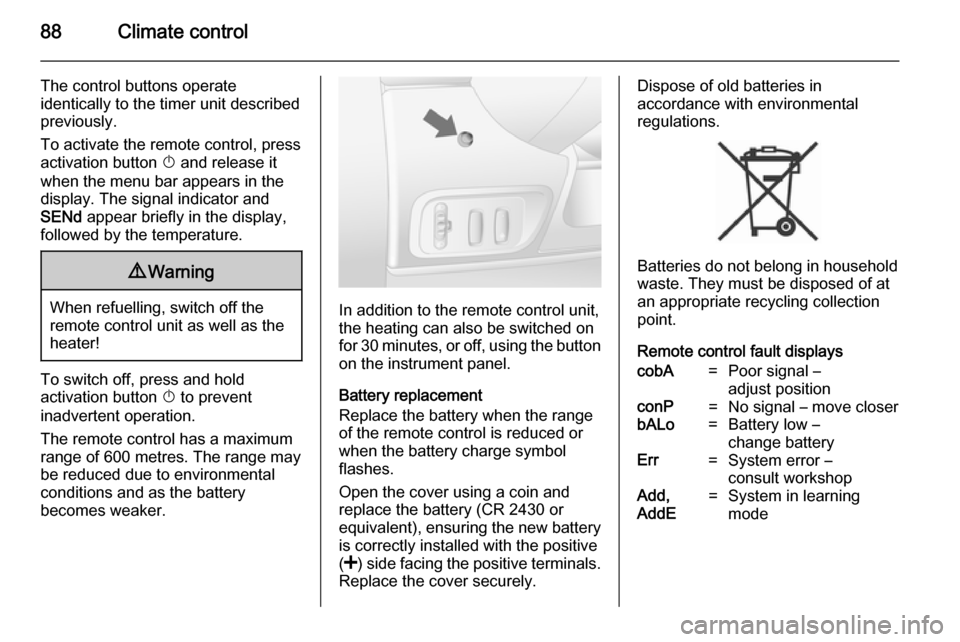
In addition to the remote control unit,
the heating can also be switched on
for 30 minutes, or off, using the button
on the instrument panel.
Battery replacement
Replace the battery when the range
of the remote control is reduced or when the battery charge symbol
flashes.
Open the cover using a coin and
replace the battery (CR 2430 or equivalent), ensuring the new battery
is correctly installed with the positive
( < ) side facing the positive terminals.
Replace the cover securely.
Dispose of old batteries in
accordance with environmental
regulations.
Batteries do not belong in household
waste. They must be disposed of at
an appropriate recycling collection
point.
Remote control fault displays
cobA=Poor signal –
adjust positionconP=No signal – move closerbALo=Battery low –
change batteryErr=System error –
consult workshopAdd,
AddE=System in learning
mode
Page 91 of 173

Climate control89
Teach remote control
If the vehicle battery is reconnected, the LED in the instrument panel
button illuminates and the system
configures the remote control menu
automatically. If the LED flashes,
press OK button on remote control,
select Add or AddE and confirm.
Additional remote control units may
also be configured. Press the button
until LED flashes, switch on the
remote control, select Add and
confirm.
AddE teaches the current remote
control unit exclusively and blocks all
previously configured units. Add
teaches up to 4 remote control units,
but only one unit can operate the
system at any one time.
Operation
Heating Y
Select Y in the menu bar and confirm.
The predetermined heating duration,
e.g. L 30, flashes in the display. The
factory setting is 30 minutes.To temporarily adjust the heating
duration, adjust with the q or r
button and confirm. The value can be
set from 10 to 120 minutes. Due to the
power consumption, note the heating duration.
To switch off, select Y in the menu bar
again and confirm.
Ventilation x
Select x in the menu bar and confirm.
The ventilation duration can be
accepted or adjusted. The duration
shown is accepted without
confirmation.
To switch off, select x in the menu bar
again and confirm.
Programming P
Up to 3 preset departure times can be
programmed, either during one day or
over one week.
■ Select P in the menu bar and
confirm
■ Select desired preset memory number 1, 2 or 3 and confirm
■ Select day and confirm■ Select hour and confirm
■ Select minutes and confirm
■ Select Y or x and confirm
■ If necessary, adjust the runtime duration prior to departure andconfirm
The next preset memory number to
be activated is underlined and the
weekday is displayed. Repeat the
procedure to programme the other
preset memory numbers.
Pressing button X during the
procedure will exit without storing programme adjustments.
To delete a preset departure time,
follow the steps for programming until
heating symbol Y flashes. Press
button q or r until oFF appears in
the display and confirm.
Heating stops automatically
5 minutes after the programmed
departure time.
Notice
The remote control system features
a temperature sensor which
calculates the runtime according to
the ambient temperature and the
Page 110 of 173
108Driving and operatingObject detection
systems
Parking assist
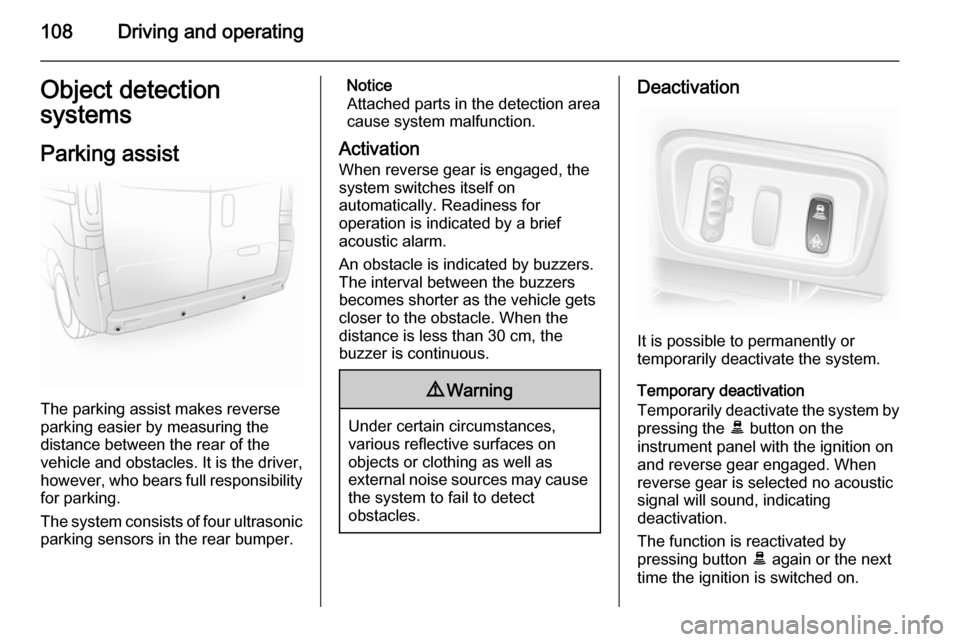
The parking assist makes reverse
parking easier by measuring the
distance between the rear of the
vehicle and obstacles. It is the driver,
however, who bears full responsibility for parking.
The system consists of four ultrasonic
parking sensors in the rear bumper.
Notice
Attached parts in the detection area
cause system malfunction.
Activation
When reverse gear is engaged, the
system switches itself on
automatically. Readiness for
operation is indicated by a brief
acoustic alarm.
An obstacle is indicated by buzzers.
The interval between the buzzers
becomes shorter as the vehicle gets
closer to the obstacle. When the
distance is less than 30 cm, the buzzer is continuous.9 Warning
Under certain circumstances,
various reflective surfaces on
objects or clothing as well as
external noise sources may cause the system to fail to detect
obstacles.
Deactivation
It is possible to permanently or
temporarily deactivate the system.
Temporary deactivation
Temporarily deactivate the system by
pressing the E button on the
instrument panel with the ignition on
and reverse gear engaged. When
reverse gear is selected no acoustic
signal will sound, indicating
deactivation.
The function is reactivated by
pressing button E again or the next
time the ignition is switched on.
Page 111 of 173
Driving and operating109
Permanent deactivation
Permanently deactivate the system
by pressing and holding the E button
on the instrument panel for approx. 3 seconds with the ignition on and
reverse gear engaged. The system is deactivated and will not operate.
When reverse gear is selected no
acoustic signal will sound, indicating
deactivation.
The function is reactivated by
pressing and holding button E for
approx. 3 seconds.
Fault
If the system detects an operating
fault, a continuous acoustic alarm will sound for approx. 5 seconds whenselecting reverse gear. Consult a
workshop to have the cause of the
fault remedied.Caution
When reversing, the area should
be free from obstacles which could
impact on the underside of the
vehicle.
Impact to the rear axle, which may
not be visible, could lead to
uncharacteristic changes in the
vehicle handling. In the event of
such an impact, consult a
workshop.Fuel
Fuel for petrol engines Only use unleaded fuel that complies
with European standard EN 228 or
E DIN 51626-1 or equivalent.
Your engine is capable of running
with E10 fuel that fulfills these
standards. E10 fuel contains up to
10 % bioethanol.
Use fuel with the recommended octane rating 3 154. Use of fuel with
too low an octane rating can reduce
engine power and torque and slightly
increases fuel consumption.Caution
Do not use fuel or fuel additives
that contain metallic compounds
such as manganese-based
additives. This may cause engine
damage.
Page 130 of 173
128Vehicle careInstrument panel
illumination Have bulbs replaced by a workshop.Electrical system
Fuses
Data on the replacement fuse must match the data on the defective fuse.
The fuse box is located on the left-
hand side of the instrument panel,
below the cupholder.
Before replacing a fuse, turn off the
respective switch and the ignition.
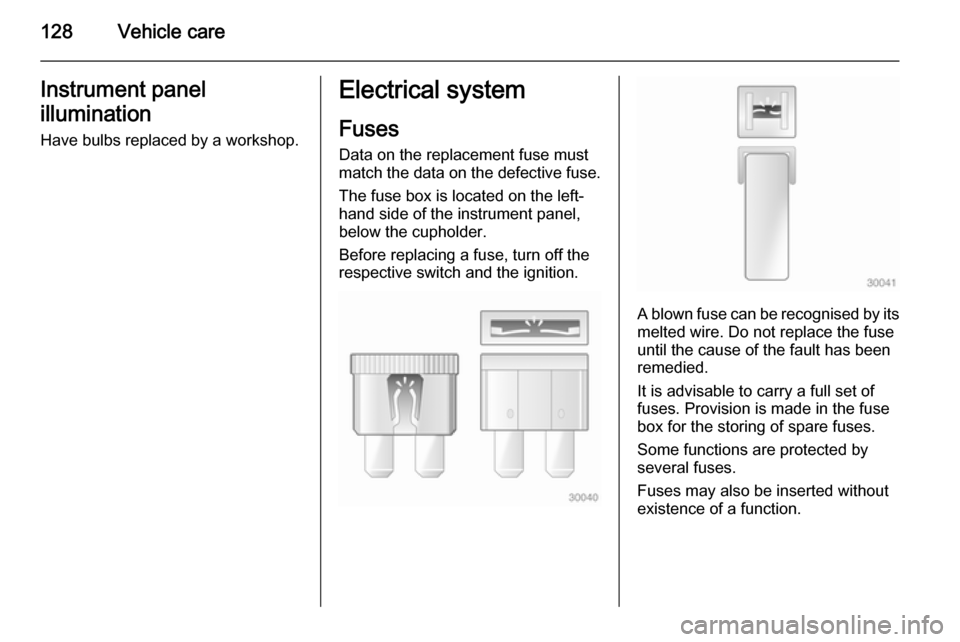
A blown fuse can be recognised by its melted wire. Do not replace the fuse
until the cause of the fault has been
remedied.
It is advisable to carry a full set of
fuses. Provision is made in the fuse
box for the storing of spare fuses.
Some functions are protected by
several fuses.
Fuses may also be inserted without
existence of a function.
Page 131 of 173
Vehicle care129
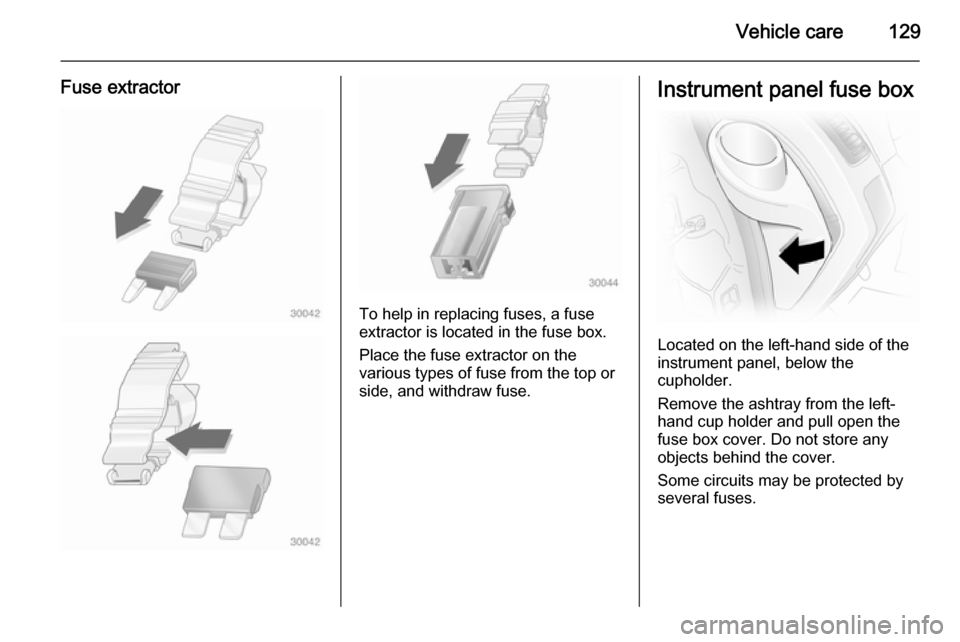
Fuse extractor
To help in replacing fuses, a fuse
extractor is located in the fuse box.
Place the fuse extractor on the
various types of fuse from the top or
side, and withdraw fuse.
Instrument panel fuse box
Located on the left-hand side of the
instrument panel, below the
cupholder.
Remove the ashtray from the left-
hand cup holder and pull open the
fuse box cover. Do not store any
objects behind the cover.
Some circuits may be protected by
several fuses.
Page 132 of 173

130Vehicle care
SymbolApplicationZAir conditioningdHeated exterior mirrorsUHeated front seats,Power windowsLLeft-hand high beamNRight-hand high beamKWindscreen wiperZRadio, Infotainment system)Cigarette lighterBoilerRear passenger compart‐
ment heaterjHornaLeft-hand low beamWRight-hand low beameInstrument panelZHeatingdInterior lampSymbolApplicationuAntilock brake systemÜHeated rear windows+Clock, interior lights, radio,
Infotainment systemUCH
INJFuel injection systemfRear window washereRear widow wiperTLeft-hand sidelightSRight-hand sidelightUCentral locking:Electrically adjustable exte‐
rior mirrorsCStop control indicator,
daytime running lightsrRear fog lights>Front fog lightsSymbolApplication?Power outletTTachograph
Page 146 of 173

144Vehicle care
Windows and windscreen wiperblades
Use a soft lint-free cloth or chamois leather together with window cleanerand insect remover.
When cleaning the rear window from
inside, always wipe in parallel to the
heating element to prevent damage.
For mechanical removal of ice, use a
sharp-edged ice scraper. Press the
scraper firmly against the glass so
that no dirt can get under it and
scratch the glass.
Clean smearing wiper blades with a
soft cloth and window cleaner.
Wheels and tyres
Do not use high-pressure jet
cleaners.
Clean rims with a pH-neutral wheel
cleaner.
Rims are painted and can be treated
with the same agents as the body.Paintwork damage
Rectify minor paintwork damage with
a touch-up pen before rust forms.
Have more extensive damage or rust
areas repaired by a workshop.
Underbody
Some areas of the vehicle underbody
have a PVC undercoating while other critical areas have a durable
protective wax coating.
After the underbody is washed, check
the underbody and have it waxed if
necessary.
Bitumen/rubber materials could
damage the PVC coating. Have
underbody work carried out by a
workshop.
Before and after winter, wash the
underbody and have the protective
wax coating checked.
Engine compartment
It is advisable to wash the engine compartment before and after winter
and preserve it with wax. Protect thealternator and brake fluid reservoir
with plastic sheets before washing
the engine.
When washing the engine with a
steam-jet cleaner, do not direct the
steam jet towards components of the
antilock brake system, air
conditioning system or the belt drive and its components.
After an engine wash, have all engine
compartment components preserved
thoroughly by a workshop using
protective wax.
Do not use high-pressure jet
cleaners.
Towing equipment
Do not clean the coupling ball bar with a steam-jet or high-pressure jet
cleaner.
Interior care Interior and upholstery
Only clean the vehicle interior,
including the instrument panel fascia
and panelling, with a dry cloth or
interior cleaner.
Page 170 of 173

168
I
Identification plate .....................150
Ignition switch positions ...............94
Immobiliser .................................. 27
Indicators ...................................... 65
Information displays...................... 74
Instrument panel fuse box .........129
Instrument panel illumination .....128
Instrument panel overview ........... 10
Instrument panel storage ..............55
Interior care ............................... 144
Interior lights ........................ 82, 127
Interior mirrors .............................. 29
Interruption of power supply ......100
Introduction .................................... 3
Isofix child restraint systems ........ 54
J Jump starting ............................. 139
K Keys ............................................. 18
Keys, locks ................................... 18
L
Lashing eyes ............................... 57
Light covers, misted...................... 82
Lighting ......................................... 79
Light switch .................................. 79
Load compartment ....................... 25Load compartment cover .............56
Load compartment lighting ..........82
Loading information .....................58
Load rails and hooks ...................57
Low fuel ....................................... 73
M Malfunction indicator light ............71
Manual adjustment ......................28
Manual anti-dazzle ......................29
Manual mode ............................... 99
Manual transmission .................... 96
Manual transmission automated . 97
Manual windows ..........................30
Messages ..................................... 75
Mirror adjustment ........................... 8
Mirrors .................................... 28, 29
Misted light covers .......................82
N
New vehicle running-in ................94
Number plate light .....................126
O Object detection systems ...........108
Octane rating .............................. 154
Odometer ..................................... 65
Oil ............................................... 117
Oil, engine .......................... 147, 152
Oil level ......................................... 67Oil pressure.................................. 73
Outside temperature ....................63
Overcab storage ..........................56
Overrun cut-off ............................. 95
P Parking .................................. 17, 95
Parking assist ............................ 108
Parking brake ............................ 102
Particulate filter ............................. 95
Performing work ........................116
Pollen filter ................................... 91
Power outlets ............................... 64
Power steering fluid ...................120
Power windows ............................ 30
Preheating ................................... 72
Puncture ..................................... 136
R Radio Frequency Identification (RFID) ..................................... 165
Radio remote control ...................18
Reading lights .............................. 83
Rear air conditioning system .......86
Rear doors ................................... 24
Rear fog light ............................... 73
Rear fog lights ............................. 82
Rear heating system .................... 86
Rear seats .................................... 36
Rear windows .............................. 30