lock VAUXHALL VIVARO 2014 User Guide
[x] Cancel search | Manufacturer: VAUXHALL, Model Year: 2014, Model line: VIVARO, Model: VAUXHALL VIVARO 2014Pages: 173, PDF Size: 4.11 MB
Page 26 of 173
24Keys, doors and windowsDoors
Sliding door
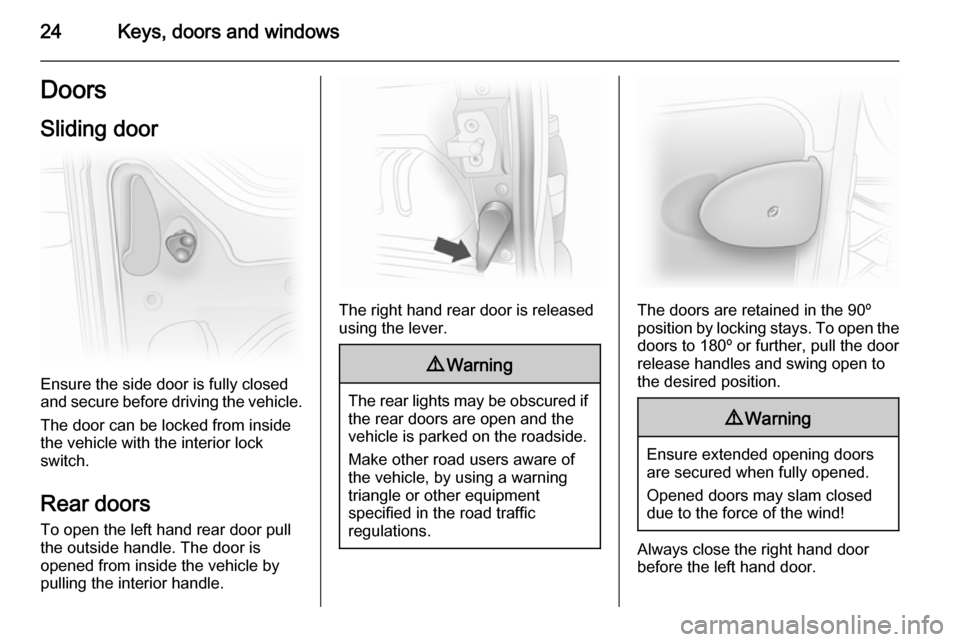
Ensure the side door is fully closed
and secure before driving the vehicle.
The door can be locked from inside
the vehicle with the interior lock
switch.
Rear doors
To open the left hand rear door pull the outside handle. The door is
opened from inside the vehicle by
pulling the interior handle.
The right hand rear door is released
using the lever.
9 Warning
The rear lights may be obscured if
the rear doors are open and the
vehicle is parked on the roadside.
Make other road users aware of the vehicle, by using a warning
triangle or other equipment
specified in the road traffic
regulations.
The doors are retained in the 90º
position by locking stays. To open the
doors to 180º or further, pull the door
release handles and swing open to
the desired position.
9 Warning
Ensure extended opening doors
are secured when fully opened.
Opened doors may slam closed due to the force of the wind!
Always close the right hand doorbefore the left hand door.
Page 27 of 173
Keys, doors and windows25Load compartment
Tailgate
Opening
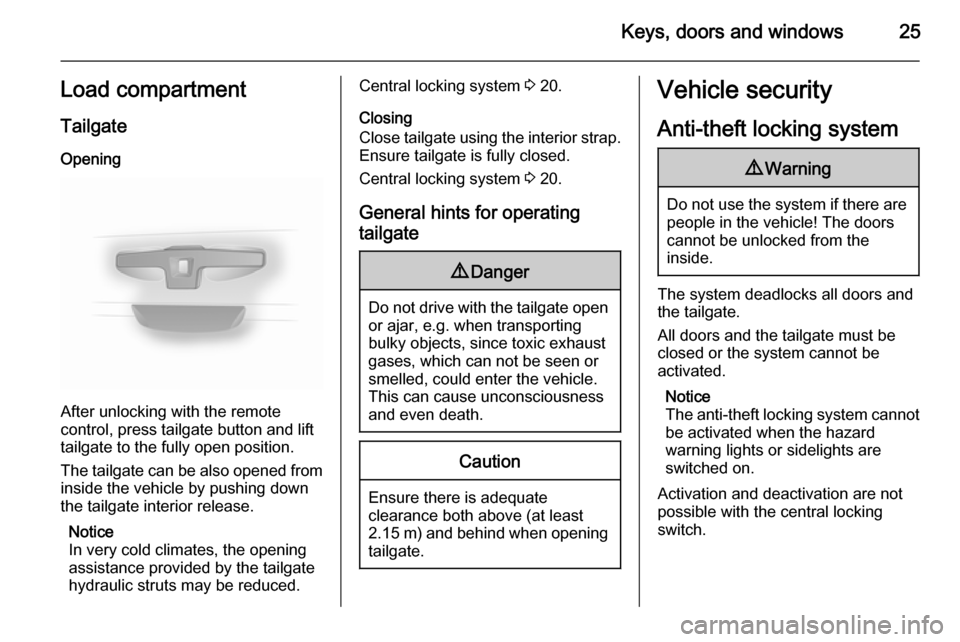
After unlocking with the remote
control, press tailgate button and lift tailgate to the fully open position.
The tailgate can be also opened from inside the vehicle by pushing down
the tailgate interior release.
Notice
In very cold climates, the opening
assistance provided by the tailgate
hydraulic struts may be reduced.
Central locking system 3 20.
Closing
Close tailgate using the interior strap. Ensure tailgate is fully closed.
Central locking system 3 20.
General hints for operating tailgate9 Danger
Do not drive with the tailgate open
or ajar, e.g. when transporting
bulky objects, since toxic exhaust
gases, which can not be seen or
smelled, could enter the vehicle.
This can cause unconsciousness
and even death.
Caution
Ensure there is adequate
clearance both above (at least
2.15 m) and behind when opening
tailgate.
Vehicle security
Anti-theft locking system9 Warning
Do not use the system if there are
people in the vehicle! The doorscannot be unlocked from the
inside.
The system deadlocks all doors and
the tailgate.
All doors and the tailgate must be
closed or the system cannot be
activated.
Notice
The anti-theft locking system cannot be activated when the hazard
warning lights or sidelights are
switched on.
Activation and deactivation are not possible with the central locking
switch.
Page 28 of 173
26Keys, doors and windows
Activation
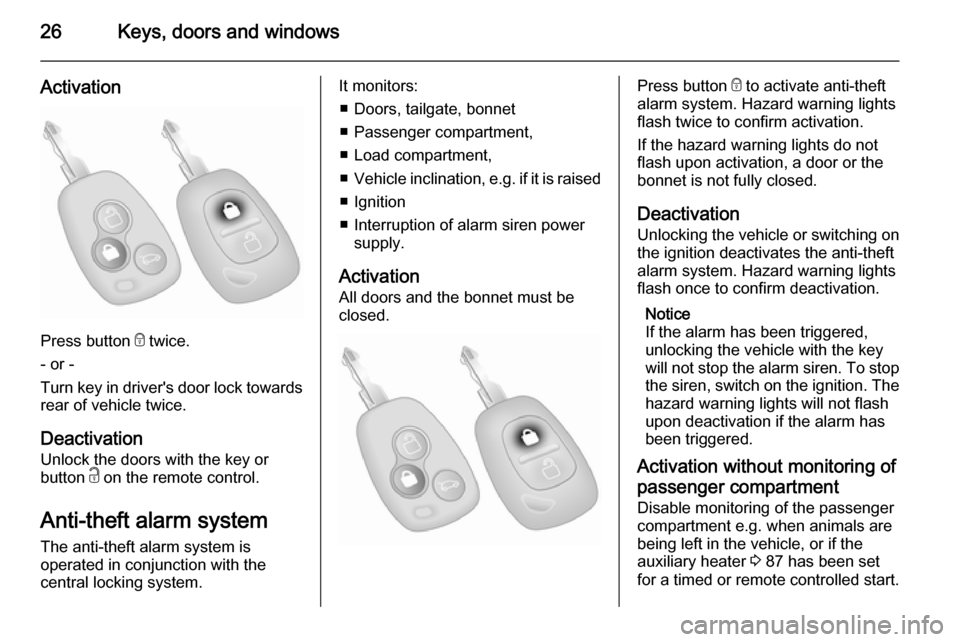
Press button e twice.
- or -
Turn key in driver's door lock towards
rear of vehicle twice.
Deactivation
Unlock the doors with the key or
button c on the remote control.
Anti-theft alarm system
The anti-theft alarm system is
operated in conjunction with the
central locking system.
It monitors:
■ Doors, tailgate, bonnet
■ Passenger compartment,
■ Load compartment,
■ Vehicle inclination, e.g. if it is raised
■ Ignition
■ Interruption of alarm siren power supply.
Activation All doors and the bonnet must be
closed.Press button e to activate anti-theft
alarm system. Hazard warning lights flash twice to confirm activation.
If the hazard warning lights do not flash upon activation, a door or the
bonnet is not fully closed.
Deactivation
Unlocking the vehicle or switching on the ignition deactivates the anti-theft
alarm system. Hazard warning lights
flash once to confirm deactivation.
Notice
If the alarm has been triggered,
unlocking the vehicle with the key
will not stop the alarm siren. To stop
the siren, switch on the ignition. The hazard warning lights will not flash
upon deactivation if the alarm has
been triggered.
Activation without monitoring of
passenger compartment
Disable monitoring of the passenger
compartment e.g. when animals are
being left in the vehicle, or if the
auxiliary heater 3 87 has been set
for a timed or remote controlled start.
Page 29 of 173
Keys, doors and windows27
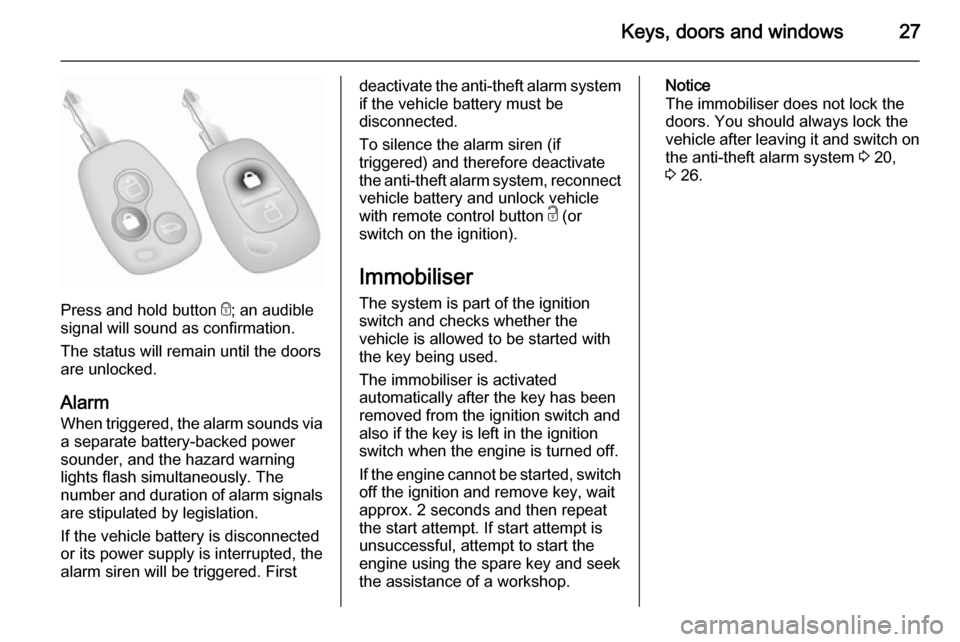
Press and hold button e; an audible
signal will sound as confirmation.
The status will remain until the doors
are unlocked.
Alarm
When triggered, the alarm sounds via a separate battery-backed power
sounder, and the hazard warning
lights flash simultaneously. The
number and duration of alarm signals
are stipulated by legislation.
If the vehicle battery is disconnected
or its power supply is interrupted, the
alarm siren will be triggered. First
deactivate the anti-theft alarm system if the vehicle battery must be
disconnected.
To silence the alarm siren (if
triggered) and therefore deactivate
the anti-theft alarm system, reconnect vehicle battery and unlock vehicle
with remote control button c (or
switch on the ignition).
Immobiliser
The system is part of the ignition
switch and checks whether the
vehicle is allowed to be started with
the key being used.
The immobiliser is activated
automatically after the key has been
removed from the ignition switch and
also if the key is left in the ignition
switch when the engine is turned off.
If the engine cannot be started, switch off the ignition and remove key, wait
approx. 2 seconds and then repeat
the start attempt. If start attempt is
unsuccessful, attempt to start the
engine using the spare key and seek
the assistance of a workshop.Notice
The immobiliser does not lock the doors. You should always lock the
vehicle after leaving it and switch on the anti-theft alarm system 3 20,
3 26.
Page 35 of 173
Seats, restraints33
Head restraint removal
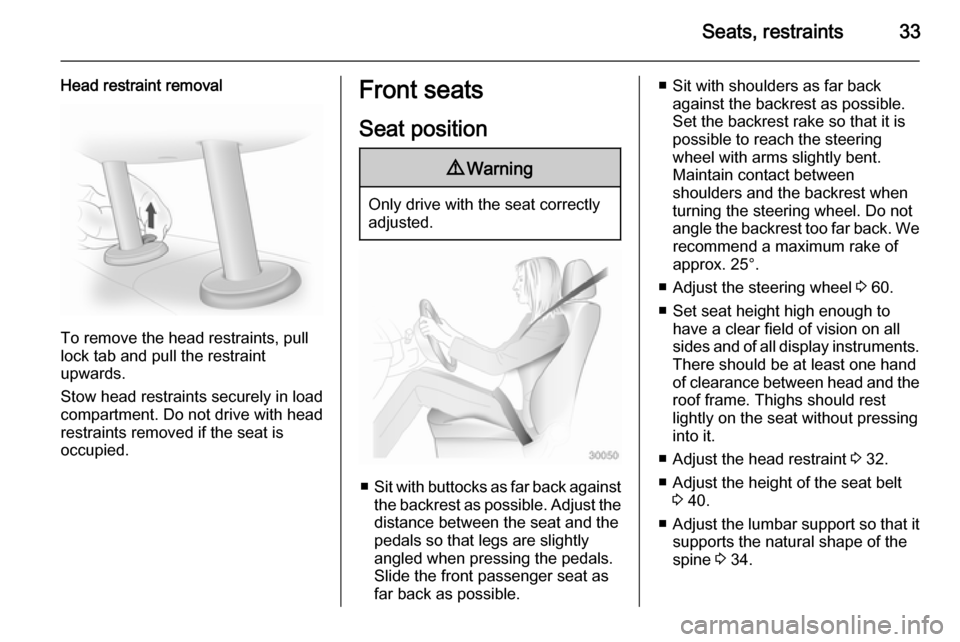
To remove the head restraints, pull
lock tab and pull the restraint
upwards.
Stow head restraints securely in load
compartment. Do not drive with head
restraints removed if the seat is
occupied.
Front seats
Seat position9 Warning
Only drive with the seat correctly
adjusted.
■ Sit with buttocks as far back against
the backrest as possible. Adjust the distance between the seat and the
pedals so that legs are slightly
angled when pressing the pedals.
Slide the front passenger seat as
far back as possible.
■ Sit with shoulders as far back against the backrest as possible.
Set the backrest rake so that it is possible to reach the steering
wheel with arms slightly bent.
Maintain contact between
shoulders and the backrest when
turning the steering wheel. Do not
angle the backrest too far back. We recommend a maximum rake of
approx. 25°.
■ Adjust the steering wheel 3 60.
■ Set seat height high enough to have a clear field of vision on allsides and of all display instruments.
There should be at least one hand
of clearance between head and the
roof frame. Thighs should rest
lightly on the seat without pressing
into it.
■ Adjust the head restraint 3 32.
■ Adjust the height of the seat belt 3 40.
■ Adjust the lumbar support so that it
supports the natural shape of the
spine 3 34.
Page 39 of 173
Seats, restraints37
Rear seat access
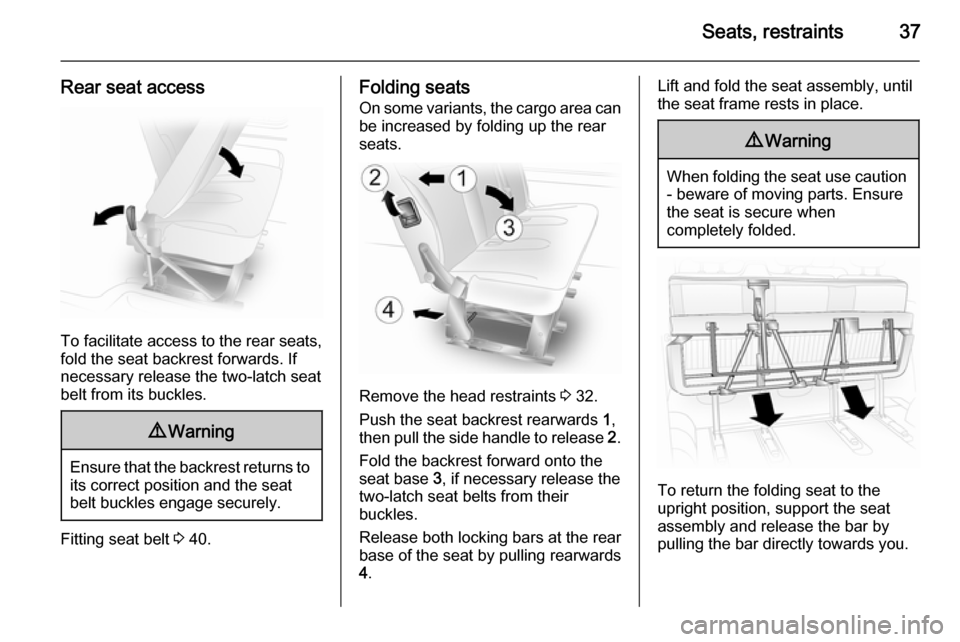
To facilitate access to the rear seats,
fold the seat backrest forwards. If necessary release the two-latch seatbelt from its buckles.
9 Warning
Ensure that the backrest returns to
its correct position and the seat
belt buckles engage securely.
Fitting seat belt 3 40.
Folding seats
On some variants, the cargo area can
be increased by folding up the rear
seats.
Remove the head restraints 3 32.
Push the seat backrest rearwards 1,
then pull the side handle to release 2.
Fold the backrest forward onto the
seat base 3, if necessary release the
two-latch seat belts from their
buckles.
Release both locking bars at the rear
base of the seat by pulling rearwards
4 .
Lift and fold the seat assembly, until
the seat frame rests in place.9 Warning
When folding the seat use caution
- beware of moving parts. Ensure
the seat is secure when
completely folded.
To return the folding seat to the
upright position, support the seat
assembly and release the bar by
pulling the bar directly towards you.
Page 40 of 173
38Seats, restraints
Gradually lower the seat assembly,
allowing the rear support legs to fold
down. Lower the seat completely,
ensuring the rear support legs are
located, and latched.
Raise the backrest, reinstall head
restraints and connect the seat belts.
Removable rear seatsOn some variants, the cargo area can
be increased by removing the rear
seats.
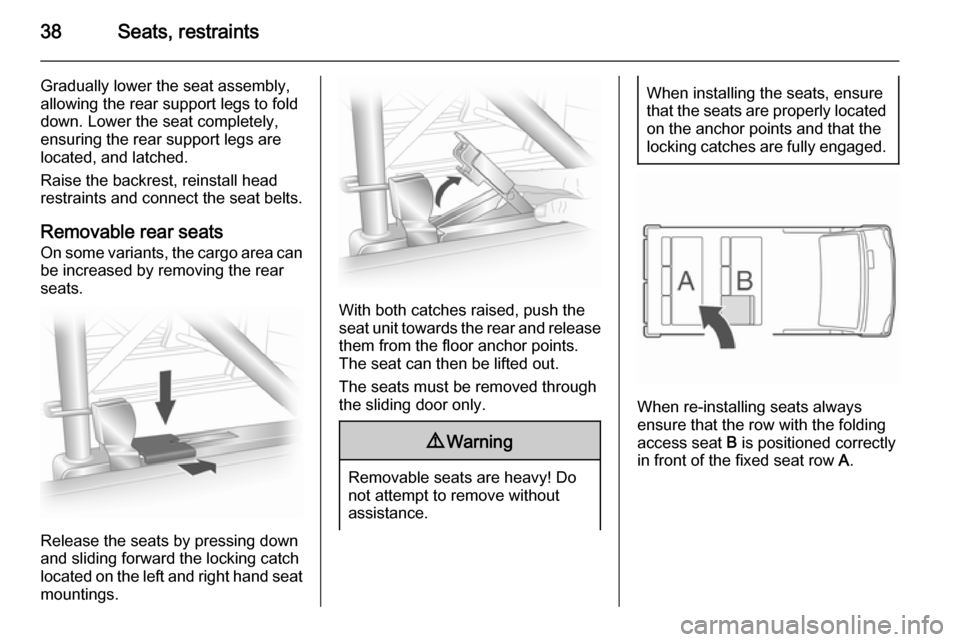
Release the seats by pressing down
and sliding forward the locking catch
located on the left and right hand seat
mountings.
With both catches raised, push the
seat unit towards the rear and release them from the floor anchor points.
The seat can then be lifted out.
The seats must be removed through
the sliding door only.
9 Warning
Removable seats are heavy! Do
not attempt to remove without
assistance.
When installing the seats, ensure that the seats are properly located
on the anchor points and that the
locking catches are fully engaged.
When re-installing seats always
ensure that the row with the folding access seat B is positioned correctly
in front of the fixed seat row A.
Page 41 of 173
Seats, restraints39Seat belts
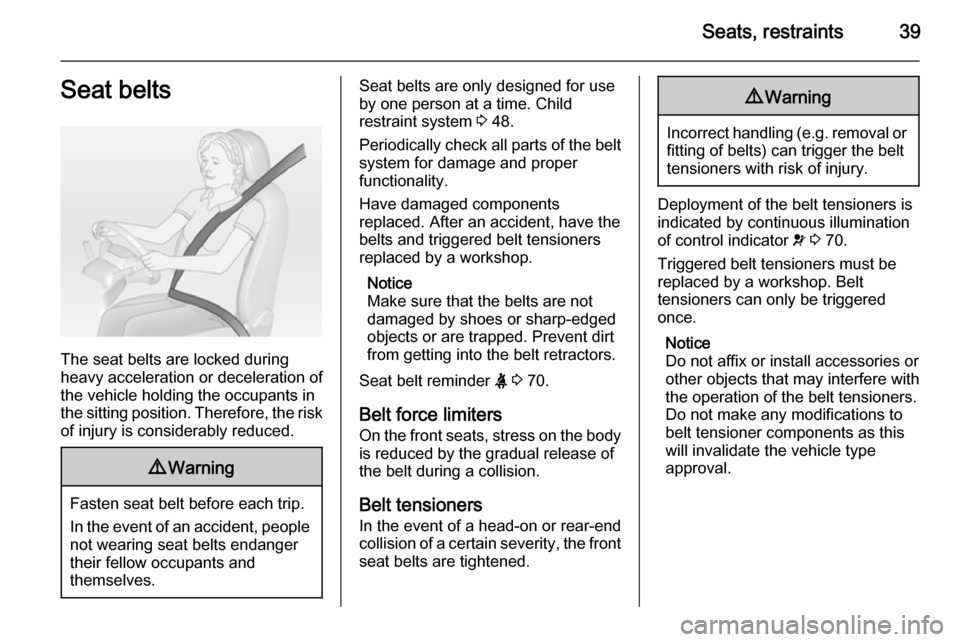
The seat belts are locked during
heavy acceleration or deceleration of
the vehicle holding the occupants in
the sitting position. Therefore, the risk of injury is considerably reduced.
9 Warning
Fasten seat belt before each trip.
In the event of an accident, people
not wearing seat belts endanger their fellow occupants and
themselves.
Seat belts are only designed for use
by one person at a time. Child
restraint system 3 48.
Periodically check all parts of the belt system for damage and proper
functionality.
Have damaged components
replaced. After an accident, have the
belts and triggered belt tensioners
replaced by a workshop.
Notice
Make sure that the belts are not
damaged by shoes or sharp-edged
objects or are trapped. Prevent dirt
from getting into the belt retractors.
Seat belt reminder X 3 70.
Belt force limiters On the front seats, stress on the body
is reduced by the gradual release of
the belt during a collision.
Belt tensioners In the event of a head-on or rear-endcollision of a certain severity, the front
seat belts are tightened.9 Warning
Incorrect handling (e.g. removal or
fitting of belts) can trigger the belt
tensioners with risk of injury.
Deployment of the belt tensioners is
indicated by continuous illumination
of control indicator v 3 70.
Triggered belt tensioners must be
replaced by a workshop. Belt
tensioners can only be triggered
once.
Notice
Do not affix or install accessories or
other objects that may interfere with
the operation of the belt tensioners.
Do not make any modifications to
belt tensioner components as this
will invalidate the vehicle type
approval.
Page 49 of 173
Seats, restraints479Warning
Keep the area in which the airbag
inflates clear of obstructions.
Airbag deactivation
Front airbag and side airbag systems for the front passenger seat have to
be deactivated if a child restraint
system is to be fitted on this seat. The curtain airbag system, the belt
tensioners and all driver airbag
systems will remain active.
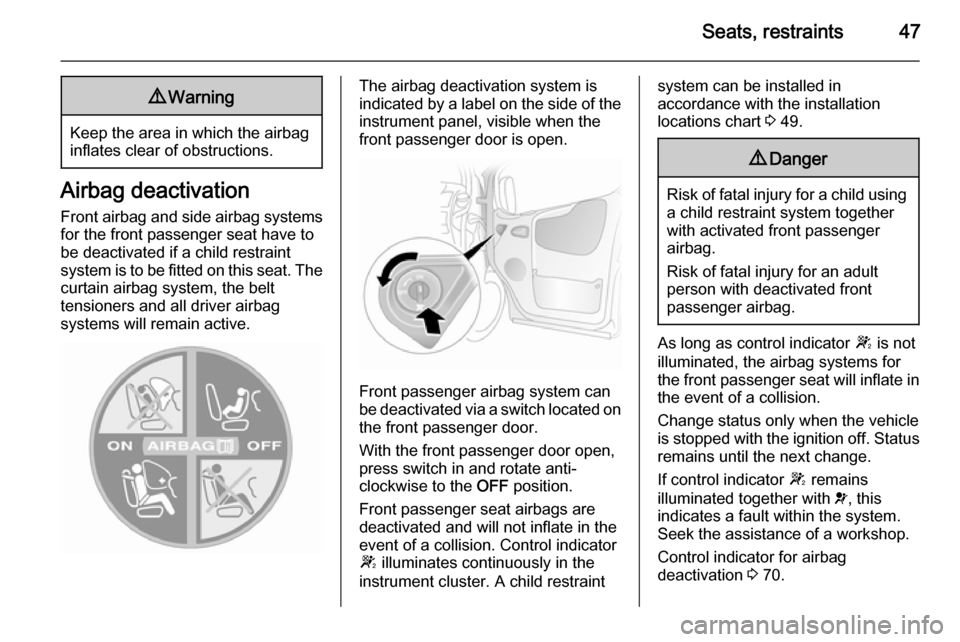
The airbag deactivation system is
indicated by a label on the side of the instrument panel, visible when the
front passenger door is open.
Front passenger airbag system can
be deactivated via a switch located on the front passenger door.
With the front passenger door open,
press switch in and rotate anti-
clockwise to the OFF position.
Front passenger seat airbags are
deactivated and will not inflate in the
event of a collision. Control indicator
W illuminates continuously in the
instrument cluster. A child restraint
system can be installed in
accordance with the installation
locations chart 3 49.9 Danger
Risk of fatal injury for a child using
a child restraint system together
with activated front passenger
airbag.
Risk of fatal injury for an adult
person with deactivated front
passenger airbag.
As long as control indicator W is not
illuminated, the airbag systems for
the front passenger seat will inflate in the event of a collision.
Change status only when the vehicle
is stopped with the ignition off. Status remains until the next change.
If control indicator W remains
illuminated together with v, this
indicates a fault within the system. Seek the assistance of a workshop.
Control indicator for airbag
deactivation 3 70.
Page 59 of 173
Storage57Load rails and hooks
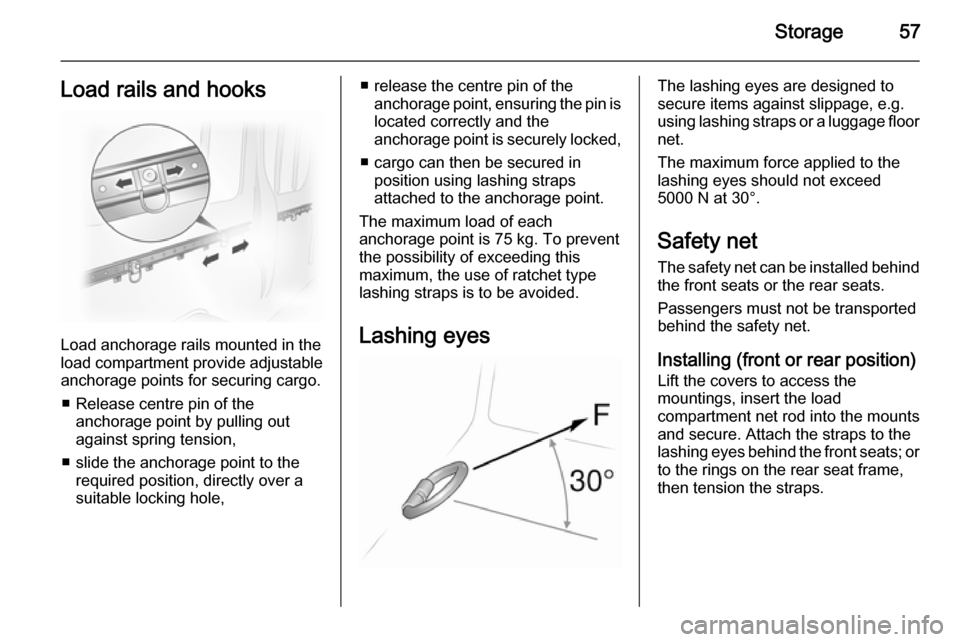
Load anchorage rails mounted in the
load compartment provide adjustable anchorage points for securing cargo.
■ Release centre pin of the anchorage point by pulling out
against spring tension,
■ slide the anchorage point to the required position, directly over a
suitable locking hole,
■ release the centre pin of the anchorage point, ensuring the pin islocated correctly and the
anchorage point is securely locked,
■ cargo can then be secured in position using lashing straps
attached to the anchorage point.
The maximum load of each
anchorage point is 75 kg. To prevent
the possibility of exceeding this
maximum, the use of ratchet type
lashing straps is to be avoided.
Lashing eyesThe lashing eyes are designed to
secure items against slippage, e.g.
using lashing straps or a luggage floor
net.
The maximum force applied to the
lashing eyes should not exceed
5000 N at 30°.
Safety net
The safety net can be installed behind the front seats or the rear seats.
Passengers must not be transported
behind the safety net.
Installing (front or rear position) Lift the covers to access the
mountings, insert the load
compartment net rod into the mounts
and secure. Attach the straps to the
lashing eyes behind the front seats; or
to the rings on the rear seat frame,
then tension the straps.