fuel VAUXHALL VIVARO 2014 Owner's Guide
[x] Cancel search | Manufacturer: VAUXHALL, Model Year: 2014, Model line: VIVARO, Model: VAUXHALL VIVARO 2014Pages: 173, PDF Size: 4.11 MB
Page 111 of 173
Driving and operating109
Permanent deactivation
Permanently deactivate the system
by pressing and holding the E button
on the instrument panel for approx. 3 seconds with the ignition on and
reverse gear engaged. The system is deactivated and will not operate.
When reverse gear is selected no
acoustic signal will sound, indicating
deactivation.
The function is reactivated by
pressing and holding button E for
approx. 3 seconds.
Fault
If the system detects an operating
fault, a continuous acoustic alarm will sound for approx. 5 seconds whenselecting reverse gear. Consult a
workshop to have the cause of the
fault remedied.Caution
When reversing, the area should
be free from obstacles which could
impact on the underside of the
vehicle.
Impact to the rear axle, which may
not be visible, could lead to
uncharacteristic changes in the
vehicle handling. In the event of
such an impact, consult a
workshop.Fuel
Fuel for petrol engines Only use unleaded fuel that complies
with European standard EN 228 or
E DIN 51626-1 or equivalent.
Your engine is capable of running
with E10 fuel that fulfills these
standards. E10 fuel contains up to
10 % bioethanol.
Use fuel with the recommended octane rating 3 154. Use of fuel with
too low an octane rating can reduce
engine power and torque and slightly
increases fuel consumption.Caution
Do not use fuel or fuel additives
that contain metallic compounds
such as manganese-based
additives. This may cause engine
damage.
Page 112 of 173
110Driving and operatingCaution
Use of fuel that does not comply toEN 228 or E DIN 51626-1 or
equivalent can lead to deposits or
engine damage and may affect
your warranty.
Caution
Use of fuel with too low an octane
rating could lead to uncontrolled combustion and engine damage.
Fuel for diesel engines
Only use diesel fuel that complies
with EN 590.
In countries outside the European
Union use Euro-Diesel fuel with a
sulphur concentration below 50 ppm.
Caution
Use of fuel that does not comply to EN 590 or similar can lead to
engine powerloss, increased wear
or engine damage and may affect
your warranty.
Do not use marine diesel oils, heating
oils, Aquazole and similar diesel-
water emulsions. Diesel fuels must
not be diluted with fuels for petrol
engines.
Refuelling
9 Danger
Before refuelling, switch off engine
and any external heaters with
combustion chambers (identified
by sticker on fuel filler flap). Switch off any mobile phones.
Follow the operating and safety
instructions of the filling station
when refuelling.
9 Danger
Fuel is flammable and explosive.
No smoking. No naked flames or
sparks.
If you can smell fuel in your
vehicle, have the cause of this
remedied immediately by a
workshop.
Caution
In case of misfuelling, do not
switch on ignition.
Notice
To ensure the fuel level is displayed
correctly, the ignition must be
switched off before refuelling. Avoid
minor fuel top-ups (e.g. less than
5 litres) to ensure accurate readings.
The fuel tank filler neck with bayonet
cap is located on the left hand side of
the vehicle.
The fuel filler flap can only be opened
if the vehicle is unlocked.
Page 113 of 173
Driving and operating111
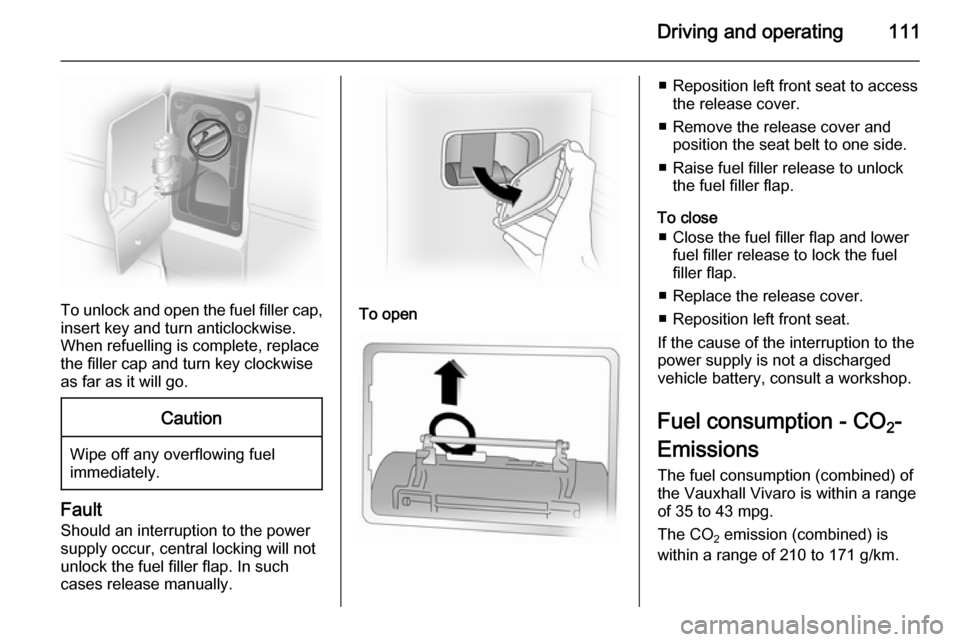
To unlock and open the fuel filler cap,insert key and turn anticlockwise.
When refuelling is complete, replace
the filler cap and turn key clockwise
as far as it will go.
Caution
Wipe off any overflowing fuel
immediately.
Fault
Should an interruption to the power supply occur, central locking will not
unlock the fuel filler flap. In such
cases release manually.
To open
■ Reposition left front seat to access the release cover.
■ Remove the release cover and position the seat belt to one side.
■ Raise fuel filler release to unlock the fuel filler flap.
To close ■ Close the fuel filler flap and lower fuel filler release to lock the fuel
filler flap.
■ Replace the release cover.
■ Reposition left front seat.
If the cause of the interruption to the
power supply is not a discharged
vehicle battery, consult a workshop.
Fuel consumption - CO 2-
Emissions
The fuel consumption (combined) of
the Vauxhall Vivaro is within a range
of 35 to 43 mpg.
The CO 2 emission (combined) is
within a range of 210 to 171 g/km.
Page 114 of 173

112Driving and operating
For the values specific to your
vehicle, refer to the EEC Certificate of Conformity provided with your vehicle
or other national registration
documents.
General information The official fuel consumption and
specific CO 2 emission figures quoted
relate to the EU base model with
standard equipment.
Fuel consumption data and CO 2
emission data are determined
according to regulation R (EC) No.
715/2007 (in the applicable version),
taking into consideration the vehicle
weight in running order, as specified
by the regulation.
The figures are provided only for the
purpose of comparison between
different vehicle variants and must
not be taken as a guarantee for the
actual fuel consumption of a
particular vehicle.
Additional equipment may result in
slightly higher results than the stated
fuel consumption and CO 2 figures.Furthermore, fuel consumption is
dependent on personal driving style
as well as road and traffic conditions.Trailer hitch
General information
Entrust retrofitting of towing
equipment to a workshop. It may be
necessary to make changes that
affect the cooling system, heat
shields or other equipment. Only use
towing equipment that has been
approved for your vehicle.
Driving characteristics and
towing tips
In the case of trailers with brakes,
attach the breakaway stopping cable.
Before attaching a trailer, lubricatethe coupling ball. However, do not do
so if a stabiliser, which acts on the coupling ball, is being used to reduce snaking movements. For trailers with
low driving stability the use of a
stabiliser is recommended.
A maximum speed of 50 mph must
not be exceeded, even in countries
where higher speeds are permitted.
Page 117 of 173

Vehicle care115Vehicle careGeneral Information...................115
Vehicle checks ........................... 116
Bulb replacement .......................124
Electrical system ........................128
Vehicle tools .............................. 131
Wheels and tyres .......................131
Towing ....................................... 141
Appearance care .......................143General Information
Accessories and vehicle
modifications
We recommend the use of Genuine Parts and Accessories and factory
approved parts specific for your
vehicle type. We cannot assess or guarantee reliability of other products
- even if they have a regulatory or
otherwise granted approval.
Do not make any modifications to the electrical system, e.g. changes of
electronic control units (chip tuning).
Vehicle storage Storage for a long period of time
If the vehicle is to be stored for several months:
■ Wash and wax the vehicle.
■ Have the wax in the engine compartment and underbody
checked.
■ Clean and preserve rubber seals.
■ Fill up fuel tank completely.■ Change the engine oil.
■ Drain the washer fluid reservoir.
■ Check the coolant antifreeze and corrosion protection.
■ Adjust tyre pressure to the value specified for full load.
■ Park vehicle in a dry, well ventilated
place. Engage first or reverse gear. Prevent the vehicle from rolling.
■ Do not apply the parking brake.
■ Open the bonnet, close all doors and lock the vehicle.
■ Disconnect the clamp from the negative terminal of the vehicle
battery. Beware that all systems are
not functional, e.g. anti-theft alarm
system.
Putting back into operation When the vehicle is to be put back into
operation:
■ Connect the clamp to the negative terminal of the vehicle battery.
Activate the electronics of the
power windows.
■ Check tyre pressure.
Page 124 of 173
122Vehicle care
Battery access
The vehicle battery is located beneath the front left hand seat floor
panel 3 139.
Warning label
Meaning of symbols: ■ No sparks, naked flames or smoking.
■ Always shield eyes. Explosive gases can cause blindness or
injury.
■ Keep the vehicle battery out of reach of children.
■ The vehicle battery containssulfuric acid which could cause
blindness or serious burn injuries.
■ See the Owner's Manual for further
information.
■ Explosive gas may be present in the vicinity of the battery.
Vehicle battery maintenance9 Danger
Ensure adequate ventilation when
charging the battery. There is a
risk of explosion if gases
generated during charging are
allowed to accumulate!
Replacing the vehicle battery
When the vehicle battery is being replaced, please ensure that there
are no open ventilation holes in the
vicinity of the positive terminal. If a
ventilation hole is open in this area, it
must be closed off with a dummy cap,
and the ventilation in the vicinity of the negative terminal must be opened.
We recommend that you have the
vehicle battery replaced by a
workshop.
Additional battery
Depending on the vehicle's auxiliary
equipment certain models may have
an additional battery located next to
the vehicle battery.
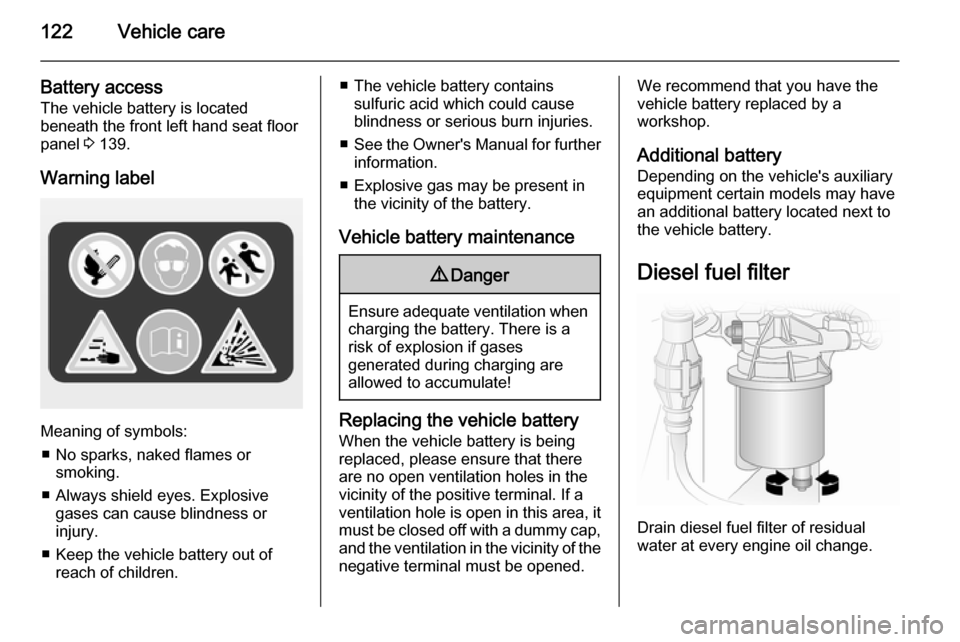
Diesel fuel filter
Drain diesel fuel filter of residual
water at every engine oil change.
Page 125 of 173
Vehicle care123
Place a container underneath the
filter housing. Loosen the knurled
screws on the filter cover and on the
lower part of the filter by approx. one
turn, to drain off the water.
The filter is drained as soon as diesel fuel emerges from the knurled screw
at the bottom. Retighten the two
screws.
Check diesel fuel filter at shorter
intervals if the vehicle is subjected to
extreme operating conditions.
Diesel fuel system
bleedingIf the fuel tank has been run dry, it will be necessary to air vent or bleed the
diesel fuel system.
Fill the tank with fuel and proceed as
follows:
1. Remove the protective cover from
the in-line supply pump.
2. Place a suitable container underneath the fuel filter vent
screw to collect fuel.
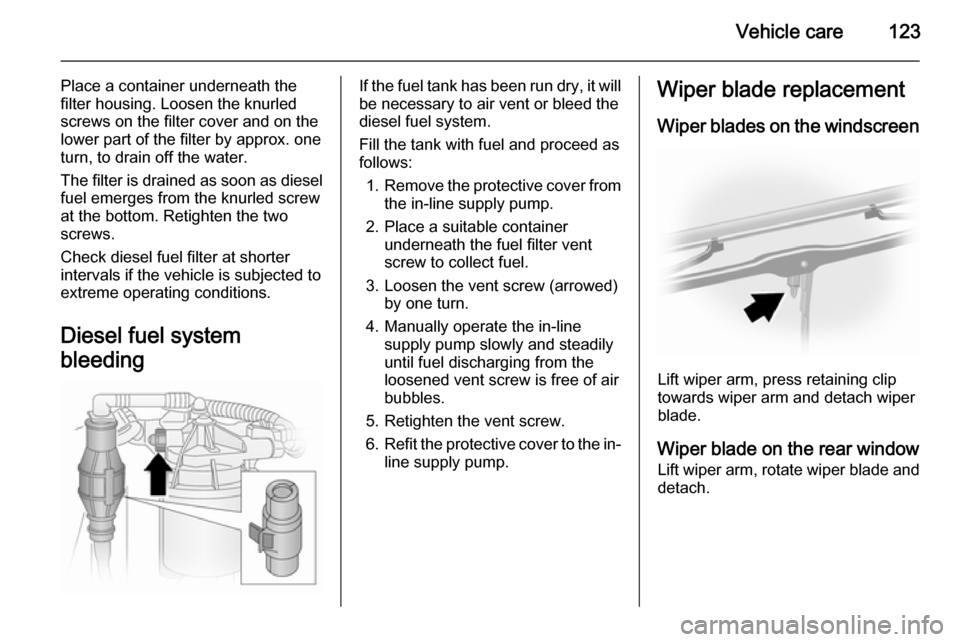
3. Loosen the vent screw (arrowed) by one turn.
4. Manually operate the in-line supply pump slowly and steadily
until fuel discharging from the
loosened vent screw is free of air
bubbles.
5. Retighten the vent screw.
6. Refit the protective cover to the in-
line supply pump.Wiper blade replacement
Wiper blades on the windscreen
Lift wiper arm, press retaining clip
towards wiper arm and detach wiper
blade.
Wiper blade on the rear window Lift wiper arm, rotate wiper blade and
detach.
Page 132 of 173

130Vehicle care
SymbolApplicationZAir conditioningdHeated exterior mirrorsUHeated front seats,Power windowsLLeft-hand high beamNRight-hand high beamKWindscreen wiperZRadio, Infotainment system)Cigarette lighterBoilerRear passenger compart‐
ment heaterjHornaLeft-hand low beamWRight-hand low beameInstrument panelZHeatingdInterior lampSymbolApplicationuAntilock brake systemÜHeated rear windows+Clock, interior lights, radio,
Infotainment systemUCH
INJFuel injection systemfRear window washereRear widow wiperTLeft-hand sidelightSRight-hand sidelightUCentral locking:Electrically adjustable exte‐
rior mirrorsCStop control indicator,
daytime running lightsrRear fog lights>Front fog lightsSymbolApplication?Power outletTTachograph
Page 134 of 173
132Vehicle careTyre pressureCheck the pressure of cold tyres at
least every 14 days and before any
long journey. Do not forget the spare
wheel.
Tyre pressures 3 163.
The tyre pressure data refers to cold
tyres. It applies to summer and winter
tyres.
Always inflate the spare tyre to the
pressure specified for full load.
Incorrect tyre pressures will impair
safety, vehicle handling, comfort and fuel economy and will increase tyre
wear.
The tyre pressure tables show all
possible tyre combinations 3 163.
For the tyres approved for your
vehicle, refer to the EEC Certificate of Conformity provided with your vehicle
or other national registration
documents.
The driver is responsible for correct
adjustment of tyre pressure.9 Warning
If the pressure is too low, this can
result in considerable tyre warm-
up and internal damage, leading to tread separation and even to tyre
blow-out at high speeds.
Tread depth
Check tread depth at regular
intervals.
Tyres should be replaced for safety
reasons at a tread depth of 2-3 mm (4 mm for winter tyres).
For safety reasons it is recommended
that the tread depth of the tyres on
one axle should not vary by more than
2 mm.
The legally permissible minimum
tread depth (1.6 mm) has been
reached when the tread has worn
down as far as one of the tread wear
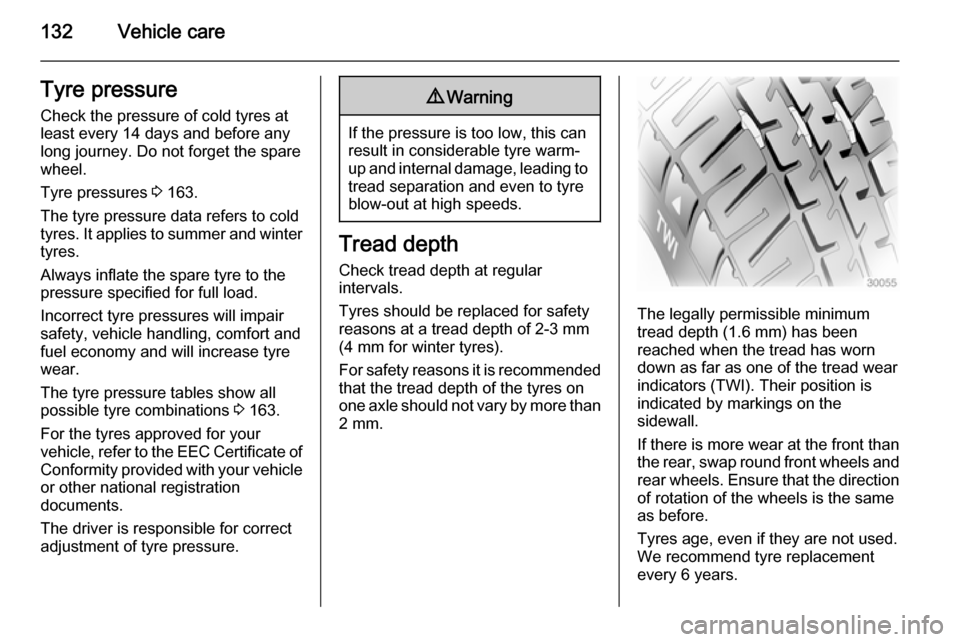
indicators (TWI). Their position is
indicated by markings on the
sidewall.
If there is more wear at the front than the rear, swap round front wheels and
rear wheels. Ensure that the direction of rotation of the wheels is the sameas before.
Tyres age, even if they are not used.
We recommend tyre replacement
every 6 years.
Page 156 of 173
![VAUXHALL VIVARO 2014 Owners Guide 154Technical dataEngine dataSales designation2.01.92.0
Engine identifier code
F4R 820F9Q 760M9R 630 2)
M9R 692Number of cylinders444Piston displacement [cm 3
]199818701995Engine power [kW]867466 / 84a](/img/38/19587/w960_19587-155.png "VAUXHALL VIVARO 2014 Owners Guide 154Technical dataEngine dataSales designation2.01.92.0
Engine identifier code
F4R 820F9Q 760M9R 630 2)
M9R 692Number of cylinders444Piston displacement [cm 3
]199818701995Engine power [kW]867466 / 84a")
154Technical dataEngine dataSales designation2.01.92.0
Engine identifier code
F4R 820F9Q 760M9R 630 2)
M9R 692Number of cylinders444Piston displacement [cm 3
]199818701995Engine power [kW]867466 / 84at rpm470035003500Torque [Nm]186240260 / 300at rpm375018001500Fuel typePetrolDieselDieselOctane rating RON recommended95possible98possible91 3)2)
Low / High output.
3) If no unleaded premium-grade fuels are available, 91 RON can be used, taking care to avoid severe engine loads and
driving at full throttle.