light VAUXHALL VIVARO 2014 Owner's Guide
[x] Cancel search | Manufacturer: VAUXHALL, Model Year: 2014, Model line: VIVARO, Model: VAUXHALL VIVARO 2014Pages: 173, PDF Size: 4.11 MB
Page 78 of 173
76Instruments and controls
When the vehicle is parked and/or the driver's door is opened: ■ When the key has been left in the ignition.
■ With exterior lights on.
■ If the vehicle has manual transmission automated; neutral is
not selected or the foot brake has
not been depressed.
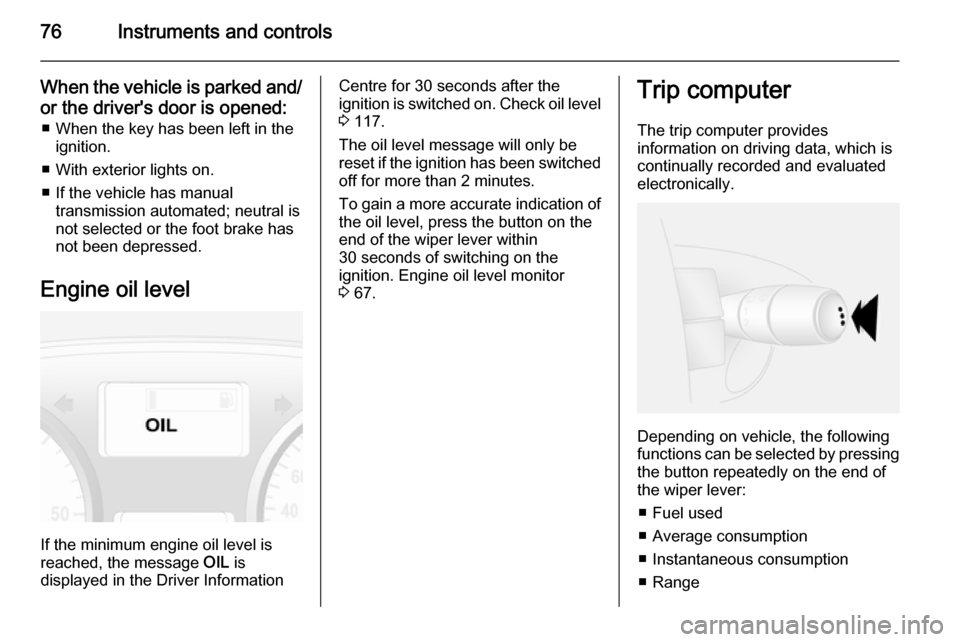
Engine oil level
If the minimum engine oil level is
reached, the message OIL is
displayed in the Driver Information
Centre for 30 seconds after the
ignition is switched on. Check oil level 3 117.
The oil level message will only be reset if the ignition has been switched
off for more than 2 minutes.
To gain a more accurate indication of the oil level, press the button on the
end of the wiper lever within
30 seconds of switching on the
ignition. Engine oil level monitor
3 67.Trip computer
The trip computer provides
information on driving data, which is
continually recorded and evaluated electronically.
Depending on vehicle, the following
functions can be selected by pressing the button repeatedly on the end of
the wiper lever:
■ Fuel used
■ Average consumption
■ Instantaneous consumption
■ Range
Page 81 of 173
Lighting79LightingExterior lighting............................ 79
Interior lighting ............................. 82
Lighting features ..........................83Exterior lighting
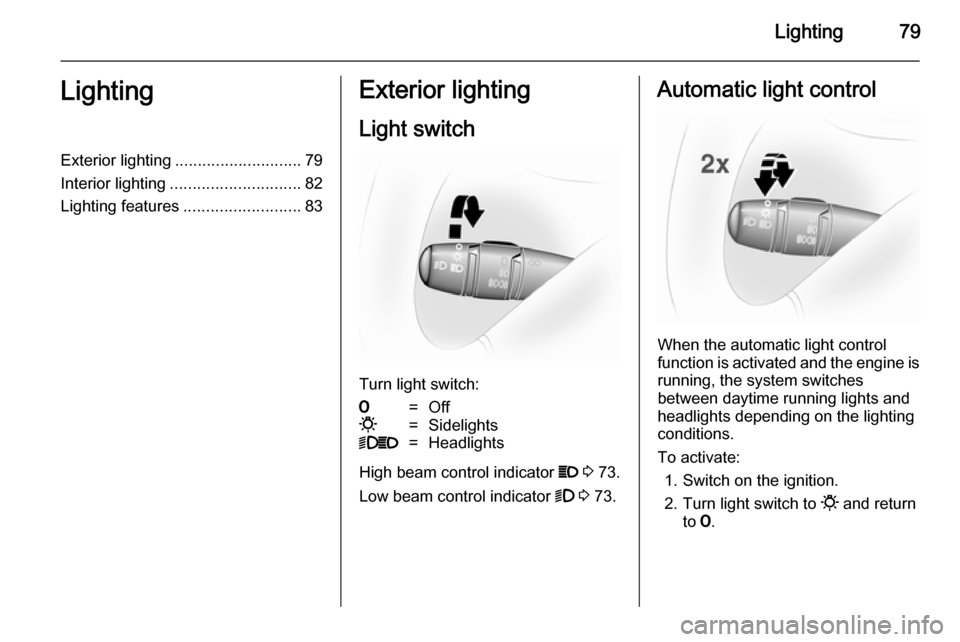
Light switch
Turn light switch:
7=Off0=Sidelights9P=Headlights
High beam control indicator P 3 73.
Low beam control indicator 9 3 73.
Automatic light control
When the automatic light control
function is activated and the engine is running, the system switches
between daytime running lights and headlights depending on the lighting
conditions.
To activate: 1. Switch on the ignition.
2. Turn light switch to 0 and return
to 7.
Page 82 of 173
80Lighting
3. Repeat step 2 within approx.5 seconds.
4. A double acoustic signal sounds for confirmation.
Repeat the operation to deactivate.
For reasons of safety, it is advisable
to have the automatic light control
function activated.
Daytime running lights Daytime running lights increase
visibility of the vehicle during daylight.
The lights operate automatically
when the ignition is switched on.
Automatic headlight activation
During poor lighting conditions the
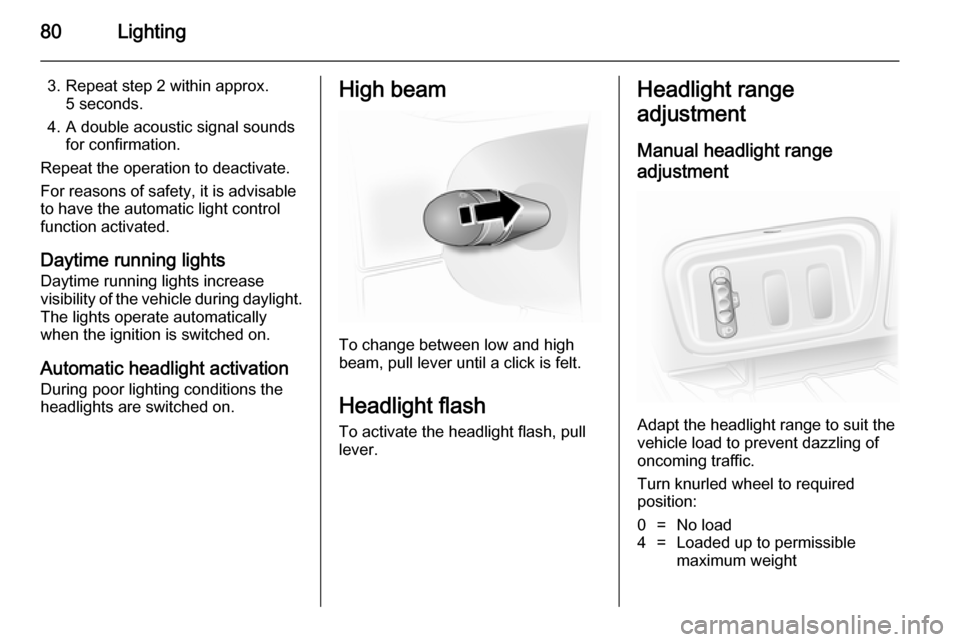
headlights are switched on.High beam
To change between low and high
beam, pull lever until a click is felt.
Headlight flash To activate the headlight flash, pull
lever.
Headlight range
adjustment
Manual headlight range
adjustment
Adapt the headlight range to suit the
vehicle load to prevent dazzling of
oncoming traffic.
Turn knurled wheel to required position:
0=No load4=Loaded up to permissible
maximum weight
Page 83 of 173
Lighting81Headlights when driving
abroad
The asymmetrical headlight beam
extends visibility at the edge of the
road at the passenger side.
However, when driving in countries
where traffic drives on the opposite
side of the road, adjust the headlights to prevent dazzling of oncoming
traffic.
Have the headlights adjusted by a
workshop.
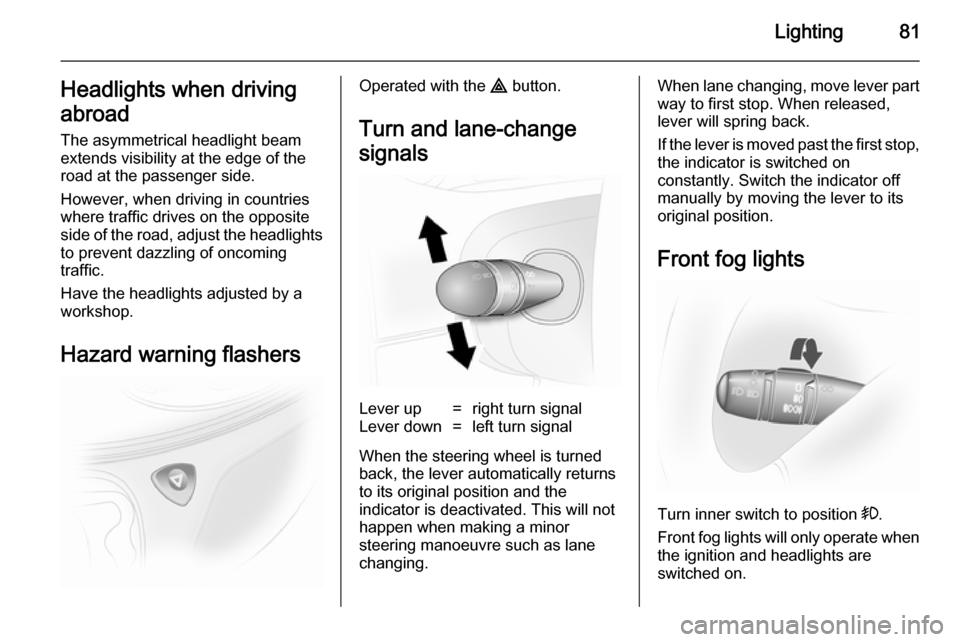
Hazard warning flashersOperated with the ¨ button.
Turn and lane-change
signalsLever up=right turn signalLever down=left turn signal
When the steering wheel is turned
back, the lever automatically returns
to its original position and the
indicator is deactivated. This will not
happen when making a minor
steering manoeuvre such as lane
changing.
When lane changing, move lever part
way to first stop. When released,
lever will spring back.
If the lever is moved past the first stop, the indicator is switched on
constantly. Switch the indicator off
manually by moving the lever to its
original position.
Front fog lights
Turn inner switch to position >.
Front fog lights will only operate when
the ignition and headlights are
switched on.
Page 84 of 173
82LightingRear fog lightsTurn inner switch to position >r.
Rear fog light comes on in
conjunction with front fog lights and
will only operate when the ignition and headlights are switched on.
Reversing lightsThe reversing lights come on when
the ignition is on and reverse gear is
selected.
Misted light covers
The inside of the light covers may mist up briefly in poor, wet and cold
weather conditions, in heavy rain or
after washing. The mist disappears
quickly by itself; to help, switch on the headlights.Interior lighting
Interior lights
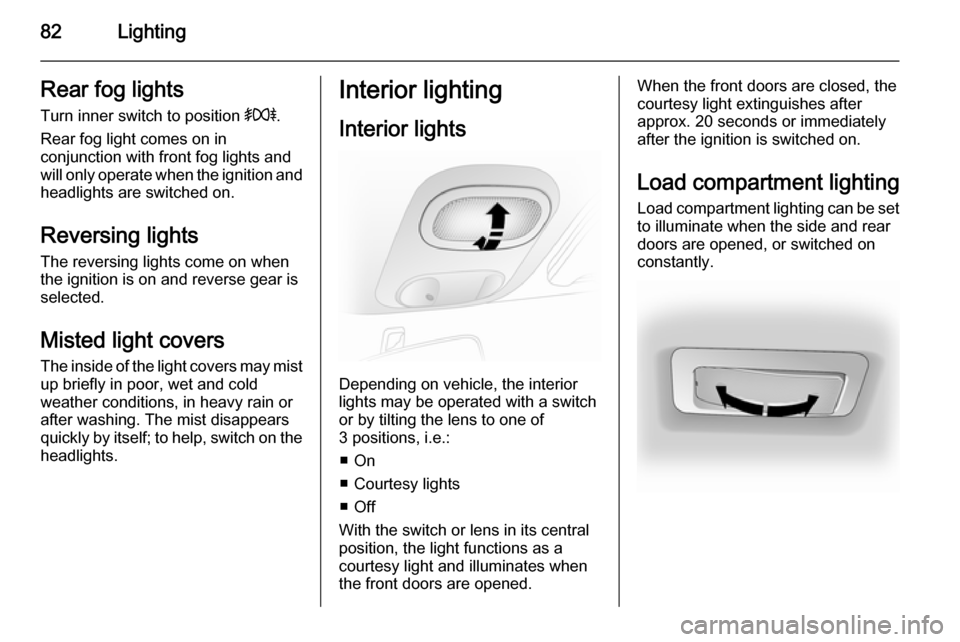
Depending on vehicle, the interior
lights may be operated with a switch
or by tilting the lens to one of
3 positions, i.e.:
■ On
■ Courtesy lights
■ Off
With the switch or lens in its central position, the light functions as a
courtesy light and illuminates when
the front doors are opened.
When the front doors are closed, the
courtesy light extinguishes after
approx. 20 seconds or immediately
after the ignition is switched on.
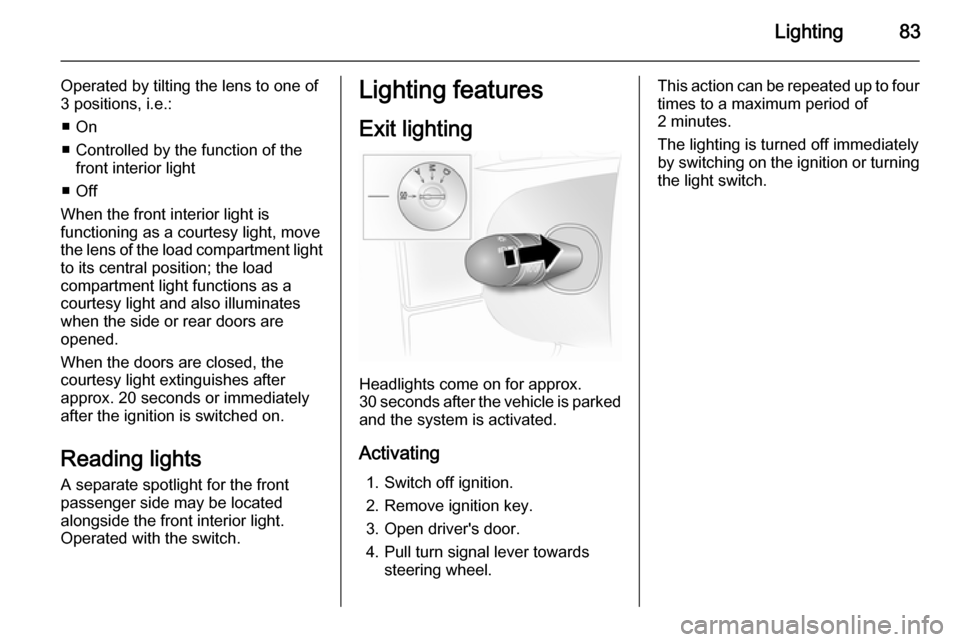
Load compartment lighting Load compartment lighting can be setto illuminate when the side and rear
doors are opened, or switched on
constantly.
Page 85 of 173
Lighting83
Operated by tilting the lens to one of3 positions, i.e.:
■ On
■ Controlled by the function of the front interior light
■ Off
When the front interior light is
functioning as a courtesy light, move
the lens of the load compartment light
to its central position; the load
compartment light functions as a
courtesy light and also illuminates
when the side or rear doors are
opened.
When the doors are closed, the
courtesy light extinguishes after
approx. 20 seconds or immediately
after the ignition is switched on.
Reading lights
A separate spotlight for the front passenger side may be located
alongside the front interior light.
Operated with the switch.Lighting features
Exit lighting
Headlights come on for approx.
30 seconds after the vehicle is parked and the system is activated.
Activating 1. Switch off ignition.
2. Remove ignition key.
3. Open driver's door.
4. Pull turn signal lever towards steering wheel.
This action can be repeated up to four
times to a maximum period of
2 minutes.
The lighting is turned off immediately
by switching on the ignition or turning the light switch.
Page 98 of 173
96Driving and operating
process takes place automatically
and the emission of smells and
smoke during this process is normal.
If cleaning of the filter is required and automatic cleaning does not occur, it
will be indicated by the illumination of
control indicator A and Z in the
instrument cluster. Seek the
assistance of a workshop
immediately.
Catalytic converter
The catalytic converter reduces the
amount of harmful substances in the
exhaust gases.Caution
Fuel grades other than those listed on pages 3 109, 3 154 could
damage the catalytic converter or
electronic components.
Unburnt petrol will overheat and
damage the catalytic converter.
Therefore avoid excessive use of
the starter, running the fuel tank
dry and starting the engine by
pushing or towing.
In the event of misfiring, uneven
engine running, a reduction in engine performance or other unusual
problems, have the cause of the fault
rectified by a workshop as soon as
possible. In an emergency, driving
can be continued for a short period,
keeping vehicle speed and engine
speed low.
If control indicator Z flashes, the
permitted emission limits may be
exceeded. Lift your foot off the
accelerator until Z stops flashing and
is steadily illuminated. Contact a
workshop immediately.
Malfunction indicator light 3 71
Manual transmission
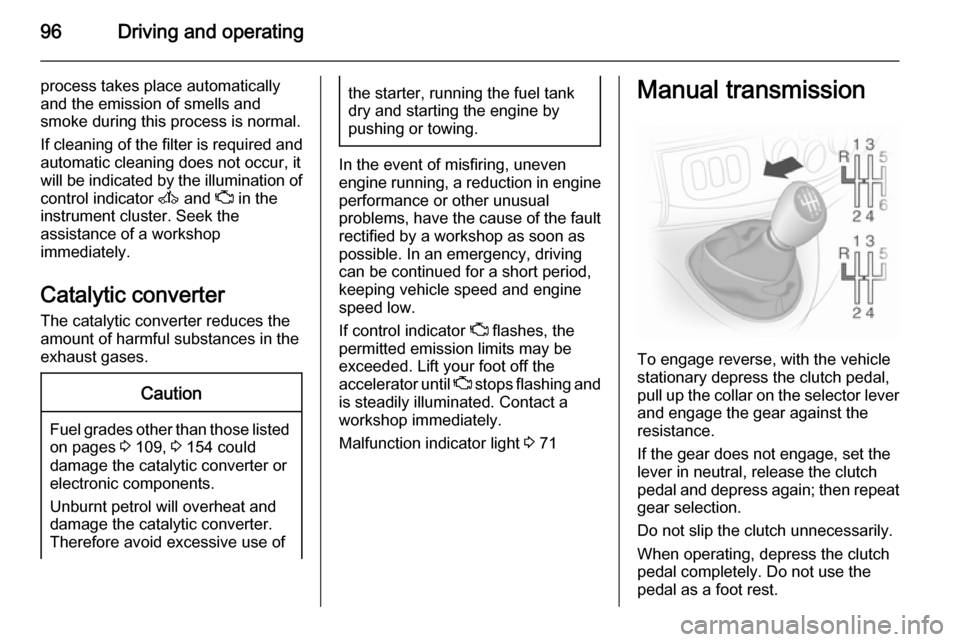
To engage reverse, with the vehicle
stationary depress the clutch pedal, pull up the collar on the selector lever
and engage the gear against the
resistance.
If the gear does not engage, set the
lever in neutral, release the clutch
pedal and depress again; then repeat
gear selection.
Do not slip the clutch unnecessarily.
When operating, depress the clutch pedal completely. Do not use the
pedal as a foot rest.
Page 99 of 173
Driving and operating97Caution
It is inadvisable to drive with hand
resting on the selector lever.
Manual transmission
automated
This transmission permits manual
(manual mode) or automatic gear
shifting (automatic mode), both with
automatic clutch control.
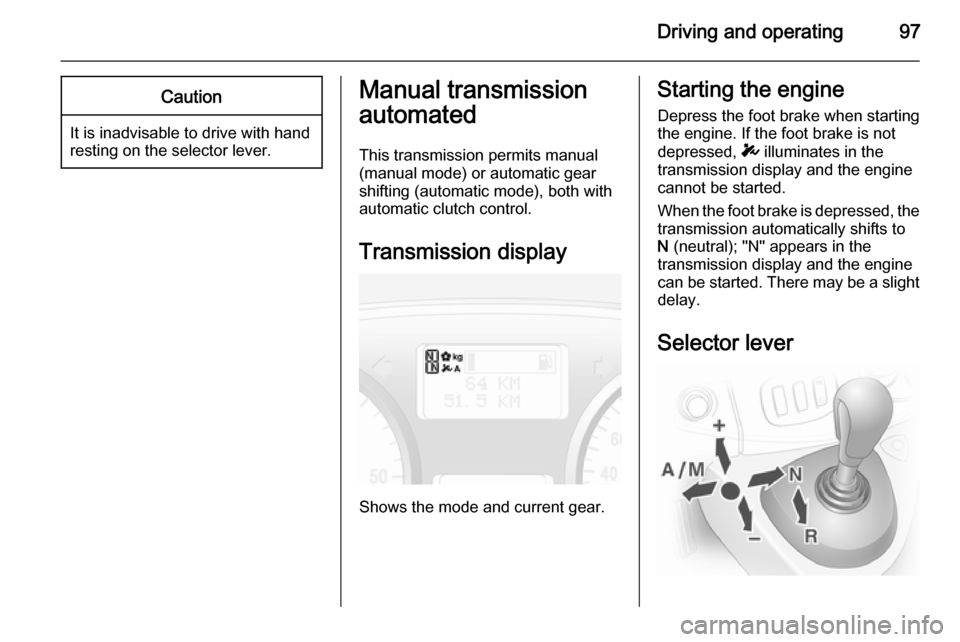
Transmission display
Shows the mode and current gear.
Starting the engine Depress the foot brake when starting
the engine. If the foot brake is not
depressed, T illuminates in the
transmission display and the engine
cannot be started.
When the foot brake is depressed, the
transmission automatically shifts to
N (neutral); "N" appears in the
transmission display and the engine
can be started. There may be a slight delay.
Selector lever
Page 101 of 173
Driving and operating99
Rocking the vehicle
Rocking the vehicle is only
permissible if the vehicle is stuck in
sand, mud, snow or a hole. Move the
selector lever between R and A/M (or
between + and -) in a repeat pattern,
while applying light pressure to the
accelerator pedal. Do not race the
engine and avoid sudden
acceleration.
Parking
Apply the parking brake. The most
recently engaged gear (see
transmission display) remains
engaged. With N, no gear is engaged.
When the ignition is switched off, the
transmission no longer responds to
movement of the selector lever.
Manual mode
If a higher gear is selected when the
engine speed is too low, or a lower
gear when the speed is too high, the
shift is not executed. This prevents
the engine from running at too low or too high an engine speed.If engine speed is too low, the
transmission automatically shifts to a
lower gear.
If engine speed is too high, the
transmission only switches to a higher gear via kickdown.
Electronic driving
programmes
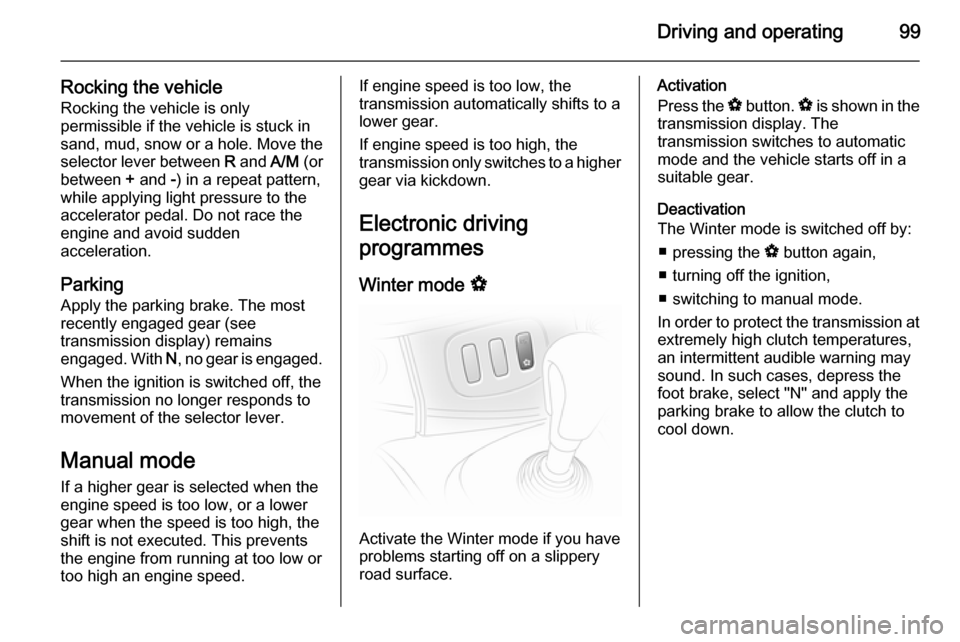
Winter mode V
Activate the Winter mode if you have
problems starting off on a slippery
road surface.
Activation
Press the V button. V is shown in the
transmission display. The
transmission switches to automatic
mode and the vehicle starts off in a
suitable gear.
Deactivation
The Winter mode is switched off by:
■ pressing the V button again,
■ turning off the ignition,
■ switching to manual mode.
In order to protect the transmission at extremely high clutch temperatures,
an intermittent audible warning may
sound. In such cases, depress the
foot brake, select "N" and apply the
parking brake to allow the clutch to
cool down.
Page 104 of 173
102Driving and operatingParking brake
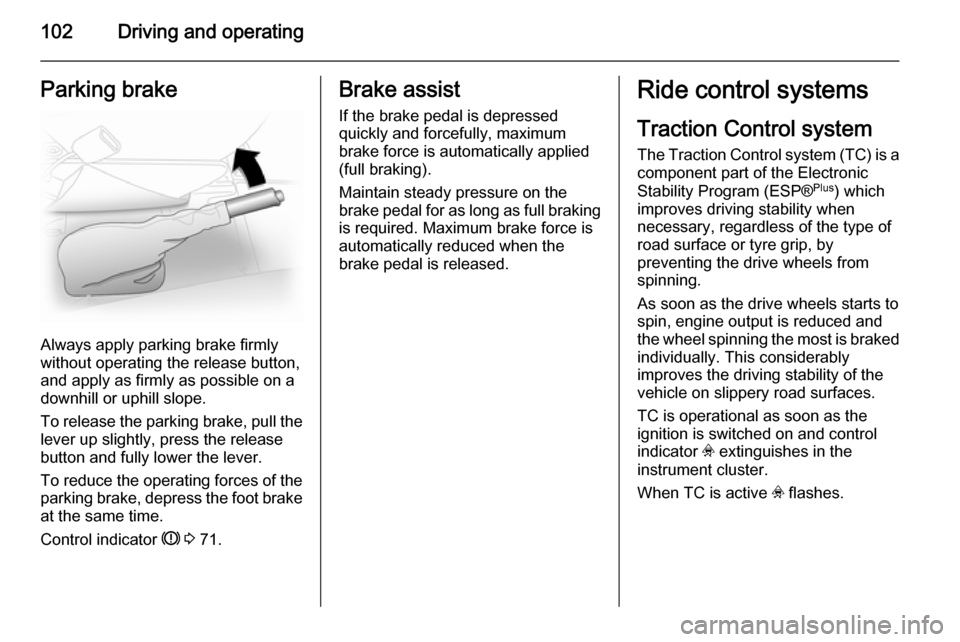
Always apply parking brake firmly
without operating the release button,
and apply as firmly as possible on a
downhill or uphill slope.
To release the parking brake, pull the lever up slightly, press the release
button and fully lower the lever.
To reduce the operating forces of the
parking brake, depress the foot brake
at the same time.
Control indicator R 3 71.
Brake assist
If the brake pedal is depressed
quickly and forcefully, maximum
brake force is automatically applied
(full braking).
Maintain steady pressure on the
brake pedal for as long as full braking
is required. Maximum brake force is
automatically reduced when the
brake pedal is released.Ride control systems
Traction Control system
The Traction Control system (TC) is a
component part of the Electronic
Stability Program (ESP® Plus
) which
improves driving stability when
necessary, regardless of the type of
road surface or tyre grip, by
preventing the drive wheels from
spinning.
As soon as the drive wheels starts to
spin, engine output is reduced and
the wheel spinning the most is braked
individually. This considerably
improves the driving stability of the
vehicle on slippery road surfaces.
TC is operational as soon as the
ignition is switched on and control
indicator v extinguishes in the
instrument cluster.
When TC is active v flashes.