tow VAUXHALL VIVARO 2014 Owner's Guide
[x] Cancel search | Manufacturer: VAUXHALL, Model Year: 2014, Model line: VIVARO, Model: VAUXHALL VIVARO 2014Pages: 173, PDF Size: 4.11 MB
Page 117 of 173

Vehicle care115Vehicle careGeneral Information...................115
Vehicle checks ........................... 116
Bulb replacement .......................124
Electrical system ........................128
Vehicle tools .............................. 131
Wheels and tyres .......................131
Towing ....................................... 141
Appearance care .......................143General Information
Accessories and vehicle
modifications
We recommend the use of Genuine Parts and Accessories and factory
approved parts specific for your
vehicle type. We cannot assess or guarantee reliability of other products
- even if they have a regulatory or
otherwise granted approval.
Do not make any modifications to the electrical system, e.g. changes of
electronic control units (chip tuning).
Vehicle storage Storage for a long period of time
If the vehicle is to be stored for several months:
■ Wash and wax the vehicle.
■ Have the wax in the engine compartment and underbody
checked.
■ Clean and preserve rubber seals.
■ Fill up fuel tank completely.■ Change the engine oil.
■ Drain the washer fluid reservoir.
■ Check the coolant antifreeze and corrosion protection.
■ Adjust tyre pressure to the value specified for full load.
■ Park vehicle in a dry, well ventilated
place. Engage first or reverse gear. Prevent the vehicle from rolling.
■ Do not apply the parking brake.
■ Open the bonnet, close all doors and lock the vehicle.
■ Disconnect the clamp from the negative terminal of the vehicle
battery. Beware that all systems are
not functional, e.g. anti-theft alarm
system.
Putting back into operation When the vehicle is to be put back into
operation:
■ Connect the clamp to the negative terminal of the vehicle battery.
Activate the electronics of the
power windows.
■ Check tyre pressure.
Page 125 of 173
Vehicle care123
Place a container underneath the
filter housing. Loosen the knurled
screws on the filter cover and on the
lower part of the filter by approx. one
turn, to drain off the water.
The filter is drained as soon as diesel fuel emerges from the knurled screw
at the bottom. Retighten the two
screws.
Check diesel fuel filter at shorter
intervals if the vehicle is subjected to
extreme operating conditions.
Diesel fuel system
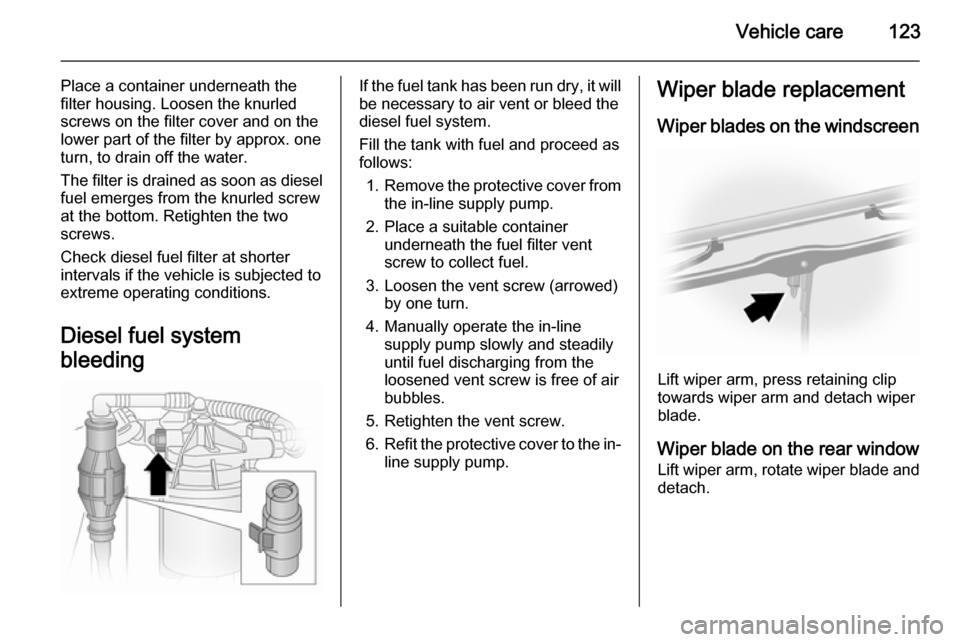
bleedingIf the fuel tank has been run dry, it will be necessary to air vent or bleed the
diesel fuel system.
Fill the tank with fuel and proceed as
follows:
1. Remove the protective cover from
the in-line supply pump.
2. Place a suitable container underneath the fuel filter vent
screw to collect fuel.
3. Loosen the vent screw (arrowed) by one turn.
4. Manually operate the in-line supply pump slowly and steadily
until fuel discharging from the
loosened vent screw is free of air
bubbles.
5. Retighten the vent screw.
6. Refit the protective cover to the in-
line supply pump.Wiper blade replacement
Wiper blades on the windscreen
Lift wiper arm, press retaining clip
towards wiper arm and detach wiper
blade.
Wiper blade on the rear window Lift wiper arm, rotate wiper blade and
detach.
Page 133 of 173
Vehicle care131Vehicle tools
Tools
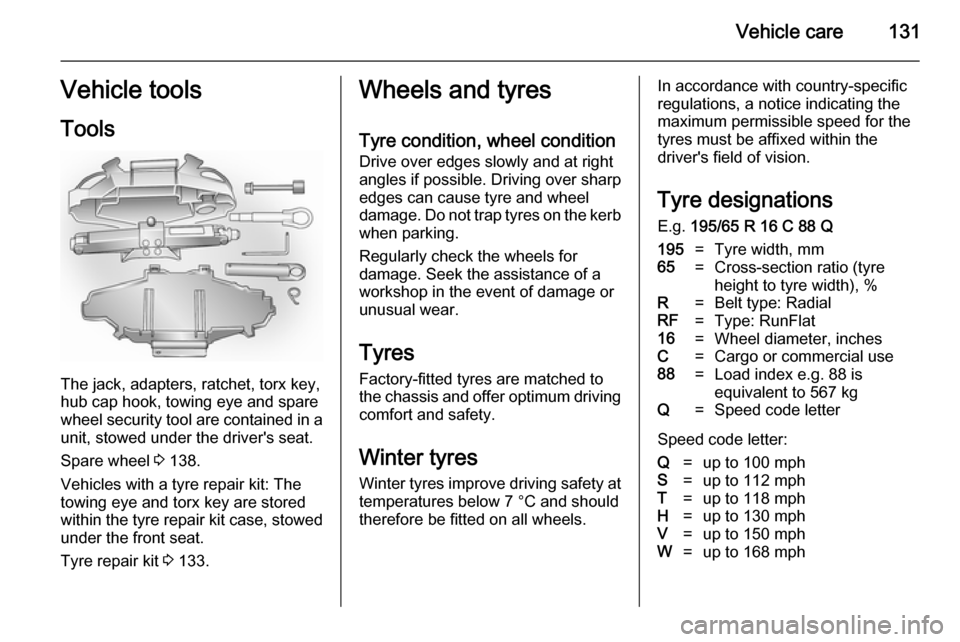
The jack, adapters, ratchet, torx key,
hub cap hook, towing eye and spare
wheel security tool are contained in a
unit, stowed under the driver's seat.
Spare wheel 3 138.
Vehicles with a tyre repair kit: The
towing eye and torx key are stored
within the tyre repair kit case, stowed
under the front seat.
Tyre repair kit 3 133.
Wheels and tyres
Tyre condition, wheel condition
Drive over edges slowly and at right
angles if possible. Driving over sharp
edges can cause tyre and wheel
damage. Do not trap tyres on the kerb when parking.
Regularly check the wheels for
damage. Seek the assistance of a
workshop in the event of damage or
unusual wear.
Tyres
Factory-fitted tyres are matched to the chassis and offer optimum driving comfort and safety.
Winter tyres Winter tyres improve driving safety attemperatures below 7 °C and shouldtherefore be fitted on all wheels.In accordance with country-specific
regulations, a notice indicating the
maximum permissible speed for the
tyres must be affixed within the
driver's field of vision.
Tyre designations E.g. 195/65 R 16 C 88 Q195=Tyre width, mm65=Cross-section ratio (tyre
height to tyre width), %R=Belt type: RadialRF=Type: RunFlat16=Wheel diameter, inchesC=Cargo or commercial use88=Load index e.g. 88 is
equivalent to 567 kgQ=Speed code letter
Speed code letter:
Q=up to 100 mphS=up to 112 mphT=up to 118 mphH=up to 130 mphV=up to 150 mphW=up to 168 mph
Page 137 of 173
Vehicle care135
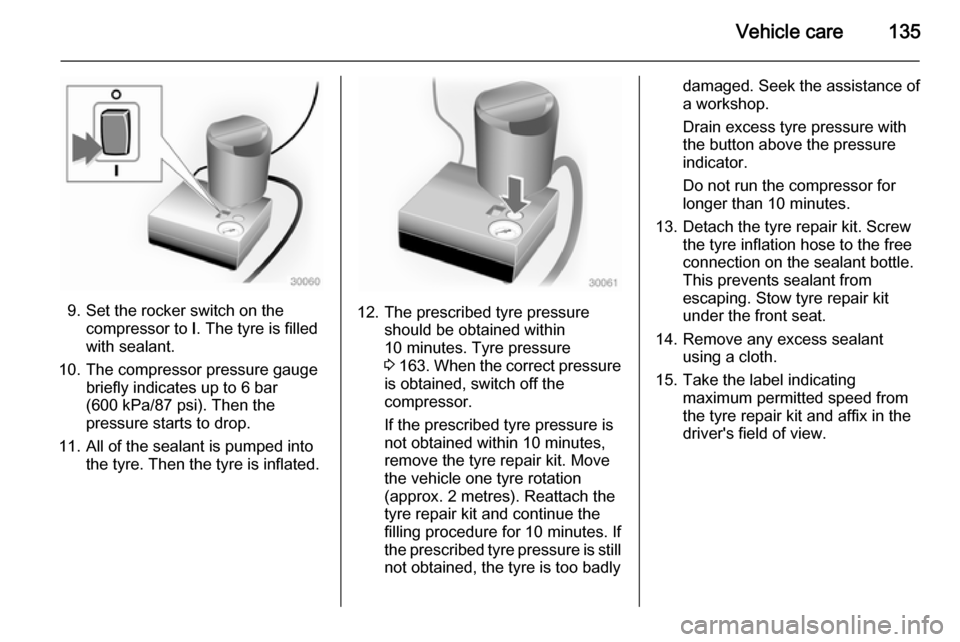
9. Set the rocker switch on thecompressor to I. The tyre is filled
with sealant.
10. The compressor pressure gauge briefly indicates up to 6 bar(600 kPa/87 psi). Then the
pressure starts to drop.
11. All of the sealant is pumped into the tyre. Then the tyre is inflated.12. The prescribed tyre pressure should be obtained within
10 minutes. Tyre pressure
3 163 . When the correct pressure
is obtained, switch off the
compressor.
If the prescribed tyre pressure is
not obtained within 10 minutes,
remove the tyre repair kit. Move
the vehicle one tyre rotation
(approx. 2 metres). Reattach the
tyre repair kit and continue the
filling procedure for 10 minutes. If
the prescribed tyre pressure is still not obtained, the tyre is too badly
damaged. Seek the assistance of
a workshop.
Drain excess tyre pressure with
the button above the pressure
indicator.
Do not run the compressor for
longer than 10 minutes.
13. Detach the tyre repair kit. Screw the tyre inflation hose to the free
connection on the sealant bottle.
This prevents sealant from
escaping. Stow tyre repair kit
under the front seat.
14. Remove any excess sealant using a cloth.
15. Take the label indicating maximum permitted speed from
the tyre repair kit and affix in the driver's field of view.
Page 138 of 173
136Vehicle care
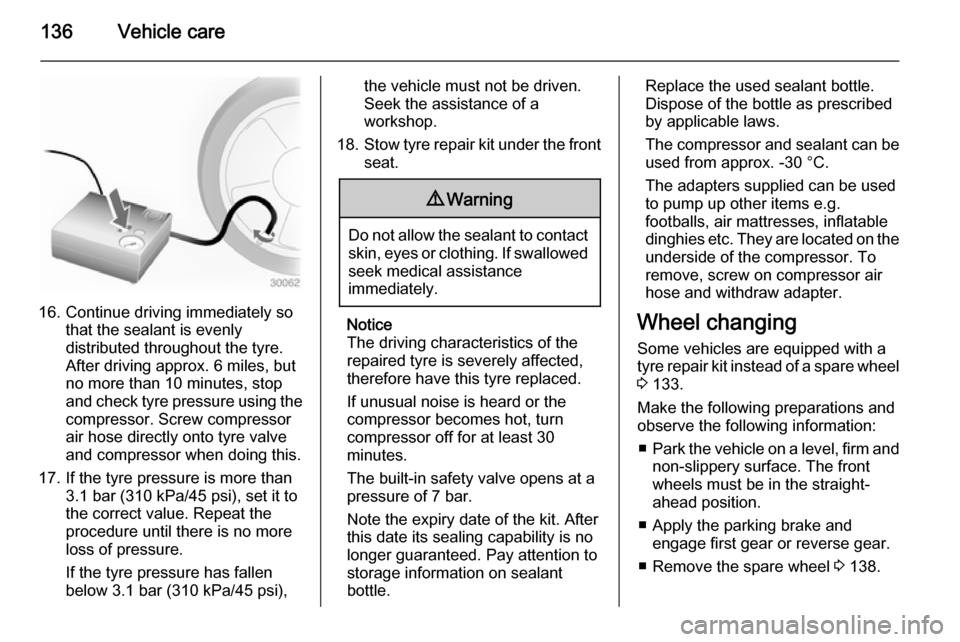
16. Continue driving immediately sothat the sealant is evenlydistributed throughout the tyre.
After driving approx. 6 miles, but
no more than 10 minutes, stop
and check tyre pressure using the
compressor. Screw compressor
air hose directly onto tyre valve
and compressor when doing this.
17. If the tyre pressure is more than 3.1 bar (310 kPa/45 psi), set it to
the correct value. Repeat the
procedure until there is no more
loss of pressure.
If the tyre pressure has fallen
below 3.1 bar (310 kPa/45 psi),
the vehicle must not be driven.
Seek the assistance of a
workshop.
18. Stow tyre repair kit under the front
seat.9 Warning
Do not allow the sealant to contact
skin, eyes or clothing. If swallowed seek medical assistance
immediately.
Notice
The driving characteristics of the
repaired tyre is severely affected,
therefore have this tyre replaced.
If unusual noise is heard or the
compressor becomes hot, turn
compressor off for at least 30
minutes.
The built-in safety valve opens at a
pressure of 7 bar.
Note the expiry date of the kit. After
this date its sealing capability is no
longer guaranteed. Pay attention to
storage information on sealant
bottle.
Replace the used sealant bottle. Dispose of the bottle as prescribed
by applicable laws.
The compressor and sealant can be used from approx. -30 °C.
The adapters supplied can be used
to pump up other items e.g.
footballs, air mattresses, inflatable
dinghies etc. They are located on the underside of the compressor. To
remove, screw on compressor air hose and withdraw adapter.
Wheel changing Some vehicles are equipped with a
tyre repair kit instead of a spare wheel 3 133.
Make the following preparations and
observe the following information:
■ Park the vehicle on a level, firm and
non-slippery surface. The frontwheels must be in the straight-ahead position.
■ Apply the parking brake and engage first gear or reverse gear.
■ Remove the spare wheel 3 138.
Page 140 of 173
138Vehicle care
Put wheel bolts somewhere
where the threads will not be
soiled.
6. Change the wheel.
7. Screw in the wheel bolts.
8. Lower vehicle.
9. Tighten each wheel bolt in a crosswise sequence. Tighteningtorque is 140 Nm.
10. Refit wheel cover
11. Change the wheel.
12. Stow the replaced wheel 3 138
and the vehicle tools 3 131.
13. Have the new wheel balanced on the vehicle. Check the tyre
pressure of the installed tyre
3 163 and also the wheel bolt
torque as soon as possible.
Have the defective tyre renewed or
repaired.
Spare wheel Some vehicles are equipped with a
tyre repair kit instead of a spare wheel
3 133.Use of a spare wheel that is smaller
than the other wheels or together with winter tyres could affect driveability.
Have the defective tyre replaced as
soon as possible.
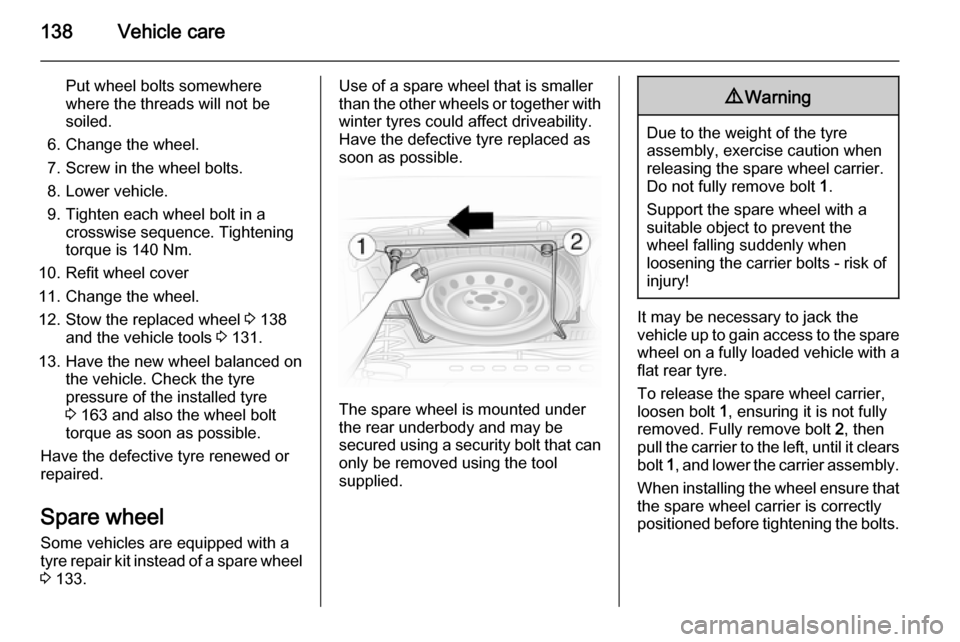
The spare wheel is mounted under
the rear underbody and may be
secured using a security bolt that can
only be removed using the tool
supplied.
9 Warning
Due to the weight of the tyre
assembly, exercise caution when
releasing the spare wheel carrier.
Do not fully remove bolt 1.
Support the spare wheel with a
suitable object to prevent the
wheel falling suddenly when
loosening the carrier bolts - risk of injury!
It may be necessary to jack the
vehicle up to gain access to the spare wheel on a fully loaded vehicle with a
flat rear tyre.
To release the spare wheel carrier,
loosen bolt 1, ensuring it is not fully
removed. Fully remove bolt 2, then
pull the carrier to the left, until it clears bolt 1, and lower the carrier assembly.
When installing the wheel ensure that
the spare wheel carrier is correctly
positioned before tightening the bolts.
Page 143 of 173
Vehicle care141
far away from the discharged
vehicle battery as possible,
however at least 60 cm.
Route the leads so that they cannot
catch on rotating parts in the engine
compartment.
To start the engine: 1. Start the engine of the vehicle providing the jump start.
2. After 5 minutes, start the other engine. Start attempts should be
made for no longer than
15 seconds at an interval of
1 minute.
3. Allow both engines to idle for approx. 3 minutes with the leads
connected.
4. Switch on electrical consumers (e.g. headlights, heated rear
window) of the vehicle receiving
the jump start.
5. Reverse above sequence exactly when removing leads.Towing
Towing the vehicle
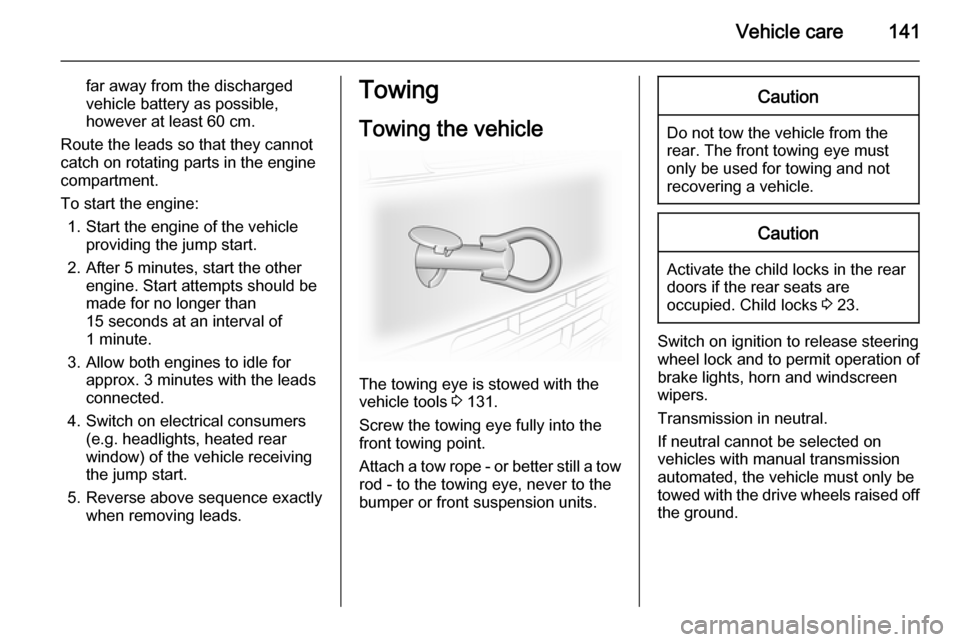
The towing eye is stowed with the
vehicle tools 3 131.
Screw the towing eye fully into the
front towing point.
Attach a tow rope - or better still a tow
rod - to the towing eye, never to the
bumper or front suspension units.
Caution
Do not tow the vehicle from the
rear. The front towing eye must
only be used for towing and not
recovering a vehicle.
Caution
Activate the child locks in the rear
doors if the rear seats are
occupied. Child locks 3 23.
Switch on ignition to release steering
wheel lock and to permit operation of
brake lights, horn and windscreen
wipers.
Transmission in neutral.
If neutral cannot be selected on
vehicles with manual transmission automated, the vehicle must only betowed with the drive wheels raised off the ground.
Page 144 of 173
142Vehicle careCaution
Drive slowly. Do not drive jerkily.
Excessive tractive force can
damage the vehicle.
When the engine is not running,
considerably more force is needed to
brake and steer.
To prevent the entry of exhaust fumes
from the towing vehicle, switch on the
air recirculation system and close the
windows.
Seek the assistance of a workshop.
After towing, unscrew the towing eye.
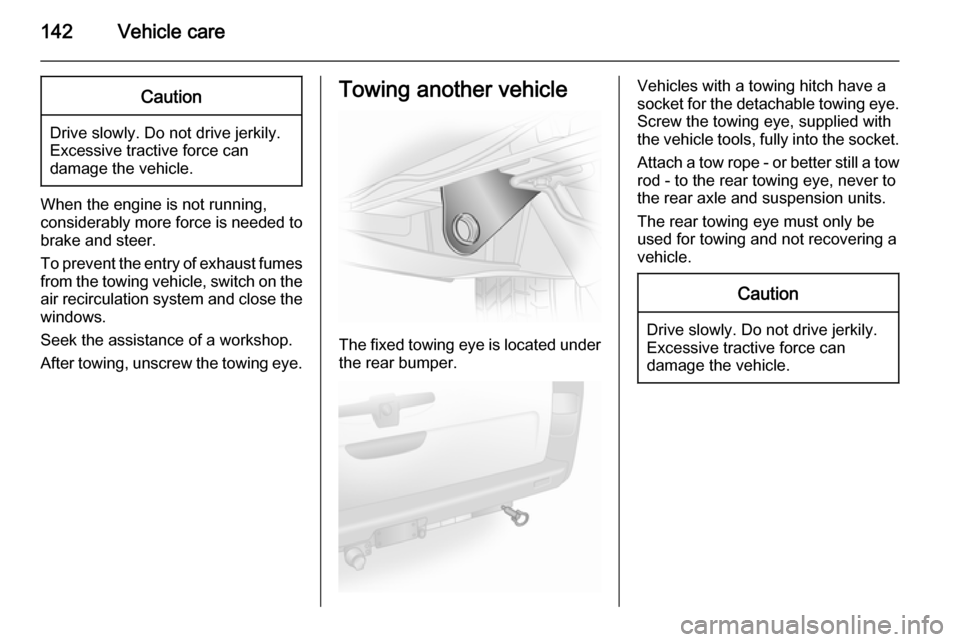
Towing another vehicle
The fixed towing eye is located under the rear bumper.
Vehicles with a towing hitch have a
socket for the detachable towing eye.
Screw the towing eye, supplied with
the vehicle tools, fully into the socket.
Attach a tow rope - or better still a tow
rod - to the rear towing eye, never to
the rear axle and suspension units.
The rear towing eye must only be
used for towing and not recovering a
vehicle.Caution
Drive slowly. Do not drive jerkily.
Excessive tractive force can
damage the vehicle.
Page 146 of 173

144Vehicle care
Windows and windscreen wiperblades
Use a soft lint-free cloth or chamois leather together with window cleanerand insect remover.
When cleaning the rear window from
inside, always wipe in parallel to the
heating element to prevent damage.
For mechanical removal of ice, use a
sharp-edged ice scraper. Press the
scraper firmly against the glass so
that no dirt can get under it and
scratch the glass.
Clean smearing wiper blades with a
soft cloth and window cleaner.
Wheels and tyres
Do not use high-pressure jet
cleaners.
Clean rims with a pH-neutral wheel
cleaner.
Rims are painted and can be treated
with the same agents as the body.Paintwork damage
Rectify minor paintwork damage with
a touch-up pen before rust forms.
Have more extensive damage or rust
areas repaired by a workshop.
Underbody
Some areas of the vehicle underbody
have a PVC undercoating while other critical areas have a durable
protective wax coating.
After the underbody is washed, check
the underbody and have it waxed if
necessary.
Bitumen/rubber materials could
damage the PVC coating. Have
underbody work carried out by a
workshop.
Before and after winter, wash the
underbody and have the protective
wax coating checked.
Engine compartment
It is advisable to wash the engine compartment before and after winter
and preserve it with wax. Protect thealternator and brake fluid reservoir
with plastic sheets before washing
the engine.
When washing the engine with a
steam-jet cleaner, do not direct the
steam jet towards components of the
antilock brake system, air
conditioning system or the belt drive and its components.
After an engine wash, have all engine
compartment components preserved
thoroughly by a workshop using
protective wax.
Do not use high-pressure jet
cleaners.
Towing equipment
Do not clean the coupling ball bar with a steam-jet or high-pressure jet
cleaner.
Interior care Interior and upholstery
Only clean the vehicle interior,
including the instrument panel fascia
and panelling, with a dry cloth or
interior cleaner.
Page 169 of 173

167
Coolant and antifreeze...............147
Coolant heater .............................. 87
Coupling ball bar ........................113
Cruise control ...................... 73, 104
Cupholders .................................. 56
Curtain airbag system .................. 46
D Danger, Warnings and Cautions ...3
Dashboard .................................... 10
Daytime running light ....................79
Declaration of conformity ............164
Diesel fuel filter .......................... 122
Diesel fuel system bleeding .......123
Diesel particle filter ......................95
Doors ............................................ 24
Driver Information Centre .............74
Driving characteristics and towing tips .............................. 112
Driving hints .................................. 93
E Electric adjustment ......................28
Electrical system......................... 128
Electronic driving programmes ....99
Electronic Stability Program 72, 103
End-of-life vehicle recovery .......116
Engine air filter ........................... 119
Engine air flow indicator .............119
Engine coolant ........................... 119Engine coolant temperature ........72
Engine data ............................... 154
Engine exhaust ............................ 95
Engine identification ...................150
Engine oil ................... 117, 147, 152
Engine oil level ............................ 76
Engine oil level monitor ................67
Engine oil pressure ......................73
Event data recorders ..................164
Exhaust gases .............................. 95
Exit lighting .................................. 83
Exterior care .............................. 143
Exterior light ................................. 73
Exterior lighting ......................12, 79
Exterior mirrors ............................. 28
F
Fault ........................................... 100
First aid kit ................................... 58
Fixed air vents ............................. 91
Fog light ....................................... 73
Fog lights .............................. 81, 124
Fog tail light ............................... 127
Folding mirrors ............................. 28
Front airbag system .....................45
Front fog lights ............................. 81
Front seats.................................... 33
Front storage ............................... 56
Front turn signal lights ...............125
Fuel............................................. 109Fuel consumption - CO 2-
Emissions ............................... 111
Fuel for diesel engines ..............110
Fuel for petrol engines ...............109
Fuel gauge ................................... 66
Fuse box ..................................... 129
Fuses ......................................... 128
G Gauges ......................................... 65
General information ...................112
Glovebox ..................................... 55
H Hand brake - see Parking brake. 102
Hazard warning flashers ..............81
Headlight flash ............................. 80
Headlight range adjustment ........80
Headlights ...................... 79, 80, 124
Headlights when driving abroad ..81
Head restraint adjustment .............8
Head restraints ............................ 32
Heated mirrors ............................. 29
Heated rear window ..................... 31
Heating ........................................ 35
Heating and ventilation system ...84
High beam ............................. 73, 80
Horn ....................................... 14, 61