warning VAUXHALL VIVARO 2014 Workshop Manual
[x] Cancel search | Manufacturer: VAUXHALL, Model Year: 2014, Model line: VIVARO, Model: VAUXHALL VIVARO 2014Pages: 173, PDF Size: 4.11 MB
Page 123 of 173
Vehicle care121Caution
Only washer fluid with a sufficient
antifreeze concentration provides
protection at low temperatures or
a sudden drop in temperature.
Brakes
A squealing noise indicates that the
brake lining is at its minimum
thickness. Continued driving is
possible but have the brake lining
replaced as soon as possible.
Once new brake linings are installed,
do not brake unnecessarily hard for
the first few journeys.
Brake fluid
9 Warning
Brake fluid is poisonous and
corrosive. Avoid contact with eyes,
skin, fabrics and painted surfaces.
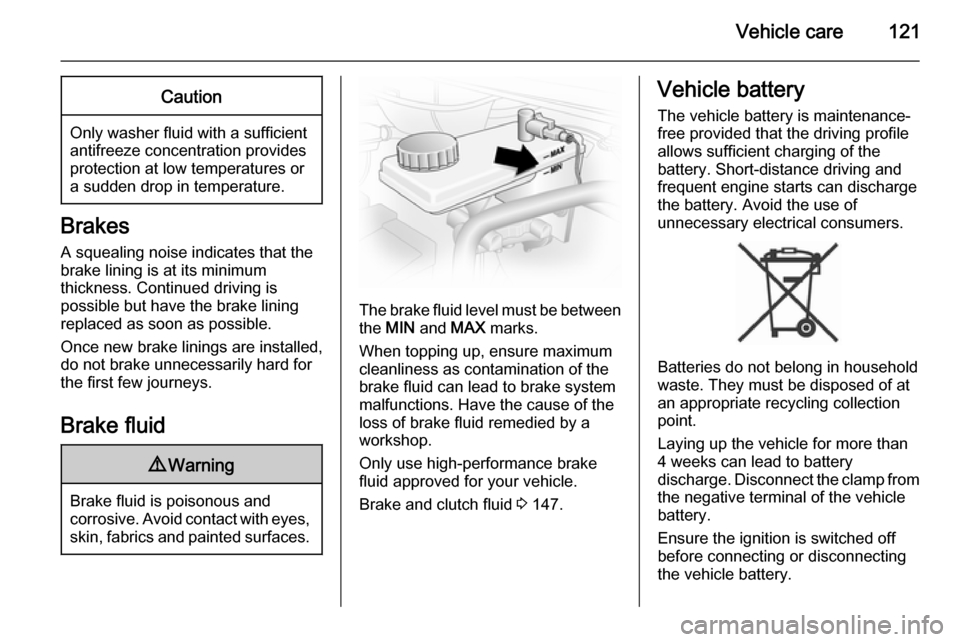
The brake fluid level must be betweenthe MIN and MAX marks.
When topping up, ensure maximum cleanliness as contamination of the
brake fluid can lead to brake system
malfunctions. Have the cause of the
loss of brake fluid remedied by a
workshop.
Only use high-performance brake
fluid approved for your vehicle.
Brake and clutch fluid 3 147.
Vehicle battery
The vehicle battery is maintenance-
free provided that the driving profile
allows sufficient charging of the
battery. Short-distance driving and frequent engine starts can discharge
the battery. Avoid the use of
unnecessary electrical consumers.
Batteries do not belong in household
waste. They must be disposed of at
an appropriate recycling collection
point.
Laying up the vehicle for more than
4 weeks can lead to battery
discharge. Disconnect the clamp from the negative terminal of the vehicle
battery.
Ensure the ignition is switched off
before connecting or disconnecting
the vehicle battery.
Page 124 of 173
122Vehicle care
Battery access
The vehicle battery is located beneath the front left hand seat floor
panel 3 139.
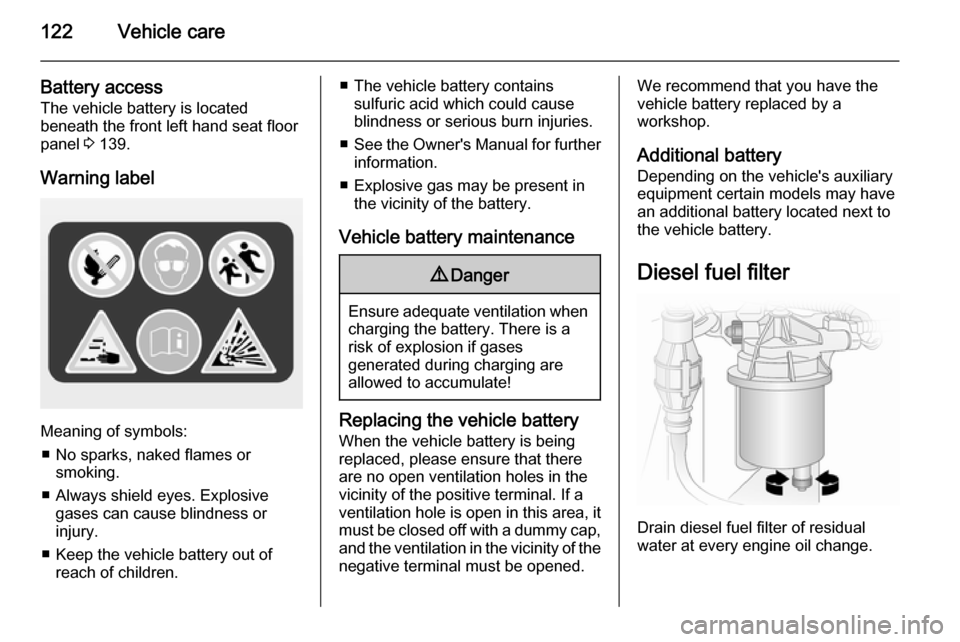
Warning label
Meaning of symbols: ■ No sparks, naked flames or smoking.
■ Always shield eyes. Explosive gases can cause blindness or
injury.
■ Keep the vehicle battery out of reach of children.
■ The vehicle battery containssulfuric acid which could cause
blindness or serious burn injuries.
■ See the Owner's Manual for further
information.
■ Explosive gas may be present in the vicinity of the battery.
Vehicle battery maintenance9 Danger
Ensure adequate ventilation when
charging the battery. There is a
risk of explosion if gases
generated during charging are
allowed to accumulate!
Replacing the vehicle battery
When the vehicle battery is being replaced, please ensure that there
are no open ventilation holes in the
vicinity of the positive terminal. If a
ventilation hole is open in this area, it
must be closed off with a dummy cap,
and the ventilation in the vicinity of the negative terminal must be opened.
We recommend that you have the
vehicle battery replaced by a
workshop.
Additional battery
Depending on the vehicle's auxiliary
equipment certain models may have
an additional battery located next to
the vehicle battery.
Diesel fuel filter
Drain diesel fuel filter of residual
water at every engine oil change.
Page 134 of 173
132Vehicle careTyre pressureCheck the pressure of cold tyres at
least every 14 days and before any
long journey. Do not forget the spare
wheel.
Tyre pressures 3 163.
The tyre pressure data refers to cold
tyres. It applies to summer and winter
tyres.
Always inflate the spare tyre to the
pressure specified for full load.
Incorrect tyre pressures will impair
safety, vehicle handling, comfort and fuel economy and will increase tyre
wear.
The tyre pressure tables show all
possible tyre combinations 3 163.
For the tyres approved for your
vehicle, refer to the EEC Certificate of Conformity provided with your vehicle
or other national registration
documents.
The driver is responsible for correct
adjustment of tyre pressure.9 Warning
If the pressure is too low, this can
result in considerable tyre warm-
up and internal damage, leading to tread separation and even to tyre
blow-out at high speeds.
Tread depth
Check tread depth at regular
intervals.
Tyres should be replaced for safety
reasons at a tread depth of 2-3 mm (4 mm for winter tyres).
For safety reasons it is recommended
that the tread depth of the tyres on
one axle should not vary by more than
2 mm.
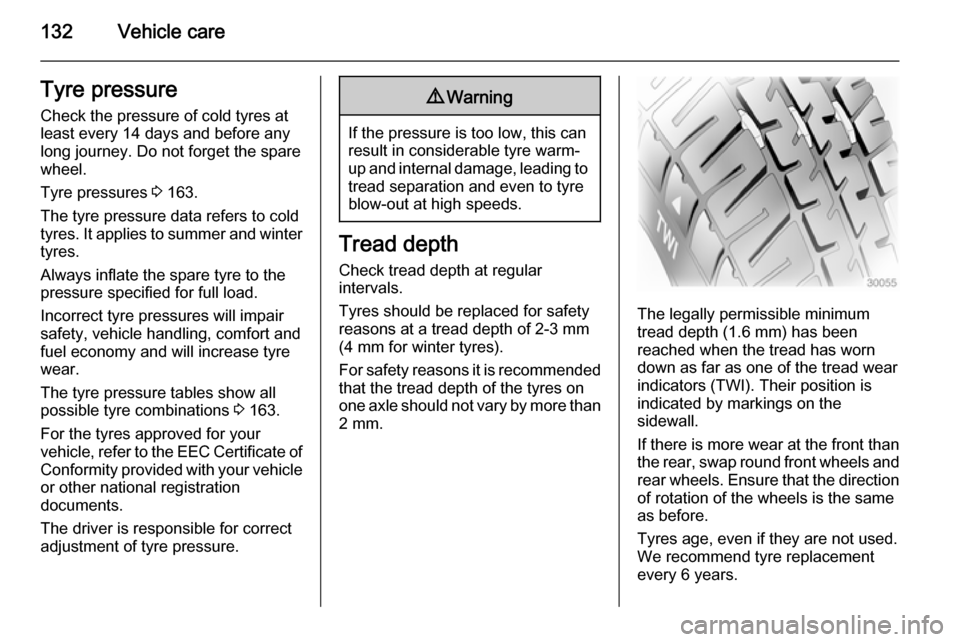
The legally permissible minimum
tread depth (1.6 mm) has been
reached when the tread has worn
down as far as one of the tread wear
indicators (TWI). Their position is
indicated by markings on the
sidewall.
If there is more wear at the front than the rear, swap round front wheels and
rear wheels. Ensure that the direction of rotation of the wheels is the sameas before.
Tyres age, even if they are not used.
We recommend tyre replacement
every 6 years.
Page 135 of 173
Vehicle care133Changing tyre and wheel
size If tyres of a different size than those
fitted at the factory are used, it may be
necessary to reprogramme the
speedometer as well as the nominal
tyre pressure and make other vehicle modifications.9 Warning
Use of unsuitable tyres or wheels
may lead to accidents and will
invalidate the vehicle type
approval.
Wheel covers
Wheel covers and tyres that are
factory approved for the respective
vehicle and comply with all of the
relevant wheel and tyre combination requirements must be used.
If the wheel covers and tyres used are
not factory approved, the tyres must
not have a rim protection ridge.
Wheel covers must not impair brake
cooling.
9 Warning
Use of unsuitable tyres or wheel
covers could lead to sudden
pressure loss and thereby
accidents.
Tyre chains
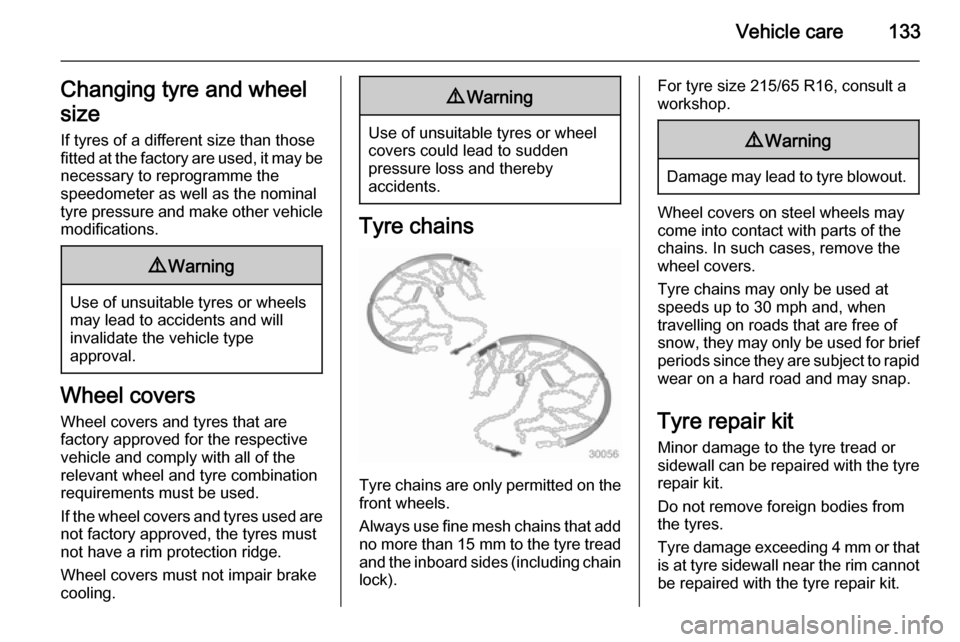
Tyre chains are only permitted on the
front wheels.
Always use fine mesh chains that add no more than 15 mm to the tyre tread
and the inboard sides (including chain lock).
For tyre size 215/65 R16, consult a
workshop.9 Warning
Damage may lead to tyre blowout.
Wheel covers on steel wheels may
come into contact with parts of the
chains. In such cases, remove the
wheel covers.
Tyre chains may only be used at
speeds up to 30 mph and, when
travelling on roads that are free of
snow, they may only be used for brief
periods since they are subject to rapid wear on a hard road and may snap.
Tyre repair kit
Minor damage to the tyre tread or
sidewall can be repaired with the tyre repair kit.
Do not remove foreign bodies from
the tyres.
Tyre damage exceeding 4 mm or that
is at tyre sidewall near the rim cannot
be repaired with the tyre repair kit.
Page 136 of 173
134Vehicle care9Warning
Do not drive faster than 50 mph.
Do not use for a lengthy period.
Steering and handling may be
affected.
If the vehicle has a flat tyre:
Apply the parking brake and engage
first gear or reverse gear.
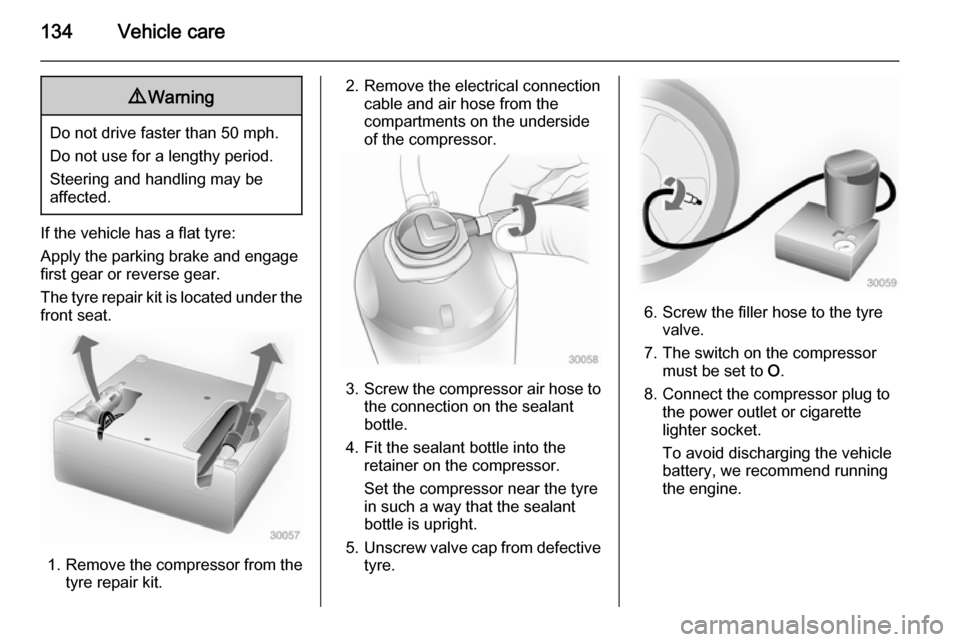
The tyre repair kit is located under the
front seat.
1. Remove the compressor from the
tyre repair kit.
2. Remove the electrical connection cable and air hose from the
compartments on the underside
of the compressor.
3. Screw the compressor air hose to
the connection on the sealant
bottle.
4. Fit the sealant bottle into the retainer on the compressor.
Set the compressor near the tyre
in such a way that the sealant
bottle is upright.
5. Unscrew valve cap from defective
tyre.
6. Screw the filler hose to the tyre valve.
7. The switch on the compressor must be set to O.
8. Connect the compressor plug to the power outlet or cigarette
lighter socket.
To avoid discharging the vehicle
battery, we recommend running
the engine.
Page 138 of 173
136Vehicle care
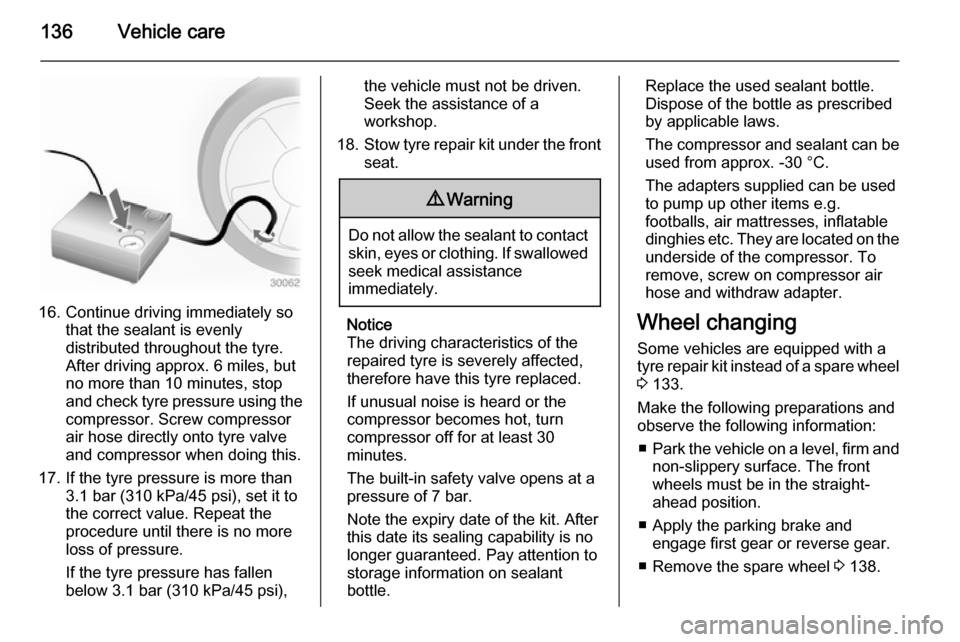
16. Continue driving immediately sothat the sealant is evenlydistributed throughout the tyre.
After driving approx. 6 miles, but
no more than 10 minutes, stop
and check tyre pressure using the
compressor. Screw compressor
air hose directly onto tyre valve
and compressor when doing this.
17. If the tyre pressure is more than 3.1 bar (310 kPa/45 psi), set it to
the correct value. Repeat the
procedure until there is no more
loss of pressure.
If the tyre pressure has fallen
below 3.1 bar (310 kPa/45 psi),
the vehicle must not be driven.
Seek the assistance of a
workshop.
18. Stow tyre repair kit under the front
seat.9 Warning
Do not allow the sealant to contact
skin, eyes or clothing. If swallowed seek medical assistance
immediately.
Notice
The driving characteristics of the
repaired tyre is severely affected,
therefore have this tyre replaced.
If unusual noise is heard or the
compressor becomes hot, turn
compressor off for at least 30
minutes.
The built-in safety valve opens at a
pressure of 7 bar.
Note the expiry date of the kit. After
this date its sealing capability is no
longer guaranteed. Pay attention to
storage information on sealant
bottle.
Replace the used sealant bottle. Dispose of the bottle as prescribed
by applicable laws.
The compressor and sealant can be used from approx. -30 °C.
The adapters supplied can be used
to pump up other items e.g.
footballs, air mattresses, inflatable
dinghies etc. They are located on the underside of the compressor. To
remove, screw on compressor air hose and withdraw adapter.
Wheel changing Some vehicles are equipped with a
tyre repair kit instead of a spare wheel 3 133.
Make the following preparations and
observe the following information:
■ Park the vehicle on a level, firm and
non-slippery surface. The frontwheels must be in the straight-ahead position.
■ Apply the parking brake and engage first gear or reverse gear.
■ Remove the spare wheel 3 138.
Page 140 of 173
138Vehicle care
Put wheel bolts somewhere
where the threads will not be
soiled.
6. Change the wheel.
7. Screw in the wheel bolts.
8. Lower vehicle.
9. Tighten each wheel bolt in a crosswise sequence. Tighteningtorque is 140 Nm.
10. Refit wheel cover
11. Change the wheel.
12. Stow the replaced wheel 3 138
and the vehicle tools 3 131.
13. Have the new wheel balanced on the vehicle. Check the tyre
pressure of the installed tyre
3 163 and also the wheel bolt
torque as soon as possible.
Have the defective tyre renewed or
repaired.
Spare wheel Some vehicles are equipped with a
tyre repair kit instead of a spare wheel
3 133.Use of a spare wheel that is smaller
than the other wheels or together with winter tyres could affect driveability.
Have the defective tyre replaced as
soon as possible.
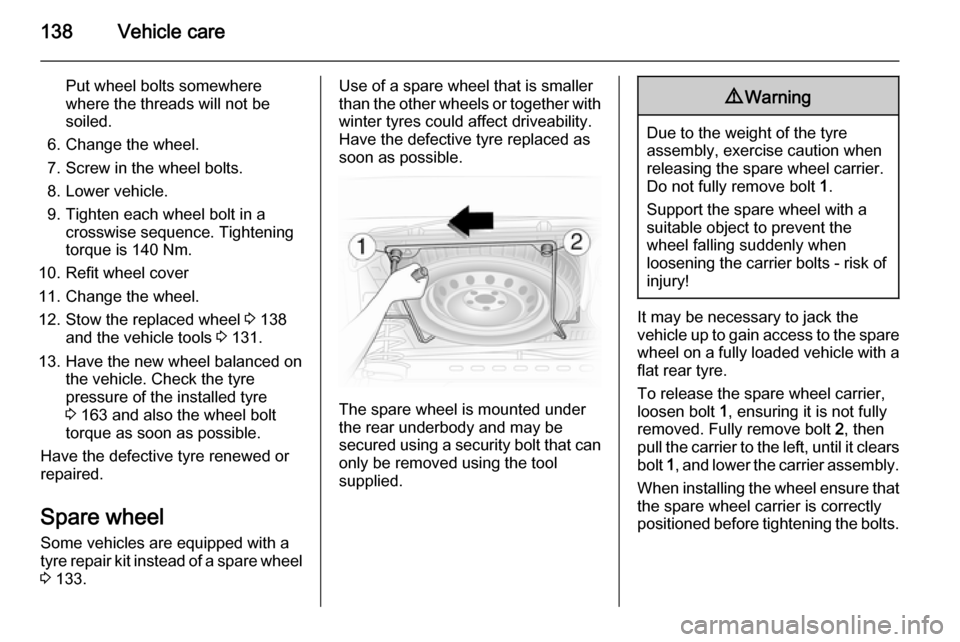
The spare wheel is mounted under
the rear underbody and may be
secured using a security bolt that can
only be removed using the tool
supplied.
9 Warning
Due to the weight of the tyre
assembly, exercise caution when
releasing the spare wheel carrier.
Do not fully remove bolt 1.
Support the spare wheel with a
suitable object to prevent the
wheel falling suddenly when
loosening the carrier bolts - risk of injury!
It may be necessary to jack the
vehicle up to gain access to the spare wheel on a fully loaded vehicle with a
flat rear tyre.
To release the spare wheel carrier,
loosen bolt 1, ensuring it is not fully
removed. Fully remove bolt 2, then
pull the carrier to the left, until it clears bolt 1, and lower the carrier assembly.
When installing the wheel ensure that
the spare wheel carrier is correctly
positioned before tightening the bolts.
Page 141 of 173
Vehicle care139
Summer and winter tyresIf you use winter tyres, the sparewheel may still be fitted with a
summer tyre.
If you use the spare wheel when it is
fitted with a summer tyre the vehicle's driveability may be affected,
especially on slippery road surfaces.
Directional tyres Fit directional tyres such that they roll
in the direction of travel. The rolling
direction is indicated by a symbol
(e.g. an arrow) on the sidewall.
The following applies to tyres fitted
opposing the rolling direction:
■ Driveability may be affected. Have the defective tyre renewed or
repaired as soon as possible.
■ Do not drive faster than 50 mph.
■ Drive particularly carefully on wet and snow-covered road surfaces.
Jump starting Do not start with a quick charger.A vehicle with a discharged battery
can be started using jump leads and the vehicle battery of another vehicle.9 Warning
Be extremely careful when starting
with jump leads. Any deviation
from the following instructions can
lead to injuries or damage caused
by battery explosion or damage to the electrical systems of both
vehicles.
9 Warning
Avoid contact of the battery with
eyes, skin, fabrics and painted
surfaces. The fluid contains
sulphuric acid which can cause
injuries and damage in the event
of direct contact.
■ Never expose the battery to naked
flames or sparks.
■ A discharged vehicle battery canalready freeze at a temperature of
0 °C. Defrost the frozen battery
before connecting jump leads.
■ Wear eye protection and protective
clothing when handling a battery.
■ Use a booster battery with the same voltage (12 volts). Its capacity(Ah) must not be much less than
that of the discharged battery.
■ Use jump leads with insulated terminals and a cross section of at
least 16 mm 2
(25 mm 2
for diesel
engines).
■ Do not disconnect the discharged vehicle battery from the vehicle.
■ Switch off all unnecessary electrical
consumers.
■ Do not lean over the battery during jump starting.
■ Do not allow the terminals of one lead to touch those of the other
lead.
Page 149 of 173

Service and maintenance147
The service display, located in the
Driver Information Centre, indicates
when the next service is due. Seek
the assistance of a workshop.
Service display 3 67.
Engine oil level monitor 3 67.Recommended fluids,
lubricants and parts
Recommended fluids andlubricants Only use products that meet the
recommended specifications.
Damage resulting from the use of
products not in line with these
specifications will not be covered by
the warranty.9 Warning
Operating materials are
hazardous and could be
poisonous. Handle with care. Pay
attention to information given on
the containers.
Engine oil
Engine oil is identified by its quality
and its viscosity. Quality is more
important than viscosity when
selecting which engine oil to use. The oil quality ensures e.g. engine
cleanliness, wear protection and oil
aging control, whereas viscosity
grade gives information on the oil's
thickness over a temperature range.
Dexos is the newest engine oil quality
that provides optimum protection for
petrol and diesel engines. If it is
unavailable, engine oils of other listed qualities have to be used.
Select the appropriate engine oil
based on its quality and on the
minimum ambient temperature
3 152.
Topping up engine oil
Engine oils of different manufacturers
and brands can be mixed as long as
they comply with the required engine oil quality and viscosity.
Use of engine oil with only
ACEA A1/B1 or only A5/B5 quality is
prohibited, since it can cause long-
term engine damage under certain
operating conditions.
Select the appropriate engine oil
based on its quality and on the
minimum ambient temperature
3 152.
Page 169 of 173

167
Coolant and antifreeze...............147
Coolant heater .............................. 87
Coupling ball bar ........................113
Cruise control ...................... 73, 104
Cupholders .................................. 56
Curtain airbag system .................. 46
D Danger, Warnings and Cautions ...3
Dashboard .................................... 10
Daytime running light ....................79
Declaration of conformity ............164
Diesel fuel filter .......................... 122
Diesel fuel system bleeding .......123
Diesel particle filter ......................95
Doors ............................................ 24
Driver Information Centre .............74
Driving characteristics and towing tips .............................. 112
Driving hints .................................. 93
E Electric adjustment ......................28
Electrical system......................... 128
Electronic driving programmes ....99
Electronic Stability Program 72, 103
End-of-life vehicle recovery .......116
Engine air filter ........................... 119
Engine air flow indicator .............119
Engine coolant ........................... 119Engine coolant temperature ........72
Engine data ............................... 154
Engine exhaust ............................ 95
Engine identification ...................150
Engine oil ................... 117, 147, 152
Engine oil level ............................ 76
Engine oil level monitor ................67
Engine oil pressure ......................73
Event data recorders ..................164
Exhaust gases .............................. 95
Exit lighting .................................. 83
Exterior care .............................. 143
Exterior light ................................. 73
Exterior lighting ......................12, 79
Exterior mirrors ............................. 28
F
Fault ........................................... 100
First aid kit ................................... 58
Fixed air vents ............................. 91
Fog light ....................................... 73
Fog lights .............................. 81, 124
Fog tail light ............................... 127
Folding mirrors ............................. 28
Front airbag system .....................45
Front fog lights ............................. 81
Front seats.................................... 33
Front storage ............................... 56
Front turn signal lights ...............125
Fuel............................................. 109Fuel consumption - CO 2-
Emissions ............................... 111
Fuel for diesel engines ..............110
Fuel for petrol engines ...............109
Fuel gauge ................................... 66
Fuse box ..................................... 129
Fuses ......................................... 128
G Gauges ......................................... 65
General information ...................112
Glovebox ..................................... 55
H Hand brake - see Parking brake. 102
Hazard warning flashers ..............81
Headlight flash ............................. 80
Headlight range adjustment ........80
Headlights ...................... 79, 80, 124
Headlights when driving abroad ..81
Head restraint adjustment .............8
Head restraints ............................ 32
Heated mirrors ............................. 29
Heated rear window ..................... 31
Heating ........................................ 35
Heating and ventilation system ...84
High beam ............................. 73, 80
Horn ....................................... 14, 61