climate control VAUXHALL VIVARO 2014 Owner's Manual
[x] Cancel search | Manufacturer: VAUXHALL, Model Year: 2014, Model line: VIVARO, Model: VAUXHALL VIVARO 2014Pages: 173, PDF Size: 4.11 MB
Page 3 of 173

Introduction.................................... 2
In brief ............................................ 6
Keys, doors and windows ............18
Seats, restraints ........................... 32
Storage ........................................ 55
Instruments and controls .............60
Lighting ........................................ 79
Climate control ............................. 84
Driving and operating ...................93
Vehicle care ............................... 115
Service and maintenance ..........146
Technical data ........................... 149
Customer information ................164
Index .......................................... 166Contents
Page 13 of 173

In brief11
1Ashtray .................................. 65
Cupholders ........................... 56
Fuse box ............................. 129
2 Fixed air vents ....................... 91
3 Side air vents ........................ 90
4 Light switch .......................... 79
Rear fog light ......................... 82
Front fog lights .....................81
Exit lighting ............................ 83
Turn and lane-change
signals ................................... 81
Sidelights .............................. 79
Headlight flash, low beam
and high beam ......................80
5 Instruments .......................... 65
Driver Information Centre ..... 74
Transmission display ............68
6 Horn ...................................... 61
Driver airbag ......................... 45
7 Steering column controls ......618Windscreen wiper,
windscreen washer system ..61
Rear window wiper, rear
window washer system ........62
Trip computer ....................... 76
9 Centre air vents ..................... 90
10 Triple-Info-Display .................74
11 Tachograph ........................... 78
12 Front passenger airbag .........45
13 Storage tray ......................... 55
14 Coin tray ............................... 55
15 Storage tray ......................... 55
16 Glovebox .............................. 55
17 Utility hook ........................... 10
18 Climate control system .......... 84
19 Hazard warning flashers .......81
20 Central locking system ..........20
Heated exterior mirrors .........29
Heated rear window ..............31Manual transmission
automated,
Winter and Laden modes ......99
Cruise control and speed
limiter ................................. 104
21 Gear lever, Manual
transmission .......................... 96
Manual transmission
automated ............................. 97
22 Power outlet .......................... 64
Cigarette lighter ..................... 64
23 Ignition switch with
steering wheel lock ...............94
24 Steering wheel adjustment ...60
25 Remote control on
steering wheel ......................60
Cruise control .....................104
26 Ultrasonic parking assist ....108
Headlight range
adjustment ........................... 80
Electronic Stability
Program ............................. 103
Traction Control system ......102
Page 17 of 173
In brief15
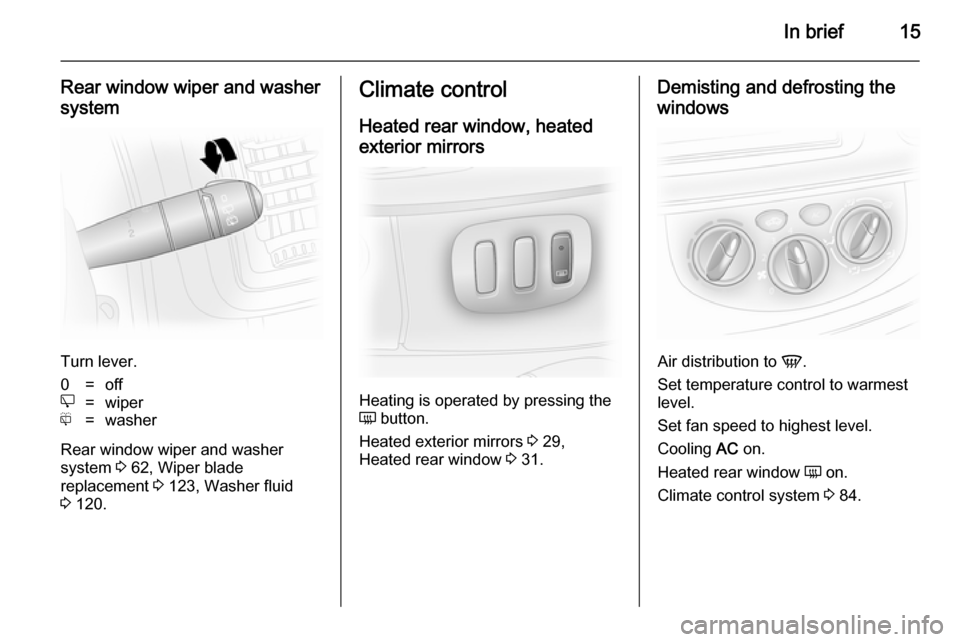
Rear window wiper and washer
system
Turn lever.
0=offe=wiperf=washer
Rear window wiper and washer
system 3 62, Wiper blade
replacement 3 123, Washer fluid
3 120.
Climate control
Heated rear window, heatedexterior mirrors
Heating is operated by pressing the
Ü button.
Heated exterior mirrors 3 29,
Heated rear window 3 31.
Demisting and defrosting the
windows
Air distribution to V.
Set temperature control to warmest
level.
Set fan speed to highest level.
Cooling AC on.
Heated rear window Ü on.
Climate control system 3 84.
Page 27 of 173
Keys, doors and windows25Load compartment
Tailgate
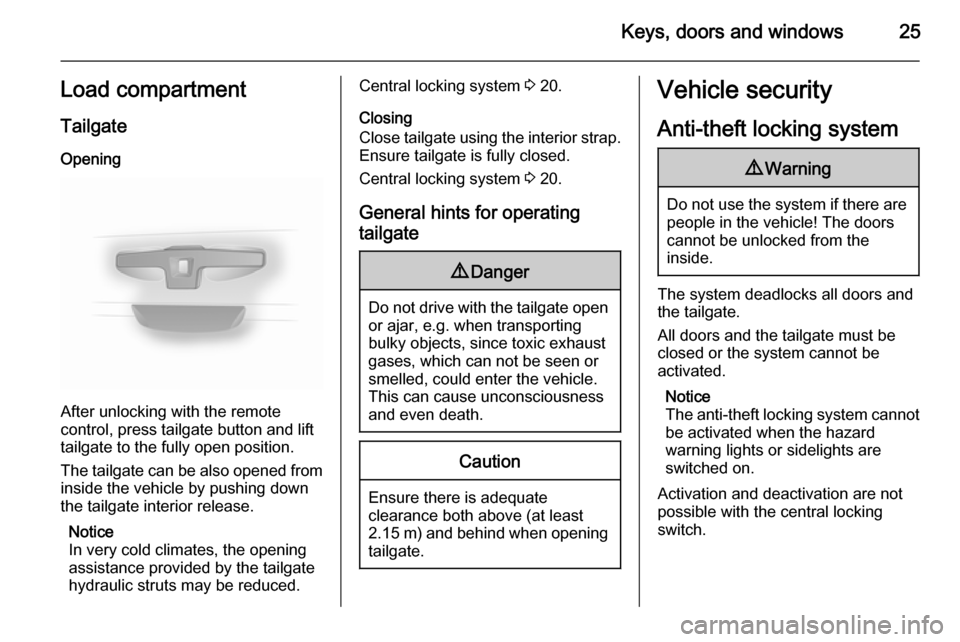
Opening
After unlocking with the remote
control, press tailgate button and lift tailgate to the fully open position.
The tailgate can be also opened from inside the vehicle by pushing down
the tailgate interior release.
Notice
In very cold climates, the opening
assistance provided by the tailgate
hydraulic struts may be reduced.
Central locking system 3 20.
Closing
Close tailgate using the interior strap. Ensure tailgate is fully closed.
Central locking system 3 20.
General hints for operating tailgate9 Danger
Do not drive with the tailgate open
or ajar, e.g. when transporting
bulky objects, since toxic exhaust
gases, which can not be seen or
smelled, could enter the vehicle.
This can cause unconsciousness
and even death.
Caution
Ensure there is adequate
clearance both above (at least
2.15 m) and behind when opening
tailgate.
Vehicle security
Anti-theft locking system9 Warning
Do not use the system if there are
people in the vehicle! The doorscannot be unlocked from the
inside.
The system deadlocks all doors and
the tailgate.
All doors and the tailgate must be
closed or the system cannot be
activated.
Notice
The anti-theft locking system cannot be activated when the hazard
warning lights or sidelights are
switched on.
Activation and deactivation are not possible with the central locking
switch.
Page 31 of 173
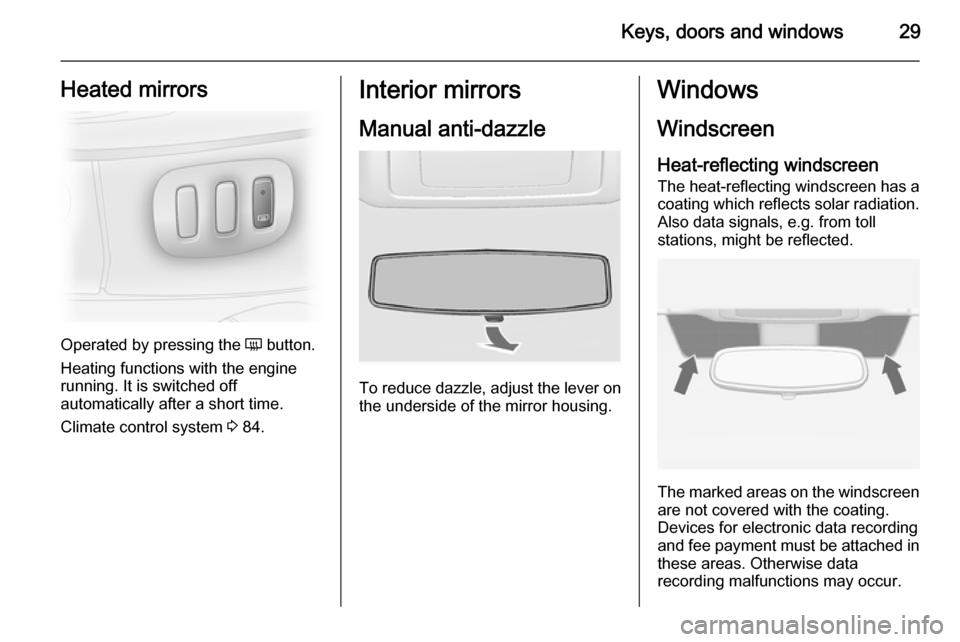
Keys, doors and windows29Heated mirrors
Operated by pressing the Ü button.
Heating functions with the engine running. It is switched off
automatically after a short time.
Climate control system 3 84.
Interior mirrors
Manual anti-dazzle
To reduce dazzle, adjust the lever on the underside of the mirror housing.
Windows
Windscreen Heat-reflecting windscreen
The heat-reflecting windscreen has a
coating which reflects solar radiation.
Also data signals, e.g. from toll
stations, might be reflected.
The marked areas on the windscreen are not covered with the coating.
Devices for electronic data recording
and fee payment must be attached in
these areas. Otherwise data
recording malfunctions may occur.
Page 33 of 173
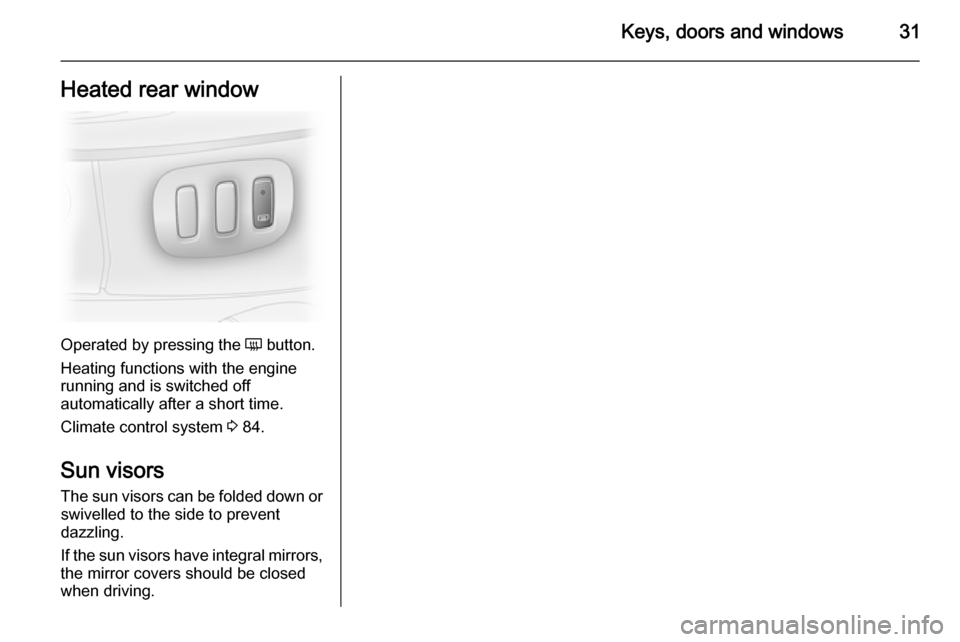
Keys, doors and windows31Heated rear window
Operated by pressing the Ü button.
Heating functions with the engine running and is switched off
automatically after a short time.
Climate control system 3 84.
Sun visors The sun visors can be folded down orswivelled to the side to prevent
dazzling.
If the sun visors have integral mirrors,
the mirror covers should be closed
when driving.
Page 86 of 173
84Climate controlClimate controlClimate control systems ............... 84
Air vents ....................................... 90
Maintenance ................................ 91Climate control systems
Heating and ventilation
system
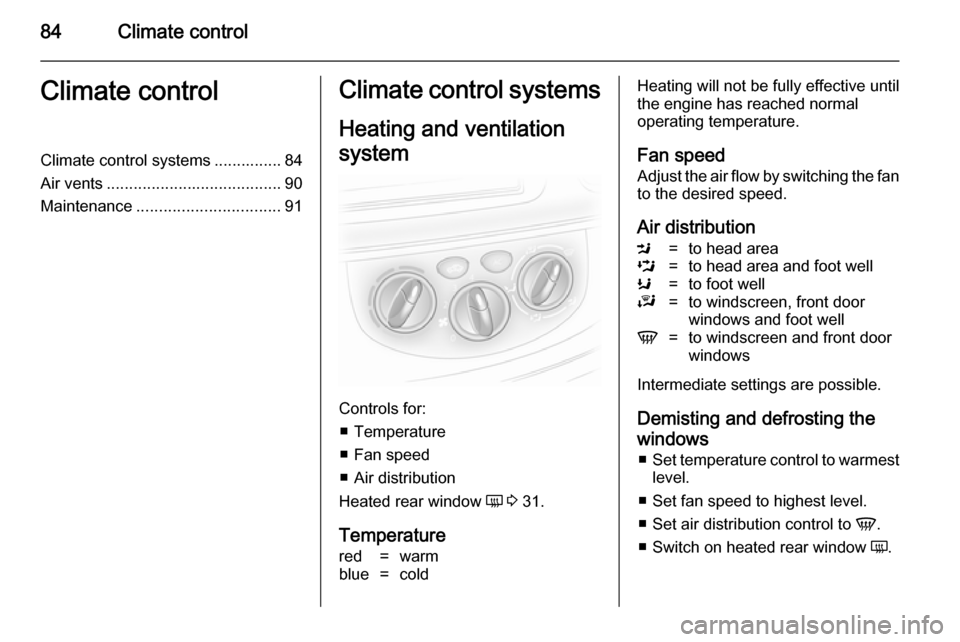
Controls for: ■ Temperature
■ Fan speed
■ Air distribution
Heated rear window Ü 3 31.
Temperature
red=warmblue=coldHeating will not be fully effective until
the engine has reached normal
operating temperature.
Fan speed Adjust the air flow by switching the fan
to the desired speed.
Air distributionM=to head areaL=to head area and foot wellK=to foot wellJ=to windscreen, front door
windows and foot wellV=to windscreen and front door
windows
Intermediate settings are possible.
Demisting and defrosting thewindows ■ Set temperature control to warmest
level.
■ Set fan speed to highest level.
■ Set air distribution control to V.
■ Switch on heated rear window Ü.
Page 87 of 173
Climate control85
■Open side air vents as required and
direct them towards door windows.
■ For simultaneous warming of the foot well, set air distribution control
to J.
Air conditioning system
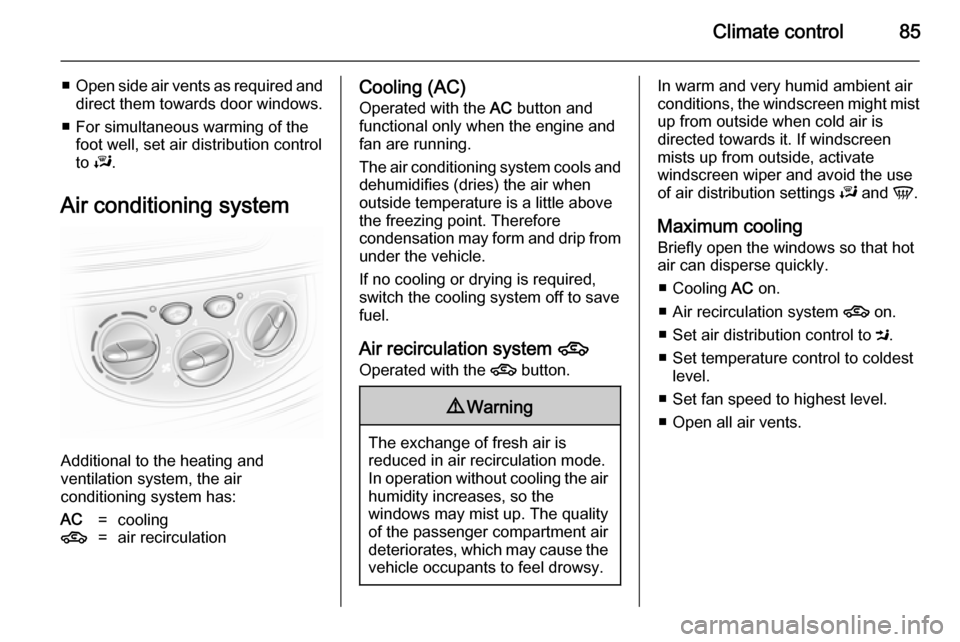
Additional to the heating and
ventilation system, the air
conditioning system has:
AC=cooling4=air recirculationCooling (AC)
Operated with the AC button and
functional only when the engine and
fan are running.
The air conditioning system cools and
dehumidifies (dries) the air when
outside temperature is a little above
the freezing point. Therefore
condensation may form and drip from under the vehicle.
If no cooling or drying is required,
switch the cooling system off to save
fuel.
Air recirculation system 4
Operated with the 4 button.9Warning
The exchange of fresh air is
reduced in air recirculation mode.
In operation without cooling the air humidity increases, so the
windows may mist up. The quality
of the passenger compartment air
deteriorates, which may cause the vehicle occupants to feel drowsy.
In warm and very humid ambient air
conditions, the windscreen might mist up from outside when cold air is
directed towards it. If windscreen
mists up from outside, activate
windscreen wiper and avoid the use
of air distribution settings J and V.
Maximum cooling Briefly open the windows so that hot
air can disperse quickly.
■ Cooling AC on.
■ Air recirculation system 4 on.
■ Set air distribution control to M.
■ Set temperature control to coldest level.
■ Set fan speed to highest level.
■ Open all air vents.
Page 88 of 173
86Climate controlRear heating system
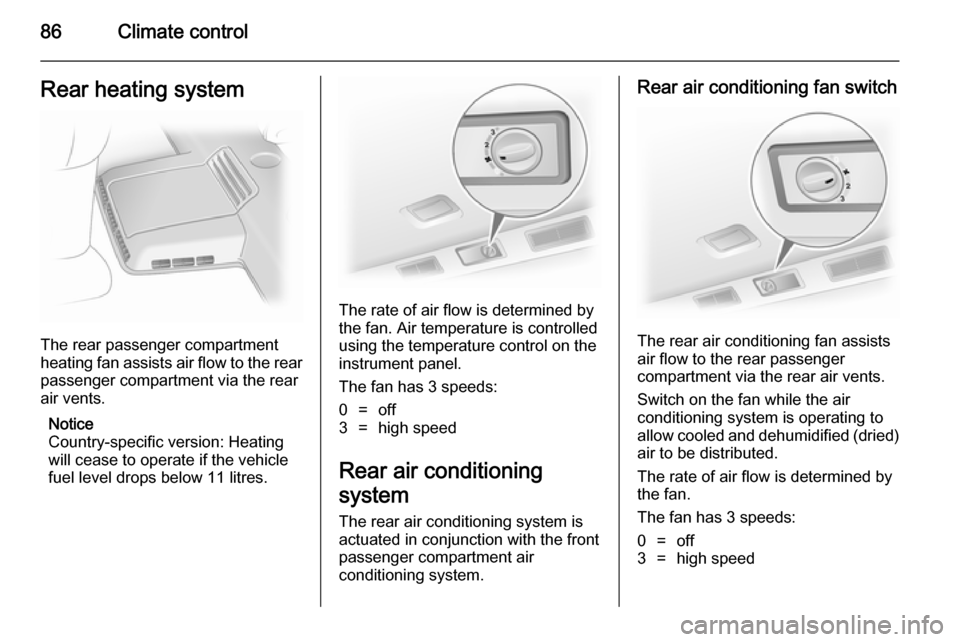
The rear passenger compartment
heating fan assists air flow to the rear
passenger compartment via the rear
air vents.
Notice
Country-specific version: Heating
will cease to operate if the vehicle
fuel level drops below 11 litres.
The rate of air flow is determined by
the fan. Air temperature is controlled
using the temperature control on the
instrument panel.
The fan has 3 speeds:
0=off3=high speed
Rear air conditioning
system
The rear air conditioning system is
actuated in conjunction with the front
passenger compartment air
conditioning system.
Rear air conditioning fan switch
The rear air conditioning fan assists
air flow to the rear passenger
compartment via the rear air vents.
Switch on the fan while the air
conditioning system is operating to
allow cooled and dehumidified (dried) air to be distributed.
The rate of air flow is determined by
the fan.
The fan has 3 speeds:
0=off3=high speed
Page 89 of 173
Climate control87Auxiliary heater
Coolant heater The Eberspächer engine-
independent, fuel-powered coolant
heater provides rapid heating of the
engine coolant to enable heating of
the vehicle interior without the engine running.9 Warning
Do not operate the system when
refuelling, when dust or
combustible vapours are present
or in enclosed spaces (e.g.
garage).
Before starting or programming the
system to start, turn the vehicle's climate control system to heat and the
air distribution to V.
Switch off when not required. Heating stops automatically after the
programmed runtime. It will also
cease to operate if the vehicle fuel
level drops too low.
During operation, power from the
vehicle battery is used. The driving
time should therefore be at least as
long as the heating time. For short
journey times, check the vehicle
battery regularly and recharge if
necessary.
To ensure efficient performance,
briefly operate the auxiliary heater
once a month.
Control units
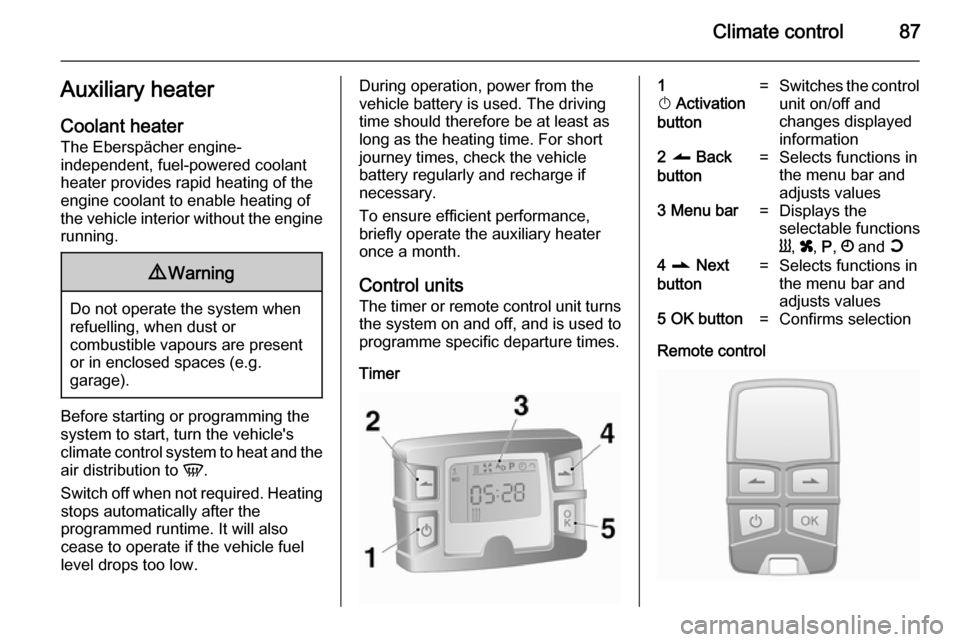
The timer or remote control unit turns the system on and off, and is used to
programme specific departure times.
Timer1
X Activation
button=Switches the control
unit on/off and
changes displayed
information2 q Back
button=Selects functions in
the menu bar and
adjusts values3 Menu bar=Displays the
selectable functions
Y , x , P , Ö and Y4 r Next
button=Selects functions in
the menu bar and
adjusts values5 OK button=Confirms selection
Remote control