clock VAUXHALL VIVARO 2016.5 User Guide
[x] Cancel search | Manufacturer: VAUXHALL, Model Year: 2016.5, Model line: VIVARO, Model: VAUXHALL VIVARO 2016.5Pages: 211, PDF Size: 5 MB
Page 144 of 211

142Driving and operatingWhen refuelling is complete, replace
the fuel filler cap and turn clockwise
as far as it will go.
Close the fuel filler flap.
Fuel filler cap Only use genuine fuel filler caps.Diesel-engined vehicles have special
fuel filler caps.
Fuel consumption - CO 2-
Emissions
The values for fuel consumption
(combined) of the model Vauxhall
Vivaro is within a range of 38 to
50 mpg.
The CO 2 emission (combined) is
within a range of 195 to 149 g/km.
For the values specific to your
vehicle, refer to the EEC Certificate of
Conformity provided with your vehicle or other national registration
documents.General information
The official fuel consumption and
specific CO 2 emission figures quoted
relate to the EU base model with
standard equipment.
Fuel consumption data and CO 2
emission data are determined
according to regulation
R (EC) No. 715/2007 (in the latest
applicable version), taking into
consideration the vehicle weight in
running order, as specified by the
regulation.
The figures are provided only for the
purpose of comparison between
different vehicle variants and must
not be taken as a guarantee for the
actual fuel consumption of a
particular vehicle.
Additional equipment may result in
slightly higher results than the stated fuel consumption and CO 2 figures.
Furthermore, fuel consumption is dependent on personal driving style
as well as road and traffic conditions.Trailer hitch
General information
Entrust retrofitting of towing
equipment to a workshop. It may be
necessary to make changes that
affect the cooling system, heat
shields or other equipment. Only use
towing equipment that has been
approved for your vehicle.
Driving characteristics and towing tips
In the case of trailers with brakes,
attach the breakaway stopping cable.
Before attaching a trailer, lubricate
the coupling ball. However, do not do
so if a stabiliser, which acts on the coupling ball, is being used to reduce snaking movements. For trailers with
low driving stability the use of a
stabiliser is recommended.
A maximum speed of 50 mph must
not be exceeded, even in countries
where higher speeds are permitted.
Page 156 of 211

154Vehicle careBulb replacement
Switch off the ignition and turn off the relevant switch or close the doors.
Only hold a new bulb at the base. Do
not touch the bulb glass with bare
hands.
Use only the same bulb type for
replacement.
Bulb check After a bulb replacement, switch on
the ignition, operate and check the
lights.
Headlights
Low beam and high beam Replace headlight bulbs from within
the engine compartment.
1. Remove protective cover by rotating it anticlockwise.
2. Remove harness connector.
3. Release retaining clip and remove
bulb.
4. Renew bulb and install retaining clip ensuring that bulb is in correctorientation.
5. Install harness connector and protective cover.
Sidelights
1.Remove bulb holder from reflector
housing by rotating it
anticlockwise.
2. Renew bulb.
3. Install bulb holder in reflector housing.
Fog lights
Access the front fog light bulb from
beneath the vehicle.
Page 157 of 211
Vehicle care155
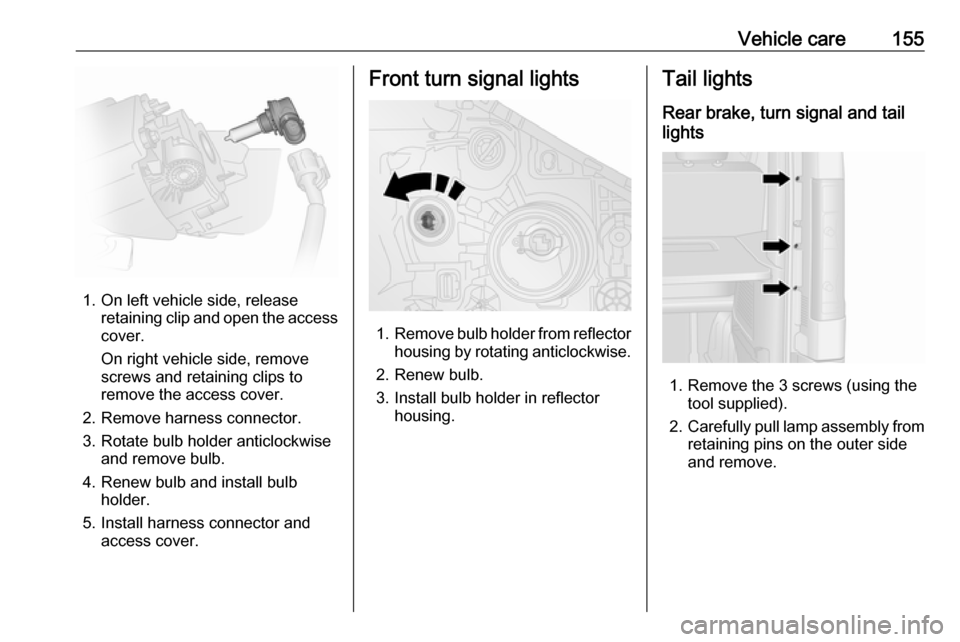
1. On left vehicle side, releaseretaining clip and open the accesscover.
On right vehicle side, remove screws and retaining clips to
remove the access cover.
2. Remove harness connector.
3. Rotate bulb holder anticlockwise and remove bulb.
4. Renew bulb and install bulb holder.
5. Install harness connector and access cover.
Front turn signal lights
1.Remove bulb holder from reflector
housing by rotating anticlockwise.
2. Renew bulb.
3. Install bulb holder in reflector housing.
Tail lights
Rear brake, turn signal and tail
lights
1. Remove the 3 screws (using the tool supplied).
2. Carefully pull lamp assembly from
retaining pins on the outer side
and remove.
Page 158 of 211

156Vehicle care
3. Rotate bulb holder anticlockwiseto separate from lamp assembly.
4. Renew bulb.
5. Push to install the bulb holder into
the lamp assembly, then rotate
clockwise to secure.
6. Check that the wiring harness is located correctly.
7. Replace lamp assembly into original position, ensuring that it isseated correctly.
8. Fit lamp assembly onto retaining pins and replace the 3 screws.
Side turn signal lights
1. Release lamp assembly fromwing by depressing clips using a
suitable tool and lift out lamp
assembly from aperture.
2. Remove bulb holder from lamp assembly by rotating
anticlockwise and renew bulb.
3. Install bulb holder in lamp assembly and install lamp
assembly into aperture.
Centre high-mounted brake light
1. Open the rear doors/tailgate.
2. Remove the 2 bolts from inside the rear doors/tailgate.
3. From outside the vehicle, remove the bulb holder by releasing the
clips with a flat blade screwdriver.
Page 159 of 211
Vehicle care1574. Renew bulb.
5. Install bulb holder and replace the
2 bolts.
Reversing light
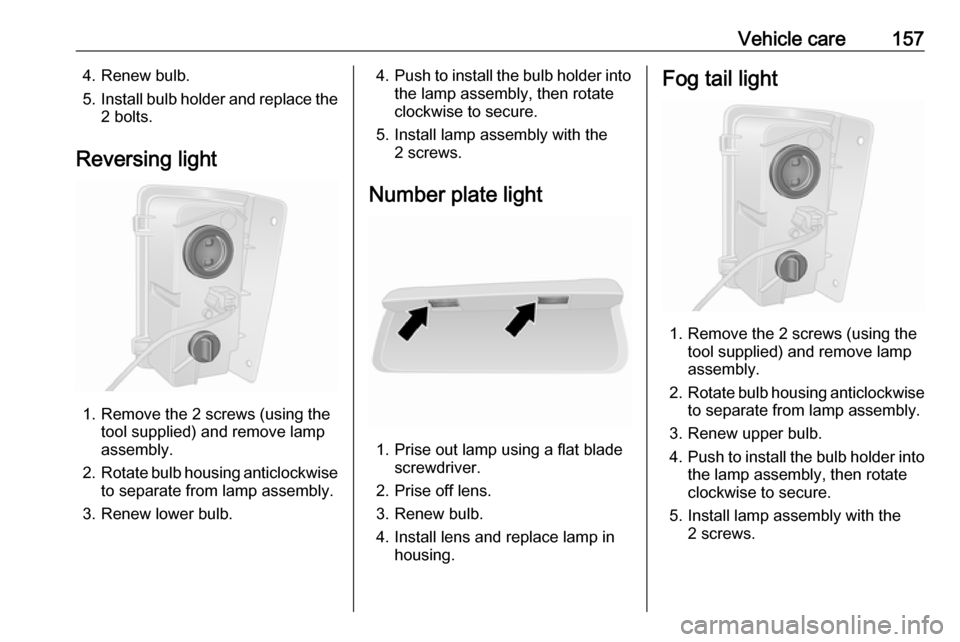
1. Remove the 2 screws (using the tool supplied) and remove lamp
assembly.
2. Rotate bulb housing anticlockwise
to separate from lamp assembly.
3. Renew lower bulb.
4. Push to install the bulb holder into
the lamp assembly, then rotate
clockwise to secure.
5. Install lamp assembly with the 2 screws.
Number plate light
1. Prise out lamp using a flat blade screwdriver.
2. Prise off lens.
3. Renew bulb.
4. Install lens and replace lamp in housing.
Fog tail light
1. Remove the 2 screws (using thetool supplied) and remove lamp
assembly.
2. Rotate bulb housing anticlockwise
to separate from lamp assembly.
3. Renew upper bulb.
4. Push to install the bulb holder into
the lamp assembly, then rotate
clockwise to secure.
5. Install lamp assembly with the 2 screws.
Page 174 of 211

172Vehicle care● Remove the spare wheel 3 173.
● Never change more than one wheel at a time.
● Use the jack only to change wheels in case of puncture, not
for a seasonal winter or summer
tyre change.
● If the ground on which the vehicle
is standing is soft, a solid board
(max. 1 cm thick) should be
placed under the jack.
● Take heavy objects out of the vehicle before jacking up.
● No people or animals may be in the vehicle when it is jacked-up.
● Never crawl under a jacked-up vehicle.
● Do not start the engine when the vehicle is raised on the jack.
● Clean wheel bolts/nuts and thread with a clean cloth before
mounting the wheel.9 Warning
Do not grease wheel bolt, wheel
nut and wheel nut cone.
1. Remove the wheel cover (using the hook supplied). Vehicle tools
3 163.
2. Loosen each of the wheel bolts by
half a turn using the wheel
wrench. Ensure the wrench
locates securely. The wrench
should turn anticlockwise to
loosen the bolts. Invert the wrench if necessary.
3. Place lifting pad spigot of the jack
under the jacking hole located
nearest the wheel concerned.
Ensure the jack is positioned
correctly. The jack base must be
on the ground directly below the
jacking hole in a manner that
prevents it from slipping.
4. Install wrench onto the jack and raise the vehicle by turning the
wrench until the wheel is clear of
the ground.
5. Unscrew wheel bolts completely by turning anticlockwise and wipe
clean with a cloth.
Page 175 of 211
Vehicle care173Put wheel bolts somewhere
where the threads will not be
soiled.
6. Change the wheel. Spare wheel 3 173.
7. Screw in the wheel bolts.
8. Lower the vehicle and remove jack.
9. Tighten each of the wheel bolts in
a crosswise sequence using the
wheel wrench. Ensure the wrench
locates securely. The wrench
should turn clockwise to tighten
the bolts. Invert the wrench if
necessary.
Tightening torque is 160 Nm.
10. Replace the wheel cover, ensuring that the valve hole in thewheel cover is aligned with the
tyre valve before installing.
Notice
If applicable, fit anti-theft bolts
nearest the tyre valve (otherwise it
may not be possible to refit the wheel
cover).11. Stow the replaced wheel 3 173
and the vehicle tools 3 163.
12. Have the new wheel balanced on the vehicle.
Check the tyre pressure of the
installed tyre 3 198.
Check the wheel bolt torque.
Have the defective tyre renewed or
repaired as soon as possible.
Spare wheel
Some vehicles are equipped with a
tyre repair kit instead of a spare wheel 3 169.
If mounting a spare wheel which is
different from the other wheels, this
wheel might be classified as a
temporary spare wheel and the
corresponding speed limits apply,
even though no label indicates this.
Seek the assistance of a workshop to
check the applicable speed limit.Caution
The use of a spare wheel that is smaller than the other wheels or in combination with winter tyres
could affect driveability. Have the defective tyre replaced as soon as
possible.
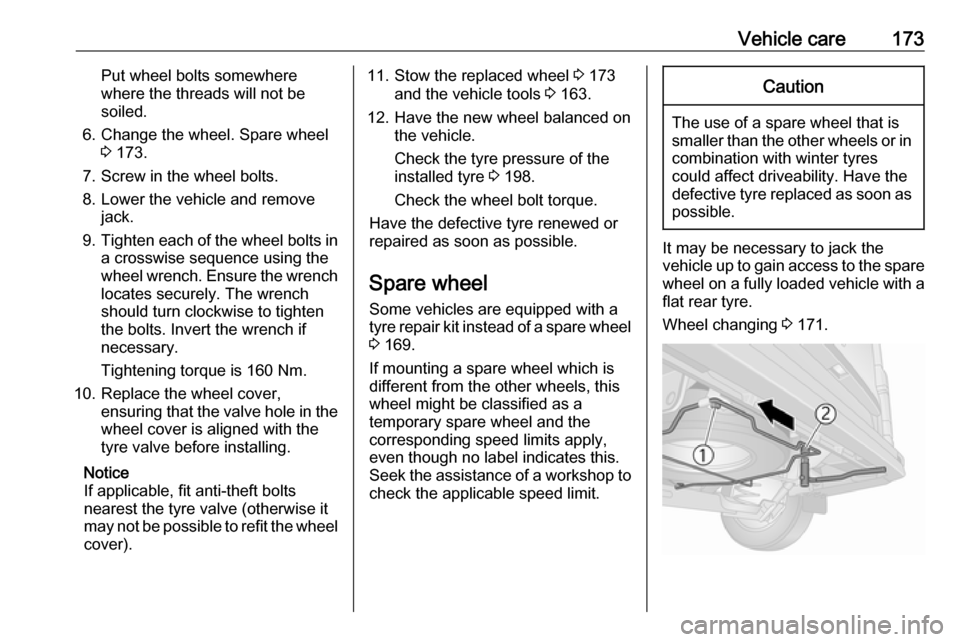
It may be necessary to jack the
vehicle up to gain access to the spare
wheel on a fully loaded vehicle with a
flat rear tyre.
Wheel changing 3 171.
Page 178 of 211
176Vehicle carefar away from the discharged
vehicle battery as possible,
however at least 60 cm.
Route the leads so that they cannot
catch on rotating parts in the engine
compartment.
To start the engine: 1. Start the engine of the vehicle providing the jump start.
2. After 5 minutes, start the other engine. Start attempts should be
made for no longer than
15 seconds at an interval of
1 minute.
3. Allow both engines to idle for approx. 3 minutes with the leads
connected.
4. Switch on electrical consumers (e.g. headlights, heated rear
window) of the vehicle receiving
the jump start.
5. Reverse above sequence exactly when removing leads.Towing
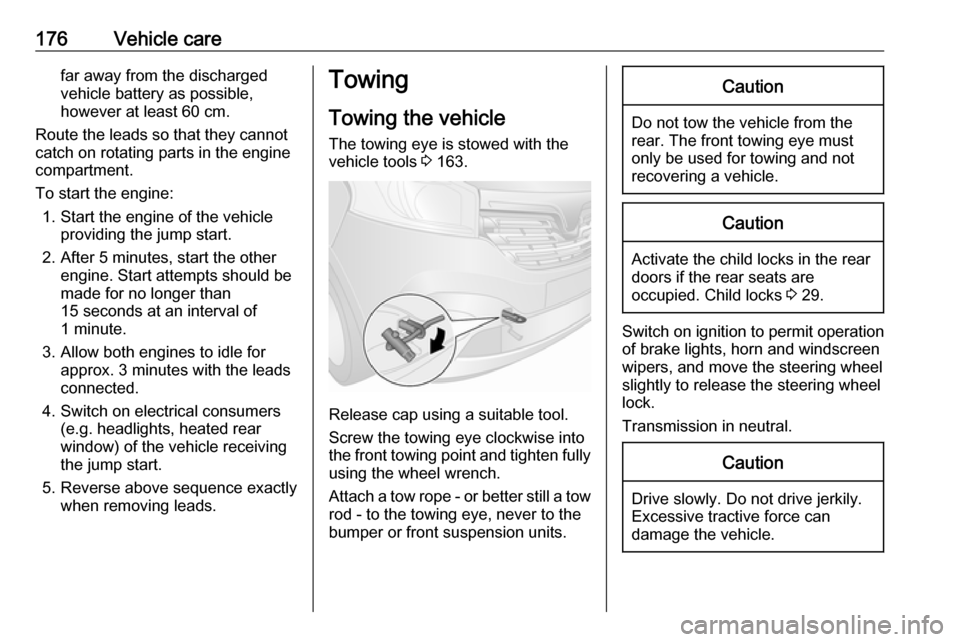
Towing the vehicle The towing eye is stowed with thevehicle tools 3 163.
Release cap using a suitable tool.
Screw the towing eye clockwise into
the front towing point and tighten fully
using the wheel wrench.
Attach a tow rope - or better still a tow rod - to the towing eye, never to the
bumper or front suspension units.
Caution
Do not tow the vehicle from the
rear. The front towing eye must
only be used for towing and not
recovering a vehicle.
Caution
Activate the child locks in the rear
doors if the rear seats are
occupied. Child locks 3 29.
Switch on ignition to permit operation
of brake lights, horn and windscreen
wipers, and move the steering wheel
slightly to release the steering wheel
lock.
Transmission in neutral.
Caution
Drive slowly. Do not drive jerkily.
Excessive tractive force can
damage the vehicle.
Page 205 of 211

203Changing tyre and wheel size ...168
Charging system .......................... 86
Child locks ................................... 29
Child restraint installation locations ................................... 60
Child restraints.............................. 59
Child restraint systems ................59
Cigarette lighter ........................... 79
Cleaning the vehicle ...................177
Climate control ............................. 15
Climate control systems .............103
Clock ............................................ 77
Coat hooks ................................... 67
Coin holder ................................... 66
Control indicators.......................... 82
Control of the vehicle .................115
Controls ........................................ 75
Controls in steering wheel ............75
Convex shape .............................. 37 Coolant ....................................... 148
Coolant and antifreeze ...............182
Coolant heater ............................ 108
Cooling (A/C) .............................. 104
Cornering light .............................. 98
Cruise control ...................... 90, 133
Cupholders .................................. 67
Curtain airbag system .................. 57D
Danger, Warnings and Cautions ...4
Dashboard .................................... 10
Daytime running lights ............97, 98
Declaration of conformity ............199
DEF ............................................ 123
Demisting and defrosting ..............15
Diesel exhaust fluid ....................123
Diesel fuel filter .......................... 152
Diesel fuel system bleeding .......152
Diesel particle filter ....................122
Directional tyres ..................164, 173
Distance to service .......................81
Document tray .............................. 67
Door locks..................................... 23
Door open .................................... 90
Door panel storage .......................68
Doors ............................................ 29
Double cab ................................... 68
DPF (diesel particle filter) ...........122
Driver assistance systems ..........133
Driver Information Centre .............90
Driving characteristics and towing tips .............................. 142
Driving economically................... 114
Driving hints ................................ 114
E ECO mode .................................. 114
ecoScoring.................................... 93Electric adjustment ......................37
Electrical accessories ...................78
Electrical system......................... 159
Electronic climate control system 105
Electronic data recording ..............39
Electronic key system ...................22
Electronic Stability Program 87,
131, 143
Electronic Stability Program off ...87
End-of-life vehicle recovery .......145
Engine air filter............................ 148
Engine air flow indicator .............148
Engine coolant ........................... 148
Engine coolant temperature ........87
Engine data ............................... 187
Engine exhaust .......................... 122
Engine identification ...................185
Engine oil ...........147, 182, 186, 197
Engine oil additives ....................182
Engine oil level ............................ 92
Engine oil pressure ......................88
Engine oil viscosity grades .........182
Enhanced Traction function 130, 131
Entry lighting .............................. 101
Event data recorders ..................201
Exhaust gases ....................122, 176
Exit lighting ................................ 102
Exterior care .............................. 177
Exterior light ................................. 89