windscreen VAUXHALL VIVARO 2016.5 User Guide
[x] Cancel search | Manufacturer: VAUXHALL, Model Year: 2016.5, Model line: VIVARO, Model: VAUXHALL VIVARO 2016.5Pages: 211, PDF Size: 5 MB
Page 106 of 211

104Climate control● Open side air vents as requiredand direct them towards door
windows.
● For simultaneous warming of the
foot well, set air distribution
control to J.
Heated rear window 3 41.
Air conditioning system
In addition to the heating and
ventilation system, the air
conditioning system has controls for:
A/C:cooling4:air recirculation
Heated seats 3 46.
Cooling (A/C)
Press A/C to switch on cooling.
Activation is indicated by illumination
of the LED in the button. Cooling is
only functional when the engine is running and climate control fan is
switched on.
Press A/C again to switch off cooling.
The air conditioning system cools and
dehumidifies (dries) the air when
outside temperature is above a
specific level. Therefore
condensation may form and drip from under the vehicle.
If no cooling or drying is required,
switch off the cooling system for fuel
saving reasons. Activated cooling
may inhibit an Autostop.
Stop-start system 3 119.
Notice
Air conditioning performance is
reduced when ECO mode has been
activated 3 114.
Air recirculation system 4
Press 4 to activate air recirculation
mode. Activation is indicated by
illumination of the LED in the button.Press 4 again to deactivate air
recirculation mode.9 Warning
The exchange of fresh air is
reduced in air recirculation mode.
In operation without cooling, the
air humidity increases, so the
windows may mist up from inside.
The quality of the passenger
compartment air deteriorates,
which may cause the vehicle
occupants to feel drowsy.
In warm and very humid ambient air conditions, the windscreen might mist up from outside when cold air is
directed towards it. If windscreen
mists up from outside, activate
windscreen wiper and avoid the use
of air distribution settings J and V.
Maximum cooling
Briefly open the windows so that hot air can disperse quickly.
● Cooling A/C on.
● Air recirculation system 4 on.
● Set air distribution control to M.
Page 108 of 211

106Climate controlIf the minimum temperature is set, the
climate control system runs at
maximum cooling.
If the maximum temperature is set, the climate control system runs at
maximum heating.
Demisting and defrosting the
windows
● Press Ê; LED illuminates in the
button when activated.
● Temperature, air distribution and cooling are regulated
automatically and the fan runs at
high speed.
● Switch on heated rear window Ü
3 41.
To return to Automatic mode: press
Ê or AUTO .
Notice
If Ê is pressed while the engine is
running, an Autostop will be inhibited until Ê is pressed again.
If Ê is pressed while the engine is in
an Autostop, the engine will restart
automatically.
Stop-start system 3 119.Manual settings
Manually changing any of the
following settings will deactivate
Automatic mode:
Fan speed Z
Adjust the air flow manually by
switching the fan to the desired
speed.
If the fan is switched off, the air
conditioning is also deactivated.
Air distribution M
Press appropriate button for desired
adjustment. LED illuminates in the
button when activated.R:to windscreen and front door
windowsM:to head areaS:to foot well
Combinations of settings are possible
by pressing two buttons until both
LEDs are illuminated.
To return to Automatic mode: Press
AUTO button.
Cooling A/C
The air conditioning system cools and dehumidifies (dries) the air when
outside temperature is above a
specific level. Therefore
condensation may form and drip from
under the vehicle.
Notice
Air conditioning performance is
reduced when ECO mode has been
activated 3 114.
If no cooling or drying is required
press A/C OFF to switch the cooling
system off, thus saving fuel. LED
illuminates in the button.
To return to Automatic mode: Press
AUTO button.
Air recirculation mode u
Activate or deactivate manual air recirculation mode with u. LED
illuminates in the button when
activated.
Page 114 of 211
112Climate controlAir vents
Adjustable air vents At least one air vent must be open
while cooling is on, in order to prevent
the evaporator from icing up due to lack of air movement.9 Warning
Do not attach any objects to the
slats of the air vents. Risk of
damage and injury in case of an
accident.
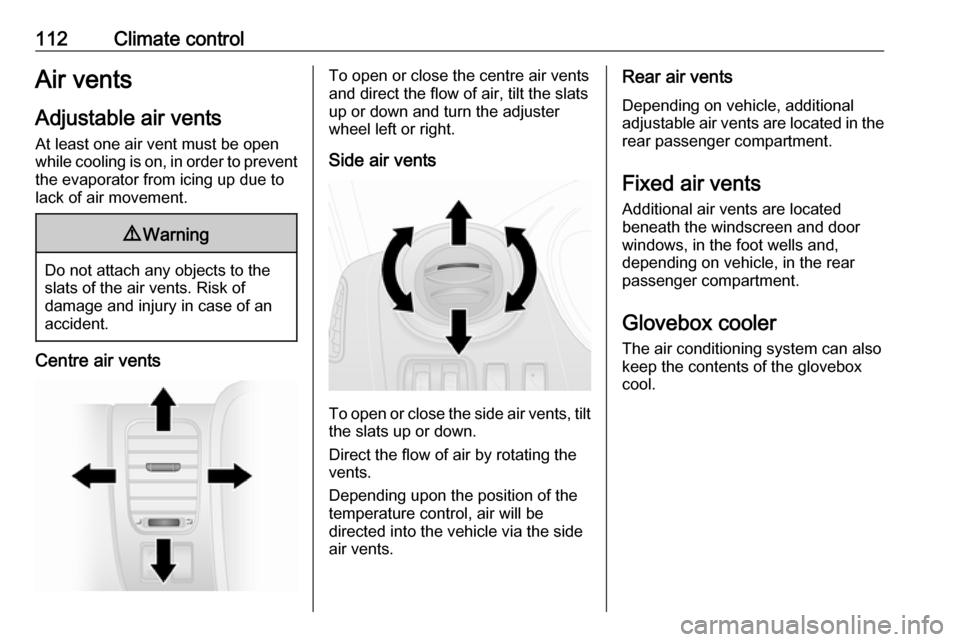
Centre air vents
To open or close the centre air vents
and direct the flow of air, tilt the slats
up or down and turn the adjuster
wheel left or right.
Side air vents
To open or close the side air vents, tilt the slats up or down.
Direct the flow of air by rotating the
vents.
Depending upon the position of the
temperature control, air will be
directed into the vehicle via the side
air vents.
Rear air vents
Depending on vehicle, additional
adjustable air vents are located in the
rear passenger compartment.
Fixed air vents Additional air vents are located
beneath the windscreen and door
windows, in the foot wells and,
depending on vehicle, in the rear
passenger compartment.
Glovebox cooler
The air conditioning system can also
keep the contents of the glovebox
cool.
Page 115 of 211

Climate control113Maintenance
Air intake The air intake in front of the
windscreen in the engine
compartment must be kept clear to
allow air intake. Remove any leaves,
dirt or snow.
Pollen filter
The pollen filter cleans dust, soot,
pollen and spores from the air
entering the vehicle through the air
intake.
Notice
Pollen filter is only fitted to vehicles
with air conditioning system.
Air conditioning regular operation
In order to ensure continuously
efficient performance, cooling must
be operated for a few minutes once a month, irrespective of the weather
and time of year. Operation with
cooling is not possible when outside
temperature is too low.Service
For optimal cooling performance, it is recommended that the climate control
system be checked annually, starting three years after initial vehicle
registration, including:
● functionality and pressure test
● heating functionality
● leakage check
● check of drive belts
● cleaning of condenser and evaporator drainage
● performance check
Page 152 of 211
150Vehicle careWasher fluid
Fill with clean water mixed with a
suitable quantity of windscreen
washer fluid which contains
antifreeze.
Caution
Only washer fluid with a sufficient
antifreeze concentration provides
protection at low temperatures or
a sudden drop in temperature.
Use of washer fluid containing
isopropanol can damage exterior
lamps.
Brakes
A squealing noise indicates that the
brake lining is at its minimum
thickness. Continued driving is
possible but have the brake lining
replaced as soon as possible.
Once new brake linings are installed,
do not brake unnecessarily hard for
the first few journeys.
Brake fluid9 Warning
Brake fluid is poisonous and
corrosive. Avoid contact with eyes, skin, fabrics and painted surfaces.
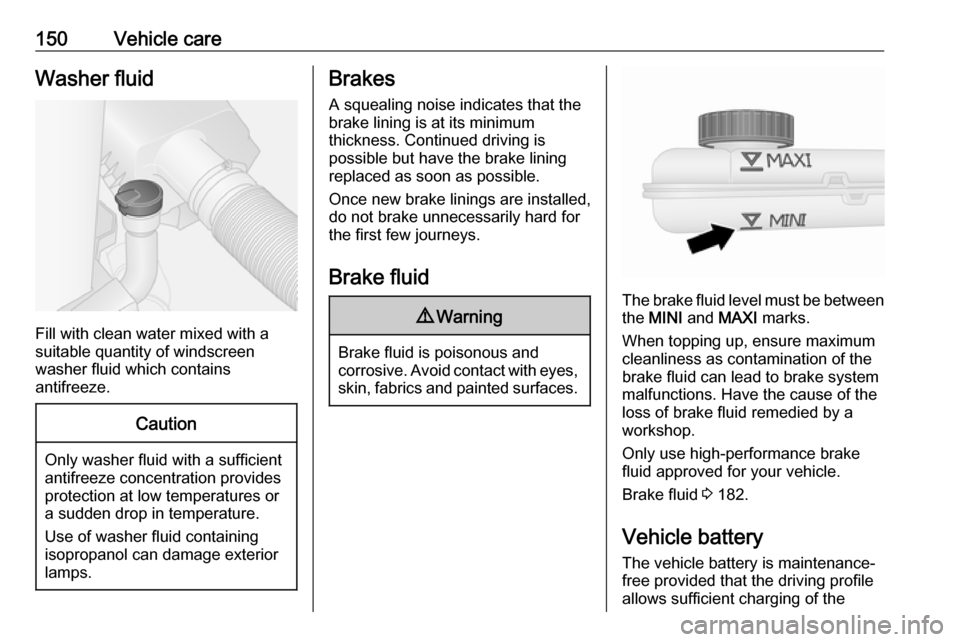
The brake fluid level must be betweenthe MINI and MAXI marks.
When topping up, ensure maximum cleanliness as contamination of the
brake fluid can lead to brake system
malfunctions. Have the cause of the
loss of brake fluid remedied by a
workshop.
Only use high-performance brake
fluid approved for your vehicle.
Brake fluid 3 182.
Vehicle battery
The vehicle battery is maintenance-
free provided that the driving profile
allows sufficient charging of the
Page 155 of 211

Vehicle care153● Switch on the ignition (key toposition 2) for 5 seconds at a
time.
● Switch off ignition (key to position
1 ) for 3 seconds.
● Repeat this process multiple times.
● Start the engine (key to position 3) then switch off (key to position
0 ).
Ignition switch positions 3 116.
With power button● Insert the electronic key in the card reader.
● Press START/STOP without
pressing any of the pedals.
● Wait a few minutes before starting engine.
Power button 3 116.
If the engine fails to start, seek the
assistance of a workshop.
Starting the engine 3 118.
Wiper blade replacement Wiper blades on the windscreenLift the wiper arm, press button to
disengage the wiper blade and
remove.
Attach new wiper blade slightly
angled to the wiper arm and push until
it engages.
Lower wiper arm carefully.
Wiper blade on the rear window
Lift wiper arm, press retaining lugs
together to disengage the wiper blade
and remove.
Lower wiper arm carefully.
Page 165 of 211

Vehicle care163No.Circuit41Load compartment power outlet42Driver power window43Rear power outlet44Starting / body control module45Heated seats46Heating / air conditioning47Windscreen wiper48Tachograph
After having changed defective fuses,
replace the trim panel.
Vehicle tools
Tools
The jack, wheel wrench, wheel bolt
sleeve, torx key, adapters, wheel
cover hook, towing eye are contained
in a unit, stowed under the driver's
seat.
Slide seat forwards and fold the
backrest forwards 3 44 to access the
tool box. The tool box may be secured
in position with a wing nut.
Wheel changing 3 171, Spare wheel
3 173.
Vehicles with tyre repair kit: The
wheel cover hook and torx key are
stored within the tyre repair kit case,
stowed under the driver's seat.
Tyre repair kit 3 169.
Page 178 of 211
176Vehicle carefar away from the discharged
vehicle battery as possible,
however at least 60 cm.
Route the leads so that they cannot
catch on rotating parts in the engine
compartment.
To start the engine: 1. Start the engine of the vehicle providing the jump start.
2. After 5 minutes, start the other engine. Start attempts should be
made for no longer than
15 seconds at an interval of
1 minute.
3. Allow both engines to idle for approx. 3 minutes with the leads
connected.
4. Switch on electrical consumers (e.g. headlights, heated rear
window) of the vehicle receiving
the jump start.
5. Reverse above sequence exactly when removing leads.Towing
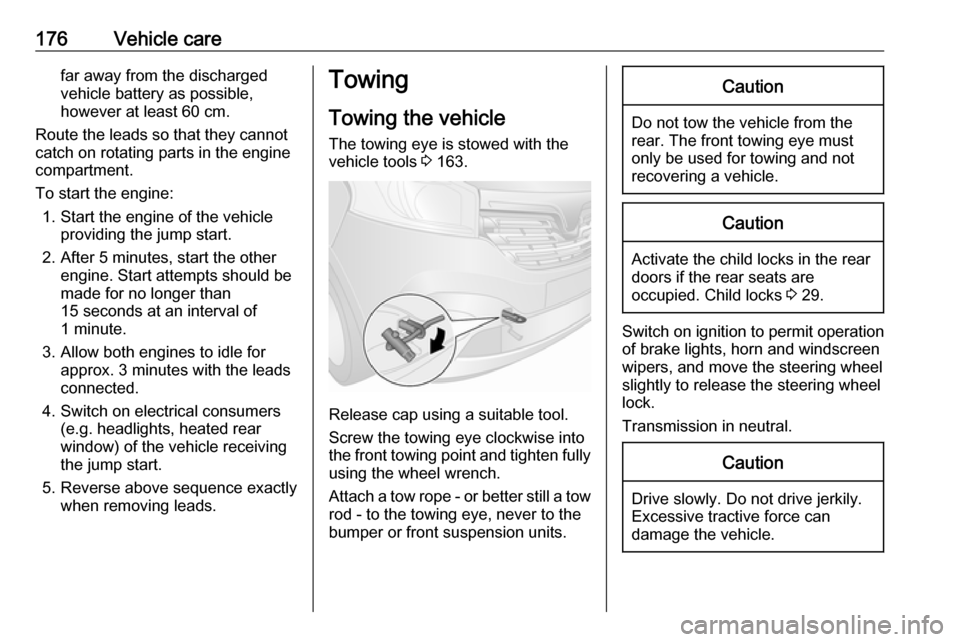
Towing the vehicle The towing eye is stowed with thevehicle tools 3 163.
Release cap using a suitable tool.
Screw the towing eye clockwise into
the front towing point and tighten fully
using the wheel wrench.
Attach a tow rope - or better still a tow rod - to the towing eye, never to the
bumper or front suspension units.
Caution
Do not tow the vehicle from the
rear. The front towing eye must
only be used for towing and not
recovering a vehicle.
Caution
Activate the child locks in the rear
doors if the rear seats are
occupied. Child locks 3 29.
Switch on ignition to permit operation
of brake lights, horn and windscreen
wipers, and move the steering wheel
slightly to release the steering wheel
lock.
Transmission in neutral.
Caution
Drive slowly. Do not drive jerkily.
Excessive tractive force can
damage the vehicle.
Page 180 of 211

178Vehicle careIf using a vehicle wash, comply with
the vehicle wash manufacturer's
instructions. The windscreen wipers and rear window wiper must be
switched off and the exterior mirrors
must be folded in. Remove antenna
and external accessories such as roof racks etc.
If you wash your vehicle by hand,
make sure that the insides of the
wheel housings are also thoroughly
rinsed out.
Clean edges and folds on opened
doors and the bonnet as well as the
areas they cover.Caution
Always use a cleaning agent with
a pH value of 4 to 9.
Do not use cleaning agents on hot surfaces.
Have the door hinges of all doors
greased by a workshop.
Do not clean the engine compartment with a steam-jet or high-pressure jet
cleaner.
Thoroughly rinse and leather-off the vehicle. Rinse leather frequently. Use
separate leathers for painted and
glass surfaces: remnants of wax on
the windows will impair vision.
Exterior lights
Headlight and other light covers are
made of plastic. Do not use any
abrasive or caustic agents, do not use
an ice scraper, and do not clean them
dry.
Polishing and waxing
Wax the vehicle regularly (at the
latest when water no longer beads).
Otherwise, the paintwork will dry out.
Polishing is necessary only if the paint
has become dull or if solid deposits
have become attached to it.
Paintwork polish with silicone forms a protective film, making waxing
unnecessary.
Unpainted plastic body parts must not
be treated with wax or polishing
agents.Matt filmed body parts or decor tapes must not be polished, to avoid
gleaming. Do not use hot wax
programmes in automatic car washes if the vehicle is equipped with theseparts.
Matt painted decor parts, e.g. mirror
housing cover, must not be polished.
Otherwise these parts would become
agleam or the colour would be
dissolved.
Windows and windscreen wiper
blades
Use a soft lint-free cloth or chamois
leather together with window cleaner and insect remover.
When cleaning the rear window from
inside, always wipe in parallel to the
heating element to prevent damage.
For mechanical removal of ice, use a
sharp-edged ice scraper. Press the
scraper firmly against the glass so
that no dirt can get under it and
scratch the glass.
Page 186 of 211

184Technical dataTechnical dataVehicle identification..................184
Vehicle Identification Number ..184
Identification plate ...................185
Engine identification ................185
Vehicle data ............................... 186
Recommended fluids and lubricants ................................ 186
Engine data ............................. 187
Vehicle weight ......................... 189
Vehicle dimensions .................192
Capacities ................................ 197
Tyre pressures ........................ 198Vehicle identification
Vehicle IdentificationNumber
The Vehicle Identification Number is
visible through the windscreen.
The VIN is also displayed behind a
removable plastic cover on the right-
hand side door step.