warning VAUXHALL VIVARO 2016.5 Workshop Manual
[x] Cancel search | Manufacturer: VAUXHALL, Model Year: 2016.5, Model line: VIVARO, Model: VAUXHALL VIVARO 2016.5Pages: 211, PDF Size: 5 MB
Page 111 of 211
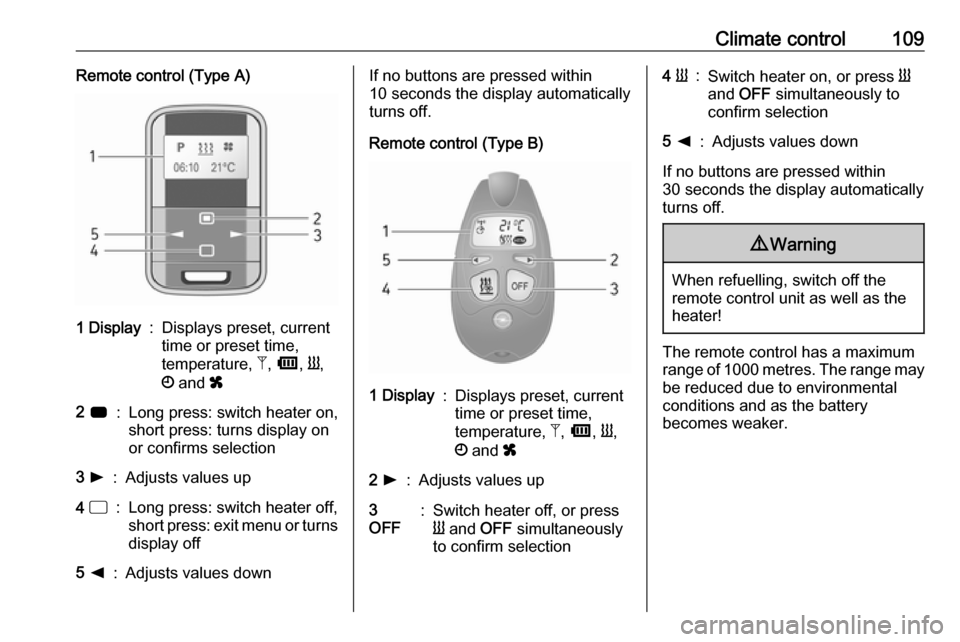
Climate control109Remote control (Type A)1 Display:Displays preset, current
time or preset time,
temperature, Z, Ü , Y ,
Ö and x2 7:Long press: switch heater on,
short press: turns display on
or confirms selection3 l:Adjusts values up4 d:Long press: switch heater off,
short press: exit menu or turns
display off5 k:Adjusts values downIf no buttons are pressed within
10 seconds the display automatically
turns off.
Remote control (Type B)1 Display:Displays preset, current
time or preset time,
temperature, Z, Ü , Y ,
Ö and x2 l:Adjusts values up3
OFF:Switch heater off, or press
Y and OFF simultaneously
to confirm selection4 Y:Switch heater on, or press Y
and OFF simultaneously to
confirm selection5 k:Adjusts values down
If no buttons are pressed within
30 seconds the display automatically
turns off.
9 Warning
When refuelling, switch off the
remote control unit as well as the
heater!
The remote control has a maximum
range of 1000 metres. The range may
be reduced due to environmental
conditions and as the battery
becomes weaker.
Page 114 of 211
112Climate controlAir vents
Adjustable air vents At least one air vent must be open
while cooling is on, in order to prevent
the evaporator from icing up due to lack of air movement.9 Warning
Do not attach any objects to the
slats of the air vents. Risk of
damage and injury in case of an
accident.
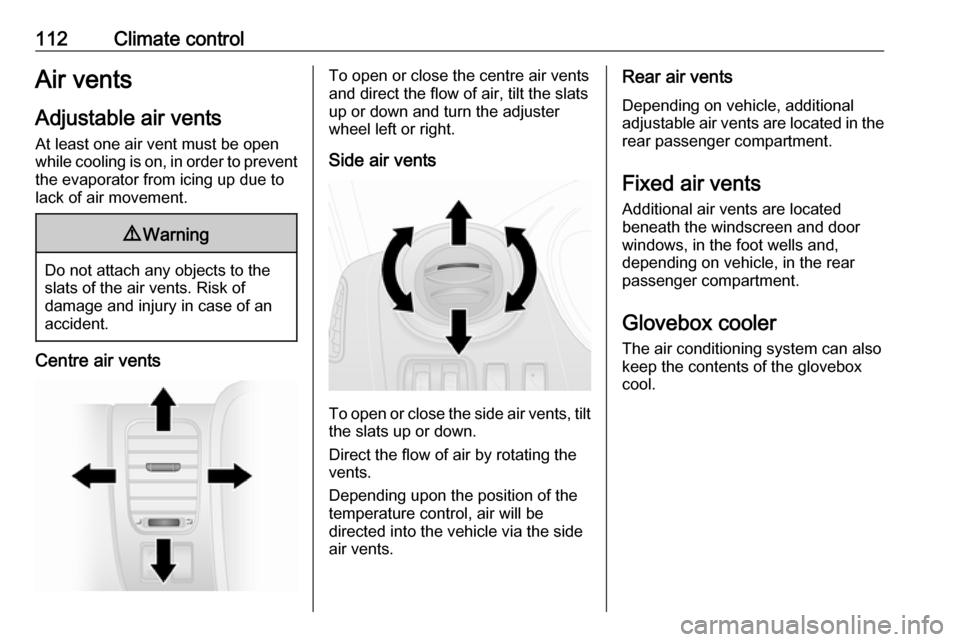
Centre air vents
To open or close the centre air vents
and direct the flow of air, tilt the slats
up or down and turn the adjuster
wheel left or right.
Side air vents
To open or close the side air vents, tilt the slats up or down.
Direct the flow of air by rotating the
vents.
Depending upon the position of the
temperature control, air will be
directed into the vehicle via the side
air vents.
Rear air vents
Depending on vehicle, additional
adjustable air vents are located in the
rear passenger compartment.
Fixed air vents Additional air vents are located
beneath the windscreen and door
windows, in the foot wells and,
depending on vehicle, in the rear
passenger compartment.
Glovebox cooler
The air conditioning system can also
keep the contents of the glovebox
cool.
Page 118 of 211

116Driving and operatingStarting and operating
New vehicle running-in
Do not brake unnecessarily hard for
the first few journeys and after new
disc brake pads have been fitted.
During the first drive, smoke may
occur because of wax and oil
evaporating off the exhaust system.
Park the vehicle in the open for a
while after the first drive and avoid
inhaling the fumes.
During the running-in period, fuel and engine oil consumption may be
higher and the cleaning process of
the diesel particle filter may take
place more often. Autostop may be
inhibited to allow for charging the
vehicle battery.
Stop-start system 3 119.
Diesel particle filter 3 122.Ignition switch positions0:Ignition off1:Steering wheel lock released,
ignition off2:Ignition on
Diesel engines: preheating3:StartingPower button
Electronic key must be inside the
vehicle, either in the card reader or
the front passenger compartment.
If the electronic key is not inside the
vehicle, a corresponding message
appears in the Driver Information
Centre (DIC) 3 90.
Notice
Do not put the electronic key in the
load compartment during driving, as
this is outside of the detection zone
(indicated by a warning chime at low
speed 3 92 and a message in the
Driver Information Centre (DIC)
3 91).
Page 119 of 211

Driving and operating117Some functions, e.g. Infotainment
system, are available for use as soon
as you enter the vehicle.
Accessory power mode
Press START/STOP without
operating clutch or brake pedal to
enable further electrical functions to
be operated.
Engine start
Operate clutch and brake pedal and press START/STOP . Release button
after starting procedure begins.
If a gear is engaged, the engine can
be started only by operating the clutch
pedal and pressing the
START/STOP button.
In some cases, it may be necessary
to move the steering wheel slightly
while pressing START/STOP to
release the steering wheel lock. A
corresponding message appears in
the DIC 3 90.
At very low outside temperatures (e.g. below -10 °C) keep the clutch pedal
depressed while pressing
START/STOP until the engine starts.If one of the starting conditions is not
applied, a corresponding message
appears in the DIC 3 90.
Vehicle messages 3 91.
Engine stop
Electronic key must be inside the
vehicle, either in the card reader or the front passenger compartment.
With the vehicle stationary, press
START/STOP to stop the engine. The
steering wheel lock is engaged when
the driver's door is opened and the
vehicle is locked.
If the electronic key is not detected, a
corresponding message appears in
the DIC 3 90. In this event, press
START/STOP for 2 seconds to stop
the engine.
Central locking system 3 23.
Retained power off
Press START/STOP for more than
two seconds; the engine is stopped
while some functions, e.g.
Infotainment system, are available for
use for approx. 10 minutes.These functions stop working when
the driver's door is opened and the vehicle is locked.
Notice
Always take the electronic key with
you when exiting the vehicle.
The electronic key being left in the
card reader is indicated by a warning chime 3 92 and a message in the
Driver Information Centre (DIC)
3 91 when the driver's door is
opened.9 Danger
Never leave an electronic key
inside the vehicle when children or animals are left in the vehicle, to
avoid unintended operation of
windows, doors or engine. Risk of
fatal injury.
Fault
If the engine cannot be started, the
cause may be one of the following:
● Fault in electronic key.
● Electronic key out of reception range.
Page 121 of 211

Driving and operating119Notice
When the fast idle function is
activated, the stop-start system is
automatically deactivated.
Stop-start system 3 119.
Vehicle shutdown
Fuel cut-off system
If the vehicle runs out of fuel, the fuel
system is cut-off and must be reset
after refuelling. A corresponding
warning message may also appear in
the Driver Information Centre (DIC)3 90.9 Danger
If you can smell fuel in the vehicle,
or a fuel leak is present, have thecause of this remedied
immediately by a workshop. Do
not reset the fuel cut-off system, to avoid the risk of fire.
Resetting with remote control
key / manual key
To reset the fuel cut-off system and
enable the vehicle to be driven:
1. Turn the ignition key to position 2
3 116.
2. Wait a few minutes to allow the fuel system to be reset.
3. Turn key to position 3 to start the
engine.
If the engine does not start, repeat the
procedure.
Resetting with electronic key
system
To reset the fuel cut-off system and
enable the vehicle to be driven:
1. Insert the electronic key in the card reader 3 116.
2. Press START/STOP without
depressing any pedals.
3. Wait a few minutes to allow the fuel system to be reset.
If the engine does not start, repeat the procedure.
Electronic key system 3 22.Power button 3 116.
Refuelling 3 141.
Overrun cut-off The fuel supply is automatically cut off
during overrun, i.e. when the vehicle
is driven with a gear engaged but
accelerator is released.
Stop-start system The stop-start system helps to save
fuel and to reduce the exhaust
emissions. When conditions allow, it
switches off the engine as soon as the
vehicle is at a low speed or at a
standstill, e.g. at a traffic light or in a
traffic jam. It restarts the engine
automatically as soon as the clutch
pedal is depressed.
A vehicle battery sensor ensures that
an Autostop is only performed if the
vehicle battery is sufficiently charged
for a restart.
Page 123 of 211

Driving and operating121Conditions for an Autostop
The stop-start system checks if each
of the following conditions is fulfilled:
● the stop-start system is not manually deactivated
● the bonnet is fully closed
● the vehicle battery is sufficiently charged and in good condition
● the engine is warmed-up
● the engine coolant temperature is
not too high
● the outside temperature is not too
low or too high (e.g. below 0 °C
or above 35 °C)
● the brake vacuum is sufficient
● the defrosting function is not activated 3 105
● the self-cleaning function of the diesel particle filter is not active
3 122
● the Antilock brake system (ABS) 3 129, Traction Control system
(TC) 3 130 and ElectronicStability Program (ESP® Plus
)
3 131 ride control systems are
not actively engaged
● the vehicle has moved since the last Autostop
Otherwise an Autostop will be
inhibited.
Certain settings of the climate control
system may inhibit an Autostop. See
" Climate control " chapter for further
information 3 105
Restart of the engine by the driver
Depress the clutch pedal to restart the
engine.
Notice
If any gear is selected, the clutch pedal must be fully depressed to
restart the engine.
Control indicator Ï 3 89 extinguishes
in the instrument cluster when the engine is restarted.
Restart of the engine by the stop- start system
The selector lever must be in neutral
to enable an automatic restart.If one of the following conditions occurs during an Autostop, the
engine will be restarted automatically by the stop-start system:
● the stop-start system is manually
deactivated
● the bonnet is opened
● the vehicle battery is discharged
● the engine temperature is too low
● the brake vacuum is not sufficient
● the vehicle starts to move
● the defrosting function is activated 3 105
If an electrical accessory, e.g. a
portable CD player, is connected to
the power outlet, a brief power drop
during engine restart may be
noticeable.
Fault
If a fault occurs in the stop-start
system, the LED in Î illuminates,
and a corresponding message
appears in the DIC 3 90. Seek the
assistance of a workshop.
Vehicle messages 3 91.
Warning chimes 3 92.
Page 124 of 211
122Driving and operatingParking9Warning
● Do not park the vehicle on an
easily ignitable surface. The
high temperature of the
exhaust system could ignite the
surface.
● Always apply parking brake without pressing release
button. Apply as firmly as
possible on a downhill slope or
uphill slope. Depress foot brake at the same time to reduce
operating force.
● Switch off the engine.
● If the vehicle is on a level surface or uphill slope, engage
first gear. On an uphill slope,
turn the front wheels away from
the kerb.
If the vehicle is on a downhill
slope, engage reverse gear.
Turn the front wheels towards the kerb.
● Lock the vehicle 3 23
● Activate the anti-theft locking system 3 33 and anti-theft alarm
system 3 35.Engine exhaust9 Danger
Engine exhaust gases contain
poisonous carbon monoxide,
which is colourless and odourless and could be fatal if inhaled.
If exhaust gases enter the interior
of the vehicle, open the windows.
Have the cause of the fault
rectified by a workshop.
Avoid driving with an open load
compartment, otherwise exhaust
gases could enter the vehicle.
Diesel particle filter
The diesel particle filter system filters
harmful soot particles out of the
exhaust gases. The system includes
a self-cleaning function that runs
automatically during driving without
any notification.
The filter is cleaned by periodically
burning off the soot particles at high
temperature. This process takes
place automatically under set driving
Page 126 of 211
124Driving and operating9Warning
Avoid contact of your eyes or skin
with AdBlue.
In case of eye or skin contact,
rinse off with water.
Caution
Avoid contact of the paintwork with AdBlue.
In case of contact, rinse off with water.
AdBlue freezes at a temperature of
approx. -11 °C. As the vehicle is
equipped with an AdBlue pre-heater,
the emissions reduction at low
temperatures is ensured. The AdBlue
pre-heater works automatically.
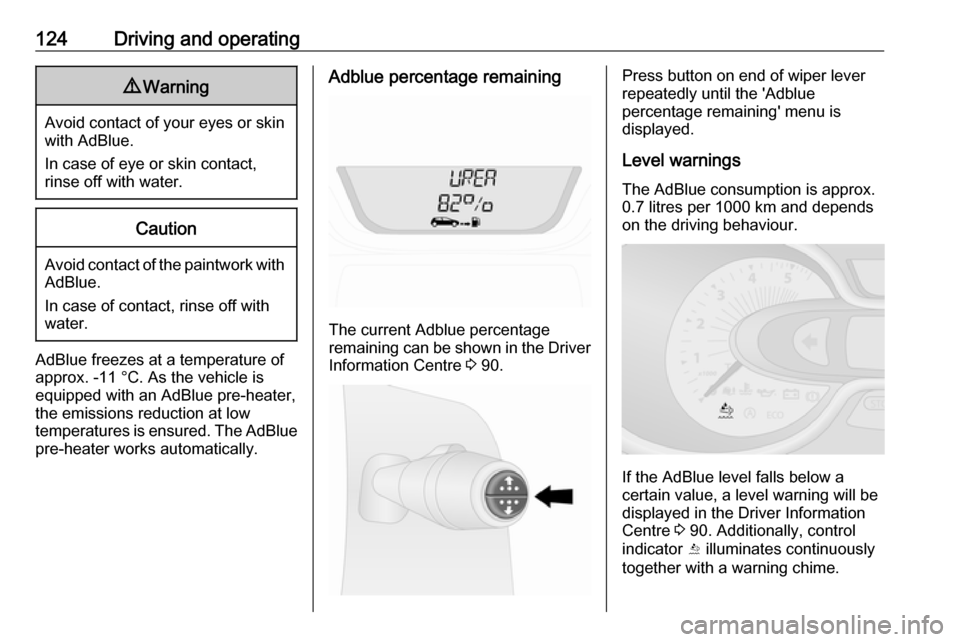
Adblue percentage remaining
The current Adblue percentage
remaining can be shown in the Driver
Information Centre 3 90.
Press button on end of wiper lever
repeatedly until the 'Adblue
percentage remaining' menu is
displayed.
Level warnings
The AdBlue consumption is approx.
0.7 litres per 1000 km and depends on the driving behaviour.
If the AdBlue level falls below a
certain value, a level warning will be
displayed in the Driver Information
Centre 3 90. Additionally, control
indicator Y illuminates continuously
together with a warning chime.
Page 127 of 211

Driving and operating125Refill the Adblue tank as soon as
possible. Refer to " Refilling AdBlue"
below.
Driving is possible without any
restrictions.
If AdBlue is not refilled within a certain
distance, further level warnings are
displayed in the Driver Information
Centre depending on the current
AdBlue level.
Engine restarts prevented
Subsequent requests to refill AdBlue
and finally the announcement that an engine restart will be prevented are
displayed in the Driver Information
Centre.
Notice
These restrictions are a legal
requirement.
Before the prevention of an engine
restart, a warning message with
0 miles is displayed in the Driver
Information Centre, indicating that
after switching off the ignition an
engine restart will be prohibited.After the prevention of an engine
start, a warning message is displayed in the Driver Information Centre
reminding the driver that AdBlue level
is insufficient.
To allow the engine to be restarted,
the tank should be filled with at least
10 litres of AdBlue.
High emission warnings
If the exhaust emission rises above a certain value, warnings similar to the
range warnings as described above
will be displayed in the Driver
Information Centre. Control indicator
Y illuminates continuously together
with F and a warning chime.
Requests to have the exhaust system
checked and finally the
announcement that an engine restart
with be prevented are displayed in the Driver Information Centre.
Notice
These restrictions are a legal
requirement.
At an AdBlue range of approx.
680 miles, a warning message is
displayed in the Driver InformationCentre showing the remaining
distance the vehicle can travel before engine restarts are prevented. This
warning message is repeated approx.
every 60 miles.
Seek the assistance of a workshop as
soon as possible.
Refilling AdBlueCaution
Only use AdBlue that complies
with European standards
DIN 70 070 and ISO 22241-1.
Do not use additives.
Page 129 of 211

Driving and operating127AdBlue canisterNotice
Only use the designated AdBlue
canisters for refilling, to prevent a
topping-up of too much AdBlue.
Additionally, the fumes in the tank
are captured in the canister and do
not emerge.
Notice
Since AdBlue has a limited
durability, check the date of expiry
before refilling.
1. Switch off engine and remove key
from ignition switch.
2. Pull fuel filler flap to open.3. Unscrew protective cap anticlockwise from the filler neck.
4. Open AdBlue canister.
5. Mount one end of the hose on the
canister and screw the other end
on the filler neck.
6. Lift the canister until it is empty.
7. Unscrew the hose from the filler neck.
8. Mount the protective cap and turn
clockwise until it engages.
9. Close fuel filler flap and left-hand door.
Notice
Dispose of AdBlue canister and
hose according to environmental requirements.
Notice
Let the vehicle idle for 10 seconds to
allow the system to detect the
AdBlue refill.
Failure to observe this procedure will result in the system only recognising
the AdBlue refill after 20 minutes of
driving.If the AdBlue refill is detected
successfully, AdBlue level warnings
will disappear.
If the AdBlue refill is not detected
some time after running the engine,
seek the assistance of a workshop.
Filler cap
Only use genuine filler caps. Adblue
tank has a special filler cap.
Fault
If the system detects an operating fault, control indicator Y illuminates
together with F and a warning chime.
Seek the assistance of a workshop
immediately.
A corresponding message appears in the Driver Information Centre 3 90.