ECU VAUXHALL VIVARO 2016 User Guide
[x] Cancel search | Manufacturer: VAUXHALL, Model Year: 2016, Model line: VIVARO, Model: VAUXHALL VIVARO 2016Pages: 209, PDF Size: 4.86 MB
Page 60 of 209

58Seats, restraintsAirbag label 3 52.
Selecting the right system The rear seats are the most
convenient location to fasten a child
restraint system.
Children should travel facing
rearwards in the vehicle as long as
possible. This makes sure that the child's backbone, which is still very
weak, is under less strain in the event
of an accident.
Suitable are restraint systems that
comply with valid UN ECE
regulations. Check local laws and
regulations for mandatory use of child restraint systems.
Ensure that the child restraint system to be installed is compatible with the
vehicle type.
Ensure that the mounting location of
the child restraint system within the
vehicle is correct, see following
tables.
Allow children to enter and exit the
vehicle only on the side facing away
from the traffic.When the child restraint system is not in use, secure the seat with a seat beltor remove it from the vehicle.
Notice
Do not affix anything on the child
restraint systems and do not cover
them with any other materials.
A child restraint system which has
been subjected to stress in an
accident must be replaced.
Page 68 of 209

66StorageCupholders
Cupholders are located at both ends
of the instrument panel, centrally in the lower instrument panel and in the
rear seat area.
Additional cupholders are located on
the back of the folded down centre
rear seat 3 66, 3 45.
The cupholders can also be used to hold the portable ashtray unit 3 78.
Remove the portable ashtray unit to
use the cupholders.
Front storage
Coat hooks are located on the cabin
bulkhead and on the grab handles in
the roof lining.
The front door pockets contain bottle
holders.
Folding centre seatback
The centre seat backrest, when
folded fully forwards, features a
storage compartment, cupholder and
a document tray.
Press button (arrowed) on rear side of
backrest to unlock the document tray
and access the storage
compartments.
To install the document tray, insert
the end piece(s) into any of the slots
by the cupholder.
The document tray must always be
returned to its original position before
raising the seat backrest.
Page 69 of 209
Storage67
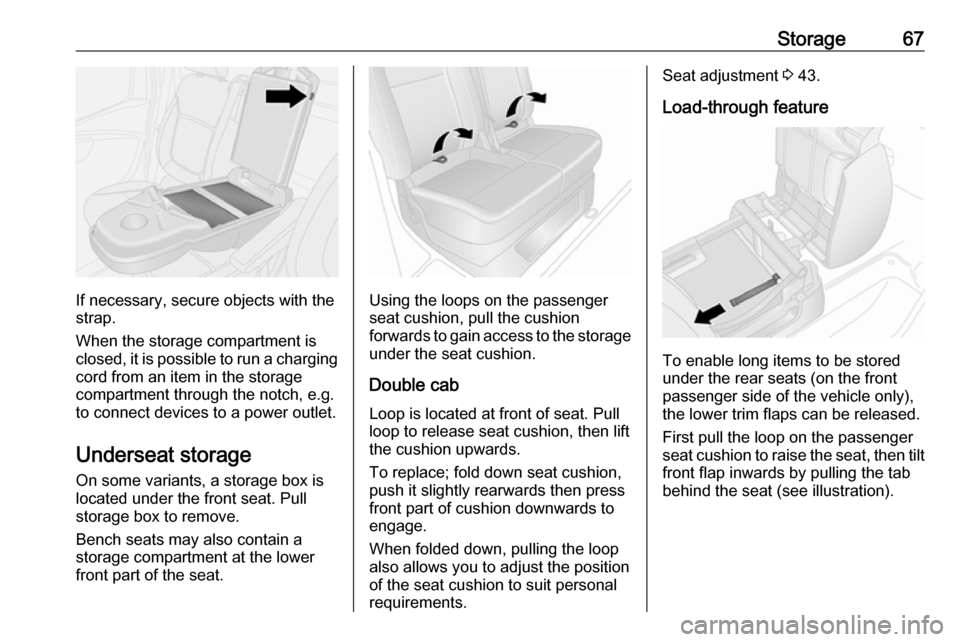
If necessary, secure objects with the
strap.
When the storage compartment is
closed, it is possible to run a charging cord from an item in the storage
compartment through the notch, e.g.
to connect devices to a power outlet.
Underseat storage
On some variants, a storage box is located under the front seat. Pull
storage box to remove.
Bench seats may also contain a
storage compartment at the lower
front part of the seat.Using the loops on the passenger
seat cushion, pull the cushion
forwards to gain access to the storage
under the seat cushion.
Double cab
Loop is located at front of seat. Pull
loop to release seat cushion, then lift
the cushion upwards.
To replace; fold down seat cushion,
push it slightly rearwards then press
front part of cushion downwards to
engage.
When folded down, pulling the loop also allows you to adjust the positionof the seat cushion to suit personal
requirements.
Seat adjustment 3 43.
Load-through feature
To enable long items to be stored
under the rear seats (on the front
passenger side of the vehicle only),
the lower trim flaps can be released.
First pull the loop on the passenger
seat cushion to raise the seat, then tilt front flap inwards by pulling the tab
behind the seat (see illustration).
Page 70 of 209

68Storage
Fold up the rear flap by hand; it is
retained in the open position by
magnets.
9 Warning
Passengers must not use the seat
when transporting objects
beneath it with the lower trim flaps
opened.
Overcab storage
The total weight in this compartment
must not exceed 35 kg.
Load compartment
Load compartment cover
Rear parcel shelf Do not place any excessively heavy
or sharp-edged objects on the rear
parcel shelf.
The maximum load permissible is
50 kg.9 Warning
Always make sure that the load in
the vehicle is securely stowed.
Otherwise objects can be thrown
around inside the vehicle and
cause personal injury or damage
to the load or car.
Page 71 of 209

Storage69
The rear parcel shelf can be installed
in 2 positions, i.e. the upper position
or the lower position.
The rear parcel shelf may also be
folded up, allowing for greater
flexibility in the load compartment.
Removing
To remove, release parcel shelf from
its retainers on both sides.
If the rear seats 3 45 are in the folded
position, remove the parcel shelf and
store it horizontally in front of the
folded rear seats.
Installing
Refit the parcel shelf by engaging in
the retainers on both sides.
Lashing eyes
Lashing eyes are mounted in the load
compartment to enable cargo to be secured against slippage using
lashing straps or a luggage floor net.
Lashing eyes may be located on the
vehicle floor and/or in the sidewall.
The number and location of the
lashing eyes may vary depending on
the vehicle.
The maximum force applied to the
lashing eyes should not exceed
6250 N at 30°.
Safety net The safety net can be installed behind
the front seats or the rear seats.
Passengers must not be transported
behind the safety net.
Page 72 of 209

70StorageInstalling
Release the covers in the roof lining
(using a flat blade screwdriver) to
access the mountings, then insert the
load compartment net rods into the
left and right mounting locations and secure.
Attach the straps to the lashing eyes
or rings behind the seats, then
tension the straps.
Removal Release tension from straps and
unhook straps from lashing eyes or
rings. Remove net rods from their
mounting locations and close the
covers.
Warning triangle
The warning triangle can be
accommodated in the space under
the seats.
Underseat storage 3 67.
First aid kit
The first aid kit can be accommodated
in the space under the seats.
Underseat storage 3 67.
Page 73 of 209

Storage71Roof rack system
Roof rack For safety reasons and to avoiddamage to the roof, the vehicle
approved roof rack system is
recommended. For further
information, contact your workshop.
Follow the installation instructions
and remove the roof rack when not in
use.
Notice
If tyres of size 215/60 R17 C are
fitted, consult a workshop before
installing a roof rack.
Refer to "Loading information" below
for further information.Loading information
● Heavy objects in the load compartment should be evenly
distributed and placed as far
forward as possible. If objects
can be stacked, the heavier
objects should be placed at the
bottom.
● Secure objects with lashing straps attached to lashing eyes
3 69.
● Secure loose objects in load compartment to prevent sliding.
● When transporting objects in the load compartment, the backrests
of the rear seats must not be
angled forward.
● Do not allow the load to protrude above the upper edge of the
backrests.
● Do not place any objects on the instrument panel.
● The load must not obstruct the operation of the pedals, parking
brake and gear selector, orhinder the freedom of movement
of the driver. Do not place any
unsecured objects in the interior.
● Do not drive with an open load compartment. In addition, the
number plate is only
distinguishable and illuminated
correctly if the doors are closed.9 Warning
Always make sure that the load in
the vehicle is securely stowed.
Otherwise objects can be thrown
around inside the vehicle and
cause personal injury or damage
to the load or car.
● The payload is the difference between the permitted gross
vehicle weight (see identification
plate 3 184) and the EC kerb
weight.
To calculate the payload, enter
the data for your vehicle in the
Weights table at the front of this
manual.
The EC kerb weight includes
weights for the driver (68 kg),
Page 74 of 209

72Storageluggage (7 kg) and all fluids (tank
90% full).
Optional equipment and
accessories increase the kerb
weight.
● Driving with a roof load increases
the sensitivity of the vehicle to
cross-winds and has a
detrimental effect on vehicle
handling due to the vehicle's
higher centre of gravity.
Distribute the load evenly and secure it properly with retaining
straps. Adjust the tyre pressure
and vehicle speed according to
the load conditions. Check and
retighten the straps frequently.
Do not drive faster than 75 mph.
The permissible roof load is
200 kg for H1 Roof height
variants and 150 kg for H2 Roof
height variants (excludes
Platform cab conversions). The
roof load is the combined weight
of the roof rack and the load.
Page 82 of 209
80Instruments and controlsFuel gauge
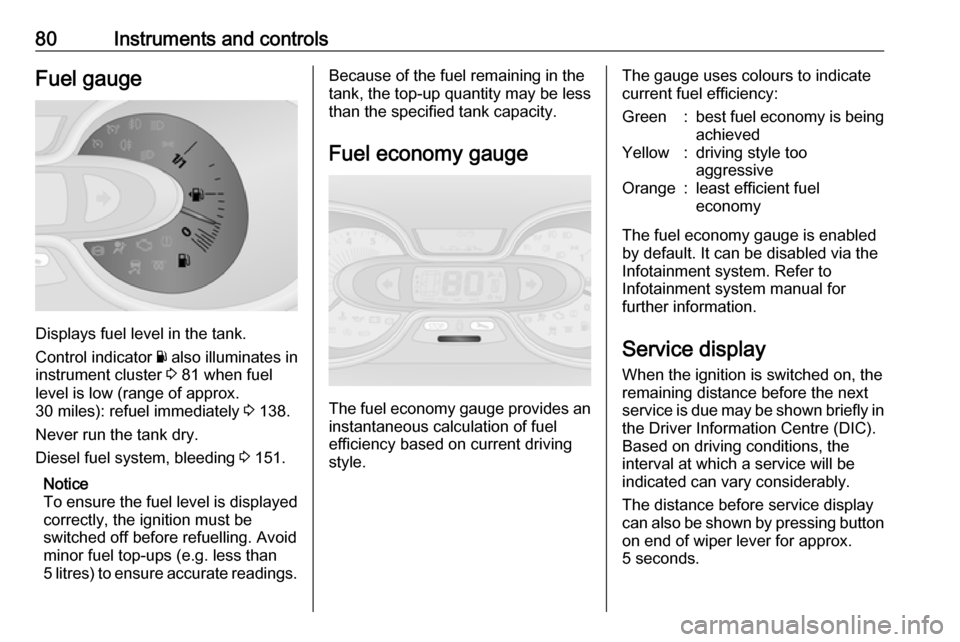
Displays fuel level in the tank.
Control indicator Y also illuminates in
instrument cluster 3 81 when fuel
level is low (range of approx.
30 miles): refuel immediately 3 138.
Never run the tank dry.
Diesel fuel system, bleeding 3 151.
Notice
To ensure the fuel level is displayed
correctly, the ignition must be
switched off before refuelling. Avoid
minor fuel top-ups (e.g. less than
5 litres) to ensure accurate readings.
Because of the fuel remaining in the
tank, the top-up quantity may be less
than the specified tank capacity.
Fuel economy gauge
The fuel economy gauge provides an
instantaneous calculation of fuel
efficiency based on current driving style.
The gauge uses colours to indicatecurrent fuel efficiency:Green:best fuel economy is being achievedYellow:driving style too
aggressiveOrange:least efficient fuel
economy
The fuel economy gauge is enabled
by default. It can be disabled via the
Infotainment system. Refer to
Infotainment system manual for
further information.
Service display When the ignition is switched on, theremaining distance before the next
service is due may be shown briefly in
the Driver Information Centre (DIC).
Based on driving conditions, the
interval at which a service will be
indicated can vary considerably.
The distance before service display
can also be shown by pressing button on end of wiper lever for approx.
5 seconds.
Page 109 of 209

Climate control107Remote control
The control buttons operate
identically to the timer unit described
previously.
To activate the remote control, press X and release it when the menu bar
appears in the display. The signal
indicator and SENd appear briefly in
the display, followed by the
temperature.
9 Warning
When refuelling, switch off the
remote control unit as well as the
heater!
To switch off, press and hold X to
prevent inadvertent operation.
The remote control has a maximum
range of 600 metres. The range may
be reduced due to environmental
conditions and as the battery
becomes weaker.
In addition to the remote control unit,
the heating can also be switched on
for 30 minutes, or off, using the
button.
Battery replacement
Replace the battery when the range
of the remote control is reduced or
when the battery charge symbol
flashes.
Open the cover using a coin and
replace the battery (CR 2430 or
equivalent), ensuring the new battery
is correctly installed with the positive
( < ) side facing the positive terminals.
Replace the cover securely.
Dispose of old batteries in
accordance with environmental
regulations.
Batteries do not belong in household
waste. They must be disposed of at
an appropriate recycling collection
point.
Remote control fault displays
cobA:Poor signal –
adjust positionconP:No signal – move closerbALo:Battery low –
change battery