lights VAUXHALL VIVARO 2016 Owner's Guide
[x] Cancel search | Manufacturer: VAUXHALL, Model Year: 2016, Model line: VIVARO, Model: VAUXHALL VIVARO 2016Pages: 209, PDF Size: 4.86 MB
Page 154 of 209
152Vehicle careIf the engine fails to start, seek the
assistance of a workshop.
Starting the engine 3 116.
Wiper blade replacement
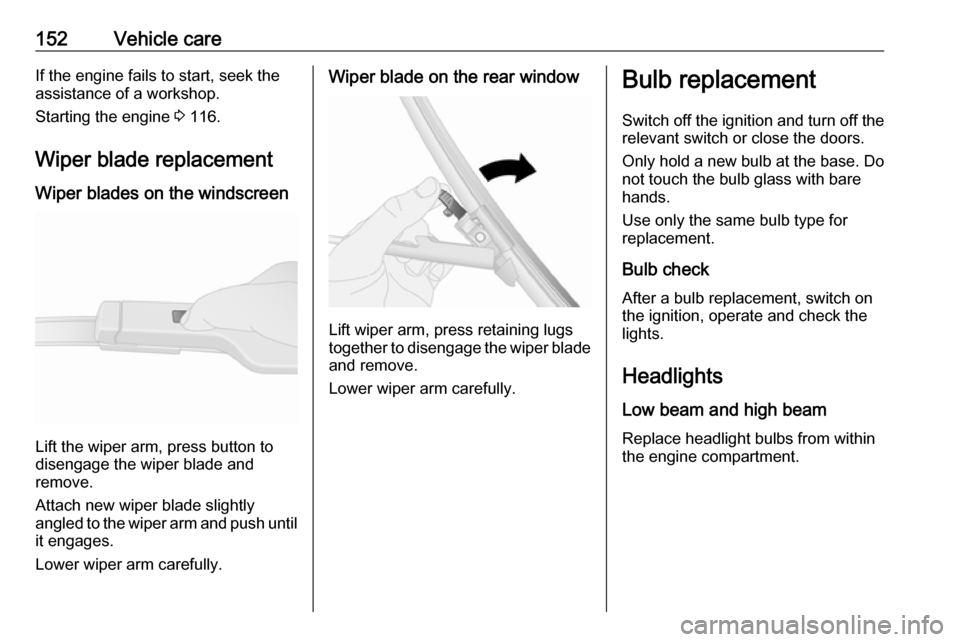
Wiper blades on the windscreen
Lift the wiper arm, press button to
disengage the wiper blade and
remove.
Attach new wiper blade slightly
angled to the wiper arm and push until
it engages.
Lower wiper arm carefully.
Wiper blade on the rear window
Lift wiper arm, press retaining lugs
together to disengage the wiper blade
and remove.
Lower wiper arm carefully.
Bulb replacement
Switch off the ignition and turn off the relevant switch or close the doors.
Only hold a new bulb at the base. Do
not touch the bulb glass with bare
hands.
Use only the same bulb type for
replacement.
Bulb check After a bulb replacement, switch on
the ignition, operate and check the
lights.
Headlights
Low beam and high beam
Replace headlight bulbs from within
the engine compartment.
Page 155 of 209
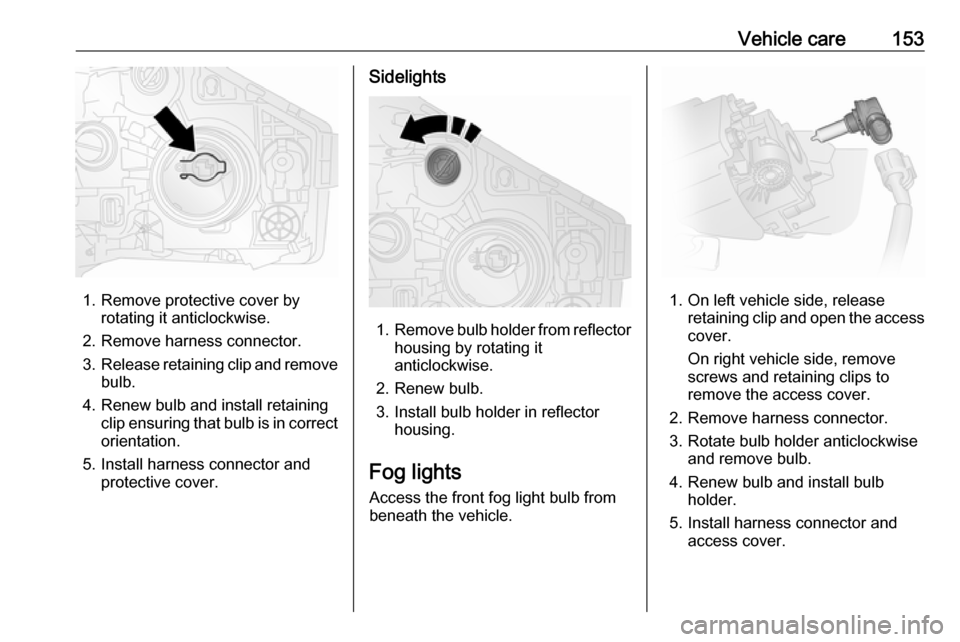
Vehicle care153
1. Remove protective cover byrotating it anticlockwise.
2. Remove harness connector.
3. Release retaining clip and remove
bulb.
4. Renew bulb and install retaining clip ensuring that bulb is in correctorientation.
5. Install harness connector and protective cover.
Sidelights
1.Remove bulb holder from reflector
housing by rotating it
anticlockwise.
2. Renew bulb.
3. Install bulb holder in reflector housing.
Fog lights
Access the front fog light bulb from
beneath the vehicle.
1. On left vehicle side, release retaining clip and open the accesscover.
On right vehicle side, remove
screws and retaining clips to
remove the access cover.
2. Remove harness connector.
3. Rotate bulb holder anticlockwise and remove bulb.
4. Renew bulb and install bulb holder.
5. Install harness connector and access cover.
Page 156 of 209

154Vehicle careFront turn signal lights
1.Remove bulb holder from reflector
housing by rotating anticlockwise.
2. Renew bulb.
3. Install bulb holder in reflector housing.
Tail lights
Rear brake, turn signal and tail
lights
1. Remove the 3 screws (using the tool supplied).
2. Carefully pull lamp assembly from
retaining pins on the outer side
and remove.
3. Rotate bulb holder anticlockwise to separate from lamp assembly.
4. Renew bulb.
5. Push to install the bulb holder into
the lamp assembly, then rotate
clockwise to secure.
6. Check that the wiring harness is located correctly.
7. Replace lamp assembly into original position, ensuring that it isseated correctly.
8. Fit lamp assembly onto retaining pins and replace the 3 screws.
Page 157 of 209

Vehicle care155Side turn signal lights
1. Release lamp assembly fromwing by depressing clips using a
suitable tool and lift out lamp
assembly from aperture.
2. Remove bulb holder from lamp assembly by rotating
anticlockwise and renew bulb.
3. Install bulb holder in lamp assembly and install lamp
assembly into aperture.
Centre high-mounted brake light
1. Open the rear doors/tailgate.
2. Remove the 2 bolts from inside the rear doors/tailgate.
3. From outside the vehicle, remove the bulb holder by releasing the
clips with a flat blade screwdriver.
4. Renew bulb.
5. Install bulb holder and replace the
2 bolts.
Reversing light
1. Remove the 2 screws (using the tool supplied) and remove lamp
assembly.
2. Rotate bulb housing anticlockwise
to separate from lamp assembly.
3. Renew lower bulb.
Page 158 of 209

156Vehicle care4.Push to install the bulb holder into
the lamp assembly, then rotate
clockwise to secure.
5. Install lamp assembly with the 2 screws.
Number plate light
1. Prise out lamp using a flat blade screwdriver.
2. Prise off lens.
3. Renew bulb.
4. Install lens and replace lamp in housing.
Fog tail light
1. Remove the 2 screws (using thetool supplied) and remove lamp
assembly.
2. Rotate bulb housing anticlockwise
to separate from lamp assembly.
3. Renew upper bulb.
4. Push to install the bulb holder into
the lamp assembly, then rotate
clockwise to secure.
5. Install lamp assembly with the 2 screws.
Interior lights
Front and rear courtesy lights
1. Release lens assembly from the clips and the locator using a flat
blade screwdriver.
2. Renew bulb.
3. Install lens assembly.
Page 163 of 209

Vehicle care161No.Circuit1Adblue injection battery2Vehicle battery (with electronic
key system)3APC battery backup (with elec‐
tronic key system)4Heating and ventilation system5Adaptations6Adaptations7Heating and ventilation system8Additional heating and ventila‐
tion / air conditioning system9Supplementary heating and
ventilation system10Electric exterior mirrors / addi‐
tional adaptations11Heated exterior mirrors12Radio / multimedia / electric
exterior mirrors / diagnostic
socket13Multimedia / trailer hitchNo.Circuit14Courtesy lights / battery
discharge protection15Fuel injection system / tyre pres‐ sure monitoring system / elec‐
tronic key system16Hazard warning flashers / turn
and lane-change signals17Central locking18Left-hand high beam / right-
hand low beam / tail lights / left- hand daytime running light19Front fog lights / rear fog lights /
number plate lighting20Alarm / horn / lighting / wiper21Instrument cluster22Light switch23Rear window wiper / wind‐
screen washer pump / horn24APC general battery25Reversing lightsNo.Circuit26Brake switch27Fuel injection / starter28Airbag / steering column lock29Passenger power window30Power steering31Brake lights32APC battery backup (with elec‐
tronic key system)33Service display34Cigarette lighter / power outlet35Right-hand high beam / left-
hand low beam / sidelights /
right-hand daytime running light36Brake lights / ABS / immobiliser37Interior lighting / air conditioning38Starting with electronic key
system39Rear window wiper40Warning chimes
Page 177 of 209
Vehicle care175
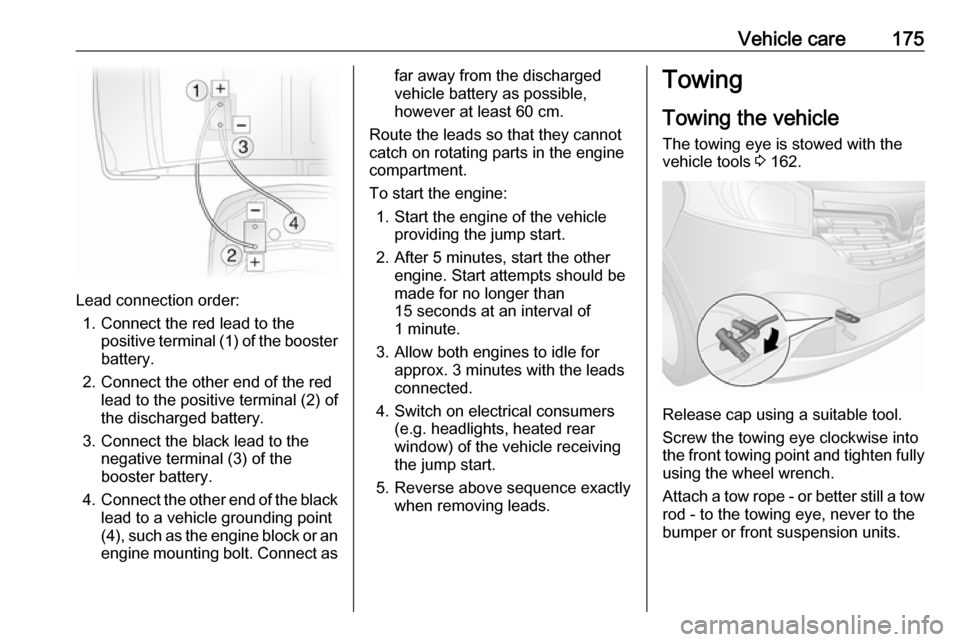
Lead connection order:1. Connect the red lead to the positive terminal (1) of the booster
battery.
2. Connect the other end of the red lead to the positive terminal (2) of
the discharged battery.
3. Connect the black lead to the negative terminal (3) of the
booster battery.
4. Connect the other end of the black
lead to a vehicle grounding point
(4), such as the engine block or an
engine mounting bolt. Connect as
far away from the discharged
vehicle battery as possible,
however at least 60 cm.
Route the leads so that they cannot
catch on rotating parts in the engine
compartment.
To start the engine: 1. Start the engine of the vehicle providing the jump start.
2. After 5 minutes, start the other engine. Start attempts should be
made for no longer than
15 seconds at an interval of
1 minute.
3. Allow both engines to idle for approx. 3 minutes with the leads
connected.
4. Switch on electrical consumers (e.g. headlights, heated rear
window) of the vehicle receiving
the jump start.
5. Reverse above sequence exactly when removing leads.Towing
Towing the vehicle The towing eye is stowed with thevehicle tools 3 162.
Release cap using a suitable tool.
Screw the towing eye clockwise into
the front towing point and tighten fully
using the wheel wrench.
Attach a tow rope - or better still a tow rod - to the towing eye, never to the
bumper or front suspension units.
Page 178 of 209
176Vehicle careCaution
Do not tow the vehicle from the
rear. The front towing eye must
only be used for towing and not
recovering a vehicle.
Caution
Activate the child locks in the rear
doors if the rear seats are
occupied. Child locks 3 28.
Switch on ignition to permit operation
of brake lights, horn and windscreen
wipers, and move the steering wheel
slightly to release the steering wheel
lock.
Transmission in neutral.
Caution
Drive slowly. Do not drive jerkily.
Excessive tractive force can
damage the vehicle.
When the engine is not running,
considerably more force is needed to
brake and steer.
To prevent the entry of exhaust fumes
from the towing vehicle, switch on the air recirculation system 3 102 and
close the windows.
Seek the assistance of a workshop.
After towing, unscrew the towing eye
and replace cap.
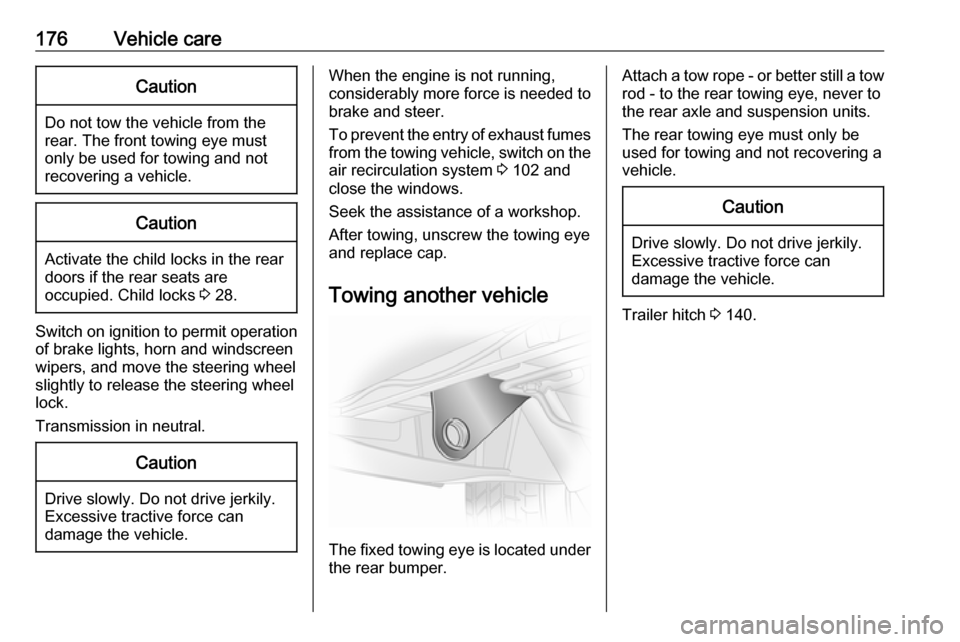
Towing another vehicle
The fixed towing eye is located under the rear bumper.
Attach a tow rope - or better still a tow
rod - to the rear towing eye, never to
the rear axle and suspension units.
The rear towing eye must only be
used for towing and not recovering a
vehicle.Caution
Drive slowly. Do not drive jerkily.
Excessive tractive force can
damage the vehicle.
Trailer hitch 3 140.
Page 179 of 209

Vehicle care177Appearance care
Exterior care LocksThe locks are lubricated at the factoryusing a high quality lock cylinder
grease. Use de-icing agent only when
absolutely necessary, as this has a
degreasing effect and impairs lock
function. After using a de-icing agent,
have the locks regreased by a
workshop.
WashingThe paintwork of your vehicle is
exposed to environmental influences.
Wash and wax your vehicle regularly.
When using automatic vehicle
washes, select a programme that
includes waxing. Restrictions for
filmed or matt painted body parts or decor tapes, see "Polishing and
waxing".
Bird droppings, dead insects, resin,
pollen and the like should be cleaned
off immediately, as they contain
aggressive constituents which can cause paint damage.If using a vehicle wash, comply with
the vehicle wash manufacturer's
instructions. The windscreen wipers
and rear window wiper must be
switched off and the exterior mirrors
must be folded in. Remove antenna
and external accessories such as roof racks etc.
If you wash your vehicle by hand,
make sure that the insides of the
wheel housings are also thoroughly
rinsed out.
Clean edges and folds on opened
doors and the bonnet as well as the
areas they cover.Caution
Always use a cleaning agent with
a pH value of 4 to 9.
Do not use cleaning agents on hot surfaces.
Have the door hinges of all doors
greased by a workshop.
Do not clean the engine compartment with a steam-jet or high-pressure jet
cleaner.
Thoroughly rinse and leather-off the vehicle. Rinse leather frequently. Use
separate leathers for painted and
glass surfaces: remnants of wax on
the windows will impair vision.
Exterior lights
Headlight and other light covers are
made of plastic. Do not use any
abrasive or caustic agents, do not use
an ice scraper, and do not clean them
dry.
Polishing and waxing
Wax the vehicle regularly (at the
latest when water no longer beads).
Otherwise, the paintwork will dry out.
Polishing is necessary only if the paint
has become dull or if solid deposits
have become attached to it.
Paintwork polish with silicone forms a protective film, making waxing
unnecessary.
Unpainted plastic body parts must not
be treated with wax or polishing
agents.
Page 203 of 209

201Charging system .......................... 84
Child locks ................................... 28
Child restraint installation locations ................................... 59
Child restraints.............................. 57
Child restraint systems ................57
Cigarette lighter ........................... 78
Cleaning the vehicle ...................177
Climate control ............................. 15
Climate control systems .............101
Clock ............................................ 76
Coat hooks ................................... 66
Coin holder ................................... 65
Control indicators.......................... 81
Control of the vehicle .................113
Controls ........................................ 74
Controls in steering wheel ............74
Convex shape .............................. 36
Coolant ....................................... 147
Coolant and antifreeze ...............181
Coolant heater ............................ 106
Cooling (AC) ............................... 102
Cornering light .............................. 97
Cruise control ...................... 88, 131
Cupholders .................................. 66
Curtain airbag system .................. 56
D Danger, Warnings and Cautions ...4
Dashboard .................................... 10Daytime running lights............95, 97
Declaration of conformity ............197
DEF ............................................ 121
Demisting and defrosting ..............15
Diesel exhaust fluid ....................121
Diesel fuel filter .......................... 150
Diesel fuel system bleeding .......151
Diesel particle filter ....................120
Directional tyres ..................163, 172
Distance to service .......................80
Document tray .............................. 66
Door locks..................................... 23
Door open .................................... 89
Doors ............................................ 29
Double cab ................................... 67
DPF (diesel particle filter) ...........120
Driver assistance systems ..........131
Driver Information Centre .............89
Driving characteristics and towing tips .............................. 140
Driving economically................... 112
Driving hints ................................ 112
E ECO mode .................................. 112
ecoScoring.................................... 91
Electric adjustment ......................36
Electrical accessories ...................77
Electrical system......................... 157
Electronic climate control system 103Electronic data recording..............38
Electronic key system ...................22
Electronic Stability Program 86,
129, 141
Electronic Stability Program off ...86
End-of-life vehicle recovery .......144
Engine air filter............................ 146
Engine air flow indicator .............146
Engine coolant ........................... 147
Engine coolant temperature ........86
Engine data ............................... 186
Engine exhaust .......................... 120
Engine identification ...................184
Engine oil ...........145, 181, 185, 195
Engine oil additives ....................181
Engine oil level ............................ 91
Engine oil pressure ......................87
Engine oil viscosity grades .........181
Enhanced Traction function 128, 129
Entry lighting .............................. 100
Event data recorders ..................199
Exhaust gases ....................120, 175
Exit lighting ................................ 100
Exterior care .............................. 177
Exterior light ................................. 88
Exterior lighting ......................12, 95
Exterior mirrors ............................. 36