Oil VAUXHALL VIVARO 2016 Owner's Manual
[x] Cancel search | Manufacturer: VAUXHALL, Model Year: 2016, Model line: VIVARO, Model: VAUXHALL VIVARO 2016Pages: 209, PDF Size: 4.86 MB
Page 19 of 209
In brief17Starting offCheck before starting off ● Tyre pressure and condition 3 163, 3 196.
● Engine oil level and fluid levels 3 145.
● All windows, mirrors, exterior lighting and number plates are
free from dirt, snow and ice and
are operational.
● Proper position of mirrors, seats and seat belts 3 36, 3 42,
3 49.
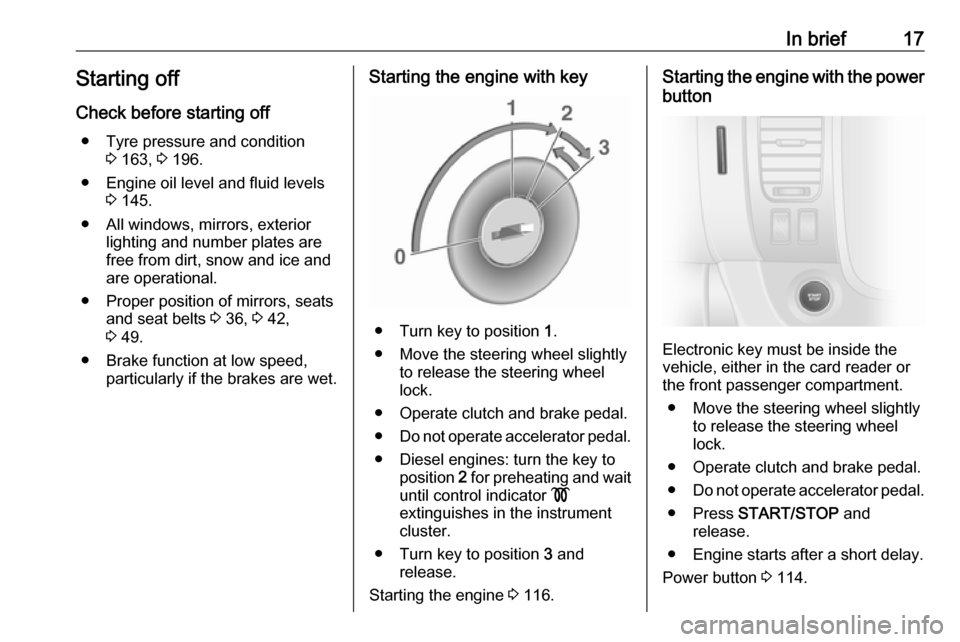
● Brake function at low speed, particularly if the brakes are wet.Starting the engine with key
● Turn key to position 1.
● Move the steering wheel slightly to release the steering wheel
lock.
● Operate clutch and brake pedal. ● Do not operate accelerator pedal.
● Diesel engines: turn the key to position 2 for preheating and wait
until control indicator !
extinguishes in the instrument
cluster.
● Turn key to position 3 and
release.
Starting the engine 3 116.
Starting the engine with the power
button
Electronic key must be inside the
vehicle, either in the card reader or
the front passenger compartment.
● Move the steering wheel slightly to release the steering wheel
lock.
● Operate clutch and brake pedal.
● Do not operate accelerator pedal.
● Press START/STOP and
release.
● Engine starts after a short delay.
Power button 3 114.
Page 75 of 209

Instruments and controls73Instruments and
controlsControls ....................................... 74
Steering wheel adjustment ........74
Steering wheel controls .............74
Horn ........................................... 74
Steering column controls ...........74
Windscreen wiper/washer .........75
Rear window wiper/washer .......76
Outside temperature ..................76
Clock ......................................... 76
Power outlets ............................. 77
Cigarette lighter ......................... 78
Ashtrays .................................... 78
Warning lights, gauges and indi‐ cators ........................................... 78
Instrument cluster ......................78
Speedometer ............................. 78
Odometer .................................. 79
Trip odometer ............................ 79
Tachometer ............................... 79
Fuel gauge ................................ 80
Fuel economy gauge .................80
Service display .......................... 80
Control indicators ......................81
Turn signal ................................. 83Seat belt reminder.....................84
Airbag and belt tensioners .........84
Airbag deactivation ....................84
Charging system .......................84
Malfunction indicator light ..........85
Service vehicle soon .................85
Stop engine ............................... 85
Brake system ............................. 85
Antilock brake system (ABS) .....86
Upshift ....................................... 86
Electronic Stability Program ......86
Electronic Stability Program off ............................................. 86
Engine coolant temperature ......86
Preheating ................................. 87
AdBlue ....................................... 87
Tyre pressure monitoring system ...................................... 87
Engine oil pressure ....................87
Fuel economy mode ..................88
Low fuel ..................................... 88
Autostop .................................... 88
Exterior light .............................. 88
High beam ................................. 88
Fog light ..................................... 88
Rear fog light ............................. 88
Cruise control ............................ 88
Tachograph ............................... 89
Door open .................................. 89Information displays.....................89
Driver Information Centre ..........89
Vehicle messages ........................90
Warning chimes .........................90
Engine oil level .......................... 91
Trip computer ............................... 91
Tachograph .................................. 93
Page 85 of 209
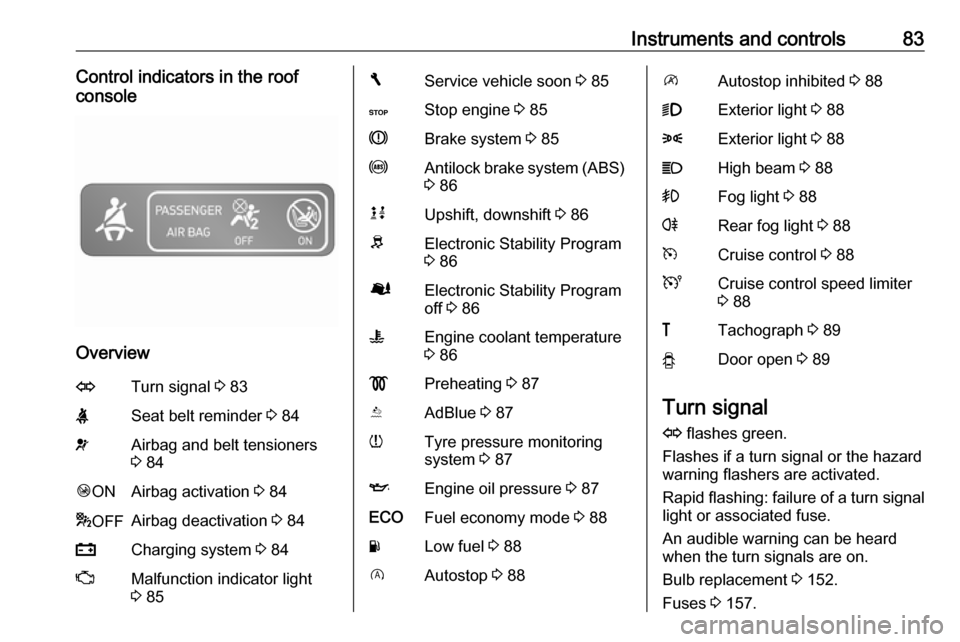
Instruments and controls83Control indicators in the roof
console
Overview
OTurn signal 3 83XSeat belt reminder 3 84vAirbag and belt tensioners
3 84Ó ONAirbag activation 3 84* OFFAirbag deactivation 3 84pCharging system 3 84ZMalfunction indicator light
3 85FService vehicle soon 3 85CStop engine 3 85RBrake system 3 85uAntilock brake system (ABS)
3 86kjUpshift, downshift 3 86RElectronic Stability Program
3 86ØElectronic Stability Program
off 3 86WEngine coolant temperature
3 86!Preheating 3 87YAdBlue 3 87wTyre pressure monitoring
system 3 87IEngine oil pressure 3 87ECOFuel economy mode 3 88YLow fuel 3 88DAutostop 3 88\Autostop inhibited 3 889Exterior light 3 888Exterior light 3 88CHigh beam 3 88>Fog light 3 88rRear fog light 3 88mCruise control 3 88UCruise control speed limiter
3 88&Tachograph 3 89yDoor open 3 89
Turn signal
O flashes green.
Flashes if a turn signal or the hazard
warning flashers are activated.
Rapid flashing: failure of a turn signal
light or associated fuse.
An audible warning can be heard
when the turn signals are on.
Bulb replacement 3 152.
Fuses 3 157.
Page 89 of 209

Instruments and controls87If there is sufficient coolant, consult a
workshop.
The control indicator must be blue
before continuing driving.
Preheating
! illuminates yellow.
Preheating is activated. Only
activates when outside temperature
is low.
AdBlue
Y illuminates yellow.
AdBlue level is low. Refill AdBlue as
soon as possible, to avoid prevention
of engine starts.
Illuminates together with control
indicator F to indicate a system
failure or as a warning that engine
starting may not be possible after a
certain distance. Seek the assistance
of a workshop immediately.
A corresponding message appears in the Driver Information Centre (DIC)
3 89.Adblue percentage remaining can
also be checked by pressing button
repeatedly on end of wiper lever. Trip computer 3 91.
AdBlue 3 121.
Tyre pressure monitoring system
w illuminates or flashes.
Illuminates
Tyre pressure loss. Stop immediately
and check tyre pressure.
Flashes
Fault in system or tyre without
pressure sensor mounted (e.g. spare wheel). After a delay the control
indicator illuminates continuously.
Consult a workshop.
Tyre pressure monitoring system (TPMS) 3 164.
Engine oil pressure
I illuminates red.Illuminates briefly when the ignition is
switched on.
Illuminates when the engine is
running
If control indicator I illuminates
when the engine is running (together
with control indicator C and a
warning chime): Stop, switch off
engine.Caution
Engine lubrication may be
interrupted. This may result in
damage to the engine and/or
locking of the drive wheels.
1. Depress clutch.
2. Select neutral gear (or move selector lever to N).
3. Move out of the flow of traffic as quickly as possible without
impeding other vehicles.
4. Switch off ignition.
Page 90 of 209

88Instruments and controls9Warning
When the engine is off,
considerably more force is needed
to brake and steer.
Do not remove key until vehicle is stationary, otherwise the steeringwheel lock could engage
unexpectedly.
Check oil level before seeking
assistance of a workshop 3 145.
Fuel economy mode
ECO illuminates green when ECO
mode is engaged to reduce fuel
consumption.
ECO mode, driving economically
3 112.
Low fuel Y illuminates yellow.
Illuminates briefly when the ignition is
switched on.
Illuminates when level in fuel tank is
low (range of approx. 30 miles); refuel immediately 3 138.
Catalytic converter 3 121.
Bleeding the diesel fuel system
3 151.
Autostop D illuminates when engine is in an
Autostop.
\ illuminates when an Autostop is
inhibited when certain conditions are
not fulfilled.
Stop-start system 3 117.
Exterior light
9 illuminates green.
Illuminated when the headlights are
on.
8 illuminates green.
Illuminated when the sidelights are
on.
Lighting 3 95.
High beam
P illuminates blue.
Illuminated when high beam is on and during headlight flash 3 96.Fog light
> illuminates green.
Illuminated when the front fog lights
are on 3 98.
Rear fog light r illuminates green.
Illuminated when the rear fog light is
on 3 98.
Cruise control
m , U illuminates green or yellow.
m illuminates green when a certain
speed is stored.
U illuminates green when the system
is on.
Speed limiter U illuminates yellow.
U illuminates yellow when the
system is on.
Cruise control and speed limiter
3 131.
Page 93 of 209

Instruments and controls91● If the vehicle battery is notcharging 3 84.
● If engine lubrication is interrupted
3 87.
● If AdBlue needs to be refilled or a
fault is present 3 121.
● If the electronic key is outside of the detection range.
Electronic key system 3 22,
Power button 3 114.
When the vehicle is parked and/or
the driver's door is opened:
● If the key has been left in the ignition.
● If the electronic key has been left
in the card reader.
Electronic key system 3 22,
Power button 3 114.
● If the vehicle is in an Autostop. Stop-start system 3 117.
● If the exterior lights are on.Engine oil level
If the minimum engine oil level is
reached, a message is displayed in
the Driver Information Centre (DIC)
3 89 for 30 seconds after the engine
is started.
Check oil level 3 145.Trip computer
The trip computer provides
information on driving data, which is
continually recorded and evaluated electronically.
Depending on vehicle, the following
functions can be selected by pressing button repeatedly on end of wiper
lever:
● odometer 3 79
● fuel used
● average consumption
● instantaneous consumption
● range
Page 116 of 209
114Driving and operatingStarting and operating
New vehicle running-in
Do not brake unnecessarily hard for
the first few journeys and after new
disc brake pads have been fitted.
During the first drive, smoke may
occur because of wax and oil
evaporating off the exhaust system.
Park the vehicle in the open for a
while after the first drive and avoid
inhaling the fumes.
During the running-in period, fuel and engine oil consumption may be
higher and the cleaning process of
the diesel particle filter may take
place more often. Autostop may be
inhibited to allow for charging the
vehicle battery.
Stop-start system 3 117.
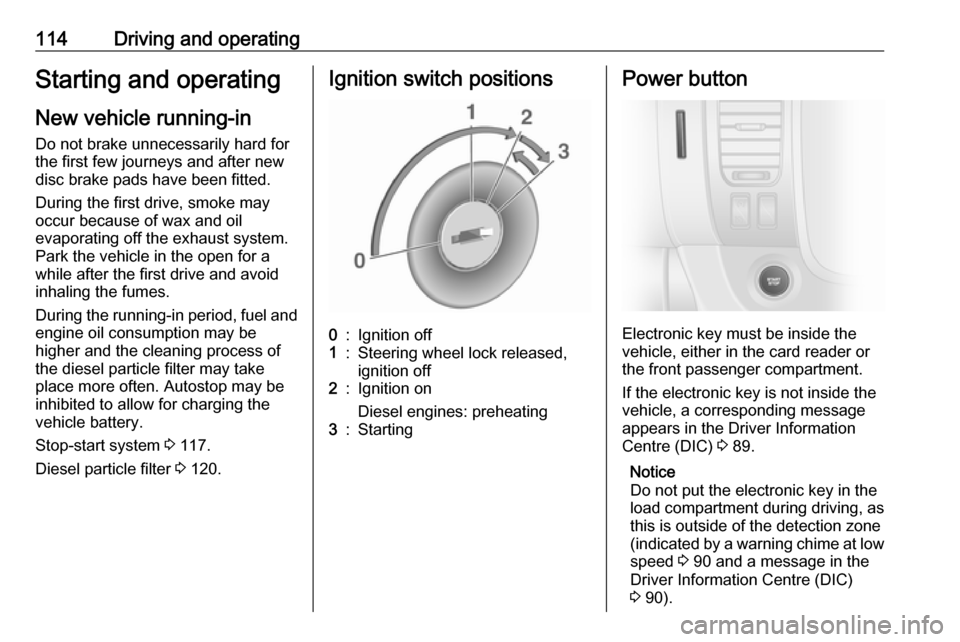
Diesel particle filter 3 120.Ignition switch positions0:Ignition off1:Steering wheel lock released,
ignition off2:Ignition on
Diesel engines: preheating3:StartingPower button
Electronic key must be inside the
vehicle, either in the card reader or
the front passenger compartment.
If the electronic key is not inside the
vehicle, a corresponding message
appears in the Driver Information
Centre (DIC) 3 89.
Notice
Do not put the electronic key in the
load compartment during driving, as
this is outside of the detection zone
(indicated by a warning chime at low
speed 3 90 and a message in the
Driver Information Centre (DIC)
3 90).
Page 140 of 209
138Driving and operatingFuel
Fuel for diesel engines Only use diesel fuel that complies
with EN 590. The fuel must have low
sulphur content (max. 10 ppm).
Equivalent standardised fuels with a
biodiesel (= FAME according to
EN14214) content of max. 7% by
volume (like DIN 51628 or equivalent
standards) may be used.
In countries outside the European
Union, use Euro-Diesel fuel with a
sulphur concentration below 50 ppm.Caution
Use of fuel that does not comply to EN 590 or similar can lead to
engine powerloss, increased wear
or engine damage and loss of
warranty.
Do not use marine diesel oils, heating
oils, Aquazole and similar diesel-
water emulsions. Diesel fuels must
not be diluted with fuels for petrol
engines.
The flow and filterability of diesel fuels are temperature-dependent. When
temperatures are low, refuel with
diesel fuel with guaranteed winter
properties.
Diesel fuel filter 3 150, diesel fuel
system bleeding 3 151.
Refuelling9 Danger
Before refuelling, switch off engine
and any external heaters with
combustion chambers.
Vehicles with stop-start system:
The engine must be switched off
and the ignition key removed, to avoid risk of engine being
restarted automatically by the
system.
Switch off any mobile phones.
Follow the operating and safety
instructions of the filling station
when refuelling.
9 Danger
Fuel is flammable and explosive.
No smoking. No naked flames or
sparks.
If you can smell fuel in your
vehicle, have the cause of this
remedied immediately by a
workshop.
Caution
In case of misfuelling, do not
switch on ignition.
Notice
To ensure the fuel level is displayed
correctly, the ignition must be
switched off before refuelling. Avoid
minor fuel top-ups (e.g. less than
5 litres) to ensure accurate readings.
The fuel filler flap is located on the left-
hand side of the vehicle.
The fuel filler flap can only be opened
if the vehicle is unlocked and the left-
hand door is opened.
Pull flap to open.
Page 144 of 209

142Vehicle careVehicle careGeneral Information...................143
Accessories and vehicle modifications .......................... 143
Vehicle storage ........................143
End-of-life vehicle recovery .....144
Vehicle checks ........................... 144
Performing work ......................144
Bonnet ..................................... 144
Engine oil ................................. 145
Engine air filter ........................ 146
Engine coolant ......................... 147
Power steering fluid .................147
Washer fluid ............................ 148
Brakes ..................................... 148
Brake fluid ............................... 148
Vehicle battery ......................... 149
Diesel fuel filter ........................150
Diesel fuel system bleeding .....151
Wiper blade replacement ........152
Bulb replacement .......................152
Headlights ............................... 152
Fog lights ................................. 153
Front turn signal lights .............154
Tail lights ................................. 154
Side turn signal lights ..............155Centre high-mounted brake
light ......................................... 155
Reversing light ......................... 155
Number plate light ...................156
Fog tail light ............................. 156
Interior lights ............................ 156
Instrument panel illumination ...157
Electrical system ........................157
Fuses ....................................... 157
Instrument panel fuse box .......159
Vehicle tools .............................. 162
Tools ........................................ 162
Wheels and tyres .......................163
Tyres ....................................... 163
Winter tyres ............................. 163
Tyre designations ....................163
Tyre pressure .......................... 163
Tyre pressure monitoring system .................................... 164
Tread depth ............................. 167
Changing tyre and wheel size . 167
Wheel covers ........................... 167
Tyre chains .............................. 168
Tyre repair kit .......................... 168
Wheel changing .......................171
Spare wheel ............................ 172
Jump starting ............................. 174Towing....................................... 175
Towing the vehicle ...................175
Towing another vehicle ...........176
Appearance care .......................177
Exterior care ............................ 177
Interior care ............................. 178
Page 145 of 209

Vehicle care143General Information
Accessories and vehicle modifications
We recommend the use of genuine
parts and accessories and factory
approved parts specific for your
vehicle type. We cannot assess or guarantee reliability of other products
- even if they have a regulatory or
otherwise granted approval.
Do not make any modifications to the
electrical system, e.g. changes of
electronic control units (chip tuning).Caution
When transporting the vehicle on
a train or on a recovery vehicle, the
mud flaps might be damaged.
Vehicle storage
Storage for a long period of time
If the vehicle is to be stored for several months:
● Wash and wax the vehicle.
● Have the wax in the engine compartment and underbody
checked.
● Clean and preserve rubber seals.
● Fill up fuel tank completely.
● Change the engine oil.
● Drain the washer fluid reservoir. ● Check the coolant antifreeze and
corrosion protection.
● Adjust tyre pressure to the value specified for full load.
● Park vehicle in a dry, well ventilated place. Engage first or
reverse gear. Prevent the vehicle from rolling.
● Do not apply the parking brake.● Open the bonnet, close all doors and lock the vehicle.
● Disconnect the clamp from the negative terminal of the vehicle
battery. Beware that all systems
are not functional, e.g. anti-theft
alarm system.
Putting back into operation When the vehicle is to be put back into
operation:
● Connect the clamp to the negative terminal of the vehicle
battery. Activate the electronics
of the power windows.
● Check tyre pressure.
● Fill up the washer fluid reservoir.
● Check the engine oil level.
● Check the coolant level.
● Fit the number plate, if necessary.