ignition VAUXHALL VIVARO 2017.5 Service Manual
[x] Cancel search | Manufacturer: VAUXHALL, Model Year: 2017.5, Model line: VIVARO, Model: VAUXHALL VIVARO 2017.5Pages: 231, PDF Size: 5.52 MB
Page 136 of 231
134Driving and operatingdeactivated automatically, and the
engine is switched off. Restart engine by pressing START/STOP .
Power button 3 129.
Autostop
If the vehicle is at a low speed or at a standstill, activate an Autostop as
follows:
● depress the clutch pedal
● move the selector lever to neutral
● release the clutch pedal
The engine will be switched off while
the ignition stays on if the required
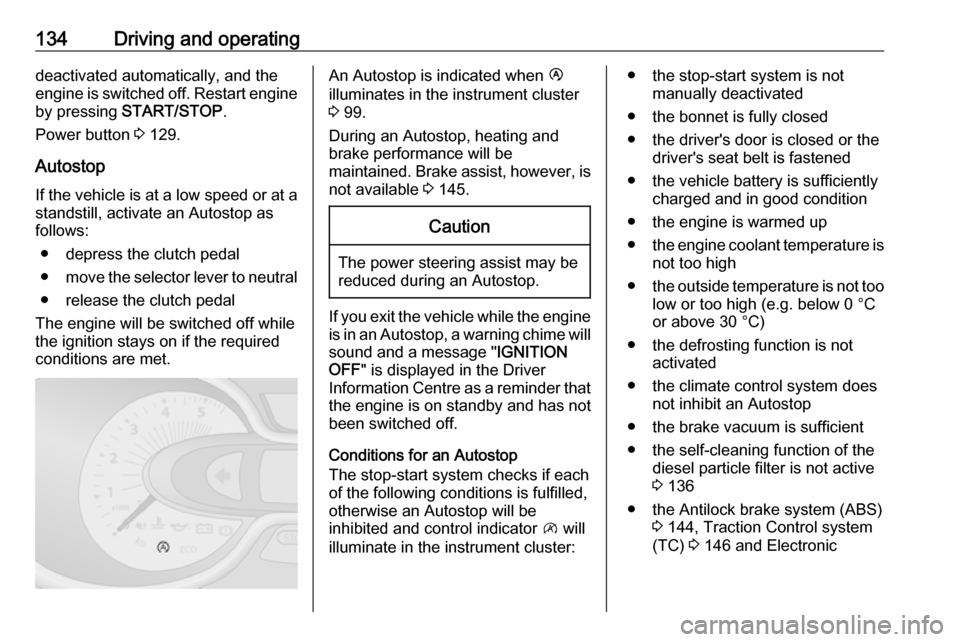
conditions are met.An Autostop is indicated when Ï
illuminates in the instrument cluster
3 99.
During an Autostop, heating and brake performance will be
maintained. Brake assist, however, is
not available 3 145.Caution
The power steering assist may be
reduced during an Autostop.
If you exit the vehicle while the engine
is in an Autostop, a warning chime will
sound and a message " IGNITION
OFF " is displayed in the Driver
Information Centre as a reminder that
the engine is on standby and has not
been switched off.
Conditions for an Autostop
The stop-start system checks if each
of the following conditions is fulfilled,
otherwise an Autostop will be
inhibited and control indicator \ will
illuminate in the instrument cluster:
● the stop-start system is not manually deactivated
● the bonnet is fully closed
● the driver's door is closed or the driver's seat belt is fastened
● the vehicle battery is sufficiently charged and in good condition
● the engine is warmed up
● the engine coolant temperature is
not too high
● the outside temperature is not too
low or too high (e.g. below 0 °C
or above 30 °C)
● the defrosting function is not activated
● the climate control system does not inhibit an Autostop
● the brake vacuum is sufficient
● the self-cleaning function of the diesel particle filter is not active
3 136
● the Antilock brake system (ABS) 3 144, Traction Control system
(TC) 3 146 and Electronic
Page 138 of 231

136Driving and operatingParking9Warning
● Do not park the vehicle on an
easily ignitable surface. The
high temperature of the
exhaust system could ignite the
surface.
● Always apply parking brake without pressing release
button. Apply as firmly as
possible on a downhill slope or
uphill slope. Depress brake
pedal at the same time to
reduce operating force.
● Switch off the engine.
● If the vehicle is on a level surface or uphill slope, engage
first gear. On an uphill slope,
turn the front wheels away from
the kerb.
If the vehicle is on a downhill
slope, engage reverse gear.
Turn the front wheels towards the kerb.
● Close the windows.
● Remove the ignition key from the ignition switch. Turn the
steering wheel until the
steering wheel lock is felt to
engage.
● Lock the vehicle by pressing e on
the remote control 3 24.
Activate the anti-theft alarm
system 3 36.
● The engine cooling fans may run
after the engine has been
switched off 3 163.
Caution
After running at high engine
speeds or with high engine loads,
operate the engine briefly at a low load or run in neutral for approx.30 seconds before switching off, in
order to protect the turbocharger.
Vehicle storage 3 162.
Engine exhaust9 Danger
Engine exhaust gases contain
poisonous carbon monoxide,
which is colourless and odourless and could be fatal if inhaled.
If exhaust gases enter the interior
of the vehicle, open the windows.
Have the cause of the fault
rectified by a workshop.
Avoid driving with an open load
compartment, otherwise exhaust
gases could enter the vehicle.
Diesel particle filter
The diesel particle filter system filters
harmful soot particles out of the
exhaust gases. The system includes
a self-cleaning function that runs
automatically during driving without
any notification.
The filter is cleaned by periodically
burning off the soot particles at high
temperature. This process takes
place automatically under set driving
Page 141 of 231

Driving and operating139Refill the AdBlue tank as soon as
possible. Refer to "Refilling AdBlue"
below.
If AdBlue is not refilled within a certain
distance, further level warnings are
displayed in the Driver Information Centre depending on the current
AdBlue level.
Engine restarts prevented
Subsequent requests to refill AdBlue
and finally the announcement that an engine restart will be prevented are
displayed in the Driver Information
Centre.
Notice
These restrictions are a legal
requirement.
Before the prevention of an engine
restart, a warning message with
0 miles is displayed in the Driver
Information Centre, indicating that
after switching off the ignition an
engine restart will be prohibited.
After the prevention of an engine
start, a warning message is displayed in the Driver Information Centre
reminding the driver that AdBlue level
is insufficient.To allow the engine to be restarted,
the tank should be refilled completely
or with a volume of at least ten litres
of AdBlue, depending on AdBlue
consumption.
Warning stages: level warnings,
engine restarts prevented
1. Y illuminates after ignition is
switched on with warning
message LEVEL ADBLUE LOW :
Driving is possible without any
restrictions.
Refill the AdBlue tank as soon as
possible.
2. Y illuminates during driving with
warning message TOP UP
ADBLUE :
Possible loss of engine power.
Refill the AdBlue tank as soon as
possible.
3. Y illuminates during driving with
warning message XXX KM STOP
ADD ADBLUE :
Vehicle speed may be limited to
12 mph after switching the engine
off and on again until the range is
reduced to 0 miles.Refill the tank completely or with a
volume of at least ten litres of
AdBlue (depending on AdBlue
consumption) as soon as
possible.
4. Y illuminates during driving with
warning message 0 KM STOP
ADD ADBLUE :
The engine cannot be restarted
after switching off the ignition.
To allow the engine to be
restarted, refill the tank
completely or with a volume of at
least ten litres of AdBlue
(depending on AdBlue
consumption) as soon as
possible.
Illumination of control indicator Y may
be accompanied by a warning chime.
Warning chimes 3 102.
High emission warnings If the exhaust emission rises above a
certain value, warnings similar to the
range warnings as described above
will be displayed in the Driver
Page 142 of 231
140Driving and operatingInformation Centre. Control indicator
Y illuminates continuously together
with F and a warning chime.
Requests to have the exhaust system checked and finally the
announcement that an engine restart
will be prevented are displayed in the Driver Information Centre.
Notice
These restrictions are a legal
requirement.
At an AdBlue range of approx.
680 miles, a warning message is
displayed in the Driver Information
Centre showing the remaining
distance the vehicle can travel before
engine restarts are prevented. This
warning message is repeated approx. every 60 miles.
Seek the assistance of a workshop as
soon as possible.
Warning stages: high emission
warnings
1. Y and F illuminate with warning
message CHECK ANTI-
POLLUTION :Fault in the system that may result
in a loss of engine power.
Seek the assistance of a
workshop as soon as possible.
2. Y and F illuminate with warning
message ANTIPOLLUTION xxx
KM FAIL :
Indicates that in less than
680 miles an engine restart will be
prohibited after switching off the
ignition.
This warning message will be
repeated every 60 miles.
Vehicle speed may be limited to
12 mph after switching the engine
off and on again until the range is
reduced to 0 miles.
Seek the assistance of a
workshop as soon as possible.
3. Y and F illuminate with warning
message ANTIPOLLUTION 0 KM
FAILURE :
The engine cannot be restarted
after switching off the ignition.
Seek the assistance of a
workshop.Illumination of control indicators Y
and F may be accompanied by a
warning chime.
Warning chimes 3 102.
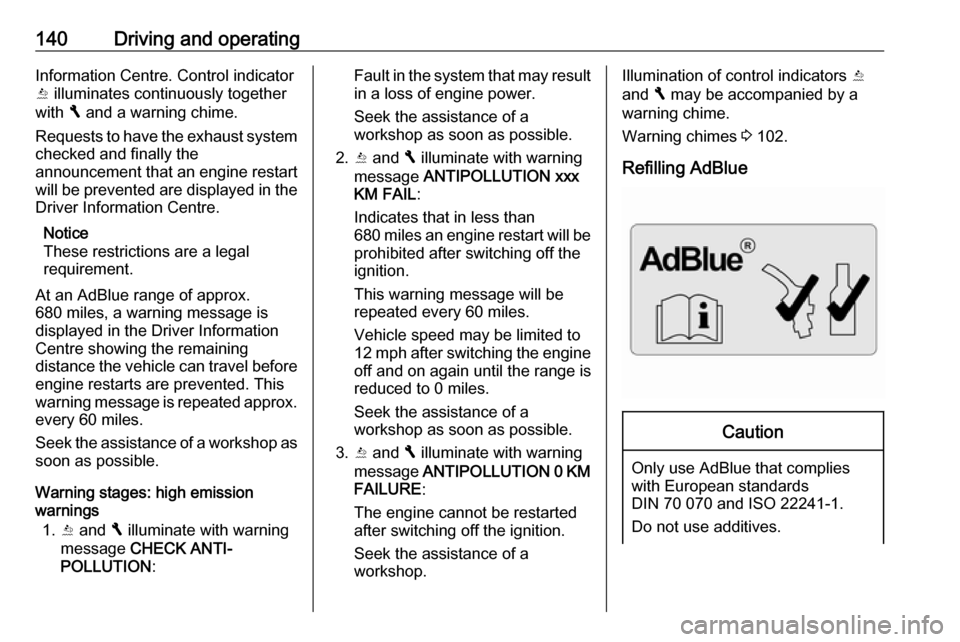
Refilling AdBlueCaution
Only use AdBlue that complies
with European standards
DIN 70 070 and ISO 22241-1.
Do not use additives.
Page 143 of 231

Driving and operating141Do not dilute AdBlue.
Otherwise the selective catalytic
reduction system could be
damaged.
Notice
If AdBlue must be refilled at very low
temperatures, the refilling of AdBlue may not be detected by the system.
In this case, park the vehicle in a
space with a higher ambient
temperature until AdBlue is
liquefied.
Notice
If engine starting is prohibited due to low AdBlue level, we recommend
refilling the tank completely or with a
volume of at least ten litres of AdBlue (depending on AdBlue
consumption).
Avoid minor top-ups (e.g. less than ten litres), otherwise the system may not detect a refill.
Notice
When unscrewing the protective cap from the filler neck, ammonia fumes
may emerge. Do not inhale as the fumes have a pungent smell. The
fumes are not harmful by inhalation.
The vehicle must be parked on a level surface.
The filler neck for AdBlue is located
behind the fuel filler flap, located on
the left-hand side of the vehicle.
The fuel filler flap can only be opened
if the vehicle is unlocked and the left- hand door is opened.9 Danger
Vehicles with stop-start system:
The engine must be switched off
and the ignition key removed, to
avoid risk of engine being
restarted automatically by the
system.
Capacities 3 215.
Filling station9 Danger
Follow the operating and safety
instructions of the filling station
when refilling AdBlue.
1. Switch off engine and remove key
from ignition switch.
2. Open left-hand door and pull fuel filler flap to open.
3. Unscrew protective capanticlockwise from the filler neck.
Page 144 of 231

142Driving and operatingCaution
The AdBlue protective cap is the
blue lower cap (arrowed in
illustration), and the fuel filler cap
is the black upper cap 3 157.
In case of incorrect refilling, do not switch on ignition. Seek the
assistance of a workshop
immediately.
4. Fully insert the pump nozzle into the filler neck and switch it on.
5. When refilling is complete, mount the protective cap and turn
clockwise until it engages.
6. Close fuel filler flap and left-hand door.
AdBlue canister Notice
Only use the designated AdBlue
canisters for refilling, to prevent a
topping-up of too much AdBlue.
Additionally, the fumes in the tank
are captured in the canister and do
not emerge.
Notice
Since AdBlue has a limited
durability, check the date of expiry
before refilling.
1. Switch off engine and remove key
from ignition switch.
2. Open left-hand door and pull fuel filler flap to open.
3. Unscrew protective capanticlockwise from the filler neck.
Caution
The AdBlue protective cap is the
blue lower cap (arrowed in
illustration), and the fuel filler cap
is the black upper cap 3 157.
In case of incorrect refilling, do not switch on ignition. Seek the
assistance of a workshop
immediately.
4. Open AdBlue canister.
5. Mount one end of the hose on the
canister and screw the other end
on the filler neck.
6. Lift the canister until it is empty, or
until the flow from the canister has
stopped. This can take up to five
minutes.
7. Place the canister on the ground to empty the hose, wait 15
seconds.
8. Unscrew the hose from the filler neck.
Page 146 of 231

144Driving and operatingCaution
It is inadvisable to drive with hand
resting on the selector lever.
Upshift 3 97.
Stop-start system 3 133.
Brakes
The brake system comprises two independent brake circuits.
If a brake circuit fails, the vehicle can
still be braked using the other brake
circuit. However, braking effect is
achieved only when you depress the
brake pedal firmly. You need to use
considerably more force for this. The
braking distance is extended. Seek
the assistance of a workshop before
continuing your journey.
When the engine is not running, the
support of the brake servo unit
disappears once the brake pedal has been depressed once or twice.
Braking effect is not reduced, but
braking requires significantly greater
force. It is especially important to bear this in mind when being towed.
If control indicator R illuminates in
the instrument cluster while driving
and a corresponding message
appears in the Driver Information
Centre 3 100, there is a fault in the
braking system. Seek the assistance
of a workshop immediately.Control indicator R 3 96.
Vehicle messages 3 101.
Antilock brake system Antilock brake system (ABS)
prevents the wheels from locking.
ABS starts to regulate brake pressure
as soon as a wheel shows a tendency to lock. The vehicle remains
steerable, even during hard braking.
ABS control is made apparent
through a pulse in the brake pedal
and the noise of the regulation
process.
For optimum braking, keep the brake
pedal fully depressed throughout the
braking process, despite the fact that
the pedal is pulsating. Do not reduce
the pressure on the pedal.
After starting-off, the system performs a self-test which may be audible.
Control indicator u 3 97.
Fault
If control indicator u does not go out
a few seconds after the ignition is switched on, or if it illuminates while
Page 148 of 231

146Driving and operatingfor a further two seconds. The brakesrelease automatically as soon as the
vehicle begins to accelerate.Caution
The Hill start assist cannot
completely prevent vehicle
movement in all situations
(extremely steep gradients, etc.).
If necessary, depress the brake
pedal to prevent the vehicle from
rolling forwards or backwards.
The Hill start assist is not active
during an Autostop. Stop-start system 3 133.
Ride control systems
Traction Control system The Traction Control system (TC) is a
component part of the Electronic
Stability Program (ESP® Plus
) which
improves driving stability when
necessary, regardless of the type of
road surface or tyre grip, by
preventing the drive wheels from
spinning.
As soon as the drive wheels starts to spin, engine output is reduced and
the wheel spinning the most is braked
individually. This considerably
improves the driving stability of the
vehicle on slippery road surfaces.
TC is operational as soon as the
ignition is switched on and control
indicator b extinguishes in the
instrument cluster. A corresponding message also appears in the Driver
Information Centre 3 100.
When TC is active b flashes.9 Warning
Do not let this special safety
feature tempt you into taking risks
when driving.
Adapt speed to the road
conditions.
Control indicator b 3 97.
Trailer stability assist (TSA) 3 160.
Enhanced Traction function
Page 149 of 231

Driving and operating147If necessary, in the event of soft
ground, mud or snow-covered road
surfaces, the Traction control system
(TC) can be deactivated to enhance
traction:
Press Ø on the instrument panel.
Control indicator Ø illuminates in the
instrument cluster and a
corresponding message appears in
the Driver Information Centre 3 100.
When vehicle speed reaches 30 mph, the system switches
automatically from Enhanced
Traction function to TC operation.
Control indicator Ø extinguishes in
the instrument cluster.
TC is reactivated by pressing Ø
again. Control indicator Ø
extinguishes.
TC is also reactivated the next time
the ignition is switched on.
Fault
If the system detects a fault, control indicator b 3 97 illuminates together
with F 3 96 in the instrument cluster
and a corresponding message
appears in the Driver Information
Centre 3 100.
TC is not operational. Have the cause of the fault remedied by a workshop.
Vehicle messages 3 101.
Electronic stability program The Electronic Stability Program
(ESP® Plus
) improves driving stability
when necessary, regardless of the
type of road surface or tyre grip. It also
prevents the drive wheels from
spinning.
As soon as the vehicle starts to
swerve (understeer/oversteer),
engine output is reduced and thewheels are braked individually. This
considerably improves the driving
stability of the vehicle on slippery road
surfaces.
ESP® Plus
is operational as soon as
the ignition is switched on and control
indicator b extinguishes in the
instrument cluster. A corresponding
message also appears in the Driver
Information Centre 3 100.
When ESP® Plus
comes into action b
flashes.9 Warning
Do not let this special safety
feature tempt you into taking risks
when driving.
Adapt speed to the road
conditions.
Control indicator b 3 97.
Trailer stability assist (TSA) 3 160.
Page 150 of 231
148Driving and operatingEnhanced Traction function
If necessary, in the event of soft
ground, mud or snow-covered road
surfaces, ESP® Plus
can be
deactivated to enhance traction:
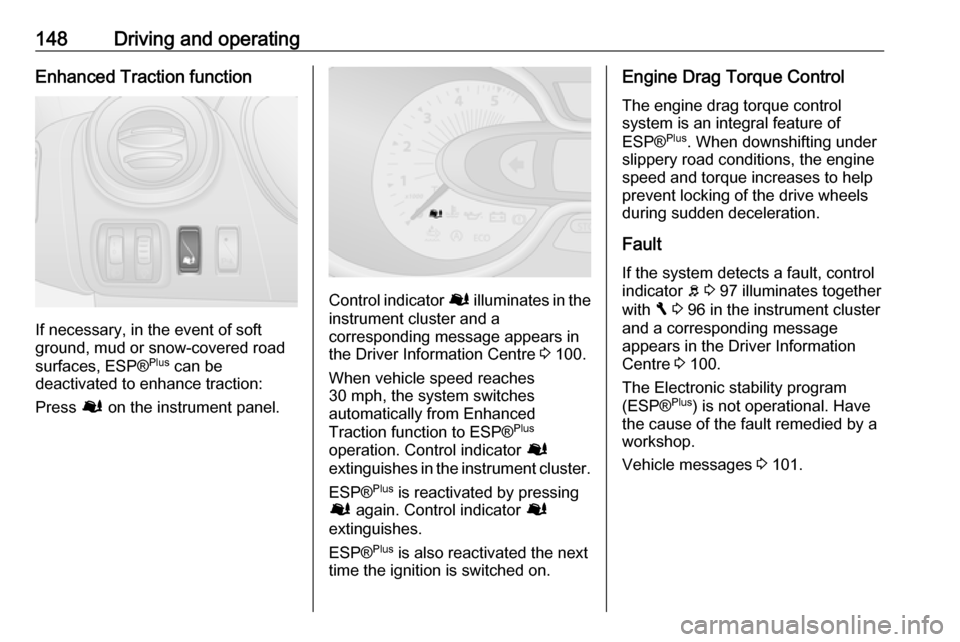
Press Ø on the instrument panel.
Control indicator Ø illuminates in the
instrument cluster and a
corresponding message appears in
the Driver Information Centre 3 100.
When vehicle speed reaches
30 mph, the system switches
automatically from Enhanced
Traction function to ESP® Plus
operation. Control indicator Ø
extinguishes in the instrument cluster.
ESP® Plus
is reactivated by pressing
Ø again. Control indicator Ø
extinguishes.
ESP® Plus
is also reactivated the next
time the ignition is switched on.
Engine Drag Torque Control
The engine drag torque control
system is an integral feature of
ESP® Plus
. When downshifting under
slippery road conditions, the engine speed and torque increases to help
prevent locking of the drive wheels
during sudden deceleration.
Fault
If the system detects a fault, control indicator b 3 97 illuminates together
with F 3 96 in the instrument cluster
and a corresponding message
appears in the Driver Information
Centre 3 100.
The Electronic stability program
(ESP® Plus
) is not operational. Have
the cause of the fault remedied by a
workshop.
Vehicle messages 3 101.