ignition VAUXHALL VIVARO 2017.5 Workshop Manual
[x] Cancel search | Manufacturer: VAUXHALL, Model Year: 2017.5, Model line: VIVARO, Model: VAUXHALL VIVARO 2017.5Pages: 231, PDF Size: 5.52 MB
Page 152 of 231

150Driving and operatingControl indicator m illuminates green
in the instrument cluster together with
U and a corresponding message
appears in the Driver Information
Centre.
Vehicle speed can be increased by
depressing the accelerator pedal.
The stored speed flashes in the
instrument cluster. When the
accelerator pedal is released, the
previously stored speed is resumed.
Cruise control remains activated
while gearshifting.
The speed is saved until the ignition
is switched off.
Increase speed
With cruise control active, the vehicle speed can be increased continuously
or in small increments by holding
down or tapping < repeatedly.
When the switch is released the
current speed is stored and
maintained.
Alternatively, accelerate to the
desired speed and store by pressing
< .Reduce speed
With cruise control active, the vehicle speed can be decreased
continuously or in small increments
by holding down or tapping ]
repeatedly.
When the switch is released the
current speed is stored and
maintained.
Deactivation
Press §; cruise control is deactivated
and the green control indicator U
extinguishes in the instrument cluster.
Automatic deactivation:
● vehicle speed drops below 20 mph
● the brake pedal is depressed
● the clutch pedal is depressed
● selector lever in N
● engine speed is in a very low or very high range
The speed is stored and a
corresponding message appears in
the Driver Information Centre.
Reactivation
Press R at a speed above 20 mph.
If the stored speed is much higher
than the current speed, the vehicle
will accelerate powerfully until the stored speed is obtained.
Pressing < will also reactivate the
cruise control function, but at the
current vehicle speed only, not the stored speed.
Deleting the stored speedPress m; Green control indicators
U and m extinguish in the instrument
cluster.
Page 155 of 231

Driving and operating153closer to the obstacle. When the
distance is less than 30 cm, the
buzzer is continuous.
Notice
In versions with Info-Display
indication, the volume of the buzzer can be adjusted via the Infotainment
system. Refer to Infotainment
manual for further information.
Deactivation
It is possible to permanently or
temporarily deactivate the system.
Notice
In versions with Info-Display
indication, the function can be
deactivated via the Infotainment
system. Refer to Infotainment
manual for further information.
Temporary deactivation
Temporarily deactivate the system by
pressing r on the instrument panel
with the ignition on. LED illuminates in
the button when deactivated.
When reverse gear is selected, no
acoustic signal will sound, indicating
deactivation.
The function is reactivated by
pressing r again or the next time
the ignition is switched on.
Permanent deactivation
Permanently deactivate the system
by pressing and holding r on the
instrument panel for approx.
three seconds with the ignition on.
LED illuminates continuously in the
button when permanently
deactivated.The system is deactivated and will not
operate. When reverse gear is
selected, no acoustic signal will
sound, indicating deactivation.
The function is reactivated by
pressing and holding r for approx.
three seconds.
Fault
If the system detects an operating
fault, when selecting reverse gear a continuous acoustic alarm will sound
for approx. five seconds, a
corresponding message appears in
the Driver Information Centre 3 100
and F illuminates in the instrument
cluster 3 96. Consult a workshop to
have the cause of the fault remedied.Caution
When reversing, the area should
be free from obstacles which could impact on the underside of the
vehicle.
Impact to the rear axle, which may
not be visible, could lead to
uncharacteristic changes in the
Page 159 of 231

Driving and operating157The flow and filterability of diesel fuels
are temperature-dependent. When
temperatures are low, refuel with
diesel fuel with guaranteed winter
properties.
Diesel fuel filter 3 170, diesel fuel
system bleeding 3 170.
Refuelling9 Danger
Before refuelling, switch off engine
and any external heaters with
combustion chambers.
Vehicles with stop-start system:
The engine must be switched off
and the ignition key removed, to avoid risk of engine being
restarted automatically by the
system.
Switch off any mobile phones.
Follow the operating and safety
instructions of the filling station
when refuelling.
9 Danger
Fuel is flammable and explosive.
No smoking. No naked flames or
sparks.
If you can smell fuel in your
vehicle, have the cause of this
remedied immediately by a
workshop.
Caution
In case of misfuelling, do not
switch on ignition.
Notice
To ensure the fuel level is displayed
correctly, the ignition must be
switched off before refuelling. Avoid
minor fuel top-ups (e.g. less than
five litres) to ensure accurate
readings.
The fuel filler flap is located on the left-
hand side of the vehicle.
The fuel filler flap can only be opened
if the vehicle is unlocked and the left- hand door is opened.
Notice
Do not open the left-hand sliding
side door during refuelling.
Pull flap to open.Caution
In vehicles with AdBlue, the
AdBlue protective cap is the blue
lower cap 3 137 , and the fuel filler
cap is the black upper cap
(arrowed in illustration).
In case of misfuelling, do not
switch on ignition. Seek the
assistance of a workshop
immediately.
Page 165 of 231
Vehicle care163End-of-life vehicle recovery
Information on end-of-life vehicle
recovery centres and the recycling of
end-of-life vehicles is available on our website, where legally required. Only
entrust this work to an authorised
recycling centre.Vehicle checks
Performing work9 Warning
Only perform engine compartment
checks when the ignition is off.
The vehicle must not be in an
Autostop 3 133.
The cooling fan may start
operating even if the ignition is off.
9 Danger
The ignition system generates
extremely high voltages. Do not
touch.
The caps for topping up the engine oil, the coolant, the brake fluid, the
washer fluid and the oil dipstick
handle are yellow for ease of
identification.
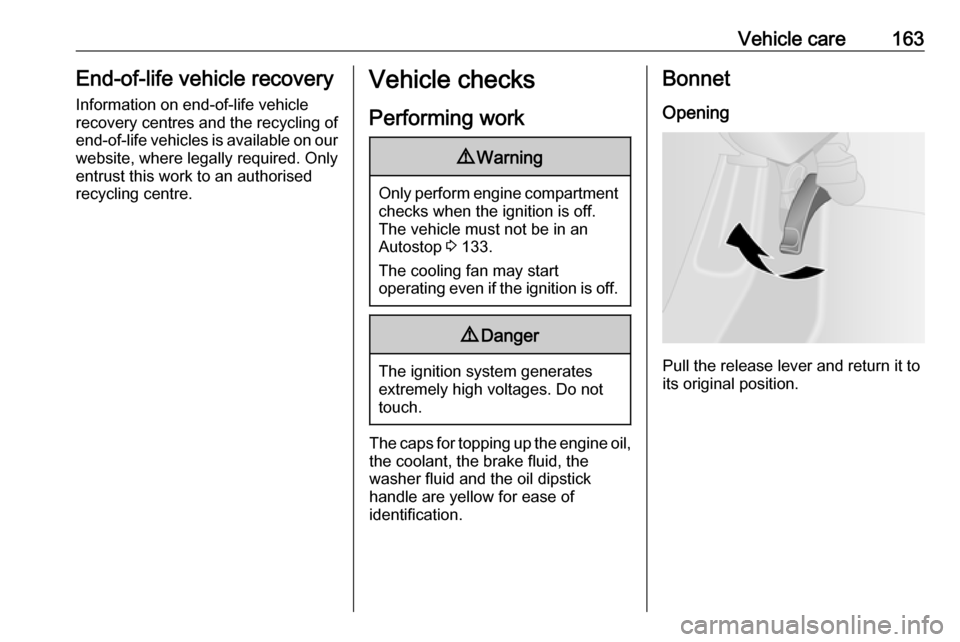
Bonnet
Opening
Pull the release lever and return it to
its original position.
Page 170 of 231

168Vehicle care
The brake fluid level must be betweenthe MINI and MAXI marks.
When topping up, ensure maximum cleanliness as contamination of the
brake fluid can lead to brake system
malfunctions. Have the cause of the
loss of brake fluid remedied by a
workshop.
Only use high-performance brake
fluid approved for your vehicle.
Brake fluid 3 201.
Vehicle battery
The vehicle battery is located under a
cover in the engine compartment.
The vehicle battery is maintenance-
free provided that the driving profile
allows sufficient charging of the
battery. Short-distance driving and
frequent engine starts can discharge
the battery. Avoid the use of
unnecessary electrical consumers.
Control indicator p illuminates if
there is a fault with the charging
system. Stop, switch off engine and
seek the assistance of a workshop.
Charging system 3 96.
Batteries do not belong in household
waste. They must be disposed of at
an appropriate recycling collection
point.
Laying up the vehicle for more than
four weeks can lead to battery
discharge.
9 Danger
Ensure the ignition is switched off
completely (the vehicle must not
be in an Autostop) before
connecting or disconnecting the
vehicle battery.
Stop-start system 3 133.
Replacing the vehicle battery
In vehicles with an AGM (Absorptive
Glass Mat) battery, make sure to
have the battery replaced with
another AGM battery.
Page 172 of 231

170Vehicle care● See the Owner's Manual forfurther information.
● Explosive gas may be present in the vicinity of the battery.
Additional battery Depending on the vehicle's auxiliary
equipment, certain models may have
an additional battery located under
the front passenger seat.
Notice
The additional battery is
automatically connected to the main vehicle battery only when the engine
is running. It does not need to be manually disconnected before
disconnecting the main vehicle
battery or before jump starting the
vehicle.
Jump starting 3 194.
Diesel fuel filter
The diesel fuel filter is accessible from the underside of the vehicle.
Drain filter of residual water at every
engine oil change.
Place a container underneath the
filter housing. Loosen the knurled screw on the lower part of the filter by
approx. one turn, to drain off the
water.
The filter is drained as soon as water- free diesel fuel emerges. Retighten
the screw.
Check diesel fuel filter at shorter
intervals if the vehicle is subjected to
extreme operating conditions.
Diesel fuel system bleeding
If the fuel tank has been run dry, it will be necessary to air vent or bleed the
diesel fuel system.
Refuel then proceed as follows:
With ignition key
● Switch on the ignition (key to position 2) for five seconds at a
time.
● Switch off ignition (key to position
1 ) for three seconds.
Page 173 of 231

Vehicle care171● Repeat this process multipletimes.
● Start the engine (key to position 3) then switch off (key to position
0 ).
Ignition switch positions 3 129.
With power button
● Insert the electronic key in the card reader.
● Press START/STOP without
pressing any of the pedals.
● Wait a few minutes before starting engine.
Power button 3 129.
If the engine fails to start, seek the
assistance of a workshop.
Starting the engine 3 131.
Wiper blade replacement Wiper blades on the windscreen
Before replacing the wiper blades,
move the wiper lever to the
maintenance position (if equipped).
Windscreen wiper/washer 3 84.
Lift the wiper arm, press button to
disengage the wiper blade and
remove.
Attach new wiper blade slightly
angled to the wiper arm and push until
it engages.
Lower wiper arm carefully.
Wiper blade on the rear window
Lift wiper arm, press retaining lugs
together to disengage the wiper blade
and raise to remove.
Lower wiper arm carefully.
When attaching new wiper blade,
ensure it is engaged securely.
Page 174 of 231
172Vehicle careBulb replacement
Switch off the ignition and turn off the relevant switch or close the doors.
Only hold a new bulb at the base. Do
not touch the bulb glass with bare
hands.
Use only the same bulb type for
replacement.
Bulb check After a bulb replacement, switch on
the ignition, operate and check the
lights.
Headlights
Low beam and high beam Replace headlight bulbs from within
the engine compartment.
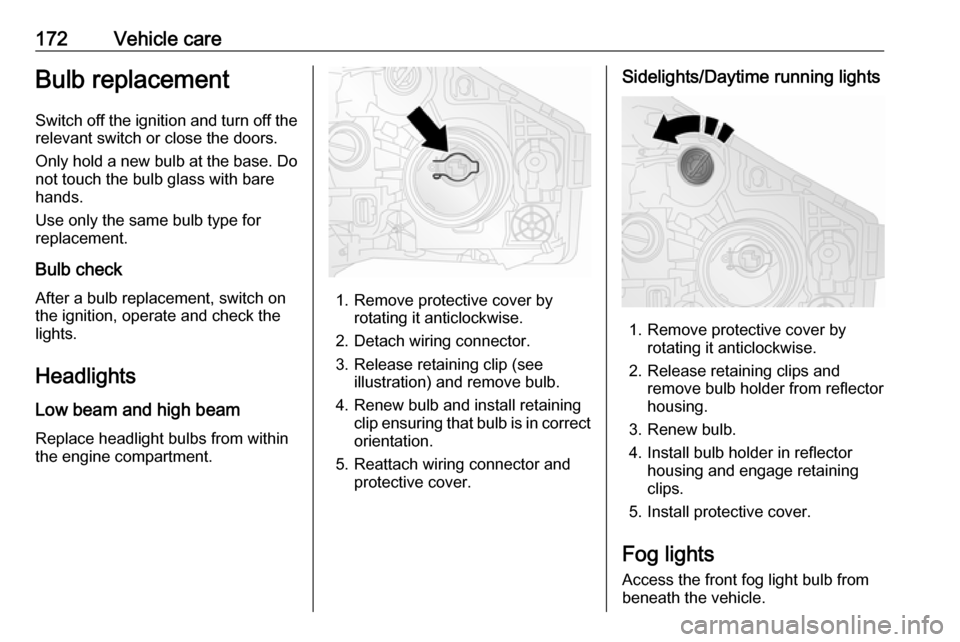
1. Remove protective cover by rotating it anticlockwise.
2. Detach wiring connector.
3. Release retaining clip (see illustration) and remove bulb.
4. Renew bulb and install retaining clip ensuring that bulb is in correct
orientation.
5. Reattach wiring connector and protective cover.
Sidelights/Daytime running lights
1. Remove protective cover byrotating it anticlockwise.
2. Release retaining clips and remove bulb holder from reflector
housing.
3. Renew bulb.
4. Install bulb holder in reflector housing and engage retaining
clips.
5. Install protective cover.
Fog lights
Access the front fog light bulb from
beneath the vehicle.
Page 180 of 231

178Vehicle careElectrical systemFuses
Data on the replacement fuse must
match the data on the defective fuse.
There are two fuse boxes in the
vehicle:
● on the left-hand side of the instrument panel, behind the trimpanel
● in the engine compartment located next to the battery
Notice
The engine compartment fuse box
should only be accessed by a
workshop.
Before replacing a fuse, turn off the
respective switch and the ignition.
There are different types of fuses in
the vehicle.
Depending on the type of fuse, a
blown fuse can be recognised by its
melted wire. Do not replace the fuse
until the cause of the fault has been
remedied.
It is advisable to carry a full set of
fuses. Provision is made in the fuse
box for the storing of spare fuses.
Some functions are protected by
several fuses.
Fuses may also be inserted without existence of a function.
Notice
Not all fuse box descriptions in this
Owner's Manual may apply to your
vehicle. Refer to the fuse box label,
where fitted.
Fuse extractor
Page 187 of 231
Vehicle care185Trailer towingWhen towing a trailer with a fully
laden vehicle, the tyre pressure must
be increased by 20 kPa/0.2 bar
(3.0 psi) and the maximum speed
limited to 60 mph.
Trailer towing 3 159.
Tyre pressure monitoring
system
The tyre pressure monitoring system
uses radio and sensor technology to
check tyre pressure levels.Caution
Tyre pressure monitoring system
warns only about low tyre pressure condition and does not replace
regular tyre maintenance by the
driver.
All wheels must be equipped with pressure sensors and the tyres must
have the prescribed pressure.
Notice
In countries where the tyre pressure
monitoring system is legally
required, the use of wheels without
pressure sensors will invalidate the
vehicle type approval.
The tyre pressure monitoring system
sensors monitor the air pressure in
the tyres and transmit tyre pressure
readings to a receiver located in the
vehicle.
Tyre pressure chart 3 216.
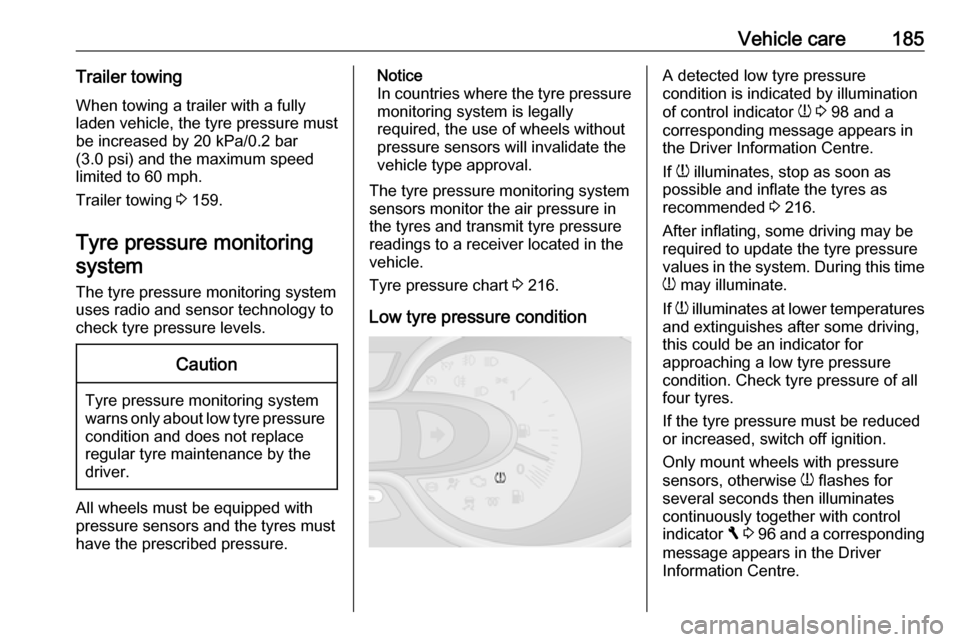
Low tyre pressure conditionA detected low tyre pressure
condition is indicated by illumination
of control indicator w 3 98 and a
corresponding message appears in
the Driver Information Centre.
If w illuminates, stop as soon as
possible and inflate the tyres as
recommended 3 216.
After inflating, some driving may be
required to update the tyre pressure
values in the system. During this time
w may illuminate.
If w illuminates at lower temperatures
and extinguishes after some driving,
this could be an indicator for
approaching a low tyre pressure
condition. Check tyre pressure of all
four tyres.
If the tyre pressure must be reduced
or increased, switch off ignition.
Only mount wheels with pressure
sensors, otherwise w flashes for
several seconds then illuminates
continuously together with control
indicator F 3 96 and a corresponding
message appears in the Driver
Information Centre.