warning VAUXHALL VIVARO 2018.5 Manual Online
[x] Cancel search | Manufacturer: VAUXHALL, Model Year: 2018.5, Model line: VIVARO, Model: VAUXHALL VIVARO 2018.5Pages: 239, PDF Size: 5.75 MB
Page 188 of 239

186Vehicle care
The tyre pressure information label
on the driver's door frame indicates
the original equipment tyres and the
correspondent tyre pressures.
Always inflate tyres to the pressures
shown on the label.
Tyre pressures 3 220.
The tyre pressure data refers to cold tyres. It applies to summer and winter tyres.
Always inflate the spare tyre to the
pressure specified for full load.
Incorrect tyre pressures will impair
safety, vehicle handling, comfort and
fuel economy and will increase tyre
wear.
Tyre pressures differ depending on
various options. For the correct tyre
pressure value, follow the procedure
below:
1. Identify the engine identifier code.
Engine data 3 209.
2. Identify the respective tyre.
The tyre pressure tables show all
possible tyre combinations 3 220.
For the tyres approved for your
vehicle, refer to the EEC Certificate of Conformity provided with your vehicle
or other national registration
documents.
The driver is responsible for correct adjustment of tyre pressure.9 Warning
If the pressure is too low, this can
result in considerable tyre warm-
up and internal damage, leading to tread separation and even to tyre
blow-out at high speeds.
9 Warning
For specific tyres the
recommended tyre pressure as
shown in the tyre pressure table may exceed the maximum tyre
pressure as indicated on the tyre.
Never exceed the maximum tyre
pressure as indicated on the tyre.
Temperature dependency
Tyre pressure depends on the
temperature of the tyre. During
driving, tyre temperature and
pressure increase.
Tyre pressure values provided on the
tyre information label and tyre
pressure chart are valid for cold tyres, which means at 20 °C. The pressure
increases by nearly 1.5 psi for a
10 °C temperature increase. This
must be considered when warm tyres
are checked.
Page 190 of 239
188Vehicle careA spare wheel or temporary spare
wheel is not equipped with pressure
sensors. The tyre pressure
monitoring system is not operational
for these wheels. For the further three wheels, the tyre pressure monitoring
system remains operational.
Control indicator w and the
corresponding message appears at
each ignition cycle until the tyres are
inflated to the correct tyre pressure.
Driver Information Centre 3 101.
Vehicle messages 3 102.
Puncture A puncture or severely under-inflated
tyre is indicated by illumination of
control indicator w together with C
3 97 and a corresponding message
appears in the Driver Information
Centre. Stop vehicle and switch off
engine.
Tyre pressure 3 220.
Tyre repair kit 3 190.
Spare wheel 3 195.
Wheel changing 3 193.Relearn function
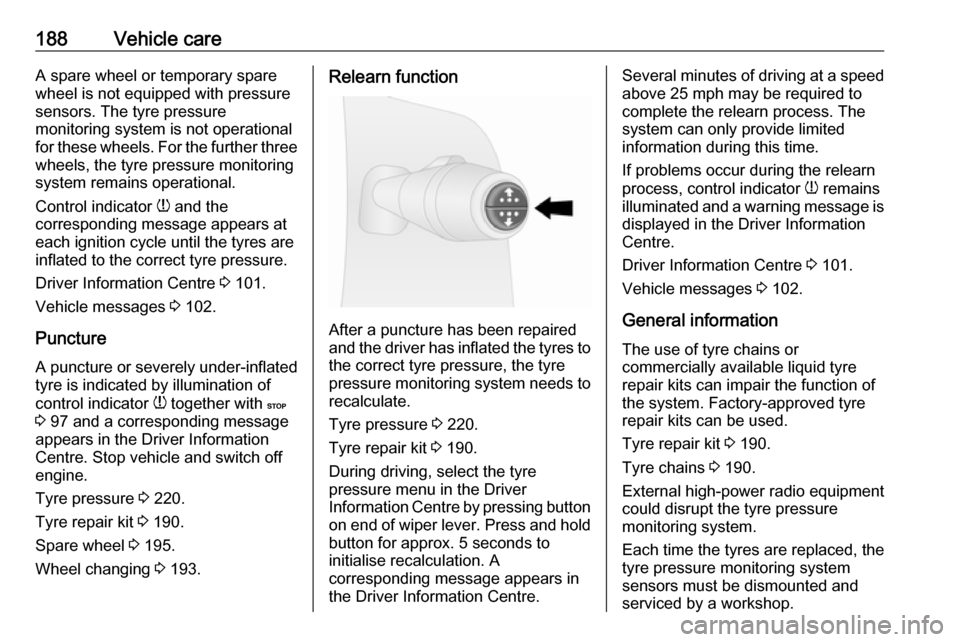
After a puncture has been repaired
and the driver has inflated the tyres to
the correct tyre pressure, the tyre
pressure monitoring system needs to recalculate.
Tyre pressure 3 220.
Tyre repair kit 3 190.
During driving, select the tyre
pressure menu in the Driver
Information Centre by pressing button
on end of wiper lever. Press and hold button for approx. 5 seconds to
initialise recalculation. A
corresponding message appears in
the Driver Information Centre.
Several minutes of driving at a speed above 25 mph may be required to
complete the relearn process. The system can only provide limited
information during this time.
If problems occur during the relearn
process, control indicator w remains
illuminated and a warning message is displayed in the Driver Information
Centre.
Driver Information Centre 3 101.
Vehicle messages 3 102.
General information The use of tyre chains or
commercially available liquid tyre
repair kits can impair the function of
the system. Factory-approved tyre
repair kits can be used.
Tyre repair kit 3 190.
Tyre chains 3 190.
External high-power radio equipment
could disrupt the tyre pressure
monitoring system.
Each time the tyres are replaced, the
tyre pressure monitoring system
sensors must be dismounted and
serviced by a workshop.
Page 191 of 239
Vehicle care189Tread depthCheck tread depth at regular
intervals.
Tyres should be replaced for safety
reasons at a tread depth of 2–3 mm
(4 mm for winter tyres).
For safety reasons it is recommended
that the tread depth of the tyres on
one axle should not vary by more than
2 mm.
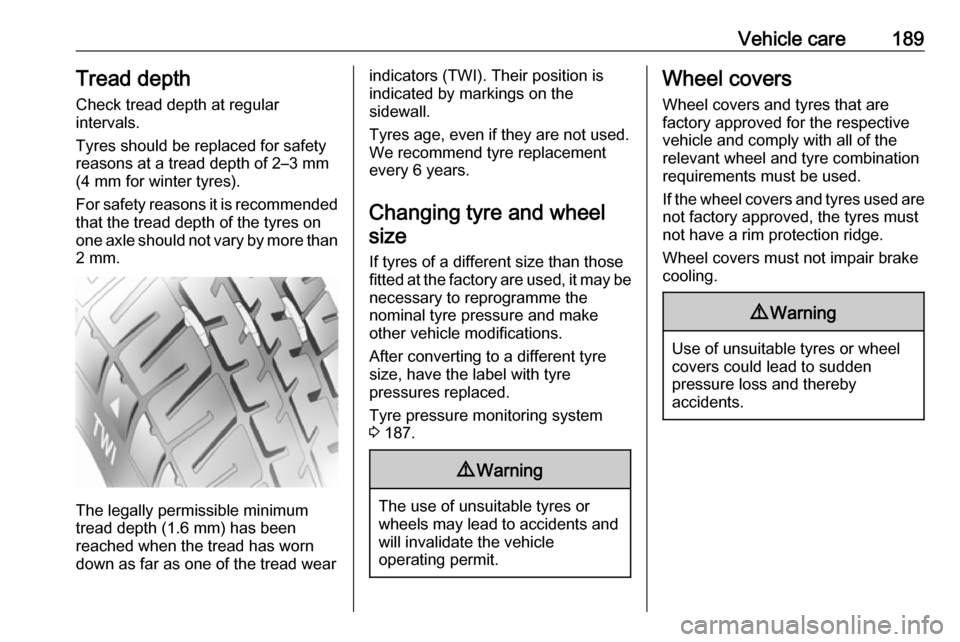
The legally permissible minimum
tread depth (1.6 mm) has been
reached when the tread has worn
down as far as one of the tread wear
indicators (TWI). Their position is
indicated by markings on the
sidewall.
Tyres age, even if they are not used.
We recommend tyre replacement
every 6 years.
Changing tyre and wheel size
If tyres of a different size than those fitted at the factory are used, it may be necessary to reprogramme the
nominal tyre pressure and make
other vehicle modifications.
After converting to a different tyre
size, have the label with tyre
pressures replaced.
Tyre pressure monitoring system
3 187.9 Warning
The use of unsuitable tyres or
wheels may lead to accidents and will invalidate the vehicle
operating permit.
Wheel covers
Wheel covers and tyres that are
factory approved for the respective
vehicle and comply with all of the
relevant wheel and tyre combination
requirements must be used.
If the wheel covers and tyres used are
not factory approved, the tyres must
not have a rim protection ridge.
Wheel covers must not impair brake
cooling.9 Warning
Use of unsuitable tyres or wheel
covers could lead to sudden
pressure loss and thereby
accidents.
Page 192 of 239

190Vehicle careTyre chains
Tyre chains are only permitted on the
front wheels.
Always use fine mesh chains that add no more than 15 mm to the tyre tread
and the inboard sides (including chain lock).
For tyre size 215/60 R17, consult a
workshop.
9 Warning
Damage may lead to tyre blowout.
Wheel covers on steel wheels may
come into contact with parts of the
chains. In such cases, remove the
wheel covers.
Tyre chains may only be used at
speeds up to 30 mph and, when
travelling on roads that are free of
snow, they may only be used for brief
periods since they are subject to rapid wear on a hard road and may snap.
The use of tyre chains is not permitted on the temporary spare wheel.
Tyre repair kit Minor damage to the tyre tread or
sidewall can be repaired with the tyre
repair kit.
Do not remove foreign bodies from
the tyres.
Tyre damage exceeding four mm or
that is at tyre sidewall near the rim
cannot be repaired with the tyre repair kit.9 Warning
Do not drive faster than 50 mph.
Do not use for a lengthy period.
Steering and handling may be
affected.
If the vehicle has a flat tyre:
Apply the parking brake and engage
first gear or reverse gear.
The tyre repair kit is located under the
driver's seat.
Vehicle tools 3 184.
1. Remove the compressor and sealant bottle from the tyre repairkit case.
2. Remove the electrical connection cable and air hose from the
compartments on the underside
of the compressor.
Page 195 of 239

Vehicle care193Seek the assistance of a
workshop.
19. Detach the tyre repair kit, return to
case and stow under the driver's
seat.9 Warning
Do not allow the sealant to contact
skin, eyes or clothing. If swallowed seek medical assistance
immediately.
Notice
The driving characteristics of the
repaired tyre is severely affected,
therefore have this tyre replaced.
If unusual noise is heard or the
compressor becomes hot, turn
compressor off for at least
30 minutes.
Pay attention to storage information
and expiry date on sealant bottle. Its
sealing capability is not guaranteed
after this time.
Replace the used sealant bottle.
Dispose of the sealant bottle as
prescribed by applicable laws.
Wheel changing
Some vehicles are equipped with a
tyre repair kit instead of a spare wheel
3 190.
Make the following preparations and
observe the following information:
● Park the vehicle on a level, firm and non-slippery surface. The
front wheels must be in the
straight-ahead position.
● Apply the parking brake and engage first gear or reverse gear.
● Remove the spare wheel 3 195.
● Never change more than one wheel at a time.
● Use the jack only to change wheels in case of puncture, not
for a seasonal winter or summer
tyre change.
● The jack is maintenance-free. ● If the ground on which the vehicle
is standing is soft, a solid board
(max. 1 cm thick) should be
placed under the jack.
● Remove heavy objects out of the
vehicle before jacking up.● No people or animals may be in the vehicle when it is jacked-up.
● Never crawl under a jacked-up vehicle.
● Do not start the engine when the vehicle is raised on the jack.
● Clean wheel bolts / nuts and thread with a clean cloth before
mounting the wheel.9 Warning
Do not grease wheel bolt, wheel
nut and wheel nut cone.
1. Remove the wheel cover (using the hook supplied).
Vehicle tools 3 184.
Page 197 of 239
Vehicle care19511. Stow the replaced wheel 3 195
and the vehicle tools 3 184.
12. Have the new wheel balanced on the vehicle.
Check the tyre pressure of the
installed tyre 3 220.
Check the wheel bolt torque.
Have the defective tyre renewed or repaired as soon as possible.
Spare wheel Some vehicles are equipped with a
tyre repair kit instead of a spare wheel
3 190.
The spare wheel can be classified as
a temporary spare wheel depending
on the size compared to the other
mounted wheels and country
regulations. In this case a permissible maximum speed applies, even
though no label at the spare wheel
indicates this.Caution
The use of a spare wheel that is smaller than the other wheels or in combination with winter tyres
could affect driveability. Have the defective tyre replaced as soon as
possible.
It may be necessary to jack the
vehicle up to gain access to the spare
wheel on a fully loaded vehicle with a
flat rear tyre.
Wheel changing 3 193.
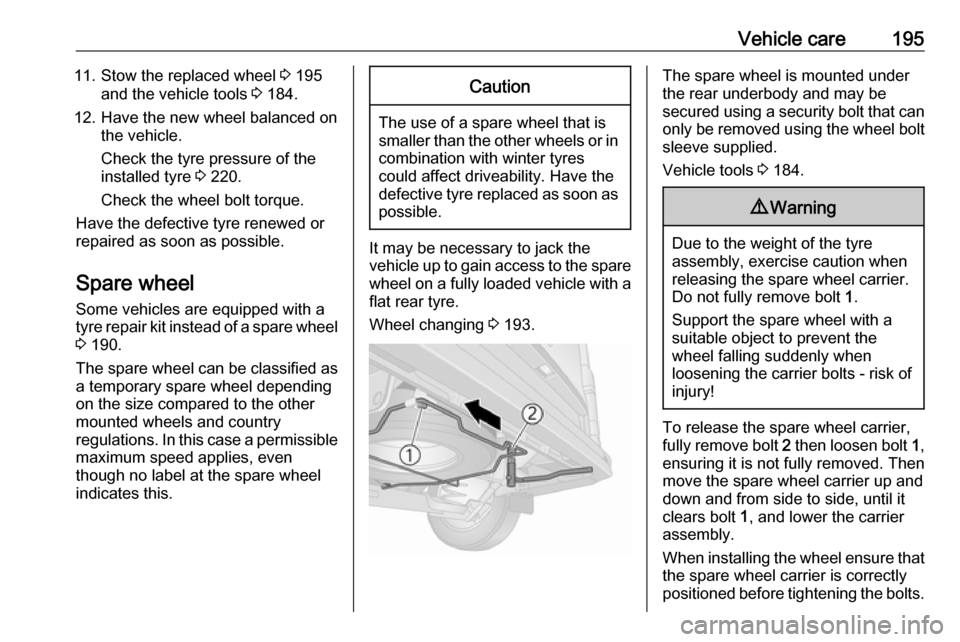
The spare wheel is mounted under
the rear underbody and may be
secured using a security bolt that can
only be removed using the wheel bolt sleeve supplied.
Vehicle tools 3 184.9 Warning
Due to the weight of the tyre
assembly, exercise caution when
releasing the spare wheel carrier.
Do not fully remove bolt 1.
Support the spare wheel with a
suitable object to prevent the
wheel falling suddenly when
loosening the carrier bolts - risk of injury!
To release the spare wheel carrier,fully remove bolt 2 then loosen bolt 1,
ensuring it is not fully removed. Then
move the spare wheel carrier up and
down and from side to side, until it
clears bolt 1, and lower the carrier
assembly.
When installing the wheel ensure that
the spare wheel carrier is correctly
positioned before tightening the bolts.
Page 198 of 239
196Vehicle careSummer and winter tyres
If you use winter tyres, the spare wheel may still be fitted with a
summer tyre.
If you use the spare wheel when it is
fitted with a summer tyre the vehicle's driveability may be affected,
especially on slippery road surfaces.
Directional tyres Fit directional tyres such that they rollin the direction of travel. The rolling
direction is indicated by a symbol
(e.g. an arrow) on the sidewall.
The following applies to tyres fitted
opposing the rolling direction:
● Driveability may be affected. Have the defective tyre renewed
or repaired as soon as possible
and fit it instead of the spare
wheel.
● Do not drive faster than 50 mph.
● Drive particularly carefully on wet
and snow-covered road
surfaces.Jump starting
Do not start with a quick charger.
A vehicle with a discharged battery
can be started using jump leads and
the vehicle battery of another vehicle.9 Warning
Be extremely careful when starting
with jump leads. Any deviation
from the following instructions can
lead to injuries or damage caused
by battery explosion or damage to the electrical systems of both
vehicles.
9 Warning
Avoid contact of the battery with
eyes, skin, fabrics and painted
surfaces. The fluid contains
sulphuric acid which can cause
injuries and damage in the event
of direct contact.
● Never expose the battery to naked flames or sparks.
● A discharged vehicle battery canalready freeze at a temperature
of 0 °C. Defrost the frozen battery
before connecting jump leads.
● Wear eye protection and protective clothing when
handling a battery.
● Use a booster battery with the same voltage (12 V). Its capacity
(Ah) must not be much less than
that of the discharged battery.
● Use jump leads with insulated terminals and a cross section of
at least 16 mm 2
(25 mm 2
for
diesel engines).
● Do not disconnect the discharged
vehicle battery from the vehicle.
● Switch off all unnecessary electrical consumers.
● Do not lean over the battery during jump starting.
● Do not allow the terminals of one
lead to touch those of the other
lead.
● The vehicles must not come into contact with each other during
the jump starting process.
Page 200 of 239
198Vehicle careTowingTowing the vehicle
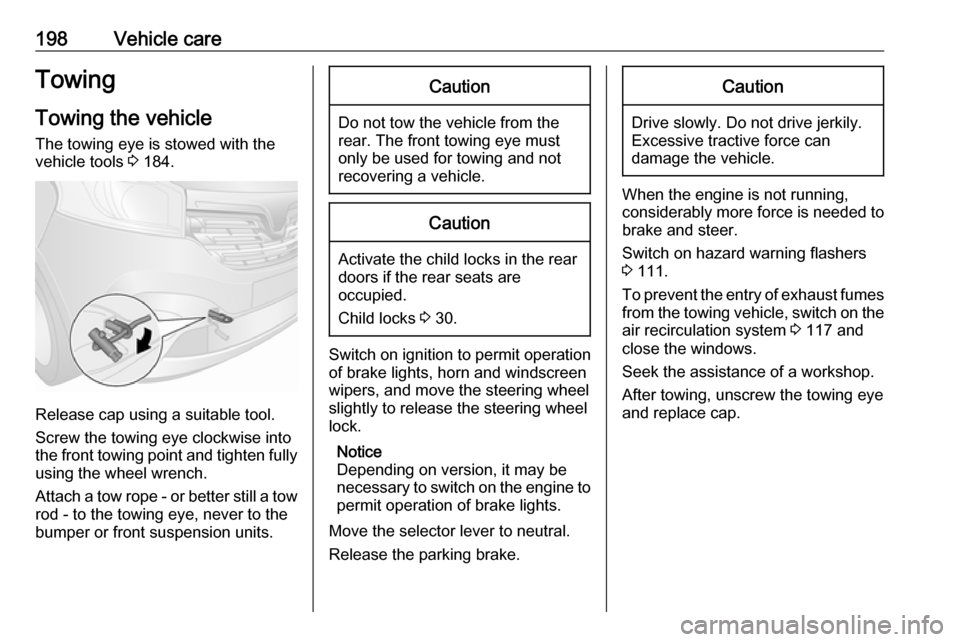
The towing eye is stowed with the
vehicle tools 3 184.
Release cap using a suitable tool.
Screw the towing eye clockwise into
the front towing point and tighten fully
using the wheel wrench.
Attach a tow rope - or better still a tow rod - to the towing eye, never to the
bumper or front suspension units.
Caution
Do not tow the vehicle from the
rear. The front towing eye must
only be used for towing and not
recovering a vehicle.
Caution
Activate the child locks in the rear
doors if the rear seats are
occupied.
Child locks 3 30.
Switch on ignition to permit operation
of brake lights, horn and windscreen
wipers, and move the steering wheel
slightly to release the steering wheel
lock.
Notice
Depending on version, it may be
necessary to switch on the engine to
permit operation of brake lights.
Move the selector lever to neutral.
Release the parking brake.
Caution
Drive slowly. Do not drive jerkily.
Excessive tractive force can
damage the vehicle.
When the engine is not running,
considerably more force is needed to
brake and steer.
Switch on hazard warning flashers
3 111.
To prevent the entry of exhaust fumes
from the towing vehicle, switch on the air recirculation system 3 117 and
close the windows.
Seek the assistance of a workshop.
After towing, unscrew the towing eye
and replace cap.
Page 206 of 239
204Service and maintenanceThe service display, located in the
Driver Information Centre, indicates
when the next service is due. Seek
the assistance of a workshop.
Service display 3 92.Recommended fluids,
lubricants and parts
Recommended fluids andlubricants
Only use products that meet the
recommended specifications.9 Warning
Operating materials are
hazardous and could be
poisonous. Handle with care. Pay
attention to information given on
the containers.
Engine oil
Engine oil is identified by its quality
and its viscosity. Quality is more
important than viscosity when
selecting which engine oil to use. The oil quality ensures e.g. engine
cleanliness, wear protection and oil
aging control, whereas viscosity
grade gives information on the oil's
thickness over a temperature range.
Dexos is the newest engine oil quality
that provides optimum protection for diesel engines. If it is unavailable,
engine oils of other listed qualities
must be used.
Select the appropriate engine oil based on its quality and on the
minimum ambient temperature
3 208.
Topping up engine oilCaution
In case of any spilled oil, wipe it up and dispose it properly.
Engine oils of different manufacturersand brands can be mixed as long as
they comply with the required engine
oil quality and viscosity.
Select the appropriate engine oil
based on its quality and on the
minimum ambient temperature
3 208.
Additional engine oil additives
The use of additional engine oil
additives could cause damage and
invalidate the warranty.
Page 233 of 239

231Child locks ................................... 30
Child restraint installation locations ................................... 66
Child restraints.............................. 64
Child restraint systems ................64
Cigarette lighter ........................... 88
Cleaning the vehicle ...................199
Climate control ............................. 15
Climate control systems .............116
Clock ............................................ 86
Coat hooks ................................... 73
Coin holder ................................... 71
Control indicators.......................... 92
Control of the vehicle .................130
Controls ........................................ 83
Controls in steering wheel ............83
Convex shape .............................. 39
Coolant ....................................... 168
Coolant and antifreeze ...............204
Coolant heater ............................ 122
Cooling (A/C) .............................. 117
Cornering lights .......................... 110
Cruise control ....................101, 151
Cupholders .................................. 73
Curtain airbag system .................. 62
D Danger, Warnings and Cautions ...4
Dashboard .................................... 10
Daytime running lights ........109, 110Declaration of conformity ............221
DEF ............................................ 140
Demisting and defrosting ..............15
Diesel exhaust fluid ....................140
Diesel fuel ................................... 159
Diesel fuel filter .......................... 172
Diesel fuel system bleeding .......172
Diesel particle filter ....................139
Directional tyres ..................185, 195
Distance to service .......................92
Document tray .............................. 73
Door locks..................................... 24
Door open .................................. 101
Door panel storage .......................74
Doors ............................................ 31
Double cab ................................... 74
DPF (diesel particle filter) ...........139
Driver assistance systems ..........151
Driver Information Centre ...........101
Driving characteristics and towing tips .............................. 161
Driving economically................... 129
Driving hints ........................ 129, 130
Driving style indicator ...................91
E
ECO mode .................................. 129
ecoScoring.................................. 104
Electric adjustment ......................39
Electrical accessories ...................87Electrical system......................... 180
Electronic climate control system 118
Electronic data recording ..............41
Electronic key system ...................21
Electronic Stability Program 98,
149, 162
Electronic Stability Program off ...98
End-of-life vehicle recovery .......165
Engine air filter............................ 167
Engine air flow indicator .............167
Engine coolant ........................... 168
Engine coolant temperature ........98
Engine data ............................... 209
Engine Drag Torque Control ......149
Engine exhaust .......................... 139
Engine identification ...................207
Engine oil ................... 166, 204, 208
Engine oil additives ....................204
Engine oil level .......................... 104
Engine oil pressure ......................99
Engine oil viscosity grades .........204
Enhanced Traction function 148, 149
Entry lighting .............................. 114
Event data recorders ..................225
Exhaust gases ....................139, 198
Exit lighting ................................ 114
Exterior care .............................. 199
Exterior light ............................... 100
Exterior lighting ....................12, 108
Exterior mirrors ............................. 39