Esc VAUXHALL VIVARO 2019 User Guide
[x] Cancel search | Manufacturer: VAUXHALL, Model Year: 2019, Model line: VIVARO, Model: VAUXHALL VIVARO 2019Pages: 231, PDF Size: 5.82 MB
Page 152 of 231
150Driving and operatingEnhanced traction function
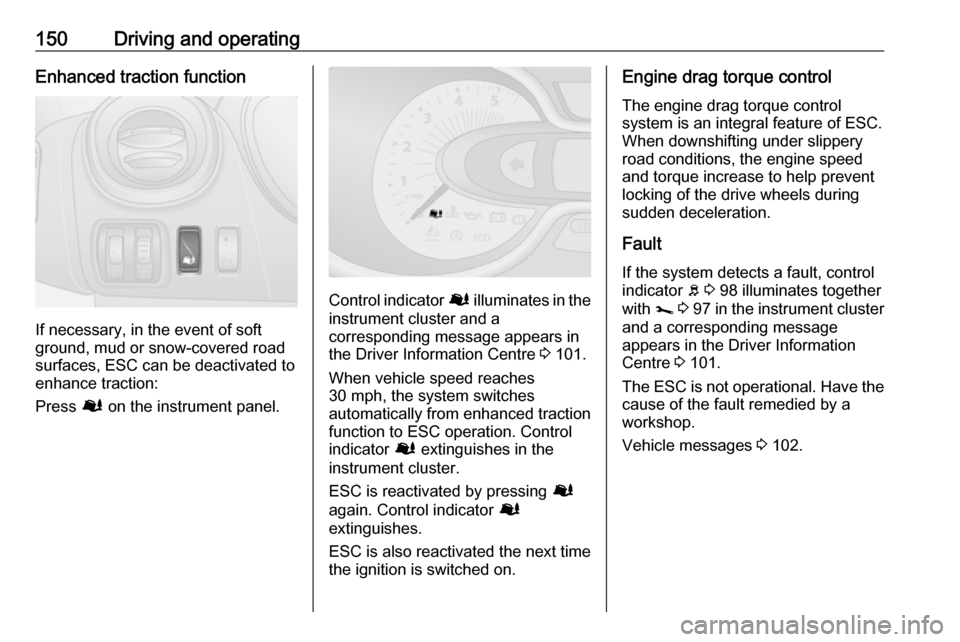
If necessary, in the event of soft
ground, mud or snow-covered road
surfaces, ESC can be deactivated to
enhance traction:
Press Ø on the instrument panel.
Control indicator Ø illuminates in the
instrument cluster and a
corresponding message appears in
the Driver Information Centre 3 101.
When vehicle speed reaches 30 mph, the system switches
automatically from enhanced traction
function to ESC operation. Control
indicator Ø extinguishes in the
instrument cluster.
ESC is reactivated by pressing Ø
again. Control indicator Ø
extinguishes.
ESC is also reactivated the next time
the ignition is switched on.
Engine drag torque control
The engine drag torque control
system is an integral feature of ESC. When downshifting under slippery
road conditions, the engine speed
and torque increase to help prevent
locking of the drive wheels during
sudden deceleration.
Fault
If the system detects a fault, control indicator b 3 98 illuminates together
with j 3 97 in the instrument cluster
and a corresponding message
appears in the Driver Information
Centre 3 101.
The ESC is not operational. Have the cause of the fault remedied by a
workshop.
Vehicle messages 3 102.
Page 165 of 231

Driving and operating163In the case of trailer loads of
1200 kg or more, the vertical coupling
load should not be less than 50 kg.
Rear axle loadWhen the trailer is coupled and the
towing vehicle fully loaded (including all occupants), the permissible rear
axle load (see identification plate or
vehicle documents) must not be
exceeded.
Trailer stability assist
If the system detects snaking
movements, engine power is reduced
and the vehicle / trailer combination is selectively braked until the snaking
ceases. While the system is working,
keep steering wheel as still as
possible.
Trailer stability assist is a function of
the Electronic Stability Control (ESC)
3 149.
Page 184 of 231
182Vehicle careIt is advisable to carry a full set of
fuses. Provision is made in the fuse
box for the storing of spare fuses.
Some functions are protected by
several fuses.
Fuses may also be inserted without existence of a function.
Notice
Not all fuse box descriptions in this
Owner's Manual may apply to your
vehicle. Refer to the fuse box label,
where fitted.
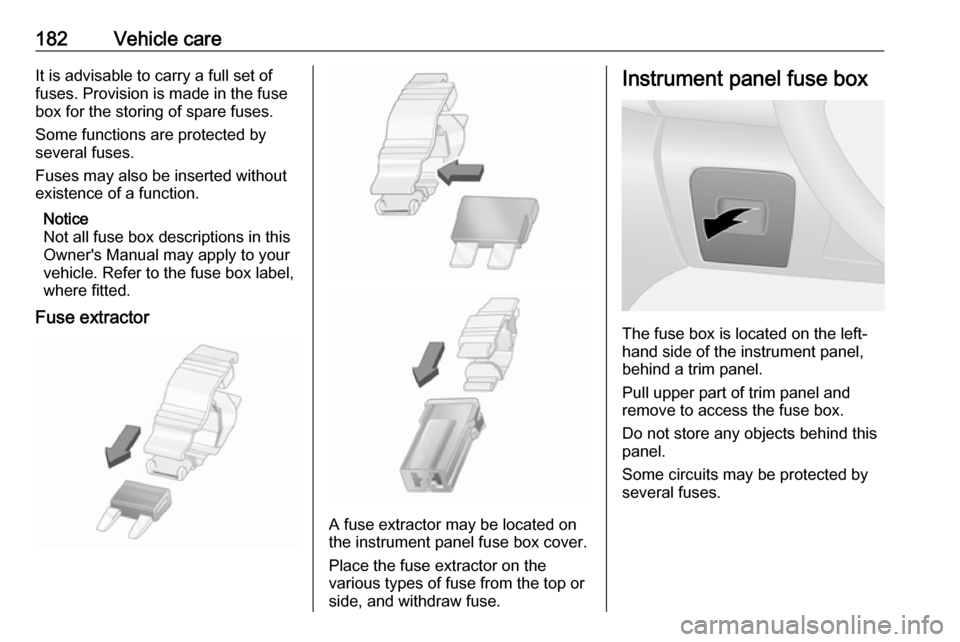
Fuse extractor
A fuse extractor may be located on
the instrument panel fuse box cover.
Place the fuse extractor on the
various types of fuse from the top or
side, and withdraw fuse.
Instrument panel fuse box
The fuse box is located on the left-
hand side of the instrument panel, behind a trim panel.
Pull upper part of trim panel and
remove to access the fuse box.
Do not store any objects behind this
panel.
Some circuits may be protected by
several fuses.
Page 188 of 231

186Vehicle careWheels and tyres
Tyre condition, wheel condition Drive over edges slowly and at right
angles if possible. Driving over sharp
edges can cause tyre and wheel
damage. Do not trap tyres on the kerb when parking.
Regularly check the wheels for
damage. Seek the assistance of a
workshop in the event of damage or
unusual wear.
We recommend not swapping the
front wheels with the rear wheels and
vice versa, as this can affect vehicle
stability. Always use less worn tyres
on the rear axle.
Tyres
Factory-fitted tyres are matched to
the chassis and offer optimum driving comfort and safety.Winter tyres
Winter tyres improve driving safety at temperatures below 7 °C and should
therefore be fitted on all wheels.
In accordance with country-specific
regulations, a notice indicating the
maximum permissible speed for the
tyres must be affixed within the
driver's field of vision.
Tyre designations
E.g. 195/65 R 16 C 88 Q195:Tyre width, mm65:Cross-section ratio (tyre height
to tyre width), %R:Belt type: RadialRF:Type: RunFlat16:Wheel diameter, inchesC:Cargo or commercial use88:Load index e.g. 88 is
equivalent to 567 kgQ:Speed code letter
Speed code letter:
Q:up to 100 mphS:up to 112 mphT:up to 118 mphH:up to 130 mphV:up to 150 mphW:up to 168 mph
Choose a tyre appropriate for the
maximum speed of your vehicle.
The maximum speed is achievable at kerb weight with driver (75 kg) plus
125 kg payload. Optional equipment
could reduce the maximum speed of
the vehicle.
Directional tyres
Fit directional tyres such that they roll in the direction of travel. The rolling
direction is indicated by a symbol
(e.g. an arrow) on the sidewall.
Tyre pressure
Check the pressure of cold tyres at
least every 14 days and before any
long journey. Do not forget the spare
wheel. This also applies to vehicles
with tyre pressure monitoring system.
Page 190 of 231
188Vehicle careTyre pressure monitoring
system
The tyre pressure monitoring system
uses radio and sensor technology to
check tyre pressure levels.Caution
Tyre pressure monitoring system
warns only about low tyre pressure condition and does not replace
regular tyre maintenance by the
driver.
All wheels must be equipped with pressure sensors and the tyres must
have the prescribed pressure.
Notice
In countries where the tyre pressure
monitoring system is legally
required, the use of wheels without
pressure sensors will invalidate the
vehicle operating permit.
The tyre pressure monitoring system
sensors monitor the air pressure in
the tyres and transmit tyre pressure
readings to a receiver located in the
vehicle.
Tyre pressure chart 3 213.
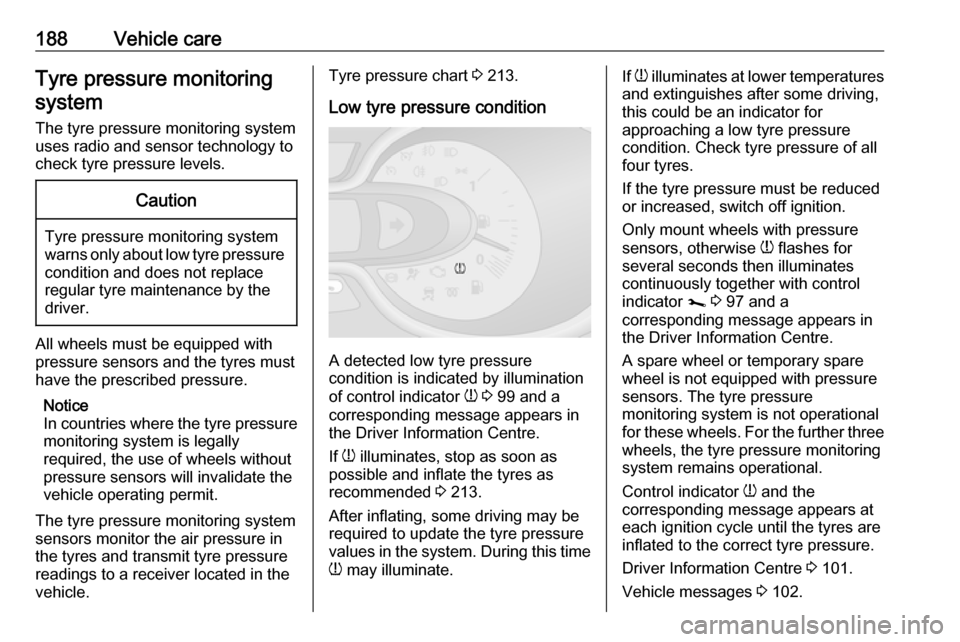
Low tyre pressure condition
A detected low tyre pressure
condition is indicated by illumination
of control indicator w 3 99 and a
corresponding message appears in
the Driver Information Centre.
If w illuminates, stop as soon as
possible and inflate the tyres as
recommended 3 213.
After inflating, some driving may be
required to update the tyre pressure
values in the system. During this time
w may illuminate.
If
w illuminates at lower temperatures
and extinguishes after some driving,
this could be an indicator for
approaching a low tyre pressure
condition. Check tyre pressure of all
four tyres.
If the tyre pressure must be reduced
or increased, switch off ignition.
Only mount wheels with pressure
sensors, otherwise w flashes for
several seconds then illuminates
continuously together with control
indicator j 3 97 and a
corresponding message appears in
the Driver Information Centre.
A spare wheel or temporary spare
wheel is not equipped with pressure
sensors. The tyre pressure
monitoring system is not operational
for these wheels. For the further three wheels, the tyre pressure monitoring
system remains operational.
Control indicator w and the
corresponding message appears at
each ignition cycle until the tyres are
inflated to the correct tyre pressure.
Driver Information Centre 3 101.
Vehicle messages 3 102.
Page 194 of 231
192Vehicle care
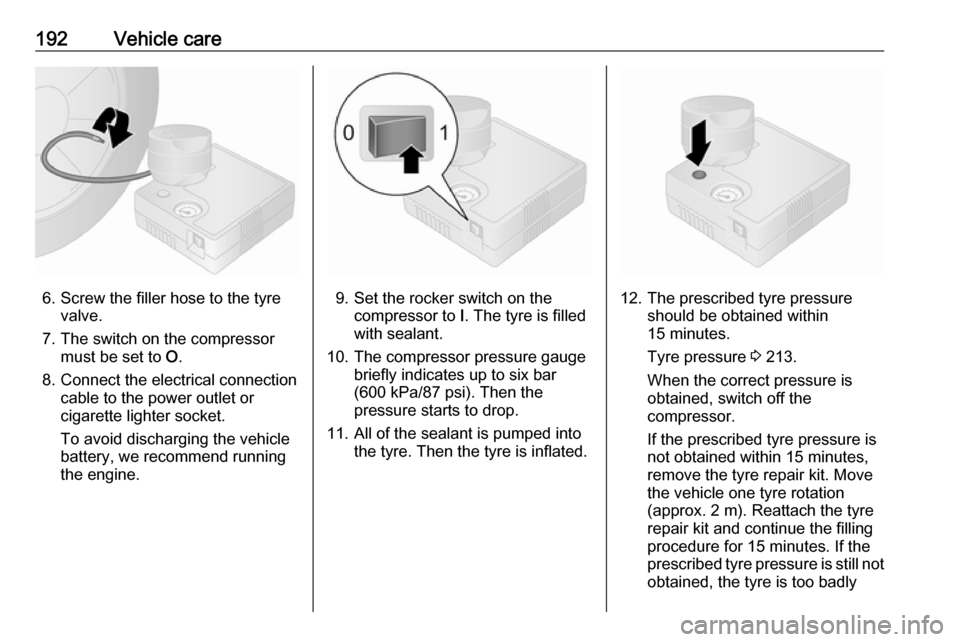
6. Screw the filler hose to the tyrevalve.
7. The switch on the compressor must be set to O.
8. Connect the electrical connection cable to the power outlet or
cigarette lighter socket.
To avoid discharging the vehicle
battery, we recommend running
the engine.9. Set the rocker switch on the compressor to I. The tyre is filled
with sealant.
10. The compressor pressure gauge briefly indicates up to six bar
(600 kPa/87 psi). Then the
pressure starts to drop.
11. All of the sealant is pumped into the tyre. Then the tyre is inflated.12. The prescribed tyre pressure should be obtained within
15 minutes.
Tyre pressure 3 213.
When the correct pressure is
obtained, switch off the
compressor.
If the prescribed tyre pressure is
not obtained within 15 minutes,
remove the tyre repair kit. Move
the vehicle one tyre rotation
(approx. 2 m). Reattach the tyre
repair kit and continue the filling
procedure for 15 minutes. If the
prescribed tyre pressure is still not
obtained, the tyre is too badly
Page 195 of 231
Vehicle care193damaged. Seek the assistance of
a workshop.
Drain excess tyre pressure with
the button beside the pressure
indicator.
Do not run the compressor for
longer than 15 minutes.
13. Detach the tyre repair kit.
14. Remove any excess sealant using a cloth.
15. Take the label indicating maximum permitted speed from
the tyre repair kit and affix in the driver's field of view.
16. Store the sealant bottle in the plastic bag. Return tyre repair kit
to case and stow under the driver's seat.
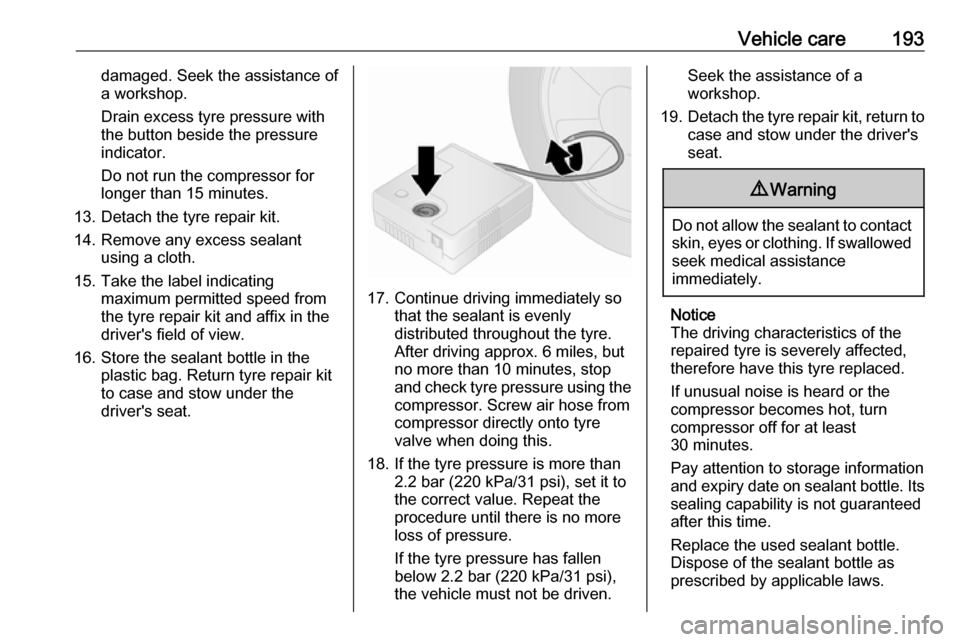
17. Continue driving immediately so that the sealant is evenly
distributed throughout the tyre.
After driving approx. 6 miles, but
no more than 10 minutes, stop
and check tyre pressure using the compressor. Screw air hose from
compressor directly onto tyre
valve when doing this.
18. If the tyre pressure is more than 2.2 bar (220 kPa/31 psi), set it to
the correct value. Repeat the
procedure until there is no more
loss of pressure.
If the tyre pressure has fallen
below 2.2 bar (220 kPa/31 psi),
the vehicle must not be driven.
Seek the assistance of a
workshop.
19. Detach the tyre repair kit, return to
case and stow under the driver's
seat.9 Warning
Do not allow the sealant to contact
skin, eyes or clothing. If swallowed seek medical assistance
immediately.
Notice
The driving characteristics of the
repaired tyre is severely affected,
therefore have this tyre replaced.
If unusual noise is heard or the
compressor becomes hot, turn
compressor off for at least
30 minutes.
Pay attention to storage information
and expiry date on sealant bottle. Its
sealing capability is not guaranteed
after this time.
Replace the used sealant bottle.
Dispose of the sealant bottle as
prescribed by applicable laws.
Page 221 of 231

Customer information219Operating data in the vehicleControl units process data for
operation of the vehicle.
This data includes, e.g.: ● vehicle status information (e.g. speed, movement delay, lateral
acceleration, wheel rotation rate,
"seat belts fastened" display)
● ambient conditions (e.g. temperature, rain sensor,
distance sensor)
As a rule such data is transient, not
stored for longer than an operational
cycle, and only processed on board
the vehicle itself. Control units often
include data storage (including the
vehicle key). This is used to allow
information to be documented
temporarily or permanently on vehicle
condition, component stress,
maintenance requirements and
technical events and errors.Depending on technical equipment
level, the data stored is as follows:
● system component operating states (e.g. fill level, tyre
pressure, battery status)
● faults and defects in important system components (e.g. lights,brakes)
● system reactions in special driving situations (e.g. triggering
of an airbag, actuation of the
stability control systems)
● information on events damaging the vehicle
● for electric vehicles the amount of
charge in the high-voltage
battery, estimated range
In special cases (e.g. if the vehicle
has detected a malfunction), it may be
necessary to save data that would
otherwise just be volatile.
When you use services (e.g. repairs,
maintenance), the operating data
saved can be read together with the
vehicle identification number and
used when necessary. Staff working
for the service network ( e.g. garages,
manufacturers) or third parties (e.g.breakdown services) can read the
data from the vehicle. The same
applies to warranty work and quality
assurance measures.
Data is generally read via the OBD
(On-Board Diagnostics) port
prescribed by law in the vehicle. The operating data which is read out,
documents the technical condition of
the vehicle or individual components
and assists with fault diagnosis,
compliance with warranty obligations
and quality improvement. This data,
in particular information on
component stress, technical events,
operator errors and other faults, is
transmitted to the manufacturer
where appropriate, together with the
vehicle identification number. The
manufacturer is also subject to
product liability. The manufacturer
potentially also uses operating data
from vehicles for product recalls. This
data can also be used to check
customer warranty and guarantee
claims.
Fault memories in the vehicle can be
reset by a service company when
carrying out servicing or repairs or at
your request.
Page 223 of 231

Customer information221Online servicesIf your vehicle has a radio network
connection, this allows data to be exchanged between your vehicle and other systems. The radio network
connection is made possible by
means of a transmitter device in your
vehicle or a mobile device provided
by you (e.g. a smartphone). Online
functions can be used via this radio
network connection. These include
online services and applications /
apps provided to you by the
manufacturer or other providers.
Proprietary services
In the case of the manufacturer's
online services, the relevant functions are described by the manufacturer in
an appropriate location (e.g. Owner's
Manual, the manufacturer's website)
and the associated data protection
information is provided. Personal
data may be used to provide online
services. Data exchange for this
purpose takes place via a protected
connection, e.g. using the
manufacturer's IT systems provided
for the purpose. Collection,processing and use of personal data
for the purposes of preparation of services take place solely on the
basis of legal permission, e.g. in the
case of a legally prescribed
emergency communication system or a contractual agreement, or by virtue
of consent.
You can activate or deactivate the
services and functions (which are
subject to charges to some extent)
and, in some cases, the vehicle's
entire radio network connection. This
does not include statutory functions
and services such as an emergency
communication system.
Third party services
If you make use of online services
from other providers (third parties),
these services are subject to the
liability and data protection and usage conditions of the provider in question.
The manufacturer frequently has no
influence over the content exchanged
in this regard.Therefore, please note the nature,
scope and purpose of the collection
and use of personal data within the
scope of third party services provided by the service provider in question.
Radio Frequency
Identification (RFID)
RFID technology is used in some
vehicles for functions such as tyre
pressure monitoring and immobiliser.
It is also used in connection with
conveniences such as radio remote
controls for door locking / unlocking
and starting. RFID technology in
Vauxhall vehicles does not use or
record personal information or link
with any other Vauxhall system
containing personal information.