ignition VAUXHALL ZAFIRA 2014.5 Repair Manual
[x] Cancel search | Manufacturer: VAUXHALL, Model Year: 2014.5, Model line: ZAFIRA, Model: VAUXHALL ZAFIRA 2014.5Pages: 219, PDF Size: 7.83 MB
Page 178 of 219

176Vehicle care
The tyre pressure tables show allpossible tyre combinations 3 206.
For the tyres approved for your
vehicle, refer to the EEC Certificate of Conformity provided with your vehicle
or other national registration
documents.
The driver is responsible for correct
adjustment of tyre pressure.9 Warning
If the pressure is too low, this can
result in considerable tyre warm-
up and internal damage, leading to tread separation and even to tyre
blow-out at high speeds.
Tyre pressure monitoring
system
The tyre pressure monitoring system
continually checks the pressure of all
four wheels when vehicle speed
exceeds a certain limit.
All wheels must be equipped with
pressure sensors and the tyres must
have the prescribed pressure.
When a low tyre condition is detected,
A illuminates. If A comes on, stop as
soon as possible and inflate the tyres as recommended in this manual. Tyre pressures 3 206.
After inflating the tyres to the
appropriate pressure, A may stay
illuminated. Pressure change will be
recognized as the vehicles is driven.
Notice
In countries where the tyre pressure
monitoring system is legally
required, the use of wheels without
pressure sensors will invalidate the
vehicle type approval.
The current tyre pressures may be
shown in the Info-Display 3 107.
Vehicle messages, tyre pressure 3 102.
Control indicator w 3 91.
If the tyre pressure shall be reduced
or increased, switch off ignition.
w may come on in cool weather when
the vehicle is first started and then
turn off as the vehicle is driven. Thiscould be an early indicator that the air
pressure is getting low and needs to
be inflated to the proper pressure.
A spare or temporary spare wheel is
not equipped with pressure sensors.
The tyre pressure monitoring system
is not operational for these wheels
and w illuminates.
Winter tyres or additional wheel sets
have to be fitted with sensors,
otherwise the system will not work
and w will indicate malfunction by
flashing one minute and then
illuminate continuously.
The use of commercially available
liquid tyre repair kits can impair the
function of the system. Factory-
approved repair kits can be used.
External high-power radio equipment
could disrupt the tyre pressure
monitoring system.
Unsuited rims can impair the
transmission quality of the tyre
pressure monitoring system sensors.
Page 179 of 219
Vehicle care177
Each time the tyres are replaced, the
tyre pressure monitoring system
sensors have to be dismounted and
serviced. For the screwed sensor
replace the valve core and sealing
ring, for the clipped sensor replace
complete rubber valve stem.
Auto learn function After changing wheels the vehicle
must be stationary for approx.
20 minutes, before the system
recalculates. The following relearn
process takes up to 10 minutes of
driving with a minimum speed of
25 km/h. ---- can be displayed in the
Info-display or pressure values can
swap.
If problems occur during the relearn
process, w will flash and then
illuminate continously.Temperature dependency
Cold tyres decrease the tyre
pressure, warm tyres increase the
tyre pressure. During driving tyre
temperature and pressure increase.
The displayed tyre pressure value
shows the actual tyre pressure.
Therefore it is important to check tyre
pressure with cold tyres.
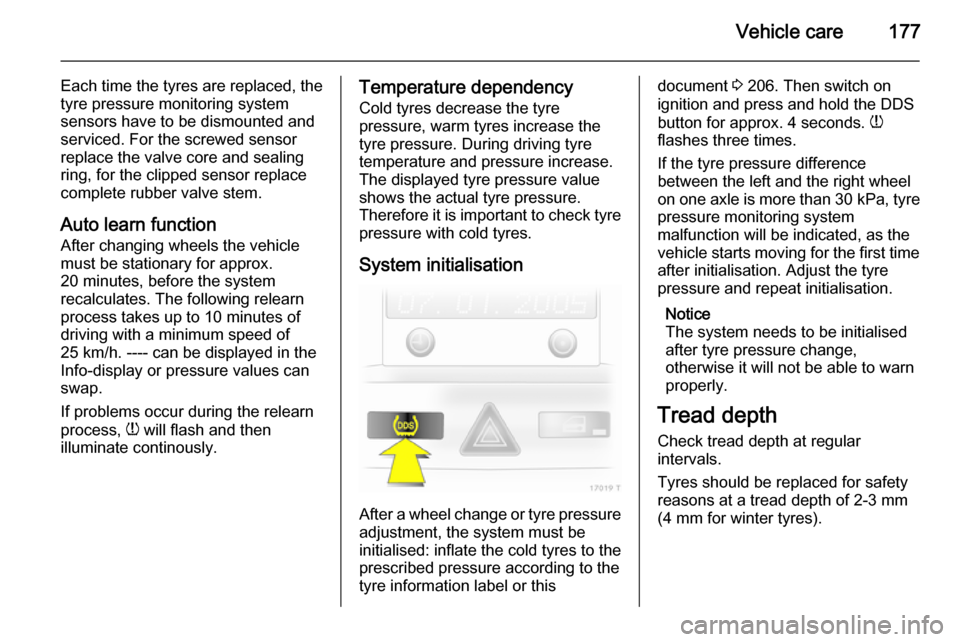
System initialisation
After a wheel change or tyre pressure
adjustment, the system must be
initialised: inflate the cold tyres to the
prescribed pressure according to the
tyre information label or this
document 3 206. Then switch on
ignition and press and hold the DDS
button for approx. 4 seconds. w
flashes three times.
If the tyre pressure difference
between the left and the right wheel
on one axle is more than 30 kPa, tyre
pressure monitoring system
malfunction will be indicated, as the vehicle starts moving for the first time after initialisation. Adjust the tyre
pressure and repeat initialisation.
Notice
The system needs to be initialised
after tyre pressure change,
otherwise it will not be able to warn
properly.
Tread depth
Check tread depth at regular
intervals.
Tyres should be replaced for safety
reasons at a tread depth of 2-3 mm
(4 mm for winter tyres).
Page 190 of 219
188Vehicle care
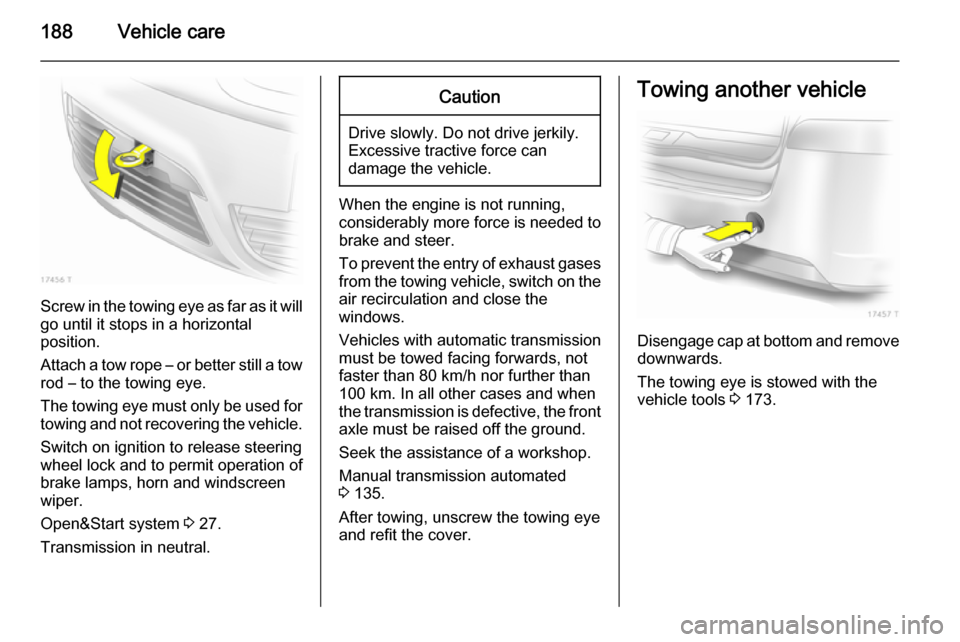
Screw in the towing eye as far as it will
go until it stops in a horizontal
position.
Attach a tow rope – or better still a tow
rod – to the towing eye.
The towing eye must only be used for towing and not recovering the vehicle.
Switch on ignition to release steering
wheel lock and to permit operation of
brake lamps, horn and windscreen
wiper.
Open&Start system 3 27.
Transmission in neutral.
Caution
Drive slowly. Do not drive jerkily.
Excessive tractive force can
damage the vehicle.
When the engine is not running,
considerably more force is needed to
brake and steer.
To prevent the entry of exhaust gases from the towing vehicle, switch on the
air recirculation and close the
windows.
Vehicles with automatic transmission
must be towed facing forwards, not faster than 80 km/h nor further than
100 km. In all other cases and when
the transmission is defective, the front axle must be raised off the ground.
Seek the assistance of a workshop.
Manual transmission automated
3 135.
After towing, unscrew the towing eye
and refit the cover.
Towing another vehicle
Disengage cap at bottom and remove
downwards.
The towing eye is stowed with the
vehicle tools 3 173.
Page 196 of 219

194Service and maintenance
Fixed service interval
When service is due, InSP appears in
the service display for approx.
10 seconds when the ignition is
switched on. Have the next service
performed by a workshop within
one week or 500 km (whichever
occurs first).
Flexible service interval
The service interval is based on
several parameters depending on
usage and is calculated using these
parameters.
If the remaining distance is less than
1500 km, InSP is displayed with a
remaining distance of 1000 km when
the ignition is switched on and off. If
less than 1000 km remain, InSP is
displayed for several seconds. Have
the next service performed by a
workshop within one week or
500 km (whichever occurs first).Display of remaining distance:
1. Switch off ignition.
2. Briefly press the trip odometer reset button. The odometer
reading is shown.
3. Press and hold the reset button for
about 2 seconds. InSP and the
remaining distance are displayed.Recommended fluids,
lubricants and parts
Recommended fluids and
lubricants Only use products that meet therecommended specifications.
Damage resulting from the use of
products not in line with these
specifiations will not be covered by
the warranty.9 Warning
Operating materials are
hazardous and could be
poisonous. Handle with care. Pay
attention to information given on
the containers.
Engine oil
Engine oil is identified by its quality
and its viscosity. Quality is more
important than viscosity when
selecting which engine oil to use. The oil quality ensures e.g. engine
cleanliness, wear protection and oil
Page 212 of 219

210Customer information
■ Vehicle reactions in particulardriving situations (e.g. inflation of
an airbag, activation of the stability
regulation system)
■ Environmental conditions (e.g. temperature)
These data are exclusively technical
and help identifying and correcting
errors as well as optimizing vehicle
functions.
Motion profiles indicating travelled
routes cannot be created with these
data.
If services are used (e.g. repair
works, service processes, warranty
cases, quality assurance),
employees of the service network
(manufacturer included) are able to
read out this technical information
from the event and error data storage
modules applying special diagnostic
devices. If required, you will receive
further information at these
workshops. After an error has been
corrected, the data are deleted from
the error storage module or they are
constantly overwritten.When using the vehicle, situations
may occur in which these technical
data related to other information
(accident report, damages on the
vehicle, witness statements etc.) may be associated with a specific person -
possibly, with the assistance of an
expert.
Additional functions contractually
agreed upon with the client (e.g.
vehicle location in emergency cases)
allow the transmission of particular vehicle data from the vehicle.Radio Frequency
Identification (RFID) RFID technology is used in somevehicles for functions such as tyre
pressure monitoring and ignition
system security. It is also used in
connection with conveniences such
as radio remote controls for door
locking/unlocking and starting, and in-
vehicle transmitters for garage door
openers. RFID technology in
Vauxhall vehicles does not use or
record personal information or link with any other Vauxhall system
containing personal information.
Page 216 of 219

214
Hazard warning flashers ............112
Headlight flash ........................... 110
Headlight range adjustment ......110
Headlights................................... 109
Headlights when driving abroad 110
Head restraint adjustment .............8
Head restraints ............................ 43
Heated mirrors ............................. 38
Heated rear window ..................... 41
Heating ........................................ 48
Heating and ventilation system . 117
High beam ........................... 93, 110
Hill start assist ........................... 140
Horn ....................................... 13, 79
I
Identification plate .....................198
Ignition switch positions .............126
Immobiliser .................................. 36
Indicators ...................................... 84
Information displays...................... 94
Instrument cluster ........................84
Instrument panel illumination .....166
Instrument panel illumination control .................................... 114
Instrument panel overview ........... 10
Interactive driving system ...........141
Interactive driving system, continuous damping control,
sport mode ............................... 91Interior care ............................... 191
Interior lighting ............................ 114
Interior lights ...................... 114, 165
Interior mirrors .............................. 38
Interruption of power supply 133, 138
Introduction .................................... 3
Isofix child restraint systems ........ 67
J Jump starting ............................. 186
K Key, memorised settings ..............27
Keys ............................................. 25
Keys, locks ................................... 25
L
Lashing eyes ............................... 72
Lighting ...................................... 102
Lighting features .........................115
Light switch ................................ 109
Load compartment ................33, 70
Load compartment cover .............70
Load compartment fuse box ......170
Loading information .....................76
Load rails and hooks ...................71
Low engine oil level .....................92
Low fuel ....................................... 92M
Malfunction indicator light ............88
Manual anti-dazzle ......................38
Manual mode .....................131, 136
Manual transmission .................. 134
Manual transmission automated 135
Manual windows ..........................39
Memorised settings ......................27
Mirror adjustment ........................... 9
Misted light covers .....................113
Moonroof ..................................... 42
N New vehicle running-in ..............125
Number plate light .....................165
O Object detection systems ...........143
Odometer ..................................... 84
Oil, engine .......................... 194, 199
Open&Start system .....................27
Open&Start system .....................92
Outside temperature ....................81
Overrun cut-off ........................... 127
P Parking ................................ 17, 127
Parking assist ............................ 143
Parking brake ............................ 140
Parking lights ............................. 113