cooling VAUXHALL ZAFIRA 2014 User Guide
[x] Cancel search | Manufacturer: VAUXHALL, Model Year: 2014, Model line: ZAFIRA, Model: VAUXHALL ZAFIRA 2014Pages: 217, PDF Size: 7.85 MB
Page 125 of 217
Climate control123
Open slats and adjust direction of air
flow.
To close the vents, direct slats
downwards.9 Warning
Do not attach any objects to the
slats of the air vents. Risk of
damage and injury in case of an
accident.
Fixed air vents
Additional air vents are located
beneath the windscreen and door windows and in the foot wells.
Maintenance
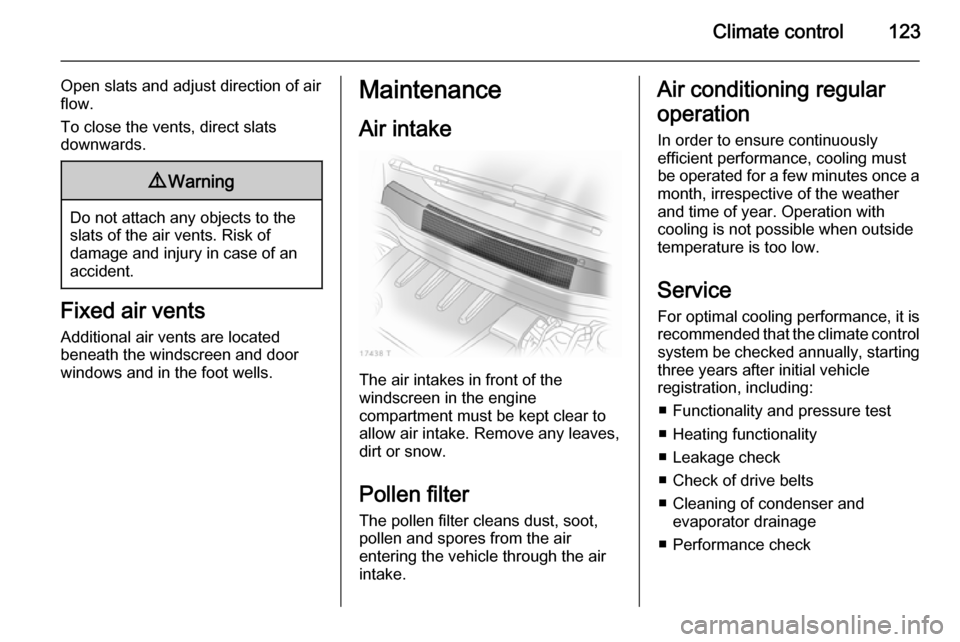
Air intake
The air intakes in front of the
windscreen in the engine
compartment must be kept clear to
allow air intake. Remove any leaves,
dirt or snow.
Pollen filter
The pollen filter cleans dust, soot,
pollen and spores from the air
entering the vehicle through the air
intake.
Air conditioning regular
operation In order to ensure continuously
efficient performance, cooling must
be operated for a few minutes once a
month, irrespective of the weather
and time of year. Operation with
cooling is not possible when outside
temperature is too low.
Service For optimal cooling performance, it isrecommended that the climate control
system be checked annually, starting three years after initial vehicle
registration, including:
■ Functionality and pressure test■ Heating functionality
■ Leakage check
■ Check of drive belts
■ Cleaning of condenser and evaporator drainage
■ Performance check
Page 148 of 217

146Driving and operating
For the values specific to your
vehicle, refer to the EEC Certificate of Conformity provided with your vehicle
or other national registration
documents.
General information The official fuel consumption and
specific CO 2 emission figures quoted
relate to the EU base model with
standard equipment.
Fuel consumption data and CO 2
emission data are determined
according to regulation
R (EC) No. 715/2007 (in the latest
applicable version), taking into
consideration the vehicle weight in
running order, as specified by the
regulation.
The figures are provided only for the
purpose of comparison between
different vehicle variants and must
not be taken as a guarantee for the
actual fuel consumption of a
particular vehicle. Additional
equipment may result in slightly
higher results than the stated
consumption and CO 2 figures.Furthermore, fuel consumption is
dependent on personal driving style
as well as road and traffic conditions.
Natural gas
The fuel consumption information
was obtained using reference fuel
G20 (methane proportion
99 - 100 mol%) under prescribed
driving conditions. When using
natural gas with a lower proportion of
methane, the fuel consumption can
differ from the specified values.Trailer hitch
General information
Only use towing equipment that has
been approved for your vehicle.
Entrust retrofitting of towing
equipment to a workshop. It may be
necessary to make changes that
affect the cooling system, heat
shields or other equipment.
Fitting of towing equipment could
cover the opening of the towing eye.
If this is the case, use the coupling ball
bar for towing. Always keep the
coupling ball bar in the vehicle.
Installation dimensions of factory-
fitted towing equipment 3 207.
Driving characteristics and towing tips Before attaching a trailer, lubricate
the coupling ball. However, do not do
so if a stabiliser, which acts on the
coupling ball, is being used to reduce snaking movements.
Page 154 of 217
152Vehicle care
■ Open bonnet, close all doors andlock the vehicle.
■ Disconnect the clamp from the negative terminal of the vehicle
battery. Beware that all systems are not functional, e.g. anti-theft alarm
system.
Putting back into operation Following must be done if the vehicle
is putting back into operation:
■ Connect the clamp to the negative terminal of the vehicle battery.
Activate the electronics of the
power windows.
■ Check tyre pressure.
■ Fill up the washer fluid reservoir.
■ Check the engine oil level.
■ Check the coolant level.
■ Fit the number plate if necessary.End-of-life vehicle
recovery
Information on end-of-life vehicle
recovery centres and the recycling of
end-of-life vehicles is available on our website. Only entrust this work to an
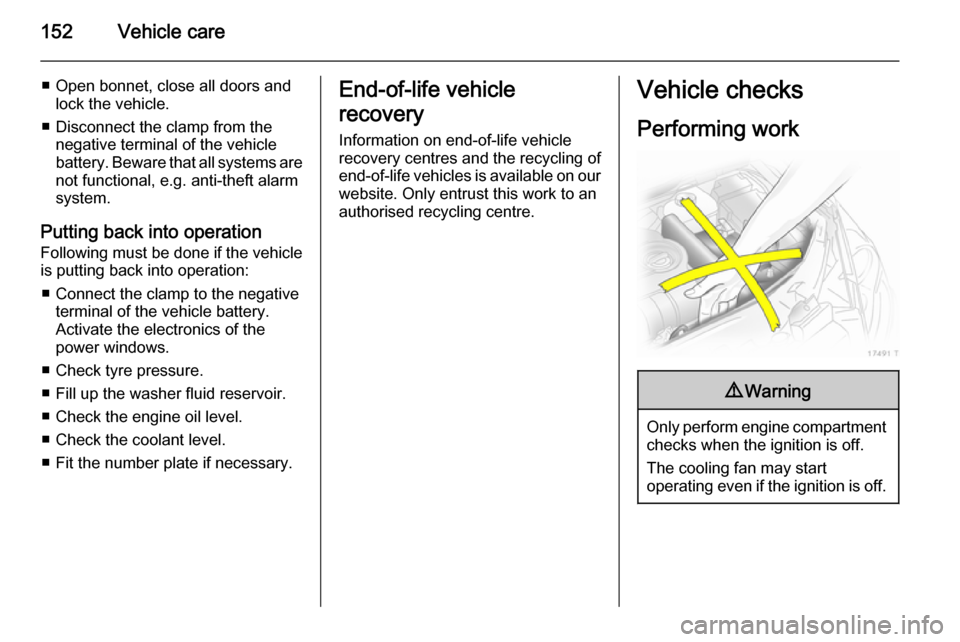
authorised recycling centre.Vehicle checks
Performing work9 Warning
Only perform engine compartment
checks when the ignition is off.
The cooling fan may start
operating even if the ignition is off.
Page 157 of 217
Vehicle care155
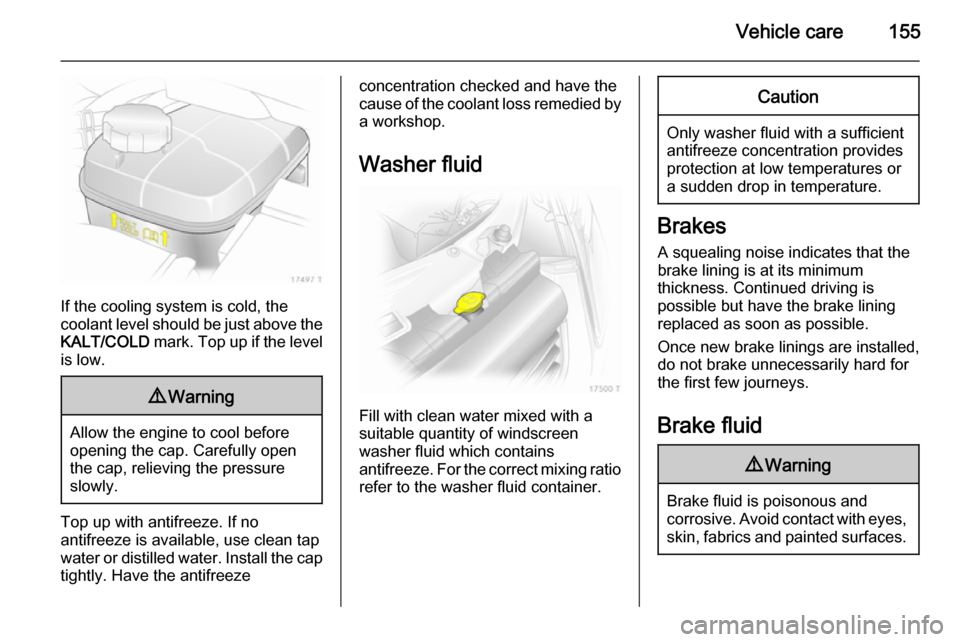
If the cooling system is cold, the
coolant level should be just above the
KALT/COLD mark. Top up if the level
is low.
9 Warning
Allow the engine to cool before
opening the cap. Carefully open
the cap, relieving the pressure
slowly.
Top up with antifreeze. If no
antifreeze is available, use clean tap
water or distilled water. Install the cap
tightly. Have the antifreeze
concentration checked and have the
cause of the coolant loss remedied by a workshop.
Washer fluid
Fill with clean water mixed with a
suitable quantity of windscreen
washer fluid which contains
antifreeze. For the correct mixing ratio refer to the washer fluid container.
Caution
Only washer fluid with a sufficient
antifreeze concentration provides
protection at low temperatures or
a sudden drop in temperature.
Brakes
A squealing noise indicates that the
brake lining is at its minimum
thickness. Continued driving is
possible but have the brake lining
replaced as soon as possible.
Once new brake linings are installed,
do not brake unnecessarily hard for
the first few journeys.
Brake fluid
9 Warning
Brake fluid is poisonous and
corrosive. Avoid contact with eyes,
skin, fabrics and painted surfaces.
Page 178 of 217
176Vehicle careTread depth
Check tread depth at regular
intervals.
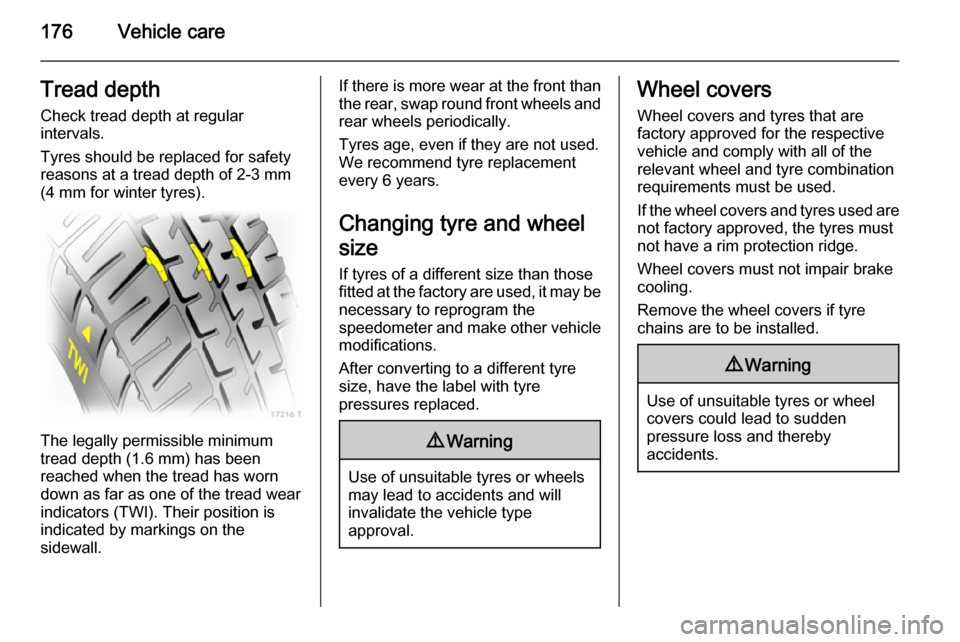
Tyres should be replaced for safety
reasons at a tread depth of 2-3 mm
(4 mm for winter tyres).
The legally permissible minimum
tread depth (1.6 mm) has been
reached when the tread has worn
down as far as one of the tread wear
indicators (TWI). Their position is
indicated by markings on the
sidewall.
If there is more wear at the front than
the rear, swap round front wheels and rear wheels periodically.
Tyres age, even if they are not used.
We recommend tyre replacement
every 6 years.
Changing tyre and wheel
size If tyres of a different size than those
fitted at the factory are used, it may be necessary to reprogram the
speedometer and make other vehicle
modifications.
After converting to a different tyre
size, have the label with tyre
pressures replaced.9 Warning
Use of unsuitable tyres or wheels
may lead to accidents and will
invalidate the vehicle type
approval.
Wheel covers
Wheel covers and tyres that are
factory approved for the respective
vehicle and comply with all of the
relevant wheel and tyre combination requirements must be used.
If the wheel covers and tyres used are
not factory approved, the tyres must
not have a rim protection ridge.
Wheel covers must not impair brake
cooling.
Remove the wheel covers if tyre
chains are to be installed.9 Warning
Use of unsuitable tyres or wheel
covers could lead to sudden
pressure loss and thereby
accidents.
Page 213 of 217

211
Child restraints.............................. 61
Child restraint systems ................61
Cigarette lighter ........................... 82
Climate control ............................. 14
Climate control systems .............116
Clock ............................................ 80
Continuous damping control ......141
Control indicators.......................... 84
Control of the vehicle .................124
Controls ........................................ 77
Convex shape .............................. 38
Coolant and antifreeze ...............192
Cruise control ...................... 92, 141
Cupholders .................................. 67
Curtain airbag system .................. 61
Curve lighting.............................. 110
D Danger, Warnings and Cautions ...4
Daytime running lights ...............110
Declaration of conformity ............208
Deflation detection system and tyre pressure monitoring
system ...................................... 90
Diesel fuel system bleeding .......157
Diesel particle filter ..............24, 127
Door open .................................... 92
Doors ............................................ 34
Drain diesel fuel filter .................101Driving characteristics and
towing tips .............................. 146
Driving hints ................................ 124
E Easytronic ................................... 134
Electric adjustment ......................38
Electrical system......................... 165
Electronic climate control system 119
Electronic driving programmes . ........................................ 131, 135
Electronic Stability Program 89, 139
End-of-life vehicle recovery .......152
Engine compartment fuse box ...166
Engine coolant ........................... 154
Engine coolant temperature ........89
Engine cooling level ..................101
Engine data ............................... 200
Engine exhaust .......................... 127
Engine identification ...................196
Engine oil ................... 153, 192, 197
Engine oil pressure ......................90
Entry lighting .............................. 114
Event data recorders ..................208
Exit lighting ................................ 114
Exterior care .............................. 187
Exterior light ................................. 92
Exterior lighting ....................12, 108
Exterior mirrors ............................. 38F
Fault ................................... 132, 136
First aid ......................................... 74
First aid kit ................................... 74
Fixed air vents ........................... 123
FlexOrganizer .............................. 23
Fog light ....................................... 92
Fog lights ................................... 161
Folding mirrors ............................. 38
Front airbag system .....................59
Front fog lights ........................... 111
Front seats.................................... 46
Fuel............................................. 144
Fuel consumption - CO 2-
Emissions ............................... 145
Fuel for diesel engines ..............144
Fuel for petrol engines ...............144
Fuel gauge ................................... 84 Fuses ......................................... 165
G
Gauges ......................................... 83
General information ...................146
Glovebox ..................................... 67
Graphic-Info-Display, Colour- Info-Display .............................. 96
H
Halogen headlights ....................158
Hand brake ......................... 138, 139