warning VAUXHALL ZAFIRA 2014 Owner's Guide
[x] Cancel search | Manufacturer: VAUXHALL, Model Year: 2014, Model line: ZAFIRA, Model: VAUXHALL ZAFIRA 2014Pages: 217, PDF Size: 7.85 MB
Page 60 of 217
58Seats, restraints
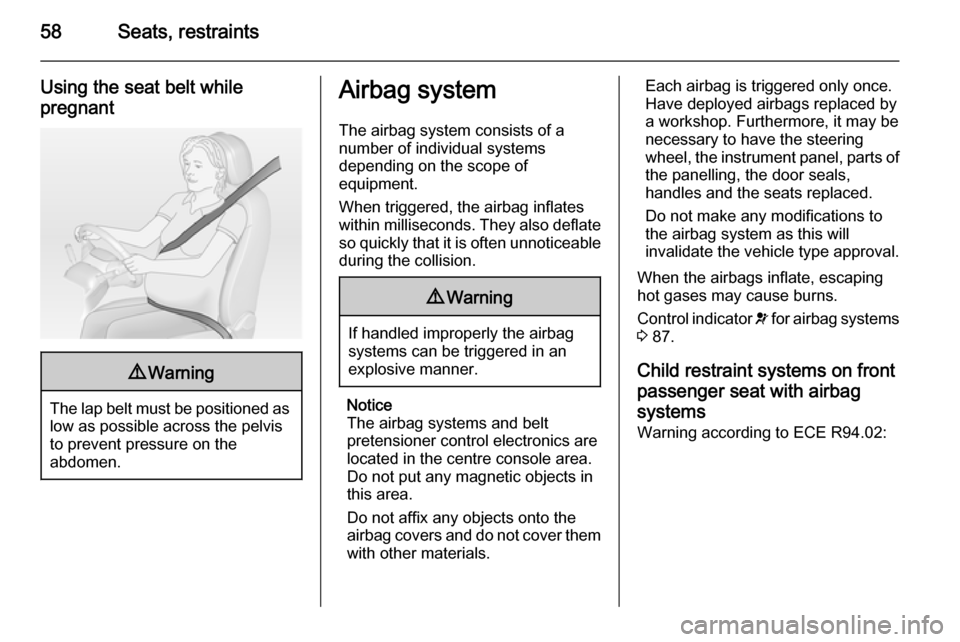
Using the seat belt whilepregnant9 Warning
The lap belt must be positioned as
low as possible across the pelvis
to prevent pressure on the
abdomen.
Airbag system
The airbag system consists of a
number of individual systems
depending on the scope of
equipment.
When triggered, the airbag inflates
within milliseconds. They also deflate
so quickly that it is often unnoticeable
during the collision.9 Warning
If handled improperly the airbag
systems can be triggered in an
explosive manner.
Notice
The airbag systems and belt
pretensioner control electronics are
located in the centre console area.
Do not put any magnetic objects in
this area.
Do not affix any objects onto the
airbag covers and do not cover them with other materials.
Each airbag is triggered only once.
Have deployed airbags replaced by
a workshop. Furthermore, it may be
necessary to have the steering
wheel, the instrument panel, parts of
the panelling, the door seals,
handles and the seats replaced.
Do not make any modifications to
the airbag system as this will
invalidate the vehicle type approval.
When the airbags inflate, escaping
hot gases may cause burns.
Control indicator v for airbag systems
3 87.
Child restraint systems on front passenger seat with airbag
systems Warning according to ECE R94.02:
Page 61 of 217
Seats, restraints59
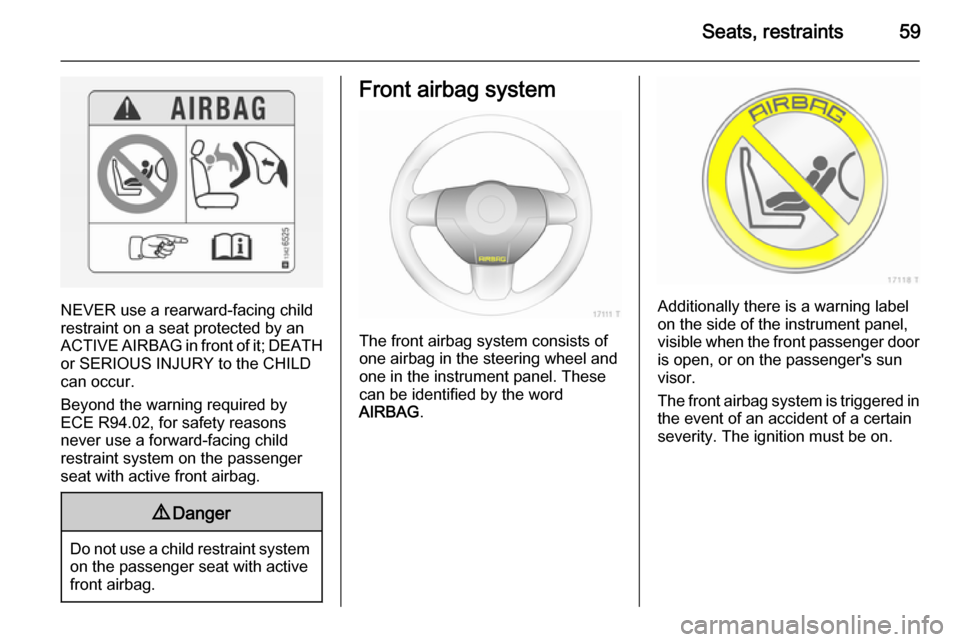
NEVER use a rearward-facing child
restraint on a seat protected by an
ACTIVE AIRBAG in front of it; DEATH or SERIOUS INJURY to the CHILDcan occur.
Beyond the warning required by
ECE R94.02, for safety reasons
never use a forward-facing child
restraint system on the passenger
seat with active front airbag.
9 Danger
Do not use a child restraint system
on the passenger seat with active
front airbag.
Front airbag system
The front airbag system consists of
one airbag in the steering wheel and
one in the instrument panel. These
can be identified by the word
AIRBAG .
Additionally there is a warning label
on the side of the instrument panel,
visible when the front passenger door
is open, or on the passenger's sun
visor.
The front airbag system is triggered in
the event of an accident of a certain
severity. The ignition must be on.
Page 62 of 217
60Seats, restraints
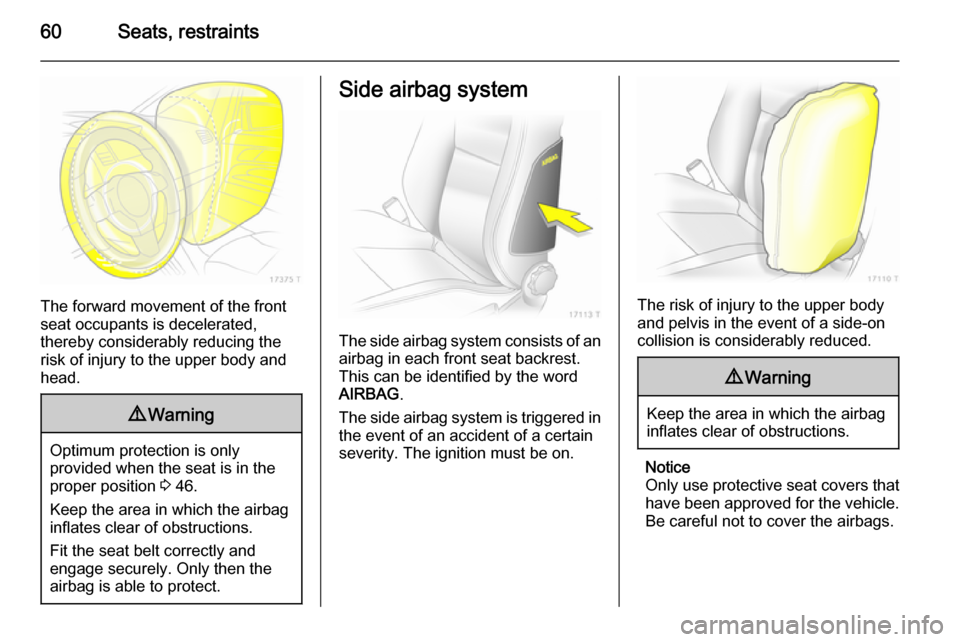
The forward movement of the front
seat occupants is decelerated,
thereby considerably reducing the risk of injury to the upper body and
head.
9 Warning
Optimum protection is only
provided when the seat is in the
proper position 3 46.
Keep the area in which the airbag
inflates clear of obstructions.
Fit the seat belt correctly and
engage securely. Only then the
airbag is able to protect.
Side airbag system
The side airbag system consists of an
airbag in each front seat backrest.
This can be identified by the word
AIRBAG .
The side airbag system is triggered in the event of an accident of a certain
severity. The ignition must be on.
The risk of injury to the upper body
and pelvis in the event of a side-on
collision is considerably reduced.
9 Warning
Keep the area in which the airbag
inflates clear of obstructions.
Notice
Only use protective seat covers that have been approved for the vehicle.Be careful not to cover the airbags.
Page 63 of 217
Seats, restraints61Curtain airbag system
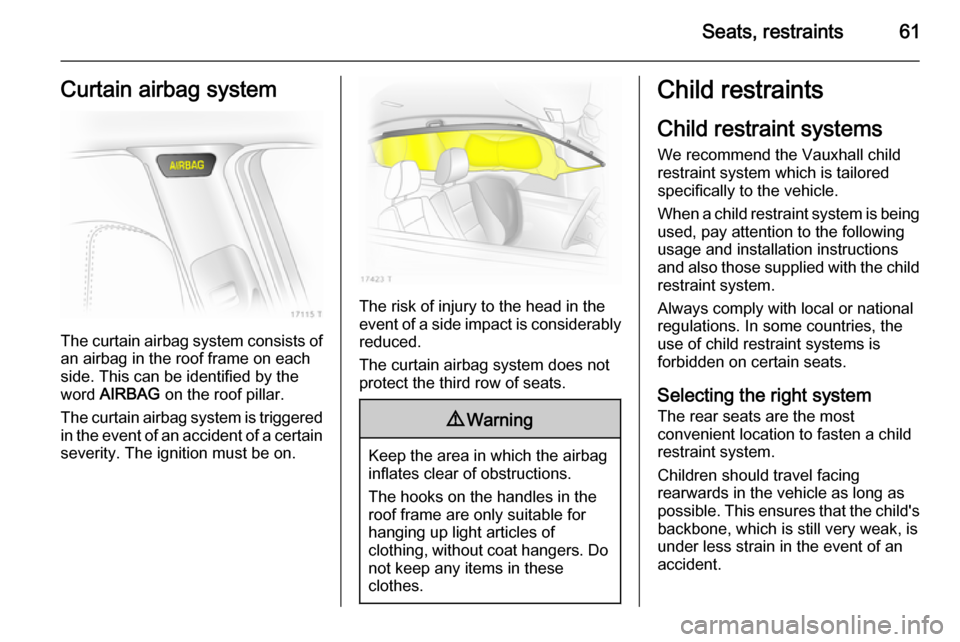
The curtain airbag system consists ofan airbag in the roof frame on each
side. This can be identified by the
word AIRBAG on the roof pillar.
The curtain airbag system is triggered
in the event of an accident of a certain severity. The ignition must be on.
The risk of injury to the head in the
event of a side impact is considerably reduced.
The curtain airbag system does not
protect the third row of seats.
9 Warning
Keep the area in which the airbag
inflates clear of obstructions.
The hooks on the handles in the
roof frame are only suitable for
hanging up light articles of
clothing, without coat hangers. Do not keep any items in these
clothes.
Child restraints
Child restraint systems We recommend the Vauxhall childrestraint system which is tailored
specifically to the vehicle.
When a child restraint system is being
used, pay attention to the following
usage and installation instructions
and also those supplied with the child restraint system.
Always comply with local or national
regulations. In some countries, the
use of child restraint systems is
forbidden on certain seats.
Selecting the right system The rear seats are the most
convenient location to fasten a child
restraint system.
Children should travel facing
rearwards in the vehicle as long as
possible. This ensures that the child's
backbone, which is still very weak, is
under less strain in the event of an
accident.
Page 69 of 217
Storage67StorageStorage compartments................67
Load compartment .......................69
Roof rack system .........................75
Loading information .....................75Storage compartments9Warning
Do not store heavy or sharp
objects in the storage
compartments. Otherwise, the
storage compartment lid could
open and vehicle occupants could be injured by objects being thrown
around in the event of hard
braking, a sudden change in
direction or an accident.
Glovebox
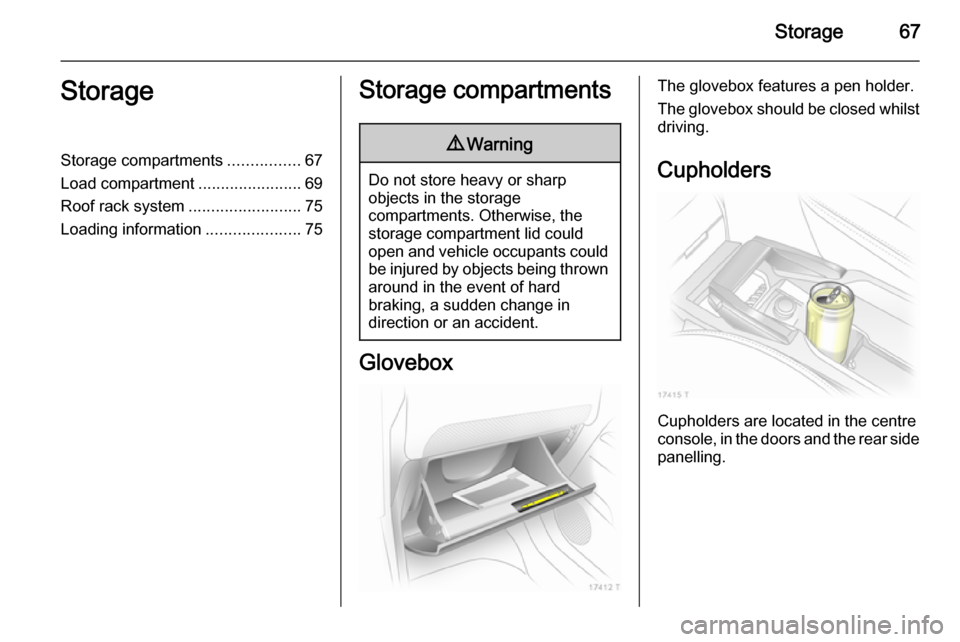
The glovebox features a pen holder.
The glovebox should be closed whilst driving.
Cupholders
Cupholders are located in the centre
console, in the doors and the rear side panelling.
Page 76 of 217
74Storage
Roll the upper net rod down to
approximately over the middle.
Place the upper net rod over the
tensioning straps next to the lower net
rod. The hooks on the upper net rod
must point away from the lower net
rod.
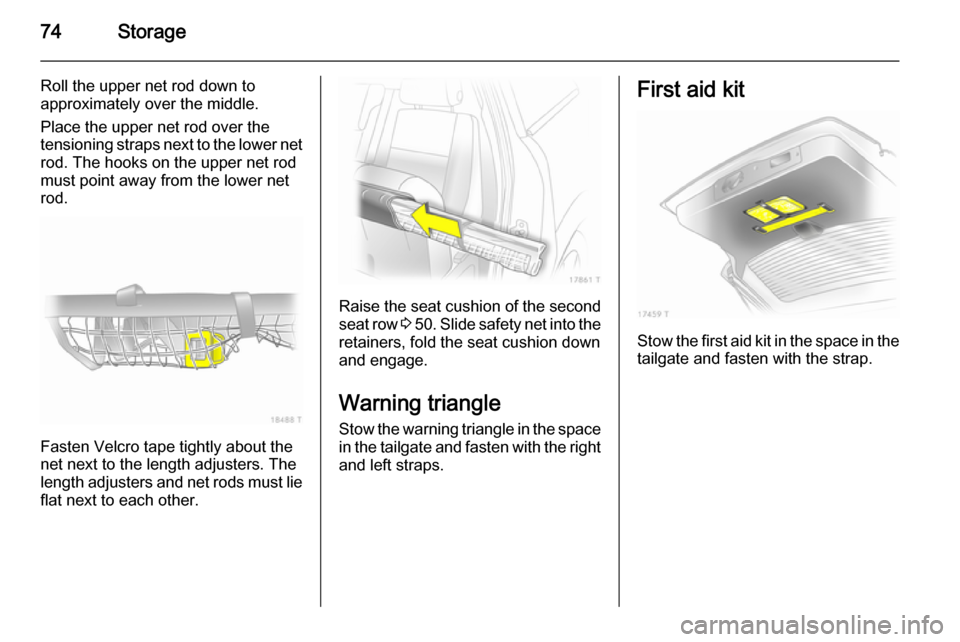
Fasten Velcro tape tightly about the
net next to the length adjusters. The
length adjusters and net rods must lie flat next to each other.
Raise the seat cushion of the second
seat row 3 50 . Slide safety net into the
retainers, fold the seat cushion down
and engage.
Warning triangle
Stow the warning triangle in the space
in the tailgate and fasten with the right and left straps.
First aid kit
Stow the first aid kit in the space in thetailgate and fasten with the strap.
Page 78 of 217

76Storage
■ When transporting objects in theload compartment, the backrests of
the second row must not be angled forward.
■ Do not allow the load to protrude above the upper edge of the
backrests.
■ Do not place any objects on the load compartment cover or theinstrument panel.
■ The load must not obstruct the operation of the pedals, parking
brake and gear selector, or hinder
the freedom of movement of the
driver. Do not place any unsecured
objects in the interior.
■ Do not drive with an open load compartment.9 Warning
Always make sure that the load in
the vehicle is securely stowed.
Otherwise objects can be thrown
around inside the vehicle and
cause personal injury or damage
to the load or car.
■ The payload is the difference between the permitted gross
vehicle weight (see identification
plate 3 196) and the EC kerb
weight.
To calculate the payload, enter the
data for your vehicle in the Weights
table at the front of this manual.
The EC kerb weight includes
weights for the driver (68 kg),
luggage (7 kg) and all fluids (tank
90 % full).
Optional equipment and
accessories increase the kerb
weight.
■ Driving with a roof load increases the sensitivity of the vehicle to
cross-winds and has a detrimental
effect on vehicle handling due to
the vehicle's higher centre of
gravity. Distribute the load evenly
and secure it properly with retaining
straps. Adjust the tyre pressure and vehicle speed according to the load
conditions. Check and retighten the
straps frequently.
Do not drive faster than 75 mph.The permissible roof load is 75 kg and 100 kg for vehicles with roof
railing. The roof load is the
combined weight of the roof rack
and the load.
Page 79 of 217
Instruments and controls77Instruments and
controlsControls ....................................... 77
Warning lights, gauges and indi‐ cators ........................................... 83
Information displays .....................93
Vehicle messages ...................... 100
Trip computer ............................. 102Controls
Steering wheel adjustment
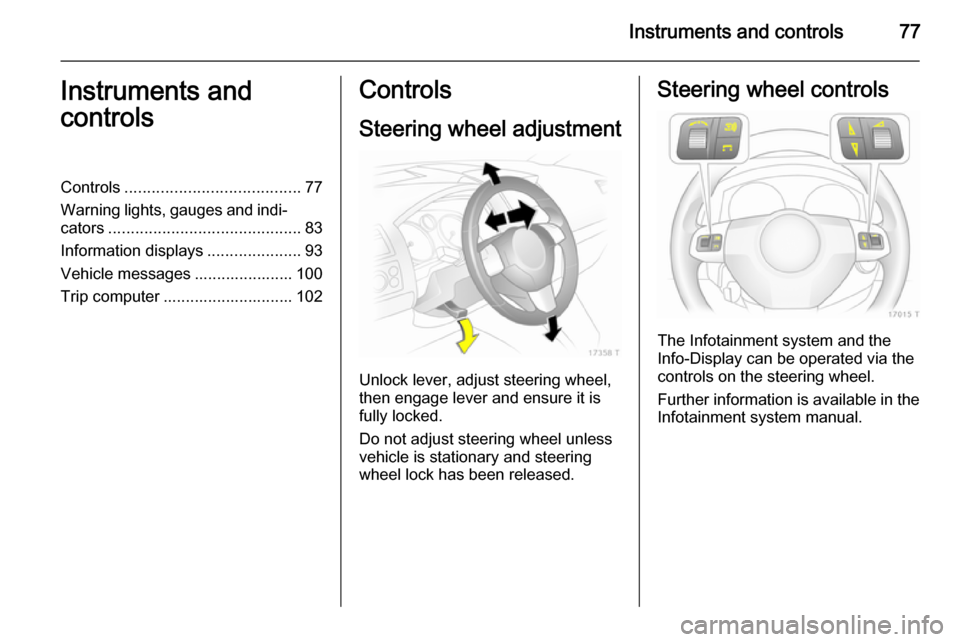
Unlock lever, adjust steering wheel,
then engage lever and ensure it is fully locked.
Do not adjust steering wheel unless
vehicle is stationary and steering
wheel lock has been released.
Steering wheel controls
The Infotainment system and the
Info-Display can be operated via the
controls on the steering wheel.
Further information is available in the
Infotainment system manual.
Page 82 of 217
80Instruments and controls
Do not use if the rear window is
frozen.
Switch off in car washes.
The rear screen wiper comes on automatically when the windscreen
wiper is switched on and reverse gear
is engaged.
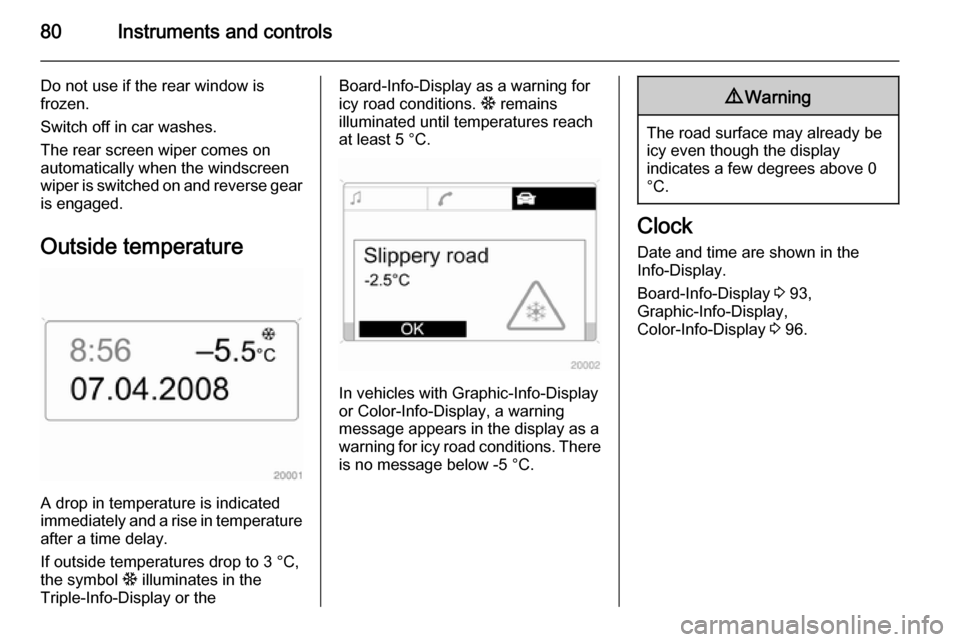
Outside temperature
A drop in temperature is indicated
immediately and a rise in temperature
after a time delay.
If outside temperatures drop to 3 °C, the symbol : illuminates in the
Triple-Info-Display or the
Board-Info-Display as a warning for
icy road conditions. : remains
illuminated until temperatures reach
at least 5 °C.
In vehicles with Graphic-Info-Display
or Color-Info-Display, a warning
message appears in the display as a warning for icy road conditions. There is no message below -5 °C.
9 Warning
The road surface may already be
icy even though the display
indicates a few degrees above 0
°C.
Clock
Date and time are shown in the
Info-Display.
Board-Info-Display 3 93,
Graphic-Info-Display,
Color-Info-Display 3 96.
Page 85 of 217
Instruments and controls83
The portable ashtray can be placed inthe cupholders.Warning lights, gauges
and indicators
Instrument cluster
In some versions, the needles of the
instruments briefly rotate to the end
position when the ignition is switched on.
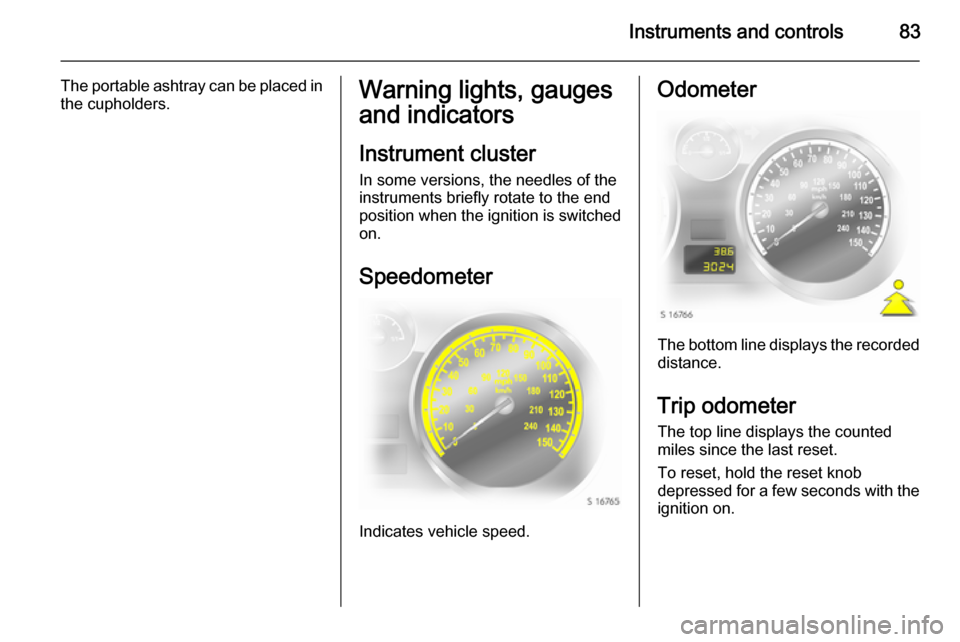
Speedometer
Indicates vehicle speed.
Odometer
The bottom line displays the recorded distance.
Trip odometer The top line displays the counted
miles since the last reset.
To reset, hold the reset knob
depressed for a few seconds with the ignition on.