roof VAUXHALL ZAFIRA 2014 Owner's Manual
[x] Cancel search | Manufacturer: VAUXHALL, Model Year: 2014, Model line: ZAFIRA, Model: VAUXHALL ZAFIRA 2014Pages: 217, PDF Size: 7.85 MB
Page 28 of 217
26Keys, doors and windowsKeys, doors and
windowsKeys, locks ................................... 26
Doors ........................................... 34
Vehicle security ............................ 35
Exterior mirrors ............................ 38
Interior mirrors ............................. 39
Windows ...................................... 40
Roof ............................................. 43Keys, locks
Keys Replacement keys
The key number is specified in the
Car Pass or on a detachable tag.
The key number must be quoted
when ordering replacement keys as it
is a component of the immobiliser
system.
When electronic keys of the
Open&Start system are being
replaced, all keys requiring
programming must be handed over to the dealer.
Locks 3 187, Open&Start system,
electronic key 3 28.
Lock cylinders
Designed to free-wheel if they are
forcefully rotated without the correct
key or if the correct key is not fully
inserted. To reset, turn cylinder with
the correct key until its slot is vertical,
remove key and then re-insert it. If the cylinder still free-wheels, turn the key
through 180° and repeat operation.Key with foldaway key section
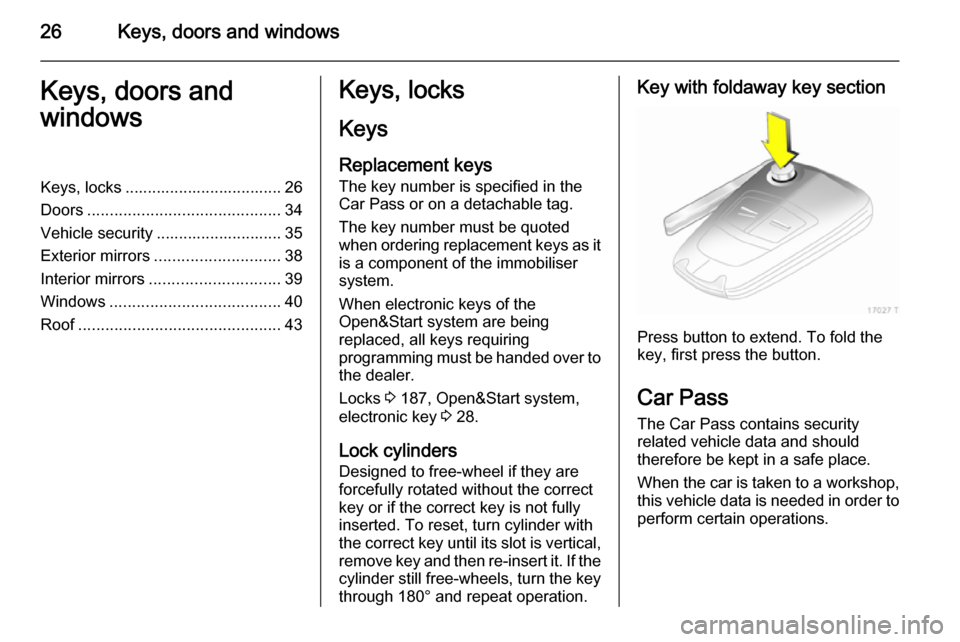
Press button to extend. To fold the
key, first press the button.
Car Pass The Car Pass contains security
related vehicle data and should
therefore be kept in a safe place.
When the car is taken to a workshop, this vehicle data is needed in order to
perform certain operations.
Page 45 of 217
Keys, doors and windows43Roof
Moonroof Do not affix any stickers to the middle
part of the roof. Do not cover the
vehicle using a tarpaulin.
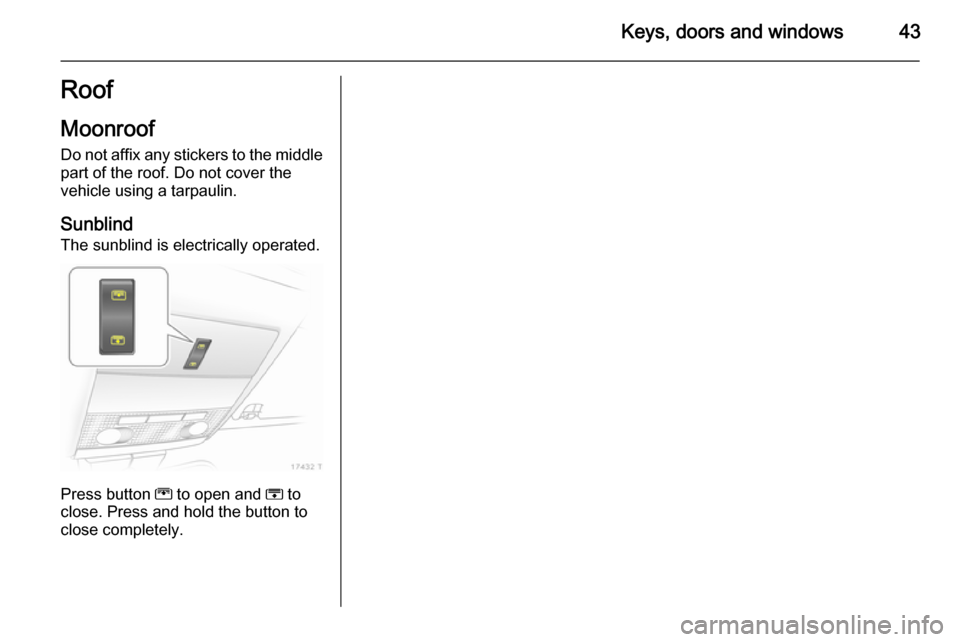
Sunblind The sunblind is electrically operated.
Press button G to open and H to
close. Press and hold the button to
close completely.
Page 48 of 217
46Seats, restraintsFront seatsSeat position9 Warning
Only drive with the seat correctly
adjusted.
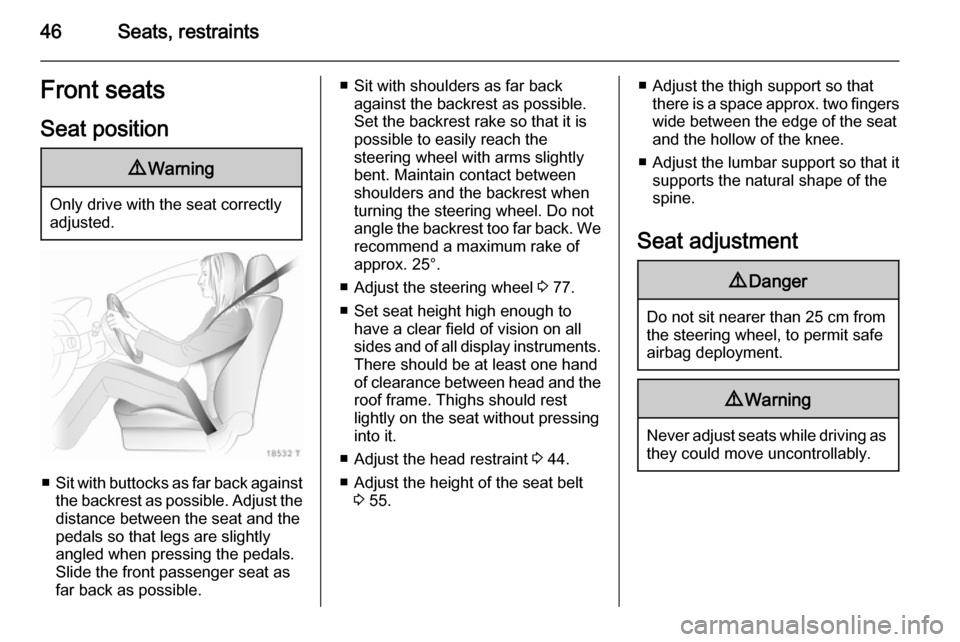
■ Sit with buttocks as far back against
the backrest as possible. Adjust the distance between the seat and the
pedals so that legs are slightly
angled when pressing the pedals.
Slide the front passenger seat as
far back as possible.
■ Sit with shoulders as far back against the backrest as possible.
Set the backrest rake so that it is possible to easily reach the
steering wheel with arms slightly bent. Maintain contact between
shoulders and the backrest when
turning the steering wheel. Do not
angle the backrest too far back. We recommend a maximum rake of
approx. 25°.
■ Adjust the steering wheel 3 77.
■ Set seat height high enough to have a clear field of vision on allsides and of all display instruments.
There should be at least one hand
of clearance between head and the
roof frame. Thighs should rest
lightly on the seat without pressing
into it.
■ Adjust the head restraint 3 44.
■ Adjust the height of the seat belt 3 55.■ Adjust the thigh support so that
there is a space approx. two fingers
wide between the edge of the seat
and the hollow of the knee.
■ Adjust the lumbar support so that it
supports the natural shape of the
spine.
Seat adjustment9 Danger
Do not sit nearer than 25 cm from
the steering wheel, to permit safe
airbag deployment.
9 Warning
Never adjust seats while driving as
they could move uncontrollably.
Page 63 of 217
Seats, restraints61Curtain airbag system
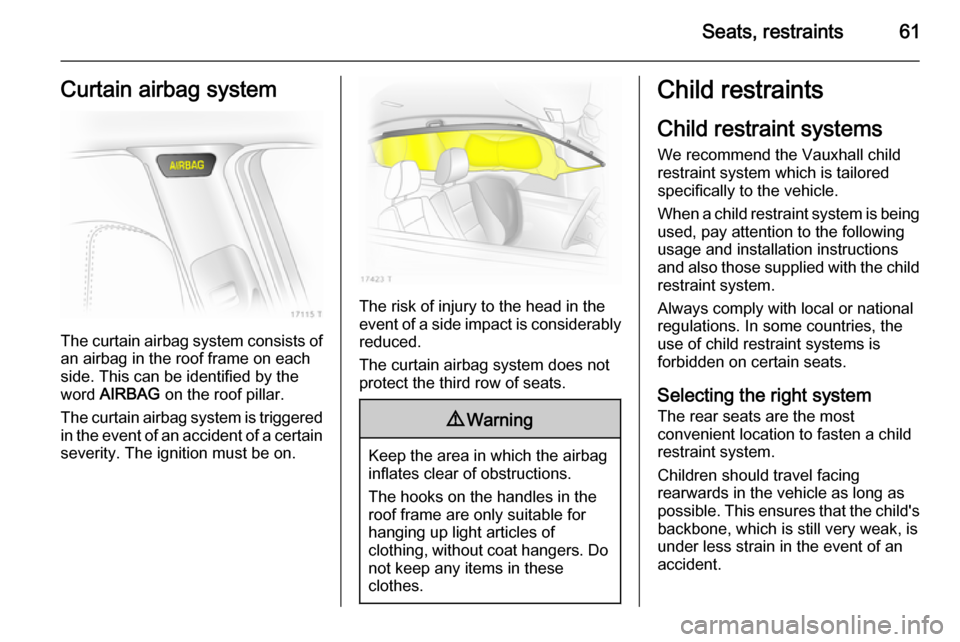
The curtain airbag system consists ofan airbag in the roof frame on each
side. This can be identified by the
word AIRBAG on the roof pillar.
The curtain airbag system is triggered
in the event of an accident of a certain severity. The ignition must be on.
The risk of injury to the head in the
event of a side impact is considerably reduced.
The curtain airbag system does not
protect the third row of seats.
9 Warning
Keep the area in which the airbag
inflates clear of obstructions.
The hooks on the handles in the
roof frame are only suitable for
hanging up light articles of
clothing, without coat hangers. Do not keep any items in these
clothes.
Child restraints
Child restraint systems We recommend the Vauxhall childrestraint system which is tailored
specifically to the vehicle.
When a child restraint system is being
used, pay attention to the following
usage and installation instructions
and also those supplied with the child restraint system.
Always comply with local or national
regulations. In some countries, the
use of child restraint systems is
forbidden on certain seats.
Selecting the right system The rear seats are the most
convenient location to fasten a child
restraint system.
Children should travel facing
rearwards in the vehicle as long as
possible. This ensures that the child's
backbone, which is still very weak, is
under less strain in the event of an
accident.
Page 69 of 217
Storage67StorageStorage compartments................67
Load compartment .......................69
Roof rack system .........................75
Loading information .....................75Storage compartments9Warning
Do not store heavy or sharp
objects in the storage
compartments. Otherwise, the
storage compartment lid could
open and vehicle occupants could be injured by objects being thrown
around in the event of hard
braking, a sudden change in
direction or an accident.
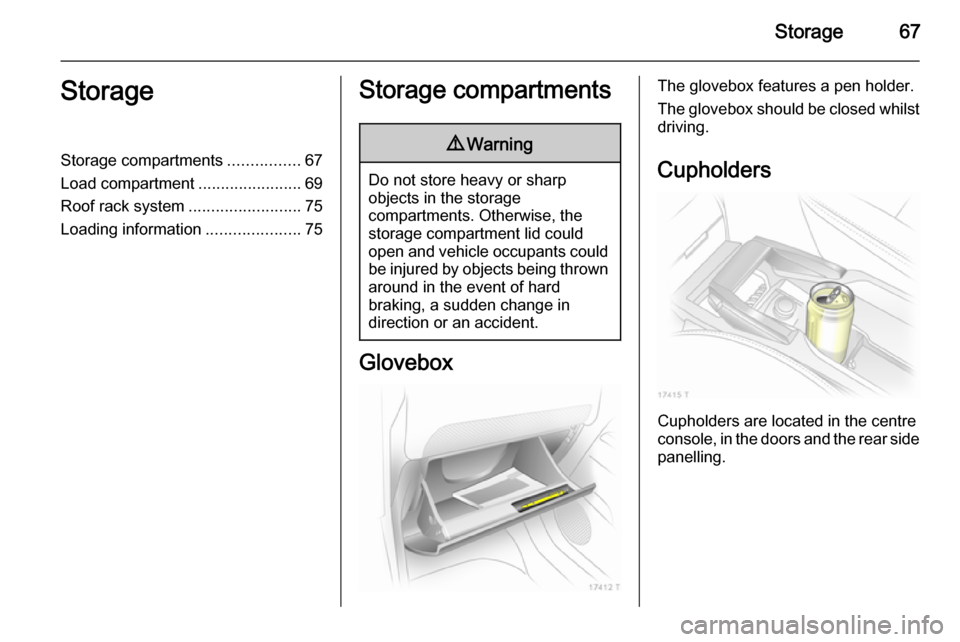
Glovebox
The glovebox features a pen holder.
The glovebox should be closed whilst driving.
Cupholders
Cupholders are located in the centre
console, in the doors and the rear side panelling.
Page 71 of 217
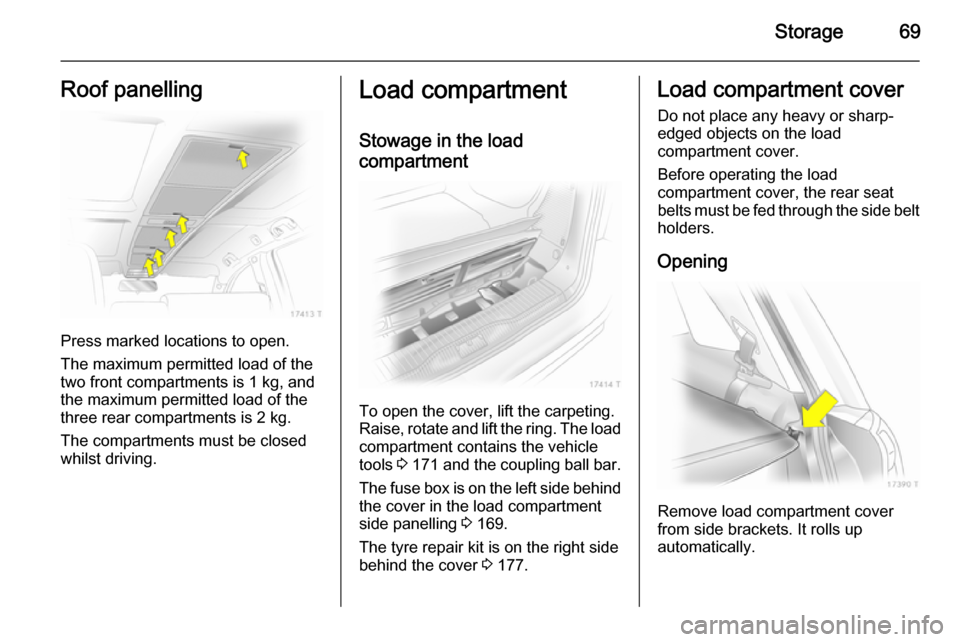
Storage69Roof panelling
Press marked locations to open.
The maximum permitted load of the
two front compartments is 1 kg, and
the maximum permitted load of the
three rear compartments is 2 kg.
The compartments must be closed
whilst driving.
Load compartment
Stowage in the load
compartment
To open the cover, lift the carpeting.
Raise, rotate and lift the ring. The load
compartment contains the vehicle
tools 3 171 and the coupling ball bar.
The fuse box is on the left side behind
the cover in the load compartment
side panelling 3 169.
The tyre repair kit is on the right side
behind the cover 3 177.
Load compartment cover
Do not place any heavy or sharp-
edged objects on the load
compartment cover.
Before operating the load
compartment cover, the rear seat
belts must be fed through the side belt holders.
Opening
Remove load compartment cover
from side brackets. It rolls up
automatically.
Page 75 of 217
Storage73
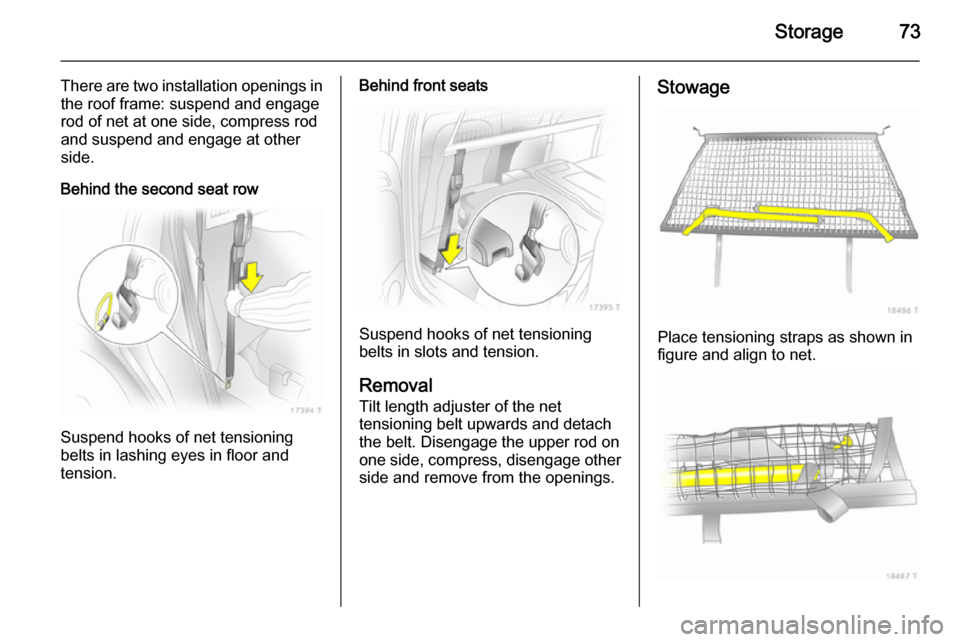
There are two installation openings inthe roof frame: suspend and engagerod of net at one side, compress rod
and suspend and engage at other
side.
Behind the second seat row
Suspend hooks of net tensioning
belts in lashing eyes in floor and
tension.
Behind front seats
Suspend hooks of net tensioning
belts in slots and tension.
Removal
Tilt length adjuster of the net
tensioning belt upwards and detach
the belt. Disengage the upper rod on
one side, compress, disengage other side and remove from the openings.
Stowage
Place tensioning straps as shown in
figure and align to net.
Page 77 of 217
Storage75Roof rack system
Roof rack For safety reasons and to avoiddamage to the roof, the vehicle
approved roof rack system is
recommended.
Follow the installation instructions and remove the roof rack when not in
use.
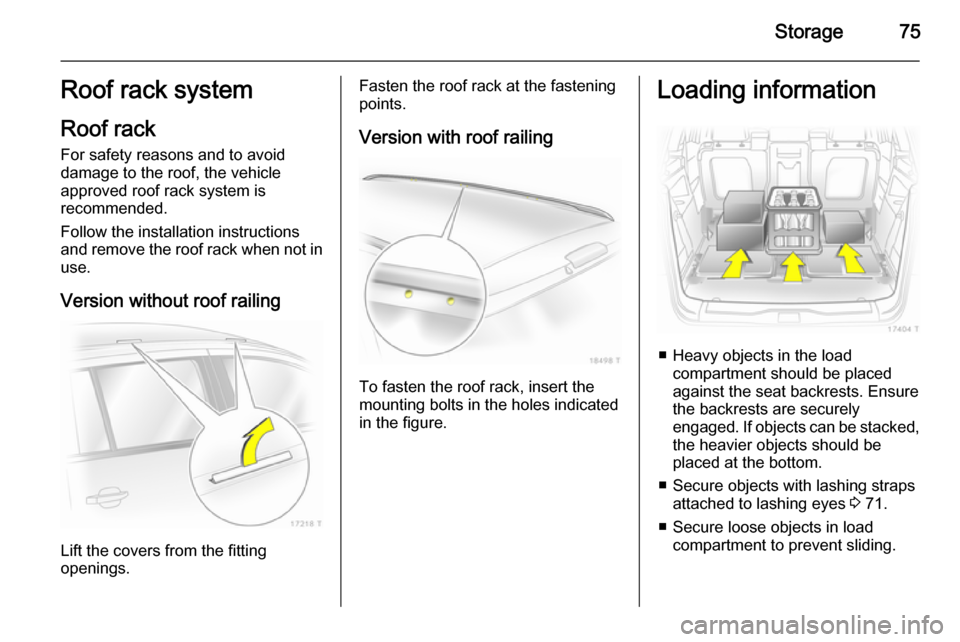
Version without roof railing
Lift the covers from the fitting
openings.
Fasten the roof rack at the fastening
points.
Version with roof railing
To fasten the roof rack, insert the
mounting bolts in the holes indicated
in the figure.
Loading information
■ Heavy objects in the load compartment should be placedagainst the seat backrests. Ensure
the backrests are securely
engaged. If objects can be stacked, the heavier objects should be
placed at the bottom.
■ Secure objects with lashing straps attached to lashing eyes 3 71.
■ Secure loose objects in load compartment to prevent sliding.
Page 78 of 217

76Storage
■ When transporting objects in theload compartment, the backrests of
the second row must not be angled forward.
■ Do not allow the load to protrude above the upper edge of the
backrests.
■ Do not place any objects on the load compartment cover or theinstrument panel.
■ The load must not obstruct the operation of the pedals, parking
brake and gear selector, or hinder
the freedom of movement of the
driver. Do not place any unsecured
objects in the interior.
■ Do not drive with an open load compartment.9 Warning
Always make sure that the load in
the vehicle is securely stowed.
Otherwise objects can be thrown
around inside the vehicle and
cause personal injury or damage
to the load or car.
■ The payload is the difference between the permitted gross
vehicle weight (see identification
plate 3 196) and the EC kerb
weight.
To calculate the payload, enter the
data for your vehicle in the Weights
table at the front of this manual.
The EC kerb weight includes
weights for the driver (68 kg),
luggage (7 kg) and all fluids (tank
90 % full).
Optional equipment and
accessories increase the kerb
weight.
■ Driving with a roof load increases the sensitivity of the vehicle to
cross-winds and has a detrimental
effect on vehicle handling due to
the vehicle's higher centre of
gravity. Distribute the load evenly
and secure it properly with retaining
straps. Adjust the tyre pressure and vehicle speed according to the load
conditions. Check and retighten the
straps frequently.
Do not drive faster than 75 mph.The permissible roof load is 75 kg and 100 kg for vehicles with roof
railing. The roof load is the
combined weight of the roof rack
and the load.
Page 190 of 217

188Vehicle care
If using a car wash, comply with the
car wash manufacturer's instructions. The windscreen wipers and rear
window wiper must be switched off.
Remove antenna and external
accessories such as roof racks etc.
If you wash your vehicle by hand,
make sure that the insides of the
wheel housings are also thoroughly
rinsed out.
Clean edges and folds on opened
doors and the bonnet as well as the
areas they cover.Caution
Always use a cleaning agent with
a pH value of 4 to 9.
Do not use cleaning agents on hot surfaces.
Have the door hinges of all doors
greased by a workshop.
Do not clean the engine compartment with a steam-jet or high-pressure jet
cleaner.
Thoroughly rinse and leather-off the vehicle. Rinse leather frequently. Use
separate leathers for painted and
glass surfaces: remnants of wax on
the windows will impair vision.
Exterior lights
Headlight and other light covers are
made of plastic. Do not use any
abrasive or caustic agents, do not use an ice scraper, and do not clean them
dry.
Polishing and waxing Wax the vehicle regularly (at the
latest when water no longer beads).
Otherwise, the paintwork will dry out.
Polishing is necessary only if the paint
has become dull or if solid deposits
have become attached to it.
Paintwork polish with silicone forms a
protective film, making waxing
unnecessary.
Plastic body parts must not be treated with wax or polishing agents.Windows and windscreen wiper
blades
Use a soft lint-free cloth or chamois leather together with window cleanerand insect remover.
When cleaning the rear window from
inside, always wipe in parallel to the
heating element to prevent damage.
For mechanical removal of ice, use a
sharp-edged ice scraper. Press the
scraper firmly against the glass so
that no dirt can get under it and
scratch the glass.
Clean smearing wiper blades with a
soft cloth and window cleaner.
Moonroof
Never clean with solvents or abrasive
agents, fuels, aggressive media
(e.g. paint cleaner, acetone-
containing solutions etc.), acidic or
highly alkaline media or abrasive
pads. Do not apply wax or polishing
agents to the middle part of the
moonroof.