fuse VOLKSWAGEN CORRADO 1990 User Guide
[x] Cancel search | Manufacturer: VOLKSWAGEN, Model Year: 1990, Model line: CORRADO, Model: VOLKSWAGEN CORRADO 1990Pages: 906, PDF Size: 6.56 MB
Page 138 of 906

* EXHAUST SYSTEM UNIFORM INSPECTION GUIDELINES *
Article Text (p. 3)
1990 Volkswagen Corrado
For Volkswagen Technical Site: http://vw.belcom.ru
Copyright © 1998 Mitchell Repair Information Company, LLC
Thursday, March 23, 2000 09:33PM
Some conditions indicate that service or part replacement is
required because the part in question is no longer providing the
function for which it is intended, does not meet a vehicle
manufacturer's design specification or is missing.
* Example: An exhaust pipe has corroded severely and has a hole
in it through which exhaust gases are leaking. Replacement of
the exhaust pipe in this case is required due to functional
failure.
* Example: A brake rotor has been worn to the point where it
measures less than the vehicle manufacturer's specifications.
Replacement of the rotor is required because it does not meet
design specifications.
Some conditions indicate that a service or part replacement
is suggested because the part is close to the end of its useful life
or to address a customer's need, convenience or request. If a
customer's vehicle has one of these conditions, the procedure may
only be to suggest service.
* Example: An exhaust pipe is rusted, corroded or weak, but no
leaks are present. In this case, the exhaust pipe has not
failed. However, there is evidence that the pipe may need
replacement in the near future. Replacement of the pipe may
be suggested for the customer's convenience in avoiding a
future problem.
* Example: The customer desires improved ride and/or handling,
but the vehicle's shocks or struts have not failed. In this
case, replacement may be suggested to satisfy the customer's
wishes. In this case, replacement of the shocks or struts may
not be sold as a requirement.
A customer, of course, has the choice of whether or not a
shop will service his or her vehicle. He or she may decide not to
follow some of your suggestions. When a customer declines to authorize
a service or repair indicated in the MAP Uniform Inspection Guidelines
as "required," a MAP shop may refuse service on that system, if
proceeding with the work could create or continue an unsafe or
unsatisfactory condition.
The following reasons may be used for required and suggested
services. These codes are shown in the "Code" column of the Uniform
Inspection Guidelines that follow.
PART REPLACEMENT CODE IDENTIFICATION
NOTE: Refer to the following tables for definitions of the codes
listed in the condition/procedure tables for the specific
components that may need to be replaced.
A - PART NO LONGER PERFORMS INTENDED PURPOSE
Page 148 of 906

* STEERING UNIFORM INSPECTION GUIDELINES *
Article Text (p. 3)
1990 Volkswagen Corrado
For Volkswagen Technical Site: http://vw.belcom.ru
Copyright © 1998 Mitchell Repair Information Company, LLC
Thursday, March 23, 2000 09:34PM
Some conditions indicate that service or part replacement is
required because the part in question is no longer providing the
function for which it is intended, does not meet a vehicle
manufacturer's design specification or is missing.
* Example: An exhaust pipe has corroded severely and has a hole
in it through which exhaust gases are leaking. Replacement of
the exhaust pipe in this case is required due to functional
failure.
* Example: A brake rotor has been worn to the point where it
measures less than the vehicle manufacturer's specifications.
Replacement of the rotor is required because it does not meet
design specifications.
Some conditions indicate that a service or part replacement
is suggested because the part is close to the end of its useful life
or to address a customer's need, convenience or request. If a
customer's vehicle has one of these conditions, the procedure may
only be to suggest service.
* Example: An exhaust pipe is rusted, corroded or weak, but no
leaks are present. In this case, the exhaust pipe has not
failed. However, there is evidence that the pipe may need
replacement in the near future. Replacement of the pipe may
be suggested for the customer's convenience in avoiding a
future problem.
* Example: The customer desires improved ride and/or handling,
but the vehicle's shocks or struts have not failed. In this
case, replacement may be suggested to satisfy the customer's
wishes. In this case, replacement of the shocks or struts may
not be sold as a requirement.
A customer, of course, has the choice of whether or not a
shop will service his or her vehicle. He or she may decide not to
follow some of your suggestions. When a customer declines to authorize
a service or repair indicated in the MAP Uniform Inspection Guidelines
as "required," a MAP shop may refuse service on that system, if
proceeding with the work could create or continue an unsafe or
unsatisfactory condition.
The following reasons may be used for required and suggested
services. These codes are shown in the "Code" column of the Uniform
Inspection Guidelines that follow.
PART REPLACEMENT CODE IDENTIFICATION
NOTE: Refer to the following tables for definitions of the codes
listed in the condition/procedure tables for the specific
components that may need to be replaced.
A - PART NO LONGER PERFORMS INTENDED PURPOSE
Page 157 of 906

* STEERING UNIFORM INSPECTION GUIDELINES *
Article Text (p. 12)
1990 Volkswagen Corrado
For Volkswagen Technical Site: http://vw.belcom.ru
Copyright © 1998 Mitchell Repair Information Company, LLC
Thursday, March 23, 2000 09:34PMÄÄÄÄÄÄÄÄÄÄÄÄÄÄÄÄÄÄÄÄÄÄÄÄÄÄÄÅÄÄÄÄÄÄ´Excessive resistance
³ B ³
ÄÄÄÄÄÄÄÄÄÄÄÄÄÄÄÄÄÄÄÄÄÄÄÄÄÄÄÅÄÄÄÄÄÄÅÄÄÄÄÄÄÄÄÄÄÄÄÄÄÄÄÄÄÄÄÄÄÄÄÄÄÄÄÄÄÄÄÄÄÄFuse blown
³ A ³
ÄÄÄÄÄÄÄÄÄÄÄÄÄÄÄÄÄÄÄÄÄÄÄÄÄÄÄÅÄÄÄÄÄÄ´ Require replacement.
Fusible link blown
³ A ³
ÄÄÄÄÄÄÄÄÄÄÄÄÄÄÄÄÄÄÄÄÄÄÄÄÄÄÄÅÄÄÄÄÄÄÅÄÄÄÄÄÄÄÄÄÄÄÄÄÄÄÄÄÄÄÄÄÄÄÄÄÄÄÄÄÄÄÄÄÄÄOpen
³ A ³
ÄÄÄÄÄÄÄÄÄÄÄÄÄÄÄÄÄÄÄÄÄÄÄÄÄÄÄÅÄÄÄÄÄÄ´ Require repair or replacement.
Poor ground
³ A ³
ÄÄÄÄÄÄÄÄÄÄÄÄÄÄÄÄÄÄÄÄÄÄÄÄÄÄÄÅÄÄÄÄÄÄÅÄÄÄÄÄÄÄÄÄÄÄÄÄÄÄÄÄÄÄÄÄÄÄÄÄÄÄÄÄÄÄÄÄÄÄRouted incorrectly
³ B ³ Require re-routing according to
³ ³ vehicle manufacturer's specs.
ÄÄÄÄÄÄÄÄÄÄÄÄÄÄÄÄÄÄÄÄÄÄÄÄÄÄÄÅÄÄÄÄÄÄÅÄÄÄÄÄÄÄÄÄÄÄÄÄÄÄÄÄÄÄÄÄÄÄÄÄÄÄÄÄÄÄÄÄÄÄShorted
³ A ³
ÄÄÄÄÄÄÄÄÄÄÄÄÄÄÄÄÄÄÄÄÄÄÄÄÄÄÄÅÄÄÄÄÄÄ´Terminal bent
³ A ³
ÄÄÄÄÄÄÄÄÄÄÄÄÄÄÄÄÄÄÄÄÄÄÄÄÄÄÄÅÄÄÄÄÄÄ´Terminal broken
³ A ³ Require repair or replacement.
ÄÄÄÄÄÄÄÄÄÄÄÄÄÄÄÄÄÄÄÄÄÄÄÄÄÄÄÅÄÄÄÄÄÄ´Terminal corroded
³ A ³
ÄÄÄÄÄÄÄÄÄÄÄÄÄÄÄÄÄÄÄÄÄÄÄÄÄÄÄÅÄÄÄÄÄÄ´Terminal loose
³ A ³
ÄÄÄÄÄÄÄÄÄÄÄÄÄÄÄÄÄÄÄÄÄÄÄÄÄÄÄÁÄÄÄÄÄÄÁÄÄÄÄÄÄÄÄÄÄÄÄÄÄÄÄÄÄÄÄÄÄÄÄÄÄÄÄÄÄÄÄÄÄÄ BALL JOINTS
Before requiring or suggesting ball joint replacement, the
approved OEM procedure must be used to measure ball joint wear. The
measurement(s) obtained, along with the vehicle manufacturer's
specifications, must be noted on the inspection report. Some states
require that these measurements also appear on the invoice.
NOTE: The term "perceptible movement," defined as any visible
movement in any direction, has been the industry standard
for determining the need for replacement of follower ball
joints. Some vehicle manufacturers are now publishing
specifications for follower ball joints that were previously
diagnosed by the "perceptible movement" standard. Before
requiring or suggesting any parts be replaced based on
"perceptible movement," consult your repair manual to
determine if OEM specifications exist.
You are not required to replace ball joints in axle sets.
However, when replacing a ball joint due to wear exceeding
manufacturer's specification, you may suggest replacement of the other
ball joint if its measurement shows it is close to the end of its
useful life, for preventive maintenance.
BALL JOINTS
ÄÄÄÄÄÄÄÄÄÄÄÄÄÄÄÄÄÄÄÄÄÄÄÄÄÄÄÂÄÄÄÄÄÄÂÄÄÄÄÄÄÄÄÄÄÄÄÄÄÄÄÄÄÄÄÄÄÄÄÄÄÄÄÄÄÄÄÄÄÄCondition
³ Code ³ Procedure
Page 214 of 906

* SUSPENSION UNIFORM INSPECTION GUIDELINES *
Article Text (p. 3)
1990 Volkswagen Corrado
For Volkswagen Technical Site: http://vw.belcom.ru
Copyright © 1998 Mitchell Repair Information Company, LLC
Thursday, March 23, 2000 09:38PM
Some conditions indicate that service or part replacement is
required because the part in question is no longer providing the
function for which it is intended, does not meet a vehicle
manufacturer's design specification or is missing.
* Example: An exhaust pipe has corroded severely and has a hole
in it through which exhaust gases are leaking. Replacement of
the exhaust pipe in this case is required due to functional
failure.
* Example: A brake rotor has been worn to the point where it
measures less than the vehicle manufacturer's specifications.
Replacement of the rotor is required because it does not meet
design specifications.
Some conditions indicate that a service or part replacement
is suggested because the part is close to the end of its useful life
or to address a customer's need, convenience or request. If a
customer's vehicle has one of these conditions, the procedure may
only be to suggest service.
* Example: An exhaust pipe is rusted, corroded or weak, but no
leaks are present. In this case, the exhaust pipe has not
failed. However, there is evidence that the pipe may need
replacement in the near future. Replacement of the pipe may
be suggested for the customer's convenience in avoiding a
future problem.
* Example: The customer desires improved ride and/or handling,
but the vehicle's shocks or struts have not failed. In this
case, replacement may be suggested to satisfy the customer's
wishes. In this case, replacement of the shocks or struts may
not be sold as a requirement.
A customer, of course, has the choice of whether or not a
shop will service his or her vehicle. He or she may decide not to
follow some of your suggestions. When a customer declines to authorize
a service or repair indicated in the MAP Uniform Inspection Guidelines
as "required," a MAP shop may refuse service on that system, if
proceeding with the work could create or continue an unsafe or
unsatisfactory condition.
The following reasons may be used for required and suggested
services. These codes are shown in the "Code" column of the Uniform
Inspection Guidelines that follow.
PART REPLACEMENT CODE IDENTIFICATION
NOTE: Refer to the following tables for definitions of the codes
listed in the condition/procedure tables for the specific
components that may need to be replaced.
A - PART NO LONGER PERFORMS INTENDED PURPOSE
Page 223 of 906

* SUSPENSION UNIFORM INSPECTION GUIDELINES *
Article Text (p. 12)
1990 Volkswagen Corrado
For Volkswagen Technical Site: http://vw.belcom.ru
Copyright © 1998 Mitchell Repair Information Company, LLC
Thursday, March 23, 2000 09:38PMÄÄÄÄÄÄÄÄÄÄÄÄÄÄÄÄÄÄÄÄÄÄÄÄÄÄÄÅÄÄÄÄÄÄ´Excessive resistance
³ B ³
ÄÄÄÄÄÄÄÄÄÄÄÄÄÄÄÄÄÄÄÄÄÄÄÄÄÄÄÅÄÄÄÄÄÄÅÄÄÄÄÄÄÄÄÄÄÄÄÄÄÄÄÄÄÄÄÄÄÄÄÄÄÄÄÄÄÄÄÄÄÄFuse blown
³ A ³
ÄÄÄÄÄÄÄÄÄÄÄÄÄÄÄÄÄÄÄÄÄÄÄÄÄÄÄÅÄÄÄÄÄÄ´ Require replacement.
Fusible link blown
³ A ³
ÄÄÄÄÄÄÄÄÄÄÄÄÄÄÄÄÄÄÄÄÄÄÄÄÄÄÄÅÄÄÄÄÄÄÅÄÄÄÄÄÄÄÄÄÄÄÄÄÄÄÄÄÄÄÄÄÄÄÄÄÄÄÄÄÄÄÄÄÄÄOpen
³ A ³
ÄÄÄÄÄÄÄÄÄÄÄÄÄÄÄÄÄÄÄÄÄÄÄÄÄÄÄÅÄÄÄÄÄÄ´ Require repair or replacement.
Poor ground
³ A ³
ÄÄÄÄÄÄÄÄÄÄÄÄÄÄÄÄÄÄÄÄÄÄÄÄÄÄÄÅÄÄÄÄÄÄÅÄÄÄÄÄÄÄÄÄÄÄÄÄÄÄÄÄÄÄÄÄÄÄÄÄÄÄÄÄÄÄÄÄÄÄRouted incorrectly
³ B ³ Require re-routing according to
³ ³ vehicle manufacturer's specs.
ÄÄÄÄÄÄÄÄÄÄÄÄÄÄÄÄÄÄÄÄÄÄÄÄÄÄÄÅÄÄÄÄÄÄÅÄÄÄÄÄÄÄÄÄÄÄÄÄÄÄÄÄÄÄÄÄÄÄÄÄÄÄÄÄÄÄÄÄÄÄShorted
³ A ³
ÄÄÄÄÄÄÄÄÄÄÄÄÄÄÄÄÄÄÄÄÄÄÄÄÄÄÄÅÄÄÄÄÄÄ´Terminal bent
³ A ³
ÄÄÄÄÄÄÄÄÄÄÄÄÄÄÄÄÄÄÄÄÄÄÄÄÄÄÄÅÄÄÄÄÄÄ´Terminal broken
³ A ³ Require repair or replacement.
ÄÄÄÄÄÄÄÄÄÄÄÄÄÄÄÄÄÄÄÄÄÄÄÄÄÄÄÅÄÄÄÄÄÄ´Terminal corroded
³ A ³
ÄÄÄÄÄÄÄÄÄÄÄÄÄÄÄÄÄÄÄÄÄÄÄÄÄÄÄÅÄÄÄÄÄÄ´Terminal loose
³ A ³
ÄÄÄÄÄÄÄÄÄÄÄÄÄÄÄÄÄÄÄÄÄÄÄÄÄÄÄÁÄÄÄÄÄÄÁÄÄÄÄÄÄÄÄÄÄÄÄÄÄÄÄÄÄÄÄÄÄÄÄÄÄÄÄÄÄÄÄÄÄÄ BALL JOINTS
Before requiring or suggesting ball joint replacement, the
approved OEM procedure must be used to measure ball joint wear. The
measurement(s) obtained, along with the vehicle manufacturer's
specifications, must be noted on the inspection report. Some states
require that these measurements also appear on the invoice.
NOTE: The term "perceptible movement," defined as any visible
movement in any direction, has been the industry standard
for determining the need for replacement of follower ball
joints. Some vehicle manufacturers are now publishing
specifications for follower ball joints that were previously
diagnosed by the "perceptible movement" standard. Before
requiring or suggesting any parts be replaced based on
"perceptible movement," consult your repair manual to
determine if OEM specifications exist.
You are not required to replace ball joints in axle sets.
However, when replacing a ball joint due to wear exceeding
manufacturer's specification, you may suggest replacement of the other
ball joint if its measurement shows it is close to the end of its
useful life, for preventive maintenance.
BALL JOINTS
ÄÄÄÄÄÄÄÄÄÄÄÄÄÄÄÄÄÄÄÄÄÄÄÄÄÄÄÂÄÄÄÄÄÄÂÄÄÄÄÄÄÄÄÄÄÄÄÄÄÄÄÄÄÄÄÄÄÄÄÄÄÄÄÄÄÄÄÄÄÄCondition
³ Code ³ Procedure
Page 382 of 906

ABBREVIATIONS
Article Text (p. 5)
1990 Volkswagen Corrado
For Volkswagen Technical Site: http://vw.belcom.ru
Copyright © 1998 Mitchell Repair Information Company, LLC
Thursday, March 23, 2000 09:42PM³ETR ³Emergency Tensioning Retractor ³
³EVAP
³Fuel Evaporative System ³
³EVIC
³Electronic Vehicle Information Center ³
³EVO
³Electronic Variable Orifice ³
³EVP
³EGR Valve Position Sensor ³
³EVR
³EGR Valve Regulator ³
³EVRV
³Electronic Vacuum Regulator Valve ³
³Elect.
³Electronic ³
³Eng.
³Engine ³
³Evap.
³Evaporative ³
³Exc.
³Except ³
ÀÄÄÄÄÄÄÄÄÄÄÄÄÄÄÄÄÄÁÄÄÄÄÄÄÄÄÄÄÄÄÄÄÄÄÄÄÄÄÄÄÄÄÄÄÄÄÄÄÄÄÄÄÄÄÄÄÄÄÄÄÄÄÄÄÄÄÄÄÙ "F" ABBREVIATION TABLE
"F" ABBREVIATION TABLE
ÚÄÄÄÄÄÄÄÄÄÄÄÄÄÄÄÄÄÂÄÄÄÄÄÄÄÄÄÄÄÄÄÄÄÄÄÄÄÄÄÄÄÄÄÄÄÄÄÄÄÄÄÄÄÄÄÄÄÄÄÄÄÄÄÄÄÄÄÄ¿
³ABBREVIATION
³DEFINITION ³
ÃÄÄÄÄÄÄÄÄÄÄÄÄÄÄÄÄÄÅÄÄÄÄÄÄÄÄÄÄÄÄÄÄÄÄÄÄÄÄÄÄÄÄÄÄÄÄÄÄÄÄÄÄÄÄÄÄÄÄÄÄÄÄÄÄÄÄÄÄ´
³ø F
³Fahrenheit (Degrees) ³
³F/B
³Fuse Block ³
³FBC
³Feedback Carburetor ³
³FI
³Fuel Injector or Fuel Injection ³
³FICD
³Fast Idle Control Device ³
³FIPL
³Fuel Injector Pump Lever ³
³FP
³Fuel Pump ³
³FPM
³Fuel Pump Monitor ³
³FPR-VSV
³Fuel Pressure Regulator Vacuum Switching Valve ³
³FWD
³Front Wheel Drive ³
³Fed.
³Federal ³
³Ft. Lbs.
³Foot Pounds ³
ÀÄÄÄÄÄÄÄÄÄÄÄÄÄÄÄÄÄÁÄÄÄÄÄÄÄÄÄÄÄÄÄÄÄÄÄÄÄÄÄÄÄÄÄÄÄÄÄÄÄÄÄÄÄÄÄÄÄÄÄÄÄÄÄÄÄÄÄÄÙ "G" ABBREVIATION TABLE
"G" ABBREVIATION TABLE
ÚÄÄÄÄÄÄÄÄÄÄÄÄÄÄÄÄÄÂÄÄÄÄÄÄÄÄÄÄÄÄÄÄÄÄÄÄÄÄÄÄÄÄÄÄÄÄÄÄÄÄÄÄÄÄÄÄÄÄÄÄÄÄÄÄÄÄÄÄ¿
³ABBREVIATION
³DEFINITION ³
ÃÄÄÄÄÄÄÄÄÄÄÄÄÄÄÄÄÄÅÄÄÄÄÄÄÄÄÄÄÄÄÄÄÄÄÄÄÄÄÄÄÄÄÄÄÄÄÄÄÄÄÄÄÄÄÄÄÄÄÄÄÄÄÄÄÄÄÄÄ´
³g
³grams ³
³GND or GRND
³Ground ³
³GRN
³Green ³
³GRY
³Gray ³
³Ga.
³Gauge ³
³Gals.
³gallons ³
³Gov.
³Governor ³
ÀÄÄÄÄÄÄÄÄÄÄÄÄÄÄÄÄÄÁÄÄÄÄÄÄÄÄÄÄÄÄÄÄÄÄÄÄÄÄÄÄÄÄÄÄÄÄÄÄÄÄÄÄÄÄÄÄÄÄÄÄÄÄÄÄÄÄÄÄÙ "H" ABBREVIATION TABLE
"H" ABBREVIATION TABLE
Page 394 of 906

ABBREVIATIONS
Article Text (p. 5)
1990 Volkswagen Corrado
For Volkswagen Technical Site: http://vw.belcom.ru
Copyright © 1998 Mitchell Repair Information Company, LLC
Thursday, March 23, 2000 09:42PM³EST ³Electronic Spark Timing ³
³ETR
³Emergency Tensioning Retractor ³
³EVAP
³Fuel Evaporative System ³
³EVIC
³Electronic Vehicle Information Center ³
³EVO
³Electronic Variable Orifice ³
³EVP
³EGR Valve Position Sensor ³
³EVR
³EGR Valve Regulator ³
³EVRV
³Electronic Vacuum Regulator Valve ³
³Elect.
³Electronic ³
³Eng.
³Engine ³
³Evap.
³Evaporative ³
³Exc.
³Except ³
ÀÄÄÄÄÄÄÄÄÄÄÄÄÄÄÄÄÄÁÄÄÄÄÄÄÄÄÄÄÄÄÄÄÄÄÄÄÄÄÄÄÄÄÄÄÄÄÄÄÄÄÄÄÄÄÄÄÄÄÄÄÄÄÄÄÄÄÄÄÙ "F" ABBREVIATION TABLE
"F" ABBREVIATION TABLE
ÚÄÄÄÄÄÄÄÄÄÄÄÄÄÄÄÄÄÂÄÄÄÄÄÄÄÄÄÄÄÄÄÄÄÄÄÄÄÄÄÄÄÄÄÄÄÄÄÄÄÄÄÄÄÄÄÄÄÄÄÄÄÄÄÄÄÄÄÄ¿
³ABBREVIATION
³DEFINITION ³
ÃÄÄÄÄÄÄÄÄÄÄÄÄÄÄÄÄÄÅÄÄÄÄÄÄÄÄÄÄÄÄÄÄÄÄÄÄÄÄÄÄÄÄÄÄÄÄÄÄÄÄÄÄÄÄÄÄÄÄÄÄÄÄÄÄÄÄÄÄ´
³ø F
³Fahrenheit (Degrees) ³
³F/B
³Fuse Block ³
³FBC
³Feedback Carburetor ³
³FI
³Fuel Injector or Fuel Injection ³
³FICD
³Fast Idle Control Device ³
³FIPL
³Fuel Injector Pump Lever ³
³FP
³Fuel Pump ³
³FPM
³Fuel Pump Monitor ³
³FPR-VSV
³Fuel Pressure Regulator Vacuum Switching Valve ³
³FWD
³Front Wheel Drive ³
³Fed.
³Federal ³
³Ft. Lbs.
³Foot Pounds ³
ÀÄÄÄÄÄÄÄÄÄÄÄÄÄÄÄÄÄÁÄÄÄÄÄÄÄÄÄÄÄÄÄÄÄÄÄÄÄÄÄÄÄÄÄÄÄÄÄÄÄÄÄÄÄÄÄÄÄÄÄÄÄÄÄÄÄÄÄÄÙ "G" ABBREVIATION TABLE
"G" ABBREVIATION TABLE
ÚÄÄÄÄÄÄÄÄÄÄÄÄÄÄÄÄÄÂÄÄÄÄÄÄÄÄÄÄÄÄÄÄÄÄÄÄÄÄÄÄÄÄÄÄÄÄÄÄÄÄÄÄÄÄÄÄÄÄÄÄÄÄÄÄÄÄÄÄ¿
³ABBREVIATION
³DEFINITION ³
ÃÄÄÄÄÄÄÄÄÄÄÄÄÄÄÄÄÄÅÄÄÄÄÄÄÄÄÄÄÄÄÄÄÄÄÄÄÄÄÄÄÄÄÄÄÄÄÄÄÄÄÄÄÄÄÄÄÄÄÄÄÄÄÄÄÄÄÄÄ´
³g
³grams ³
³GND or GRND
³Ground ³
³GRN
³Green ³
³GRY
³Gray ³
³Ga.
³Gauge ³
³Gals.
³gallons ³
³Gov.
³Governor ³
ÀÄÄÄÄÄÄÄÄÄÄÄÄÄÄÄÄÄÁÄÄÄÄÄÄÄÄÄÄÄÄÄÄÄÄÄÄÄÄÄÄÄÄÄÄÄÄÄÄÄÄÄÄÄÄÄÄÄÄÄÄÄÄÄÄÄÄÄÄÙ "H" ABBREVIATION TABLE
Page 409 of 906

ANTI-LOCK BRAKE SYSTEM
Article Text
1990 Volkswagen Corrado
For Volkswagen Technical Site: http://vw.belcom.ru
Copyright © 1998 Mitchell Repair Information Company, LLC
Thursday, March 23, 2000 09:42PM
ARTICLE BEGINNING
1990-92 BRAKES
Volkswagen Anti-Lock Brake System
Corrado, Jetta, Passat
DESCRIPTION
All models use a Teves Anti-Lock Brake System (ABS). See
Fig. 1. This system reduces the chance of wheel lock-up during heavy
braking. The system consists of 4 wheel speed sensors, Electronic
Control Unit (ECU), hydraulic modulator/pump and solenoid valves,
ANTI-LOCK warning light and BRAKE warning light. There are 2 relays
located at fuse/relay panel, to protect the hydraulic modulator and
ECU.
NOTE: For more information on brake system, see appropriate BRAKE
SYSTEM article.
OPERATION
When pressure is applied to brake pedal, the ECU monitors
input signals from each wheel speed sensor. If ECU measures a rate of
reduction greater than what is programmed in ECU, the ECU will output
a signal to appropriate solenoid valve. Each solenoid valve allows
hydraulic pressure to increase or decrease to the appropriate wheel
cylinder.
If a system failure occurs, the ANTI-LOCK warning light,
located on instrument panel, will come on. System will be deactivated,
but conventional brake system will still operate. If brake fluid level
drops too low, BRAKE warning light, located on instrument panel, will
come on.
ANTI-LOCK BRAKE SAFETY PRECAUTIONS
* NEVER open a bleeder valve or loosen a hydraulic line while
ABS is pressurized,
* NEVER disconnect or reconnect any electrical connectors while
ignition is on. Damage to ABS control unit may result.
* Only use specially designed brake hoses/lines on ABS equipped
vehicles.
* DO NOT tap on speed sensor components (sensor, sensor rings).
Speed rings must be pressed, NOT hammered into hubs. Striking
these components can cause demagnetization or a loss of
polarization, affecting the accuracy of the speed signal
returning to the ABS control unit.
* DO NOT mix tire sizes. Increasing the width, as long as tires
remain close to the original diameter, is acceptable. Rolling
diameter must be identical for all 4 tires (and spare tire
also). Some manufacturers recommend tires of the same brand,
Page 412 of 906
ANTI-LOCK BRAKE SYSTEM
Article Text (p. 4)
1990 Volkswagen Corrado
For Volkswagen Technical Site: http://vw.belcom.ru
Copyright © 1998 Mitchell Repair Information Company, LLC
Thursday, March 23, 2000 09:42PM
seconds maximum and then stop. Depress brake pedal a few times; pump
should operate again for a few seconds. If pump motor does not
operate, check electrical system. If pump motor operates for more than
60 seconds, internal or external hydraulic leak may be indicated.
Check for external leaks. If external leak is not found, further
testing may be needed to check for internal leaks.
ANTI-LOCK WARNING LIGHT
Start engine. ANTI-LOCK warning light should come on, then
turn off after a few seconds. If light does not come on when engine is
started, check electrical system. If light comes on and stays on,
fault has been detected by the ECU and testing will be needed. See
SYSTEM TESTING under DIAGNOSIS & TESTING.
DIAGNOSIS & TESTING
SYSTEM TESTING
NOTE: Check battery condition, brake fluid level, electrical
connections and wiring for damage. If fluid level is
incorrect or battery and/or electrical connections are
faulty, correct problem before preceding. Perform each step,
in sequence, to test entire system, except for ECU. If
faulty ECU is suspected, replace with a known good one, and
retest system. Unplug ECU connector for all test steps.
Power Voltage-To-ECU Test
Turn ignition off. Unplug ECU connector. Turn ignition on.
Using a voltmeter, check voltage between ECU connector terminals No. 1
and 2. See Fig. 2. If voltage is 10 volts or more, go to next test. If
voltage is less than 10 volts, check battery, ground, ABS fuse, relay
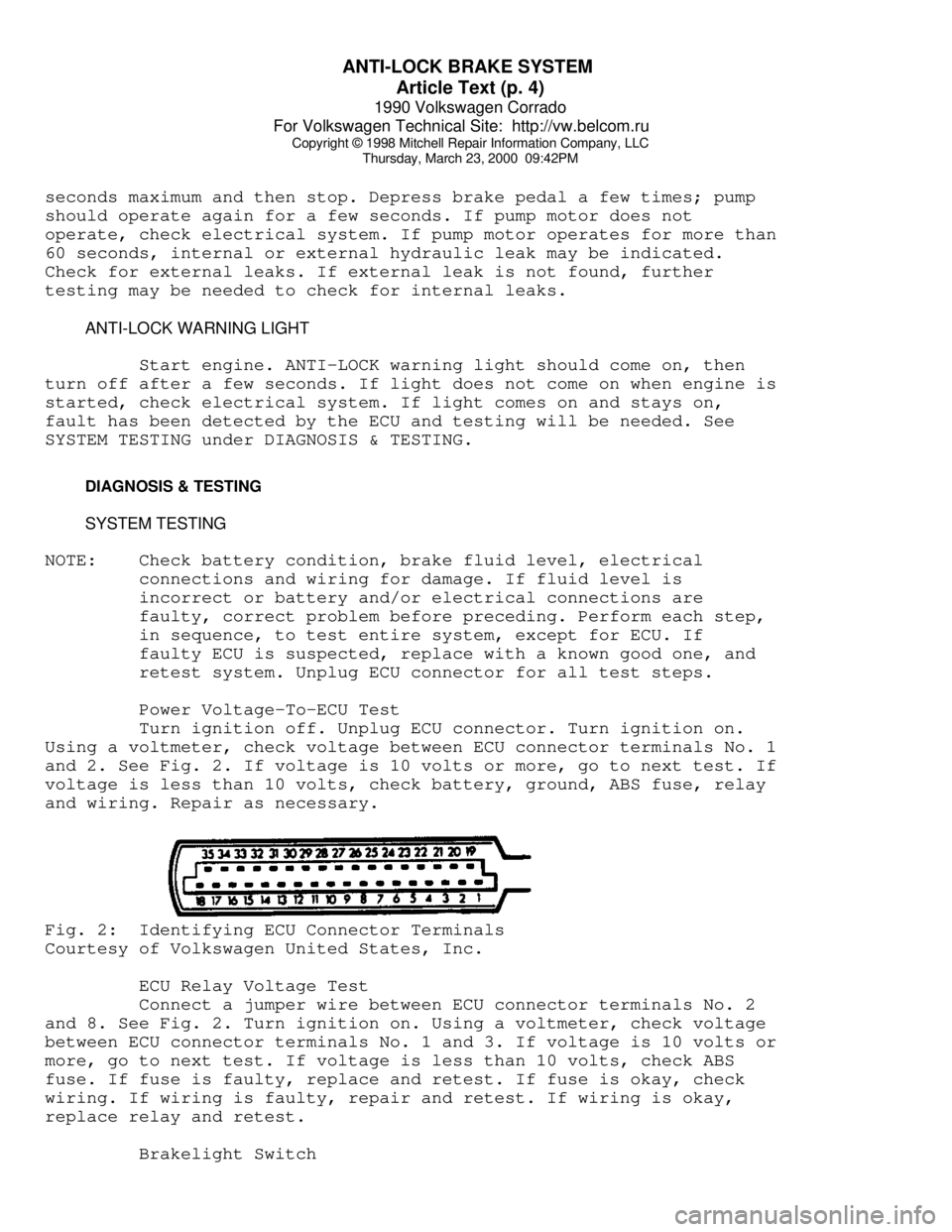
and wiring. Repair as necessary.Fig. 2: Identifying ECU Connector Terminals
Courtesy of Volkswagen United States, Inc.
ECU Relay Voltage Test
Connect a jumper wire between ECU connector terminals No. 2
and 8. See Fig. 2. Turn ignition on. Using a voltmeter, check voltage
between ECU connector terminals No. 1 and 3. If voltage is 10 volts or
more, go to next test. If voltage is less than 10 volts, check ABS
fuse. If fuse is faulty, replace and retest. If fuse is okay, check
wiring. If wiring is faulty, repair and retest. If wiring is okay,
replace relay and retest.
Brakelight Switch
Page 413 of 906

ANTI-LOCK BRAKE SYSTEM
Article Text (p. 5)
1990 Volkswagen Corrado
For Volkswagen Technical Site: http://vw.belcom.ru
Copyright © 1998 Mitchell Repair Information Company, LLC
Thursday, March 23, 2000 09:42PM
Turn ignition on. Apply brakes. Check for 12 volts between
terminals No. 12 and 1. If 12 volts are present, brakelight switch is
okay. If 12 volts are not present, check fuse, brakelight switch and
Black/Red wire from brakelight switch to ECU.
Hydraulic Modulator/Pump Relay Voltage Test
1) Turn ignition off. Unplug hydraulic modulator/pump
connector. Depress brake pedal 25 times. Turn ignition on. Using a
voltmeter, measure voltage between ECU connector terminals No. 1 and
32. See Fig. 2. If voltage is 10 volts or more, go to RIGHT REAR WHEEL
SPEED SENSOR VOLTAGE TEST under SYSTEM TESTING.
2) If voltage is less than 10 volts, check hydraulic
modulator/pump fuse. If fuse is okay, check wiring between ECU
connector terminal No. 32 and hydraulic modulator/pump connector
terminal No. 1 (large gauge Red/Black wire). See Figs. 2 and 4-9. If
wiring is not okay, repair wiring, and retest. If wiring is okay,
replace relay, and retest.
Right Rear Wheel Speed Sensor Voltage Test
Connect an AC voltmeter between ECU connector terminals No. 4
and 22. See Fig. 2. Rotate right rear wheel at one revolution per
second. Measure voltage with wheel rotating. If voltage is 0.075 volt
or more, go to next test. If voltage is less than 0.075 volt, check
wheel speed sensor and/or toothed ring for damage, wear and proper
installation. If damage or wear is found, replace faulty component and
retest. If not properly installed, reposition and retest. If
components are okay, replace wheel speed sensor and retest.
Left Rear Wheel Speed Sensor Voltage Test
Connect an AC voltmeter between ECU connector terminals No. 6
and 24. See Fig. 2. Rotate left rear wheel at one revolution per
second. Measure voltage with wheel rotating. If voltage is 0.075 volt
or more, go to next test. If voltage is less than 0.075 volt, check
wheel speed sensor and/or toothed ring for damage, wear and proper
installation. If damage or wear is found, replace faulty component and
retest. If not properly installed, reposition and retest. If
components are okay, replace wheel speed sensor and retest.
Right Front Wheel Speed Sensor Voltage Test
Connect an AC voltmeter between ECU connector terminals No. 7
and 25. See Fig. 2. Rotate right front wheel at one revolution per
second. Measure voltage with wheel rotating. If voltage is 0.075 volt
or more, go to next test. If voltage is less than 0.075 volt, check
wheel speed sensor and/or toothed ring for damage, wear and improper
installation. If damage or wear is found, replace faulty component,
and retest. If component is improperly installed, reposition
component, and retest. If components are okay, replace wheel speed
sensor, and retest.
Left Front Wheel Speed Sensor Voltage Test
Connect an AC voltmeter between ECU connector terminals No. 5
and 23. See Fig. 2. Rotate left front wheel at one revolution per