engine VOLKSWAGEN CORRADO 1990 Repair Manual
[x] Cancel search | Manufacturer: VOLKSWAGEN, Model Year: 1990, Model line: CORRADO, Model: VOLKSWAGEN CORRADO 1990Pages: 906, PDF Size: 6.56 MB
Page 579 of 906

H - TESTS W/O CODES
Article Text (p. 6)
1990 Volkswagen Corrado
For Volkswagen Technical Site: http://vw.belcom.ru
Copyright © 1998 Mitchell Repair Information Company, LLC
Thursday, March 23, 2000 09:45PM
* Check fuel system and control system pressure. Replace
pressure regulator if necessary.
* Check thermo time switch operation.
* Check airflow sensor voltage output.
* Check air induction system for leaks.
* Check fuel injector operation.
* Check coolant temperature sensor operation.
* Check Oxygen (O2) sensor operation.
ENGINE DIESELING
CIS-E & CIS-E MOTRONIC
* Ensure ignition timing and timing advance are set to
specifications.
* Check for engine overheating.
* Check cold start valve for leaking (engine warm).
* Check for leaking injectors.
* Check airflow sensor plate/control plunger rest position.
Adjust as necessary.
* Check carbon canister solenoid valve.
* Verify no leaks in exhaust system.
FAILED EMISSIONS TEST
* Test lambda control system. Replace if faulty.
* Check air/fuel mixture. Adjust if necessary.
* Ensure air intake system is not restricted.
* Ensure engine is at normal operating temperature.
* Ensure fuel system pressure is correct.
* Check cold start valve for leaking (engine warm).
* Check thermo time switch operation.
* Verify base timing is correct.
* Check for correct PCV valve operation.
* Check crankcase for gasoline contamination.
* Check idle stabilizer operation.
* Check EGR system for correct operation (if equipped).
* Check vapor recovery system operation.
* Check operation of coolant temperature sensor.
* Check fuel tank filler tube for tampering of restrictor.
If tampering has occurred, check catalytic converter for
lead contamination and exhaust system restriction.
* Check for use of poor quality fuel containing insufficient
cleaning additives. Prolonged use of poor quality fuel can
cause injector clogging and carbon build-up on intake system.
INTERMITTENT PROBLEM DIAGNOSIS
Intermittent fault testing requires duplicating circuit or
component failure to identify the problem. If necessary, monitor
voltage or resistance values using a DVOM while attempting to
Page 580 of 906

H - TESTS W/O CODES
Article Text (p. 7)
1990 Volkswagen Corrado
For Volkswagen Technical Site: http://vw.belcom.ru
Copyright © 1998 Mitchell Repair Information Company, LLC
Thursday, March 23, 2000 09:45PM
reproduce conditions causing intermittent fault.
A status change on DVOM indicates a fault has been located.
When monitoring voltage, ensure ignition switch is in ON position or
engine is running. Ensure ignition switch is in OFF position or
negative battery cable is disconnected when monitoring circuit
resistance.
TEST PROCEDURES
INTERMITTENT SIMULATION
To reproduce the conditions creating an intermittent fault,
use the following methods:
* Lightly vibrate component.
* Heat component.
* Wiggle or bend wiring harness.
* Spray component with water.
* Remove/apply vacuum source.
END OF ARTICLE
Page 585 of 906
HEATER SYSTEM
Article Text (p. 5)
1990 Volkswagen Corrado
For Volkswagen Technical Site: http://vw.belcom.ru
Copyright © 1998 Mitchell Repair Information Company, LLC
Thursday, March 23, 2000 09:45PM
retaining screws. Remove lower left instrument panel. Remove lower
right instrument panel tray retaining screws.
2) Remove lower right instrument panel. Remove gearshift
lever knob. Remove gearshift lever boot. Remove center console
retaining screws. Slide center console rearward. Disconnect electrical
connectors attached to center console. Remove center console.
3) Remove temperature control knobs. Remove trim plate.
Remove radio. Remove switches from instrument panel. Remove instrument
panel trim plate retaining screws. Remove instrument panel trim plate.
Remove instrument cluster retaining screws. Remove instrument cluster.
4) Disconnect speedometer cable, electrical connectors and
vacuum hoses from instrument cluster. Remove speaker grilles. Remove
air outlet grilles from housings. Remove housing retaining screws.
Remove air outlet housings. Remove instrument panel mounting nuts and
screws.
5) Remove instrument panel. Disconnect heater hoses from
heater core. Remove heater assembly mounting bolts and nuts. Remove
all attaching ducts. Disconnect cables from heater assembly. Remove
heater assembly.
INSTALLATION
Reverse removal procedure for installation. Fill radiator
with coolant and start engine. Ensure heater control is in warm
position to purge air from heater core.
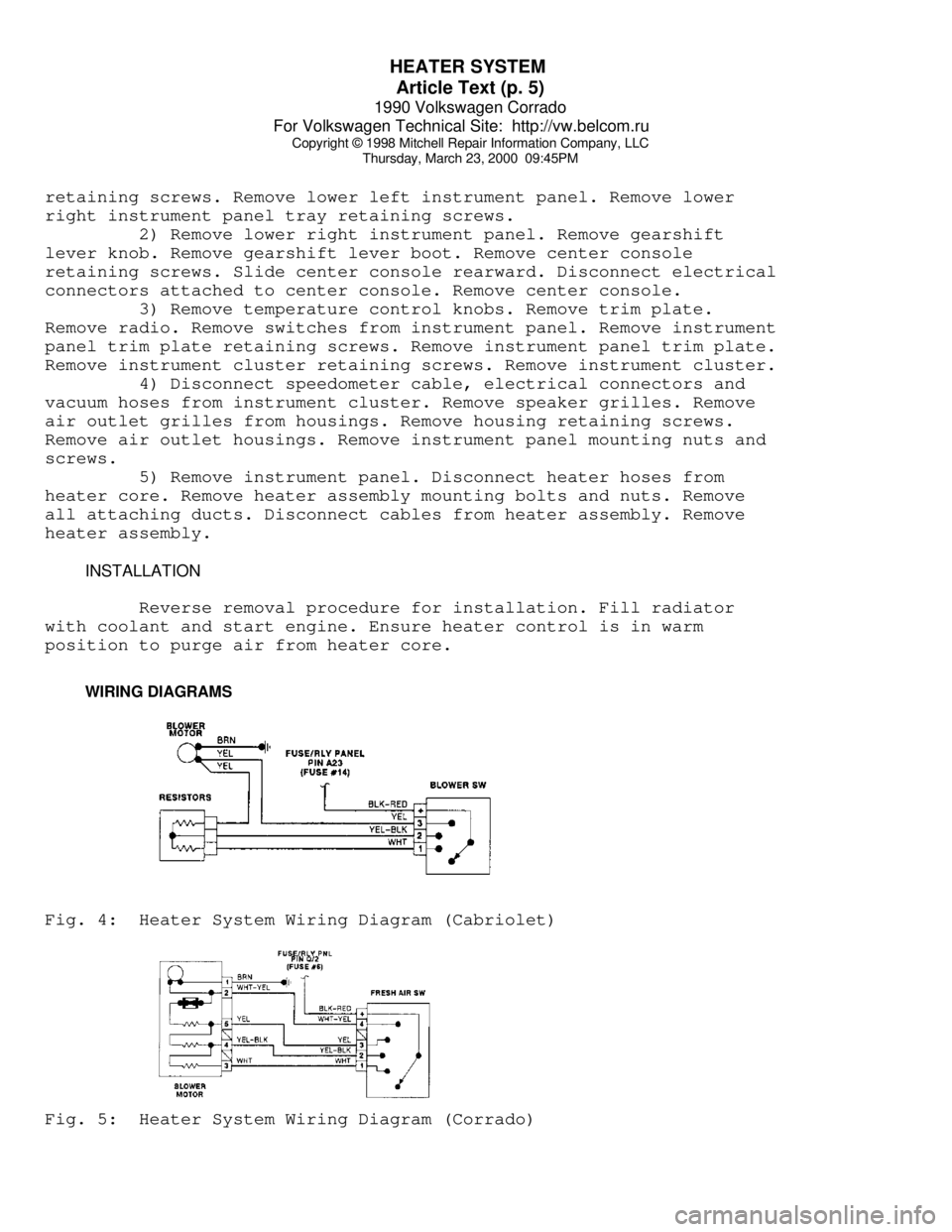
WIRING DIAGRAMSFig. 4: Heater System Wiring Diagram (Cabriolet)Fig. 5: Heater System Wiring Diagram (Corrado)
Page 588 of 906

I - SYSTEM/COMPONENT TESTS
Article Text
1990 Volkswagen Corrado
For Volkswagen Technical Site: http://vw.belcom.ru
Copyright © 1998 Mitchell Repair Information Company, LLC
Thursday, March 23, 2000 09:46PM
ARTICLE BEGINNING
1990 ENGINE PERFORMANCE
Systems & Component Testing
Volkswagen; Cabriolet, Corrado, Fox, Golf GL/GTI,
Jetta, Vanagon
INTRODUCTION
Before testing separate components or systems, perform
procedures in F - BASIC TESTING and H - TESTS W/O CODES articles.
NOTE: Testing individual components does not isolate shorts or
opens. Perform all voltage tests with a Digital
Volt-Ohmmeter (DVOM) with a minimum 10-megohm input
impedance, unless stated otherwise in test procedure. Use
ohmmeter to isolate wiring harness shorts or opens.
AIR INDUCTION SYSTEMS (SUPERCHARGER)
BOOST PRESSURE
1) Before checking supercharger boost pressure, ensure engine
idle speed is correct. See D - ADJUSTMENTS article. Ensure engine oil
temperature is 176øF (80øC). Check knock sensor operation. See KNOCK
SENSOR under IDLE CONTROL SYSTEM in this article.
2) Connect Pressure Gauge (VW1397) or equivalent to the
pressure regulator hose using adapter "T". Open pressure gauge check
valve to position "A" and start engine.
3) Remove harness connector from CO potentiometer and Blue
connector from temperature sensor (in front flange on cylinder head).
Accelerate to full throttle. Engine speed must increase periodically
then drop (surge). Watch pressure gauge, boost pressure must reach 8.7
psi (0.6 kg/cm
ý). If boost does not reach specification, check for
leaks in air system and correct by-pass valve setting. Check
supercharger.
COMPUTERIZED ENGINE CONTROLS
NOTE: For fuel system used on model being tested, see FUEL SYSTEM
APPLICATION table.
FUEL SYSTEM APPLICATION
ÄÄÄÄÄÄÄÄÄÄÄÄÄÄÄÄÄÄÄÄÄÄÄÄÄÄÄÄÄÄÄÄÄÄÄÄÄÄÄÄÄÄÄÄÄÄÄÄÄÄÄÄÄÄÄÄÄÄÄÄÄÄÄÄÄÄÄÄÄÄApplication Fuel System
Cabriolet, Corrado, Golf GL/GTI,
Jetta & Vanagon .................................. AFC-Digifant II
Fox .......................................................... CIS-E
Jetta GLi ............................................. CIS-Motronic
Page 590 of 906
I - SYSTEM/COMPONENT TESTS
Article Text (p. 3)
1990 Volkswagen Corrado
For Volkswagen Technical Site: http://vw.belcom.ru
Copyright © 1998 Mitchell Repair Information Company, LLC
Thursday, March 23, 2000 09:46PM
circuits to ECU. The ECU engine ground is near ignition distributor.
Remove ECU connector. Check resistance to ground on terminal No. 35.
Resistance should be zero ohms. If resistance is not zero ohms, repair
open or short in wiring.
POWER CIRCUITS
Turn ignition off. Disconnect ECU connector. Using a
voltmeter, check terminals No. 12, 14, 19 and 34 for battery voltage.
If battery voltage is not present. Check fuses No. 15, 18 and 24. If
fuses are okay, check for open in wiring between ECU and fuse box. See
L - WIRING DIAGRAMS for terminal identification and wire colors.
ENGINE SENSORS & SWITCHES
AIRFLOW SENSOR (FOX & JETTA GLI)
1) Start engine to pressurized fuel system. Turn engine off
and remove intake boot from top of airflow sensor. Disconnect coil
secondary wire from coil and jumper to ground.
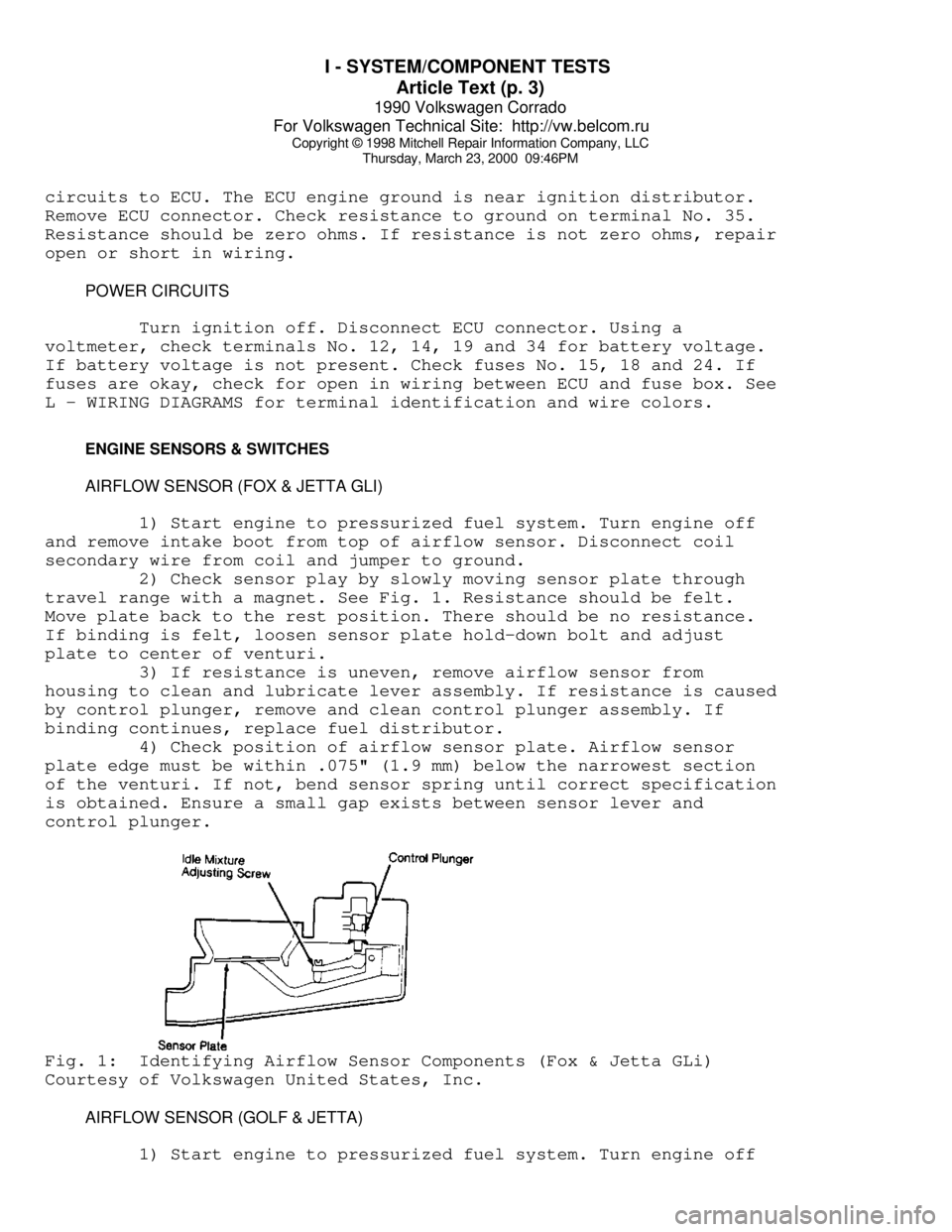
2) Check sensor play by slowly moving sensor plate through
travel range with a magnet. See Fig. 1. Resistance should be felt.
Move plate back to the rest position. There should be no resistance.
If binding is felt, loosen sensor plate hold-down bolt and adjust
plate to center of venturi.
3) If resistance is uneven, remove airflow sensor from
housing to clean and lubricate lever assembly. If resistance is caused
by control plunger, remove and clean control plunger assembly. If
binding continues, replace fuel distributor.
4) Check position of airflow sensor plate. Airflow sensor
plate edge must be within .075" (1.9 mm) below the narrowest section
of the venturi. If not, bend sensor spring until correct specification
is obtained. Ensure a small gap exists between sensor lever and
control plunger.Fig. 1: Identifying Airflow Sensor Components (Fox & Jetta GLi)
Courtesy of Volkswagen United States, Inc.
AIRFLOW SENSOR (GOLF & JETTA)
1) Start engine to pressurized fuel system. Turn engine off
Page 592 of 906
I - SYSTEM/COMPONENT TESTS
Article Text (p. 5)
1990 Volkswagen Corrado
For Volkswagen Technical Site: http://vw.belcom.ru
Copyright © 1998 Mitchell Repair Information Company, LLC
Thursday, March 23, 2000 09:46PM
COOLANT TEMPERATURE SENSOR
Turn ignition off. Use a thermometer to measure coolant
temperature. Unplug connector from Electronic Control Unit (ECU).
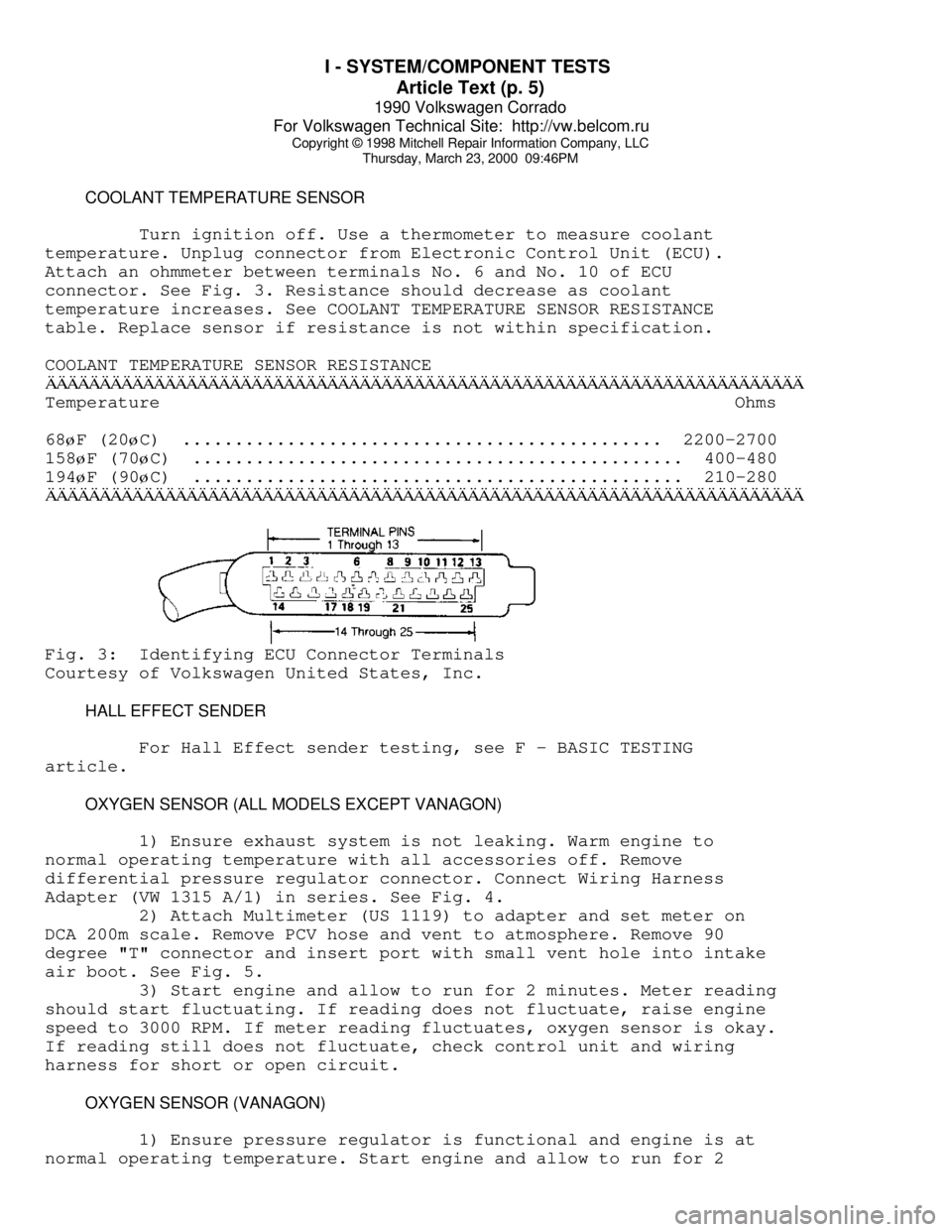
Attach an ohmmeter between terminals No. 6 and No. 10 of ECU
connector. See Fig. 3. Resistance should decrease as coolant
temperature increases. See COOLANT TEMPERATURE SENSOR RESISTANCE
table. Replace sensor if resistance is not within specification.
COOLANT TEMPERATURE SENSOR RESISTANCEÄÄÄÄÄÄÄÄÄÄÄÄÄÄÄÄÄÄÄÄÄÄÄÄÄÄÄÄÄÄÄÄÄÄÄÄÄÄÄÄÄÄÄÄÄÄÄÄÄÄÄÄÄÄÄÄÄÄÄÄÄÄÄÄÄÄÄÄÄÄTemperature Ohms
68
øF (20øC) .............................................. 2200-2700
158
øF (70øC) ............................................... 400-480
194
øF (90øC) ............................................... 210-280
ÄÄÄÄÄÄÄÄÄÄÄÄÄÄÄÄÄÄÄÄÄÄÄÄÄÄÄÄÄÄÄÄÄÄÄÄÄÄÄÄÄÄÄÄÄÄÄÄÄÄÄÄÄÄÄÄÄÄÄÄÄÄÄÄÄÄÄÄÄÄFig. 3: Identifying ECU Connector Terminals
Courtesy of Volkswagen United States, Inc.
HALL EFFECT SENDER
For Hall Effect sender testing, see F - BASIC TESTING
article.
OXYGEN SENSOR (ALL MODELS EXCEPT VANAGON)
1) Ensure exhaust system is not leaking. Warm engine to
normal operating temperature with all accessories off. Remove
differential pressure regulator connector. Connect Wiring Harness
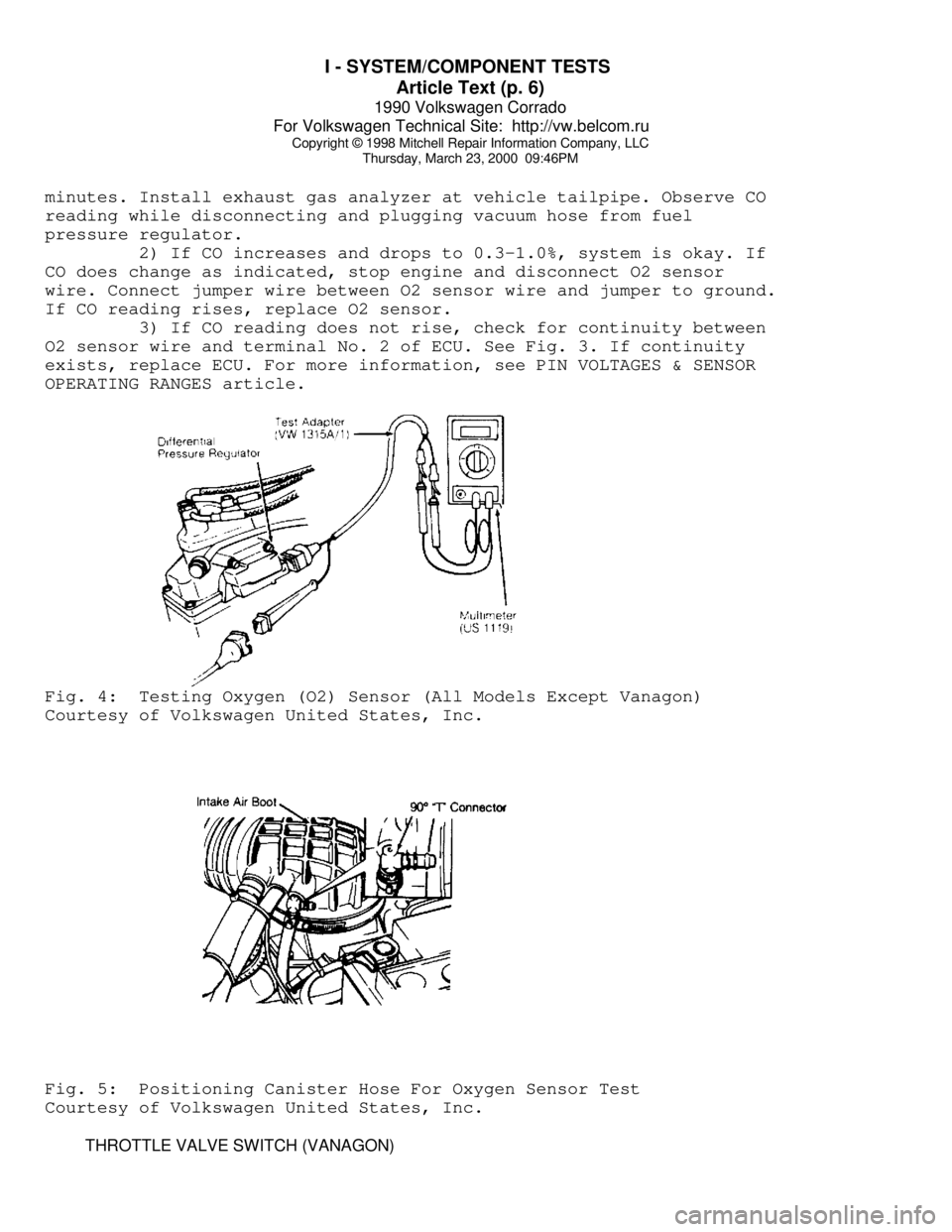
Adapter (VW 1315 A/1) in series. See Fig. 4.
2) Attach Multimeter (US 1119) to adapter and set meter on
DCA 200m scale. Remove PCV hose and vent to atmosphere. Remove 90
degree "T" connector and insert port with small vent hole into intake
air boot. See Fig. 5.
3) Start engine and allow to run for 2 minutes. Meter reading
should start fluctuating. If reading does not fluctuate, raise engine
speed to 3000 RPM. If meter reading fluctuates, oxygen sensor is okay.
If reading still does not fluctuate, check control unit and wiring
harness for short or open circuit.
OXYGEN SENSOR (VANAGON)
1) Ensure pressure regulator is functional and engine is at
normal operating temperature. Start engine and allow to run for 2
Page 593 of 906
I - SYSTEM/COMPONENT TESTS
Article Text (p. 6)
1990 Volkswagen Corrado
For Volkswagen Technical Site: http://vw.belcom.ru
Copyright © 1998 Mitchell Repair Information Company, LLC
Thursday, March 23, 2000 09:46PM
minutes. Install exhaust gas analyzer at vehicle tailpipe. Observe CO
reading while disconnecting and plugging vacuum hose from fuel
pressure regulator.
2) If CO increases and drops to 0.3-1.0%, system is okay. If
CO does change as indicated, stop engine and disconnect O2 sensor
wire. Connect jumper wire between O2 sensor wire and jumper to ground.
If CO reading rises, replace O2 sensor.
3) If CO reading does not rise, check for continuity between
O2 sensor wire and terminal No. 2 of ECU. See Fig. 3. If continuity
exists, replace ECU. For more information, see PIN VOLTAGES & SENSOR
OPERATING RANGES article.Fig. 4: Testing Oxygen (O2) Sensor (All Models Except Vanagon)
Courtesy of Volkswagen United States, Inc.Fig. 5: Positioning Canister Hose For Oxygen Sensor Test
Courtesy of Volkswagen United States, Inc.
THROTTLE VALVE SWITCH (VANAGON)
Page 596 of 906
I - SYSTEM/COMPONENT TESTS
Article Text (p. 9)
1990 Volkswagen Corrado
For Volkswagen Technical Site: http://vw.belcom.ru
Copyright © 1998 Mitchell Repair Information Company, LLC
Thursday, March 23, 2000 09:46PM
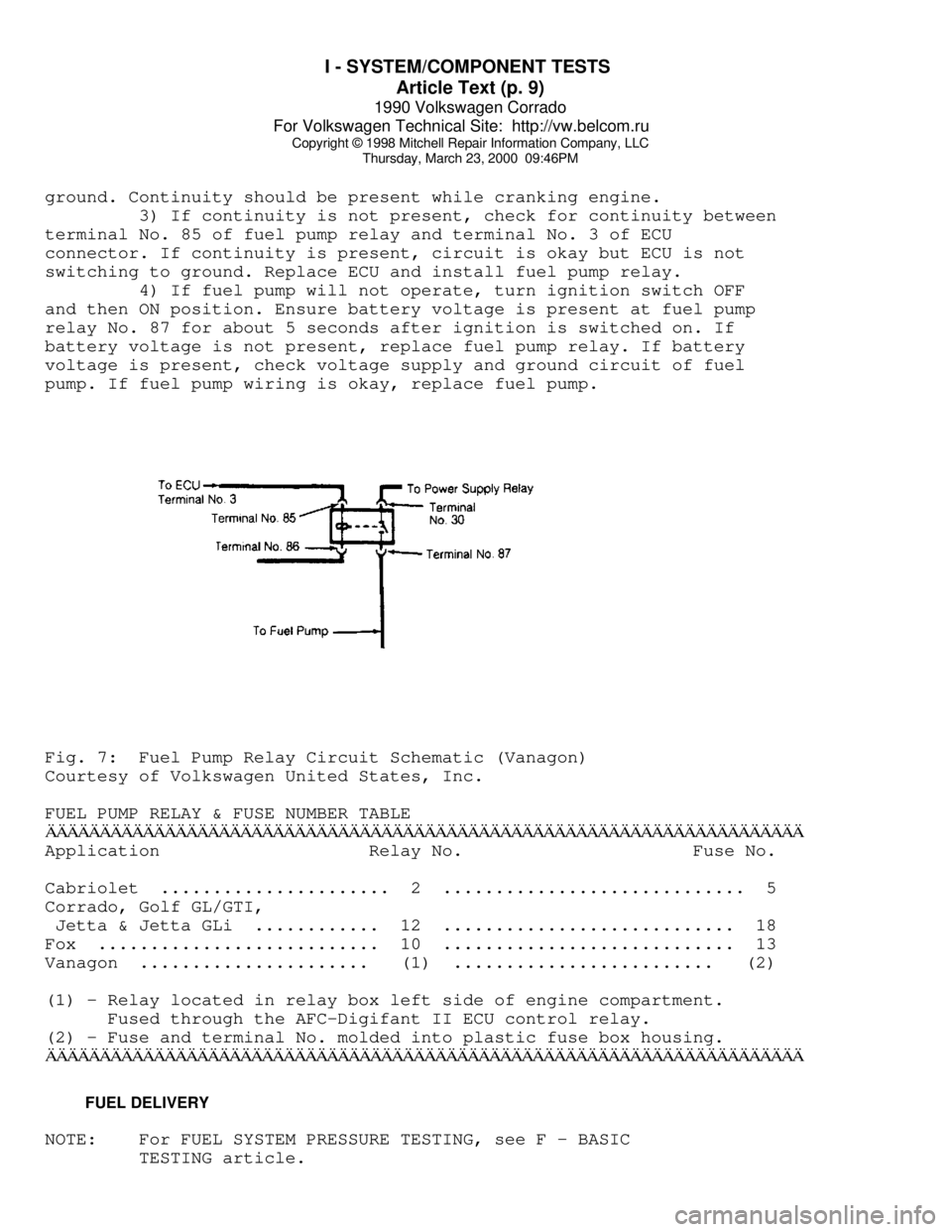
ground. Continuity should be present while cranking engine.
3) If continuity is not present, check for continuity between
terminal No. 85 of fuel pump relay and terminal No. 3 of ECU
connector. If continuity is present, circuit is okay but ECU is not
switching to ground. Replace ECU and install fuel pump relay.
4) If fuel pump will not operate, turn ignition switch OFF
and then ON position. Ensure battery voltage is present at fuel pump
relay No. 87 for about 5 seconds after ignition is switched on. If
battery voltage is not present, replace fuel pump relay. If battery
voltage is present, check voltage supply and ground circuit of fuel
pump. If fuel pump wiring is okay, replace fuel pump.Fig. 7: Fuel Pump Relay Circuit Schematic (Vanagon)
Courtesy of Volkswagen United States, Inc.
FUEL PUMP RELAY & FUSE NUMBER TABLEÄÄÄÄÄÄÄÄÄÄÄÄÄÄÄÄÄÄÄÄÄÄÄÄÄÄÄÄÄÄÄÄÄÄÄÄÄÄÄÄÄÄÄÄÄÄÄÄÄÄÄÄÄÄÄÄÄÄÄÄÄÄÄÄÄÄÄÄÄÄApplication Relay No. Fuse No.
Cabriolet ...................... 2 ............................. 5
Corrado, Golf GL/GTI,
Jetta & Jetta GLi ............ 12 ............................ 18
Fox ........................... 10 ............................ 13
Vanagon ...................... (1) ......................... (2)
(1) - Relay located in relay box left side of engine compartment.
Fused through the AFC-Digifant II ECU control relay.
(2) - Fuse and terminal No. molded into plastic fuse box housing.
ÄÄÄÄÄÄÄÄÄÄÄÄÄÄÄÄÄÄÄÄÄÄÄÄÄÄÄÄÄÄÄÄÄÄÄÄÄÄÄÄÄÄÄÄÄÄÄÄÄÄÄÄÄÄÄÄÄÄÄÄÄÄÄÄÄÄÄÄÄÄ FUEL DELIVERY
NOTE: For FUEL SYSTEM PRESSURE TESTING, see F - BASIC
TESTING article.
Page 597 of 906
I - SYSTEM/COMPONENT TESTS
Article Text (p. 10)
1990 Volkswagen Corrado
For Volkswagen Technical Site: http://vw.belcom.ru
Copyright © 1998 Mitchell Repair Information Company, LLC
Thursday, March 23, 2000 09:46PM
FUEL CONTROL
COLD START VALVE (ALL MODELS EXCEPT VANAGON)
1) Engine temperature must be below 85øF (30øC). Disconnect
cold start valve attaching screws and remove valve with harness
connector and fuel line attached.
2) Remove ignition coil secondary wire and jumper to ground.
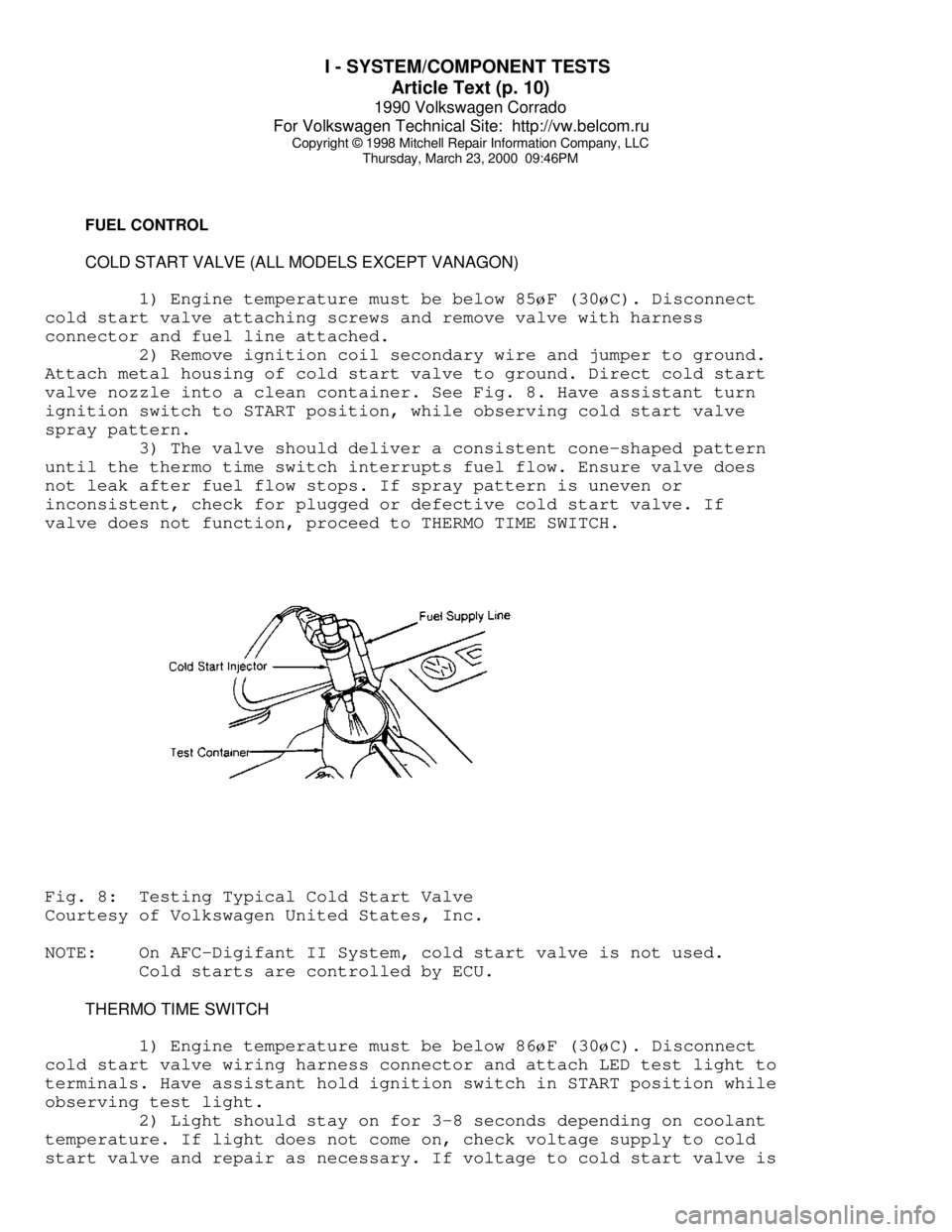
Attach metal housing of cold start valve to ground. Direct cold start
valve nozzle into a clean container. See Fig. 8. Have assistant turn
ignition switch to START position, while observing cold start valve
spray pattern.
3) The valve should deliver a consistent cone-shaped pattern
until the thermo time switch interrupts fuel flow. Ensure valve does
not leak after fuel flow stops. If spray pattern is uneven or
inconsistent, check for plugged or defective cold start valve. If
valve does not function, proceed to THERMO TIME SWITCH.Fig. 8: Testing Typical Cold Start Valve
Courtesy of Volkswagen United States, Inc.
NOTE: On AFC-Digifant II System, cold start valve is not used.
Cold starts are controlled by ECU.
THERMO TIME SWITCH
1) Engine temperature must be below 86
øF (30øC). Disconnect
cold start valve wiring harness connector and attach LED test light to
terminals. Have assistant hold ignition switch in START position while
observing test light.
2) Light should stay on for 3-8 seconds depending on coolant
temperature. If light does not come on, check voltage supply to cold
start valve and repair as necessary. If voltage to cold start valve is
Page 598 of 906

I - SYSTEM/COMPONENT TESTS
Article Text (p. 11)
1990 Volkswagen Corrado
For Volkswagen Technical Site: http://vw.belcom.ru
Copyright © 1998 Mitchell Repair Information Company, LLC
Thursday, March 23, 2000 09:46PM
okay, check ground circuit through thermo time switch. Replace thermo
time switch if contact to ground cannot be made.
IDLE CONTROL SYSTEM
NOTE: Knock control is integral in AFC-Digifant II ECU.
KNOCK SENSOR CONTROL UNIT (ALL MODELS EXCEPT VANAGON)
1) Check ignition coil and Hall Effect sender before checking
knock sensor control unit. Remove knock sensor control unit harness
connector. Turn ignition on. Using a voltmeter, check for battery
voltage between terminals No. 3 and No. 5 and terminals No. 6 and No.
3 of knock sensor control unit. Open throttle valve. Voltage should
drop to zero volts.
2) If voltage does not drop to zero volts, check throttle
valve switch (full throttle). Check voltage between terminals No. 8
and No. 3, while fully opening throttle valve. If battery voltage was
not present when throttle fully open, replace throttle valve switch.
See Fig. 13.
3) Remove Hall Effect sender connector and connect voltmeter
to outside terminals. Turn ignition on. There should be 5 volts
present. Turn ignition off. Connect voltmeter between terminals No. 1
(negative) and No. 15 (positive) of ignition coil. Turn ignition on
and touch center terminal of Hall Effect sender briefly to ground.
Voltage should jump momentarily to approximately 2 volts. If voltage
does not jump, replace knock sensor control unit.
KNOCK SENSOR(S)
Before replacing knock sensor, check knock sensor torque and
resistance. Remove knock sensor connector and check resistance between
terminals No. 13 and No. 14. See KNOCK SENSOR TORQUE & RESISTANCE
SPECIFICATION table. If resistance is incorrect, replace knock sensor.
NOTE: Knock sensor mounting bolt torque must be exact. DO NOT use
washers when mounting knock sensor.
KNOCK SENSOR RESISTANCE & TORQUE SPECIFICATIONÄÄÄÄÄÄÄÄÄÄÄÄÄÄÄÄÄÄÄÄÄÄÄÄÄÄÄÄÄÄÄÄÄÄÄÄÄÄÄÄÄÄÄÄÄÄÄÄÄÄÄÄÄÄÄÄÄÄÄÄÄÄÄÄÄÄÄÄÄÄApplication Resistance Ft. Lbs (N.m)
Type I ...................... 300,000 ................ 7-9 (10-12)
Type II .................... Infinite .............. 15-18 (20-25)
ÄÄÄÄÄÄÄÄÄÄÄÄÄÄÄÄÄÄÄÄÄÄÄÄÄÄÄÄÄÄÄÄÄÄÄÄÄÄÄÄÄÄÄÄÄÄÄÄÄÄÄÄÄÄÄÄÄÄÄÄÄÄÄÄÄÄÄÄÄÄ IDLE STABILIZATION SYSTEM (VANAGON)
1) Attach Test Meter (VW 1315/2) and Adapter (US 1119) to
idle stabilization valve. Set meter to milliampere scale. Start
engine. Observe test meter while turning A/C control switch to ON
position. If milliampere reading increases, system is okay.