engine VOLKSWAGEN CORRADO 1990 Repair Manual
[x] Cancel search | Manufacturer: VOLKSWAGEN, Model Year: 1990, Model line: CORRADO, Model: VOLKSWAGEN CORRADO 1990Pages: 906, PDF Size: 6.56 MB
Page 674 of 906

N - REMOVE/INSTALL/OVERHAUL
Article Text
1990 Volkswagen Corrado
For Volkswagen Technical Site: http://vw.belcom.ru
Copyright © 1998 Mitchell Repair Information Company, LLC
Thursday, March 23, 2000 09:49PM
ARTICLE BEGINNING
1990 ENGINE PERFORMANCE
Removal, Overhaul & Installation
Volkswagen; Cabriolet, Corrado, Fox, Golf GL/GTI,
Jetta, Vanagon
INTRODUCTION
Removal, overhaul and installation procedures are covered in
this article. If component removal and installation is primarily an
unbolt and bolt-on procedure, only a torque specification may be
furnished. See TORQUE SPECIFICATIONS at the end of this article.
REMOVAL & INSTALLATION
DISTRIBUTOR (DIGIFANT)
Removal (AFC-Digifant II)
Turn engine crankshaft to TDC. Remove distributor cap. Rotor
should point to No. 1 cylinder mark on edge of distributor housing.
Index mark the distributor housing to the crankcase relation. Remove
distributor hold-down clamp and bolt. Remove distributor assembly.
Installation
Align rotor with No. 1 cylinder mark on edge of distributor
housing. Install distributor and align housing to index mark made on
crankcase. Install distributor hold-down clamp and bolt. Install
distributor cap. Check timing. Tighten hold-down bolt to
specification. See TORQUE SPECIFICATIONS.
DISTRIBUTOR (CIS SYSTEMS)
Removal (CIS-E & CIS-E Motronic)
1) Turn engine crankshaft to TDC. Marking on vibration
dampener pulley must align with drive belt guard pointer. Marking on
cam shaft gear sprocket must align with cylinder head cover.
2) Remove distributor cap and mark position of rotor. Rotor
should be pointing to No. 1 cylinder in distributor firing sequence.
Mark position of distributor housing for installation reference.
Remove distributor hold-down clamp and bolt. Remove distributor
assembly, noting position of rotor when distributor shaft gear is
disengaged from driving gear.
Installation
1) Align oil pump drive pinion lug parallel to crankshaft.
Set rotor pointing toward mark made when distributor was disengaged
from drive gear.
2) Install distributor. Rotor should now point to mark made
for No. 1 cylinder in distributor firing sequence. Align mark for
Page 678 of 906

N - REMOVE/INSTALL/OVERHAUL
Article Text (p. 5)
1990 Volkswagen Corrado
For Volkswagen Technical Site: http://vw.belcom.ru
Copyright © 1998 Mitchell Repair Information Company, LLC
Thursday, March 23, 2000 09:49PM
distributor. Install fuel distributor. See TORQUE SPECIFICATIONS for
tightening specifications. Connect all fuel lines except those to fuel
injectors. Check sensor plate adjusting lever and fuel distributor
control piston for smooth operation.
2) Remove fuel pump relay and bridge fuel pump circuit. Use
Jumper Switch (US 4480/3) in place of fuel pump relay. When pressure
has built up, turn off fuel pump. Move sensor plate from rest position
to end of travel.
3) Uniform resistance should be felt during entire movement.
No resistance should be felt during entire movement. No resistance
should be felt on quick return to rest position. Connect injector
lines. Install fuel pump relay. Start engine and check for leaks.
INJECTORS (DIGIFANT)
CAUTION: Fuel system pressure must be relieved before removing
injectors. Wipe up all spilled fuel BEFORE continuing
service.
Removal (AFC-Digifant II)
Disconnect negative battery cable. Disconnect main electrical
connector from fuel rail. Remove idle stabilizer valve. Loosen and
remove both hoses on each end of fuel rail. Remove fuel pressure
regulator and mounting bracket. Remove fuel rail mounting bolts. Pry
off injector mounting clips. Disconnect injector electrical
connectors. Remove fuel rail. Remove each injector from its insert.
Installation
To install injectors, reverse removal procedures. Use new "O"
rings when installing injectors. Replace hose clamps if necessary. See
TORQUE SPECIFICATIONS table at end of this article. Check for fuel
leaks.
INJECTORS (CIS SYSTEMS)
Removal (CIS-E & CIS-E Motronic)
Remove injectors from inserts in cylinder head with fuel
lines attached. Using 12-mm or 13-mm hex wrench, remove inserts from
head. Use 2 wrenches to remove injectors from fuel lines.
Installation
To install, reverse removal procedures. Use 2 wrenches when
tightening injector lines to injectors. Use new "O" rings lightly
lubricated. On models with 2-piece inserts, replace insert sealing
washer (against head) and use sealing compound on upper insert
threaded portion. See TORQUE SPECIFICATIONS.
OXYGEN (O2) SENSOR
Removal & Installation
Oxygen (O2) sensor is mounted in the exhaust pipe in front of
catalytic converter. Disconnect permanent pigtail from sensor. Ensure
Page 679 of 906
N - REMOVE/INSTALL/OVERHAUL
Article Text (p. 6)
1990 Volkswagen Corrado
For Volkswagen Technical Site: http://vw.belcom.ru
Copyright © 1998 Mitchell Repair Information Company, LLC
Thursday, March 23, 2000 09:49PM
sensor is free of contaminants, avoid using any cleaning solvents.
Sensor may be difficult to remove when engine temperature is less than
118øF (48øC). Always use anti-seize compound on threads before
installation. Tighten sensor to specification. See
TORQUE SPECIFICATIONS.
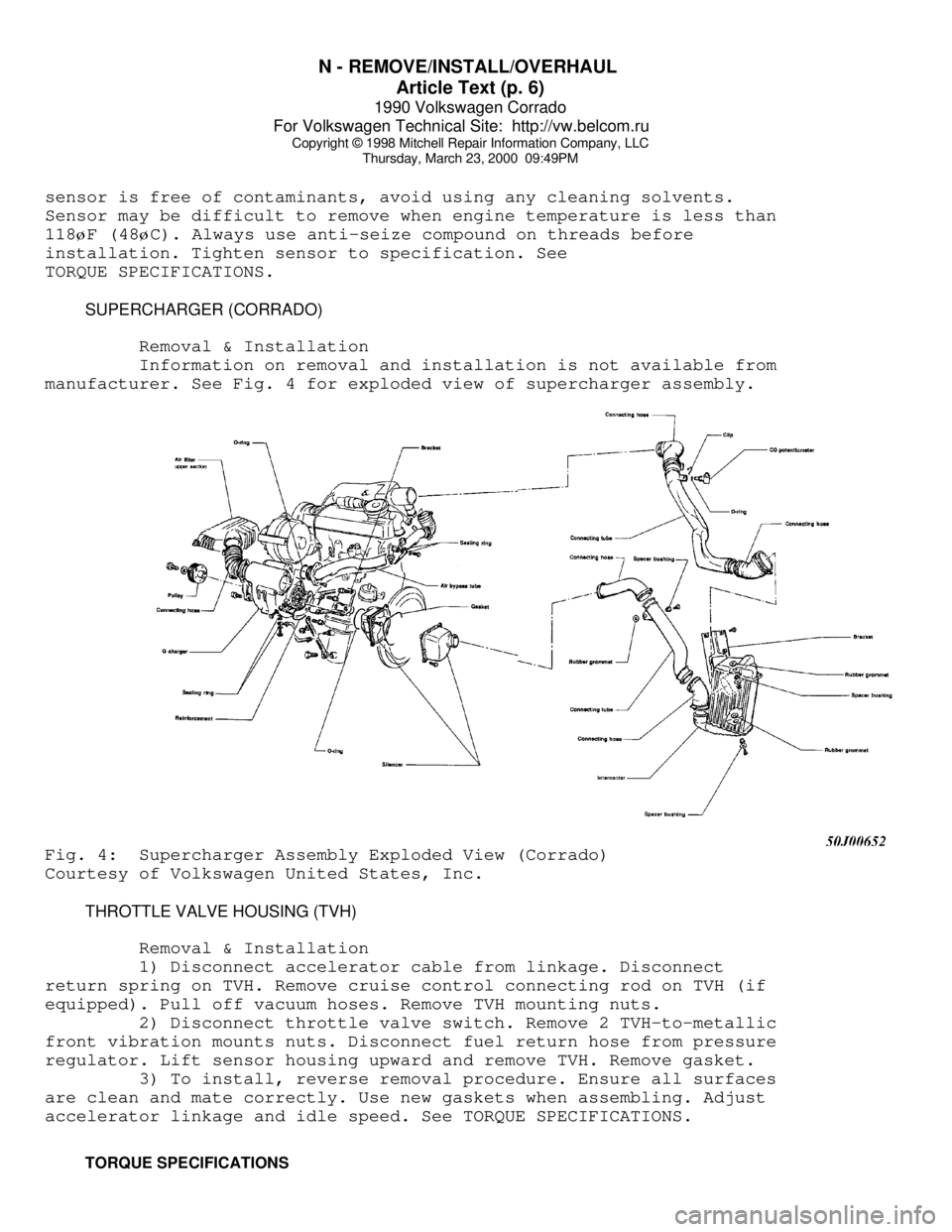
SUPERCHARGER (CORRADO)
Removal & Installation
Information on removal and installation is not available from
manufacturer. See Fig. 4 for exploded view of supercharger assembly.Fig. 4: Supercharger Assembly Exploded View (Corrado)
Courtesy of Volkswagen United States, Inc.
THROTTLE VALVE HOUSING (TVH)
Removal & Installation
1) Disconnect accelerator cable from linkage. Disconnect
return spring on TVH. Remove cruise control connecting rod on TVH (if
equipped). Pull off vacuum hoses. Remove TVH mounting nuts.
2) Disconnect throttle valve switch. Remove 2 TVH-to-metallic
front vibration mounts nuts. Disconnect fuel return hose from pressure
regulator. Lift sensor housing upward and remove TVH. Remove gasket.
3) To install, reverse removal procedure. Ensure all surfaces
are clean and mate correctly. Use new gaskets when assembling. Adjust
accelerator linkage and idle speed. See TORQUE SPECIFICATIONS.
TORQUE SPECIFICATIONS
Page 681 of 906

P - EGR FUNCTION TESTING
Article Text
1990 Volkswagen Corrado
For Volkswagen Technical Site: http://vw.belcom.ru
Copyright © 1998 Mitchell Repair Information Company, LLC
Thursday, March 23, 2000 09:49PM
ARTICLE BEGINNING
1989-95 ENGINE PERFORMANCE
Volkswagen EGR Function Testing
All Models
EGR VALVE (EXCEPT DIESEL)
1) Run engine at idle speed. Using a hand-held vacuum pump,
apply 12 in. Hg to EGR valve. Engine should run rough or stall. If
not, check EGR valve pintle for movement. If EGR pintle is moving, EGR
port is plugged. If EGR valve does not function, replace EGR valve.
2) To check EGR port vacuum supply, connect vacuum gauge to
EGR vacuum line using a "T" fitting. Start engine and increase engine
speed to about 3000 RPM. Vacuum gauge should indicate vacuum. If
vacuum is not present, vacuum source is plugged. Repair as necessary
and repeat test.
END OF ARTICLE
Page 682 of 906

POSSIBLE ENGINE STALL DUE TO FUEL RESTRICTION
Article Text
1990 Volkswagen Corrado
For Volkswagen Technical Site: http://vw.belcom.ru
Copyright © 1998 Mitchell Repair Information Company, LLC
Thursday, March 23, 2000 09:49PM
ARTICLE BEGINNING
NHTSA RECALL BULLETIN
Model(s): 1990 Volkswagen Corrado
1991 Volkswagen Corrado
Campaign No: 91V068000
Number of Affected Vehicles: 8500
Beginning Date of Manufacture: 1989 OCTOBER
Ending Date of Manufacture: 1991 OCTOBER
VEHICLE DESCRIPTION:
Passenger cars.
DESCRIPTION OF DEFECT:
The fuel filter housing, which serves as the base for the fuel pump
(located in the fuel tank) could deform, resulting in the fuel pump
becoming loose.
FAULT:
Poor fit/loose
SYSTEM:
Fuel pump filter.
CONSEQUENCE OF DEFECT:
A loose and improperly seated fuel pump can cause reduced fuel flow to
the engine resulting in possible driveability problems and stalling of
the vehicle.
CORRECTIVE ACTION:
Replace fuel filter.
ADDITIONAL INFORMATION:
The National Highway Traffic Safety Administration operates Monday
through Friday from 8:00 AM to 4:00 PM, Eastern Time. For more
information call (800) 424-9393 or (202) 366-0123. For the hearing
impaired, call (800) 424-9153.
END OF ARTICLE
Page 686 of 906

SCHEDULED SERVICES
Article Text (p. 3)
1990 Volkswagen Corrado
For Volkswagen Technical Site: http://vw.belcom.ru
Copyright © 1998 Mitchell Repair Information Company, LLC
Thursday, March 23, 2000 09:49PM
restored, driveability problems may exist on some vehicles.
These vehicles may require a relearn procedure. See COMPUTER
RELEARN PROCEDURES article in GENERAL INFORMATION section.
REPLACING BLOWN FUSES
Before replacing a blown fuse, remove ignition key, turn off
all lights and accessories to avoid damaging the electrical system. Be
sure to use fuse with the correct indicated amperage rating. The use
of an incorrect amperage rating fuse may result in a dangerous
electrical system overload.
BRAKE PAD REPLACEMENT
WARNING: Use caution when checking and/or changing brake pads, some
pads may contain asbestos which can irritate eyes and may
cause other health hazards. A water based solution should be
used to clean brake dust from wheel and brake components.
DO NOT use compressed air to blow off brake dust.
BRAKE SYSTEM
CAUTION: If brake warning light comes on while driving it indicates
a low fluid level or failure in one of the braking
circuits. If the brake pedal can be depressed further than
normal it is an indication that one of the brake circuits
is not functioning. Stop vehicle and check brake reservoir
fluid level. If level is below MIN mark, DO NOT drive
vehicle. Have it towed to a repair shop. If level is
between the MIN and MAX marks, proceed cautiously to a
repair shop.
BRAKE PAD WEAR INDICATOR
Indicator will cause a squealing or scraping noise, warning
that brake pads need replacement.
BRAKE PEDAL PRESSURE WITH ENGINE NOT RUNNING
CAUTION: Brake pedal requires extreme pressure to stop the vehicle
when the engine is not running.
CATALYTIC CONVERTER
Continued operation of vehicle with a severe malfunction
could cause converter to overheat, resulting in possible damage to
converter and vehicle.
Any modification to the exhaust system on turbo models, which
reduces exhaust backpressure, will lead to lean fuel mixtures and
excessive spark advance. This could cause serious engine damage.
COOLANT (PROPYLENE-GLYCOL FORMULATIONS)
Page 687 of 906

SCHEDULED SERVICES
Article Text (p. 4)
1990 Volkswagen Corrado
For Volkswagen Technical Site: http://vw.belcom.ru
Copyright © 1998 Mitchell Repair Information Company, LLC
Thursday, March 23, 2000 09:49PM
To avoid possible damage to vehicle use only ethylene-glycol
based coolants with a mixture ratio from 44-68% anti-freeze.
DO NOT use 100% anti-freeze as it will cause the formation
of cooling system deposits. This results in coolant
temperatures of over 300ø F (149øC) which can melt plastics.
100% anti-freeze has a freeze point of only -8
ø F (-22øC).
CAUTION: Propylene-Glycol Mixtures has a smaller temperature range
than Ethylene-Glycol. The temperature range (freeze-boil)
of a 50/50 Anti-Freeze/Water Mix is as follows:
Propylene-Glycol -26
ø F (-32øC) - 257ø F (125øC)
Ethylene-Glycol -35
ø F (-37øC) - 263ø F (128øC)
CAUTION: Propylene-Glycol/Ethylene-Glycol Mixtures can cause the
destabilization of various corrosion inhibitors. Also
Propylene-Glycol/Ethylene-Glycol has a different specific
gravity than Ethylene-Glycol coolant, which will result in
inaccurate freeze point calculations.
ELECTROSTATIC DISCHARGE SENSITIVE (ESD) PARTS
WARNING: Many solid state electrical components can be damaged by
static electricity (ESD). Some will display a warning label,
but many will not. Discharge personal static electricity by
touching a metal ground point on the vehicle prior to
servicing any ESD sensitive component.
ELECTRIC SHOCK HAZARD
WARNING: Contact with live components of ignition system while
engine is running could lead to a fatal electric shock.
ENGINE OIL
CAUTION: Never use non-detergent or straight mineral oil.
FUEL SYSTEM SERVICE
WARNING: Relieve fuel system pressure prior to servicing any fuel
system component (fuel injection models).
HALOGEN BULBS
Halogen bulbs contain pressurized gas which may explode if
overheated. DO NOT touch glass portion of bulb with bare hands. Eye
protection should be worn when handling or working around halogen
bulbs.
RADIATOR CAP
CAUTION: Always disconnect the fan motor when working near the
Page 688 of 906
SCHEDULED SERVICES
Article Text (p. 5)
1990 Volkswagen Corrado
For Volkswagen Technical Site: http://vw.belcom.ru
Copyright © 1998 Mitchell Repair Information Company, LLC
Thursday, March 23, 2000 09:49PM
radiator fan. The fan is temperature controlled and could
start at any time even when the ignition key is in the OFF
position. DO NOT loosen or remove radiator cap when cooling
system is hot.
RADIATOR FAN
WARNING: Keep hands away from radiator fan. Fan is controlled by a
thermostatic switch which may come on or run for up to
15 minutes even after engine is turned off.
WHEELS & TIRES
Only wheels tested and approved by the manufacturer should be
used on models equipped with Air Dam aerodynamic components.
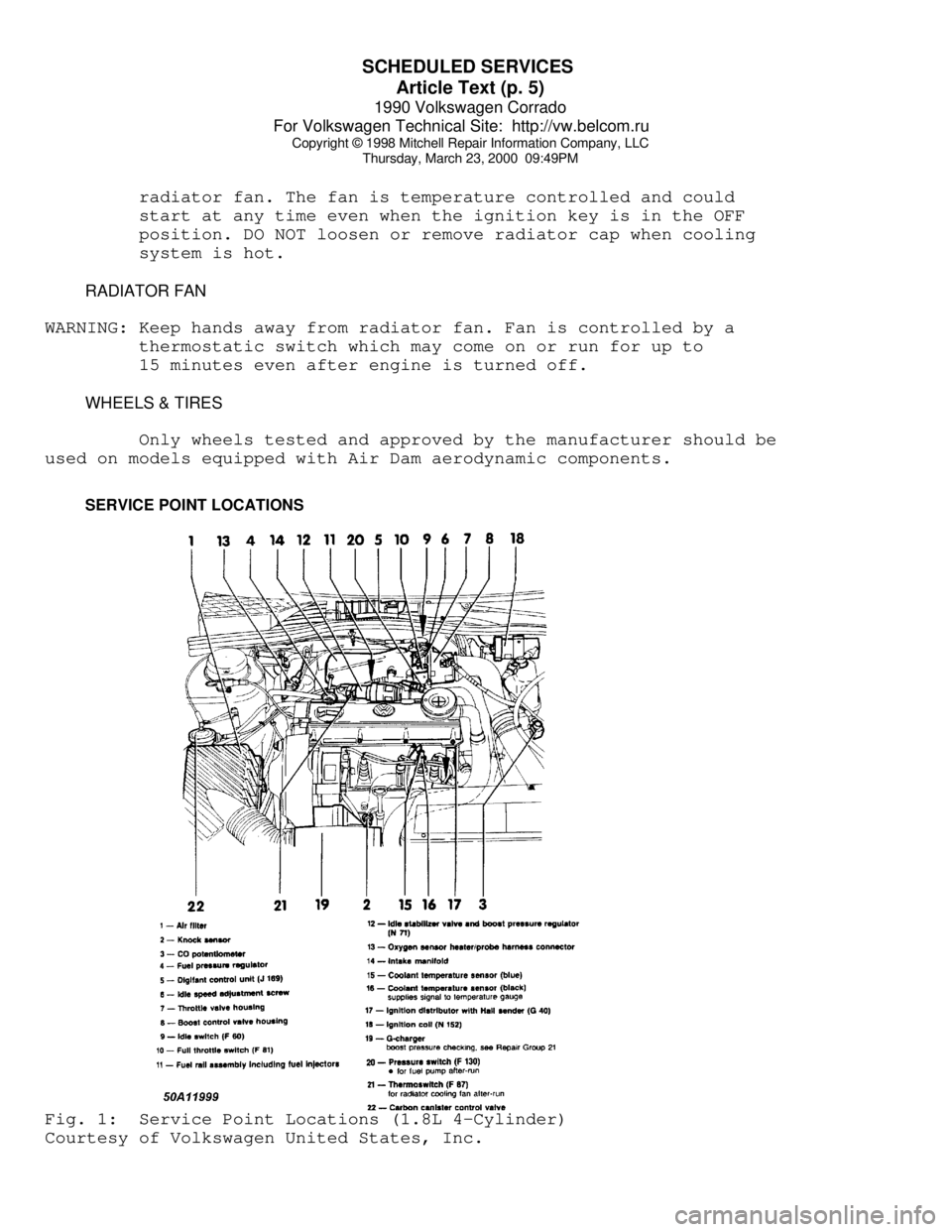
SERVICE POINT LOCATIONSFig. 1: Service Point Locations (1.8L 4-Cylinder)
Courtesy of Volkswagen United States, Inc.
Page 690 of 906
SCHEDULED SERVICES
Article Text (p. 7)
1990 Volkswagen Corrado
For Volkswagen Technical Site: http://vw.belcom.ru
Copyright © 1998 Mitchell Repair Information Company, LLC
Thursday, March 23, 2000 09:49PM
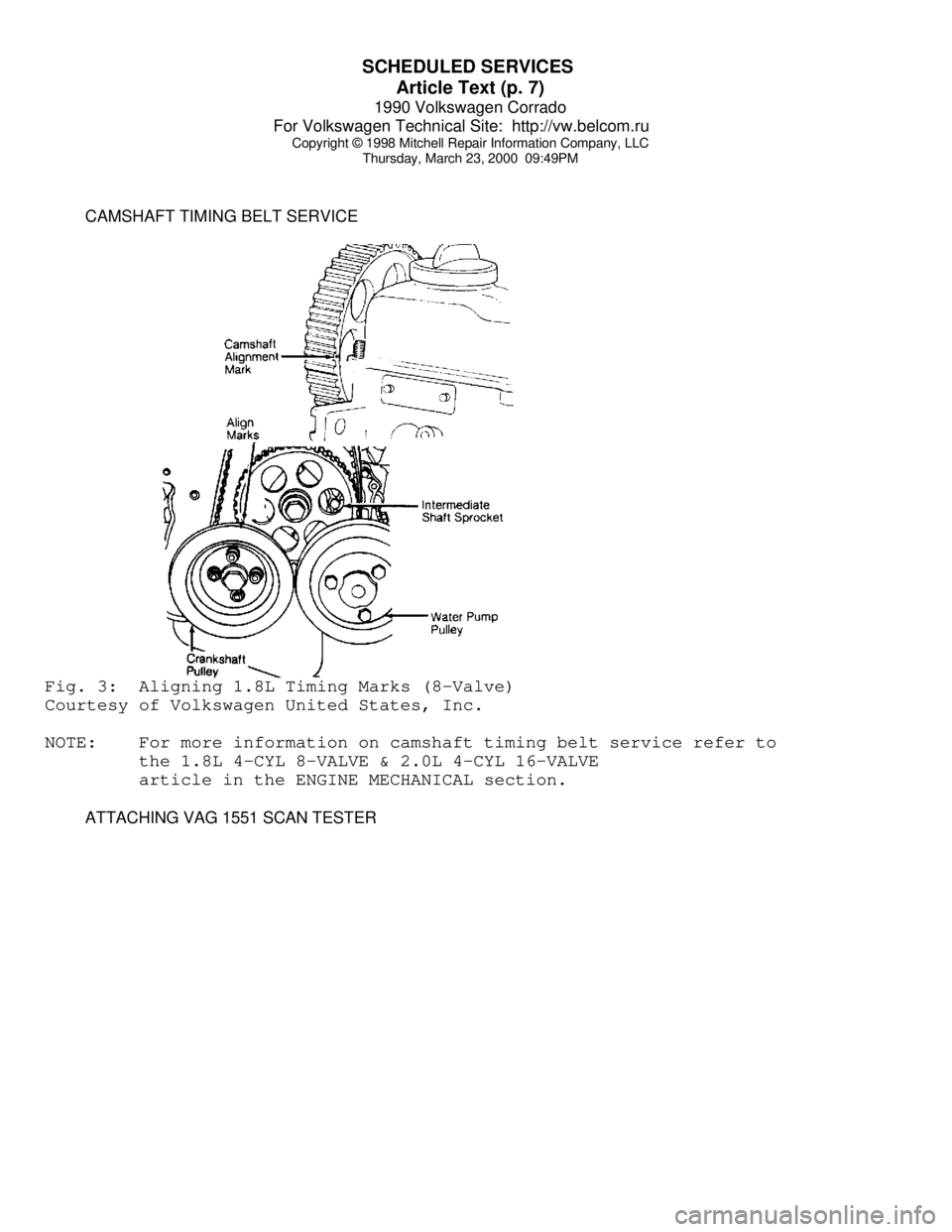
CAMSHAFT TIMING BELT SERVICEFig. 3: Aligning 1.8L Timing Marks (8-Valve)
Courtesy of Volkswagen United States, Inc.
NOTE: For more information on camshaft timing belt service refer to
the 1.8L 4-CYL 8-VALVE & 2.0L 4-CYL 16-VALVE
article in the ENGINE MECHANICAL section.
ATTACHING VAG 1551 SCAN TESTER
Page 691 of 906
SCHEDULED SERVICES
Article Text (p. 8)
1990 Volkswagen Corrado
For Volkswagen Technical Site: http://vw.belcom.ru
Copyright © 1998 Mitchell Repair Information Company, LLC
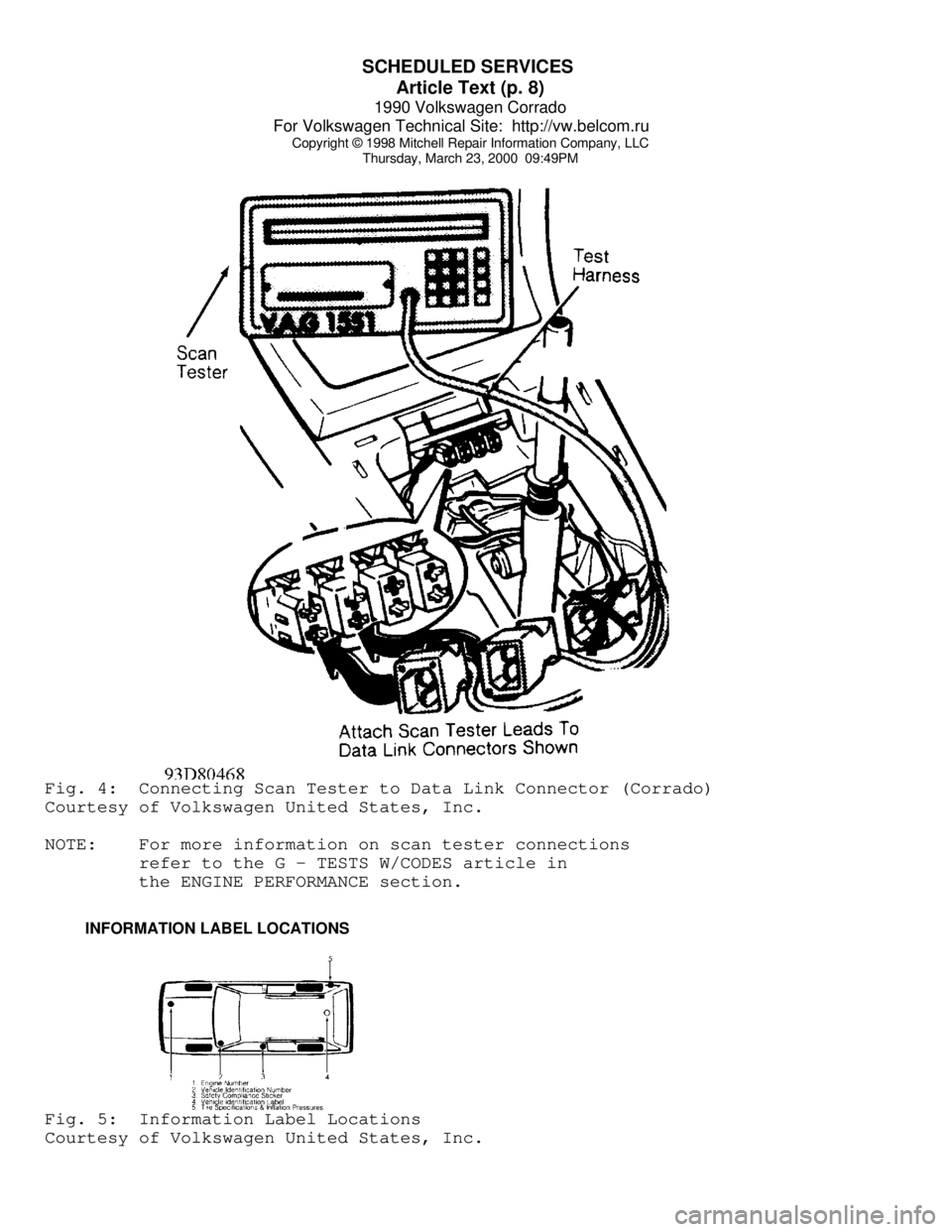
Thursday, March 23, 2000 09:49PMFig. 4: Connecting Scan Tester to Data Link Connector (Corrado)
Courtesy of Volkswagen United States, Inc.
NOTE: For more information on scan tester connections
refer to the G - TESTS W/CODES article in
the ENGINE PERFORMANCE section.
INFORMATION LABEL LOCATIONSFig. 5: Information Label Locations
Courtesy of Volkswagen United States, Inc.