check engine light VOLKSWAGEN CORRADO 1990 Owner's Manual
[x] Cancel search | Manufacturer: VOLKSWAGEN, Model Year: 1990, Model line: CORRADO, Model: VOLKSWAGEN CORRADO 1990Pages: 906, PDF Size: 6.56 MB
Page 536 of 906

ENGINE OVERHAUL PROCEDURES - GENERAL INFORMATION
Article Text (p. 27)
1990 Volkswagen Corrado
For Volkswagen Technical Site: http://vw.belcom.ru
Copyright © 1998 Mitchell Repair Information Company, LLC
Thursday, March 23, 2000 09:44PM
the same time.
MAIN BEARING BORE & ALIGNMENT
For checking main bearing bore, remove all bearings from
cylinder block and main bearing caps. Install main bearing caps in
original location. Tighten bolts to specification. Using inside
micrometer, measure main bearing bore in 2 areas 90 degrees apart.
Determine bore size and out-of-round. If diameter is not within
specification, block must be align-bored.
For checking alignment, place a straightedge along centerline
of main bearing saddles. Check for clearance between straightedge and
main bearing saddles. Block must be align-bored if clearance is
present.
EXPANSION PLUG REMOVAL & INSTALLATION
Removal
Drill a hole in the center of expansion plug. Remove with
screwdriver or punch. Use care not to damage sealing surface.
Installation
Ensure sealing surface is free of burrs. Coat expansion plug
with sealer. Use a wooden dowel or pipe of slightly smaller diameter,
install expansion plug. Ensure expansion plug is evenly located.
OIL GALLERY PLUG REMOVAL & INSTALLATION
Removal
Remove threaded oil gallery plugs using the appropriate
wrench. Soft, press-in plugs are removed by drilling into plug and
installing a sheet metal screw. Remove plug with slide hammer or
pliers.
Installation
Ensure threads or sealing surface is clean. Coat threaded oil
gallery plugs with sealer and install. Replacement soft press-in plugs
are driven in place with a hammer and drift.
CAMSHAFT
* PLEASE READ THIS FIRST *
NOTE: Always refer to appropriate engine overhaul article in the
ENGINES section for complete overhaul procedures and
specifications for the vehicle being repaired.
CLEANING & INSPECTION
Clean camshaft with solvent. Ensure all oil passages are
clear. Inspect cam lobes and bearing journals for pitting, flaking or
scoring. Using micrometer, measure bearing journal O.D.
Page 547 of 906

F - BASIC TESTING
Article Text (p. 2)
1990 Volkswagen Corrado
For Volkswagen Technical Site: http://vw.belcom.ru
Copyright © 1998 Mitchell Repair Information Company, LLC
Thursday, March 23, 2000 09:44PM
exhaust system backpressure is greater than 1 3/4-2 psi, exhaust
system or catalytic converter is plugged.
If a vacuum gauge is used, connect vacuum gauge hose to
intake manifold vacuum port and start engine. Observe vacuum gauge.
Open throttle part way and hold steady. If vacuum gauge reading slowly
drops after stabilizing, exhaust system should be checked for a
restriction.
FUEL SYSTEM APPLICATION TABLE
FUEL SYSTEM APPLICATION TABLEÄÄÄÄÄÄÄÄÄÄÄÄÄÄÄÄÄÄÄÄÄÄÄÄÄÄÄÄÄÄÄÄÄÄÄÄÄÄÄÄÄÄÄÄÄÄÄÄÄÄÄÄÄÄÄÄÄÄÄÄApplication Fuel System
Cabriolet, Corrado, Golf GL/GTI
Jetta & Vanagon ........................ AFC-Digifant II
Fox ................................................ CIS-E
Jetta GLi ................................... CIS-Motronic
ÄÄÄÄÄÄÄÄÄÄÄÄÄÄÄÄÄÄÄÄÄÄÄÄÄÄÄÄÄÄÄÄÄÄÄÄÄÄÄÄÄÄÄÄÄÄÄÄÄÄÄÄÄÄÄÄÄÄÄÄ FUEL PRESSURE CHECK
Basic diagnosis of fuel system should begin with determining
fuel system pressure.
FUEL PUMP CIRCUIT CHECK
Remove fuel tank cap. Turn ignition on and listen for fuel
pump operating sound for approximately 2 seconds. If there is no
sound, check fuse, fuel pump relay, fuel pump and all electrical
connections.
VISUAL CHECK (AFC-DIGIFANT II)
Push air door open, slight resistance should be felt and door
should not bind. Uniform resistance should be felt throughout travel
after slight amount of free travel. No binding should be felt when air
door is released.
VISUAL CHECK (CIS-E & CIS-MOTRONIC)
Move sensor plate slowly upward. Sensor plate should have
slight resistance from control piston adjusting lever. No binding
should be felt. Let sensor plate fall. There should no resistance.
Slight fuel seepage past control piston is acceptable.
FUEL PRESSURE TEST
WARNING: ALWAYS relieve fuel pressure before disconnecting any fuel
injection-related component. DO NOT allow fuel to contact
engine or electrical components.
Page 550 of 906
F - BASIC TESTING
Article Text (p. 5)
1990 Volkswagen Corrado
For Volkswagen Technical Site: http://vw.belcom.ru
Copyright © 1998 Mitchell Repair Information Company, LLC
Thursday, March 23, 2000 09:44PM
to OFF position.
(2) - With pressure regulator vacuum hose disconnected, pressure
should be 36 psi (2.5 kg/cmý).
ÄÄÄÄÄÄÄÄÄÄÄÄÄÄÄÄÄÄÄÄÄÄÄÄÄÄÄÄÄÄÄÄÄÄÄÄÄÄÄÄÄÄÄÄÄÄÄÄÄÄÄÄÄÄÄÄÄÄÄÄÄÄÄÄÄÄÄÄÄÄ TRANSFER PUMP CHECK
TRANSFER PUMP FUEL VOLUME CHECK
1) Turn ignition off. To check transfer pump (in tank),
remove rear seat. Remove fuel sending unit access cover. Disconnect
ignition coil secondary wire and jumper to ground. With transmission
in neutral, crank engine for a 3-4 seconds. While the starter is
turning and for a few seconds afterwards, an audible sound should be
heard at the pump. If not, proceed to step 2).
2) Activate fuel pumps by removing fuel pump relay and
attaching jumper wire between terminals No. 30 battery voltage and No.
87 output to fuel pumps. Terminal identification is molded on
fuse/relay panel. If pump does not operate, remove transfer pump
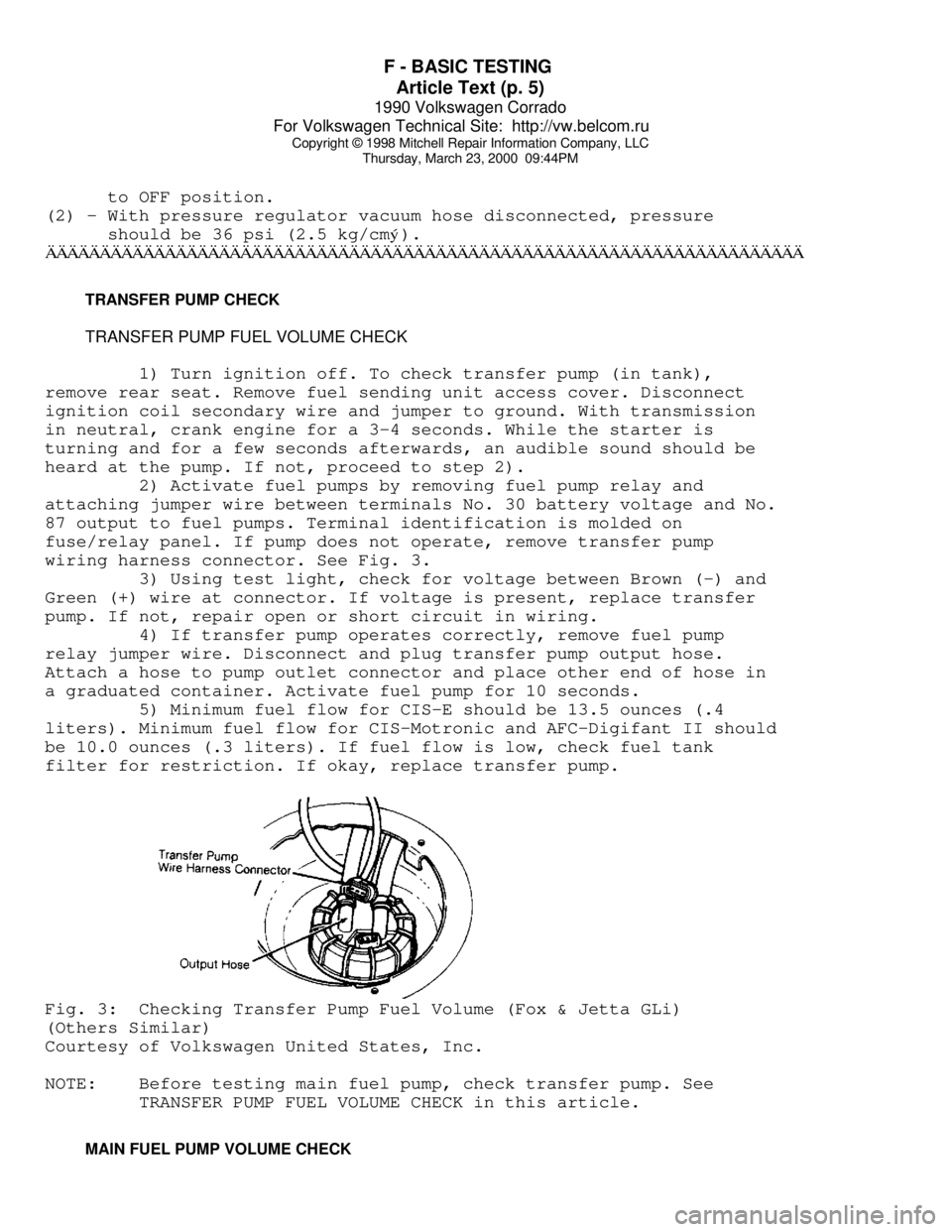
wiring harness connector. See Fig. 3.
3) Using test light, check for voltage between Brown (-) and
Green (+) wire at connector. If voltage is present, replace transfer
pump. If not, repair open or short circuit in wiring.
4) If transfer pump operates correctly, remove fuel pump
relay jumper wire. Disconnect and plug transfer pump output hose.
Attach a hose to pump outlet connector and place other end of hose in
a graduated container. Activate fuel pump for 10 seconds.
5) Minimum fuel flow for CIS-E should be 13.5 ounces (.4
liters). Minimum fuel flow for CIS-Motronic and AFC-Digifant II should
be 10.0 ounces (.3 liters). If fuel flow is low, check fuel tank
filter for restriction. If okay, replace transfer pump.Fig. 3: Checking Transfer Pump Fuel Volume (Fox & Jetta GLi)
(Others Similar)
Courtesy of Volkswagen United States, Inc.
NOTE: Before testing main fuel pump, check transfer pump. See
TRANSFER PUMP FUEL VOLUME CHECK in this article.
MAIN FUEL PUMP VOLUME CHECK
Page 553 of 906
F - BASIC TESTING
Article Text (p. 8)
1990 Volkswagen Corrado
For Volkswagen Technical Site: http://vw.belcom.ru
Copyright © 1998 Mitchell Repair Information Company, LLC
Thursday, March 23, 2000 09:44PM
Fox
Coil Wire With Connectors .................... 1600-2400
Spark Plug Wire With Connectors .............. 4800-7200
Spark Plug Connector ......................... 4000-6000
Suppressor .................................... 800-1200ÄÄÄÄÄÄÄÄÄÄÄÄÄÄÄÄÄÄÄÄÄÄÄÄÄÄÄÄÄÄÄÄÄÄÄÄÄÄÄÄÄÄÄÄÄÄÄÄÄÄÄÄÄÄÄÄÄÄÄÄ IGNITION COIL RESISTANCE TABLE
IGNITION COIL RESISTANCE TABLE - Ohms @ 68
øF (20øC)
ÄÄÄÄÄÄÄÄÄÄÄÄÄÄÄÄÄÄÄÄÄÄÄÄÄÄÄÄÄÄÄÄÄÄÄÄÄÄÄÄÄÄÄÄÄÄÄÄÄÄÄÄÄÄÄÄÄÄÄÄApplication Primary Secondary
Jetta GLi 2.0L ......... .60-.70 ............. 6500-8500
All Other Models ....... .52-.76 ............. 2400-3500
ÄÄÄÄÄÄÄÄÄÄÄÄÄÄÄÄÄÄÄÄÄÄÄÄÄÄÄÄÄÄÄÄÄÄÄÄÄÄÄÄÄÄÄÄÄÄÄÄÄÄÄÄÄÄÄÄÄÄÄÄ DISTRIBUTOR
HALL EFFECT SENDER
1) Remove coil secondary and attach to ground. Disconnect
Hall Effect sender harness connector at distributor. Using a LED Test
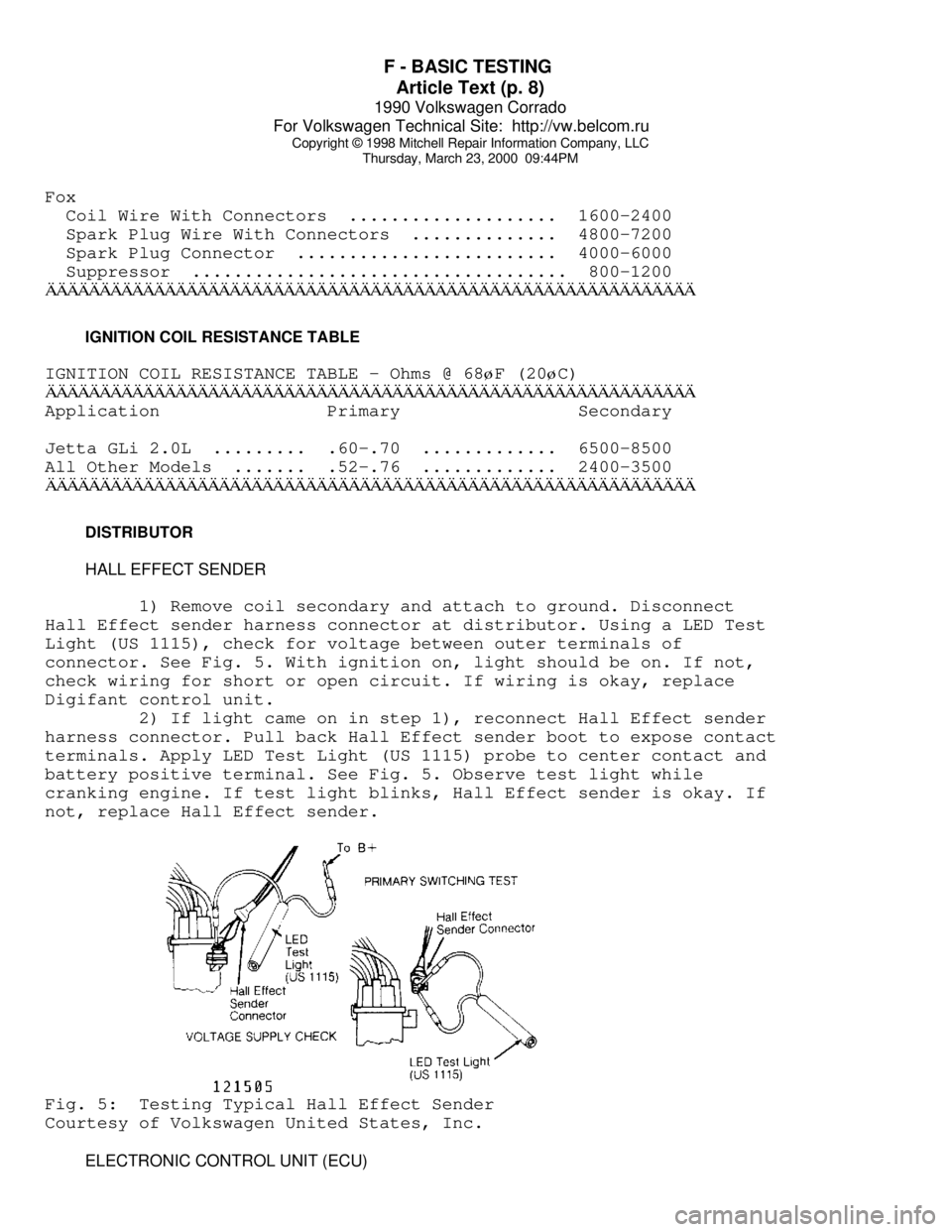
Light (US 1115), check for voltage between outer terminals of
connector. See Fig. 5. With ignition on, light should be on. If not,
check wiring for short or open circuit. If wiring is okay, replace
Digifant control unit.
2) If light came on in step 1), reconnect Hall Effect sender
harness connector. Pull back Hall Effect sender boot to expose contact
terminals. Apply LED Test Light (US 1115) probe to center contact and
battery positive terminal. See Fig. 5. Observe test light while
cranking engine. If test light blinks, Hall Effect sender is okay. If
not, replace Hall Effect sender.Fig. 5: Testing Typical Hall Effect Sender
Courtesy of Volkswagen United States, Inc.
ELECTRONIC CONTROL UNIT (ECU)
Page 556 of 906
F - BASIC TESTING
Article Text (p. 11)
1990 Volkswagen Corrado
For Volkswagen Technical Site: http://vw.belcom.ru
Copyright © 1998 Mitchell Repair Information Company, LLC
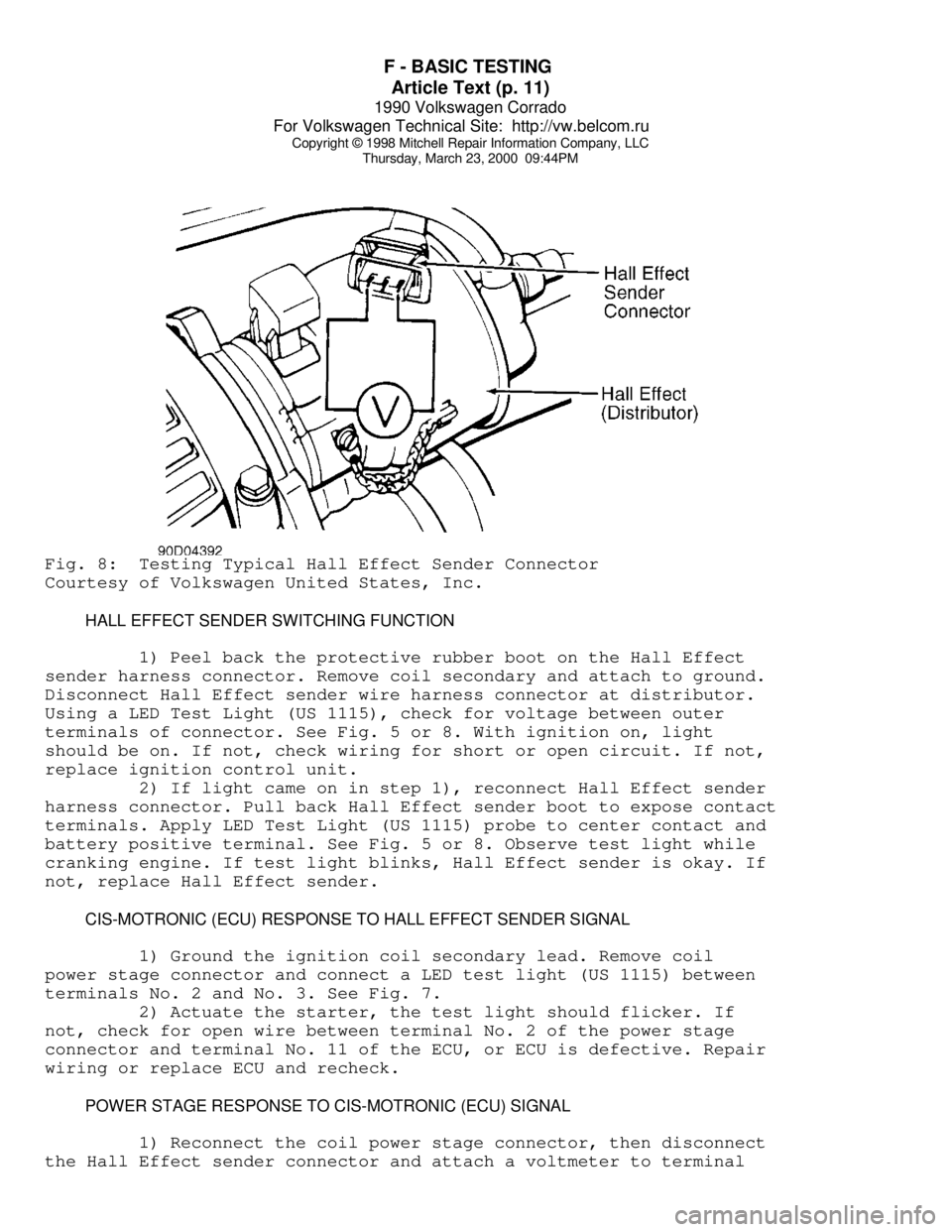
Thursday, March 23, 2000 09:44PMFig. 8: Testing Typical Hall Effect Sender Connector
Courtesy of Volkswagen United States, Inc.
HALL EFFECT SENDER SWITCHING FUNCTION
1) Peel back the protective rubber boot on the Hall Effect
sender harness connector. Remove coil secondary and attach to ground.
Disconnect Hall Effect sender wire harness connector at distributor.
Using a LED Test Light (US 1115), check for voltage between outer
terminals of connector. See Fig. 5 or 8. With ignition on, light
should be on. If not, check wiring for short or open circuit. If not,
replace ignition control unit.
2) If light came on in step 1), reconnect Hall Effect sender
harness connector. Pull back Hall Effect sender boot to expose contact
terminals. Apply LED Test Light (US 1115) probe to center contact and
battery positive terminal. See Fig. 5 or 8. Observe test light while
cranking engine. If test light blinks, Hall Effect sender is okay. If
not, replace Hall Effect sender.
CIS-MOTRONIC (ECU) RESPONSE TO HALL EFFECT SENDER SIGNAL
1) Ground the ignition coil secondary lead. Remove coil
power stage connector and connect a LED test light (US 1115) between
terminals No. 2 and No. 3. See Fig. 7.
2) Actuate the starter, the test light should flicker. If
not, check for open wire between terminal No. 2 of the power stage
connector and terminal No. 11 of the ECU, or ECU is defective. Repair
wiring or replace ECU and recheck.
POWER STAGE RESPONSE TO CIS-MOTRONIC (ECU) SIGNAL
1) Reconnect the coil power stage connector, then disconnect
the Hall Effect sender connector and attach a voltmeter to terminal
Page 558 of 906

F - BASIC TESTING
Article Text (p. 13)
1990 Volkswagen Corrado
For Volkswagen Technical Site: http://vw.belcom.ru
Copyright © 1998 Mitchell Repair Information Company, LLC
Thursday, March 23, 2000 09:44PM
DISTRIBUTOR
HALL EFFECT SENDER
1) Remove coil secondary and attach to ground. Disconnect
Hall Effect sender wire at the distributor. Using a LED Test Light (US
1115), check for voltage between outer terminals of connector. See
Fig. 5 or 8. With ignition on, light should be on. If not, check
wiring for short or open circuit. If wiring is okay, replace Digifant
control unit.
2) If light came on in step 1), reconnect Hall Effect sender
harness connector. Pull back Hall Effect sender boot to expose contact
terminals. Apply LED Test Light (US 1115) probe to center contact and
battery positive terminal. See Fig. 5. Observe test light while
cranking engine. If test light blinks, Hall Effect sender is okay. If
not, replace Hall Effect-sender.
IDLE SPEED, CO LEVEL & IGNITION TIMING
Ensure idle speed, CO level and base ignition timing are set
to specification. If necessary, see ON-VEHICLE ADJUSTMENTS article.
IDLE SPEED & CO LEVEL TABLEÄÄÄÄÄÄÄÄÄÄÄÄÄÄÄÄÄÄÄÄÄÄÄÄÄÄÄÄÄÄÄÄÄÄÄÄÄÄÄÄÄÄÄÄÄÄÄÄÄÄÄÄÄÄÄÄÄÄÄÄApplication Idle RPM CO Level %
All Models ............ 800-1000 .............. 0.3-1.2%
ÄÄÄÄÄÄÄÄÄÄÄÄÄÄÄÄÄÄÄÄÄÄÄÄÄÄÄÄÄÄÄÄÄÄÄÄÄÄÄÄÄÄÄÄÄÄÄÄÄÄÄÄÄÄÄÄÄÄÄÄIGNITION TIMING TABLE (Degrees BTDC @ RPM)
ÄÄÄÄÄÄÄÄÄÄÄÄÄÄÄÄÄÄÄÄÄÄÄÄÄÄÄÄÄÄÄÄÄÄÄÄÄÄÄÄÄÄÄÄÄÄÄÄÄÄÄÄÄÄÄÄÄÄÄÄApplication Checking Adjusting
1.8L ............... 4-8 @ 2250-2350 . 5-7 @ 2250-2350
2.0L ................ 4-8 @ 770-830 ...... 5-7 @ 770-830
2.1L (1) ........... 4-8 @ 2250-2350 . 5-7 @ 2250-2350
(1) - With coolant temperature sensor disconnected.
ÄÄÄÄÄÄÄÄÄÄÄÄÄÄÄÄÄÄÄÄÄÄÄÄÄÄÄÄÄÄÄÄÄÄÄÄÄÄÄÄÄÄÄÄÄÄÄÄÄÄÄÄÄÄÄÄÄÄÄÄ SUMMARY
If no faults were found while performing F - BASIC TESTING,
proceed to H - TESTS W/CODES article for diagnosis by symptom (i.e.,
ROUGH IDLE, NO START, etc.) or intermittent diagnostic procedures.
END OF ARTICLE
Page 597 of 906
I - SYSTEM/COMPONENT TESTS
Article Text (p. 10)
1990 Volkswagen Corrado
For Volkswagen Technical Site: http://vw.belcom.ru
Copyright © 1998 Mitchell Repair Information Company, LLC
Thursday, March 23, 2000 09:46PM
FUEL CONTROL
COLD START VALVE (ALL MODELS EXCEPT VANAGON)
1) Engine temperature must be below 85øF (30øC). Disconnect
cold start valve attaching screws and remove valve with harness
connector and fuel line attached.
2) Remove ignition coil secondary wire and jumper to ground.
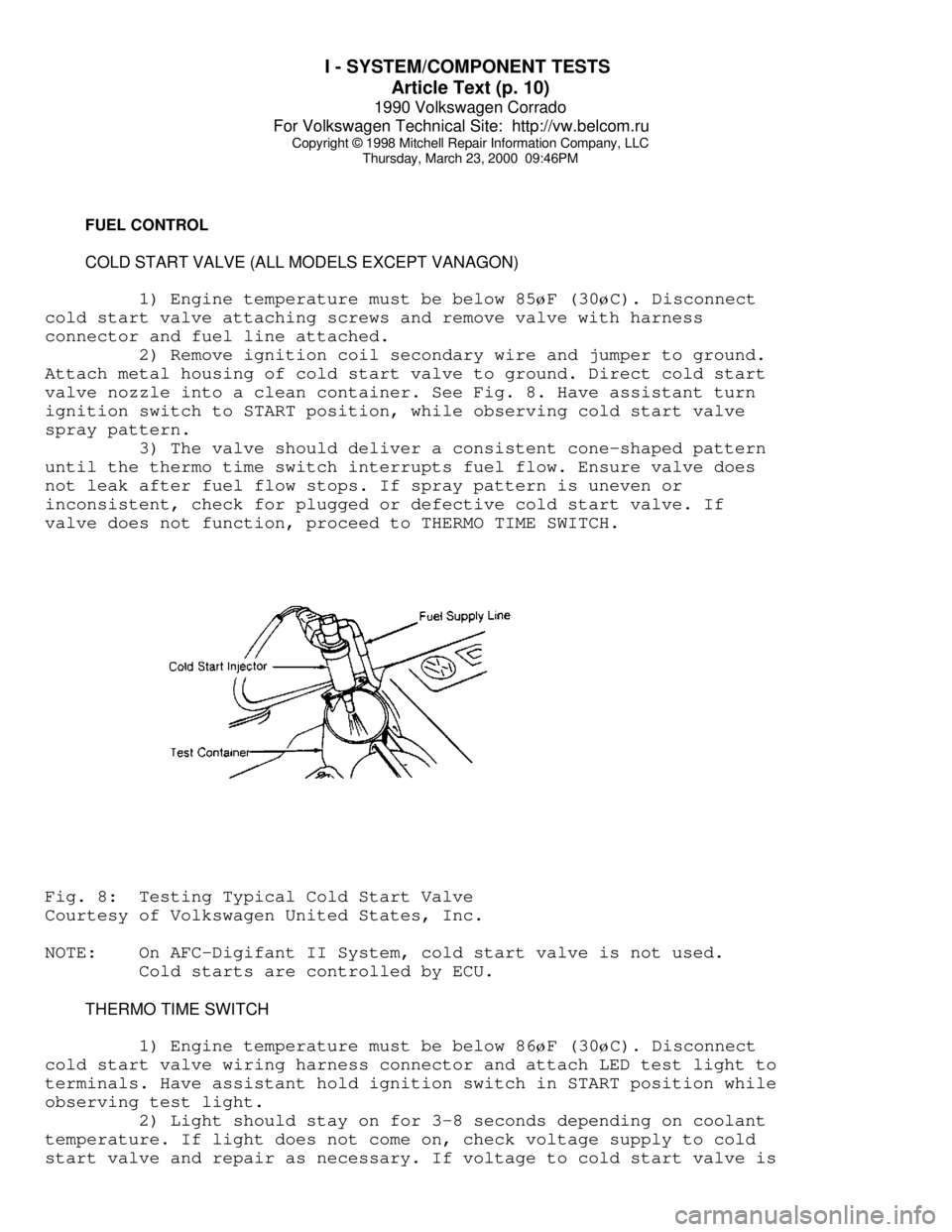
Attach metal housing of cold start valve to ground. Direct cold start
valve nozzle into a clean container. See Fig. 8. Have assistant turn
ignition switch to START position, while observing cold start valve
spray pattern.
3) The valve should deliver a consistent cone-shaped pattern
until the thermo time switch interrupts fuel flow. Ensure valve does
not leak after fuel flow stops. If spray pattern is uneven or
inconsistent, check for plugged or defective cold start valve. If
valve does not function, proceed to THERMO TIME SWITCH.Fig. 8: Testing Typical Cold Start Valve
Courtesy of Volkswagen United States, Inc.
NOTE: On AFC-Digifant II System, cold start valve is not used.
Cold starts are controlled by ECU.
THERMO TIME SWITCH
1) Engine temperature must be below 86
øF (30øC). Disconnect
cold start valve wiring harness connector and attach LED test light to
terminals. Have assistant hold ignition switch in START position while
observing test light.
2) Light should stay on for 3-8 seconds depending on coolant
temperature. If light does not come on, check voltage supply to cold
start valve and repair as necessary. If voltage to cold start valve is
Page 599 of 906
I - SYSTEM/COMPONENT TESTS
Article Text (p. 12)
1990 Volkswagen Corrado
For Volkswagen Technical Site: http://vw.belcom.ru
Copyright © 1998 Mitchell Repair Information Company, LLC
Thursday, March 23, 2000 09:46PM
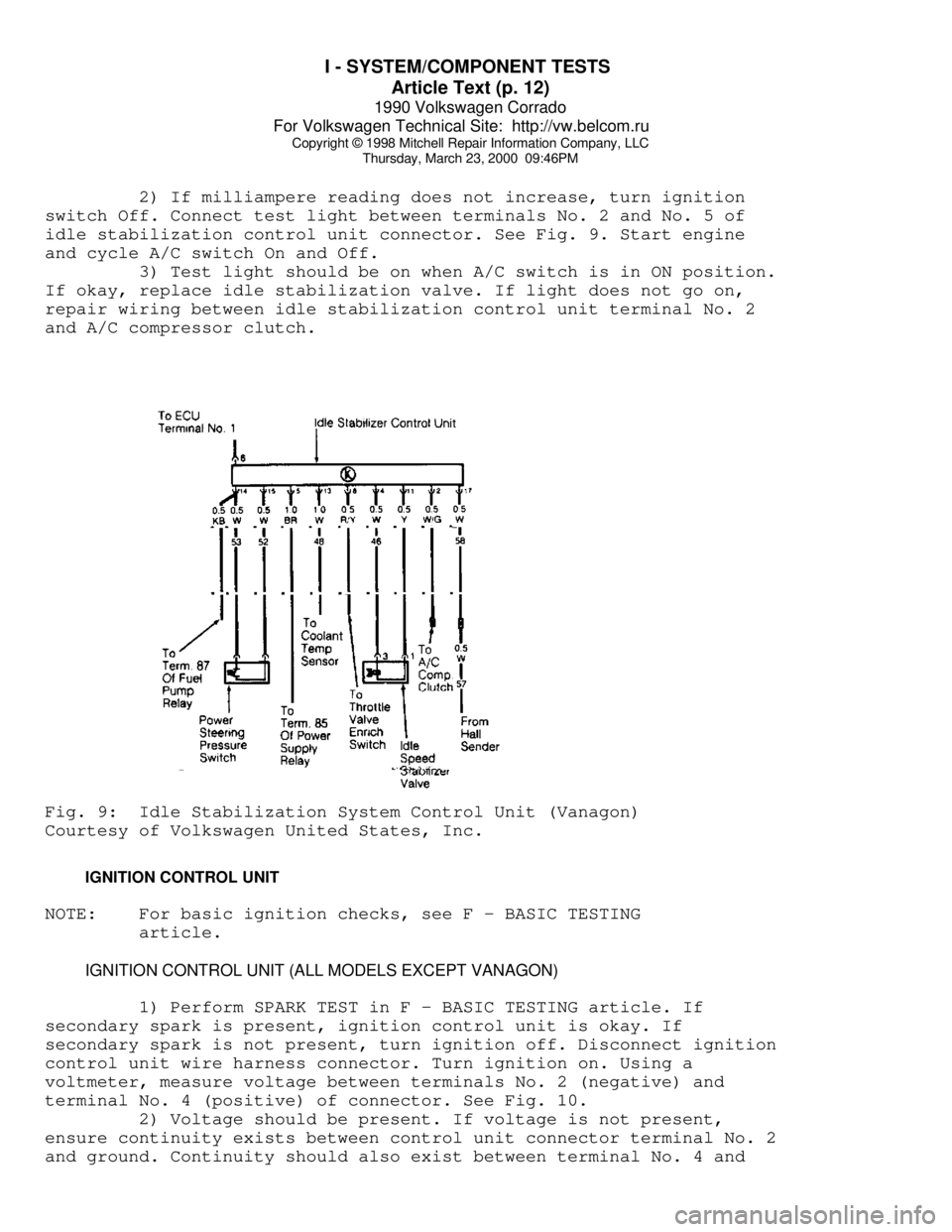
2) If milliampere reading does not increase, turn ignition
switch Off. Connect test light between terminals No. 2 and No. 5 of
idle stabilization control unit connector. See Fig. 9. Start engine
and cycle A/C switch On and Off.
3) Test light should be on when A/C switch is in ON position.
If okay, replace idle stabilization valve. If light does not go on,
repair wiring between idle stabilization control unit terminal No. 2
and A/C compressor clutch.Fig. 9: Idle Stabilization System Control Unit (Vanagon)
Courtesy of Volkswagen United States, Inc.
IGNITION CONTROL UNIT
NOTE: For basic ignition checks, see F - BASIC TESTING
article.
IGNITION CONTROL UNIT (ALL MODELS EXCEPT VANAGON)
1) Perform SPARK TEST in F - BASIC TESTING article. If
secondary spark is present, ignition control unit is okay. If
secondary spark is not present, turn ignition off. Disconnect ignition
control unit wire harness connector. Turn ignition on. Using a
voltmeter, measure voltage between terminals No. 2 (negative) and
terminal No. 4 (positive) of connector. See Fig. 10.
2) Voltage should be present. If voltage is not present,
ensure continuity exists between control unit connector terminal No. 2
and ground. Continuity should also exist between terminal No. 4 and
Page 609 of 906

INTERFERENCE VERIFICATION CHECK FOR OHC ENGINE
Article Text (p. 3)
1990 Volkswagen Corrado
For Volkswagen Technical Site: http://vw.belcom.ru
Copyright © 1998 Mitchell Repair Information Company, LLC
Thursday, March 23, 2000 09:46PM
1976-80 ..... (2) 1.5L 4-Cyl. Diesel ...... (3) 60,000
1981-84 ........ (2) 1.6L 4-Cyl.
Diesel & Turbo Diesel ....... (3) 60,000
1983-84 .......... 1.7L 4-Cyl. ............ (3) 60,000
1.8L 4-Cyl. ............ (3) 60,000
Scirocco
1976-79 .......... 1.5L 4-Cyl. ............ (3) 60,000
1976-80 .......... 1.6L 4-Cyl. ............ (3) 60,000
1983-84 .......... 1.7L 4-Cyl. ............ (3) 60,000
1.8L 4-Cyl. ............ (3) 60,000
1985-89 ....... 1.8L 4-Cyl. (DOHC) ........ (3) 60,000
1.8L 4-Cyl. (SOHC) ........ (3) 60,000
Scirocco (Canadian)
1989 .......... 1.8L 4-Cyl. (DOHC) ........ (3) 60,000
1.8L 4-Cyl. (SOHC) ........ (3) 60,000
(1) - Other interference engine applications may exist which
are not indicated here.
(2) - Interference engine. Check for possible damage to
piston(s) or valve(s) if there has been a timing belt
failure.
(3) - Although the vehicle manufacturer does not recommend a
specific scheduled maintenance interval, aftermarket
belt manufacturers suggest the belt be replaced at
60,000 mile intervals.
(4) - Vehicle manufacturer recommends replacing all belts at
the same time.ÄÄÄÄÄÄÄÄÄÄÄÄÄÄÄÄÄÄÄÄÄÄÄÄÄÄÄÄÄÄÄÄÄÄÄÄÄÄÄÄÄÄÄÄÄÄÄÄÄÄÄÄÄÄÄÄÄÄÄÄTIMING BELT INTERFERENCE VERIF. TABLE - LIGHT TRUCKS (1)
ÄÄÄÄÄÄÄÄÄÄÄÄÄÄÄÄÄÄÄÄÄÄÄÄÄÄÄÄÄÄÄÄÄÄÄÄÄÄÄÄÄÄÄÄÄÄÄÄÄÄÄÄÄÄÄÄÄÄÄÄ Replacement Interval
Application Engine (Miles)
Eurovan (Canadian)
1992-96 .......... 2.5L 5-Cyl. ............ (3) 60,000
Pickup
1980 ....... (2) 1.5L 4-Cyl. Diesel ....... (3) 60,000
1980-83 .......... 1.6L 4-Cyl. ............ (3) 60,000
1981-83 .... (2) 1.6L 4-Cyl. Diesel ....... (3) 60,000
1.7L 4-Cyl. ............ (3) 60,000
Transporter (Canadian)
1992-96 .......... 2.5L 5-Cyl. ............ (3) 60,000
Vanagon
1981-82 .... (2) 1.6L 4-Cyl. Diesel ....... (3) 60,000
(1) - Other interference engine applications may exist which
are not indicated here.
(2) - Interference engine. Check for possible damage to
piston(s) or valve(s) if there has been a timing belt
failure.
(3) - Although the vehicle manufacturer does not recommend a
Page 611 of 906
J - PIN VOLTAGE CHARTS
Article Text
1990 Volkswagen Corrado
For Volkswagen Technical Site: http://vw.belcom.ru
Copyright © 1998 Mitchell Repair Information Company, LLC
Thursday, March 23, 2000 09:46PM
ARTICLE BEGINNING
1990 ENGINE PERFORMANCE
Pin Voltage & Sensor Operating Ranges
Volkswagen; Corrado, Fox, Golf, Jetta, Vanagon
NOTE: Cabriolet pin voltage and sensor operating range charts are
not available from manufacturer.
INTRODUCTION
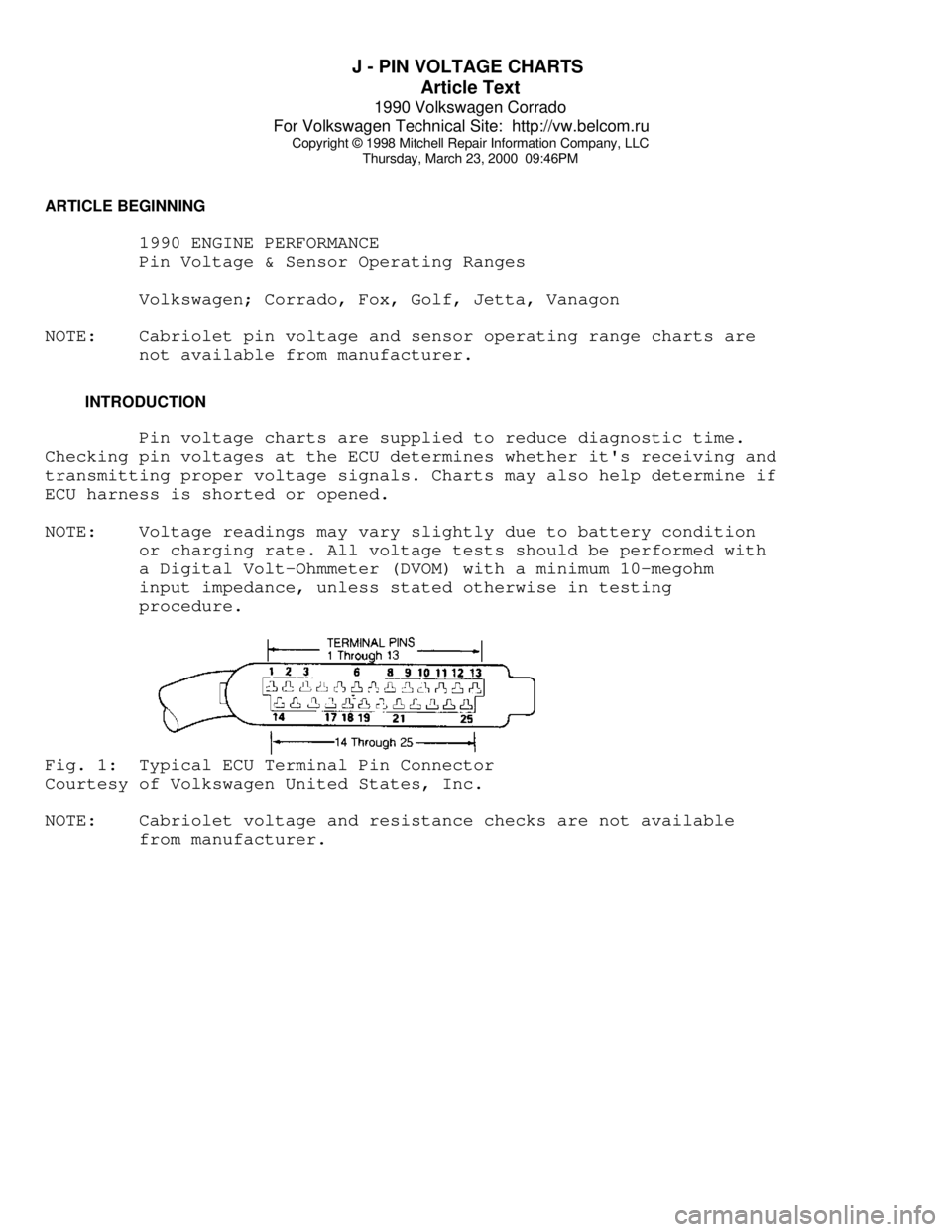
Pin voltage charts are supplied to reduce diagnostic time.
Checking pin voltages at the ECU determines whether it's receiving and
transmitting proper voltage signals. Charts may also help determine if
ECU harness is shorted or opened.
NOTE: Voltage readings may vary slightly due to battery condition
or charging rate. All voltage tests should be performed with
a Digital Volt-Ohmmeter (DVOM) with a minimum 10-megohm
input impedance, unless stated otherwise in testing
procedure.Fig. 1: Typical ECU Terminal Pin Connector
Courtesy of Volkswagen United States, Inc.
NOTE: Cabriolet voltage and resistance checks are not available
from manufacturer.