check engine VOLKSWAGEN CORRADO 1990 Workshop Manual
[x] Cancel search | Manufacturer: VOLKSWAGEN, Model Year: 1990, Model line: CORRADO, Model: VOLKSWAGEN CORRADO 1990Pages: 906, PDF Size: 6.56 MB
Page 438 of 906

D - ADJUSTMENTS
Article Text
1990 Volkswagen Corrado
For Volkswagen Technical Site: http://vw.belcom.ru
Copyright © 1998 Mitchell Repair Information Company, LLC
Thursday, March 23, 2000 09:43PM
ARTICLE BEGINNING
1990 ENGINE PERFORMANCE
On-Vehicle Adjustments
Volkswagen; Cabriolet, Corrado, Fox, Golf GL/GTI,
Jetta, Vanagon
ENGINE COMPRESSION
Check engine compression with engine at normal operating
temperature at specified cranking speed, all spark plugs removed and
throttle wide open.
ENGINE COMPRESSION TESTÄÄÄÄÄÄÄÄÄÄÄÄÄÄÄÄÄÄÄÄÄÄÄÄÄÄÄÄÄÄÄÄÄÄÄÄÄÄÄÄÄÄÄÄÄÄÄÄÄÄÄÄÄÄÄÄÄÄÄÄÄÄÄÄÄÄÄÄÄÄModel Standard Minimum
psi (kg/cm
ý) psi (kg/cmý)
Cabriolet ............. 131-174 (9.0-12.0) ............. 109 (7.5)
Corrado ............... 116-174 (8.0-12.0) .............. 87 (6.0)
Fox ................... 131-174 (9.0-12.0) ............. 102 (7.0)
Golf GL/GTI 1.8L ...... 131-174 (9.0-12.0) ............. 102 (7.0)
Jetta ................. 131-174 (9.0-12.0) ............. 102 (7.0)
Jetta GLi 2.0L ........ 145-190 (10.0-13.0) ............ 109 (7.5)
Vanagon ............... 87-131 (6.1-9.2) ................ 87 (6.0)
ÄÄÄÄÄÄÄÄÄÄÄÄÄÄÄÄÄÄÄÄÄÄÄÄÄÄÄÄÄÄÄÄÄÄÄÄÄÄÄÄÄÄÄÄÄÄÄÄÄÄÄÄÄÄÄÄÄÄÄÄÄÄÄÄÄÄÄÄÄÄ VALVE CLEARANCE
NOTE: All models use hydraulic lifters. No adjustments are
required.
IGNITION TIMING
NOTE: Basic timing readings are only valid when engine idle speed
and idle mixture are within specifications. For best
results, the manufacturer recommends ignition timing, idle
CO and idle speed be checked and adjusted in that order.
NOTE: Off idle timing is computer controlled on models with knock
sensor(s). Only idle ignition timing can be set.
ALL MODELS EXCEPT VANAGON
1) Warm engine to normal operating temperature (cooling fan
should cycle at least once). Remove the 27 mm plastic plug from timing
check hole on transaxle bellhousing.
2) With ignition off, connect a tachometer and timing light
to vehicle. Start engine, raise speed above 2100 RPM a few times, and
allow engine to idle normally. With distributor vacuum hoses
Page 439 of 906

D - ADJUSTMENTS
Article Text (p. 2)
1990 Volkswagen Corrado
For Volkswagen Technical Site: http://vw.belcom.ru
Copyright © 1998 Mitchell Repair Information Company, LLC
Thursday, March 23, 2000 09:43PM
connected, timing mark on flywheel should appear at pointer in hole.
NOTE: Before checking engine timing, raise engine speed above 2100
RPM at least 4 times. This must be done each time ignition
is turned off and restarted to clear ECU memory and by-pass
hot-start, fast-idle function.
3) If an adjustment is needed, turn ignition off and loosen
distributor hold-down bolt (2.0L has 2 hold-down bolts) just enough to
move distributor by hand. Start engine and allow to idle. Turn
distributor until timing mark is aligned with pointer in bellhousing.
4) Stop engine and tighten hold down bolt to 18 ft. lbs. (24
N.m). On 2.0L tighten hold-down bolts to 87 INCH lbs. (10 N.m). Check
and readjust if necessary and install plastic plug in inspection hole.
VANAGON
1) Engine oil temperature must be 176ø F (80ø C). Connect
timing light and tachometer. Start engine and allow to idle. Check
ignition timing at 800-1000 RPM.
NOTE: Before checking engine timing, raise engine speed above 2100
RPM at least 4 times. This must be done each time ignition
is turned off and restarted to clear ECU memory and by-pass
hot-start, fast-idle function.
2) If an adjustment is needed, turn ignition off and loosen
distributor hold-down bolt just enough to move distributor by hand.
Remove connectors from idle stabilizer by squeezing connectors then
pulling apart. Plug idle stabilizer connectors together.
3) Start and allow engine to idle. Turn distributor until
notch on V-belt pulley matches separation in case. Set timing and RPM.
Reconnect electrical connectors to idle stabilizer. Tighten
distributor clamp bolt.
IGNITION TIMING TABLE
IGNITION TIMING (Degrees BTDC @ RPM)
ÄÄÄÄÄÄÄÄÄÄÄÄÄÄÄÄÄÄÄÄÄÄÄÄÄÄÄÄÄÄÄÄÄÄÄÄÄÄÄÄÄÄÄÄÄÄÄÄÄÄÄÄÄÄÄÄÄÄÄÄÄÄÄÄÄÄÄÄÄÄApplication Checking Adjusting
1.8L ..................... 4-8 @ 870-930 ........... 5-7 @ 870-930
2.0L ..................... 4-8 @ 770-830 ........... 5-7 @ 770-830
2.1L ..................... 4-8 @ 800-900 ........... 5-7 @ 800-900
ÄÄÄÄÄÄÄÄÄÄÄÄÄÄÄÄÄÄÄÄÄÄÄÄÄÄÄÄÄÄÄÄÄÄÄÄÄÄÄÄÄÄÄÄÄÄÄÄÄÄÄÄÄÄÄÄÄÄÄÄÄÄÄÄÄÄÄÄÄÄ COLD (FAST) IDLE
Fast idle RPM is not adjustable.
IDLE SPEED & MIXTURE
Page 440 of 906
D - ADJUSTMENTS
Article Text (p. 3)
1990 Volkswagen Corrado
For Volkswagen Technical Site: http://vw.belcom.ru
Copyright © 1998 Mitchell Repair Information Company, LLC
Thursday, March 23, 2000 09:43PM
NOTE: Mixture adjustment is NOT a part of normal tune-up procedure
and should not be performed unless mixture control unit is
replaced or vehicle fails emissions testing.
NOTE: Ensure system pressure is correct before attempting idle
speed or mixture adjustment.
IDLE SPEED & MIXTURE ADJUSTMENT
FOX (CIS-E) & JETTA GLI 2.0L (CIS-MOTRONIC)
1) Ignition timing and idle speed must be checked before CO
is adjusted. See CHECKING & ADJUSTING under IGNITION TIMING. With
ignition timing properly adjusted, check and adjust idle speed,
differential pressure regulator current and idle mixture. Repeat the
adjustments until all occur at the same time.
2) Warm engine to normal operating temperature. Radiator fan
must come on at least once and engine oil temperature must be at least
176øF (80øC). Turn off all electrical equipment, including A/C and
radiator fan. Disconnect all fuel pressure test equipment (if
installed). If injection lines have been removed or replaced, run
engine several times to 3000 RPM for about 2 minutes.
3) Ensure idle switch is properly adjusted. Check that
auxiliary air regulator valve is fully closed. Pinch shut the hose
leading from the idle speed boost valve(s). Remove temperature sensor
harness connector from the temperature sensor. Pull crankcase breather
hoses off valve cover and air filter, vent to atmosphere.
4) Remove suction hose from carbon canister. Disconnect "T"
fitting from carbon canister at air intake boot. On Fox models only,
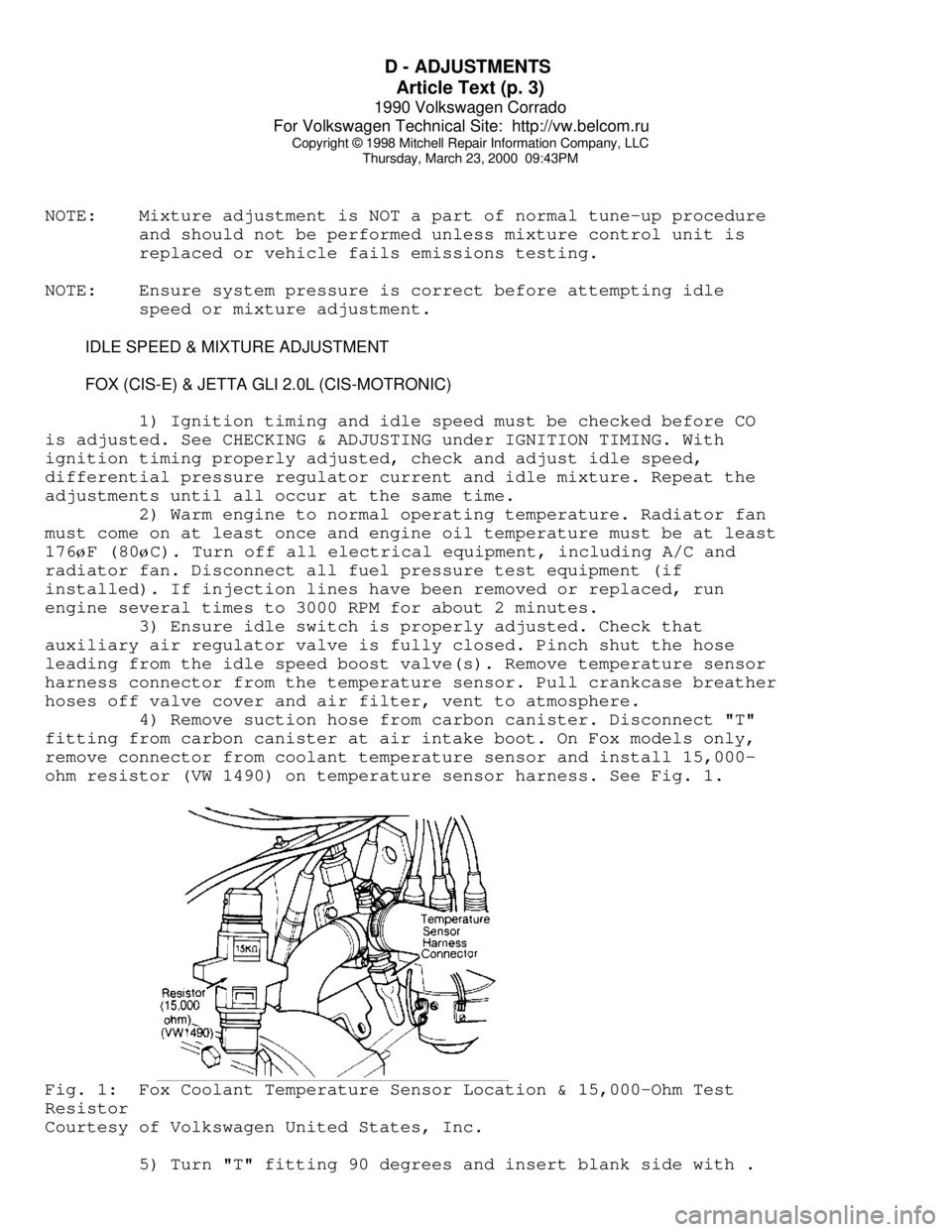
remove connector from coolant temperature sensor and install 15,000-
ohm resistor (VW 1490) on temperature sensor harness. See Fig. 1.Fig. 1: Fox Coolant Temperature Sensor Location & 15,000-Ohm Test
Resistor
Courtesy of Volkswagen United States, Inc.
5) Turn "T" fitting 90 degrees and insert blank side with .
Page 442 of 906
D - ADJUSTMENTS
Article Text (p. 5)
1990 Volkswagen Corrado
For Volkswagen Technical Site: http://vw.belcom.ru
Copyright © 1998 Mitchell Repair Information Company, LLC
Thursday, March 23, 2000 09:43PM
8) Connect adapter between connector and regulator. Connect
multimeter to adapter and turn switch to DCA 200 milliamp-range. Read
and compare current (4-16 milliamps) and CO values to specifications.
Turn engine off.
9) If CO reading is more than 1.2% at current reading of 4-16
milliamps, check for exhaust system leaks, ignition timing, injector
inserts for leaks, and fuel distributor for uneven fuel distribution.
If required, seal injector inserts with sealing compound and tighten
to 15 ft. lbs. (20 N.m).
10) If current reading is less than 4 milliamps or more than
16 milliamps, adjustment must be made with CO adjustment screw as
follows: remove boot from mixture control unit. Center punch hole in
CO adjusting hole and drill a 3/32" hole to a depth of 5/32" (4 mm).
DO NOT drill completely through as adjustment screw will be damaged.
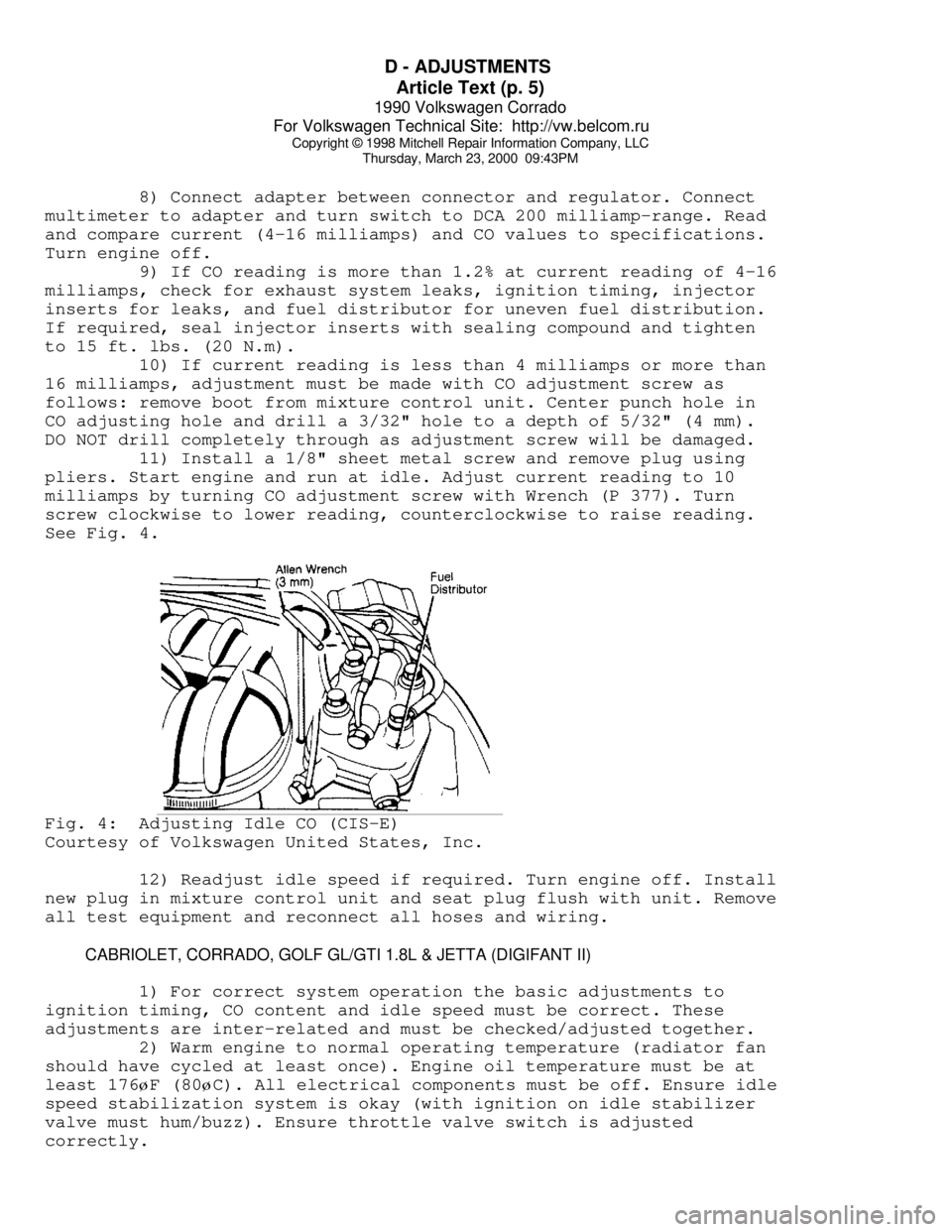
11) Install a 1/8" sheet metal screw and remove plug using
pliers. Start engine and run at idle. Adjust current reading to 10
milliamps by turning CO adjustment screw with Wrench (P 377). Turn
screw clockwise to lower reading, counterclockwise to raise reading.
See Fig. 4.Fig. 4: Adjusting Idle CO (CIS-E)
Courtesy of Volkswagen United States, Inc.
12) Readjust idle speed if required. Turn engine off. Install
new plug in mixture control unit and seat plug flush with unit. Remove
all test equipment and reconnect all hoses and wiring.
CABRIOLET, CORRADO, GOLF GL/GTI 1.8L & JETTA (DIGIFANT II)
1) For correct system operation the basic adjustments to
ignition timing, CO content and idle speed must be correct. These
adjustments are inter-related and must be checked/adjusted together.
2) Warm engine to normal operating temperature (radiator fan
should have cycled at least once). Engine oil temperature must be at
least 176øF (80øC). All electrical components must be off. Ensure idle
speed stabilization system is okay (with ignition on idle stabilizer
valve must hum/buzz). Ensure throttle valve switch is adjusted
correctly.
Page 443 of 906
D - ADJUSTMENTS
Article Text (p. 6)
1990 Volkswagen Corrado
For Volkswagen Technical Site: http://vw.belcom.ru
Copyright © 1998 Mitchell Repair Information Company, LLC
Thursday, March 23, 2000 09:43PM
NOTE: Before checking engine timing, raise engine speed above 2100
RPM at least 4 times. This must be done each time ignition
is turned off and restarted to clear ECU memory and by-pass
hot-start, fast-idle function.
3) Connect an inductive tachometer or Tester (VW 1367) to
alternator, Test Lead (VW 1473) to ignition coil, and timing light
lead to No. 1 spark plug wire. See Fig. 2. Start engine and ensure
engine speed and timing are correct. If not, adjust to specification.
4) Remove the Blue cap from the CO tap tube rising from the
exhaust manifold and connect exhaust gas analyzer. Disconnect the
coolant sensor harness connector. Raise the oil dipstick slightly to
vent crankcase. Disconnect and plug the crankcase ventilation hose.
Start engine and raise engine speed to 2100 RPM at least 4 times.
Check idle, adjust if incorrect. check CO is correct. See IDLE & CO
LEVEL table. If CO adjustment is needed, the idle mixture screw anti-
tamper plug must be remove from the top of the air flow sensor.
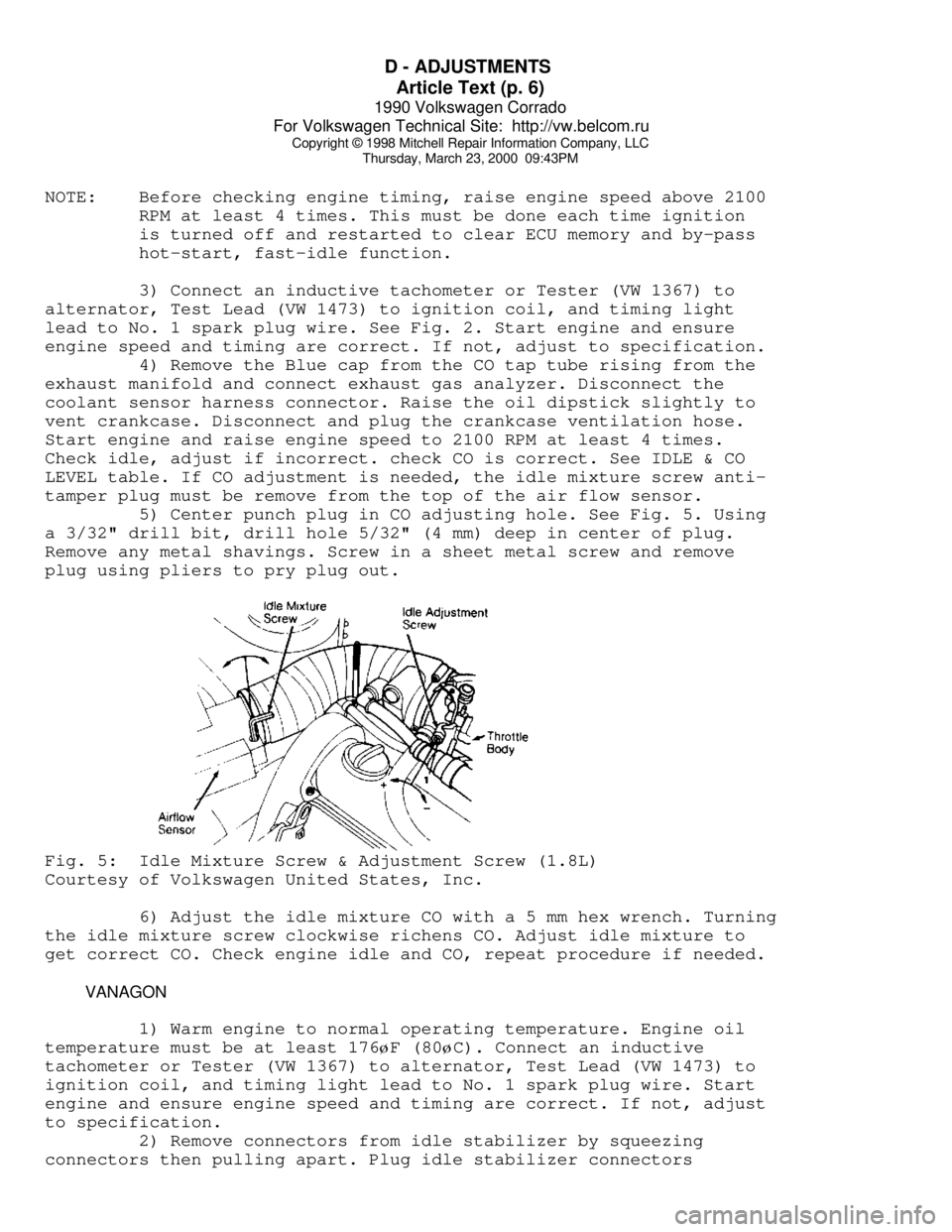
5) Center punch plug in CO adjusting hole. See Fig. 5. Using
a 3/32" drill bit, drill hole 5/32" (4 mm) deep in center of plug.
Remove any metal shavings. Screw in a sheet metal screw and remove
plug using pliers to pry plug out.Fig. 5: Idle Mixture Screw & Adjustment Screw (1.8L)
Courtesy of Volkswagen United States, Inc.
6) Adjust the idle mixture CO with a 5 mm hex wrench. Turning
the idle mixture screw clockwise richens CO. Adjust idle mixture to
get correct CO. Check engine idle and CO, repeat procedure if needed.
VANAGON
1) Warm engine to normal operating temperature. Engine oil
temperature must be at least 176øF (80øC). Connect an inductive
tachometer or Tester (VW 1367) to alternator, Test Lead (VW 1473) to
ignition coil, and timing light lead to No. 1 spark plug wire. Start
engine and ensure engine speed and timing are correct. If not, adjust
to specification.
2) Remove connectors from idle stabilizer by squeezing
connectors then pulling apart. Plug idle stabilizer connectors
Page 444 of 906

D - ADJUSTMENTS
Article Text (p. 7)
1990 Volkswagen Corrado
For Volkswagen Technical Site: http://vw.belcom.ru
Copyright © 1998 Mitchell Repair Information Company, LLC
Thursday, March 23, 2000 09:43PM
together. Turn idle speed screw until idle speed is correct. To adjust
timing, see CHECKING & ADJUSTING under IGNITION TIMING in this
article.
3) Ensure all vehicle electrical equipment is off. Place
exhaust gas analyzer in exhaust pipe. See IDLE SPEED & CO LEVEL table.
If adjustment is needed, go to next step.
4) If adjustment is needed in step 2). Remove intake air
sensor from engine. Center punch plug in CO adjusting hole. Using a
3/32" drill bit, drill hole 5/32" (4 mm) deep in center of plug.
Remove any metal shavings. Screw in a sheet metal screw and remove
plug using pliers to pry plug out.
5) Disconnect oxygen sensor connector on left side of engine
compartment (Green wire). Start engine. Set idle speed and CO reading
by alternately turning mixture and idle speed adjustment screws.
Reconnect oxygen sensor and idle stabilizer connectors. Let engine
idle for 2 minutes.
6) Check CO value. If incorrect, repeat adjusting procedure.
If correct turn ignition off. Drive in new adjusting hole plug flush
with air intake sensor. Remove all test equipment and reconnect all
hoses and wiring.
NOTE: Do not push down on adjustment screw and do not accelerate
engine with wrench in plate. Remove wrench after each
adjustment and accelerate engine briefly before measuring
current reading. Always adjust from a high to a low reading.
IDLE SPEED & CO LEVELÄÄÄÄÄÄÄÄÄÄÄÄÄÄÄÄÄÄÄÄÄÄÄÄÄÄÄÄÄÄÄÄÄÄÄÄÄÄÄÄÄÄÄÄÄÄÄÄÄÄÄÄÄÄÄÄÄÄÄÄÄÄÄÄÄÄÄÄÄÄApplication Idle RPM CO Level
Cabriolet .................. 850-1000 ................... 0.3-1.2%
Fox ........................ 800-1000 ................... 0.3-1.2%
Golf ....................... 800-1000 ................... 0.3-1.2%
Golf GT ..................... 800-900 ................... 0.3-1.2%
GTI ........................ 800-1000 ................... 0.3-1.2%
Jetta ...................... 800-1000 ................... 0.3-1.2%
Vanagon ..................... 830-930 ................... 0.3-1.2%
ÄÄÄÄÄÄÄÄÄÄÄÄÄÄÄÄÄÄÄÄÄÄÄÄÄÄÄÄÄÄÄÄÄÄÄÄÄÄÄÄÄÄÄÄÄÄÄÄÄÄÄÄÄÄÄÄÄÄÄÄÄÄÄÄÄÄÄÄÄÄ THROTTLE STOP SCREW
NOTE: Stop screw is set by manufacturer and should not be moved.
If basic factory setting has been changed, turn throttle stop
screw counterclockwise until there is a gap between stop and screw.
Turn screw in until it just touches stop. Turn screw 1/2 turn (180
degrees) further. Check and adjust idle speed and CO.
IDLE & FULL THROTTLE SWITCH ADJUSTMENTS
IDLE SWITCH ADJUSTMENT DIGIFANT II (EXCEPT VANAGON)
Page 458 of 906
E - THEORY/OPERATION - DIGIFANT
Article Text (p. 8)
1990 Volkswagen Corrado
For Volkswagen Technical Site: http://vw.belcom.ru
Copyright © 1998 Mitchell Repair Information Company, LLC
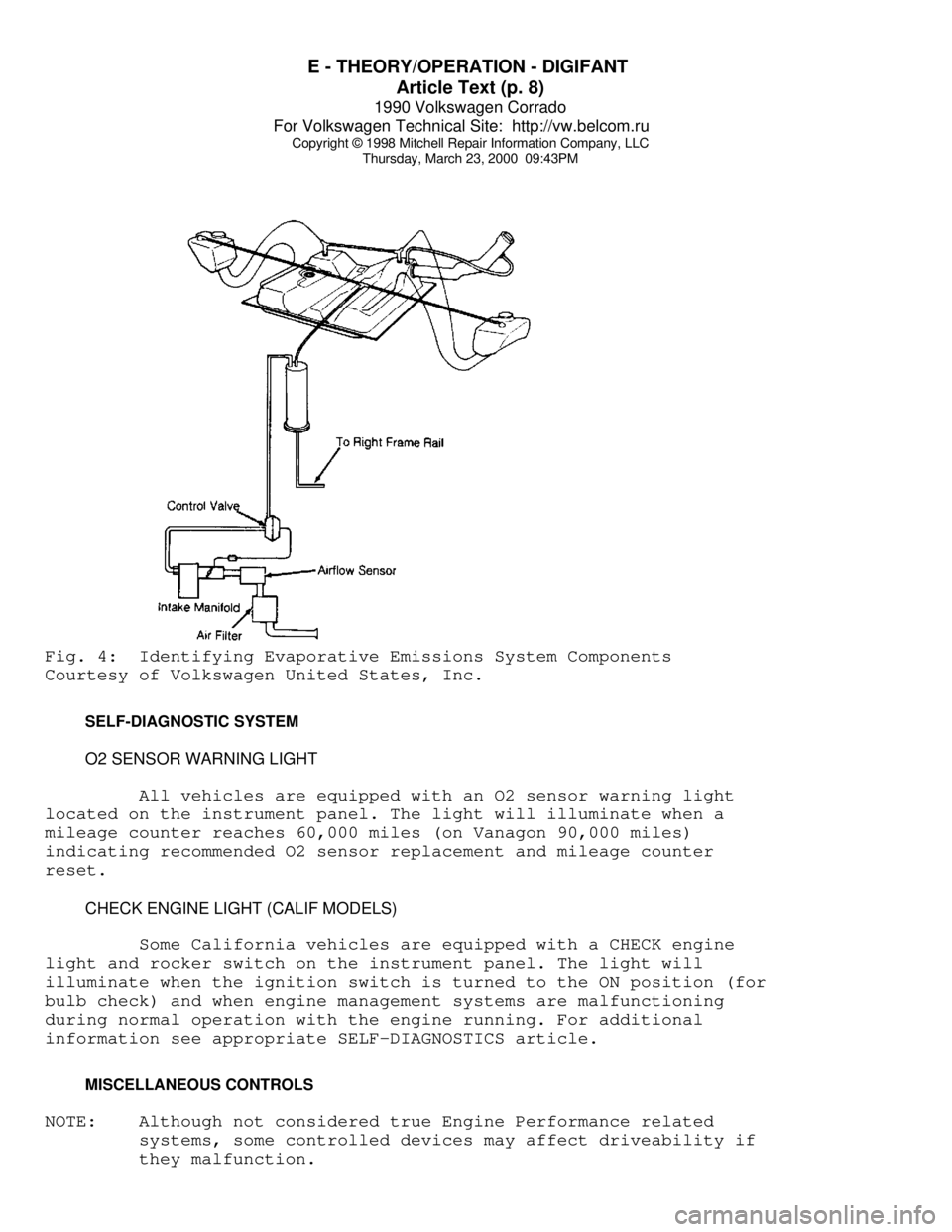
Thursday, March 23, 2000 09:43PMFig. 4: Identifying Evaporative Emissions System Components
Courtesy of Volkswagen United States, Inc.
SELF-DIAGNOSTIC SYSTEM
O2 SENSOR WARNING LIGHT
All vehicles are equipped with an O2 sensor warning light
located on the instrument panel. The light will illuminate when a
mileage counter reaches 60,000 miles (on Vanagon 90,000 miles)
indicating recommended O2 sensor replacement and mileage counter
reset.
CHECK ENGINE LIGHT (CALIF MODELS)
Some California vehicles are equipped with a CHECK engine
light and rocker switch on the instrument panel. The light will
illuminate when the ignition switch is turned to the ON position (for
bulb check) and when engine management systems are malfunctioning
during normal operation with the engine running. For additional
information see appropriate SELF-DIAGNOSTICS article.
MISCELLANEOUS CONTROLS
NOTE: Although not considered true Engine Performance related
systems, some controlled devices may affect driveability if
they malfunction.
Page 495 of 906
EMISSION CONTROL VISUAL INSPECTION PROCEDURES
Article Text
1990 Volkswagen Corrado
For Volkswagen Technical Site: http://vw.belcom.ru
Copyright © 1998 Mitchell Repair Information Company, LLC
Thursday, March 23, 2000 09:44PM
ARTICLE BEGINNING
GENERAL INFORMATION
All Makes Emission Control Visual Inspection Procedures
All Models
PLEASE READ THIS FIRST
This article is provided for general information only. Not
all information applies to all makes and models. For more complete
information, see appropriate article(s) in the ENGINE PERFORMANCE
Section.
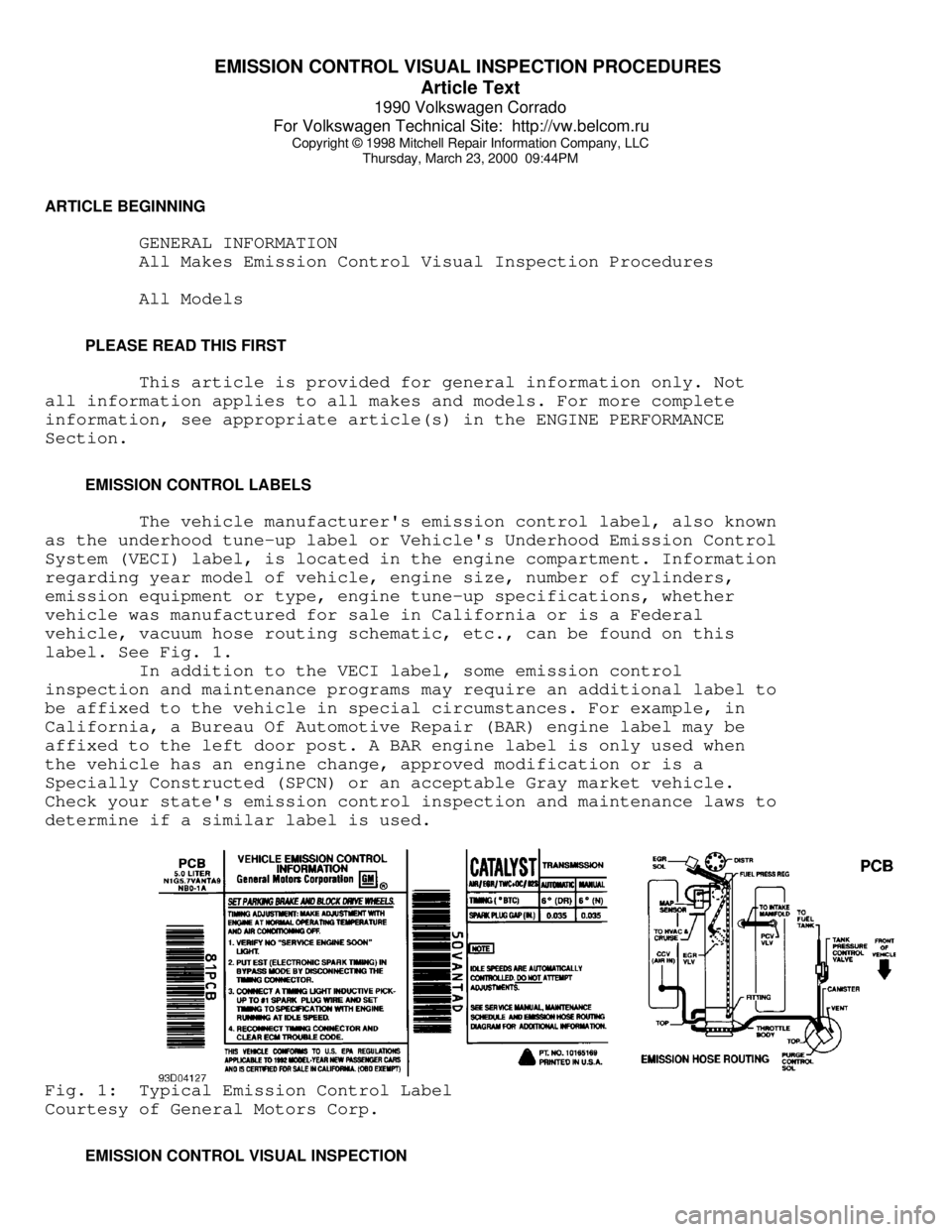
EMISSION CONTROL LABELS
The vehicle manufacturer's emission control label, also known
as the underhood tune-up label or Vehicle's Underhood Emission Control
System (VECI) label, is located in the engine compartment. Information
regarding year model of vehicle, engine size, number of cylinders,
emission equipment or type, engine tune-up specifications, whether
vehicle was manufactured for sale in California or is a Federal
vehicle, vacuum hose routing schematic, etc., can be found on this
label. See Fig. 1.
In addition to the VECI label, some emission control
inspection and maintenance programs may require an additional label to
be affixed to the vehicle in special circumstances. For example, in
California, a Bureau Of Automotive Repair (BAR) engine label may be
affixed to the left door post. A BAR engine label is only used when
the vehicle has an engine change, approved modification or is a
Specially Constructed (SPCN) or an acceptable Gray market vehicle.
Check your state's emission control inspection and maintenance laws to
determine if a similar label is used.Fig. 1: Typical Emission Control Label
Courtesy of General Motors Corp.
EMISSION CONTROL VISUAL INSPECTION
Page 496 of 906
EMISSION CONTROL VISUAL INSPECTION PROCEDURES
Article Text (p. 2)
1990 Volkswagen Corrado
For Volkswagen Technical Site: http://vw.belcom.ru
Copyright © 1998 Mitchell Repair Information Company, LLC
Thursday, March 23, 2000 09:44PM
NOTE: The following emission control visual inspection procedures
should be used as a guide only. When performing a visual
inspection, always follow your state's recommended
inspection procedures.
A visual inspection is made to determine if any required
emission control devices are missing, modified or disconnected.
Missing, modified or disconnected systems must be made fully
operational before a vehicle can be certified.
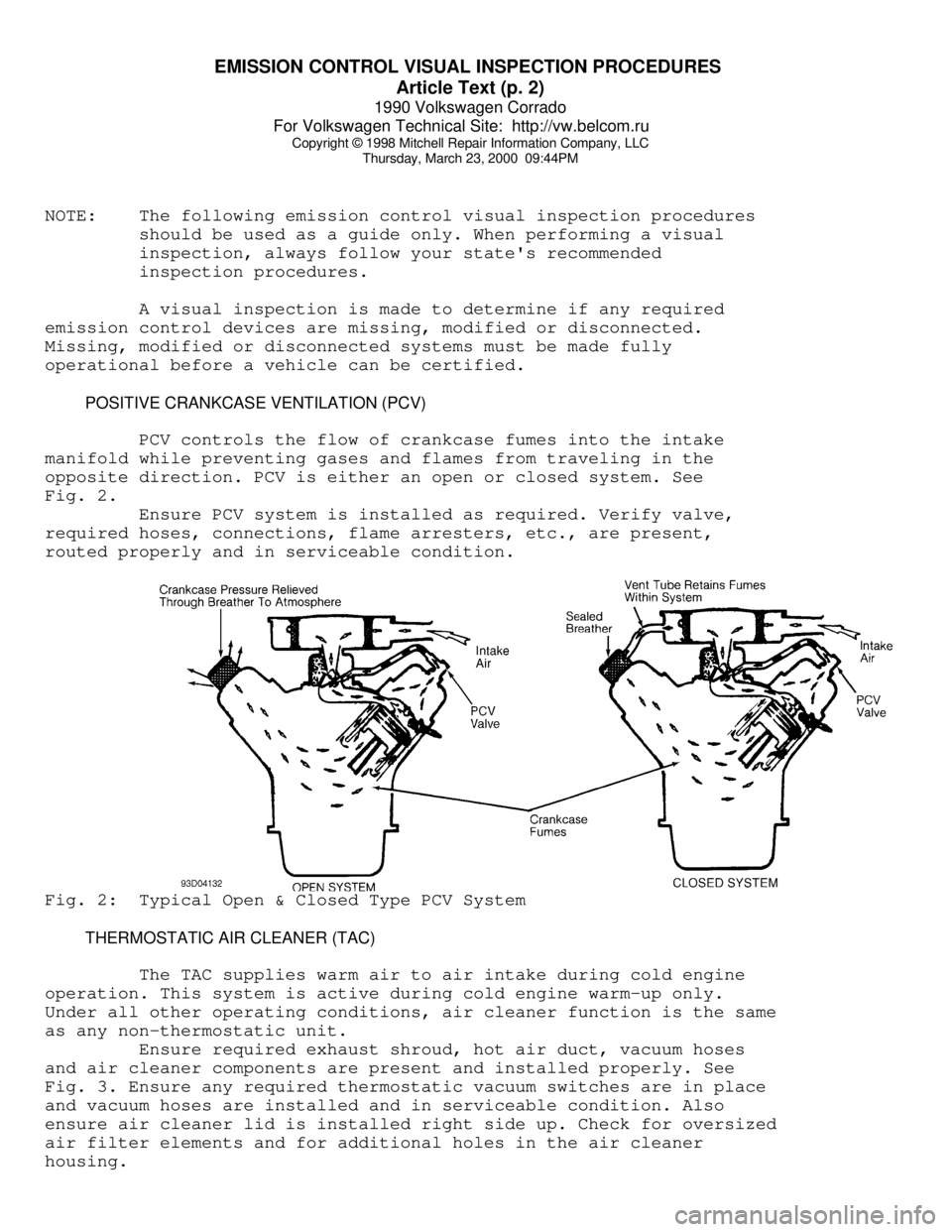
POSITIVE CRANKCASE VENTILATION (PCV)
PCV controls the flow of crankcase fumes into the intake
manifold while preventing gases and flames from traveling in the
opposite direction. PCV is either an open or closed system. See
Fig. 2.
Ensure PCV system is installed as required. Verify valve,
required hoses, connections, flame arresters, etc., are present,
routed properly and in serviceable condition.Fig. 2: Typical Open & Closed Type PCV System
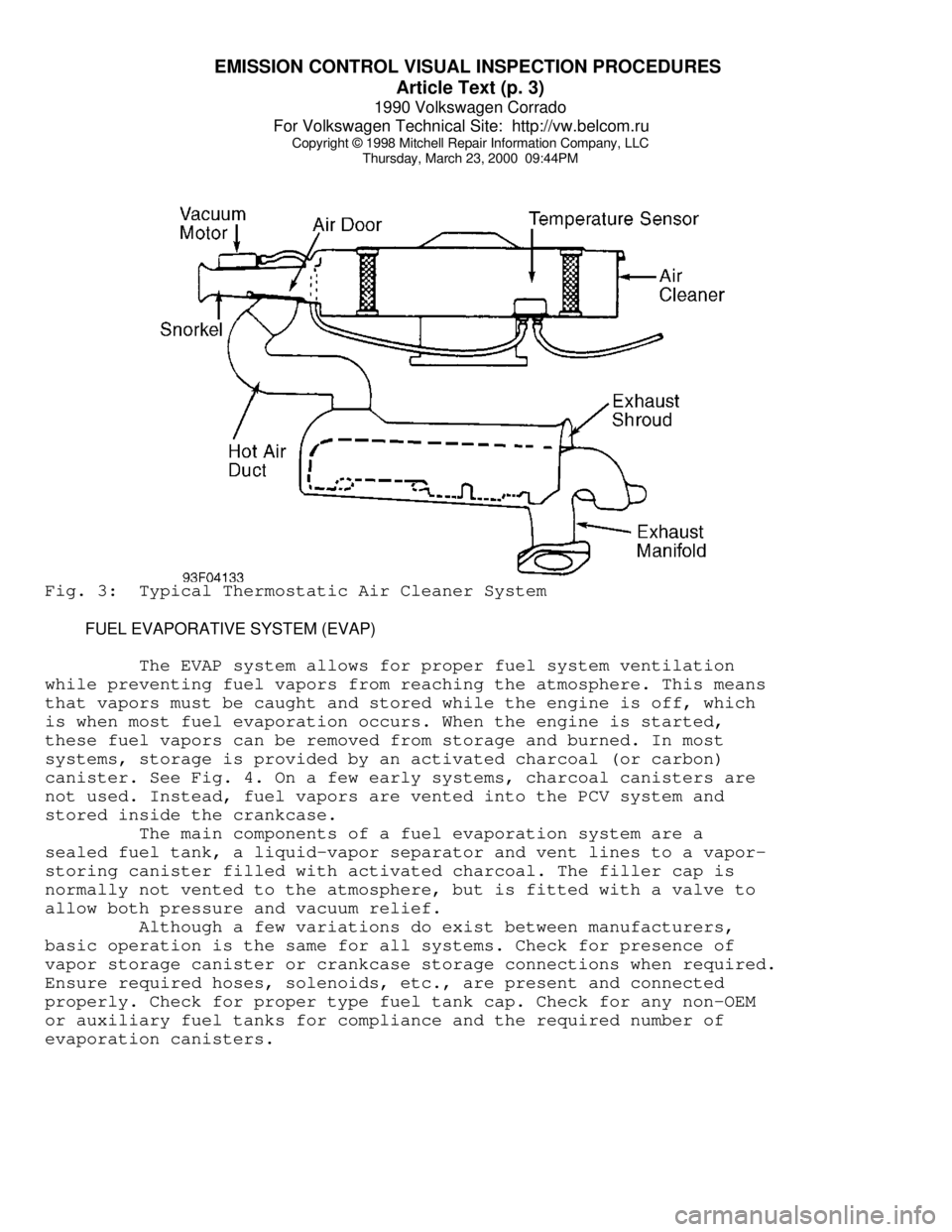
THERMOSTATIC AIR CLEANER (TAC)
The TAC supplies warm air to air intake during cold engine
operation. This system is active during cold engine warm-up only.
Under all other operating conditions, air cleaner function is the same
as any non-thermostatic unit.
Ensure required exhaust shroud, hot air duct, vacuum hoses
and air cleaner components are present and installed properly. See
Fig. 3. Ensure any required thermostatic vacuum switches are in place
and vacuum hoses are installed and in serviceable condition. Also
ensure air cleaner lid is installed right side up. Check for oversized
air filter elements and for additional holes in the air cleaner
housing.
Page 497 of 906
EMISSION CONTROL VISUAL INSPECTION PROCEDURES
Article Text (p. 3)
1990 Volkswagen Corrado
For Volkswagen Technical Site: http://vw.belcom.ru
Copyright © 1998 Mitchell Repair Information Company, LLC
Thursday, March 23, 2000 09:44PMFig. 3: Typical Thermostatic Air Cleaner System
FUEL EVAPORATIVE SYSTEM (EVAP)
The EVAP system allows for proper fuel system ventilation
while preventing fuel vapors from reaching the atmosphere. This means
that vapors must be caught and stored while the engine is off, which
is when most fuel evaporation occurs. When the engine is started,
these fuel vapors can be removed from storage and burned. In most
systems, storage is provided by an activated charcoal (or carbon)
canister. See Fig. 4. On a few early systems, charcoal canisters are
not used. Instead, fuel vapors are vented into the PCV system and
stored inside the crankcase.
The main components of a fuel evaporation system are a
sealed fuel tank, a liquid-vapor separator and vent lines to a vapor-
storing canister filled with activated charcoal. The filler cap is
normally not vented to the atmosphere, but is fitted with a valve to
allow both pressure and vacuum relief.
Although a few variations do exist between manufacturers,
basic operation is the same for all systems. Check for presence of
vapor storage canister or crankcase storage connections when required.
Ensure required hoses, solenoids, etc., are present and connected
properly. Check for proper type fuel tank cap. Check for any non-OEM
or auxiliary fuel tanks for compliance and the required number of
evaporation canisters.