check engine VOLKSWAGEN CORRADO 1990 Owner's Manual
[x] Cancel search | Manufacturer: VOLKSWAGEN, Model Year: 1990, Model line: CORRADO, Model: VOLKSWAGEN CORRADO 1990Pages: 906, PDF Size: 6.56 MB
Page 303 of 906
1.8L 4-CYL 8-VALVE & 1.8L 4-CYL 16-VALVE
Article Text (p. 12)
1990 Volkswagen Corrado
For Volkswagen Technical Site: http://vw.belcom.ru
Copyright © 1998 Mitchell Repair Information Company, LLC
Thursday, March 23, 2000 09:40PM
2) Remove intake camshaft bearing cap Nos. 5, 7 and rear
evenly a little at a time. See Fig. 12. Loosen remaining intake
camshaft bearing caps evenly a little at a time. Remove exhaust
camshaft bearing cap Nos. 1, 3, front and rear evenly a little at a
time. Loosen remaining exhaust camshaft bearing caps evenly a little
at a time. Remove loosened caps. Lift camshafts out of cylinder head
together.
INSPECTION
1) Check camshaft bearing oil clearance. See ENGINE
SPECIFICATIONS at end of this article. If oil clearance is greater
than specifications, install new camshaft and recheck clearance.
2) If clearance is still greater than specifications, replace
cylinder head. If replacing camshaft(s), ensure identification number
between lobes of cylinder No. one, are the same.
INSTALLATION (16-VALVE)
1) On engines with oil spray jets, position spray at right
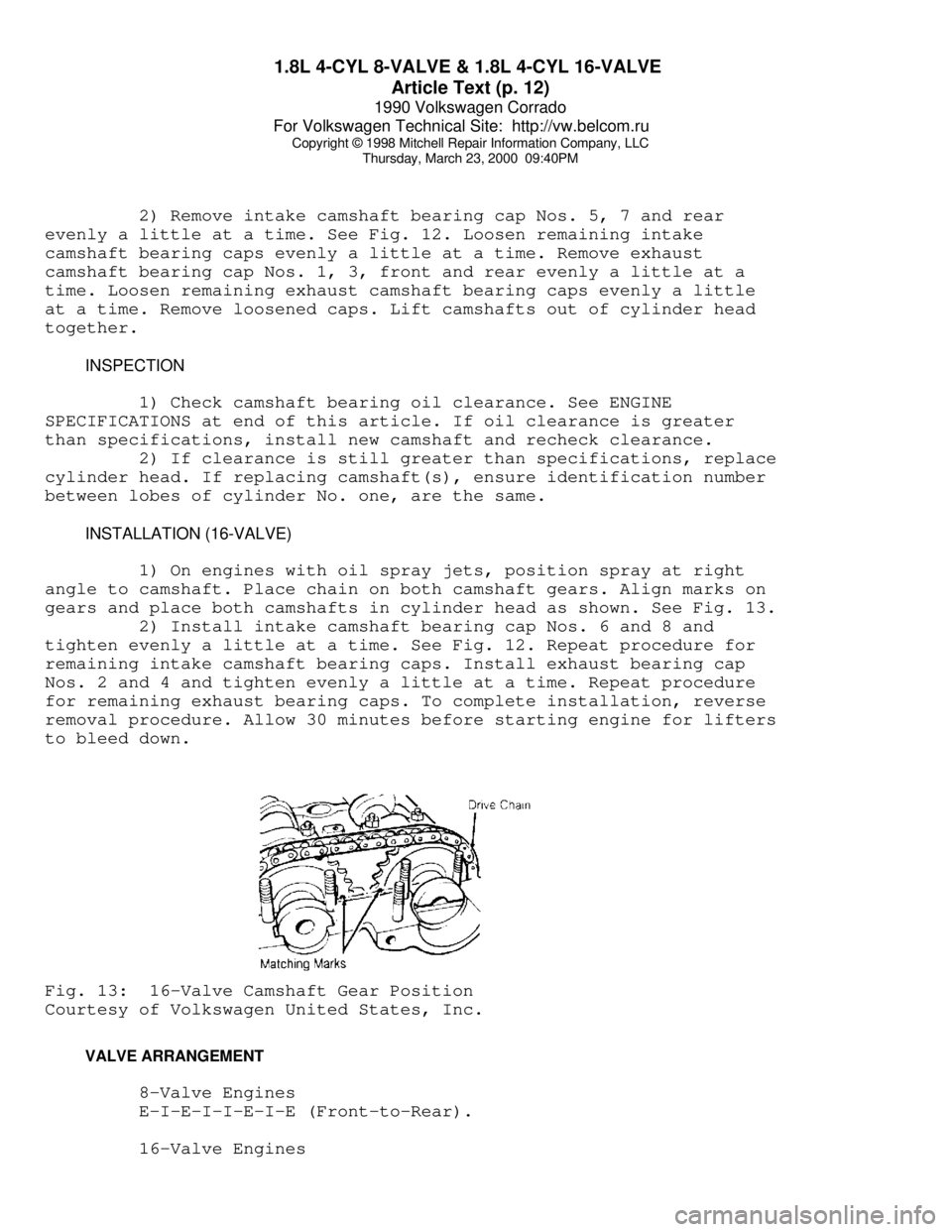
angle to camshaft. Place chain on both camshaft gears. Align marks on
gears and place both camshafts in cylinder head as shown. See Fig. 13.
2) Install intake camshaft bearing cap Nos. 6 and 8 and
tighten evenly a little at a time. See Fig. 12. Repeat procedure for
remaining intake camshaft bearing caps. Install exhaust bearing cap
Nos. 2 and 4 and tighten evenly a little at a time. Repeat procedure
for remaining exhaust bearing caps. To complete installation, reverse
removal procedure. Allow 30 minutes before starting engine for lifters
to bleed down.Fig. 13: 16-Valve Camshaft Gear Position
Courtesy of Volkswagen United States, Inc.
VALVE ARRANGEMENT
8-Valve Engines
E-I-E-I-I-E-I-E (Front-to-Rear).
16-Valve Engines
Page 304 of 906
1.8L 4-CYL 8-VALVE & 1.8L 4-CYL 16-VALVE
Article Text (p. 13)
1990 Volkswagen Corrado
For Volkswagen Technical Site: http://vw.belcom.ru
Copyright © 1998 Mitchell Repair Information Company, LLC
Thursday, March 23, 2000 09:40PM
Right Side - Exhaust Valves.
Left Side - Intake Valves.
NOTE: "Right" and "Left" refer to right and left side of engine
NOT vehicle.
VALVE SEALS & SPRINGS R & I
Valve seals and springs may be removed with cylinder head
installed in vehicle. Remove camshaft as previously described. Mark
and remove lifters. Use compressed air to hold valves closed.
Installation Bar (2036), Spring Compressor (VW 541/1) and Valve Seal
Replacer/Sleeve (10-204/A) are necessary tools for replacing. DO NOT
install valve seal without using sleeve.
VALVE GUIDE R & I
If valve-to-guide clearance is not within specifications,
replace guide(s). See ENGINE SPECIFICATIONS tables at end of this
article. To replace valve guide, press guide out from combustion
chamber side. Press guide in cold cylinder head as far as guide will
go. DO NOT exceed one ton pressure. Ream guides by hand to achieve
proper valve-to-guide clearance.
VALVE SEATS
1) Check valve seats prior to any other cylinder head
service. If valve seats are less than specifications, cylinder head
must be replaced. Insert the valve and hold firmly against the valve
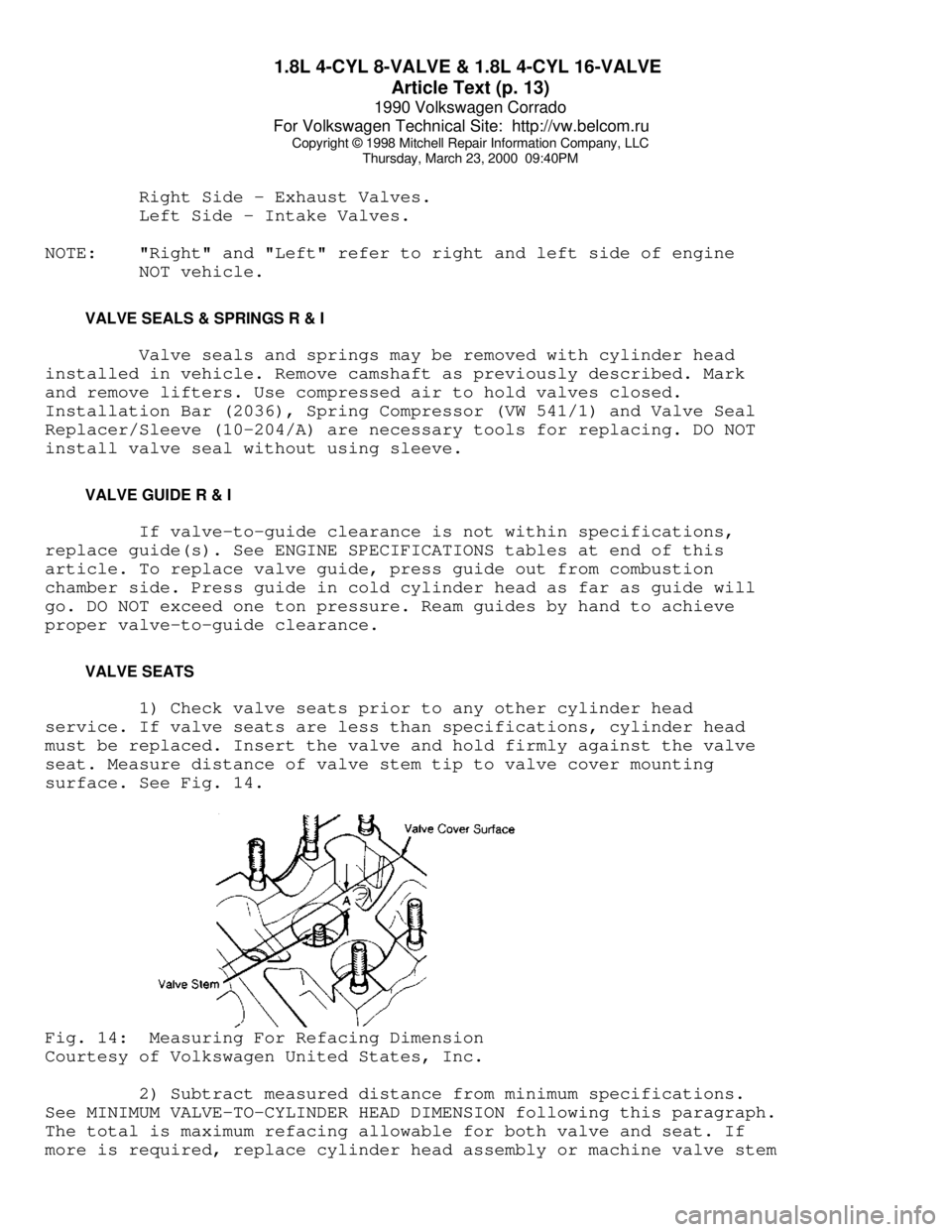
seat. Measure distance of valve stem tip to valve cover mounting
surface. See Fig. 14.Fig. 14: Measuring For Refacing Dimension
Courtesy of Volkswagen United States, Inc.
2) Subtract measured distance from minimum specifications.
See MINIMUM VALVE-TO-CYLINDER HEAD DIMENSION following this paragraph.
The total is maximum refacing allowable for both valve and seat. If
more is required, replace cylinder head assembly or machine valve stem
Page 305 of 906

1.8L 4-CYL 8-VALVE & 1.8L 4-CYL 16-VALVE
Article Text (p. 14)
1990 Volkswagen Corrado
For Volkswagen Technical Site: http://vw.belcom.ru
Copyright © 1998 Mitchell Repair Information Company, LLC
Thursday, March 23, 2000 09:40PM
(Cabriolet only). If less than minimum dimension is used, valve
lifters will not function.
MINIMUM VALVE-TO-CYLINDER HEAD DIMENSIONÄÄÄÄÄÄÄÄÄÄÄÄÄÄÄÄÄÄÄÄÄÄÄÄÄÄÄÄÄÄÄÄÄÄÄÄÄÄÄÄÄÄÄÄÄApplication In. (mm)
8-Valve
Intake Valve .............. 1.330 (33.78)
Exhaust Valve ............. 1.342 (34.09)
16-Valve
Intake Valve .............. 1.354 (34.39)
Exhaust Valve ............. 1.366 (34.70)
ÄÄÄÄÄÄÄÄÄÄÄÄÄÄÄÄÄÄÄÄÄÄÄÄÄÄÄÄÄÄÄÄÄÄÄÄÄÄÄÄÄÄÄÄÄ VALVES
1) With valves removed, measure dimension of valves. If not
within specifications, replace valves. DO NOT reface exhaust valves
with machine. Lap valves by hand or replace as necessary. See ENGINE
SPECIFICATIONS at end of this article.
CAUTION: On 16-valve engines, exhaust valves are sodium filled. Use
following procedure to dispose of valves properly.
2) To dispose of sodium filled valves, cut valve stem off
near head of valve with hacksaw. DO NOT allow water to contact valve
during cutting. Throw valve stem in bucket of water and move quickly
away. Once reaction with water has ceased, discard valve. Repeat
procedure as necessary.
VALVE CLEARANCE ADJUSTMENT
NOTE: Cylinder heads without shims between camshaft(s) and lifters
are not adjustable. See LIFTERS under VALVES in this article.
1) After any cylinder head repair, check and adjust valves
with engine cold. After 1000 miles (after repair) or at normal service
interval, adjust with engine warm. Shims are available in different
thicknesses. Etched side of shim must be installed away from camshaft.
2) Position camshaft lobes of cylinder to be check with high
points facing upward (valves closed). Measure clearance. See VALVE
ADJUSTMENT SPECIFICATIONS table in this article. If clearance cannot
be achieved with thinnest shim, shorter valves may be installed. If
clearance is greater than specifications, use appropriate shim to
acquire proper clearance.
3) To remove shim, rotate lifter (follower) so grooves face
inward towards each other (one cylinder at a time). Using Lifter
Compressor (2078) and Pliers (10-208), remove shim. To install,
reverse removal procedure.
Page 307 of 906
1.8L 4-CYL 8-VALVE & 1.8L 4-CYL 16-VALVE
Article Text (p. 16)
1990 Volkswagen Corrado
For Volkswagen Technical Site: http://vw.belcom.ru
Copyright © 1998 Mitchell Repair Information Company, LLC
Thursday, March 23, 2000 09:40PM
FITTING PISTONS & RINGS
1) DO NOT measure clearances with cylinder block mounted on
an engine stand. Check clearance of piston-to-cylinder bore. Piston
diameter is stamped on top of piston in millimeters. Arrow on top of
piston faces front of engine.
PISTON-TO-CYLINDER BORE DIMENSIONSÄÄÄÄÄÄÄÄÄÄÄÄÄÄÄÄÄÄÄÄÄÄÄÄÄÄÄÄÄÄÄÄÄÄÄÄÄÄÄÄÄÄÄÄÄÄÄÄÄÄÄÄÄÄÄ Piston Diameter Cylinder Bore
Size In. (mm) In. (mm)
Standard ....... 3.188 (80.98) ...... 3.189 (81.01)
1st Over ....... 3.198 (81.23) ...... 3.199 (81.26)
2nd Over ....... 3.208 (81.48) ...... 3.209 (81.51)
ÄÄÄÄÄÄÄÄÄÄÄÄÄÄÄÄÄÄÄÄÄÄÄÄÄÄÄÄÄÄÄÄÄÄÄÄÄÄÄÄÄÄÄÄÄÄÄÄÄÄÄÄÄÄÄ 2) Measure ring end gap. Measure ring side clearance with
piston. If not within specifications, replace as necessary. See ENGINE
SPECIFICATIONS at end of this article. Install rings on piston with
"TOP" mark facing upward. Recessed edge on outside of center ring must
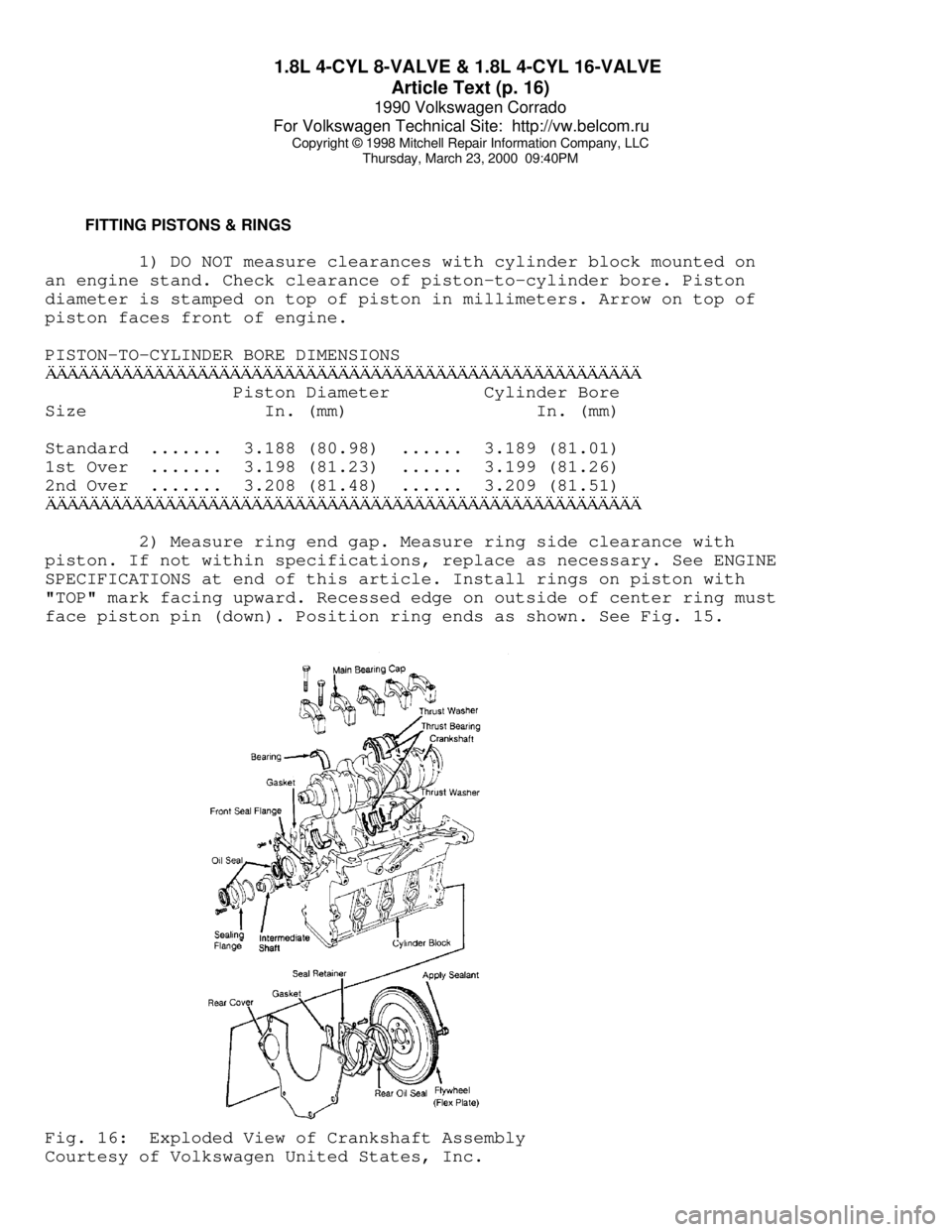
face piston pin (down). Position ring ends as shown. See Fig. 15.Fig. 16: Exploded View of Crankshaft Assembly
Courtesy of Volkswagen United States, Inc.
Page 308 of 906

1.8L 4-CYL 8-VALVE & 1.8L 4-CYL 16-VALVE
Article Text (p. 17)
1990 Volkswagen Corrado
For Volkswagen Technical Site: http://vw.belcom.ru
Copyright © 1998 Mitchell Repair Information Company, LLC
Thursday, March 23, 2000 09:40PM
PISTON PIN REPLACEMENT R & I
Ensure piston and rod are properly marked. Remove both
circlips from pin bore groove. Use Piston Pin Replacer (VW 207C) to
remove and install the piston pin. If pin is too tight, heat piston to
140øF (60øC). To install, reverse removal procedure. Ensure rod is
properly positioned with piston. See Fig. 15.
CRANKSHAFT R & I
1) Using flywheel Holder (10-201), remove flywheel bolts.
Remove flywheel. Remove front and rear oil seals and covers. Remove
connecting rod bearing caps.
2) Measure crankshaft end play. See CRANKSHAFT END PLAY CHECK
in this article. Remove main bearing cap bolts. Remove main bearing
caps. Remove crankshaft. To install, reverse removal procedure.
MAIN BEARING INSTALLATION
Main bearing caps are marked with matching journal and must
be installed to original position. See Fig. 16. Thrust bearing is
located at No. 3 main bearing cap. Use Plastigage method to check
clearance. Machine or replace as necessary. See ENGINE SPECIFICATIONS
at end of this article. Tighten evenly to specifications in several
steps.
CONNECTING ROD BEARING INSTALLATION
Ensure rod caps are marked to ensure installation to original
position and location. Use Plastigage to measure bearing clearances.
Measure connecting rod side play. Replace or machine as necessary. See
ENGINE SPECIFICATIONS at end of this article. Tighten evenly to
specifications in several steps.
CRANKSHAFT END PLAY CHECK
Insert feeler gauge between No. 3 main bearing and crankshaft
thrust face to measure end play. See Fig. 16. Replace thrust bearing
as necessary. See ENGINE SPECIFICATIONS at end of this article.
Original thrust bearing uses plain shell with 4 separate washers and
replacements have attached collar.
REAR MAIN BEARING OIL SEAL R & I
Remove flywheel/flex plate and discard retaining bolts. Oil
seal may removed without removing retaining flange by prying seal out.
Remove retaining flange if gasket is leaking. See Fig. 16. If
installing without removing retaining flange, use Centering Tool
(2003/2A) to center seal and Installer (2003/1) to install seal.
Page 309 of 906

1.8L 4-CYL 8-VALVE & 1.8L 4-CYL 16-VALVE
Article Text (p. 18)
1990 Volkswagen Corrado
For Volkswagen Technical Site: http://vw.belcom.ru
Copyright © 1998 Mitchell Repair Information Company, LLC
Thursday, March 23, 2000 09:40PM
Install new flywheel bolts.
FRONT COVER OIL SEAL R & I
REMOVAL
Remove timing belt. See REMOVAL under TIMING BELT R & I in
this article. Rotate inner part of Oil Seal Extractor (2085) outward 2
turns and tighten set screw. See Fig. 11. Lubricate threaded area of
extractor and push in as far as possible. Loosen set screw and turn
inner part of extractor until oil seal is removed.
INSTALLATION
Lubricate outer edge and lip of new seal. Place guide sleeve
from Seal Installer (3083) onto crankshaft. Push oil seal over guide
sleeve. Press seal completely into position. To complete installation,
reverse removal procedure.
INTERMEDIATE SHAFT ASSEMBLY
Remove timing belt. See REMOVAL under TIMING BELT in this
article. Mark distributor assembly for installation reference and
remove distributor assembly. Check intermediate shaft end play. See
INTERMEDIATE SHAFT END PLAY SPECIFICATION table following this
paragraph. Remove intermediate shaft sprocket. Remove intermediate
shaft seal flange. Replace seal (if necessary). To install, reverse
removal procedure. See ENGINE SPECIFICATIONS at end of this article.
INTERMEDIATE SHAFT END PLAY SPECIFICATIONÄÄÄÄÄÄÄÄÄÄÄÄÄÄÄÄÄÄÄÄÄÄÄÄÄÄÄÄÄÄÄÄÄÄÄÄÄÄÄÄÄÄÄÄÄApplication In. (mm)
1.8L ........................... .010 (.25)
ÄÄÄÄÄÄÄÄÄÄÄÄÄÄÄÄÄÄÄÄÄÄÄÄÄÄÄÄÄÄÄÄÄÄÄÄÄÄÄÄÄÄÄÄÄ CYLINDER BLOCK INSPECTION
DO NOT measure cylinder block while mounted on an engine
stand. Inaccurate measurements may be achieved. Check cylinder bore
for wear, out-of-round and taper. Pistons are available in oversize.
Cylinder block bore may be machined. Check cylinder block for warpage.
See ENGINE SPECIFICATIONS at end of this article.
ENGINE OILING SYSTEM SPECIFICATIONS
CRANKCASE CAPACITY
CRANKCASE CAPACITY TABLE
ÄÄÄÄÄÄÄÄÄÄÄÄÄÄÄÄÄÄÄÄÄÄÄÄÄÄÄÄÄÄÄÄÄÄÄÄÄÄÄÄÄÄÄÄÄÄÄÄÄÄÄÄÄÄÄ With Filter Without Filter
Page 310 of 906

1.8L 4-CYL 8-VALVE & 1.8L 4-CYL 16-VALVE
Article Text (p. 19)
1990 Volkswagen Corrado
For Volkswagen Technical Site: http://vw.belcom.ru
Copyright © 1998 Mitchell Repair Information Company, LLC
Thursday, March 23, 2000 09:40PM
Model Replacement Replacement
Fox ........... 3.7 Qts. (3.5L) . 3.2 Qts. (3.0L)
All Others .... 4.3 Qts. (4.1L) . 4.7 Qts. (4.5L)ÄÄÄÄÄÄÄÄÄÄÄÄÄÄÄÄÄÄÄÄÄÄÄÄÄÄÄÄÄÄÄÄÄÄÄÄÄÄÄÄÄÄÄÄÄÄÄÄÄÄÄÄÄÄÄ OIL PRESSURE
Minimum oil pressure at idle is 4.3 psi (.3 kg/cm
ý). Oil
pressure at 2000 RPM is 29 psi (2.0 kg/cm
ý).
OIL PAN REMOVAL
REMOVAL
Oil pan can be removed and installed with engine in vehicle.
No further information available from manufacturer.
OIL PUMP R & I
REMOVAL & INSTALLATION
Remove oil pan. Remove oil pump attaching bolts and remove
oil pump assembly. To install, reverse removal procedure.
INSPECTION
Check oil pump backlash and oil pump axial play. If not
within specifications, replace oil pump assembly. See OIL PUMP
SPECIFICATIONS table in this article.
OIL PUMP SPECIFICATIONS
ÄÄÄÄÄÄÄÄÄÄÄÄÄÄÄÄÄÄÄÄÄÄÄÄÄÄÄÄÄÄÄÄÄÄÄÄÄÄÄÄÄÄÄÄÄApplication In. (mm)
Backlash
New .......................... .002 (.05)
Limit ........................ .008 (.20)
Axial Play Limit ............... .006 (.15)
ÄÄÄÄÄÄÄÄÄÄÄÄÄÄÄÄÄÄÄÄÄÄÄÄÄÄÄÄÄÄÄÄÄÄÄÄÄÄÄÄÄÄÄÄÄ ENGINE COOLING SYSTEM
CAUTION: Coolant/water mixture should be used at all times. Only
ethylene glycol based (phosphate-free) antifreeze may be
used, as it protects aluminum/iron engines from corrosion.
BELT TENSION
Belt deflection with 22 lbs. (10 kg) pressure applied at
midpoint of longest belt run should be 3/8-9/16" (10-15mm).
Page 317 of 906

A - ENGINE/VIN ID
Article Text
1990 Volkswagen Corrado
For Volkswagen Technical Site: http://vw.belcom.ru
Copyright © 1998 Mitchell Repair Information Company, LLC
Thursday, March 23, 2000 09:40PM
ARTICLE BEGINNING
1990 ENGINE PERFORMANCE
Introduction
Volkswagen; Cabriolet, Corrado, Fox, Golf GL/GTI,
Jetta, Vanagon
1990 MODEL COVERAGE TABLEÄÄÄÄÄÄÄÄÄÄÄÄÄÄÄÄÄÄÄÄÄÄÄÄÄÄÄÄÄÄÄÄÄÄÄÄÄÄÄÄÄÄÄÄÄÄÄÄÄÄÄÄÄÄÄÄÄÄÄÄÄÄÄÄÄÄÄÄÄÄ BODY ENGINE FUEL IGNITION
MODEL CODE ENGINE ID SYSTEM SYSTEM
Cabriolet 15 1.8L JH (1) Hall Effect
Corrado 50 1.8L PG (1) Hall Effect
Fox 30 1.8L JN (2) Hall Effect
Golf GL/GTI 17 1.8L 8-Valve GX (1) Hall Effect
Jetta 16 1.8L 8-Valve GX (1) Hall Effect
Jetta GLi 17 2.0L 16-Valve 9A (3) Hall Effect
Vangon 25 2.1L MV (1) Hall Effect
(1) - AFC-Digifant.
(2) - CIS-E.
(3) - CIS-Motronic.
ÄÄÄÄÄÄÄÄÄÄÄÄÄÄÄÄÄÄÄÄÄÄÄÄÄÄÄÄÄÄÄÄÄÄÄÄÄÄÄÄÄÄÄÄÄÄÄÄÄÄÄÄÄÄÄÄÄÄÄÄÄÄÄÄÄÄÄÄÄÄ VIN ID
(VIN) W V W C B 5 1 5 2 L C 0 0 0 0 0 1
1 2 3 4 5 6 7 8 9 10 11 12 13 14 15 16 17
1, 2, 3 - Indicates Nation of Origin.
4 - Indicates Series.
5 - Indicates Engine Type.
6 - Indicates Restraint System.
7, 8 - Indicates Body Code.
9 - Indicates Check Digit.
10 - Indicates Model Year.
11 - Indicates Assembly Plant.
12 thru 17 - Vehicle Production Sequence.
MODEL YEAR VIN CODE APPLICATION
ÄÄÄÄÄÄÄÄÄÄÄÄÄÄÄÄÄÄÄÄÄÄÄÄÄÄÄÄÄÄÄÄÄÄÄÄÄÄÄÄÄVIN Code Model Year
J ................................ 1988
K ................................ 1989
L ................................ 1990
ÄÄÄÄÄÄÄÄÄÄÄÄÄÄÄÄÄÄÄÄÄÄÄÄÄÄÄÄÄÄÄÄÄÄÄÄÄÄÄÄÄ ENGINE CODE LOCATION
Page 319 of 906

A/C COMPRESSOR OIL CHECKING
Article Text
1990 Volkswagen Corrado
For Volkswagen Technical Site: http://vw.belcom.ru
Copyright © 1998 Mitchell Repair Information Company, LLC
Thursday, March 23, 2000 09:41PM
ARTICLE BEGINNING
1990 AIR CONDITIONING & HEAT
Compressor Oil Checking
ISOLATING COMPRESSOR
NOTE: Only compressors with stem-type service valves can be
isolated.
1) Connect service gauge set to the compressor service valves
and open compressor valves slightly (turn in clockwise). Start engine
and operate air conditioning. Slowly turn compressor suction valve
clockwise toward closed (front-seated) position.
2) When suction pressure is reduced to zero or less, turn off
engine and compressor and quickly turn suction valve stem in to full
front-seated position. Suction pressure should be slightly above zero.
Turn discharge valve into front-seated position.
3) To check oil level, slowly open compressor crankcase plug
to relieve any remaining pressure. After oil level is corrected, cap
service gauge ports on both valves. Back-seat suction service valve to
allow refrigerant to enter compressor. Open discharge valve halfway.
4) Loosen discharge service valve cap, allowing refrigerant
pressure to force air out of compressor. Back-seat service valve and
tighten cap. Compressor is now ready for operation.
REFRIGERANT OIL
Only new, pure, moisture-free refrigerant oil should be used
in the air conditioning system. This oil is highly refined and
dehydrated to a point where moisture content is less than 10 parts per
million. The oil container must be tightly closed at all times when
not in use, or moisture will be absorbed into the refrigerant oil from
the air.
SERVICING PRECAUTIONS
NOTE: Recent findings by the EPA indicate that refrigerant is
harmful to the earth's protective Ozone layer. When
discharging refrigerant, DO NOT allow refrigerant to enter
the atmosphere. If available, use refrigerant
recovery/recycle systems when discharging system. Always
follow manufacturer's instructions.
DISCHARGING SYSTEM PRECAUTIONS
If compressor has stem-type service valves, it can be
isolated and removed without discharging entire system. See ISOLATING
COMPRESSOR at the beginning of this article. Otherwise, discharge
system completely before loosening any fittings.
Page 320 of 906

A/C COMPRESSOR OIL CHECKING
Article Text (p. 2)
1990 Volkswagen Corrado
For Volkswagen Technical Site: http://vw.belcom.ru
Copyright © 1998 Mitchell Repair Information Company, LLC
Thursday, March 23, 2000 09:41PM
DISCONNECTING LINES & FITTINGS TEST
After system is discharged, carefully clean area around all
fittings to be opened. Always use 2 wrenches when tightening or
loosening fittings to avoid twisting or distorting lines. Cap or plug
all openings as soon as lines are removed. DO NOT remove caps until
immediately before connections are made. This will keep entry of air
and moisture to a minimum.
CONNECTING LINES AND FITTINGS
A new gasket or "O" ring should be used in all instances when
connecting lines or fittings. Dip "O" ring in new refrigerant oil and
ensure it is not twisted during installation. Always use 2 wrenches to
prevent damage to lines and fittings.
PLACING SYSTEM IN OPERATION
After component service or replacement has been completed and
all connections have been made, evacuate system thoroughly with a
vacuum pump. Charge system with proper amount of refrigerant and
perform a leak test. See REFRIGERANT OIL & R-12 SPECIFICATIONS chart
in this section for system capacities. Be sure to check all fittings
that have been opened. After system has been leak tested, make a
system performance check.
NOTE: Air conditioning systems will not normally need addition of
refrigerant oil unless definite oil loss has occurred due to
ruptured lines, leaking compressor seals, compressor
overhaul or component replacement.
ATSUGI ROTARY VANE DRAIN & REFILL
1) Before checking and adjusting oil level, operate
compressor at engine idling speed, with controls set for maximum
cooling and high blower speed, for 20 to 30 minutes to return oil to
compressor.
2) Stop engine, discharge refrigerant and remove compressor
from vehicle. See SERVICING PRECAUTIONS at beginning of article. Drain
compressor oil from compressor discharge port and measure the amount.
Oil is sometimes hard to drain when compressor is cool. Remove oil
while compressor is warm.
3) If the amount drained is less than 3 ounces, conduct leak
tests at system connections, and if necessary, repair or replace
faulty parts. Check purity of oil and adjust oil level as follows.
4) If amount drained was above 3 ounces, oil level is right.
Pour in same amount as was drained. If amount drained was below 3
ounces, pour in 3 ounces of new refrigerant oil.