sensor VOLKSWAGEN CORRADO 1990 Manual PDF
[x] Cancel search | Manufacturer: VOLKSWAGEN, Model Year: 1990, Model line: CORRADO, Model: VOLKSWAGEN CORRADO 1990Pages: 906, PDF Size: 6.56 MB
Page 443 of 906
D - ADJUSTMENTS
Article Text (p. 6)
1990 Volkswagen Corrado
For Volkswagen Technical Site: http://vw.belcom.ru
Copyright © 1998 Mitchell Repair Information Company, LLC
Thursday, March 23, 2000 09:43PM
NOTE: Before checking engine timing, raise engine speed above 2100
RPM at least 4 times. This must be done each time ignition
is turned off and restarted to clear ECU memory and by-pass
hot-start, fast-idle function.
3) Connect an inductive tachometer or Tester (VW 1367) to
alternator, Test Lead (VW 1473) to ignition coil, and timing light
lead to No. 1 spark plug wire. See Fig. 2. Start engine and ensure
engine speed and timing are correct. If not, adjust to specification.
4) Remove the Blue cap from the CO tap tube rising from the
exhaust manifold and connect exhaust gas analyzer. Disconnect the
coolant sensor harness connector. Raise the oil dipstick slightly to
vent crankcase. Disconnect and plug the crankcase ventilation hose.
Start engine and raise engine speed to 2100 RPM at least 4 times.
Check idle, adjust if incorrect. check CO is correct. See IDLE & CO
LEVEL table. If CO adjustment is needed, the idle mixture screw anti-
tamper plug must be remove from the top of the air flow sensor.
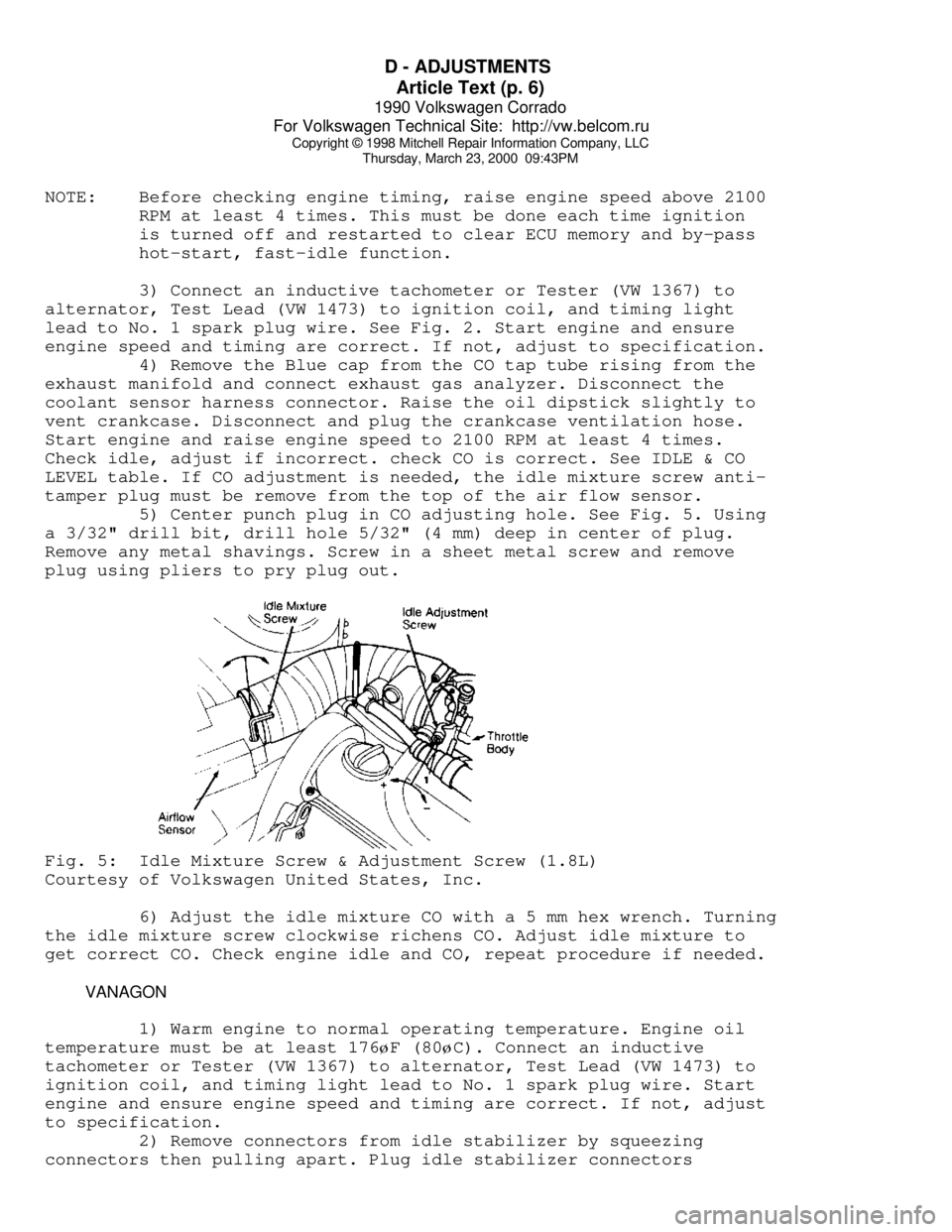
5) Center punch plug in CO adjusting hole. See Fig. 5. Using
a 3/32" drill bit, drill hole 5/32" (4 mm) deep in center of plug.
Remove any metal shavings. Screw in a sheet metal screw and remove
plug using pliers to pry plug out.Fig. 5: Idle Mixture Screw & Adjustment Screw (1.8L)
Courtesy of Volkswagen United States, Inc.
6) Adjust the idle mixture CO with a 5 mm hex wrench. Turning
the idle mixture screw clockwise richens CO. Adjust idle mixture to
get correct CO. Check engine idle and CO, repeat procedure if needed.
VANAGON
1) Warm engine to normal operating temperature. Engine oil
temperature must be at least 176øF (80øC). Connect an inductive
tachometer or Tester (VW 1367) to alternator, Test Lead (VW 1473) to
ignition coil, and timing light lead to No. 1 spark plug wire. Start
engine and ensure engine speed and timing are correct. If not, adjust
to specification.
2) Remove connectors from idle stabilizer by squeezing
connectors then pulling apart. Plug idle stabilizer connectors
Page 444 of 906

D - ADJUSTMENTS
Article Text (p. 7)
1990 Volkswagen Corrado
For Volkswagen Technical Site: http://vw.belcom.ru
Copyright © 1998 Mitchell Repair Information Company, LLC
Thursday, March 23, 2000 09:43PM
together. Turn idle speed screw until idle speed is correct. To adjust
timing, see CHECKING & ADJUSTING under IGNITION TIMING in this
article.
3) Ensure all vehicle electrical equipment is off. Place
exhaust gas analyzer in exhaust pipe. See IDLE SPEED & CO LEVEL table.
If adjustment is needed, go to next step.
4) If adjustment is needed in step 2). Remove intake air
sensor from engine. Center punch plug in CO adjusting hole. Using a
3/32" drill bit, drill hole 5/32" (4 mm) deep in center of plug.
Remove any metal shavings. Screw in a sheet metal screw and remove
plug using pliers to pry plug out.
5) Disconnect oxygen sensor connector on left side of engine
compartment (Green wire). Start engine. Set idle speed and CO reading
by alternately turning mixture and idle speed adjustment screws.
Reconnect oxygen sensor and idle stabilizer connectors. Let engine
idle for 2 minutes.
6) Check CO value. If incorrect, repeat adjusting procedure.
If correct turn ignition off. Drive in new adjusting hole plug flush
with air intake sensor. Remove all test equipment and reconnect all
hoses and wiring.
NOTE: Do not push down on adjustment screw and do not accelerate
engine with wrench in plate. Remove wrench after each
adjustment and accelerate engine briefly before measuring
current reading. Always adjust from a high to a low reading.
IDLE SPEED & CO LEVELÄÄÄÄÄÄÄÄÄÄÄÄÄÄÄÄÄÄÄÄÄÄÄÄÄÄÄÄÄÄÄÄÄÄÄÄÄÄÄÄÄÄÄÄÄÄÄÄÄÄÄÄÄÄÄÄÄÄÄÄÄÄÄÄÄÄÄÄÄÄApplication Idle RPM CO Level
Cabriolet .................. 850-1000 ................... 0.3-1.2%
Fox ........................ 800-1000 ................... 0.3-1.2%
Golf ....................... 800-1000 ................... 0.3-1.2%
Golf GT ..................... 800-900 ................... 0.3-1.2%
GTI ........................ 800-1000 ................... 0.3-1.2%
Jetta ...................... 800-1000 ................... 0.3-1.2%
Vanagon ..................... 830-930 ................... 0.3-1.2%
ÄÄÄÄÄÄÄÄÄÄÄÄÄÄÄÄÄÄÄÄÄÄÄÄÄÄÄÄÄÄÄÄÄÄÄÄÄÄÄÄÄÄÄÄÄÄÄÄÄÄÄÄÄÄÄÄÄÄÄÄÄÄÄÄÄÄÄÄÄÄ THROTTLE STOP SCREW
NOTE: Stop screw is set by manufacturer and should not be moved.
If basic factory setting has been changed, turn throttle stop
screw counterclockwise until there is a gap between stop and screw.
Turn screw in until it just touches stop. Turn screw 1/2 turn (180
degrees) further. Check and adjust idle speed and CO.
IDLE & FULL THROTTLE SWITCH ADJUSTMENTS
IDLE SWITCH ADJUSTMENT DIGIFANT II (EXCEPT VANAGON)
Page 445 of 906
D - ADJUSTMENTS
Article Text (p. 8)
1990 Volkswagen Corrado
For Volkswagen Technical Site: http://vw.belcom.ru
Copyright © 1998 Mitchell Repair Information Company, LLC
Thursday, March 23, 2000 09:43PM
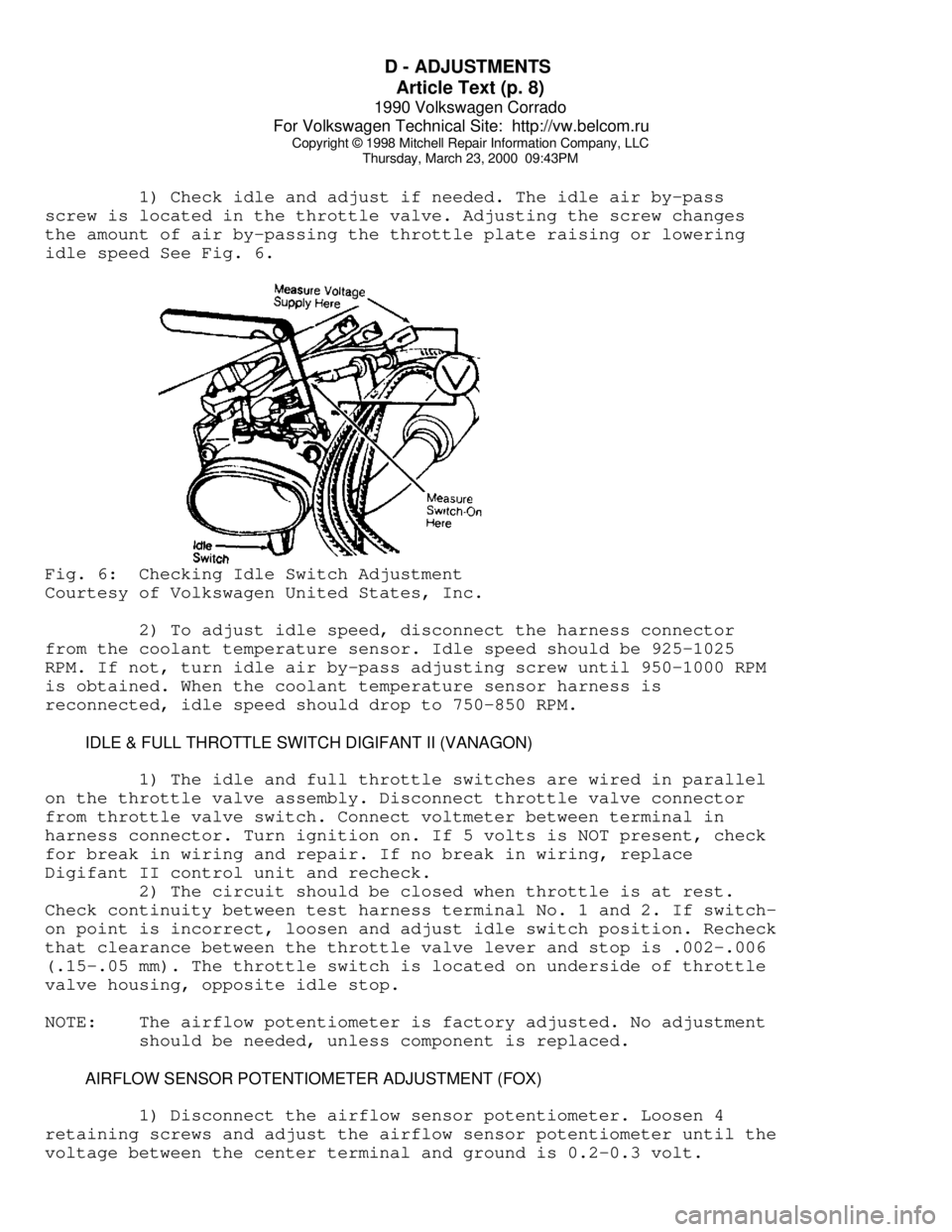
1) Check idle and adjust if needed. The idle air by-pass
screw is located in the throttle valve. Adjusting the screw changes
the amount of air by-passing the throttle plate raising or lowering
idle speed See Fig. 6.Fig. 6: Checking Idle Switch Adjustment
Courtesy of Volkswagen United States, Inc.
2) To adjust idle speed, disconnect the harness connector
from the coolant temperature sensor. Idle speed should be 925-1025
RPM. If not, turn idle air by-pass adjusting screw until 950-1000 RPM
is obtained. When the coolant temperature sensor harness is
reconnected, idle speed should drop to 750-850 RPM.
IDLE & FULL THROTTLE SWITCH DIGIFANT II (VANAGON)
1) The idle and full throttle switches are wired in parallel
on the throttle valve assembly. Disconnect throttle valve connector
from throttle valve switch. Connect voltmeter between terminal in
harness connector. Turn ignition on. If 5 volts is NOT present, check
for break in wiring and repair. If no break in wiring, replace
Digifant II control unit and recheck.
2) The circuit should be closed when throttle is at rest.
Check continuity between test harness terminal No. 1 and 2. If switch-
on point is incorrect, loosen and adjust idle switch position. Recheck
that clearance between the throttle valve lever and stop is .002-.006
(.15-.05 mm). The throttle switch is located on underside of throttle
valve housing, opposite idle stop.
NOTE: The airflow potentiometer is factory adjusted. No adjustment
should be needed, unless component is replaced.
AIRFLOW SENSOR POTENTIOMETER ADJUSTMENT (FOX)
1) Disconnect the airflow sensor potentiometer. Loosen 4
retaining screws and adjust the airflow sensor potentiometer until the
voltage between the center terminal and ground is 0.2-0.3 volt.
Page 446 of 906
D - ADJUSTMENTS
Article Text (p. 9)
1990 Volkswagen Corrado
For Volkswagen Technical Site: http://vw.belcom.ru
Copyright © 1998 Mitchell Repair Information Company, LLC
Thursday, March 23, 2000 09:43PM
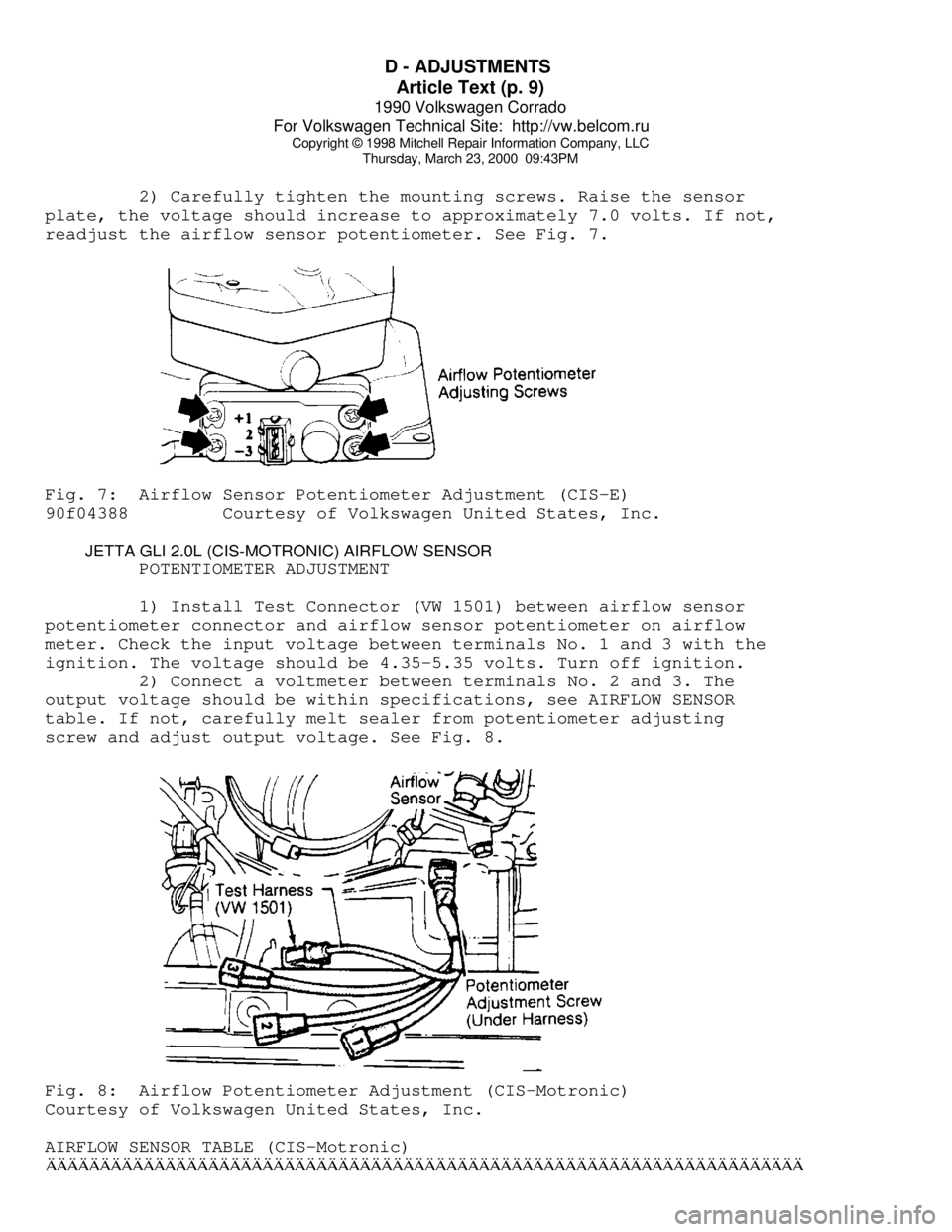
2) Carefully tighten the mounting screws. Raise the sensor
plate, the voltage should increase to approximately 7.0 volts. If not,
readjust the airflow sensor potentiometer. See Fig. 7.Fig. 7: Airflow Sensor Potentiometer Adjustment (CIS-E)
90f04388 Courtesy of Volkswagen United States, Inc.
JETTA GLI 2.0L (CIS-MOTRONIC) AIRFLOW SENSOR
POTENTIOMETER ADJUSTMENT
1) Install Test Connector (VW 1501) between airflow sensor
potentiometer connector and airflow sensor potentiometer on airflow
meter. Check the input voltage between terminals No. 1 and 3 with the
ignition. The voltage should be 4.35-5.35 volts. Turn off ignition.
2) Connect a voltmeter between terminals No. 2 and 3. The
output voltage should be within specifications, see AIRFLOW SENSOR
table. If not, carefully melt sealer from potentiometer adjusting
screw and adjust output voltage. See Fig. 8.Fig. 8: Airflow Potentiometer Adjustment (CIS-Motronic)
Courtesy of Volkswagen United States, Inc.
AIRFLOW SENSOR TABLE (CIS-Motronic)ÄÄÄÄÄÄÄÄÄÄÄÄÄÄÄÄÄÄÄÄÄÄÄÄÄÄÄÄÄÄÄÄÄÄÄÄÄÄÄÄÄÄÄÄÄÄÄÄÄÄÄÄÄÄÄÄÄÄÄÄÄÄÄÄÄÄÄÄÄÄ
Page 452 of 906
E - THEORY/OPERATION - DIGIFANT
Article Text (p. 2)
1990 Volkswagen Corrado
For Volkswagen Technical Site: http://vw.belcom.ru
Copyright © 1998 Mitchell Repair Information Company, LLC
Thursday, March 23, 2000 09:43PM
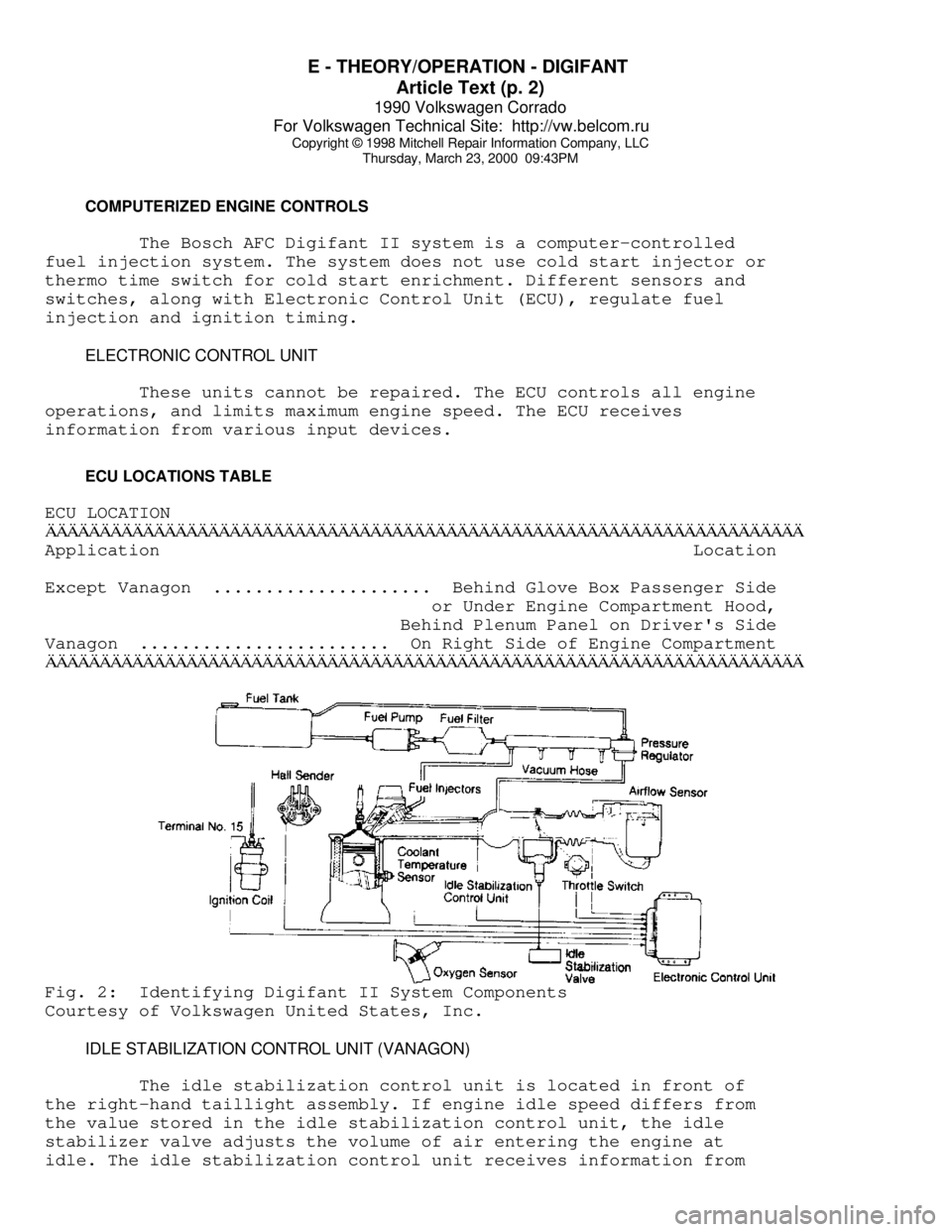
COMPUTERIZED ENGINE CONTROLS
The Bosch AFC Digifant II system is a computer-controlled
fuel injection system. The system does not use cold start injector or
thermo time switch for cold start enrichment. Different sensors and
switches, along with Electronic Control Unit (ECU), regulate fuel
injection and ignition timing.
ELECTRONIC CONTROL UNIT
These units cannot be repaired. The ECU controls all engine
operations, and limits maximum engine speed. The ECU receives
information from various input devices.
ECU LOCATIONS TABLE
ECU LOCATIONÄÄÄÄÄÄÄÄÄÄÄÄÄÄÄÄÄÄÄÄÄÄÄÄÄÄÄÄÄÄÄÄÄÄÄÄÄÄÄÄÄÄÄÄÄÄÄÄÄÄÄÄÄÄÄÄÄÄÄÄÄÄÄÄÄÄÄÄÄÄApplication Location
Except Vanagon ..................... Behind Glove Box Passenger Side
or Under Engine Compartment Hood,
Behind Plenum Panel on Driver's Side
Vanagon ........................ On Right Side of Engine Compartment
ÄÄÄÄÄÄÄÄÄÄÄÄÄÄÄÄÄÄÄÄÄÄÄÄÄÄÄÄÄÄÄÄÄÄÄÄÄÄÄÄÄÄÄÄÄÄÄÄÄÄÄÄÄÄÄÄÄÄÄÄÄÄÄÄÄÄÄÄÄÄFig. 2: Identifying Digifant II System Components
Courtesy of Volkswagen United States, Inc.
IDLE STABILIZATION CONTROL UNIT (VANAGON)
The idle stabilization control unit is located in front of
the right-hand taillight assembly. If engine idle speed differs from
the value stored in the idle stabilization control unit, the idle
stabilizer valve adjusts the volume of air entering the engine at
idle. The idle stabilization control unit receives information from
Page 453 of 906
E - THEORY/OPERATION - DIGIFANT
Article Text (p. 3)
1990 Volkswagen Corrado
For Volkswagen Technical Site: http://vw.belcom.ru
Copyright © 1998 Mitchell Repair Information Company, LLC
Thursday, March 23, 2000 09:43PM
the following:
* Coolant Temperature Sensor
* ECU Control Relay
* ECU
* Oxygen Sensor
* Power Steering Oil Pressure Switch
NOTE: Components are grouped into 2 categories. The first category
covers INPUT DEVICES, which control or produce voltage
signals monitored by the control unit. The second category
covers OUTPUT SIGNALS, which are components controlled by
the control unit.
INPUT DEVICES
AIRFLOW SENSOR (EXCEPT CORRADO)
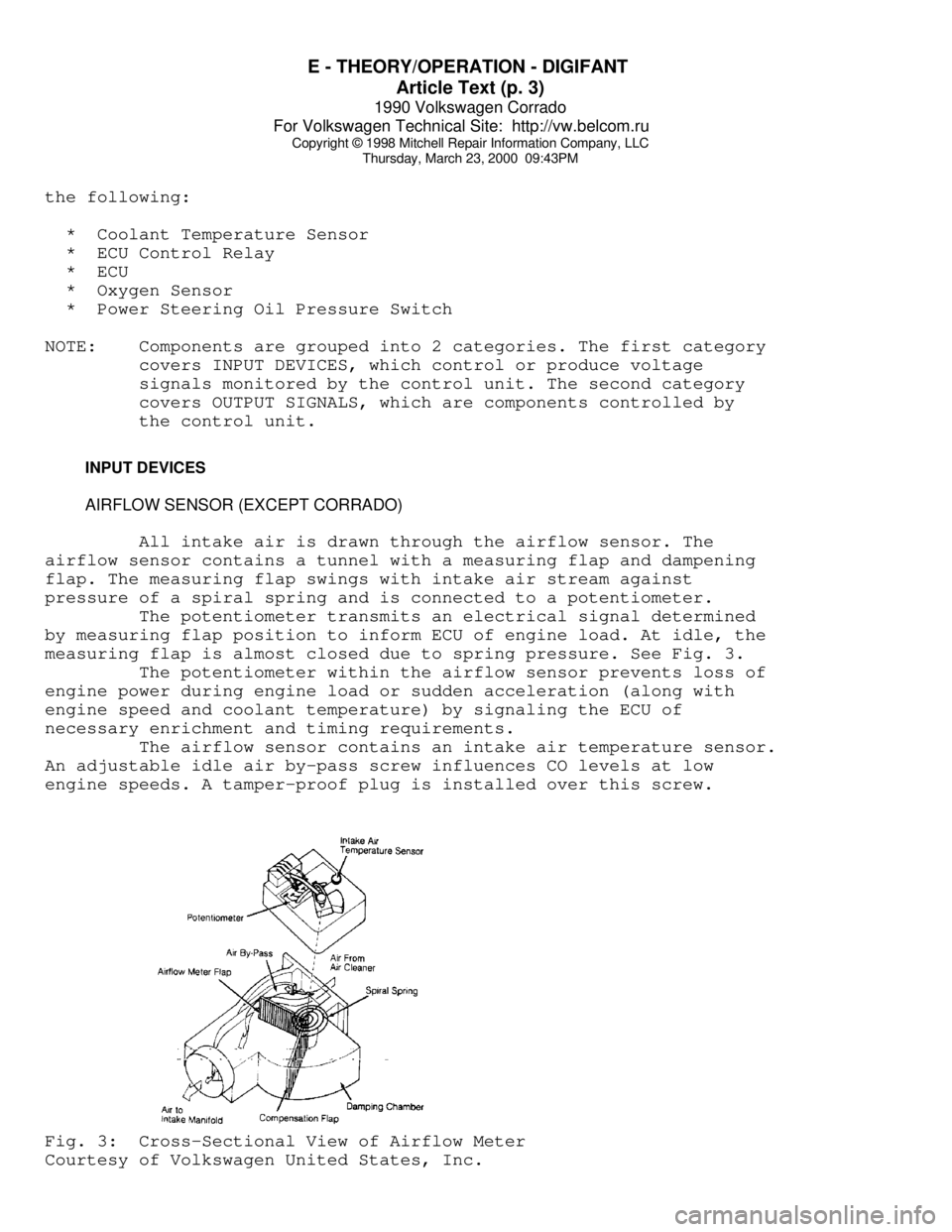
All intake air is drawn through the airflow sensor. The
airflow sensor contains a tunnel with a measuring flap and dampening
flap. The measuring flap swings with intake air stream against
pressure of a spiral spring and is connected to a potentiometer.
The potentiometer transmits an electrical signal determined
by measuring flap position to inform ECU of engine load. At idle, the
measuring flap is almost closed due to spring pressure. See Fig. 3.
The potentiometer within the airflow sensor prevents loss of
engine power during engine load or sudden acceleration (along with
engine speed and coolant temperature) by signaling the ECU of
necessary enrichment and timing requirements.
The airflow sensor contains an intake air temperature sensor.
An adjustable idle air by-pass screw influences CO levels at low
engine speeds. A tamper-proof plug is installed over this screw.Fig. 3: Cross-Sectional View of Airflow Meter
Courtesy of Volkswagen United States, Inc.
Page 454 of 906

E - THEORY/OPERATION - DIGIFANT
Article Text (p. 4)
1990 Volkswagen Corrado
For Volkswagen Technical Site: http://vw.belcom.ru
Copyright © 1998 Mitchell Repair Information Company, LLC
Thursday, March 23, 2000 09:43PM
COOLANT TEMPERATURE SENSOR
Is a temperature sensitive variable resistor sensor (less
resistance as temperature increases). This sensor returns signals to
the ECU to determine amount of cold start enrichment, ignition timing
and idle stabilization during warm-up. The sensor return signal has
input to the ECU when the oxygen sensor, idle stabilization, and full
throttle enrichment functions are activated.
CO POTENTIOMETER (CORRADO)
The CO potentiometer adjusts CO mixture. Located on the
intake air duct before the throttle housing. The adjustment screw has
a tamper-proof plug. An air temperature sensor located within the
potentiometer housing is used to calculate air density.
ECU CONTROL RELAY
When energized by ignition switch, the ECU control relay
provides battery voltage to ECU.
FULL THROTTLE (FUEL) ENRICHMENT SWITCH
The full throttle enrichment switch supplies the control unit
with information to increase amount of fuel injected during full
throttle operation.
HALL EFFECT SENSOR
See ELECTRONIC IGNITION SYSTEM under IGNITION SYSTEM in this
article.
INTAKE AIR TEMPERATURE SENSOR
Intake air temperature sensor is a thermistor-type variable
resistor (resistance decreases with increase of temperature). This
sensor voltage signal varies to ECU in relation to engine air
temperature. Sensor is located inside the airflow meter.
KNOCK SENSOR(S)
Pick-up engine vibrations before knock occurs. The ECU
compensates timing as needed and controls timing advance or retard for
maximized engine performance.
MANIFOLD ABSOLUTE PRESSURE (MAP) SENSOR (CORRADO)
MAP is located inside the ECU. The MAP sensor signal is used
by ECU to determine engine load and manifold boost pressure. This
signal along with RPM and intake air temperature is used to calculate
fuel injection quantity.
Page 455 of 906

E - THEORY/OPERATION - DIGIFANT
Article Text (p. 5)
1990 Volkswagen Corrado
For Volkswagen Technical Site: http://vw.belcom.ru
Copyright © 1998 Mitchell Repair Information Company, LLC
Thursday, March 23, 2000 09:43PM
OXYGEN (O2) SENSOR
The O2 sensor detects oxygen content in the exhaust gas and
sends this information to the ECU. In operation, the ECU receives
signals from the O2 sensor and varies the duration during which fuel
is injected. A high voltage signal indicates a rich mixture. A low
voltage signal indicates a lean mixture.
The O2 sensor is heated electrically for rapid warm-up and
constant operating temperature. Power to the heating element is
supplied whenever ignition switch is turned to ON position.
POWER STEERING (P/S) OIL PRESSURE SWITCH
The P/S oil pressure switch signals the ECU when the power
steering load is high. The ECU then sends a voltage signal to the idle
stabilization valve to increase idle speed with power steering load.
THROTTLE VALVE SWITCH (VANAGON ONLY)
Throttle valve switch supplies ECU with information that
throttle valve is closed. If engine is above 1500 RPM with throttle
closed, fuel will be shut off to the injectors. At idle speed, this
switch signals control unit to regulate amount of fuel injected.
OUTPUT SIGNALS
NOTE: Each vehicle may be equipped with different combinations of
computer controlled components. The following listed
components may NOT be used on all models. For theory and
operation on each output component, refer to the system
indicated in brackets, to the right of each component.
* Fuel Injectors (Fuel Control)
* Idle Air Stabilizer Valve (Idle Speed)
* Ignition Coil Control (Ignition System)
FUEL DELIVERY
ELECTRIC FUEL PUMP
The fuel pump provides fuel under pressure to the fuel
pressure regulator. Power for operation during cranking mode is
provided from starter relay via the fuel pump relay. After the engine
has started, control of the fuel pump is through the ignition signal.
The fuel pump is sealed unit.
FUEL PUMP RELAY
When energized by the ignition switch and grounded by the
ECU. The fuel pump relay provides battery voltage to the fuel pumps,
injectors, idle stabilization control unit, oxygen sensor heating
Page 457 of 906

E - THEORY/OPERATION - DIGIFANT
Article Text (p. 7)
1990 Volkswagen Corrado
For Volkswagen Technical Site: http://vw.belcom.ru
Copyright © 1998 Mitchell Repair Information Company, LLC
Thursday, March 23, 2000 09:43PM
The idle air stabilizer valve is ECU controlled. On Vanagon
idle stabilizer valve is controlled by a separate idle stabilizer
controller. The idle air stabilizer operates to continuously maintains
engine idle at a computed engine idle speed.
IGNITION SYSTEM
The Hall Effect sending unit in the distributor, uses a
shutter window wheel mounted on the distributor shaft. The shutter
blades pass in and out of the air gap of the hall effect sender
resulting in signal pulses (engine speed signal). There is one shutter
window for each engine cylinder. Signals from distributor hall sender
are sent to the ECU.
ELECTRONIC IGNITION SYSTEM
IGNITION COIL CONTROL
Signals from distributor hall sender are sent to the ECU,
which produces a pulsating signal to the ignition coil. This computed
signal from ECU to ignition coil, control ignition timing according to
engine load (airflow sensor signal), engine speed (Hall Effect signal)
and engine coolant temperature.
IGNITION TIMING ADVANCE CONTROL SYSTEM
Timing is ECU controlled.
EMISSION SYSTEMS
EVAPORATIVE EMISSIONS SYSTEM
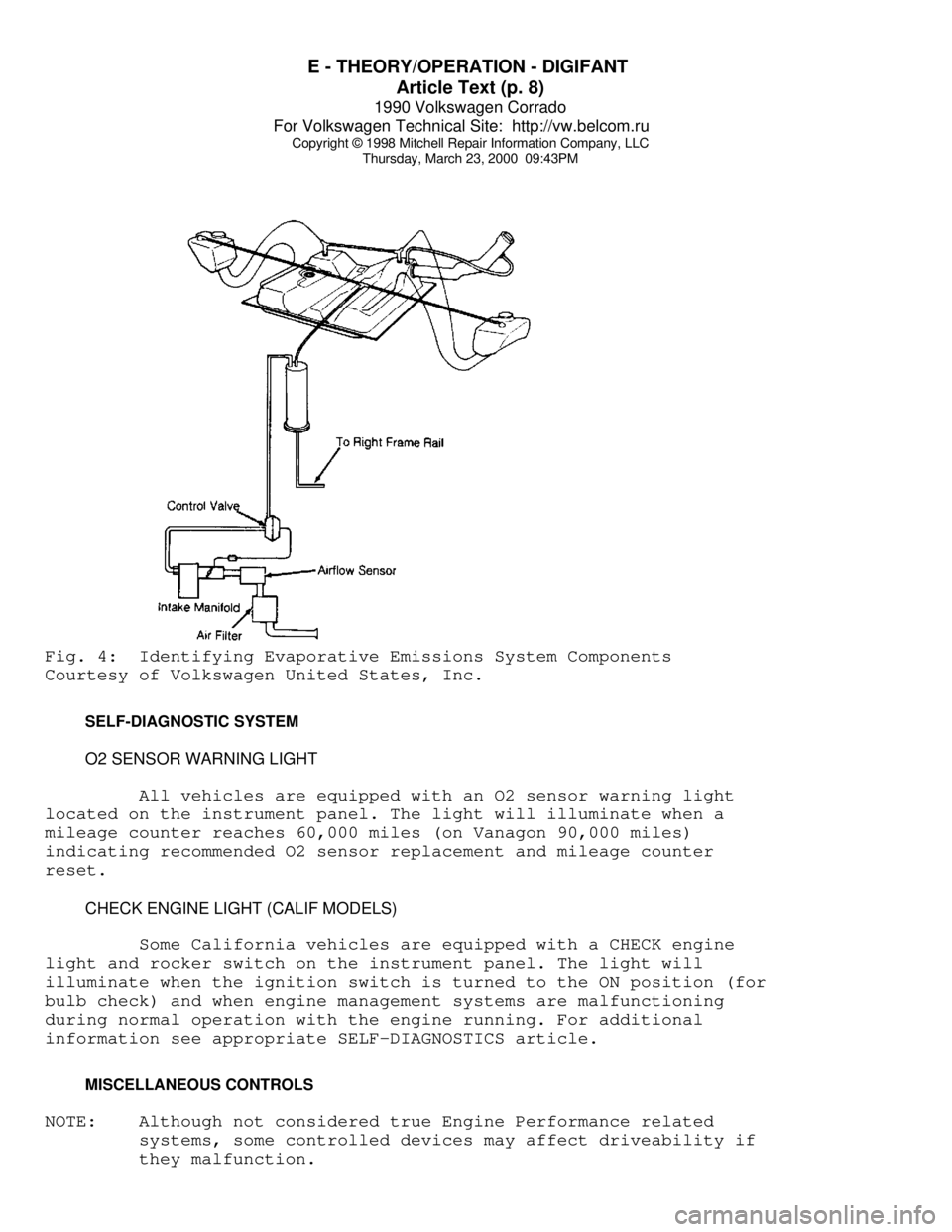
Fuel vapors are collected in the expansion tank. Any liquid
gasoline collect in expansion tank flows back to the fuel tank through
vent lines. See Fig. 4. Fuel vapors are drawn from tops of the
expansion tanks and flow into the carbon canister where the vapors are
stored. When the engine is not running.
After engine is started, the control valve is opened by
throttle vacuum. Fresh air is drawn into bottom of the canister. Fuel
vapors from the canister are drawn into the intake manifold.
EXHAUST GAS RECIRCULATION
Information is not available. See M - VACUUM DIAGRAMS for
system components and vacuum hose routings.
Page 458 of 906
E - THEORY/OPERATION - DIGIFANT
Article Text (p. 8)
1990 Volkswagen Corrado
For Volkswagen Technical Site: http://vw.belcom.ru
Copyright © 1998 Mitchell Repair Information Company, LLC
Thursday, March 23, 2000 09:43PMFig. 4: Identifying Evaporative Emissions System Components
Courtesy of Volkswagen United States, Inc.
SELF-DIAGNOSTIC SYSTEM
O2 SENSOR WARNING LIGHT
All vehicles are equipped with an O2 sensor warning light
located on the instrument panel. The light will illuminate when a
mileage counter reaches 60,000 miles (on Vanagon 90,000 miles)
indicating recommended O2 sensor replacement and mileage counter
reset.
CHECK ENGINE LIGHT (CALIF MODELS)
Some California vehicles are equipped with a CHECK engine
light and rocker switch on the instrument panel. The light will
illuminate when the ignition switch is turned to the ON position (for
bulb check) and when engine management systems are malfunctioning
during normal operation with the engine running. For additional
information see appropriate SELF-DIAGNOSTICS article.
MISCELLANEOUS CONTROLS
NOTE: Although not considered true Engine Performance related
systems, some controlled devices may affect driveability if
they malfunction.