engine VOLKSWAGEN CORRADO 1993 Repair Manual
[x] Cancel search | Manufacturer: VOLKSWAGEN, Model Year: 1993, Model line: CORRADO, Model: VOLKSWAGEN CORRADO 1993Pages: 920, PDF Size: 6.92 MB
Page 564 of 920
ENGINE OVERHAUL PROCEDURES - GENERAL INFORMATION
Article Text (p. 35)
1993 Volkswagen Corrado
For Volkswagen Technical Site: http://vw.belcom.ru
Copyright © 1998 Mitchell Repair Information Company, LLC
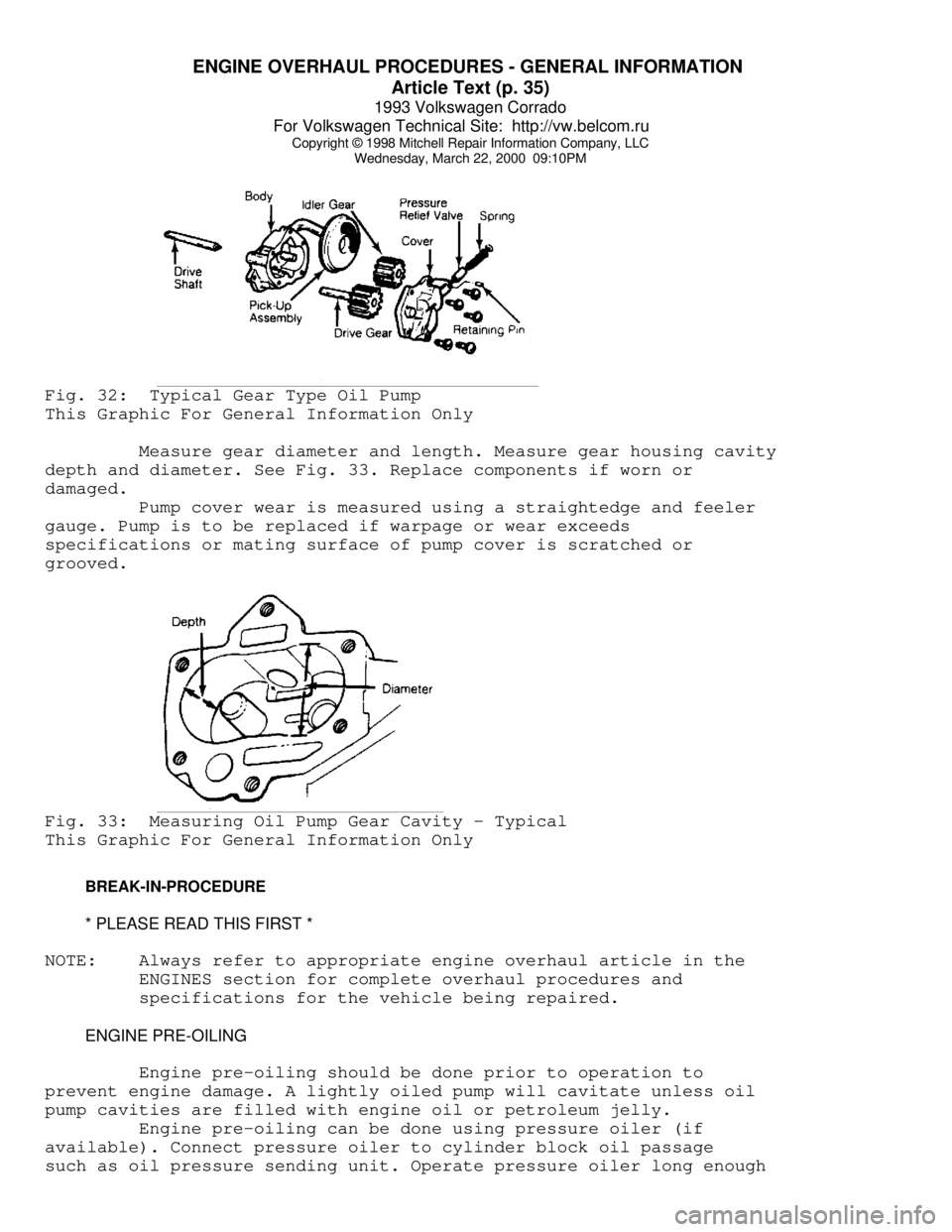
Wednesday, March 22, 2000 09:10PMFig. 32: Typical Gear Type Oil Pump
This Graphic For General Information Only
Measure gear diameter and length. Measure gear housing cavity
depth and diameter. See Fig. 33. Replace components if worn or
damaged.
Pump cover wear is measured using a straightedge and feeler
gauge. Pump is to be replaced if warpage or wear exceeds
specifications or mating surface of pump cover is scratched or
grooved.Fig. 33: Measuring Oil Pump Gear Cavity - Typical
This Graphic For General Information Only
BREAK-IN-PROCEDURE
* PLEASE READ THIS FIRST *
NOTE: Always refer to appropriate engine overhaul article in the
ENGINES section for complete overhaul procedures and
specifications for the vehicle being repaired.
ENGINE PRE-OILING
Engine pre-oiling should be done prior to operation to
prevent engine damage. A lightly oiled pump will cavitate unless oil
pump cavities are filled with engine oil or petroleum jelly.
Engine pre-oiling can be done using pressure oiler (if
available). Connect pressure oiler to cylinder block oil passage
such as oil pressure sending unit. Operate pressure oiler long enough
Page 565 of 920

ENGINE OVERHAUL PROCEDURES - GENERAL INFORMATION
Article Text (p. 36)
1993 Volkswagen Corrado
For Volkswagen Technical Site: http://vw.belcom.ru
Copyright © 1998 Mitchell Repair Information Company, LLC
Wednesday, March 22, 2000 09:10PM
to ensure correct amount of oil has filled crankcase. Check oil level
while pre-oiling.
If pressure oiler is not available, disconnect ignition
system. Remove oil pressure sending unit and replace with oil pressure
test gauge. Using starter motor, rotate engine starter until gauge
shows normal oil pressure for several seconds. DO NOT crank engine
for more than 30 seconds to avoid starter motor damage.
Ensure oil pressure has reached the most distant point from
the oil pump. Reinstall oil pressure sending unit. Reconnect ignition
system.
INITIAL START-UP
Start the engine and operate engine at low speed while
checking for coolant, fuel and oil leaks. Stop engine. Recheck coolant
and oil level. Adjust if necessary.
CAMSHAFT
Break-in procedure is required when a new or reground
camshaft has been installed. Operate and maintain engine speed between
1500-2500 RPM for approximately 30 minutes. Procedure may vary due to
manufacturers recommendations.
PISTON RINGS
Piston rings require a break-in procedure to ensure seating
of rings to cylinder walls. Serious damage may occur to rings if
correct procedures are not followed.
Extremely high piston ring temperatures are produced obtained
during break-in process. If rings are exposed to excessively high RPM
or high cylinder pressures, ring damage can occur. Follow piston ring
manufacturer's recommended break-in procedure.
FINAL ADJUSTMENTS
Check or adjust ignition timing and dwell (if applicable).
Adjust valves (if necessary). Adjust carburetion or injection idle
speed and mixture. Retighten cylinder heads (if required). If
cylinder head or block is aluminum, retighten bolts when engine is
cold. Follow the engine manufacturer's recommended break-in procedure
and maintenance schedule for new engines.
NOTE: Some manufacturer's require that head bolts be retightened
after specified amount of operation. This must be done to
prevent head gasket failure.
END OF ARTICLE
Page 566 of 920

F - BASIC TESTING
Article Text
1993 Volkswagen Corrado
For Volkswagen Technical Site: http://vw.belcom.ru
Copyright © 1998 Mitchell Repair Information Company, LLC
Wednesday, March 22, 2000 09:10PM
ARTICLE BEGINNING
1993 ENGINE PERFORMANCE
Volkswagen Basic Diagnostic Procedures
Cabriolet, Corrado SLC, EuroVan, Fox, Golf,
GTI, Jetta, Passat GL, Passat GLX
INTRODUCTION
The following diagnostic steps will help prevent overlooking
a simple problem. This is also where to begin diagnosis for a no-start
condition.
The first step in diagnosing any driveability problem is
verifying the customer's complaint with a test drive under the
conditions the problem reportedly occurred.
Before entering self-diagnostics (if equipped), perform a
careful and complete visual inspection. Most engine control problems
result from mechanical breakdowns, poor electrical connections, or
damaged/misrouted vacuum hoses. Before condemning the computerized
system, perform each test listed in this article.
NOTE: Perform all voltage tests with a Digital Volt-Ohmmeter
(DVOM) with a minimum 10-megohm input impedance, unless
stated otherwise in test procedure.
PRELIMINARY INSPECTION & ADJUSTMENTS
VISUAL INSPECTION
Visually inspect all electrical wiring, looking for chafed,
stretched, cut or pinched wiring. Ensure electrical connectors fit
tightly and are not corroded. Ensure vacuum hoses are properly routed
and are not pinched or cut. See M - VACUUM DIAGRAMS article in this
section to verify routing and connections (if necessary). Inspect air
induction system for possible vacuum leaks.
MECHANICAL INSPECTION
Compression
Check engine mechanical condition with a compression gauge,
vacuum gauge, or an engine analyzer. See engine analyzer manual for
specific instructions.
WARNING: DO NOT use ignition switch during compression tests on fuel
injected vehicles. Use a remote starter to crank engine. Fuel
injectors on many models are triggered by ignition switch
during cranking mode, which can create a fire hazard or
contaminate the engine's oiling system.
COMPRESSION SPECIFICATION TABLE
Page 567 of 920

F - BASIC TESTING
Article Text (p. 2)
1993 Volkswagen Corrado
For Volkswagen Technical Site: http://vw.belcom.ru
Copyright © 1998 Mitchell Repair Information Company, LLC
Wednesday, March 22, 2000 09:10PMÄÄÄÄÄÄÄÄÄÄÄÄÄÄÄÄÄÄÄÄÄÄÄÄÄÄÄÄÄÄÄÄÄÄÄÄÄÄÄÄÄÄÄÄÄÄÄÄÄÄÄÄÄÄÄÄÄÄÄÄÄÄÄÄÄ Compression
Pressure Compression
Application psi (kg/cm
ý) Ratio
Cabriolet ............. 131-174 (9.2-12.2) ........... 10.0:1
Corrado SLC ........... 157-186 (11.0-13.0) .......... 10.0:1
EuroVan ............... 128-170 (9.0-12.0) ........... 8.5:1
Fox ................... 128-170 (9.0-12.0) ............ 9.0:1
Golf & GTI ............ 142-186 (10.0-13.0) .......... 10.0:1
Jetta ................. 142-186 (10.0-13.0) .......... 10.0:1
Passat GL (2.0L) ...... 142-186 (10.0-13.0) .......... 10.8:1
Passat GLX (2.8L) ..... 142-186 (10.0-13.0) .......... 10.0:1
ÄÄÄÄÄÄÄÄÄÄÄÄÄÄÄÄÄÄÄÄÄÄÄÄÄÄÄÄÄÄÄÄÄÄÄÄÄÄÄÄÄÄÄÄÄÄÄÄÄÄÄÄÄÄÄÄÄÄÄÄÄÄÄÄÄ Exhaust System Backpressure
The exhaust system can be checked with a vacuum or pressure
gauge. Remove O2 sensor or air injection check valve (if equipped).
Connect a 0-5 psi pressure gauge and operate engine at 2500 RPM. If
exhaust system backpressure is greater than 2 psi, exhaust system or
catalytic converter is plugged.
If a vacuum gauge is used, connect vacuum gauge hose to
intake manifold vacuum port and start engine. Observe vacuum gauge.
Open throttle part way and hold steady. If vacuum gauge reading slowly
drops after stabilizing, check exhaust system for restriction.
FUEL SYSTEM
FUEL SYSTEM APPLICATION
FUEL SYSTEM APPLICATION TABLE
ÚÄÄÄÄÄÄÄÄÄÄÄÄÄÂÄÄÄÄÄÄÄÄÄÂÄÄÄÄÄÄÂÄÄÄÄÄÄÄÄÄÄÄÄÄÄÄÄÄ¿
³
³ ³Engine³ ³
³ Model
³ Engine ³ ID ³ Fuel System ³
ÃÄÄÄÄÄÄÄÄÄÄÄÄÄÅÄÄÄÄÄÄÄÄÄÅÄÄÄÄÄÄÅÄÄÄÄÄÄÄÄÄÄÄÄÄÄÄÄÄ´
³ Cabriolet
³ 1.8L ³ 2H ³ Digifant II MFI ³
³
³ 8-Valve ³ ³ (1) ³
ÃÄÄÄÄÄÄÄÄÄÄÄÄÄÅÄÄÄÄÄÄÄÄÄÅÄÄÄÄÄÄÅÄÄÄÄÄÄÄÄÄÄÄÄÄÄÄÄÄ´
³ Corrado SLC
³ 2.8L VR6³ AAA ³ Motronic MFI (2)³
ÃÄÄÄÄÄÄÄÄÄÄÄÄÄÅÄÄÄÄÄÄÄÄÄÅÄÄÄÄÄÄÅÄÄÄÄÄÄÄÄÄÄÄÄÄÄÄÄÄ´
³ EuroVan
³ 2.5L ³ AAF ³ Digifant MFI ³
³
³10-Valve ³ ³ ³
ÃÄÄÄÄÄÄÄÄÄÄÄÄÄÅÄÄÄÄÄÄÄÄÄÅÄÄÄÄÄÄÅÄÄÄÄÄÄÄÄÄÄÄÄÄÄÄÄÄ´
³ Fox
³ 1.8L ³ ABG ³ Digifant II MFI ³
³
³ 8-Valve ³ ³ (1) ³
ÃÄÄÄÄÄÄÄÄÄÄÄÄÄÅÄÄÄÄÄÄÄÄÄÅÄÄÄÄÄÄÅÄÄÄÄÄÄÄÄÄÄÄÄÄÄÄÄÄ´
³ Golf
³ 2.0L ³ ABA ³ Motronic MFI (2)³
³
³ 8-Valve ³ ³ ³
ÃÄÄÄÄÄÄÄÄÄÄÄÄÄÅÄÄÄÄÄÄÄÄÄÅÄÄÄÄÄÄÅÄÄÄÄÄÄÄÄÄÄÄÄÄÄÄÄÄ´
³ GTI
³ 2.0L ³ ABA ³ Motronic MFI (2)³
³
³ 8-Valve ³ ³ ³
ÃÄÄÄÄÄÄÄÄÄÄÄÄÄÅÄÄÄÄÄÄÄÄÄÅÄÄÄÄÄÄÅÄÄÄÄÄÄÄÄÄÄÄÄÄÄÄÄÄ´
Page 568 of 920

F - BASIC TESTING
Article Text (p. 3)
1993 Volkswagen Corrado
For Volkswagen Technical Site: http://vw.belcom.ru
Copyright © 1998 Mitchell Repair Information Company, LLC
Wednesday, March 22, 2000 09:10PM³ Jetta ³ 2.0L ³ ABA ³ Motronic MFI (2)³
³
³ 8-Valve ³ ³ ³
ÃÄÄÄÄÄÄÄÄÄÄÄÄÄÅÄÄÄÄÄÄÄÄÄÅÄÄÄÄÄÄÅÄÄÄÄÄÄÄÄÄÄÄÄÄÄÄÄÄ´
³ Passat GL
³ 2.0L ³ 9A ³ CIS-E Motronic ³
³
³16-Valve ³ ³ MFI (2) ³
ÃÄÄÄÄÄÄÄÄÄÄÄÄÄÅÄÄÄÄÄÄÄÄÄÅÄÄÄÄÄÄÅÄÄÄÄÄÄÄÄÄÄÄÄÄÄÄÄÄ´
³ Passat GLX
³ 2.8L VR6³ AAA ³ Motronic MFI (2)³
ÃÄÄÄÄÄÄÄÄÄÄÄÄÄÁÄÄÄÄÄÄÄÄÄÁÄÄÄÄÄÄÁÄÄÄÄÄÄÄÄÄÄÄÄÄÄÄÄÄ´
³(1) - California vehicles are equipped with
³
³ Digifant I.
³
³(2) - Sequential Multiport Fuel Injection.
³
ÀÄÄÄÄÄÄÄÄÄÄÄÄÄÄÄÄÄÄÄÄÄÄÄÄÄÄÄÄÄÄÄÄÄÄÄÄÄÄÄÄÄÄÄÄÄÄÄÄÙ FUEL PRESSURE
Basic diagnosis of fuel system should begin with determining
fuel system pressure.
WARNING: ALWAYS relieve fuel pressure before disconnecting any fuel
injection-related component. DO NOT allow fuel to contact
engine or electrical components.
CIS-E Motronic
1) Ensure ignition is off. Wrap a cloth around fuel
distributor port near cold start valve. Slowly loosen distributor port
near cold start valve to release fuel pressure. Connect fuel pressure
gauge between fuel distributor port and end of fuel line to cold start
valve. Disconnect differential pressure regulator harness connector.
2) Start engine and let it run. System fuel pressure should
89-96 psi (6.3-6.7 kg/cm
ý). If system fuel pressure is lower than
specification, perform fuel volume check. If fuel volume is okay,
replace fuel pressure regulator.
3) If fuel pressure is greater than specification, remove
return hose from pressure regulator and place in a container. Repeat
test. If system pressure is okay, check for restricted fuel return
line. If pressure is incorrect, replace fuel pressure regulator.
4) Turn ignition off. After 10 minutes, residual pressure
should be 48 psi (3.4 kg/cm
ý). After 20 minutes, residual pressure
should be 46 psi (3.2 kg/cm
ý). If system fuel pressure is low, check
fuel pump check valve, sensor plate free play, fuel distributor "O"
rings and seats. Replace if necessary. If these components are okay,
replace fuel pressure regulator.
Digifant
1) Ensure ignition is off. Wrap a cloth around service port
on fuel plenum. Slowly loosen service port on fuel plenum to release
fuel pressure. Install fuel pressure gauge at service port on fuel
plenum. Fuel pressure gauge must have reading range of 0-50 psi. Start
engine and allow it to idle. System fuel pressure should be
approximately 36 psi (2.5 kg/cm
ý).
2) Disconnect vacuum hose from top of fuel pressure
regulator. Fuel pressure should increase to approximately 44 psi (3
Page 569 of 920
F - BASIC TESTING
Article Text (p. 4)
1993 Volkswagen Corrado
For Volkswagen Technical Site: http://vw.belcom.ru
Copyright © 1998 Mitchell Repair Information Company, LLC
Wednesday, March 22, 2000 09:10PM
kg/cmý). Turn engine off. After 10 minutes, residual pressure should
be 29 psi (2 kg/cm
ý). If system pressure is too high, replace fuel
pressure regulator.
3) If residual pressure is too low, operate engine until
system pressure builds up, then pinch off Blue fuel return line. If
pressure holds, replace the fuel regulator. If fuel pressure is low,
check for leaks at fuel lines, fuel injectors and fuel pump check
valve
TRANSFER PUMP CHECK
Transfer Pump Fuel Volume Check
1) Turn ignition off. To check transfer pump (in tank),
remove rear seat. Remove fuel sending unit access cover. Disconnect
ignition coil secondary wire and jumper to ground.
2) With transmission in Neutral, crank engine for 3-4
seconds. While starter is turning and for a few seconds afterwards, an
audible sound should be heard at the pump. If sound is not heard, go
to next step. If sound is heard, go to step 5).
3) Remove fuel pump relay from relay panel. On Corrado and
Passat, activate fuel pumps using Remote Control (VAG 1348/3A). On all
other models, activate fuel pumps using Remote Control (US 4480/3). On
all models, if pump does not operate, remove transfer pump wire
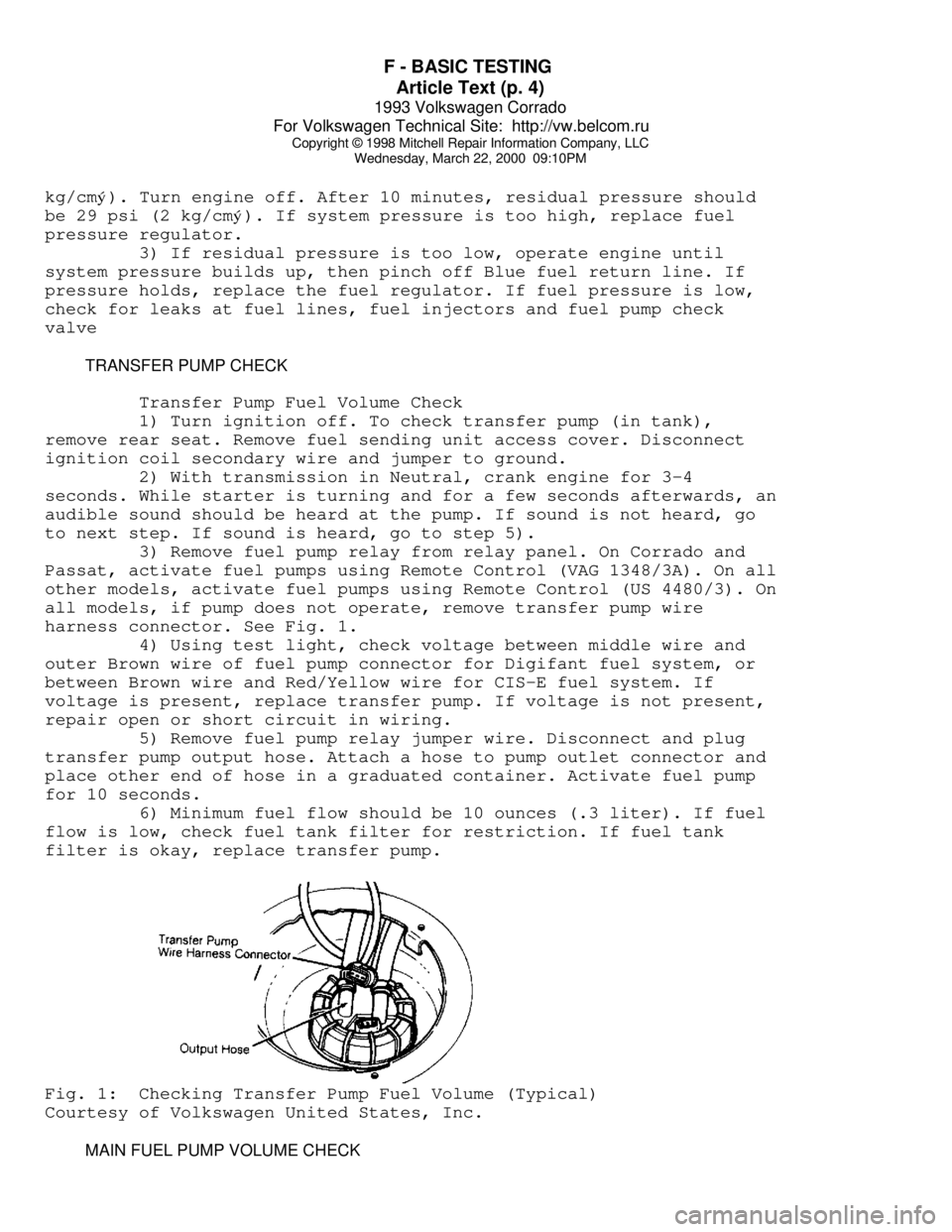
harness connector. See Fig. 1.
4) Using test light, check voltage between middle wire and
outer Brown wire of fuel pump connector for Digifant fuel system, or
between Brown wire and Red/Yellow wire for CIS-E fuel system. If
voltage is present, replace transfer pump. If voltage is not present,
repair open or short circuit in wiring.
5) Remove fuel pump relay jumper wire. Disconnect and plug
transfer pump output hose. Attach a hose to pump outlet connector and
place other end of hose in a graduated container. Activate fuel pump
for 10 seconds.
6) Minimum fuel flow should be 10 ounces (.3 liter). If fuel
flow is low, check fuel tank filter for restriction. If fuel tank
filter is okay, replace transfer pump.Fig. 1: Checking Transfer Pump Fuel Volume (Typical)
Courtesy of Volkswagen United States, Inc.
MAIN FUEL PUMP VOLUME CHECK
Page 570 of 920

F - BASIC TESTING
Article Text (p. 5)
1993 Volkswagen Corrado
For Volkswagen Technical Site: http://vw.belcom.ru
Copyright © 1998 Mitchell Repair Information Company, LLC
Wednesday, March 22, 2000 09:10PM
NOTE: Before testing main fuel pump, check transfer pump. See
TRANSFER PUMP CHECK.
Cabriolet, Fox, Golf & Jetta
Remove fuel pump relay from relay panel. Activate fuel pumps
using Remote Control (US 4480/3). Activate fuel pumps for 30 seconds.
Compare fuel volume with values in FUEL PUMP PERFORMANCE table.
Corrado, GTI & Passat
1) Remove fuel pump relay from relay panel. On Corrado and
Passat, activate fuel pumps using Remote Control (VAG 1348/3A). On
GTI, activate fuel pumps using Remote Control (US 4480/3). On all
models, measure voltage being applied to fuel pump when activating
with remote control. Record voltage.
2) Fuel volume is relative to voltage applied to fuel pumps.
Activate fuel pumps for 30 seconds. Compare volume with values in FUEL
PUMP PERFORMANCE table.
FUEL PUMP PERFORMANCEÄÄÄÄÄÄÄÄÄÄÄÄÄÄÄÄÄÄÄÄÄÄÄÄÄÄÄÄÄÄÄÄÄÄÄÄÄÄÄÄÄÄÄÄÄÄÄÄÄÄÄÄÄÄÄÄÄÄÄÄÄÄÄÄÄ Pressure Min. Vol. In 30 Sec.
Application psi (kg/cm(
ý) Pts. (L)
Cabriolet ................ 43 (3.0) ............... 1.4 (0.7)
Corrado SLC (1) .......... 58 (4.0) ....... 1.0-1.4 (0.5-0.7)
Golf, GTI & Jetta (1) .... 43 (3.0) ....... 1.0-1.4 (0.5-0.7)
EuroVan (1) .............. 43 (3.0) ....... 1.0-1.4 (0.5-0.7)
Fox (2) .................. 36 (2.5) ............... 1.4 (0.7)
Passat GL .......... (3) 87-94 (6.1-6.6) .. 1.0-1.4 (0.5-0.7)
Passat GLX (1) ........... 58 (4.0) ....... 1.0-1.4 (0.5-0.7)
(1) - Using Adapter Cable (VAG 1348/3-2) between battery positive
terminal and terminal No. 4 of fuel pump relay socket. Fuel
pump energized, with 10-12 volts at fuel pump and engine off.
(2) - Using Remove Control Switch (US 4480/3) in place of fuel
pump relay.
(3) - Briefly operate starter and ensure fuel pump runs for at
least one second. Alternate method is to disconnect
Electronic Control Module (ECM) and ground terminal No. 12
using Remove Control Switch (VAG 1348/3A).
ÄÄÄÄÄÄÄÄÄÄÄÄÄÄÄÄÄÄÄÄÄÄÄÄÄÄÄÄÄÄÄÄÄÄÄÄÄÄÄÄÄÄÄÄÄÄÄÄÄÄÄÄÄÄÄÄÄÄÄÄÄÄÄÄÄREGULATED FUEL PRESSURE
ÄÄÄÄÄÄÄÄÄÄÄÄÄÄÄÄÄÄÄÄÄÄÄÄÄÄÄÄÄÄÄÄÄÄÄÄÄÄÄÄÄÄÄÄÄÄÄÄÄÄÄÄÄÄÄÄÄÄÄÄÄÄÄÄÄ At Idle At Idle
w/Vacuum w/o Vacuum
Application psi (kg/cm
ý) (1) psi (kg/cmý)
Cabriolet & Fox ........ 36 (2.5) .................. 43 (3.0)
Corrado SLC ............ 50 (3.5) .................. 58 (4.0)
Golf, GTI & Jetta ...... 36 (2.5) .................. 43 (3.0)
Page 571 of 920

F - BASIC TESTING
Article Text (p. 6)
1993 Volkswagen Corrado
For Volkswagen Technical Site: http://vw.belcom.ru
Copyright © 1998 Mitchell Repair Information Company, LLC
Wednesday, March 22, 2000 09:10PM
EuroVan ................ 36 (2.5) .................. 43 (3.0)
Passat GL ........ (2) 87-94 (6.1-6.6) ... (3) 87-94 (6.1-6.6)
Passat GLX ............. 50 (3.5) .................. 58 (4.0)
(1) - With vacuum hose disconnected from fuel pressure regulator.
(2) - Approximately 4.3-7.2 psi (0.3-0.5 kg/cmý) below system
pressure, with differential pressure regulator disconnected.
(3) - Approximately 18.5-23.0 psi (1.3-1.6 kg/cm
ý) below system
pressure, with differential pressure regulator connected.
ÄÄÄÄÄÄÄÄÄÄÄÄÄÄÄÄÄÄÄÄÄÄÄÄÄÄÄÄÄÄÄÄÄÄÄÄÄÄÄÄÄÄÄÄÄÄÄÄÄÄÄÄÄÄÄÄÄÄÄÄÄÄÄÄÄ IGNITION CHECKS
NOTE: Ignition checks are divided according to fuel system.
SPARK TEST
1) Using an ohmmeter, check resistance of each spark plug
wire. See HIGH TENSION WIRE RESISTANCE table. Check for a strong Blue
spark at coil wire and at each spark plug wire by holding wire
terminal 5/16" from ground while cranking engine.
2) Disconnect and inspect all related ignition system
connectors and harness. Clean or repair if necessary. If related
connectors and harness are okay, remove negative battery cable.
Disconnect secondary and primary leads from ignition coil.
3) Using ohmmeter, check primary resistance between primary
terminals of coil. Check secondary resistance between coil secondary
terminal and primary positive terminal. Replace coil if readings are
not within specifications. See IGNITION COIL RESISTANCE table.
HIGH TENSION WIRE RESISTANCE TABLE
ÄÄÄÄÄÄÄÄÄÄÄÄÄÄÄÄÄÄÄÄÄÄÄÄÄÄÄÄÄÄÄÄÄÄÄÄÄÄÄÄÄÄÄÄÄÄÄÄÄÄÄÄÄÄÄApplication Ohms
Coil Wire Only .................................. (1)
Coil Wire With Connector .................. 1600-2400
Spark Plug Wire Connector ................. 4000-6000
Suppressor (2) ............................. 600-1400
(1) - Check for continuity.
(2) - Suppressor is located between ignition coil wire
and distributor cap.
ÄÄÄÄÄÄÄÄÄÄÄÄÄÄÄÄÄÄÄÄÄÄÄÄÄÄÄÄÄÄÄÄÄÄÄÄÄÄÄÄÄÄÄÄÄÄÄÄÄÄÄÄÄÄÄ IGNITION COIL
IGNITION COIL RESISTANCE - Ohms @ 68
øF (20øC)
ÄÄÄÄÄÄÄÄÄÄÄÄÄÄÄÄÄÄÄÄÄÄÄÄÄÄÄÄÄÄÄÄÄÄÄÄÄÄÄÄÄÄÄÄÄÄÄÄÄÄÄÄÄÄÄApplication Primary Secondary
Cabriolet
Digifant I ........... 0.5-0.7 ......... 3000-4000
Page 572 of 920
F - BASIC TESTING
Article Text (p. 7)
1993 Volkswagen Corrado
For Volkswagen Technical Site: http://vw.belcom.ru
Copyright © 1998 Mitchell Repair Information Company, LLC
Wednesday, March 22, 2000 09:10PM
Digifant II ......... 0.52-0.76 ........ 2400-3500
Corrado SLC (1) ........ ..... .............. .....
Fox
Digifant I ........... 0.5-0.7 ......... 3000-4000
Digifant II .......... 0.6-0.7 ......... 2500-3500
Golf, GTI & Jetta ..... 0.5-0.7 ......... 3000-4000
Passat GL ............. 0.6-0.8 ......... 6500-8500
Passat GLX (1) ......... ..... .............. .....
(1) - Ignition coil pack, new for 1993, is located on
left side of cylinder head. When ignition coil is
triggered, spark is supplied to 2 spark plugs at
one time. One spark plug fires during compression
stroke and the other plug fires during exhaust
stroke (waste spark). Ignition coil specifications
are not available from manufacturer.ÄÄÄÄÄÄÄÄÄÄÄÄÄÄÄÄÄÄÄÄÄÄÄÄÄÄÄÄÄÄÄÄÄÄÄÄÄÄÄÄÄÄÄÄÄÄÄÄÄÄÄÄÄÄÄ DISTRIBUTOR
Hall Effect Sender
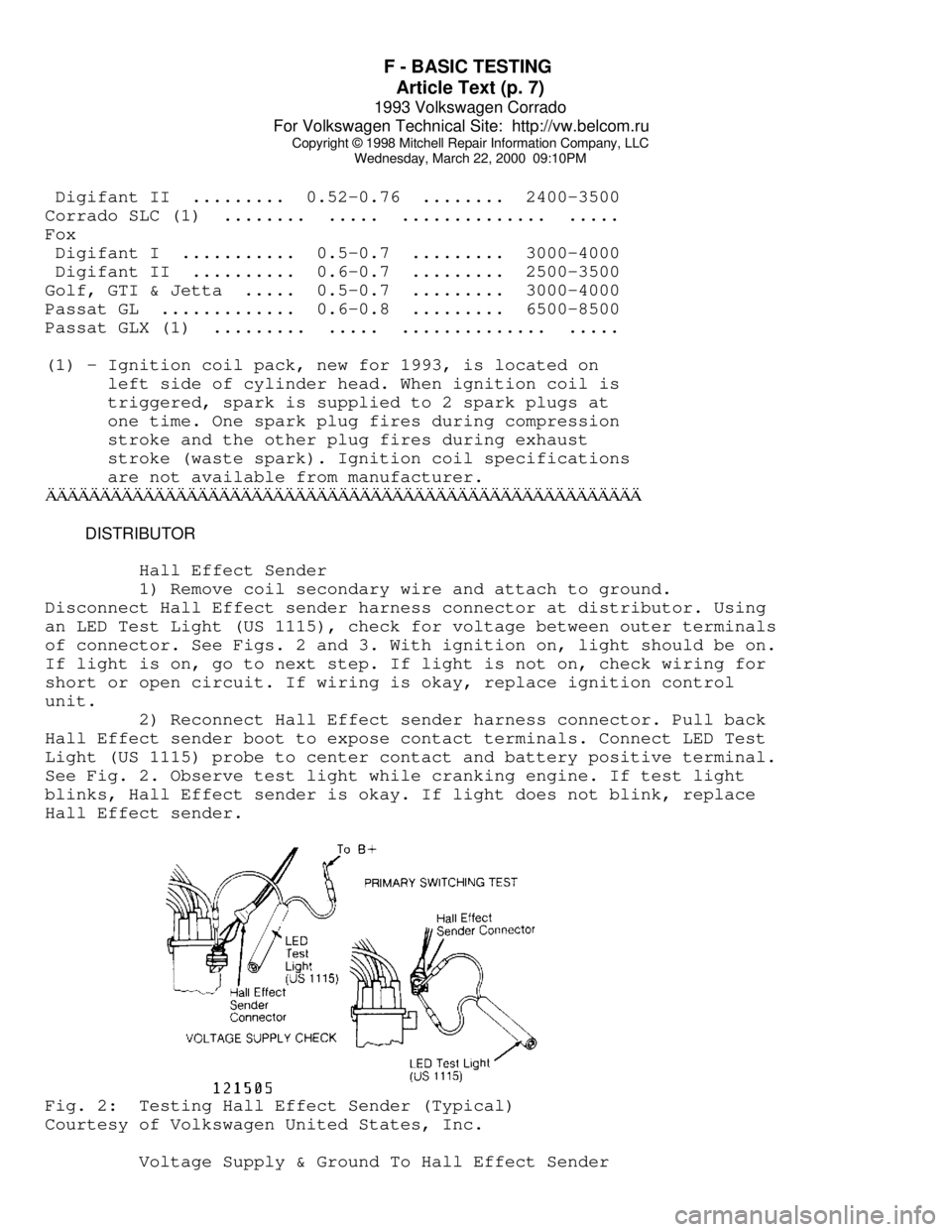
1) Remove coil secondary wire and attach to ground.
Disconnect Hall Effect sender harness connector at distributor. Using
an LED Test Light (US 1115), check for voltage between outer terminals
of connector. See Figs. 2 and 3. With ignition on, light should be on.
If light is on, go to next step. If light is not on, check wiring for
short or open circuit. If wiring is okay, replace ignition control
unit.
2) Reconnect Hall Effect sender harness connector. Pull back
Hall Effect sender boot to expose contact terminals. Connect LED Test
Light (US 1115) probe to center contact and battery positive terminal.
See Fig. 2. Observe test light while cranking engine. If test light
blinks, Hall Effect sender is okay. If light does not blink, replace
Hall Effect sender.Fig. 2: Testing Hall Effect Sender (Typical)
Courtesy of Volkswagen United States, Inc.
Voltage Supply & Ground To Hall Effect Sender
Page 575 of 920

F - BASIC TESTING
Article Text (p. 10)
1993 Volkswagen Corrado
For Volkswagen Technical Site: http://vw.belcom.ru
Copyright © 1998 Mitchell Repair Information Company, LLC
Wednesday, March 22, 2000 09:10PM
to specification. If necessary, see the appropriate D - ADJUSTMENTS
article in this section. Refer to the following menu:
NOTE: For the appropriate D - ADJUSTMENTS article, go to:
* For Cabriolet, see: D - ADJUSTMENTS
* For Corrado SLC, see: D - ADJUSTMENTS
* For EuroVan, see: D - ADJUSTMENTS
* For Fox, see: D - ADJUSTMENTS
* For Golf, GTI, Jetta, see: D - ADJUSTMENTS
* For Passat GL 2.0L 4-Cylinder, see: D - ADJUSTMENTS - 4-CYL
* For Passat GLX 2.8L VR6, see: D - ADJUSTMENTS - VR6
IDLE SPEED & CO LEVELÄÄÄÄÄÄÄÄÄÄÄÄÄÄÄÄÄÄÄÄÄÄÄÄÄÄÄÄÄÄÄÄÄÄÄÄÄÄÄÄÄÄÄÄÄÄÄÄÄÄÄÄÄÄÄApplication Idle RPM CO Level %
Cabriolet (1)
Digifant I ............. 750-850 ......... 0.3-1.2
Digifant II ............ 750-850 ......... 0.3-1.1
Corrado SLC (2) ......... 650-750 ......... 0.3-1.5
Fox ................... (3) 875-925 ....... 0.3-1.2
Golf, Jetta & GTI (2)
800-880
0.3-1.2
Passat GL ............ (4) 800-1000 ....... 0.2-1.2
Passat GLX (2) .......... 650-750 ......... 0.3-1.5
(1) - With engine running, after reconnecting Blue coolant
temperature sensor. See the D - ADJUSTMENTS article
in this section for more information. See menu above.
(2) - Idle speed and fuel mixture (CO level) are not
adjustable.
(3) - If A/C equipped, disconnect idle speed boost valve
harness connector when checking idle speed. Clamp
crankcase breather hose near emission control valve
when checking CO level.
(4) - Idle speed is not adjustable.
ÄÄÄÄÄÄÄÄÄÄÄÄÄÄÄÄÄÄÄÄÄÄÄÄÄÄÄÄÄÄÄÄÄÄÄÄÄÄÄÄÄÄÄÄÄÄÄÄÄÄÄÄÄÄÄIGNITION TIMING (Degrees BTDC @ RPM)
ÄÄÄÄÄÄÄÄÄÄÄÄÄÄÄÄÄÄÄÄÄÄÄÄÄÄÄÄÄÄÄÄÄÄÄÄÄÄÄÄÄÄÄÄÄÄÄÄÄÄÄÄÄÄÄÄÄÄÄÄApplication Checking Adjusting
Cabriolet (1) ....... 4-8 @ 2000-2500 .. 5-7 @ 2000-2500
Corrado SLC ............... (2) .................... (2)
Fox (1) ............. 4-8 @ 2000-2500 .. 5-7 @ 2000-2500
Golf, GTI & Jetta ... (3) 12 @ 800-880 ............ .....
Passat GL ........... 4-8 @ 800-1000 .... 5-7 @ 800-1000
Passat GLX ................ (2) .................... (2)
(1) - On Digifant I systems, ensure engine oil temperature