engine VOLKSWAGEN CORRADO 1993 Repair Manual
[x] Cancel search | Manufacturer: VOLKSWAGEN, Model Year: 1993, Model line: CORRADO, Model: VOLKSWAGEN CORRADO 1993Pages: 920, PDF Size: 6.92 MB
Page 594 of 920

GENERAL COOLING SYSTEM SERVICING
Article Text
1993 Volkswagen Corrado
For Volkswagen Technical Site: http://vw.belcom.ru
Copyright © 1998 Mitchell Repair Information Company, LLC
Wednesday, March 22, 2000 09:11PM
ARTICLE BEGINNING
GENERAL INFORMATION
General Cooling System Servicing
* PLEASE READ THIS FIRST *
The following article is for general information only.
Information may not apply to all years, makes and models. See specific
article in the ENGINE COOLING section.
DESCRIPTION
The basic liquid cooling system consists of a radiator, water
pump, thermostat, electric or belt-driven cooling fan, pressure cap,
heater, and various connecting hoses and cooling passages in the block
and cylinder head.
MAINTENANCE
DRAINING
Remove radiator cap and open heater control valve to maximum
heat position. Open drain cocks or remove plugs in bottom of radiator
and engine block. In-line engines usually have one plug or drain cock,
while "V" type engines will have 2, one in each bank of cylinders.
CLEANING
A good cleaning compound removes most rust and scale. Follow
manufacturer's instructions in the use of cleaner. If considerable
rust and scale has to be removed, cooling system should be flushed.
Clean radiator air passages with compressed air.
FLUSHING
CAUTION: Some manufacturers use an aluminum and plastic radiator.
Flushing solution must be compatible with aluminum.
Back Flushing
Back flushing is an effective means of removing cooling
system rust and scale. The radiator, engine and heater core should be
flushed separately.
Radiator
To flush radiator, connect flushing gun to water outlet of
radiator and disconnect water inlet hose. To prevent flooding engine,
use a hose connected to radiator inlet. Use air in short bursts to
prevent damage to radiator. Continue flushing until water runs clear.
Engine
Page 595 of 920
GENERAL COOLING SYSTEM SERVICING
Article Text (p. 2)
1993 Volkswagen Corrado
For Volkswagen Technical Site: http://vw.belcom.ru
Copyright © 1998 Mitchell Repair Information Company, LLC
Wednesday, March 22, 2000 09:11PM
To flush engine, remove thermostat and replace housing.
Connect flushing gun to water outlet of engine. Flush using short air
bursts until water runs clean.
Heater Core
Flush heater core as described for radiator. Ensure heater
control valve is set to maximum heat position before flushing heater.
REFILLING
To prevent air from being trapped in engine block, engine
should be running when refilling cooling system. After system is full,
continue running engine until thermostat is open, then recheck fill
level. Do not overfill system.
TESTING
THERMOSTAT
1) Visually inspect thermostat for corrosion and proper
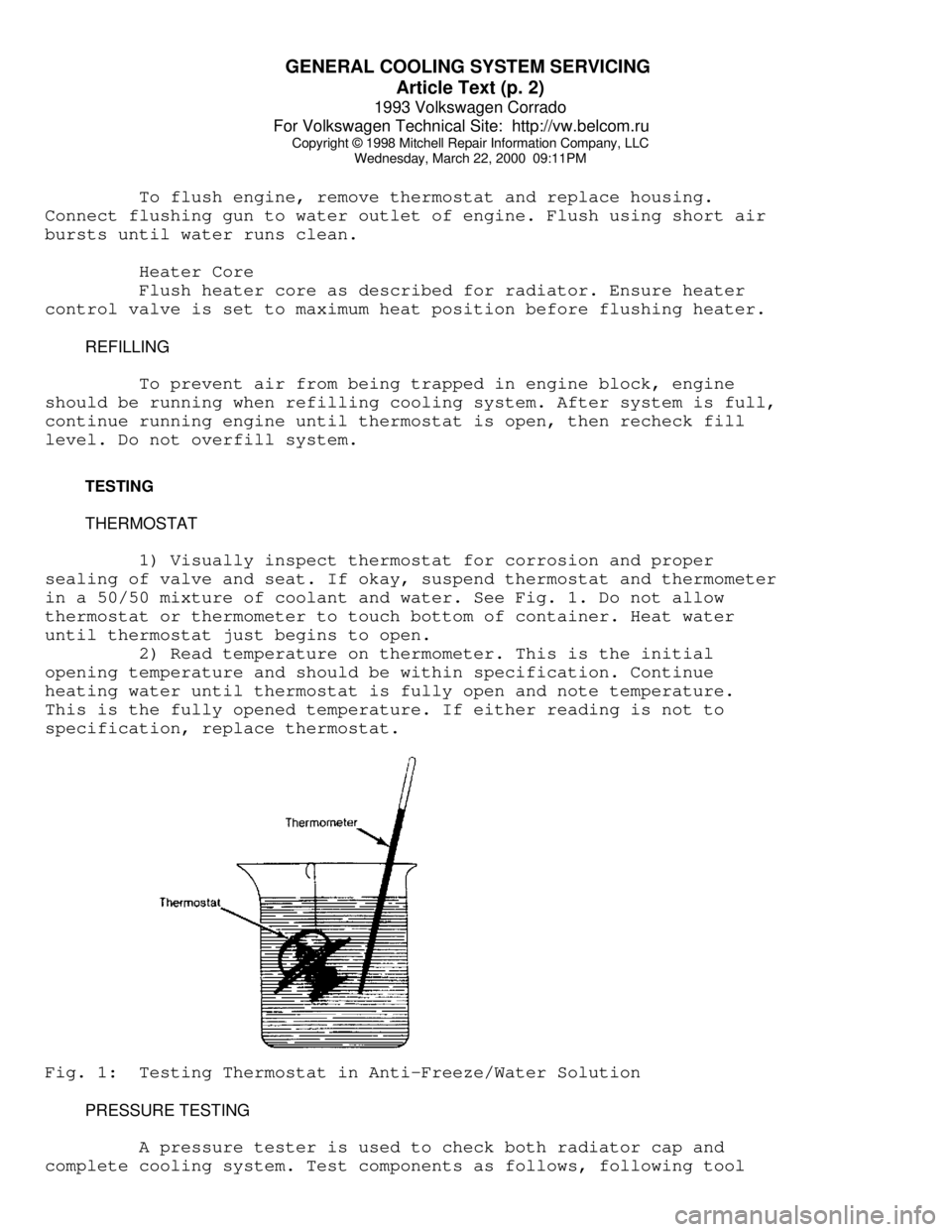
sealing of valve and seat. If okay, suspend thermostat and thermometer
in a 50/50 mixture of coolant and water. See Fig. 1. Do not allow
thermostat or thermometer to touch bottom of container. Heat water
until thermostat just begins to open.
2) Read temperature on thermometer. This is the initial
opening temperature and should be within specification. Continue
heating water until thermostat is fully open and note temperature.
This is the fully opened temperature. If either reading is not to
specification, replace thermostat.Fig. 1: Testing Thermostat in Anti-Freeze/Water Solution
PRESSURE TESTING
A pressure tester is used to check both radiator cap and
complete cooling system. Test components as follows, following tool
Page 596 of 920
GENERAL COOLING SYSTEM SERVICING
Article Text (p. 3)
1993 Volkswagen Corrado
For Volkswagen Technical Site: http://vw.belcom.ru
Copyright © 1998 Mitchell Repair Information Company, LLC
Wednesday, March 22, 2000 09:11PM
manufacturer's instructions.
Radiator Cap
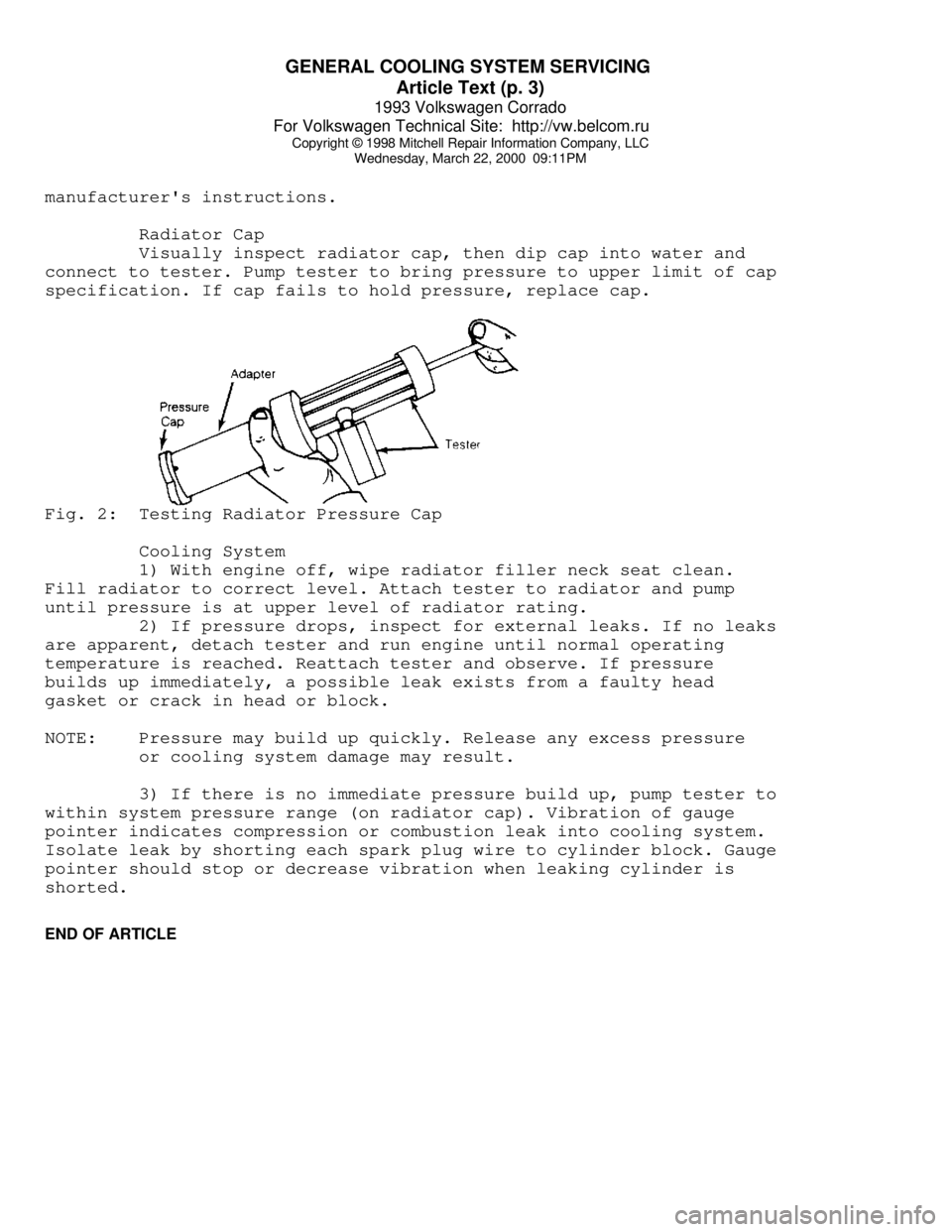
Visually inspect radiator cap, then dip cap into water and
connect to tester. Pump tester to bring pressure to upper limit of cap
specification. If cap fails to hold pressure, replace cap.Fig. 2: Testing Radiator Pressure Cap
Cooling System
1) With engine off, wipe radiator filler neck seat clean.
Fill radiator to correct level. Attach tester to radiator and pump
until pressure is at upper level of radiator rating.
2) If pressure drops, inspect for external leaks. If no leaks
are apparent, detach tester and run engine until normal operating
temperature is reached. Reattach tester and observe. If pressure
builds up immediately, a possible leak exists from a faulty head
gasket or crack in head or block.
NOTE: Pressure may build up quickly. Release any excess pressure
or cooling system damage may result.
3) If there is no immediate pressure build up, pump tester to
within system pressure range (on radiator cap). Vibration of gauge
pointer indicates compression or combustion leak into cooling system.
Isolate leak by shorting each spark plug wire to cylinder block. Gauge
pointer should stop or decrease vibration when leaking cylinder is
shorted.
END OF ARTICLE
Page 597 of 920

H - TESTS W/O CODES
Article Text
1993 Volkswagen Corrado
For Volkswagen Technical Site: http://vw.belcom.ru
Copyright © 1998 Mitchell Repair Information Company, LLC
Wednesday, March 22, 2000 09:11PM
ARTICLE BEGINNING
1993 ENGINE PERFORMANCE
Volkswagen Trouble Shooting - No Codes
Cabriolet, Corrado SLC, EuroVan, Fox
Golf, GTI, Jetta, Passat GL, Passat GLX
INTRODUCTION
PRELIMINARY INFORMATION
Before diagnosing symptoms or intermittent faults, perform
steps in the F - BASIC TESTING article in this section. Use this
article to diagnose driveability problems existing when a hard fault
code is not present or vehicle is not equipped with a self-diagnostic
system.
NOTE: Some driveability problems may have been corrected by
manufacturer with a revised computer calibration chip or
computer control unit. Check with manufacturer for latest
chip or computer application.
Symptom checks can direct the technician to malfunctioning
component(s) for further diagnosis. A symptom should lead to a
specific component, system test or an adjustment.
Use intermittent test procedures to locate driveability
problems that DO NOT occur when the vehicle is being tested. These
test procedures should also be used if a soft (intermittent) trouble
code was present, but no problem was found during self-diagnostic
testing.
NOTE: For specific test procedures, see the I - SYS/COMP TESTS
article in this section. For adjustment procedures, see the
appropriate D - ADJUSTMENTS article. For Engine Performance
related specifications, see appropriate C - SPECIFICATIONS
article in this section. See the following menus:
C - SPECIFICATIONS ARTICLES MENU
NOTE: For the appropriate C - SPECIFICATIONS article, go to:
* For Cabriolet, see: C - SPECIFICATIONS
* For Corrado SLC, see: C - SPECIFICATIONS
* For EuroVan, see: C - SPECIFICATIONS
* For Fox, see: C - SPECIFICATIONS
* For Golf, GTI, Jetta, see: C - SPECIFICATIONS
* For Passat, see: C - SPECIFICATIONS
D - ADJUSTMENTS ARTICLES MENU
NOTE: For the appropriate D - ADJUSTMENTS article, go to:
Page 598 of 920

H - TESTS W/O CODES
Article Text (p. 2)
1993 Volkswagen Corrado
For Volkswagen Technical Site: http://vw.belcom.ru
Copyright © 1998 Mitchell Repair Information Company, LLC
Wednesday, March 22, 2000 09:11PM
* For Cabriolet, see: D - ADJUSTMENTS
* For Corrado SLC, see: D - ADJUSTMENTS
* For EuroVan, see: D - ADJUSTMENTS
* For Fox, see: D - ADJUSTMENTS
* For Golf, GTI, Jetta, see: D - ADJUSTMENTS
* For Passat GL 2.0L 4-Cylinder, see: D - ADJUSTMENTS - 4-CYL
* For Passat GLX 2.8L VR6, see: D - ADJUSTMENTS - VR6
I - SYS/COMP TESTS ARTICLES MENU
NOTE: For the appropriate I - SYS/COMP TESTS article, go to:
* For Cabriolet, see: I - SYSTEM/COMPONENT TESTS
* For Corrado SLC, see: I - SYSTEM/COMPONENT TESTS
* For EuroVan, see: I - SYSTEM/COMPONENT TESTS
* For Fox, see: I - SYSTEM/COMPONENT TESTS
* For Golf, GTI, Jetta, see: I - SYSTEM/COMPONENT TESTS
* For Passat GL 2.0L 4-Cylinder, see:
I - SYSTEM/COMPONENT TESTS - 4-CYL
* For Passat GLX 2.8L VR6, see:
I - SYSTEM/COMPONENT TESTS - VR6
SYMPTOMS
SYMPTOM DIAGNOSIS
Symptom checks cannot be used properly unless the problem is
actually happening while the vehicle is being tested. To reduce
diagnostic time, ensure battery voltage is okay and starter motor
turns engine over before attempting to diagnose a symptom.
Check engine mechanical condition (compression pressure,
valve timing, etc.), wiring harness and connections (terminals not
corroded or pushed back), and vacuum hose (not disconnected or
leaking).
Also check for correct tire sizes, as recommended by
manufacturer. Ensure wheels rotate freely (brake drag or bad wheel
bearings). Ensure no speed reducing accessories are installed.
Symptoms available for diagnosis include the following.
* Engine Does Not Start Or Is Difficult To Start When Cold
* Engine Does Not Start Or Is Difficult To Start When Warm
* Uneven Idle Or No Idle With Cold Engine Or During Warm-Up
* Engine Starts But Stalls
* Idle Speed Exceeds Specification
* Poor Acceleration With Cold Engine Or During Warm-Up
* Engine Stalls While Driving
* Poor Performance
* Engine Run-On (Dieseling)
* High Fuel Consumption
* Engine Knock
* Engine Runs Unevenly Over Entire Speed Range
Page 599 of 920

H - TESTS W/O CODES
Article Text (p. 3)
1993 Volkswagen Corrado
For Volkswagen Technical Site: http://vw.belcom.ru
Copyright © 1998 Mitchell Repair Information Company, LLC
Wednesday, March 22, 2000 09:11PM
NOTE: Symptoms listed are for CIS-E Motronic system. When working
on Digifant and Motronic systems, use symptoms listed only
as a diagnostic guide. A list of specific symptoms for
Digifant and Motronic systems is not available from
manufacturer.
ENGINE DOES NOT START OR IS DIFFICULT TO START WHEN COLD
* Check for insufficient fuel in tank.
* Check fuel pump relay and fuel pump.
* Check fuel system for leaks.
* Check auxiliary air intake system.
* Check fuel system after-start, acceleration enrichment and
warm-up circuits.
* Check cold-start valve.
* Check airflow sensor lever adjustment and control plunger.
* Check sensor plate rest position and idle circuit.
* Check fuel system differential and residual pressures.
* Check fuel injection volume.
* Check engine coolant temperature sensor.
* Check ignition timing, spark plugs, distributor, secondary
ignition wiring and coil.
* Check Hall Effect sensor.
* Check ignition coil power output stage.
ENGINE DOES NOT START OR IS DIFFICULT TO START WHEN WARM
* Check radiator cooling fan after-run circuit.
* Check fuel pump check valve.
* Check fuel evaporative frequency solenoid(s).
* Check fuel system for leaks.
* Check auxiliary air intake system.
* Check idle speed.
* Check fuel system after-start, acceleration enrichment and
warm-up circuits.
* Check cold-start valve.
* Check injector fuel pressure and volume.
* Check sensor plate rest position and idle circuit.
* Check sealing ring under control plunger.
* Check fuel system differential and residual pressures.
* Check engine coolant temperature sensor.
* Check ignition timing, spark plugs, distributor, secondary
ignition wiring and coil.
UNEVEN IDLE OR NO IDLE WITH COLD ENGINE OR DURING WARM-UP
* Check fuel evaporative frequency solenoid(s).
* Check fuel system for leaks.
* Check auxiliary air intake system.
* Check idle speed.
* Check oxygen sensor control circuit.
Page 600 of 920

H - TESTS W/O CODES
Article Text (p. 4)
1993 Volkswagen Corrado
For Volkswagen Technical Site: http://vw.belcom.ru
Copyright © 1998 Mitchell Repair Information Company, LLC
Wednesday, March 22, 2000 09:11PM
* Check cold-start valve.
* Check injector fuel pressure and volume.
* Check throttle potentiometer.
* Check fuel system differential and residual pressures.
* Check idle switch.
* Check engine coolant temperature sensor.
* Check exhaust system.
* Check ignition timing and spark plugs.
ENGINE STARTS BUT STALLS
* Check fuel pump relay and fuel pump.
* Check auxiliary air intake system.
* Check idle speed.
* Check fuel system after-start, acceleration enrichment and
warm-up circuits.
* Check airflow sensor lever adjustment and control plunger.
* Check sensor plate rest position and idle circuit.
* Check fuel system differential and residual pressures.
* Check idle switch.
* Check engine coolant temperature sensor.
IDLE SPEED EXCEEDS SPECIFICATION
* Check throttle cable adjustment.
* Check fuel evaporative frequency solenoid(s).
* Check auxiliary air intake system.
* Check idle speed.
* Check throttle potentiometer.
* Check idle switch.
* Check engine coolant temperature sensor.
* Check throttle body basic adjustment.
* Check ignition timing.
POOR ACCELERATION WITH COLD ENGINE OR DURING WARM-UP
* Check fuel pump.
* Check auxiliary air intake system.
* Check oxygen sensor control circuit.
* Check fuel system after-start, acceleration enrichment and
warm-up circuits.
* Check airflow sensor lever adjustment and control plunger.
* Check throttle potentiometer.
* Check fuel system differential and residual pressures.
* Check injector fuel pressure and volume.
* Check idle switch.
* Check engine coolant temperature sensor.
* Check throttle body basic adjustment.
* Check exhaust system.
* Check ignition timing, spark plugs, distributor, secondary
ignition wiring and coil.
Page 601 of 920

H - TESTS W/O CODES
Article Text (p. 5)
1993 Volkswagen Corrado
For Volkswagen Technical Site: http://vw.belcom.ru
Copyright © 1998 Mitchell Repair Information Company, LLC
Wednesday, March 22, 2000 09:11PM
ENGINE STALLS WHILE DRIVING
* Check fuel pump.
* Check auxiliary air intake system.
* Check injector fuel pressure and volume.
* Check idle and full throttle switches.
* Check intake air preheating system.
* Check ignition timing, spark plugs, distributor, secondary
ignition wiring and coil.
POOR PERFORMANCE
* Check fuel pump.
* Check throttle cable adjustment.
* Check auxiliary air intake system.
* Check airflow sensor lever adjustment and control plunger.
* Check throttle potentiometer.
* Check fuel system differential and residual pressures.
* Check injector fuel pressure and volume.
* Check full throttle switch.
* Check mass airflow sensor (if equipped).
* Check intake air preheating system.
* Check catalytic converter.
* Check ignition timing.
ENGINE RUN-ON (DIESELING)
* Check fuel evaporative frequency solenoid(s).
* Check fuel system for leaks.
* Check cold-start valve.
* Check injector fuel pressure and volume.
* Check airflow sensor lever adjustment and control plunger.
HIGH FUEL CONSUMPTION
* Check fuel system for leaks.
* Check oxygen sensor control circuit.
* Check cold-start valve.
* Check injector fuel pressure and volume.
* Check airflow sensor lever adjustment and control plunger.
* Check throttle potentiometer.
* Check injector fuel pressure and volume.
* Check full throttle switch.
* Check mass airflow sensor (if equipped).
* Check intake air preheating system.
* Check exhaust system for leaks (between cylinder and
oxygen (O2) sensor).
* Check ignition timing.
ENGINE KNOCK
* Check knock sensors (if equipped).
Page 602 of 920

H - TESTS W/O CODES
Article Text (p. 6)
1993 Volkswagen Corrado
For Volkswagen Technical Site: http://vw.belcom.ru
Copyright © 1998 Mitchell Repair Information Company, LLC
Wednesday, March 22, 2000 09:11PM
* Check full throttle switch.
* Check ignition timing.
ENGINE RUNS UNEVENLY OVER ENTIRE SPEED RANGE
* Check auxiliary air intake system.
* Check injector fuel pressure and volume.
* Check ignition timing, spark plugs, distributor, secondary
ignition wiring and coil.
INTERMITTENTS
INTERMITTENT PROBLEM DIAGNOSIS
Intermittent fault testing requires duplicating circuit or
component failure to identify the problem. These procedures may lead
to the computer setting a fault code (on some systems) which may help
in diagnosis.
If problem vehicle does not produce fault codes, monitor
voltage or resistance values using a DVOM while attempting to
reproduce conditions causing intermittent fault. A status change on
DVOM indicates a fault has been located.
Use a DVOM to pinpoint faults. When monitoring voltage,
ensure ignition switch is in ON position or engine is running. Ensure
ignition switch is in OFF position or negative battery cable is
disconnected when monitoring circuit resistance. Status changes on
DVOM during test procedures indicate area of fault.
TEST PROCEDURES
Intermittent Simulation
To reproduce the conditions creating an intermittent fault,
use the following methods:
* Lightly vibrate component.
* Heat component.
* Wiggle or bend wiring harness.
* Spray component with water.
* Remove/apply vacuum source.
Monitor circuit/component voltage or resistance while
simulating intermittent. If engine is running, monitor for self-
diagnostic codes. Use the test results to identify a faulty component
or circuit. For system or component testing refer to the appropriate
I - SYS/COMP TESTS article in this section. See the menu below:
* For Cabriolet, see: I - SYSTEM/COMPONENT TESTS
* For Corrado SLC, see: I - SYSTEM/COMPONENT TESTS
* For EuroVan, see: I - SYSTEM/COMPONENT TESTS
* For Fox, see: I - SYSTEM/COMPONENT TESTS
* For Golf, GTI, Jetta, see: I - SYSTEM/COMPONENT TESTS
* For Passat GL 2.0L 4-Cylinder, see:
Page 607 of 920

HOW TO USE SYSTEM WIRING DIAGRAMS
Article Text (p. 4)
1993 Volkswagen Corrado
For Volkswagen Technical Site: http://vw.belcom.ru
Copyright © 1998 Mitchell Repair Information Company, LLC
Wednesday, March 22, 2000 09:11PM
When trying to locate a component in a wiring diagram and you
don't know the specific system where it is located, use this handy
component locator to find the system wiring diagram in which the
component is located. Then, go to that system and locate the component
within the wiring diagram.
For example, if you don't know the specific system in which
the ignition switch is located, look up ignition switch in the wiring
diagram component location tables and go to the appropriate wiring
diagram(s) which contain either full or partial views of the ignition
switch. The full view of the ignition switch is located in Power
Distribution.
The first listing for the component will be the full or most
complete view of the component. Additional listings will be partial
views of the component. Not all components are used on all models.
All components will have a partial view in Ground
Distribution and Power Distribution. Data Link Connectors show
connecting circuits between modules. Alternate names for components
may be listed in wiring diagram component locations tables.
WIRING DIAGRAM COMPONENT LOCATIONS TABLEÄÄÄÄÄÄÄÄÄÄÄÄÄÄÄÄÄÄÄÄÄÄÄÄÄÄÄÄÄÄÄÄÄÄÄÄÄÄÄÄÄÄÄÄÄÄÄÄÄÄÄÄÄÄÄÄÄÄÄÄÄÄÄÄÄÄÄÄÄÄComponent Wiring Diagram
ABS Electronic Control Unit ....................... Anti-Lock Brakes
Data Link Connectors
ABS Hydraulic Unit ................................ Anti-Lock Brakes
Acceleration Sensor ............................... Anti-Lock Brakes
Accessory Delay Relay ................................ Power Windows
A/C Compressor Clutch Relay ..................... Engine Performance
A/C Sensor ...................................... Engine Performance
A/C Pressure Switch ............................. Engine Performance
Adaptive Lamp Control Module ....................... Exterior Lights
Air Bag(s) ................................ Air Bag Restraint System
Air Bag Module ............................ Air Bag Restraint System
Air Bag Sensor(s) ......................... Air Bag Restraint System
Air Injection Pump Relay ........................ Engine Performance
Air Temperature Sensor ............................ Overhead Console
Alternator (Generator) ..................... Generators & Regulators
Anti-Theft Control Module ........................ Anti-Theft System
Starters
Autolamp Control Relay ........................... Headlight Systems
Daytime Running Lights
Automatic Shutdown (ASD) Relay .................. Engine Performance
Generators & Regulators
Autostick Switch ................................ Engine Performance
Auxiliary Battery Relay .................... Generators & Regulators
Back-Up Lights ...................................... Back-Up Lights
Exterior Lights
Barometric (BARO) Pressure Sensor ............... Engine Performance
Battery ......................................... Power Distribution
Battery Temperature Sensor ...................... Engine Performance