ESP VOLKSWAGEN CORRADO 1993 User Guide
[x] Cancel search | Manufacturer: VOLKSWAGEN, Model Year: 1993, Model line: CORRADO, Model: VOLKSWAGEN CORRADO 1993Pages: 920, PDF Size: 6.92 MB
Page 387 of 920

AA - USING THIS SECTION (GENERAL HELP INFORMATION)
Article Text
1993 Volkswagen Corrado
For Volkswagen Technical Site: http://vw.belcom.ru
Copyright © 1998 Mitchell Repair Information Company, LLC
Wednesday, March 22, 2000 08:49PM
ARTICLE BEGINNING
ENGINE PERFORMANCE
How To Use This Section
INTRODUCTION
NOTE: Because there are so many possible combinations of
articles for the different manufacturers and models,
the new hyper-text capabilities built into this product
DO NOT apply to this article.
It is the purpose of this repair information system to help
professional automotive technicians maintain top vehicle performance
and correct driveability problems related to today's high tech
vehicles.
Because of the limited amount of space allowable for the this
product, our titles have been condensed to fit into the menus. An
alphabetical designation has been added to the front of each title to
allow the titles to be displayed in a way that reflects their
respective order of use. References to the titles in some of the
diagnostic flow charts sometimes will not correlate with the titles in
the this product menu. If not, refer to the MENU CROSS-REFERENCE table
below.
MENU CROSS-REFERENCE TABLEÄÄÄÄÄÄÄÄÄÄÄÄÄÄÄÄÄÄÄÄÄÄÄÄÄÄÄÄÄÄÄÄÄÄÄÄÄÄÄÄÄÄÄÄÄÄÄÄÄÄÄÄÄÄÄÄÄÄÄÄÄÄÄÄÄÄÄÄÄÄTitle Associate Print (Book) Title:
A - ENGINE/VIN I D .................................... Introduction
B - EMISSION APPLICATION ..................... Emission Applications
C - TUNE-UP SPECS .............. Service & Adjustment Specifications
C - SPECIFICATIONS ............. Service & Adjustment Specifications
D - ADJUSTMENTS ............................. On-Vehicle Adjustments
E - THEORY/OPERATION ............................ Theory & Operation
F - BASIC TESTING ...................... Basic Diagnostic Procedures
G - TESTS W/ CODES ................................ Self-Diagnostics
H - TESTS W/O CODES .................... Trouble Shooting - No Codes
I - SYS/COMP TESTS ..................... Systems & Component Testing
J - PIN VOLTAGE CHARTS .......................... Pin Voltage Charts
K - SENSOR RANGE CHARTS .............. Sensor Operating Range Charts
L - WIRING DIAGRAMS ................................ Wiring Diagrams
M - VACUUM DIAGRAMS ................................ Vacuum Diagrams
N - REMOVE/INSTALL/OHAUL .......... Removal, Overhaul & Installation
ÄÄÄÄÄÄÄÄÄÄÄÄÄÄÄÄÄÄÄÄÄÄÄÄÄÄÄÄÄÄÄÄÄÄÄÄÄÄÄÄÄÄÄÄÄÄÄÄÄÄÄÄÄÄÄÄÄÄÄÄÄÄÄÄÄÄÄÄÄÄ Because of this we recommend that you read the rest of these
INTRODUCTION paragraphs to better understand why the information is
presented in this new format.
The A - ENGINE/VIN I D article will help you identify the
vehicle and its systems. It will also explain the VIN code and in many
cases, show its location.
Page 413 of 920
ANTI-LOCK BRAKE SYSTEM
Article Text (p. 3)
1993 Volkswagen Corrado
For Volkswagen Technical Site: http://vw.belcom.ru
Copyright © 1998 Mitchell Repair Information Company, LLC
Wednesday, March 22, 2000 08:57PM
this article.
Attach hose and container to right rear bleeder screw.
Position actuator lever on load-sensing pressure regulator toward rear
of vehicle. Depress brake pedal and turn ignition on. Open bleeder
screw and allow fluid to exit until no air is present in fluid. Close
bleeder screw. Turn ignition off and release brake pedal. Perform same
procedure for left rear brake. Ensure fluid level does not go below
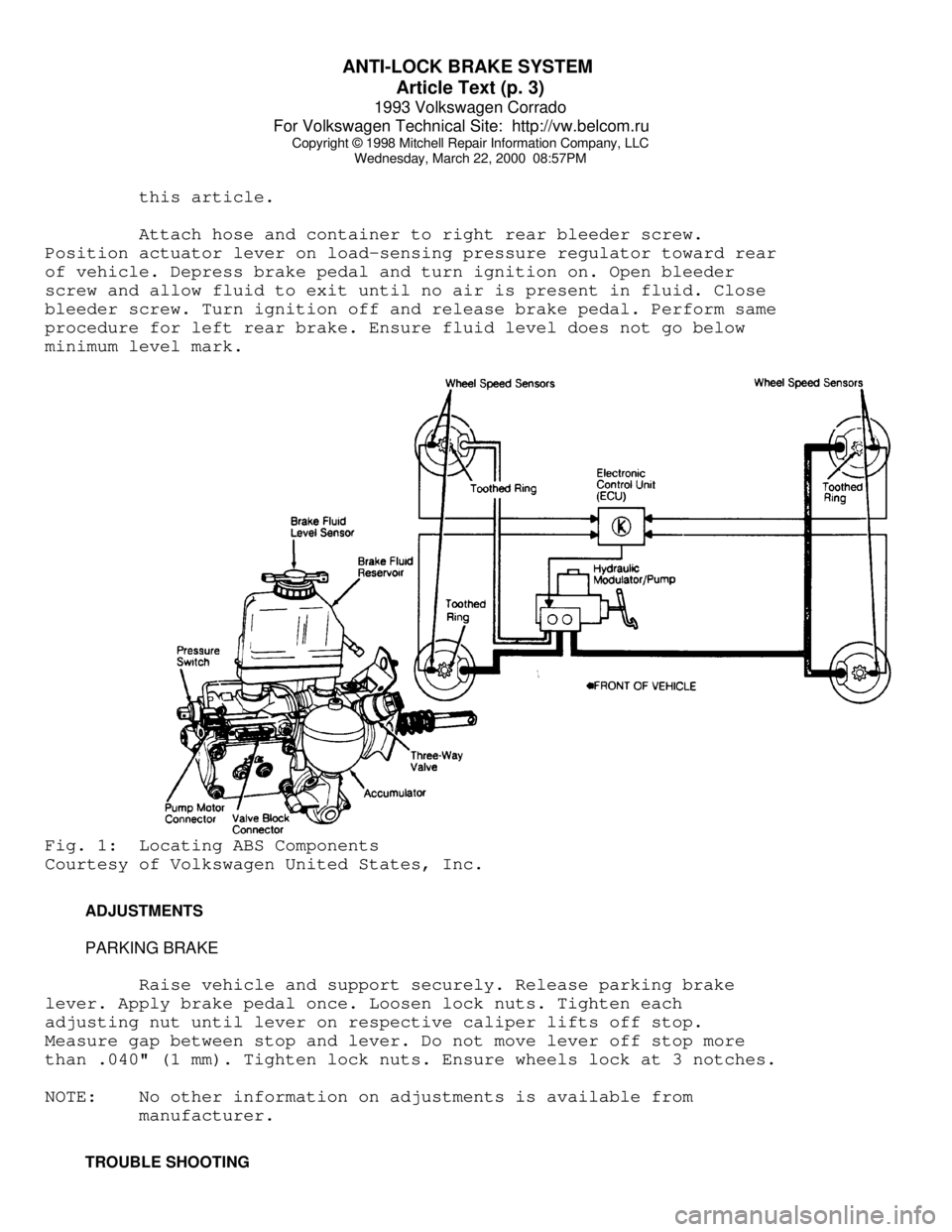
minimum level mark.Fig. 1: Locating ABS Components
Courtesy of Volkswagen United States, Inc.
ADJUSTMENTS
PARKING BRAKE
Raise vehicle and support securely. Release parking brake
lever. Apply brake pedal once. Loosen lock nuts. Tighten each
adjusting nut until lever on respective caliper lifts off stop.
Measure gap between stop and lever. Do not move lever off stop more
than .040" (1 mm). Tighten lock nuts. Ensure wheels lock at 3 notches.
NOTE: No other information on adjustments is available from
manufacturer.
TROUBLE SHOOTING
Page 452 of 920

COMPUTER RELEARN PROCEDURES
Article Text (p. 2)
1993 Volkswagen Corrado
For Volkswagen Technical Site: http://vw.belcom.ru
Copyright © 1998 Mitchell Repair Information Company, LLC
Wednesday, March 22, 2000 08:58PM
"D" and allow engine to idle for one minute.
* Accelerate at normal throttle position (20-50%) until vehicle
shifts into top gear.
* Cruise at light to medium throttle.
* Decelerate to a stop, allowing vehicle to downshift, and use
brakes normally.
* Process may be repeated as necessary.
Manual Transmission
* Place transmission in Neutral position.
* Ensure emergency brake has been set and all accessories
are turned off.
* Start engine and bring to normal operating temperature.
* Allow vehicle to idle in Neutral for one minute.
* Initial relearn is complete: process will be completed during
normal driving.
Some manufacturers identify a specific relearn procedure
which will help establish suitable driveability during relearn stage.
These procedures are especially important if vehicle is equipped with
and electronically controlled automatic transmission or transaxle.
Always complete procedure before returning vehicle to customer.
END OF ARTICLE
Page 533 of 920

ENGINE OVERHAUL PROCEDURES - GENERAL INFORMATION
Article Text (p. 4)
1993 Volkswagen Corrado
For Volkswagen Technical Site: http://vw.belcom.ru
Copyright © 1998 Mitchell Repair Information Company, LLC
Wednesday, March 22, 2000 09:09PM
specifications for the vehicle being repaired.
SHEET METAL PARTS
Examples of sheet metal parts are the rocker covers, front
and side covers, oil pan and bellhousing dust cover. Glass bead
blasting or hot tank may be used for cleaning.
Ensure all mating surfaces are flat. Deformed surfaces should
be straightened. Check all sheet metal parts for cracks and dents.
INTAKE & EXHAUST MANIFOLDS
Using solvent cleaning or bead blasting, clean manifolds for
inspection. If the intake manifold has an exhaust crossover, all
carbon deposits must be removed. Inspect manifolds for cracks, burned
or eroded areas, corrosion and damage to fasteners.
Exhaust heat and products of combustion cause threads of
fasteners to corrode. Replace studs and bolts as necessary. On "V"
type intake manifolds, the sheet metal oil shield must be removed for
proper cleaning and inspection. Ensure that all manifold parting
surfaces are flat and free of burrs.
CYLINDER HEAD REPLACEMENT
* PLEASE READ THIS FIRST *
NOTE: Always refer to appropriate engine overhaul article in the
ENGINES section for complete overhaul procedures and
specifications for the vehicle being repaired.
REMOVAL
Remove intake and exhaust manifolds and valve cover. Cylinder
head and camshaft carrier bolts (if equipped), should be removed only
when the engine is cold. On many aluminum cylinder heads, removal
while hot will cause cylinder head warpage. Mark rocker arm or
overhead cam components for location.
Remove rocker arm components or overhead cam components.
Components must be installed in original location. Individual design
rocker arms may utilize shafts, ball-type pedestal mounts or no rocker
arms. For all design types, wire components together and identify
according to the corresponding valve. Remove cylinder head bolts.
Note length and location. Some applications require cylinder head
bolts be removed in proper sequence to prevent cylinder head damage.
See Fig. 1. Remove cylinder head.
Page 547 of 920
ENGINE OVERHAUL PROCEDURES - GENERAL INFORMATION
Article Text (p. 18)
1993 Volkswagen Corrado
For Volkswagen Technical Site: http://vw.belcom.ru
Copyright © 1998 Mitchell Repair Information Company, LLC
Wednesday, March 22, 2000 09:09PM
of piston skirt area. Subtract piston diameter from cylinder bore
diameter. The difference is piston-to-cylinder clearance. Clearance
must be within specification. Mark piston for proper cylinder
location.
ASSEMBLING PISTON & CONNECTING ROD
Install proper fitted piston on connecting rod for proper
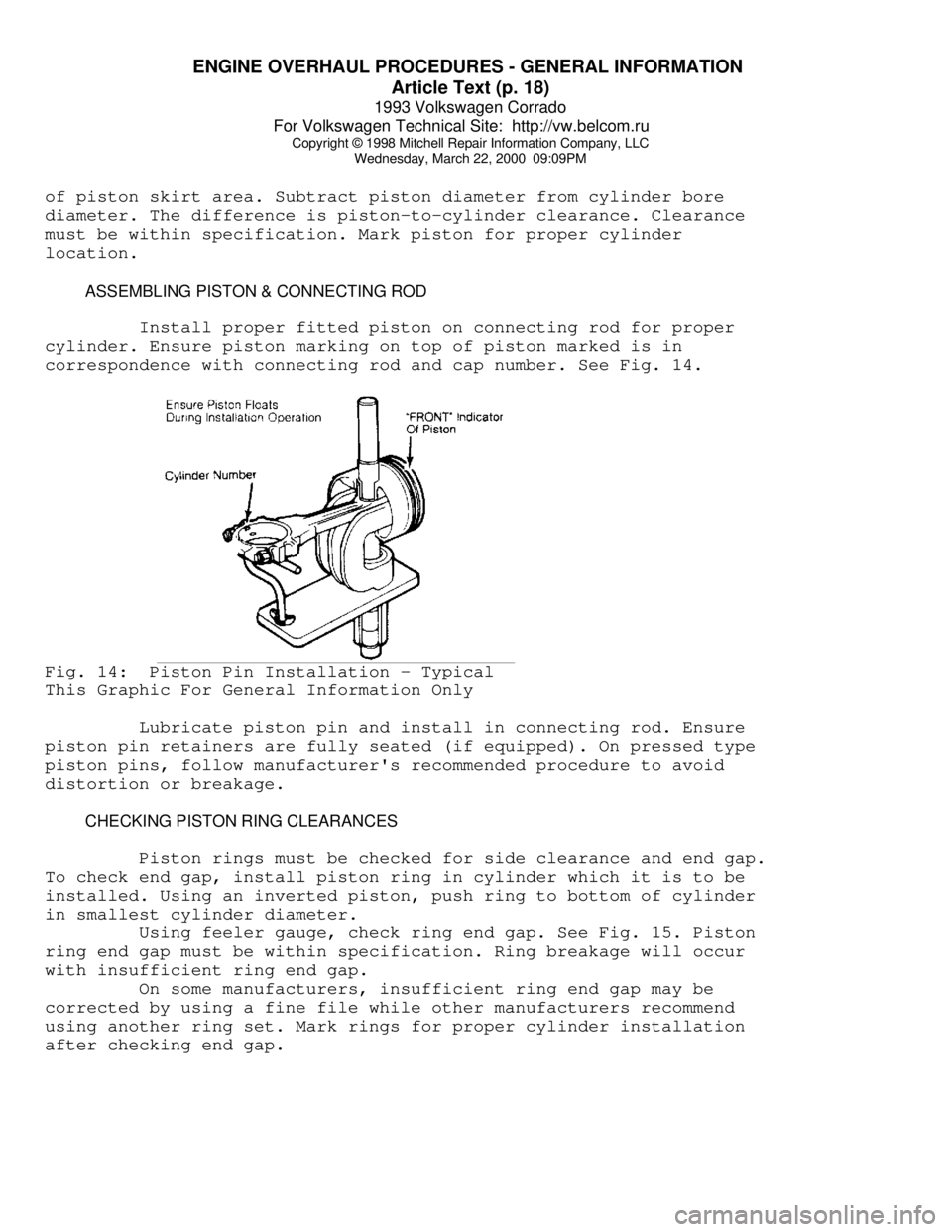
cylinder. Ensure piston marking on top of piston marked is in
correspondence with connecting rod and cap number. See Fig. 14.Fig. 14: Piston Pin Installation - Typical
This Graphic For General Information Only
Lubricate piston pin and install in connecting rod. Ensure
piston pin retainers are fully seated (if equipped). On pressed type
piston pins, follow manufacturer's recommended procedure to avoid
distortion or breakage.
CHECKING PISTON RING CLEARANCES
Piston rings must be checked for side clearance and end gap.
To check end gap, install piston ring in cylinder which it is to be
installed. Using an inverted piston, push ring to bottom of cylinder
in smallest cylinder diameter.
Using feeler gauge, check ring end gap. See Fig. 15. Piston
ring end gap must be within specification. Ring breakage will occur
with insufficient ring end gap.
On some manufacturers, insufficient ring end gap may be
corrected by using a fine file while other manufacturers recommend
using another ring set. Mark rings for proper cylinder installation
after checking end gap.
Page 551 of 920
ENGINE OVERHAUL PROCEDURES - GENERAL INFORMATION
Article Text (p. 22)
1993 Volkswagen Corrado
For Volkswagen Technical Site: http://vw.belcom.ru
Copyright © 1998 Mitchell Repair Information Company, LLC
Wednesday, March 22, 2000 09:10PM
rotated.
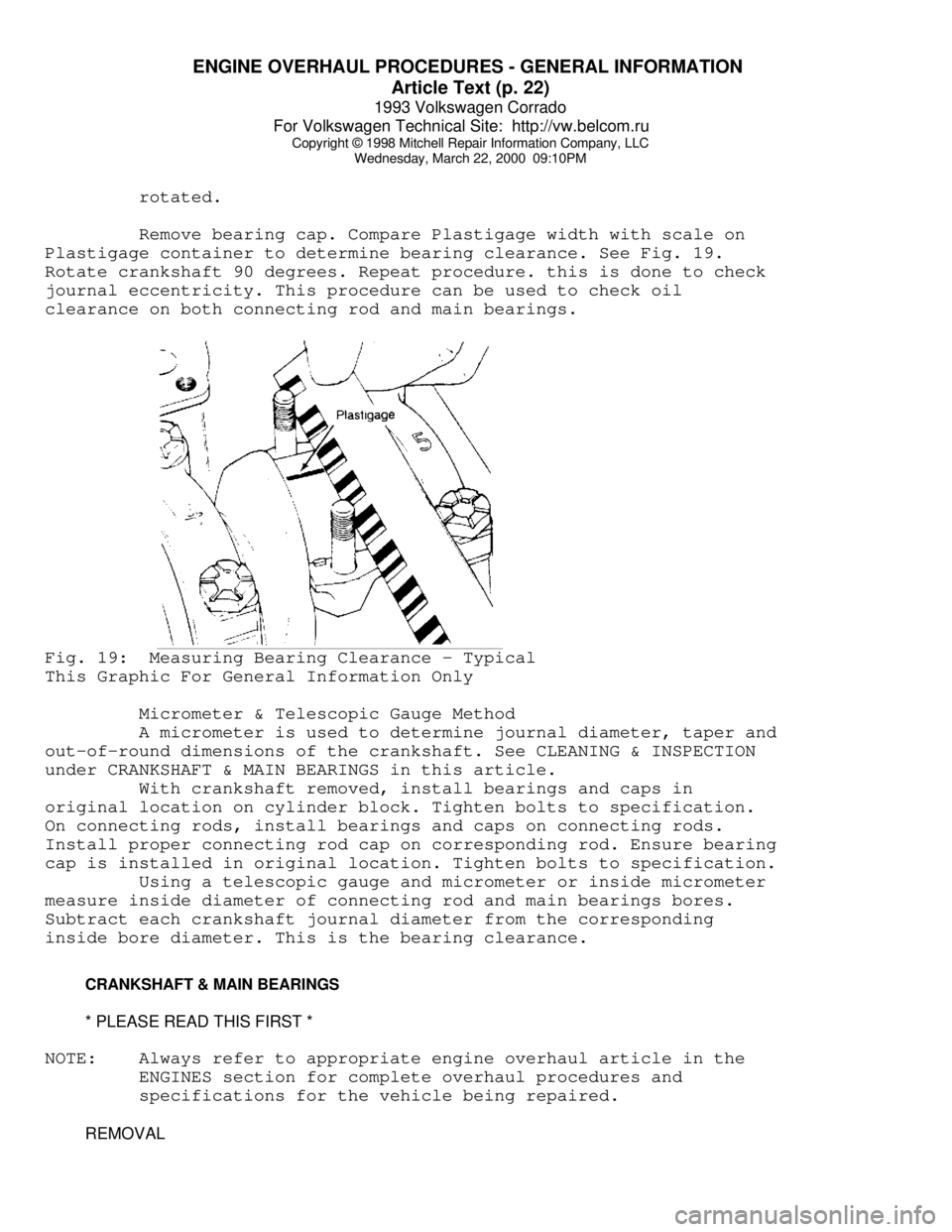
Remove bearing cap. Compare Plastigage width with scale on
Plastigage container to determine bearing clearance. See Fig. 19.
Rotate crankshaft 90 degrees. Repeat procedure. this is done to check
journal eccentricity. This procedure can be used to check oil
clearance on both connecting rod and main bearings.Fig. 19: Measuring Bearing Clearance - Typical
This Graphic For General Information Only
Micrometer & Telescopic Gauge Method
A micrometer is used to determine journal diameter, taper and
out-of-round dimensions of the crankshaft. See CLEANING & INSPECTION
under CRANKSHAFT & MAIN BEARINGS in this article.
With crankshaft removed, install bearings and caps in
original location on cylinder block. Tighten bolts to specification.
On connecting rods, install bearings and caps on connecting rods.
Install proper connecting rod cap on corresponding rod. Ensure bearing
cap is installed in original location. Tighten bolts to specification.
Using a telescopic gauge and micrometer or inside micrometer
measure inside diameter of connecting rod and main bearings bores.
Subtract each crankshaft journal diameter from the corresponding
inside bore diameter. This is the bearing clearance.
CRANKSHAFT & MAIN BEARINGS
* PLEASE READ THIS FIRST *
NOTE: Always refer to appropriate engine overhaul article in the
ENGINES section for complete overhaul procedures and
specifications for the vehicle being repaired.
REMOVAL
Page 659 of 920

MAINTENANCE INFORMATION
Article Text (p. 12)
1993 Volkswagen Corrado
For Volkswagen Technical Site: http://vw.belcom.ru
Copyright © 1998 Mitchell Repair Information Company, LLC
Wednesday, March 22, 2000 09:14PM
of 650 amps.
CAUTIONS & WARNINGS
CAUTION: Contact with live components of ignition system while
engine is running could lead to a fatal electric shock.
CAUTION: Brake pedal requires extreme pressure to stop vehicle when
engine is not running.
WARRANTY INFORMATION
CAUTION: Always refer to customer's copy of warranty information for
specific model application and/or coverage limitations.
BASIC NEW CAR WARRANTY
Manufacturer warrants to the original retail customer, and
any subsequent purchaser, that every vehicle imported and sold as a
new vehicle to a retail customer will be free of defects in material
and workmanship for 2 years or 24,000 miles, whichever comes first,
after date of delivery to the first retail customer, or after vehicle
was first placed in service.
LIMITED WARRANTY
Warrants cars to be free of defects in materials or
workmanship for a period of 2 years or 24,000 miles, whichever comes
first.
LIMITED POWER TRAIN WARRANTY
Covers engine, transmission and drivetrain for a period of 5
years or 50,000 miles, whichever occurs first.
ANTI-CORROSION
Covers holes caused by corrosion in body sheet metal for 6
years, without respect to mileage, so long as inspection and
maintenance services are performed.
EMISSION CONTROL SYSTEM
Manufacturer warrants to the initial purchaser and each
subsequent purchaser that this vehicle is designed, built, and
equipped so as to conform at the time of sale with all U.S. and
California Air Resources Board emission regulations applicable at the
time of manufacture, and that this vehicle is free from defects in
materials and workmanship which cause it to fail to conform with
applicable regulations within the first 5 years or 50,000 miles,
whichever occurs first.
Page 811 of 920

TROUBLE SHOOTING - BASIC PROCEDURES
Article Text (p. 20)
1993 Volkswagen Corrado
For Volkswagen Technical Site: http://vw.belcom.ru
Copyright © 1998 Mitchell Repair Information Company, LLC
Wednesday, March 22, 2000 09:26PM
DRIVE AXLE - NOISE DIAGNOSIS
UNRELATED NOISES
Some driveline trouble symptoms are also common to the
engine, transmission, wheel bearings, tires, and other parts of the
vehicle. Ensure cause of trouble actually is in the drive axle before
adjusting, repairing, or replacing any of its parts.
NON-DRIVE AXLE NOISES
A few conditions can sound just like drive axle noise and
have to be considered in pre-diagnosis. The 4 most common noises are
exhaust, tires, CV/universal joints and wheel trim rings.
In certain conditions, the pitch of the exhaust gases may
sound like gear whine. At other times, it may be mistaken for a wheel
bearing rumble.
Tires, especially radial and snow, can have a high-pitched
tread whine or roar, similar to gear noise. Also, some non-standard
tires with an unusual tread construction may emit a roar or whine.
Defective CV/universal joints may cause clicking noises or
excessive driveline play that can be improperly diagnosed as drive
axle problems.
Trim and moldings also can cause a whistling or whining
noise. Ensure none of these components are causing the noise before
disassembling the drive axle.
GEAR NOISE
A "howling" or "whining" noise from the ring and pinion gear
can be caused by an improper gear pattern, gear damage, or improper
bearing preload. It can occur at various speeds and driving
conditions, or it can be continuous.
Before disassembling axle to diagnose and correct gear
noise, make sure that tires, exhaust, and vehicle trim have been
checked as possible causes.
CHUCKLE
This is a particular rattling noise that sounds like a stick
against the spokes of a spinning bicycle wheel. It occurs while
decelerating from 40 MPH and usually can be heard until vehicle comes
to a complete stop. The frequency varies with the speed of the
vehicle.
A chuckle that occurs on the driving phase is usually caused
by excessive clearance due to differential gear wear, or by a damaged
tooth on the coast side of the pinion or ring gear. Even a very small
tooth nick or a ridge on the edge of a gear tooth is enough the cause
the noise.
This condition can be corrected simply by cleaning the gear
tooth nick or ridge with a small grinding wheel. If either gear is
damaged or scored badly, the gear set must be replaced. If metal has
Page 864 of 920

WAVEFORMS - INJECTOR PATTERN TUTORIAL
Article Text (p. 5)
1993 Volkswagen Corrado
For Volkswagen Technical Site: http://vw.belcom.ru
Copyright © 1998 Mitchell Repair Information Company, LLC
Wednesday, March 22, 2000 09:26PM
second, all measurements in between are averaged. Because a potential
voltage drop is visible for such a small amount of time, it gets
"averaged out", causing you to miss it.
Only a DVOM that has a "min-max" function that checks EVERY
MILLISECOND will catch this fault consistently (if used in that mode).
The Fluke 87 among others has this capability.
A "min-max" DVOM with a lower frequency of checking (100
millisecond) can miss the fault because it will probably check when
the injector is not on. This is especially true with current
controlled driver circuits. The Fluke 88, among others fall into this
category.
Outside of using a Fluke 87 (or equivalent) in the 1 mS "min-
max" mode, the only way to catch a voltage drop fault is with a lab
scope. You will be able to see a voltage drop as it happens.
One final note. It is important to be aware that an injector
circuit with a solenoid resistor will always show a voltage drop when
the circuit is energized. This is somewhat obvious and normal; it is a
designed-in voltage drop. What can be unexpected is what we already
covered--a voltage drop disappears when the circuit is unloaded. The
unloaded injector circuit will show normal battery voltage at the
injector. Remember this and do not get confused.
Checking Injector On-Time With Built-In Function
Several DVOMs have a feature that allows them to measure
injector on-time (mS pulse width). While they are accurate and fast to
hookup, they have three limitations you should be aware of:
* They only work on voltage controlled injector drivers (e.g
"Saturated Switch"), NOT on current controlled injector
drivers (e.g. "Peak & Hold").
* A few unusual conditions can cause inaccurate readings.
* Varying engine speeds can result in inaccurate readings.
Regarding the first limitation, DVOMs need a well-defined
injector pulse in order to determine when the injector turns ON and
OFF. Voltage controlled drivers provide this because of their simple
switch-like operation. They completely close the circuit for the
entire duration of the pulse. This is easy for the DVOM to interpret.
The other type of driver, the current controlled type, start
off well by completely closing the circuit (until the injector pintle
opens), but then they throttle back the voltage/current for the
duration of the pulse. The DVOM understands the beginning of the pulse
but it cannot figure out the throttling action. In other words, it
cannot distinguish the throttling from an open circuit (de-energized)
condition.
Yet current controlled injectors will still yield a
millisecond on-time reading on these DVOMs. You will find it is also
always the same, regardless of the operating conditions. This is
because it is only measuring the initial completely-closed circuit on-
time, which always takes the same amount of time (to lift the injector
pintle off its seat). So even though you get a reading, it is useless.
The second limitation is that a few erratic conditions can
Page 866 of 920

WAVEFORMS - INJECTOR PATTERN TUTORIAL
Article Text (p. 7)
1993 Volkswagen Corrado
For Volkswagen Technical Site: http://vw.belcom.ru
Copyright © 1998 Mitchell Repair Information Company, LLC
Wednesday, March 22, 2000 09:26PM
everything together it does not miss anything (though this is also a
severe weakness that we will look at later). If an injector has a
fault where it occasionally skips a pulse, the meter registers it and
the reading changes accordingly.
Let's go back to figuring out dwell/duty readings by using
injector on-time specification. This is not generally practical, but
we will cover it for completeness. You NEED to know three things:
* Injector mS on-time specification.
* Engine RPM when specification is valid.
* How many times the injectors fire per crankshaft revolution.
The first two are self-explanatory. The last one may require
some research into whether it is a bank-fire type that injects every
360ø of crankshaft rotation, a bank-fire that injects every 720ø, or
an SFI that injects every 720
ø. Many manufacturers do not release this
data so you may have to figure it out yourself with a frequency meter.
Here are the four complete steps to convert millisecond on-
time:
1) Determine the injector pulse width and RPM it was obtained
at. Let's say the specification is for one millisecond of on-time at a
hot idle of 600 RPM.
2) Determine injector firing method for the complete 4 stroke
cycle. Let's say this is a 360
ø bank-fired, meaning an injector fires
each and every crankshaft revolution.
3) Determine how many times the injector will fire at the
specified engine speed (600 RPM) in a fixed time period. We will use
100 milliseconds because it is easy to use.
Six hundred crankshaft Revolutions Per Minute (RPM) divided
by 60 seconds equals 10 revolutions per second.
Multiplying 10 times .100 yields one; the crankshaft turns
one time in 100 milliseconds. With exactly one crankshaft rotation in
100 milliseconds, we know that the injector fires exactly one time.
4) Determine the ratio of injector on-time vs. off-time in
the fixed time period, then figure duty cycle and/or dwell. The
injector fires one time for a total of one millisecond in any given
100 millisecond period.
One hundred minus one equals 99. We have a 99% duty cycle. If
we wanted to know the dwell (on 6 cylinder scale), multiple 99% times
.6; this equals 59.4
ø dwell.
Weaknesses of Dwell/Duty Meter
The weaknesses are significant. First, there is no one-to-one
correspondence to actual mS on-time. No manufacturer releases
dwell/duty data, and it is time-consuming to convert the mS on-time
readings. Besides, there can be a large degree of error because the
conversion forces you to assume that the injector(s) are always firing
at the same rate for the same period of time. This can be a dangerous
assumption.
Second, all level of detail is lost in the averaging process.
This is the primary weakness. You cannot see the details you need to
make a confident diagnosis.